Furthermore, what are we teaching our congregations about worship music? If it is always the same thing over and over again; isn’t this unfair to them? We say things like, “we are multi-generational,” “we are racially diverse,” “we are multi-ethnic.” We say, “we are global Christians” (of course what we probably mean is that we sent a mission team to the Caribbean this summer) and the list goes on and on. Yet, our setlists never change.
Tag: Music
What makes a worship song good for congregational singing?
What makes a worship song suitable for use in a corporate worship service?
I’ve been mulling this question over lately, trying to articulate what is often largely an intuition for me as a worship leader. Here’s a first go at it. (Thanks to my friend Steve for sharing some good thoughts with me on this.)
The song needs to be neither too low nor too high. Worship leader Jamie Brown has what I’ve found to be a helpful guideline for what range of notes to cover: “From C to shining C.” He puts it well, so I quote him here:
My rule of thumb is “C to shining C”…, meaning that the lowest a song should generally go is a C (one octave below middle C on a piano) and the highest it should go is one octave up from there. I’ll still use songs that dip a bit lower than a middle C or jump up to a D, Eb, or even an E from time to time, but I want to make sure the song isn’t “hanging out” up in the stratosphere or down in the depths.
Chris Tomlin and Hillsong United both sing their songs pretty high.
Just try doing “From the Inside Out” in its original key! (Or, rather, don’t. Drop it down a few steps before leading a congregation in it.) Same with Charlie Hall–love his music, but I often change the key before leading others in his songs. And that’s okay! In fact, it’s an important part of my job as a worship leader to make sure the range of the song is singable for a congregation.
The rhythm and lyrical cadence ought to be simple. Too many dotted eighth notes or too-fast moving lyrics are difficult for a group of folks to sing well together. I often slow down “Blessed Be Your Name” and “Everlasting God” when I lead them for this very reason. I want to make sure we have time to savor the lyrics we’re singing, and not feel rushed to squeeze them all in to the song.
If it’s new, teach it first. I wrote about this last week here.
“More stepwise motion and fewer big leaps up or down.” This one is from Steve. It articulates well what is often intuition for worship leaders. Simpler is better. An example:
Thanks to some students with whom I lead worship in a Christian college setting, I’ve really gotten into the band Gungor recently. I love their song “Dry Bones.”
This song has quite a few “big leaps up or down” and not a lot of “stepwise motion.” It’s hard for me to imagine a congregation singing this in a worship service. But I will blast it through my speakers when I am feeling the need for God to breathe life into my dry bones! I might even rock out to it on guitar with a fellow worship leader, or in a jam session. Great for in car, perhaps not for in the chapel.
I hesitate to use Gungor as a foil, especially since he’s one of the most thoughtful contemporary music worship leaders I know of. His We Will Run, on the other hand, is a great song for congregational singing–especially with its focus on repentance of sin and corporate turning back to God. Listen to it if you like:
Notice that “We will run” is one note, then “to you” is just a half step down:
That same pattern is then repeated a few notes higher: “Turning from our” is one note, “our sin” is just a whole step down.
Simple.
What would you add to this list?
Teaching a new worship song to a congregation
This morning I had the privilege of teaching our worshiping community this song:
Because I had guessed it would be new to the majority of our congregation, I decided to teach the song before we sang it all the way through. There are at least six things I like to try to do when teaching a new song:
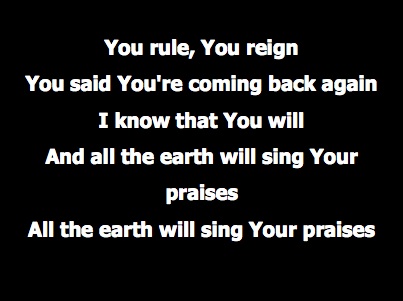
1. Split it into pieces. I had the chorus for All the Earth Will Sing Your Praises on two Powerpoint slides. So I sang through the first half of the chorus (one PPT slide), stopped, and invited the congregation to sing that same part with me:
Then I repeated that same process for the second half of the chorus:
This way the congregation had heard the chorus once and sung it once.
2. Teach it not in order. This helps me and hopefully others remember that we’re actually working on learning the song. It also keeps us attentive to what part of the song we’re working on. We’ll piece it all together only once we’ve learned the component parts.
3. Highlight the lyrical content. If the tune is new, the lyrics likely are, too. At least they were in this case. So because this song speaks of Christ’s death, resurrection, and ascension, I took the opportunity to highlight that. I actually read some of the song lyrics before teaching it, and connected them to something my church says in our weekly worship: “Christ has died, Christ is risen, Christ will come again.” I mentioned that like 1 Corinthians 15 and Luke 24, this is one of the great summaries of our faith that can unite us across multiple denominations and Christian backgrounds.
4. Teach it with a conversational tone. I can’t think of any other way to teach a song than by actually talking with the congregation about it, what we’re doing, what we’re about to do, etc. I find a friendly, inviting, conversational tone works best. At least it feels right to me when I am teaching a song!
5. Affirm the congregation. Our worshiping community picked this song up so fast today (some knew it already, I think) that this was easy to do. I actually cut short the process of teaching the song so that we could begin from the beginning singing it all the way through. This was due to the fact that as I began teaching the verse (i.e., “I’ll sing so you can hear it”), I could already hear folks singing along. It would certainly not be out of place to sincerely say something like, “You all are good singers!” (Provided it’s true.)
6. Have them hear the song even before I teach it. For example, I had All the Earth will Sing Your Praises played over the speakers as they were leaving worship Monday, knowing we’d be learning it today. It’s a little thing, but it helps. Other options could have been playing it as the prelude today, emailing a Web link to the tune, etc.
The bottom line for me is: if we’re doing a song that I think will be new to most in the room, we highlight it as such and carve out time to work to learn it together. Then singing the new song from start to finish is not only easier, but feels like something we have worked at together in a way that draws us closer as we worship.
Music by Abram K-J (link)
Make All Things New
I’ve particularly benefited from this song of late. I mentioned it here in last week’s Worship Leading Wednesday.
Creation… Fall… Redemption… Consummation. (Another one hour worship service from scratch)
On Sunday I led a group of student ministry leaders in worship for an hour. As in the time I described in this post, it was a one hour worship service from scratch. In other words, I was invited to plan and lead the hour of worship from start to finish. In my previous post I mentioned one way to give shape to what otherwise could be unstructured worship, using the A.C.T.S. acronym.
Here’s how I opted to structure the hour together with this same group this year. This is a version of the run sheet the worship musicians and I had before us.
Intro: Creation, Fall, Redemption, Consummation
- What it is: way of understanding the whole sweep of the Bible (explain each part briefly)
- Why it’s important: tells us God’s story—and our place in it. Situate selves at start of new year.
- We’ll weave between Scripture and Song and Prayer, standing and sitting, together and alone
Creation
- Scripture: Gen. 1:1,31, Col. 1:15-18
- Song: All Creatures of Our God and King
- Scripture/Prayer: Psalm 8, read in unison (scroll down to Ps. 8 at link)
- Song: Indescribable
- Prayer (standing): People thank God for what he has created, briefly, silently or aloud
Fall
- The sin at Eden. Separation from God, humans, land
- Scripture: Romans 3:23, 8:22
- Prayer (seated): Confession of Sin
- Moment of Silence for individual confession
- Confession from Book of Common Prayer
- Assurance of Pardon from 1 John (read in unison)
- Song (standing or seated): Create in Me a Clean Heart
Redemption
- Scripture in unison: Romans 5:8, John 3:16, Colossians 1:19-20
- Song (standing): Lead me to the Cross
- Redemption is ongoing… reconciliation is ongoing… even as we have been reconciled to God through the cross, we continue to see the need for reconciliation. So we pray…
- Song: We Will Run to You
Consummation
- Scripture: Revelation 21:1-5
- And so our prayer, “Make all things new” is finally answered.
- Moment of silence to reflect on “I am making all things new.”
- Song (standing): Grace Like Rain
Conclusion: Close in prayer
Little kids review Radiohead’s “Paranoid Android” (bonus: they’re British)
Via Sleeping at Last. I can’t wait to share this with my 4-year-old son.
A one hour worship service from scratch
Worship leaders from time to time may be called upon to plan a worship service start to finish, as I was this time last year. Here’s how I chose to give shape to an hour of worship with a group of student ministry leaders. This is one of many possible ways to go, but I did find that the sense of structure and movement helped us to feel like we had gotten somewhere by the end. Here is a version of the run sheet I used for myself.
Intro: Explanation of A.C.T.S. acronym
- What it stands for: Adoration, Confession, Thanksgiving, Supplication
- Why it’s important: keeps us focused on God….keeps us balanced in prayer life (not just “Me, me, me”)
- It will frame our worship time together
- We’ll weave between Scripture and Song and Prayer, standing and sitting, together and alone
Adoration
- Scripture: Psalm 147: 1-6, 11-12, read aloud in unison
- Song: Beautiful One
- Song: (optional) Praise to the Lord, the Almighty
- Prayer: (standing) People thank God for who he is, briefly, aloud
- Song: Holy, Holy (Tim Hughes version)
Confession
- Prayer: (seated) Confession of Sin
- Moment of Silence for individual confession
- Confession from Book of Common Prayer
- Assurance of Pardon from 1 John (read in unison)
- Song: (standing or seated) (optional) I Love the Lord
Thanksgiving
- Song: How Great Thou Art
- Scripture: (seated) Lectio Divinia with Colossians 3:15-17
- Explain Lectio Divina (Powerpoint slide with all four steps, one after the other)
- NOTE: Four volunteer readers needed
Supplication
- Prayer: (remain seated) How can we be praying for each other? For our community?
- (standing) Teach song: Today
- Scripture: Joshua 24:14-15 with intro (give its context)
- Song: Today
Conclusion: close in prayer
In the very near future I’m leading this same group in an hour of worship. I’m thinking through selecting songs, Scriptures, and prayers that follow the basic outline of salvation history: Creation, Fall, Redemption, Consummation. I’ll post the outline of that service on a future Worship Leading Wednesday.
Opera Sitcom, episode 1
From the exceedingly talented Kara Morgan: singer, actor, comedian.
“Bringing our Pain to God” (Michael Card)
We’re afraid of other people’s pain. Like Job’s friends, we’re afraid when we don’t have answers. Job doesn’t get any answers for his sufferings, but he gets God.
–Michael Card, from this great article on Biblical lament in worship.
He’s got an album called The Hidden Face of God, which you can hear at Grooveshark for free (or click on the album image to the left). It kicks off with a great Gospel-flavored track called, “Come Lift Up Your Sorrows.”