He crushes guns and diffuses bombs; he destroys weapons of destruction (Psalm 46 speaks into the mass school shooting)

gun

Psalm 46, a Psalm for tragedies and disasters, reads:

God is our refuge and strength,
an ever-present help in trouble.
Therefore we will not fear, though the earth give way
and the mountains fall into the heart of the sea,
though its waters roar and foam
and the mountains quake with their surging.

There is a river whose streams make glad the city of God,
the holy place where the Most High dwells.
God is within her, she will not fall;
God will help her at break of day.
Nations are in uproar, kingdoms fall;
he lifts his voice, the earth melts.

The Lord Almighty is with us;
the God of Jacob is our fortress.

Come and see what the Lord has done,
the desolations he has brought on the earth.
He makes wars cease
to the ends of the earth.
He breaks the bow and shatters the spear;
he burns the shields with fire.
He says, “Be still, and know that I am God;
I will be exalted among the nations,
I will be exalted in the earth.”

The Lord Almighty is with us;
the God of Jacob is our fortress.

The third part of this Psalm begins, “Come and see the works of the LORD, the desolations he has brought on the earth. He makes wars cease to the ends of the earth.” God is stronger than war—he can demolish even the strongest weapons of warfare. So in some kind of cosmic sense we don’t have to be afraid when there is violence.

“He breaks the bow and shatters the spear, he burns the shields with fire.” We might read this today as, “He crushes guns and diffuses bombs, he destroys human weapons of destruction.”

And then there is the main point of the Psalm, verse 10, followed by the refrain in verse 11 that appeared earlier in the Psalm: “Be still, and know that I am God; I will be exalted among the nations, I will be exalted in the earth. The LORD Almighty is with us; the God of Jacob is our fortress.”

Nature can appear to be in chaos, human actions can leave us scratching our heads, but neither the chaos of nature nor the chaos of human sinfulness can ultimately stand up to the power of God. He is exalted over the earth and over all people. He is a warrior God who declares war on war and causes all violence to end.

“The LORD Almighty,” a title for God from verse 11 and earlier in verse 7, is also sometimes translated “LORD of hosts,” or God of the angel armies. Based on these verses Martin Luther wrote, “LORD Sabaoth his name, from age to age the same, and he must win the battle.”

This Almighty warrior God is with us, present in chaos and suffering. He is the God of heavenly hosts of armies, yet he is the God of Jacob, too, a title that speaks of God’s personal relationship with his people.

He is a personal God that people can know. He invites us into an intimate relationship with him, especially when we are hurting, especially when things are going wrong.

The above is adapted from part of a sermon I preached a couple of summers ago on Psalm 46. I post in now in light of today’s awful news.


Jesus weeps, we weep

Shannon Hicks/Newtown Bee, via Associated Press

Jesus wept, and he weeps again today, with the horrible news of another school shooting in Newton, CT. From the New York Times:

A gunman killed 26 people, 20 of them children between the ages of 5 and 10, in a shooting on Friday morning at an elementary school in Newtown, Conn., about 65 miles northeast of New York City, the authorities said.

The gunman, who was believed to be in his 20s, walked into a classroom at Sandy Hook Elementary School where his mother was a teacher. He shot and killed her and then shot 20 students, most in the same classroom. He also shot five other adults, and then killed himself inside the school.

This evil deed is so heinous that even naming and describing it feels bad. May God have mercy on the souls of those poor children, and the grieving families they leave behind.

Christians have a rich Biblical tradition of lament that we can employ in times like this. This summer after the Colorado shooting, I posted this prayer, which was an aid to me in processing the grief, anger, and bewilderment I felt after hearing such awful news.

Prayer of Lament

O God, you are our help and strength,
our refuge in the time of trouble.
In you our ancestors trusted;
They trusted and you delivered them.
When we do not know how to pray as we ought,
your very Spirit intercedes for us
with sighs too deep for words.
We plead for the intercession now, Gracious One.

For desolation and destruction are in our streets,
and terror dances before us.
Our hearts faint; our knees tremble;
our bodies quake; all faces grow pale.
Our eyes are spent from weeping
and our stomachs churn.

How long, O Lord, how long
must we endure this devastation?
How long will destruction lay waste at noonday?
Why does violence flourish
while peace is taken prisoner?
Rouse yourself! Do not cast us off in times of trouble.
Come to our help;
redeem us for the sake of your steadfast love.

For you are a gracious God
abounding in steadfast love and faithfulness.

By the power of the cross,
through which you redeemed the world,
bring to an end hostility
and establish justice in the gate.
For you will gather together your people into that place
where mourning and crying and pain
will be no more,
and tears will be wiped from every eye.
Hasten the day, O God for our salvation.
Accomplish it quickly! Amen.

**From Let the Whole Church Say Amen! A Guide for Those Who Pray in Public, by Laurence Hull Stookey, pp 94-95 (Copyright 2001 by Abingdon Press). Reproduced by permission. Formatted print-friendly pdf of prayer here.

The Scriptures that the above prayer draws on are: Psalm 124:8, Psalm 37:39, Psalm 22:4, Romans 8:26, Isaiah 59:7, Job 41:22, Nahum 2:10, Lamentations 2:11, Isaiah 6:11, Psalm 91:6, Psalm 44:23, Psalm 44:26, Exodus 34:6, 1 Corinthians 1:17, Ephesians 2:14, Amos 5:15, Revelation 21:4, Isaiah 60:22.

10 things about the new Archbishop of Canterbury

Breaking news: the new Archbishop of Canterbury, Justin Welby, is on Twitter. (He’s funny, too.)

He comes to the Anglican Communion’s highest position from a post as Bishop in Durham, where N.T. Wright previously served.

A piece on him in the New York Times is here.

And the BBC has published an article with “10 lesser-known things” about the new Archbishop. I found this one particularly poignant:

4. He set up a special day for bereaved parents in Coventry Cathedral. There is now an annual service commemorating the lives of children who have died. A book with the names of lost children is always on display in the cathedral – anyone who has lost a child under any circumstances can ask for their child’s name to be added to the book.

Bishop Welby’s own eldest daughter, Johanna, died when she was just seven months old in a car crash in France in 1983. He has previously said her death brought him and his wife Caroline closer to God. The couple have five other children.

The rest of the BBC article is here.

New Archbishop of Canterbury

The Telegraph reports that the new Archbishop of Canterbury has been named: Justin Welby, Bishop of Durham.

Sources have confirmed that the Eton-educated bishop will be announced as successor to Dr Rowan Williams as early as Friday, after the Crown Nominations Commission put his name forward to Downing Street.

It marks a meteoric rise for the former oil executive who has been a bishop for only a year, but insiders described Welby as “the outstanding candidate”.

The full article is here.

New President for Princeton Seminary

Princeton Seminary has just announced a new President, Reverend Dr. M. Craig Barnes:

The Board of Trustees of Princeton Theological Seminary is pleased to announce the unanimous election of the Reverend Dr. M. Craig Barnes as its seventh president, and as professor of pastoral ministry.  Barnes, a 1981 Master of Divinity graduate of Princeton, has also served as a trustee of the Seminary. Dr. Barnes currently serves as the Robert Meneilly Professor of Pastoral Ministry and Leadership at Pittsburgh Theological Seminary and pastor of the 1,100-member Shadyside Presbyterian Church in Pittsburgh.

Here is the announcement in full.

A wife for Jesus?

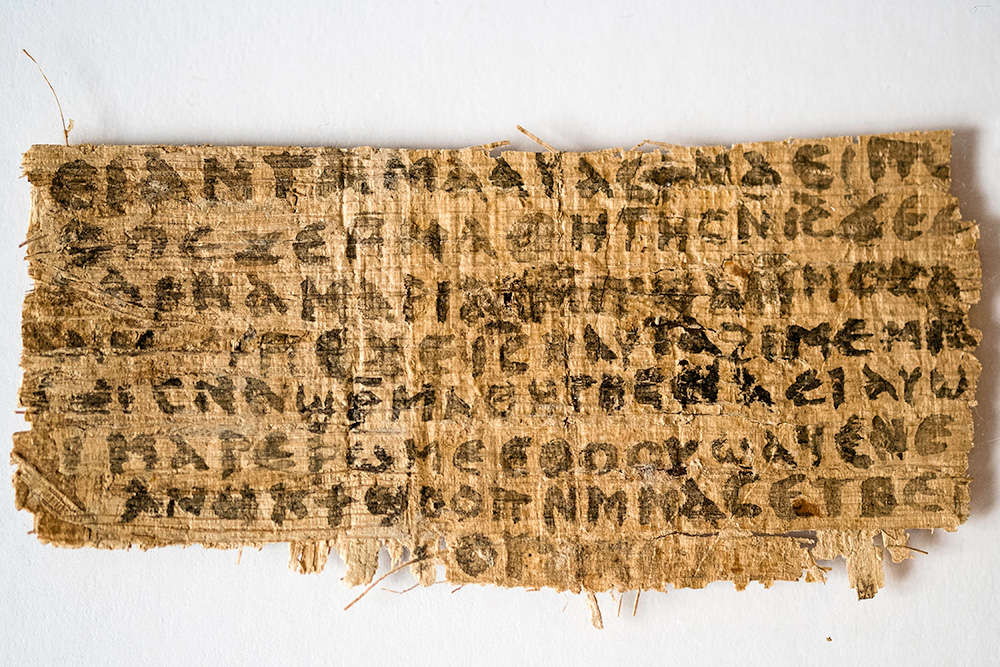
Front of papyrus fragment, Karen L. King, 2012

Did Jesus have a wife? Does it matter?

In the last two days I’ve seen about 50 Facebook status updates from friends and groups I follow, each with their own take on the “Gospel of Jesus’s Wife” papyrus that Harvard Professor Karen L. King recently announced. (Nerdy grammatical excursus: King has titled the papyrus with Jesus’s, but I follow Strunk and White and prefer Jesus’.)

The Harvard Divinity School press release is here. It begins,

Four words on a previously unknown papyrus fragment provide the first evidence that some early Christians believed Jesus had been married, Harvard Professor Karen King told the 10th International Congress of Coptic Studies today.

The papyrus has been dated to the 4th century and is written in Coptic, the alphabet of which has overlap with the Greek alphabet. King has postulated, in fact, that the Coptic in this little fragment may have translated a Greek original.

The key quote from the papyrus is translated, “Jesus said to them, ‘My wife….'” It then gets cut off. Go here for a full translation, as well as helpful Q&A with Professor King.

It seems to me there are two primary questions on folks’ minds right now. First, is this thing real or a fake? Second, did Jesus have a wife, or could he have?

In pursuit of these questions, I spoke with two Professors of Biblical Studies at Gordon College, a top Christian liberal arts school, located just north of Boston. Was Jesus married?

“Is there anything in the Gospels that would give us a hint he was married? I don’t think so,” noted Professor Marvin R. Wilson. “If he was married, how come he says to his beloved disciple at the cross, ‘Take my mother,’ not ‘Take my wife’?”

The significant woman in Jesus’ life, for whom he is looking out in his final hours, is his mother Mary, not a wife.

All the same, Wilson said, “It’s a good question. One who had no marriage would certainly have been the exception. We have an exception in Jeremiah, but that was a divinely commanded celibacy.”

Wilson noted, however, that the assertion that Jesus had a wife is still an argument from silence. “Certainly he had a wonderful ministry with women. We know the 4th century was a time of theological clarification (Council of Nicea) as well as turbulence. This Coptic text may have represented a small sect of aberrant Christians that had broken away from the larger–yet still emerging–traditional community.”

Is there much at stake in the question of whether or not Jesus had a wife?

“Certainly I don’t think any key issues of the Christian faith are at stake here. If Jesus had a self-imposed celibacy because of the work he was called to accomplish, that would make him unusual, but not unique.”

Professor Steven Hunt noted, “There’s so much we don’t know about it yet. It’s apparently a very small fragment.”

Regarding the authenticity of the papyrus, he added, “I’m perfectly willing to go with [Professor King] and say that it’s an authentic fragment of some document that’s now lost, but it’s probably speaking more to the nature of debates in the 3rd and 4th century about sex and marriage… it’s almost certainly not giving us accurate information about the historical Jesus.”

More interesting than the fragment itself, Hunt noted, is the question, “Would Christians be troubled to find out Jesus was married? The fact that many would, may really be quite suggestive, especially if their reaction was rooted in a negative attitude toward bodily existence in general and sexuality in particular.

“So, while there’s no good historical evidence that he was [married], from my perspective,” Hunt said, “it’s not really theologically problematic to suggest that he could have been. Since the Bible affirms the essential goodness of marriage and sexuality, what would be the problem with that?”

New scholarly edition of the Greek New Testament

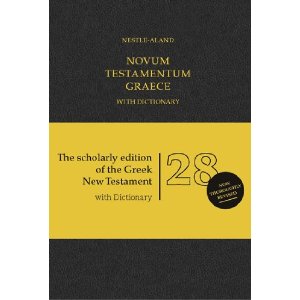
The Nestle-Aland Novum Testamentum Graece (Greek New Testament) releases in its 28th edition soon. Here is a description from the NA28 Website:

The long-awaited 28th edition of the Novum Testamentum Graece has now been published. Once again the editors thoroughly examined the critical apparatus and they introduced more than 30 textual changes in the Catholic Letters, reflecting recent comprehensive collations. With the intent to make this book more user-friendly, the editors also revised the introductions and provided more explanations in English. This concise edition of the Greek New Testament, which has now grown to 1,000 pages, will continue to play a leading role in academic teaching and scholarly exegesis.

Prof. Dr. Holgar Strutwolf speaks more about it here:

And check out this page for the digital Web-based version of the text, with apparatus and full manuscript information (via Evangelical Textual Criticism).

“One Race, Every Medalist Ever”

Usain Bolt set an Olympic record in the men’s 100 meter final the other day. (9.63 seconds!)

But did you know that 100 years ago, a sprinter would merely have had to crack 11 seconds to win the 100 meters?

The New York Times has a great graphic/video that shows all 100 meter medalists since 1896 on the same track. As a friend of mine on Facebook said, “I’d be willing to bet this is one of the coolest things you’ll see today.” He’s right. Check it out.