A New Reader’s Lexicon of the Greek New Testament, Reviewed

Unfamiliar vocabulary proves to be an enduring challenge for students of New Testament Greek. Even students who understand the rules of the language get bogged down having to look up uncommon words while translating. Nevertheless the correct interpretation of many passages of Scripture hinges on the meaning of its rare words.

–Michael H. Burer and Jeffrey E. Miller, Preface

Vocabulary acquisition is key to being able to read any language, but so is just reading a text straight through. A “reader’s lexicon” or “reader’s Bible” seeks to bridge the gap so students can both improve their vocabulary and engage in a continuous reading of the text. To that end, Kregel Academic and Professional has published A New Reader’s Lexicon of the Greek New Testament by Michael H. Burer and Jeffrey E. Miller.

But why a new reader’s lexicon when the old one (by Kubo) has been useful to students of the Greek New Testament for so long? That’s been the primary question before me as I’ve reviewed the New Reader’s Lexicon (NRL). Daniel B. Wallace in the preface gives the reasons for this new lexicon:

But as helpful as Kubo was, there were weaknesses. First, it was not updated to the glosses found in the third edition of the Bauer Lexicon (BDAG). Second, there were numerous errors (involving word frequency numbers, omissions of words, inappropriate glosses, etc.) that went uncorrected. Third, the special vocabulary section at the beginning of each book, involving all the words that occurred more than five times in that book but less than fifty times in the New Testament, created its own problems: designed for efficiency of space, it did not prove helpful for efficiency in learning.

While I think Wallace has it right on the first two points, I (sort of) disagree with the third–that list that Kubo offers at the beginning has actually been helpful to me for learning a given book’s vocabulary, since it groups some of that book’s common words together. However, it does mean that words in that beginning list don’t then appear in Kubo’s lexicon throughout the rest of the book. To overcome this, I would make a copy of the list and use it as a bookmark, referring to it often so I didn’t have to keep flipping pages.

Herein lies one area of strength for the New Reader’s Lexicon. There is no common vocabulary list at the beginning of each book (users now can generate those easily enough through Bible software), but it means that every word that occurs less than 50 times in the New Testament is in this lexicon… in the verse in which it appears. So as I’m beginning my way through Mark 6, I can look in the NRL to quickly see that ἐκεῖθεν in verse 1 means “from there.”

To Wallace’s first two points, that the NRL uses the updated BDAG is a great relief–readers now don’t have to guess whether recent advances in lexicography or discoveries of new papyri mean that the word in front of them actually has a slightly different nuance. The NRL updates Kubo here well.

In addition to “concisely defin[ing] in context” each word, the NRL gives statistics for how many times that word appears. (Names and proper nouns are included.) There are up to three numbers listed:

  • How many times the word appears in that given book of the New Testament
  • How many times that word appears “in all canonical works by the traditional author of the book at hand”
  • How many times the word appears in the whole NT

Kubo had the first and third numbers. This second statistic now allows me to see not only how many times ἀνάθεμα appears in 1 Corinthians (twice) and in the NT (six times), but it tells me that five of the six uses of this word in the NT are with Paul.

And here’s where the lexicon is unique and really stands out–in the instance of such a rarely occurring word, it lists cross references, so I can quickly see that the other use of ἀνάθεμα in I Corinthians is at 16:22and that Paul also uses the word in Romans 9:3, Galatians 1:8,9, and that the only non-Pauline NT occurrence of the word is at Acts 23:14.

The NRL truly does improve upon Kubo’s lexicon. It accomplishes its mission quite well.

But don’t take my word for it. I’ve found that what original language resources to own and invest in is often a matter of personal preference and what works best for an individual. If you’re still on the fence about this resource, download a free sample of the lexicon for Colossians here (pdf). Read through Colossians with it in hand and see how it goes. Personally I’ve found this to be an indispensable resource for making my way through the Greek New Testament.

One huge bonus: the book is designed well. The pages are smooth and thick and bright. The font is clear and easy to read. And the binding is sewn! This means it will stand the test of time well, which you’d hope a reference work like this would.

My thanks to Kregel Academic for providing me with a review copy of this book. Find out more about the book at Kregel’s site or look inside on Amazon.

Jared Wilson (from Gospel Coalition “colonizes” and “conquers” post) apologizes

I wrote about (rather, against) the use of “colonizing” language to describe the sex act here and here, reacting to a recent Gospel Coalition post.

Just now Jared Wilson, author of the original post, has issued an apology. He’s even taken down the original offending post. Read his apology here.

Sex as colonization? A reply to my comment, and my reply back

I linked yesterday morning to a Gospel Coalition piece that has gathered a lot of attention on the Internet recently. I wrote my reply to the piece here.

Yesterday Jared Wilson, author of the original post, wrote this reply as a follow up to the first post and its many critics. I asked Jared for clarification of a few things in the comments here, and he posted a reply, if anyone wants to see it. Just click here, then search for “Abram” in the comments (as of the time of writing this I’m the seventh comment down).

UPDATE: Here’s my reply to Jared’s reply, printed in full below (left as a comment at his site). The Douglas Wilson article he mentions (to which I respond below) is here.

Jared, thanks very much for your reply.

I read and re-read and re-read again Doug Wilson’s follow up piece. I get a little bit more where he’s coming from.

However, “colonizes” still gets me. He spent one sentence in his post explaining that particular choice of words, in which he quoted Song of Solomon 4:12 (“A garden locked is my sister, my bride”) as an example of Scripture having to do with “colonizes” (if I’m reading him right).

But reading through the following verses in Song of Solomon… “SHE” (ESV) replies, “Blow upon my garden… let my beloved come to his garden.” (“come to” ESV=Hebrew “come into” for intercourse) Then “HE” says, “I came [in]to my garden, my sister, my bride.”

That’s it. Just “came into.” The Hebrew word there is the common way of referring to intercourse (lit., “he went into her”=English “he had sex with her”). Wilson quotes the “locked garden” verse as implying, “My garden is locked… therefore come colonize me.” But that’s neither what she says nor what he does after that verse in response to her locked garden.

“Colonizes” is *really* exegetically difficult to pull out of that passage both based on Hebrew word meaning *and* the full context of the passage in which it occurs (which, as you’ve rightly pointed out, context is a key determiner of meaning). All this holds true, too, by the way, of his explanation of his use of the verb “conquer,” based on Song 4:4. It’s not in there and it’s not what the passage seems to mean.

So if “colonizes” cannot come from the place Wilson mentions, does he find it elsewhere in Scripture to be an appropriate description of the male-female sex act? It not, that’s a continuing concern to me….

Sex as colonization?

This morning I followed a friend’s Facebook link to a Gospel Coalition blog post. Here is the post I read. It’s hard to summarize, but the basic topic is the “good, God-honoring, and body-protecting authority and submission between husbands and wives.” That part sounds not so bad, but the blog post quotes a guy named Douglas Wilson who says:

In other words, however we try, the sexual act cannot be made into an egalitarian pleasuring party. A man penetrates, conquers, colonizes, plants. A woman receives, surrenders, accepts. This is of course offensive to all egalitarians, and so our culture has rebelled against the concept of authority and submission in marriage.

You can go to the post to read the quote in a bit of a fuller context, but I was still amazed to read this at a site that is usually as exegetically careful as the Gospel Coalition. Once you’ve read the initial blog post, I’ve reproduced the comment I left at that site here:

This, of course, is the most difficult part of the initial quote:

In other words, however we try, the sexual act cannot be made into an egalitarian pleasuring party. A man penetrates, conquers, colonizes, plants. A woman receives, surrenders, accepts.

A key concept of discourse analysis (Steve Runge talks about this with reference to the Greek New Testament) is that “choice implies meaning.” So instead of the Biblical Hebrew “goes into,” Wilson chose “penetrates.” Instead of “establishes/builds,” he chose “colonizes,” etc. It’s his prerogative as an author to choose those words, whether one likes them or not.

The problem is, each of those words has meanings associated with them, whether we want them to or not. This is true whether or not a word *should* mean a certain thing. (I’m thinking of Jared’s comment, “It is difficult to understand, I’m sure, when they are defined with violence in mind. In this isolated passage Wilson has ruled that out.”)

I don’t agree that Wilson has sufficiently ruled that out (that last paragraph when he speaks against “devours” is too short to do that, but maybe the rest of Wilson’s work does?). But even if he has ruled out violence, his *choice* to use especially *colonizes* is confusing. As the immense and growing field of post-colonial literature attests, colonization has left untold trauma in its wake. And, yes, colonization was all too often violent. Rape often occurred as part of colonization, so that choice of word (remember, choice implies meaning) in this context (speaking about rape–even if against it) was particularly surprising and probably did not help the author’s case at all.

Also, Wilson’s saying “the sexual act cannot be made into an egalitarian pleasuring party” is just bizarre. Besides seeming like an unwarranted barb against egalitarians, what seems to be implied (with that sentence contextualizing the next two) is that there is no way (“cannot”) for *both* parties (“egalitarian”) to be *pleasured* (“pleasuring party”) all the time, since one is busy “penetrat[ing]” (with pleasure) and the other (merely) “receives” and “surrenders” (implied: even if she doesn’t receive pleasure from it?). You can see how it’s not a far leap in the reader’s mind from there to rape imagery, whether Wilson means this or not. I’m certainly not accusing him of anything. But it was, at best, a bad choice of words.

Is it egalitarianism that he is speaking against? Or is it against the idea of man and woman both having pleasure in sex? In other words, would Wilson approve of a “complementarian pleasuring party where the man penetrates and the woman receives, both receive pleasure, and if one does not, per I Cor 7:4-5, both stop out of mutual love for each other?” I’d assume he would, based on these comments above.

But “surrenders” in this context, especially when used unidirectionally and paired with “colonizes”–IF Wilson means to apply them specifically to the sex act, which it seems he does–is an unfortunate choice of words. If/when there is any “surrendering” in sex, it goes both ways, as the apostle Paul points out. (I know Paul is talking about *not* having sex, but his larger principle from I Cor 7:4 surely applies to having sex, too.) Neither has authority over his/her own body, but yields it to the other. “Colonizes” and “surrenders” are pretty difficult to square with this.

UPDATE: A reply and my reply to the reply here.

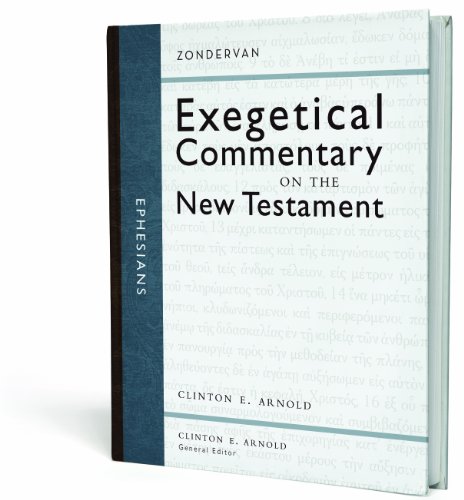
Free Book! Ephesians commentary by Arnold (Zondervan)

I am giving away a book at Words on the Word this weekend. It’s a commentary on Ephesians by Clinton E. Arnold, from Zondervan’s Exegetical Commentary on the New Testament series.

Last weekend I reviewed Luke from that same series. You can read that review to find out more about the structure and layout of each book in the series. Anyone who is preaching, teaching, or just studying their own way through Ephesians will find this book illuminating. Those who know even a little Greek will benefit most from this book, but Arnold translates everything, so those who know no Greek will benefit, too.

I will choose a winner at random. To enter the drawing, comment on this blog post with your answer to the question, “If you had a chance to sit down for a cup of coffee or tea with the apostle Paul today, what is the first thing you would ask him?” (I know what I would ask!)

Then if you link to this post on your Facebook, Twitter, blog, etc., come back here to tell me in the comments section that you did, and you’ll receive a second entry. I will announce the winner on the blog first thing Monday morning.

If you want to skip the giveaway contest and just buy the book for yourself, you can find it here.