I’ve always had a hard time answering who my “favorite author” was (how could I pick just one?), but when it comes to people who have written about the Bible, R.T. France is definitely in the top three. I found myself moved to tears several times when reading through his highly technical (read: supposed to be dry) commentary on Mark.
So I was thrilled when I learned that Baker’s Teach the Text Commentary Series (TTT) had R.T. France as the author of its Luke volume. France died in February 2012, so to have this posthumous work of his is a real treat–especially since he already has a major commentary on Matthew and one on Mark. This rounds out France’s writing on the Synoptic Gospels.
So far the TTT series is a strong entry into the already highly populated world of commentaries. I reviewed the Romans volume here. Baker has a fantastic series Website here with plenty of information, videos, and samples from the series.
How France Teaches Luke
France divides the 24 chapters of Luke into 65 text units (or passages), each of which receives six pages of commentary. It breaks down in this way:
“Big Idea” at the beginning of each commentary passage.This is a short Tweet-length summary of the passage. For example, the Big Idea for Luke 1:57-80 (“The Birth of John”) is: “Both the extraordinary circumstances of his birth and his father’s inspired utterance testify to John’s pivotal role in the plan of salvation.”
A “Key Themes” sidebar. This is a set of bullet points that gives the highlights of each passage.
“Understanding the Text.” Here France offers:
The Text in Context (one of his real gifts is a sense of always knowing the larger literary context, and reminding the reader of it)
Outline/Structure
Historical and Cultural Background
Verse-by-verse Interpretive Insights
Theological Insights
France is especially adept in the Theological Insights section. He is reliable, creative, and faithful to the text. His experience as both scholar and pastor seems to have helped here.
“Teaching the Text.” France offers specific suggestions for how the preacher might approach the sermon on each text.
“Illustrating the Text.” Whether it’s a personal story, someone else’s anecdote, history, literature, film, or art, France gives ideas for how the preacher or teacher can illustrate the message.
France’s introduction to Luke is a mere seven pages (which includes commentary on Luke 1:1-4), but his awareness of literary and biblical context throughout the book offers what one might otherwise miss by way of introductory matters.
How France Treats a Passage (Luke 17:1-19)
To explore a sample passage more in depth, France combines Luke 17:1-19 into one passage, on which he spends the requisite six pages. The decision to treat Luke 17:1-19 as a single passage limits how much he can offer, and occasionally the reader will experience the results of such space limitations in TTT. (This is part of the purpose of the series, though, and is perhaps just indicative of my desire for more France.) Luke 17:1-10 (itself consisting of “four separate units of teaching”) and 17:11-19 probably ought to be treated as two separate passages–the Revised Common Lectionary, among other places, does.
His “Big Idea” in this section (“True discipleship cannot be undertaken causally; the service of God demands all that we can bring to it”) is more relevant to vv. 1-10 than it is to vv. 11-19. (By contrast, this similarly-targeted Luke commentary has, “Faith recognizes Jesus as the source of healing and expresses itself in gratitude and praise to him,” for vv. 11-19.)
Even so, France has this good insight to offer on verse 19:
This formula [‘your faith has made you well’] is often a ‘performative utterance,’ but not here, since the cure of the ten has already taken place, all of them presumably through similar ‘faith.’ But this man’s overt praise of God is evidence of a spiritual health that Jews would not expect to find in a Samaritan.
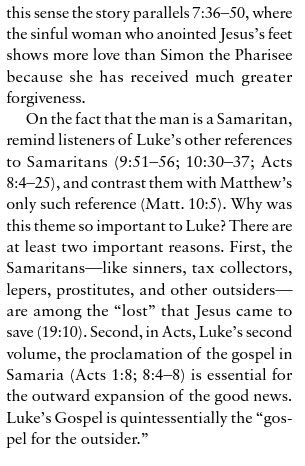
And his “Teaching the Text” portion does suggest ways to preach from vv. 1-10 and vv. 11-19 as separate passages. On the latter he writes:
In“Illustrating the Text” France moves between a 1962 film (Days of Wine and Roses, about leading another into alcoholism), a personal anecdote on forgiveness by Cardinal Bernardin, and a quotation by author Lewis B. Smedes on gratitude and happiness.
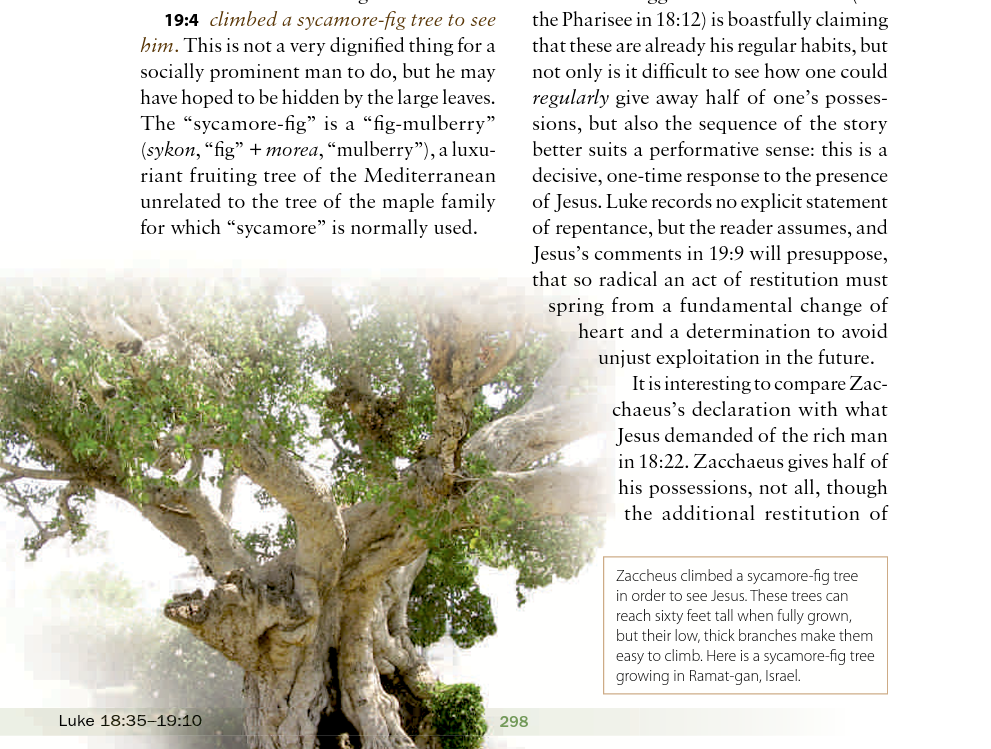
As with the Romans Teach the Text volume, the illustrations throughout help the reader better envision what’s going on in the biblical text. Here’s a portion from the passage that describes Zacchaeus’s encounter with Jesus:
Zacchaeus’s Sycamore Tree
An added bonus is the high quality of the book materials. The hardcover looks pretty indestructible, the binding is sewn, and the pages are thick and glossy (but not too glossy to accept notes from a writing utensil). The full-color pages throughout are a nice touch, too. Translation: this commentary will make it through multiple series and preaching cycles on Luke. I’ve even been able to use it recently as I preach through Matthew, consulting the parallel passages here.
There are already five TTT volumes available, with more on the way. If the quality of this series continue to match that of France and Pate (Romans), I’ll want to keep consulting this series, and other preachers and teachers will want to, as well.
Thanks to Baker Publishing for the review copy of Luke. Its Baker product page is here, and it is for sale at Amazon here.
I’ve had a fascinating realization recently: almost all of Jesus’ first recorded words in Matthew and Luke were first spoken by somebody else. Jesus is highly prone to quotation early in his ministry.
This first stood out to me when reading through Matthew. After Jesus’ baptism and temptation, his first words of public proclamation (Matthew 4:17) are:
“Repent, for the kingdom of heaven has drawn near!”
John the Baptist had been saying the same thing (Matthew 3:2), verbatim, in his first recorded words in Matthew:
“Repent, for the kingdom of heaven has drawn near!”
The man Raymond Brown calls JBap
I’m sure that Jesus’/Matthew’s use of these same words from John are deliberate. Jesus and Matthew are showing that Jesus stands in the line of the prophetic, John-the-Baptist tradition. This is a tradition that fulfills what God has promised in the Old Testament. By chapter 4, the prophecy-fulfillment theme has already been prevalent in Matthew.
The very first words of Jesus that Matthew records are at Jesus’ baptism, where he tells a protesting John, “Let it be [this way] now, for this is proper, in order to fulfill all righteousness.”
But after that, the next three statements of Jesus in Matthew are quotations of Deuteronomy to fend off the devil in the temptation narrative. Then comes Matthew 4:17, where Jesus issues the same call to repentance that John has issued.
Luke is similar. After Luke 2:49 has Jesus telling his parents that he had to be in his Father’s house, Luke moves to his account of the temptation. Luke also includes three “It is written” statements by Jesus. Then he goes to his hometown synagogue in Nazareth and reads from Isaiah–yet more quoted words on the lips of Jesus.
What are we to make of this? Did Jesus not have anything original to say at the beginning of his ministry?
I think both of these Gospel writers and Jesus were keen to show that Jesus’ ministry was a continuation–better, a culmination–of the work and ministry that God had already initiated through Moses and the prophets. (Note: Mark and John look a bit different here.)
“God spoke long ago,” Hebrews begins, “in many instances and in many ways, to [our] fathers through the prophets, but in these last days he has spoken to us by [his] Son….”
At the baptism of Jesus in Matthew 3, God declared Jesus to be his Son. This Son carries on and brings to completion the work of salvation that God has already been effecting in the world. Matthew and Luke highlight Jesus’ use of Scripture early in his ministry to place him firmly at the center of God’s action in the world. The Sermon on the Mount of Matthew 5 and following will show even more in-depth interaction between Jesus and the Scriptures.
Jesus speaks God’s words, only now with an authority that exceeds the authority of all those who came before him. Jesus speaks other people’s words, but now with the authority of a Son, who was already present with God when the Word first inspired those words long ago.
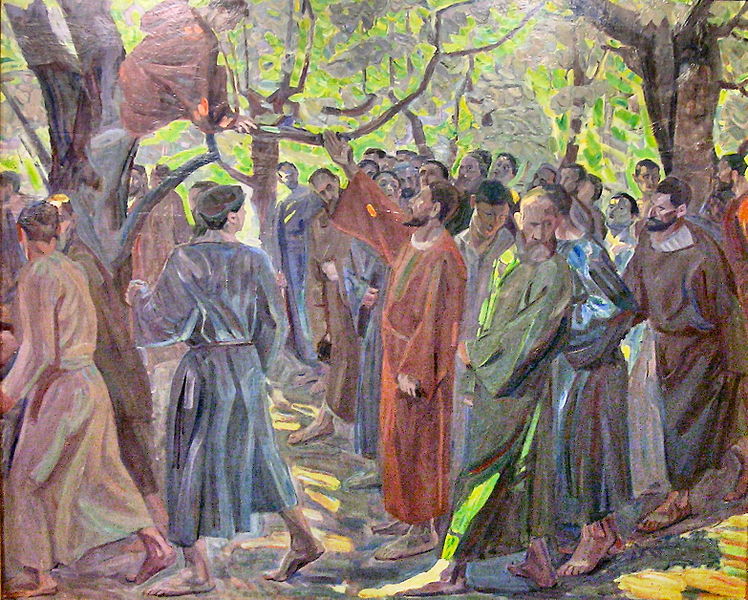
Even though Zacchaeus was “a wee little man”–he was not “wee” or “little” in terms of his financial standing.
Luke 19:1-2 Jesus entered Jericho and was passing through. A man was there by the name of Zacchaeus; he was a chief tax collector and was wealthy.
He was “a chief tax collector” and he “was wealthy.” Those two things are actually three strikes against Zacchaeus.
Strike one: He was a tax collector.
Tax collectors made out pretty well in Jesus’ day. They contracted with the Roman state to collect taxes from their fellow Jews. As long as the tax collectors paid the Romans a certain amount, they could charge whatever commission they wanted.
Strike two: He was a chief tax collector.
A chief tax collector oversaw other tax collectors. Zacchaeus had a prime position.
There was really little regulation here. This is sort of like pre-2008 subprime mortgage lending. Only it’s worse, because Zacchaeus as chief tax collector has a lot of other tax collectors doing the dirty work for him. And not only are they getting rich from people’s hard-earned cash, they’re even giving some of it to an imperial power–Rome. And who knows what non-kosher godlessness that money is going to!
Strike three: Zacchaeus was rich.
He was a tax collector, he was a chief tax collector, and he was rich. There’s nothing wrong with being rich, of course, but generally in Luke’s Gospel, the rich people Jesus meets have a hard time loving God on account of all their money.
Zacchaeus got rich off of other people’s money. Think: Ebenezer Scrooge.
As with the tax collector last week, the listeners expect this chief tax collector to be the antagonist.
So it’s no surprise in verse 3 when Zacchaeus can’t see Jesus. Sure, he’s short–probably not even 5 feet tall–but even if he were 6 feet tall, I’ll bet the crowd wouldn’t have made way for a guy like him.
Luke 19:3 He wanted to see who Jesus was, but being a short man he could not, because of the crowd.
Source: Adrienne Lavidor-Berman (Boston Globe)
These people are waiting to see Jesus! This is even more exciting than watching Big Papi and the Red Sox get on a duck boat! No way they’re going to make room for Zacchaeus.
The crowd blocks his line of sight. But Luke says he wanted to see Jesus. He seems to have these three strikes against him, but maybe this is a bit of character development here? Another translation says, “He wanted to see Jesus, who he was.”
He wants to figure out who Jesus is. He’s interested. He’s what church growth gurus in the 1980s and 90s referred to as “a seeker.”
The Motif of Urgency
Luke 19:4 So he ran ahead and climbed a sycamore-fig tree to see him, since Jesus was coming that way.
Zacchaeus runs ahead. He seems to be eager to see Jesus.
It wasn’t until I’d read this passage at least a dozen times and went for a long walk that I picked up on this motif of urgency.
The story picks up the pace at this point. Jesus is on his way to Jerusalem. He’s about to die. And rise again. He’s aware of what’s coming; his disciples are not, really.
But this is Jesus’ last face-to-face encounter till he gets to Jerusalem. So Luke as a writer is going to pack in as much as he can.
We’ve got lots of Luke’s themes here:
Wealth can keep you from God, or you can use it to worship him and serve others
Belief in God always leads to action and compassion for others
Jesus came to save the lost
God is a seeker, who goes after the ones he loves
In Luke this is a sort of final crescendo to close out this movement, before Jesus’ triumphal entry into Jerusalem, and then the events of Holy Week. All those themes are here, and Luke the storyteller notes that they are all important–urgently important.
verse 4: Zacchaeus runs ahead
verse 5: Jesus tells him to come down immediately…
verse 5 again: Jesus must stay at his house today
verse 6: Zacchaeus comes down at once
verse 8: Zacchaeus re-directs his giving and quits his cheating ways, and he metes out this retributive justice “here and now,” he says
“Today,” Jesus says in verse 9, “salvation has come to this house”
So keep that motif in mind as we work through the rest of the passage. Zacchaeus runs up the tree, and Jesus sees him.
Jesus Invites Himself Over
Luke 19:5b “Zacchaeus, come down immediately. I must stay at your house today.”
This culture valued hospitality, but there are still ways to do hospitality and ways not to do it. What you don’t do is invite yourself over to someone’s house. That’s still true today.
But Jesus has to–Jesus must–stay at his house. Forget the conventions of hospitality. Forget the conventions of not eating with unclean sinners. Forget that Zacchaeus was a traitor and that there were some in the crowd who just wanted Jesus to be Che Guevera and overthrow Rome.
How does Jesus know Zacchaeus’s name? Luke doesn’t tell us. Jesus other knew him through divine omniscience or through Zacchaeus’s reputation. But he’s got to get to Zacchaeus’s house.
Why? We’ll come to that in a bit.
Already we’re struck by Jesus’ offer of fellowship. His offer to fellowship with him is a standing offer, but as with Zacchaeus, it’s also an offer he wants us to take him up on right now. This very day. This very minute. Jesus wants to come to us, to enter the homes of our hearts and minds, and have communion with us.
God calls the ones he has made good. And when we go bad–as Zacchaeus did–he does not turn away from us, but continues to pursue us, and invite himself into our homes, our work, our daily routines, our lives.
Zacchaeus models a response to Jesus. He comes down with the same urgency Jesus had in calling him.
Luke 19:6 So he came down at once and welcomed him gladly.
He receives Jesus into his home as an esteemed guest. No delay. There’s not putting it off till another time. Zacchaeus comes down have fellowship with Jesus right now.
The people in the crowd don’t like this, of course.
Luke 19:7 All the people saw this and began to mutter, “He has gone to be the guest of a ‘sinner.’”
They grumble against Jesus. But haven’t they figured out by now that this is the sort of thing Jesus does? Have we learned that yet?
Zacchaeus’s Immediate Response
And then, more urgency:
Luke 19:8 But Zacchaeus stood up and said to the Lord, “Look, Lord! Here and now I give half of my possessions to the poor, and if I have cheated anybody out of anything, I will pay back four times the amount.”
Right now–on the spot, Zacchaeus pays it all back. Retributive justice, it’s called. He makes amends in a way that is appropriate to the crime. Redistribution of ill-gotten wealth was the only way for him to do this.
Saint Augustine once wrote of grace that it “is bestowed on us, not because we have done good works, but that we may be able to do them.”
This is another side of the coin when we consider last week’s tax collector and his uttered prayer. “God, have mercy on me, a sinner.” This prayer of faith made him right with God, Jesus said. Here, there is action, which always accompanies belief. Salvation has come, Jesus says, and that is evident because of what Zacchaeus is doing with his money.
He literally puts his money where his mouth is. His profession of faith is only truly complete as he acts on it. And he acts on it “here and now.”
He held his money loosely. He embodied that offertory prayer: “All things come from thee, O Lord, and of thine own have we given thee.”
Zacchaeus is going to lose a ton of money here–and think of all the logistics in making sure everyone gets repaid properly.
But no matter–he is eager to express his love toward God through his vocation and his giving.
Luke 19:9-10 Jesus said to him, “Today salvation has come to this house, because this man, too, is a son of Abraham. For the Son of Man came to seek and to save what was lost.”
Remember how Jesus said, “I must stay at your house today”? Or, as another translation puts it, “It is necessary” for Jesus to stay?
This is because Jesus’ fellowship with Zacchaeus was “mission-critical.” It was the core of Jesus’ mission to “seek and to save what was lost.” He’s doing that here. He has done that here. He sought Zacchaeus, and saved him– “Today salvation has come to this house.”
Zacchaeus did his part, of course–he climbed a tree, pledged to give back money he had extorted from people.
But Jesus is the ultimate initiator, I think. He could have passed by that tree… pretended not to see Zacchaeus.
The Prodigal Son Returns, Rembrandt
“The Son of Man [Jesus] came to seek and to save what was lost.”
The 1 sheep, lost and wandering away from the other 99. The 1 coin, lost on a dusty floor. The 1 son, lost in his youthful rebellion and waywardness. A despised chief tax collector. Prostitutes. People with diseases. Gentiles. You. Me. Jesus comes to seek and to get all of these.
Our Mission with Jesus
Jesus’ mission is “to seek and to save what was lost.”
This has now become the mission of the church, as the visible expression of Jesus’ body on earth.
Faith and action go hand in hand, as they did with Zacchaeus. For him, following Jesus necessarily entailed that he do all he could to bring about justice. The kingdom ethics of Jesus transformed the way he thought about his business relationships. It revolutionized the way he worked.
Zacchaeus responded to Jesus immediately. There was a sense of urgency in his desire to make things right before God.
And he responded to Jesus with joy.
May we be inspired by this unlikely hero. Zacchaeus allowed his whole life to be transformed by his encounter with Jesus, in the very moment of Christ’s coming to him. Salvation has come to our house today. Let’s receive him with joy.
The above is adapted from the sermon I preached this Sunday on Luke 19:1-10, covering the story of Zacchaeus’s encounter with Jesus. All Scripture quotations come from the NIV (1984). See my other sermons, if you desire, here.
“Lord Jesus Christ, Son of God, have mercy on me, a sinner!”
“Lord Jesus Christ, Son of God, have mercy on me, a sinner!”
“Lord Jesus Christ, Son of God, have mercy on me, a sinner!”
It’s a surprising source, but I have J.D. Salinger to thank for introducing me to the Jesus Prayer in his book Franny and Zooey.
“Lord Jesus Christ, Son of God, have mercy on me, a sinner!”
In a simplified form, that is the prayer of the tax collector in Jesus’ parable of the Pharisee and the tax collector (Luke 18:9-14): “God, have mercy on me, a sinner.” It has become known as the Jesus Prayer.
The tax collector is a model for prayer, though if this character in Jesus’ story were worshiping with us today, he’d never let us hold him up as an exemplar.
Two Guys Walk into the Temple to Pray….
Luke 18:9 To some who were confident of their own righteousness and looked down on everybody else, Jesus told this parable:
Note the phrases, “confident of their own righteousness” and, “looked down on everybody else.”
The Old Testament prophet Isaiah speaks of such people:
They say, “Keep to yourself!
Don’t get near me, for I am holier than you!”
These people are like smoke in my nostrils,
like a fire that keeps burning all day long. (Isa 65:5)
Luke 18:10 Two men went up to the temple to pray, one a Pharisee and the other a tax collector.
Of these two men, who do the listeners think is going to be the hero? The Pharisee. Just about everyone hated tax collectors.
Oh, this is going to be good, the self-righteous listeners must have thought. Jesus is about to validate us, as he should!
Jesus isn’t out to bash Pharisees with this parable. We have to be careful about this as we read the Gospels. In fact, as one commentator points out, “The Pharisees were admired by the common folk for their piety and devotion to the Mosaic Law. Our contemporary equation of Pharisaism with hypocrisy would not have been made by a first-century Jew.”
It’s the same kind of setup as you get in the Good Samaritan parable–the religious person ends up showing us what not to do, while the real sinner becomes the example.
God Is Lucky to Have Him
Luke 18:11 The Pharisee stood up and prayed about himself: “God, I thank you that I am not like other men—robbers, evildoers, adulterers—or even like this tax collector.
Some of the listeners in the audience are saying, “Amen! Good prayer! Jesus gets it!”
This Pharisee starts his prayer out in the right way–“God, I thank you,” a typical beginning to Jewish prayers.
But it never really was an actual thanking of God for who God is. It was a thanking of God for who the Pharisee was.
He’s at the temple praying, standing up. This is a posture that suggests he was praying for others to hear him.
Note that it says he “prayed about himself.” This is much more soliloquy than prayer. Dear God–but enough about you. Here’s who I am and what I bring to the table. He mentions God, prays to him, but God quickly becomes just a footnote in the prayer. He continuses:
Luke 18:12 “I fast twice a week and give a tenth of all I get.”
What a good, religious guy! No, really–he is living an exemplary life, in terms of spiritual practices.
And he might well be sincere in his fasting and tithing. His fasting twice a week was more than was required. Designating a tenth of everything to God is an Old Testament practice that many continue today when they consider financial giving to their churches.
But he’s missing the point.
The primary subject and actor in this prayer is… the one praying. Not the one he prays to.
He addresses his prayer to “God,” but after that, he thanks God for who he is not. He’s telling God what he’s doing for God, and he’s also making sure to remind God of how rotten these other people are. God, you’re lucky to have me!
This guy’s understanding of himself is interesting to me. He defines himself before God in two primary ways:
(a) who he is not (these other people) and
(b) what he has done.
The guy has identity issues. Can he only be secure in himself by putting others down? Or maybe he’s a little more sincere than that. Maybe he’s like the older brother in the Prodigal Son story–he does his duty, says his prayers, fasts, tithes… but the people around him are moral slackers. And he just can’t stand it.
He’s still missing the point. The despised tax collector, however, really does get it.
He Can’t Even Look at God
The Pharisee and the Tax Collector, by Gustave Doré (1832–1883)
Luke 18:13 But the tax collector stood at a distance. He would not even look up to heaven, but beat his breast and said, “God, have mercy on me, a sinner.”
With the Pharisee, the primary subject and actor in his prayer was… the one praying. The subject and primary actor in this prayer is God. “God, have mercy on me, a sinner.”
That’s it. It’s much shorter prayer than the Pharisee’s prayer.
Before he even prays, he beats his chest, a sign of lament. He did not stand where everyone could see him. The Message version says he was “slumped in the shadows.”
Clearly he was “supposed to” be the antagonist of the story. A tax collector was in collusion with the Roman occupiers. Assuming he was Jewish, he took money from his own people to pay a foreign power, often with a kickback for himself.
He knows he’s supposed to be the antagonist in the story–he knows his sin too well. He confesses his sin to God.
An Old Testament prayer goes: “O my God, I am too ashamed and embarrassed to lift my face to you, my God, for our iniquities have risen higher than our heads, and our guilt has mounted up to the heavens” (Ezra 9:6).
But God–and all the listeners to this story knew this–God is a God who forgives wrongdoings. He welcomes the wayward sinner home.
Jesus concludes:
Luke 18:14 “I tell you that this man, rather than the other, went home justified before God. For everyone who exalts himself will be humbled, and he who humbles himself will be exalted.”
Remember how the story started? “To some who were confident of their own righteousness and looked down on everybody else, Jesus told this parable.”
They were confident in their own righteousness, their own right standing, their peace with God. But, look, Jesus says, you don’t get that from yourself, so stop trying. If you hold yourself up as righteous, you’ll humbled. But if you are humble, you will be exalted–not a sort of fame or glory with other people, but if you are humble, you will be truly justified before God. You will have peace with God.
“God, have mercy on me, a sinner.”
Where We Fit in the Parable
One writer (quoting another for the first portion below) says that because we know the end of the story:
“We identify with the tax collector and feel silent gratitude that we are decent and humble rather than being self-righteous like that shameful Pharisee.” We can be like the Sunday school teacher who goes through the lesson and says at the end, “Now, children, let us bow our heads and thank God we are not like that Pharisee.”
And that’s one of our reactions reading this text, isn’t it?
Well, yeah, I’d never actually name people in my prayer and say, “God, thank you that I’m not like him or her or those people.” And maybe that’s true. Maybe we don’t explicitly pray prayers like that, certainly not out loud.
But we might think thoughts like that. This same loathing of others that the Pharisee brings to God… we may do this in more subtle ways.
We might smugly watch the people going for long walks on a Sunday morning while we drive to church. We might watch the way a parent scolds their child and think: well, I would never do anything like that. We might work hard in the office or even here at the church, and secretly resent those who don’t seem to be as productive as we are. Or we might just look at someone with pseudo-pity and say to ourselves, “I am sure glad I don’t have to be that person.”
“God, have mercy on me, a sinner.” This is the sort of attitude, the kind of prayer that brings us into fellowship with God.
This prayer, in various forms, has inspired people ever since the tax collector prayed it. Ironically enough–the prayer of this humble man has been exalted and used by many.
What Salinger’s Franny Knew About Prayer
J.D. Salinger first wrote Franny and Zooey in the late 1950s as two separate shorts in The New Yorker magazine. Franny is a college student who is becoming disillusioned with college–not with her studies, per se, but with other college students. She thinks they’re fake, shallow, and egotistical. Her boyfriend Lane isn’t much better.
He’s a name-dropper, a complainer. He boasts in his own achievements–his good grades and his upcoming paper he’s going to publish. He’s sort of like the Pharisee in the parable.
What Franny read
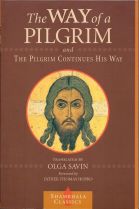
Franny is in the middle of an existential crisis. At the recommendation of a prof, she’s been reading The Way of a Pilgrim, a 19th century Russian story about a pilgrim who wants to know how to “pray without ceasing,” as one verse says. He finally finds a spiritual advisor who tells him to repeatedly pray a version of the tax collector’s prayer: “Lord Jesus Christ, Son of God, have mercy on me, a sinner.” The idea is to make this prayer move from the lips to the heart, so that, as Salinger puts it, the prayer “becomes an automatic function in the person, right along with the heartbeat.”
Franny has been experimenting with the prayer, and at the end of the story, she faints. When she comes to, with boyfriend Lane by her side, she is mouthing the words: “Lord Jesus Christ, Son of God, have mercy on me, a sinner.”
Various Christian traditions suggest praying the prayer repeatedly, as the Russian pilgrim did, and as Franny tried to do.
As one devotes 5, 15, then 30 minutes to praying this prayer, different words stand out each time. Jesus Christ is Lord. Jesus is the Son of God. I am a sinner. Mercy–Jesus has mercy on us, or shows us grace when we don’t deserve it. “Lord Jesus Christ, Son of God, have mercy on me, a sinner.”
Some recommend breathing in as you pray the first half of the prayer–inhale with “Lord Jesus Christ, Son of God,” then exhale as you pray the second half–”have mercy on me, a sinner.” You internalize this prayer, so that its words become as natural to you as breathing.
But humility is a tricky thing. Just as soon as we think we are humble, we are tempted to congratulate ourselves on our humility. Maybe not loudly, but quietly. So we cling to the message of this parable, summarized elsewhere in Scripture: “God opposes the proud, but gives grace to the humble.”
I wonder if Salinger’s character Franny knew that: even as she saw occasion to criticize shallowness and inauthenticity around her, she clung to the prayer of humility. It moved from her lips to her heart. It became not just a prayer, but a posture. It wasn’t a formula, but her very breath.
It is Christ’s mercy, his “unmerited favor,” as some have defined it, that sets us right with God. We remind ourselves of that mercy each time we confess our sins and call on God for his aid.
“Not to us, Lord, not to us, but to your name be the glory.” (Ps. 115:1)
The above is adapted from the sermon I preached today on Luke 18:9-14, covering the Parable of the Pharisee and the Tax Collector. All Scripture quotations come from the NIV (1984). See my other sermons, if you desire, here.
With St. Francis of Assisi, another patron saint of Italy
“When my goodness saw that you could be drawn in no other way, I sent him to be lifted onto the wood of the cross. I made of that cross an anvil where this child of humankind could be hammered into an instrument to release humankind from death and restore it to the life of grace. In this way he drew everything to himself: for he proved his unspeakable love, and the human heart is always drawn by love.”
–Catherine of Siena (1347-1380)
We are spending six weeks in our adult Sunday School with Foster and Smith’s Devotional Classics book. Here are the writers we’ve looked at each session:
A hidden gem in BibleWorks is the “MacDonald Greek Transcription.”
BibleWorks comes with sentence diagrams for the Greek New Testament. They are also useful and look like this:
Luke 18:1-2 (click to enlarge)
The MacDonald transcriptions above, however, replicate something I haven’t seen in any other Bible software (EDIT/UPDATE: Logos has a “clausal outlines” module, minus the color coding), which is the sentence flow method of representing and visualizing a sentence. He uses color coding and spacing to line up parallel ideas and repeated words, making them easier to see than in just the text or even the diagrams.
It’s a great way to get at the motifs and important words of a given passage. And I’d forgotten about it until recently, but am now using it most weeks in sermon preparation.
The full title of the resource above is Syntactic and Thematic Greek Transcription of the New Testament, by William Graham MacDonald, 2008. BibleWorks is available here. Its full contents list is here.
This week’s Gospel lectionary reading is Luke 18:1-8. Quite a few commentaries have noted the (possible) connection between themes in Sirach 35 and Jesus’ parable. The two texts are below (NRSV):
Luke 18:1-8
Then Jesus told them a parable about their need to pray always and not to lose heart. He said, “In a certain city there was a judge who neither feared God nor had respect for people. In that city there was a widow who kept coming to him and saying, ‘Grant me justice against my opponent.’ For a while he refused; but later he said to himself, ‘Though I have no fear of God and no respect for anyone, yet because this widow keeps bothering me, I will grant her justice, so that she may not wear me out by continually coming.’” And the Lord said, “Listen to what the unjust judge says. And will not God grant justice to his chosen ones who cry to him day and night? Will he delay long in helping them? I tell you, he will quickly grant justice to them. And yet, when the Son of Man comes, will he find faith on earth?”
Sirach 35:17-22a
He will not ignore the supplication of the orphan,
or the widow when she pours out her complaint.
Do not the tears of the widow run down her cheek
as she cries out against the one who causes them to fall?
The one whose service is pleasing to the Lord will be accepted,
and his prayer will reach to the clouds.
The prayer of the humble pierces the clouds,
and it will not rest until it reaches its goal;
it will not desist until the Most High responds
and does justice for the righteous, and executes judgment.
The overlap of themes, of course, does not prove that either had/has impact on the other, but it is interesting to think about whether Jesus/Luke had the Sirach passage in mind when telling the parable in Luke.
“If the worth of our prayer life depended upon the maintenance of a constant high level of feeling or understanding, we would be in a dangerous place. Though these often seem to fail us, the reigning will remains. Even when our heart is cold and our mind is dim, prayer is still possible to us.”
–Evelyn Underhill (1875-1941)
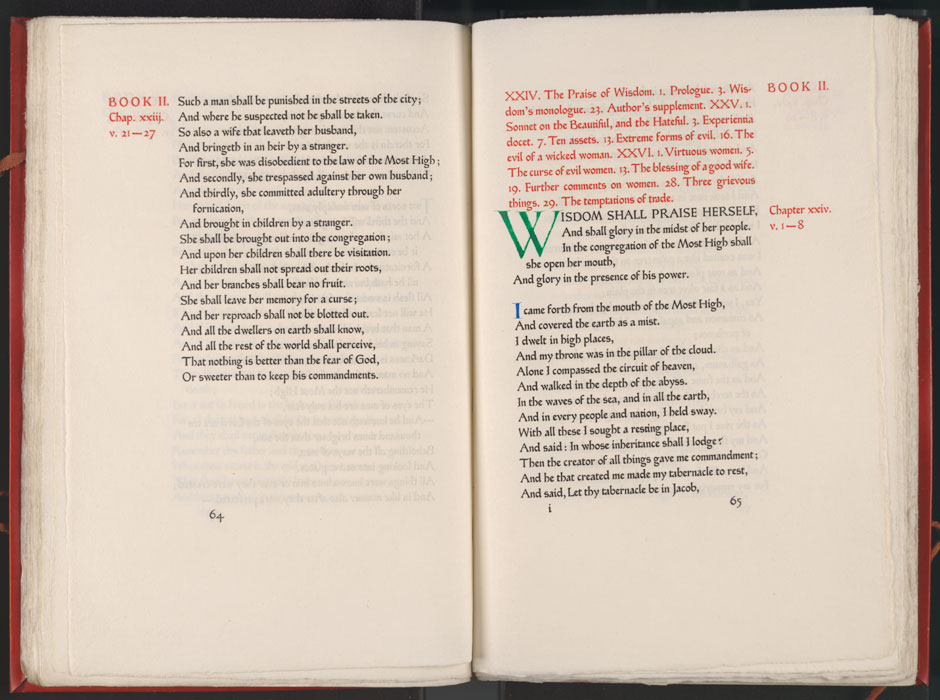
For the first six weeks I am teaching/leading adult Sunday School at my church. We are spending those six weeks with Foster and Smith’s Devotional Classics book. Here are the writers for each session:
Week 4: Apocryphal Literature
(This is not in Devotional Classics. But we’ll look at Ecclesiasticus (Sirach), Wisdom of Solomon, and the Prayer of Manasseh.)
Week 5: Catherine of Siena
Week 6: Kathleen Norris
Each week we do a short bio of the writer, some reading, some discussion, and some prayer.
“Your mind is a beautiful thing. Learn to trust it less and you’ll make better use of it.”
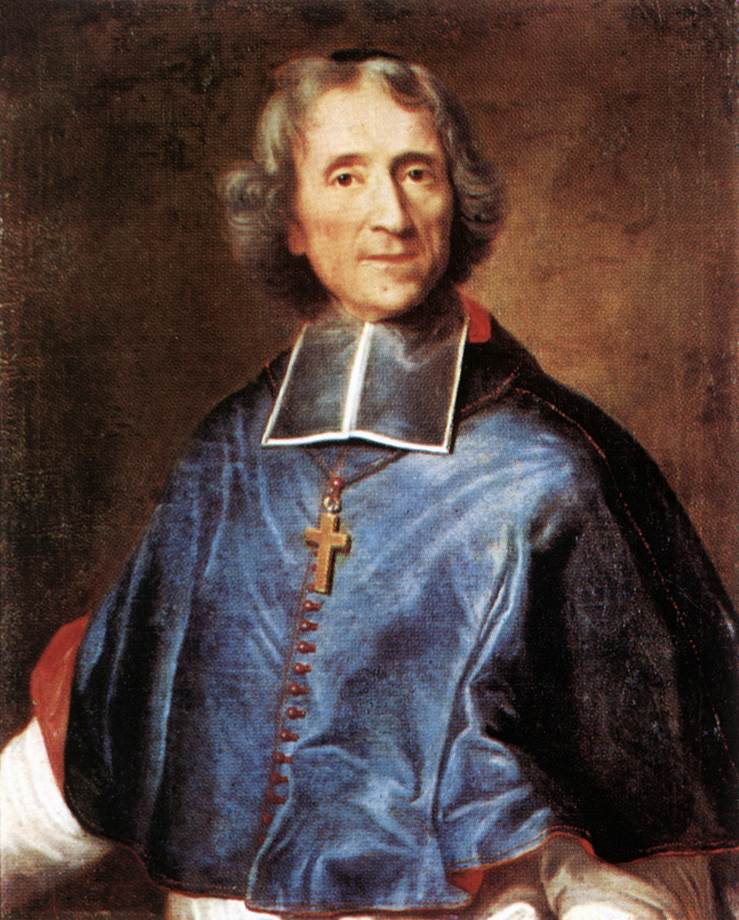
So went my introduction some dozen years ago to François Fénelon, royal tutor, priest, archbishop, and wise theologian.
For the first six weeks I am teaching/leading adult Sunday School at my church. We are spending those six weeks with Foster and Smith’s Devotional Classics book. Here are the writers for each session:
Week 4: Apocryphal Literature
(This is not in Devotional Classics. But we’ll look at Ecclesiasticus (Sirach), Wisdom of Solomon, and the Prayer of Manasseh.)
Week 5: Catherine of Siena
Week 6: Kathleen Norris
Each week we do a short bio of the writer, some reading, some discussion, and some prayer.
First things first: Do we really need another commentary series? This video from Baker Publishing offers an (affirmative) answer, as it introduces the new Teach the Text Commentary Series:
I agree. As I’ve worked through the Romans volume in the Teach the Text (TTT) series, by C. Marvin Pate, I’ve appreciated the way it balances “the best of biblical scholarship” with the actual end product of the sermon in view. TTT has a fantastic accompanying Website.
Baker has summarized the layout of the commentary well here. Each text unit (or passage) is “six pages of focused commentary,” consisting of the following:
“Big Idea” at the head of each passage. This is not to be confused with “big idea” preaching, as this commentary’s “big idea” tends to stay within the world and era of the biblical text.
A “Key Themes” sidebar. This expands a bit on the “big idea” in bullet-point format to draw out key points from a given passage.
“Understanding the Text.” This is the meat of the commentary, and covers literary context, outline and structure, historical background, theology, and interpretation.
“Teaching the Text.” Here Pate offers guidance in how one could preach and/or teach the text, with an eye specifically to application. Pate suggests what sermons/sermon topics come to mind for him in a given passage. More technical or scholarly commentaries tend not to include this step.
“Illustrating the Text.” This feels like the added bonus section. Having a topic in mind is just a first step. Culling from history, literature, art, the social sciences, and more, Pate gives ideas for how the preacher or teacher could help make the sermon or lesson come alive via illustration.
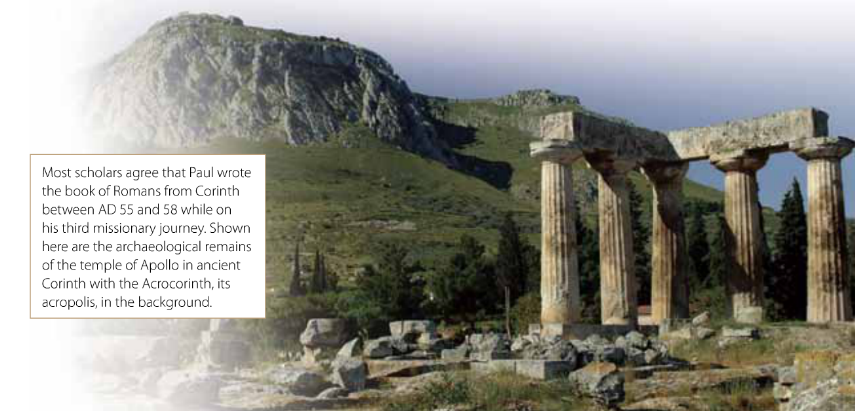
The full-color photographs throughout the text are of high quality, and help connect the reader visually to the ancient world.
From the commentary: Corinth, where Paul wrote Romans
There are also “Additional Insights” throughout the commentary, that more fully develop themes like “The Backgrounds of Christian Baptism,” “Faith and Law in Paul,” and others.
Pate’s 15-page introduction to Romans covers Paul’s world(s), letters, theology, composition, Romans in history, date and place of writing, recipients, theme, purpose, and genre. He writes:
Paul therefore writes Romans to defend his gospel of the grace of God through Christ by arguing that it is rooted in the Old Testament (Rom. 2-5), providing the disclaimer that it is not antinomian in ethic (God’s grace is not a license to sin [so Rom. 6-8]), and holding out a future for Israel (Rom. 9-11).
Not all will agree with Pate’s view of “Romans as Paul’s official doctrinal statement,” but, then again, many will. I was wishing the introduction had given more attention to Paul’s theme of a justification by faith that is decidedly pan-ethnic. Pate does talk about “the end-time conversion of the nations,” but there is also a sense in which Paul is interested in multiethnic justification (where all are saved by faith, whether Jew or Gentile) now. Fortunately the body of the commentary does address this theme in places (e.g., in Rom. 3:21-26–“So Paul’s point is that God offers justification equitably to all”).
From the commentary: map of the Roman Empire
Pate is able to interpret from multiple vantage points, synthesizing material across centuries that will benefit preachers in their sermon preparation. He moves from lexical analysis (Greek is transliterated) to 1st century historical background to practical theology in a fairly seamless manner. The illustrations are on point, too. He points out, for example, in Romans 13:13-14, that Augustine’s conversion story included meditation on these verses. The same unit includes an illustration involving Jean Valjean and Les Mis. Movie illustrations and hymn quotations are particularly present throughout, though preachers will also want to use their own, original illustrations, too.
The series claims to be “an essential commentary for pastors.” If and as pastoral budgets permit, I’d echo the sentiment and recommend this series as a worthy bookshelf addition.
More TTT volumes are on the way, including a posthumous Luke volume by the blessed R.T. France. Lord willing, as I continue to preach through Luke, I’ll review France’s volume in the future. A full-color pdf sample of Romans (including the introduction and first passage) is here.
Thanks to Baker Publishing for the review copy of Romans. Its Baker product page is here, and it is for sale at Amazon here.


 To explore a sample passage more in depth, France combines Luke 17:1-19 into one passage, on which he spends the requisite six pages. The decision to treat Luke 17:1-19 as a single passage limits how much he can offer, and occasionally the reader will experience the results of such space limitations in TTT. (This is part of the purpose of the series, though, and is perhaps just indicative of my desire for more France.) Luke 17:1-10 (itself consisting of “four separate units of teaching”) and 17:11-19 probably ought to be treated as two separate passages–the Revised Common Lectionary, among other places, does.















 Words on the Word