Logos Free Book of the Month for May

Screenshot 2014-05-01 21.12.34This month’s free book in Logos Bible Software is 300 Quotations for Preachers from the Puritans. It is free as a stand-alone, and also part of a larger series I reviewed about a year ago, 1,500 Quotations for Preachers.

Here’s the link to the free 300 quotations book. Richard Baxter, John Bunyan, Jonathan Edwards, John Owen, and a number of others are included.

There is also a short commentary on James (from Logos’s Pastorum Series) available for $0.99, here.

Death Has Been Swallowed Up in Victory

The resurrection

You don’t go to a tomb to rejoice. You don’t go to a graveyard, shortly after someone has been buried there, to celebrate.

And so, Matthew writes, “After the Sabbath, at dawn on the first day of the week, Mary Magdalene and the other Mary went to look at the tomb.”

They have come to pay their respects and to remember their now deceased teacher. They have come to mourn–expecting to find comfort, perhaps, in being together, but not expecting much more than that.

Then an angel pushes away the stone covering the tomb–we can think of the tomb as a sort of underground walk-in closet. And the guards are so scared, they shake and are petrified.

“Do not be afraid!” the angel has to say to the unsuspecting women. “Jesus is not here–he is risen!” Come, look, the angel says, “see the place where he lay.” “Go quickly and tell his disciples–He has risen from the dead!”

As they hurry off, their fast-beating hearts a jumble of joy and fear, they see Jesus. “Greetings,” he says, nonchalantly. (“Hey, what’s up?”)

They kneel down, grasp his feet, and worship him.

They had gone to his tomb to weep.
Instead, they went away laughing and rejoicing.

They had come early that morning to encounter the stark reality of death.
Instead, they found the glorious miracle of new life.

They had come to process an immense and unthinkable loss.
Instead, they met a living Jesus, the triumphant victor over death.

These women, and then, in turn, all of Jesus’ disciples from that day forward, would never see death the same way again.

Death Swallowed Up in Victory: Paul’s Reminder

Some years later Paul would remind his church of the “gospel,” the good news of Jesus.

The good news, he says, is “that Christ died for our sins according to the Scriptures, that he was buried, that he was raised on the third day according to the Scriptures….”

By this “gospel,” the good news of Jesus’ death and coming back from life to show himself again to his followers–by this “gospel,” Paul says, you are saved. You are delivered.

Where your life had been a prison,
you are freed.

Where you had once seen darkness,
now you see light.

Though you had come to a tomb, ready to mourn because of the end of things,
now you rejoice at a new beginning and fresh possibilities.

Where it had once been a long, hard, cold, relentless winter,
the spring of new life is finally here.

Because Jesus was raised on the third day, we will never see death the same way again.

“Death has been swallowed up in victory.” Paul speaks of a day when that will come true, when death itself is finally and forever dead.

But the way Paul is talking–it’s so certain a fate for death, for it to be completely vanquished and drowned in new life… it’s so certain that he’s saying it’s true, in a sense, right now.

Through the resurrection of Jesus, death and evil have already been defeated.

“Where, O death, is your victory?
Where, O death, is your sting?”

Christ’s resurrection proved that, when God is at work, “dead” isn’t really “dead.”

Feeling Defeated by Death

And yet, such an idea was the farthest thing from the minds of the disciples that weekend.

How long Good Friday to Easter Sunday must have felt that year!

When you lose a friend, a brother, a spouse, a parent, a child, someone you love… the day of your dear one’s death is painful. Agonizing. Unthinkable. Whether unexpected or expected, there’s always a quality of “this is not how it should be” when a loved one dies. So much still could have been… should have been.

Then there’s something about the second day that hurts even more. Maybe the initial shock is gone (though probably not really), and reality sets in a bit more. This death wasn’t a bad dream you woke up from. You’re still here, and your good friend, your valued family member is really gone.

I bet that second day–Saturday–was even more difficult for the disciples than the Friday when they watched Jesus die a criminal’s death.

Jesus was not just any loved one…he was, to his followers, a teacher and friend and humble servant, but he was also supposed to be their deliverer, their shepherd, their light, their life… NOT someone who just goes dying on them.

Was he not who they thought he was?

Was their promised deliverance, their offer of hope and a new life, just a farce?

Was Jesus just one among many other teachers claiming to be divine, but in reality, mortal like everyone else?

Jimmy Chitwood HoosiersOne of my favorite movies, and arguably the greatest sports movie of all time, is the movie Hoosiers. It’s based on the true story of a high school basketball team in rural Indiana who in 1954 won the state championship, beating much bigger and more established schools along the way.

And even though I know how it ends, I still watch it, probably at least once a year. “Did they win again?” I’ve often been asked after watching it for the umpteenth time.

It’s a little easier to watch through the suspense and nail-biting overtime games when I know the outcome. But for the characters in the movie, of course, the players and fans that the actors played, there was no guarantee of a good ending.

It’s hard for us to get at just what those women, characters in the story, must have been feeling as they went to the tomb. We know how this story ends. We know what (or, rather, who) is waiting for them at the tomb.

But they felt firmly wrapped in the grip of death, of disappointment, of shattered dreams, of hopes delayed or even demolished. Perhaps their trust had been severely misplaced, after all.

They’re blindsided when they see the angel, the empty tomb, and then… Jesus. That’s why Matthew says they are both filled with joy and scared out of their minds.

It’s not that they had weak faith, but Jesus was dead! Not just mostly dead, but dead dead.

Jesus had cheated death before by slipping through hostile crowds and, for all we know, dodging stones thrown his way, but this was not supposed to happen, or so his mourning disciples thought.

The Last Scene Was a Victory

Resurrection 2But a tomb was not the last scene in this story.

The apostle Peter would later preach to a crowd in Acts, “But God released him from the horrors of death and raised him back to life, for death could not keep him in its grip.”

Death did not have dominion, mastery, or the power of intimidation over Jesus. Once Jesus got a hold of death, it would never be the same.

Through his miraculous coming-back-to-life, Jesus showed that even death cannot stop him. Through Jesus’ resurrection, Paul says, “Death [was] swallowed up in victory.” As one preacher wryly (but accurately) said, “Jesus beat the hell out of sin and death.”

And so “dead” for Jesus didn’t really mean “dead.” It wasn’t the end. There was life on the other side of it.

We who follow the risen Jesus, then, do not need to be afraid. Though death is maybe one of the scariest, or most painful things that many of us can think of, the Christian’s death does not actually end in death. We, too, have been raised with Christ.

As one Christian martyr put it:

The fact that Jesus Christ died is more important than the fact that I will die. And the fact that Jesus Christ was raised from the dead is the sole ground of my hope that I, too, will be raised on the day of judgment. Our salvation is ‘from outside ourselves.’ I find salvation not in my life story, but only in the story of Jesus Christ. Only those who allow themselves to be found in Jesus Christ — in the incarnation, cross, and resurrection — are with God and God with them.

“Death has been swallowed up in” the victory of the life of Christ, a life in which we are invited to participate, a life which we can receive by believing in the risen Lord. As we see the living Jesus and hear his invitation to life, how else can we respond but to do what the two Marys did, and throw ourselves at him and praise him?

Death is cause for lament and mourning–you don’t go to a tomb to rejoice–yet just as death no longer has dominion over Jesus, it no longer shall have dominion over us.

Jesus’ resurrection means that death is no longer our intimidator, master, or schoolyard bully.

Evil loses, and death is dead.

Paul taunts death in the Corinthians passage, “Whatcha got, death? I’m alive with the resurrected Christ–how you like me now?”

Paul had to remind his church of the powerlessness of death, just like we need to remind ourselves, because it so often looks like death and sin and evil and inhumanity reign supreme in the world around us. Death and evil are still talking a big game.

But that’s all it is–it’s just talk.

Sin is no longer the undefeatable foe it might have once seemed to be. Evil is not inevitable. Death is not really the end.

We do not have to be afraid.

Through the victory of the resurrected Christ, the lifeless are made alive. Darkness becomes light.

Mourning turns to rejoicing.

Winter turns to spring.

The impossible becomes possible.

Dormant dreams can spring back to life again.

Good outcomes can result from bad things happening.

Because of Jesus’ decisive victory over the powers of evil and death,
even what looks like a cold and empty tomb
contains within it a glimmer of hope,
and the promise of new life.

The above is the sermon I preached on Easter Day 2014.

A Personal Reflection on Dietrich Bonhoeffer: What I’ve Found This Lent


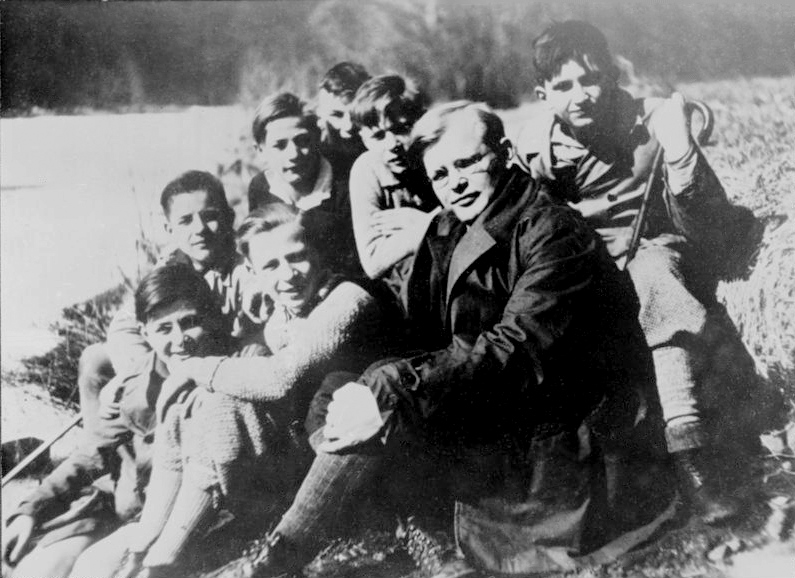
Bonhoeffer with Confirmands, 1932

I knew when I was preaching through the Sermon on the Mount recently that I would make good use of Dietrich Bonhoeffer’s Cost of Discipleship. I had no idea that a single question I asked would lead me–in my quest for an “answer”–so far into the life and writings of Bonhoeffer.

Of War and Peace: Which Bonhoeffer? (Revisited)

Russia invaded Ukraine in early March, just days after the Revised Common Lectionary reading was Matthew 5:38-48, which reads in part:

You have heard that it was said, ‘Eye for eye, and tooth for tooth.’ But I tell you, do not resist an evil person. If anyone slaps you on the right cheek, turn to them the other cheek also.

You have heard that it was said, ‘Love your neighbor and hate your enemy.’ But I tell you, love your enemies and pray for those who persecute you, that you may be children of your Father in heaven.

I wondered: does “turn the other cheek” apply just on an interpersonal level, or at a state level? I turned to Bonhoeffer, who rejected a privatized read of Jesus’ words. In 1937’s Discipleship he wrote:

The overcoming of others now occurs by allowing their evil to run its course. The evil does not find what it is seeking, namely, resistance and, therewith, new evil which will inflame it even more. Evil will become powerless when it finds no opposing object, no resistance, but, instead, is willingly borne and suffered….

Should Ukrainians (or other oppressed peoples) just let themselves be invaded (or oppressed)? I struggled with Bonhoeffer’s words:

There is no thinkable deed in which evil is so large and strong that it would require a different response from a Christian. The more terrible the evil, the more willing the disciple should be to suffer. Evil persons must be delivered to the hands of Jesus. Not I but Jesus must deal with them.

And yet in 1945 he was hanged for his involvement in a conspiracy to kill Hitler. This was not the “no opposing object” and “no resistance” that Bonhoeffer had talked about in Discipleship.

But maybe Bonhoeffer differentiated between evil done to him and evil done to others? Should the Christian be willing “to suffer” in the former instance but willing to act and resist on behalf of another in the latter instance?

As I asked these questions a month and a half ago, I found my own response to Matthew 5 and “turn the other cheek” to be more tension-filled than I would have liked.

Is There a Resolution to the Tension in Bonhoeffer? 

I had been hoping that further study of Bonhoeffer would help me to find some writing where he would essentially repudiate his non-violence stance in Discipleship, saying instead something like, “But when others are oppressed, take up force to eliminate evil, if necessary.”

Bonhoeffer never said any such thing. In fact, on July 21, 1944, the day after a bomb intended for Hitler failed to kill him, Bonhoeffer wrote from prison (about that 1937 book) to his good friend and biographer-to-be Eberhard Bethge:

Today I clearly see the dangers of that book, though I still stand by it.

He still stood by it. Did he mean he also stood by the line from that book, “Not I but Jesus must deal with them”? Was not his involvement in an effort to bomb Hitler a way of trying to deal with him? (Note: I’m not sure I fault Bonhoeffer either way.)

After a Lenten discipline of reading Bonhoeffer (and sections of his biographies) slowly and meditatively, I’m no closer to a resolution of such tensions than I was when I first discovered them. If anything, I’ve been encouraged to see other readers of Bonhoeffer wrestling with the same sorts of questions. This question of whether a ready-to-use-violence Bonhoeffer is consistent with the turn-the-other-cheek Bonhoeffer is, in fact, a fruitful question in Bonhoeffer studies.

What I’ve Found Instead

Tension in Bonhoeffer notwithstanding (and I’m actually coming to appreciate it), I’ve been deeply moved at nearly every turn as I’ve delved more deeply into the life and writings of an activist pastor.

I’ve found:

  • An inspired and passionate preacher, not afraid to tell the truth about life and about Jesus
  • A brilliant writer, already evident at age 19 and age 21
  • An eloquent catechist and Christian educator
  • A brave and gutsy man, who valued the life of others more than his own
  • A gifted poet with incisive awareness of the human condition

His preaching has encouraged mine. His deliberateness in pastoral care and visiting congregants has inspired me. I used one of his catechisms for our church membership class (his writing in that context was met with appreciation by all of us). His courage has bolstered mine, even if I don’t face the sort of trials that he did.

And, best of all, he has pointed away from himself and to the cross of Christ, so that my appreciation for Bonhoeffer doesn’t finally center on Bonhoeffer himself. Rather, through the writings of Dietrich Bonhoeffer–no doubt inhabited again by the Holy Spirit–I have come to see and know and love Jesus more deeply.

As Bonhoeffer says of the early disciples, listening to Jesus on the mountainside:

They have only him. Yes, and with him they have nothing in the world, nothing at all, but everything, everything with God.

Ukraine: Love Your Russian Occupiers? What Would Bonhoeffer Do?

You have heard that it was said, ‘Eye for eye, and tooth for tooth.’ But I tell you, do not resist an evil person. If anyone slaps you on the right cheek, turn to them the other cheek also. 

You have heard that it was said, ‘Love your neighbor and hate your enemy.’ But I tell you, love your enemies and pray for those who persecute you, that you may be children of your Father in heaven.

I find myself thoroughly challenged by Jesus’ words (Matthew 5:38-48). I hear in “love your enemies” a call to individuals. I am sure that at least that much is there. I know that “pray for those who persecute you” needs to shape our lives. When we pray for and seek the good of our adversaries–any with whom we have conflict–we inhabit a new and better Kingdom reality.

But is this portion of the Sermon on the Mount merely a private text, as Martin Luther and other interpreters have said? Is this call of Jesus just for the interpersonal domain?

Or–as a long line of Anabaptist thinkers and others are convinced–is it true that there really is no private vs. public distinction with Jesus? Jesus certainly doesn’t say in the Sermon on the Mount that loving enemies works differently at a corporate or national level. Many faithful Christians have inferred a difference, on various grounds, but it’s not explicitly stated, at least not in this text.

So Russia moves into Ukraine and today we hear Jesus say, “Don’t retaliate. Love your enemies.”

Turn the other cheek. Do not resist an evildoer. Pray for those who persecute you.

CREDIT:  REUTERS / Baz Ratner
CREDIT: REUTERS / Baz Ratner

How does a Ukrainian read this text today? There were presumably churches in Ukraine who heard Matthew 5:38-48 last week, when it was the Revised Common Lectionary reading. These words from the Sermon on the Mount are still ringing in their ears, even as the sound of Putin’s tanks and soldiers try to drown it out.

Dietrich Bonhoeffer, in his Cost of Discipleship, adamantly defended this Gospel text in its fullness: he said it did not apply on a merely private level, but that it also applied at the level of those who hold office (i.e., corporately), because people are people, in whatever capacity they are acting…. If it’s wrong to retaliate with force in an interpersonal reaction, it’s wrong at a state level, too, Bonhoeffer argued. In an era in which Hitler had already come to power, Bonhoeffer would write in 1937:

The overcoming of others now occurs by allowing their evil to run its course. The evil does not find what it is seeking, namely, resistance and, therewith, new evil which will inflame it even more. Evil will become powerless when it finds no opposing object, no resistance, but, instead, is willingly borne and suffered….

And that sounds so good. I cling to that hope.

But Hitler, finding no opposing object, and no resistance, not even from much of the church in Germany, continued his rise to power. Evil became not “powerless,” but more powerful.

Bonhoeffer goes on:

There is no thinkable deed in which evil is so large and strong that it would require a different response from a Christian. The more terrible the evil, the more willing the disciple should be to suffer. Evil persons must be delivered to the hands of Jesus. Not I but Jesus must deal with them.

Bonhoeffer
Which Bonhoeffer?

Critics were quick to call Bonhoeffer overly idealistic and impractical for this understanding of the Sermon on the Mount. But he was firm in his read of Jesus.

And then, something happened. Something happened in Bonhoeffer that led him to align himself with a group of folks who tried to overthrow Hitler, planning to use force if necessary. Bonhoeffer was arrested and imprisoned and implicated in a plot to kill Hitler. Bonhoeffer was hanged in 1945.

If we grant that “turn the other cheek” and “love your enemies” have to do with both individual and corporate domains, which Bonhoeffer was right? The one who wrote, “The more terrible the evil, the more willing the disciple should be to suffer. …. Not I but Jesus must deal with them”?

Or was it the Bonhoeffer who tried to make a plan to “deal with” Hitler in perhaps more physical ways?

Perhaps Bonhoeffer saw a distinction between evil done to him and evil done to another. You can turn your own cheek, but when it’s the cheek of another, and you see them being struck, it’s all you can do to run over and move (maybe even push?) the oppressor out of the way.

So I leave this text with questions and tensions. What seems a fairly straightforward statement, “Love your enemy,” is difficult. What does it mean to love enemies? In what spheres must that take place, and how should it happen, especially in the presence of an inordinately powerful evil? How categorical is Jesus in his forbidding of force? Was he speaking to disciples, or to disciples and states?

But even with the questions, there are two places I find myself landing. First, the one purpose statement in this passage is this: “But I tell you, love your enemies and pray for those who persecute you, that you may be children of your Father in heaven.”

That you may win them over? Hopefully, but not necessarily. “Love your enemies and pray for those who persecute you,” so that they might be converted and join the Kingdom of Heaven, turning from their ways of oppression? Yeah, that would be awesome, but it’s not always going to happen. “Love your enemies and pray for those who persecute you,” for by so doing, you are called children of your Father in heaven. “Blessed are the peacemakers, for they shall be called the children of God.” They are children who do the things they see their God doing.

Which brings me to my second landing point, amid the questions I still have of this passage. Jesus, Philippians says,

made himself nothing
by taking the very nature of a servant,
being made in human likeness.
And being found in appearance as a man,
he humbled himself
by becoming obedient to death—
even death on a cross!

In the end, Jesus submitted himself to death. He humbled himself in the ultimate manifestation of turning the other cheek: “by becoming obedient to death–even death on a cross!”

And yet in that defeat was the very stuff of victory.

In that death was the very stuff of life.

In that humbling was the very stuff of exaltation.

Philippians goes on:

Therefore God exalted him to the highest place
and gave him the name that is above every name,
that at the name of Jesus every knee should bow,
in heaven and on earth and under the earth,
and every tongue acknowledge that Jesus Christ is Lord,
to the glory of God the Father.

He knew full well what he was doing–he was going to that cross to die. He was accepting the unjust death penalty–even the torture–that had been set upon him. But he was also going to that cross to win. He was going to the cross to defeat death and evil. In the end he would rise again.

The Son of God endured suffering, and yet scorned its shame, unmasking the evil powers that put him on the cross, and razing them to the ground. Through death, through the cross, he made an offer of peace to even his enemies (including us!) so that we could love our enemies, too.

Jesus’ resistance to death was not violent, but neither was it passive. It was sure, deliberate, subversive, generous to all, and full of love, even to enemies.

There is power in Jesus’ going to the cross. It is the ultimate act of cheek-turning, self-giving love. The cross of Christ is an act of defiance that says:

No, suffering!
You cannot warp me into a person I don’t want to be.

No, violence!
You cannot seduce me to kill.

No, evil!
You do not have the last word.

The above is adapted from the sermon I preached on Matthew 5:38-48 yesterday. Scripture quotations come from the NIV (1984 or 2011) or TNIV.

New OT Commentary Series: Hearing the Message of Scripture

HMS Obadiah by BlockZondervan has just published the first two volumes of a new Old Testament commentary series, Hearing the Message of Scripture. Here’s part of a brief description of its approach:

[W]hen dealing with specific texts, the authors of the commentaries in this series are concerned with three principal questions:

  1. What are the principal theological points the biblical writers are making?
  2. How do biblical writers make those points?
  3. What significance does the message of the present text have for understanding the message of the biblical book within which it is embedded and the message of the Scriptures as a whole?

The achievement of these goals requires careful attention to the way ideas are expressed in the OT, including the selection and arrangement of materials and the syntactical shaping of the text.

Zondervan introduces the series more fully here, with a listing of contributors here. Or, if you prefer a video introduction, here is Series Editor Daniel I. Block on the series:

You can see PDF samples from Obadiah (by Daniel I. Block) here and from Jonah (by Kevin J. Youngblood) here. Zondervan’s book pages for each title are here and here. I’ve read half of the Obadiah volume so far and will post a review shortly.

Matthew and Jesus: Fulfill, fulfill, fulfill, fulfill

Baptism of Christ, Francesco Albani

One of the most important things anyone has ever said about Scripture is:

Do not think that I have come to abolish the Law or the Prophets; I have not come to abolish them but to fulfill them.

–Jesus in Matthew 5:17

The careful reader of Matthew will hear “fulfill” in 5:17 and recall at least some of its previous uses already in the book.

Fulfillment is one of Matthew’s major themes. Calling the other uses of “fulfill” to mind gives Jesus’ claim even more impact.

Having established that Jesus’ birth was “to fulfill what was written…,” Matthew shows John baptizing an adult Jesus “to fulfill all righteousness.” Early in Jesus’ ministry, Matthew shows Jesus as the fulfilling light that the people walking in darkness have been waiting for.

Here is a one-page pdf listing the instances of fulfillment in the birth and early ministry of Jesus in Matthew 1-4.

With so much of his life a fulfillment of the Scriptures already, Matthew’s reader is now prepared to see how Jesus fulfills all of Scripture–down to the last letter–through his read and interpretation of it. In the rest of Matthew 5, Jesus will unpack just what he means by “fulfill [the Scriptures],” using six specific biblical examples, culminating at last in a call to the disciples to “be perfect.”

What is the Good Life? Jesus’ Take

Shane Claiborne is an author and activist who helped found The Simple Way, an intentional Christian community in Philadelphia. He loves Jesus and loves the poor, and has given his life on their behalf.

Shane Claiborne
Shane Claiborne

Shane was lined up to speak at a youth worker’s national conference once, and to the surprise of the crowd and the organizers, when his keynote came, he stood up, read the Sermon on the Mount, and then sat down. His “talk” was done–a reading of Jesus’ sermon in Matthew 5-7.

When interviewed about it later, Claiborne said that as much as he loves that particular conference, the amount of noise and clutter and “Christian stuff” of that conference led him to the simplicity of the words of Jesus. He wanted to read them and let them stand on their own.  Continue reading “What is the Good Life? Jesus’ Take”

A Paradox I Encountered During my Sunday School and Sermon Prep

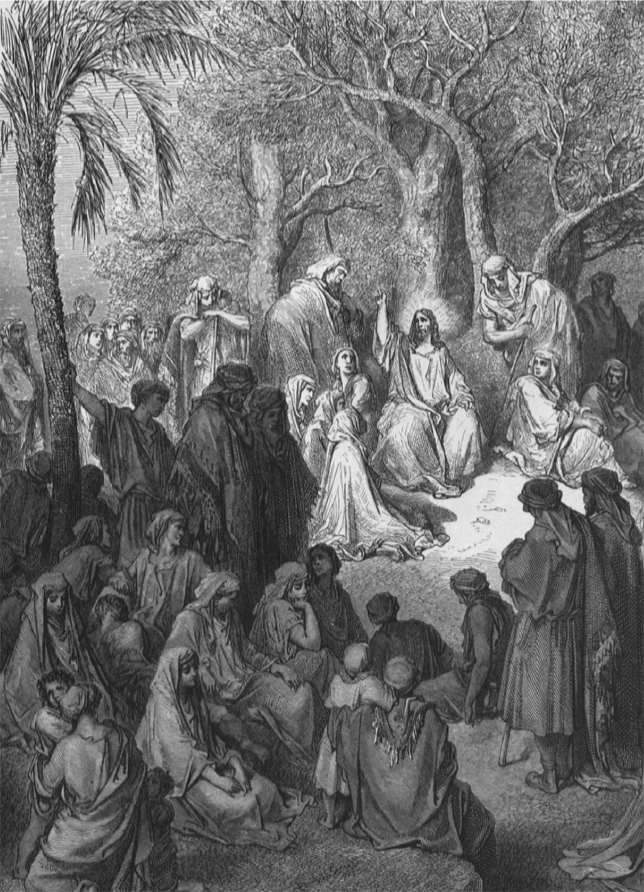
The Sermon on the Mount, by Gustave Doré (1832–1883.
The Sermon on the Mount, by Gustave Doré (1832–1883)

Annie Dillard (whom we are reading for this Sunday’s Sunday School class) writes:

I cannot cause light; the most I can do is try to put myself in the path of its beam.

And yet Jesus confidently tells his disciples (before they’ve even done much of anything): 

You are the light of the world. …Let your light shine before others, that they may see your good deeds and praise your Father in heaven.

Those lines of Jesus are from the Sermon on the Mount, on which I’m preaching. Holding those two ideas about light in juxtaposition has made for interesting preparation for this Sunday! On the face of it, they seem to contradict, but I don’t think they really do…. I’ll try to post more here next week, as I continue to work it out.

Before you preach a book of the Bible…

Preaching the NT

Some good advice here: before you preach a book of the Bible, try to live “inside” it first.

In line with the way one ought to prepare to preach any book of the Bible, the preacher needs to live inside a Gospel for a while before trying to preach any part of it. Reading it through at a single setting, several times, is a great way to begin; for those who have the training, working carefully through the text in Greek during preceding months will prove personally rewarding and homiletically enriching.

–D.A. Carson, “Preaching the Gospels,” in Preaching the New Testament (IVP Academic, 2013)

So far the above collection of essays is well-written and helpful. I’ll post more about it in the coming weeks and months.

Teach the Text: Luke by R.T. France

R.T. France
R.T. France

I’ve always had a hard time answering who my “favorite author” was (how could I pick just one?), but when it comes to people who have written about the Bible, R.T. France is definitely in the top three. I found myself moved to tears several times when reading through his highly technical (read: supposed to be dry) commentary on Mark.

So I was thrilled when I learned that Baker’s Teach the Text Commentary Series (TTT) had R.T. France as the author of its Luke volume. France died in February 2012, so to have this posthumous work of his is a real treat–especially since he already has a major commentary on Matthew and one on Mark. This rounds out France’s writing on the Synoptic Gospels.

So far the TTT series is a strong entry into the already highly populated world of commentaries. I reviewed the Romans volume here. Baker has a fantastic series Website here with plenty of information, videos, and samples from the series.

How France Teaches Luke

France divides the 24 chapters of Luke into 65 text units (or passages), each of which receives six pages of commentary. It breaks down in this way: 

“Big Idea” at the beginning of each commentary passage.This is a short Tweet-length summary of the passage. For example, the Big Idea for Luke 1:57-80 (“The Birth of John”) is: “Both the extraordinary circumstances of his birth and his father’s inspired utterance testify to John’s pivotal role in the plan of salvation.”

A “Key Themes” sidebar. This is a set of bullet points that gives the highlights of each passage.

“Understanding the Text.” Here France offers:

  • The Text in Context (one of his real gifts is a sense of always knowing the larger literary context, and reminding the reader of it)
  • Outline/Structure
  • Historical and Cultural Background
  • Verse-by-verse Interpretive Insights
  • Theological Insights

France is especially adept in the Theological Insights section. He is reliable, creative, and faithful to the text. His experience as both scholar and pastor seems to have helped here.

“Teaching the Text.” France offers specific suggestions for how the preacher might approach the sermon on each text.

“Illustrating the Text.” Whether it’s a personal story, someone else’s anecdote, history, literature, film, or art, France gives ideas for how the preacher or teacher can illustrate the message.

France’s introduction to Luke is a mere seven pages (which includes commentary on Luke 1:1-4), but his awareness of literary and biblical context throughout the book offers what one might otherwise miss by way of introductory matters.

How France Treats a Passage (Luke 17:1-19)

Luke by FranceTo explore a sample passage more in depth, France combines Luke 17:1-19 into one passage, on which he spends the requisite six pages. The decision to treat Luke 17:1-19 as a single passage limits how much he can offer, and occasionally the reader will experience the results of such space limitations in TTT. (This is part of the purpose of the series, though, and is perhaps just indicative of my desire for more France.) Luke 17:1-10 (itself consisting of “four separate units of teaching”) and 17:11-19 probably ought to be treated as two separate passages–the Revised Common Lectionary, among other places, does.

His “Big Idea” in this section (“True discipleship cannot be undertaken causally; the service of God demands all that we can bring to it”) is more relevant to vv. 1-10 than it is to vv. 11-19.  (By contrast, this similarly-targeted Luke commentary has, “Faith recognizes Jesus as the source of healing and expresses itself in gratitude and praise to him,” for vv. 11-19.)

Even so, France has this good insight to offer on verse 19:

This formula [‘your faith has made you well’] is often a ‘performative utterance,’ but not here, since the cure of the ten has already taken place, all of them presumably through similar ‘faith.’ But this man’s overt praise of God is evidence of a spiritual health that Jews would not expect to find in a Samaritan.

And his “Teaching the Text” portion does suggest ways to preach from vv. 1-10 and vv. 11-19 as separate passages. On the latter he writes:

France on Luke 17_1France on Luke 17_2

In “Illustrating the Text” France moves between a 1962 film (Days of Wine and Roses, about leading another into alcoholism), a personal anecdote on forgiveness by Cardinal Bernardin, and a quotation by author Lewis B. Smedes on gratitude and happiness.

As with the Romans Teach the Text volume, the illustrations throughout help the reader better envision what’s going on in the biblical text. Here’s a portion from the passage that describes Zacchaeus’s encounter with Jesus:

Zacchaeus's Sycamore Tree
Zacchaeus’s Sycamore Tree

An added bonus is the high quality of the book materials. The hardcover looks pretty indestructible, the binding is sewn, and the pages are thick and glossy (but not too glossy to accept notes from a writing utensil). The full-color pages throughout are a nice touch, too. Translation: this commentary will make it through multiple series and preaching cycles on Luke. I’ve even been able to use it recently as I preach through Matthew, consulting the parallel passages here.

There are already five TTT volumes available, with more on the way. If the quality of this series continue to match that of France and Pate (Romans), I’ll want to keep consulting this series, and other preachers and teachers will want to, as well.

Thanks to Baker Publishing for the review copy of Luke. Its Baker product page is here, and it is for sale at Amazon here.