A Short Note on God’s First Greek Words

The Greek of Genesis 1:3 reads,

καὶ εἶπεν ὁ θεός Γενηθήτω φῶς. καὶ ἐγένετο φῶς.

In English it reads, “And God said, ‘Let there be light.’ And there was light.”

The Septuagint straightforwardly translates the Hebrew, which is:

ויאמר אלהים יהי אור ויהי־אור

The Greek καὶ is versatile. The first καὶ in Genesis 1:3 is connected to what precedes it in 1:2 (darkness over the deep), but not necessarily inextricably so. In other words, one could leave it untranslated when going into English, with 1:3 beginning just, “God said….” The second  καὶ in 1:3, however, seems to be more closely related to what precedes it. “And there was light” follows immediately upon God’s calling for light. God said it, and it happened.

Susan Brayford, in her LXX Genesis commentary (Septuagint Commentary Series, Brill) writes:

God’s first words bring light into being in order to counter the darkness that was over the earth. In the first words attributed to God, LXX-G establishes a formulaic speech pattern that continues throughout the chapter, namely, a verb in the third person imperative (let x be), followed by ‘and,’ and concludes with a verb in the aorist (and x was). The pattern, similar to that in the MT noticed by Westermann and others, not only represents God as an orderly creator, but more importantly, as a powerful creator whose very words accomplish actions.

Dietrich Bonhoeffer has much to say about this in his Creation and Fall lectures on Genesis 1-3. On Tuesday I’ll post about his take on the link between God’s speech and the resulting creation.

Grammar of Septuagint Greek

Grammar of Septuagint Greek

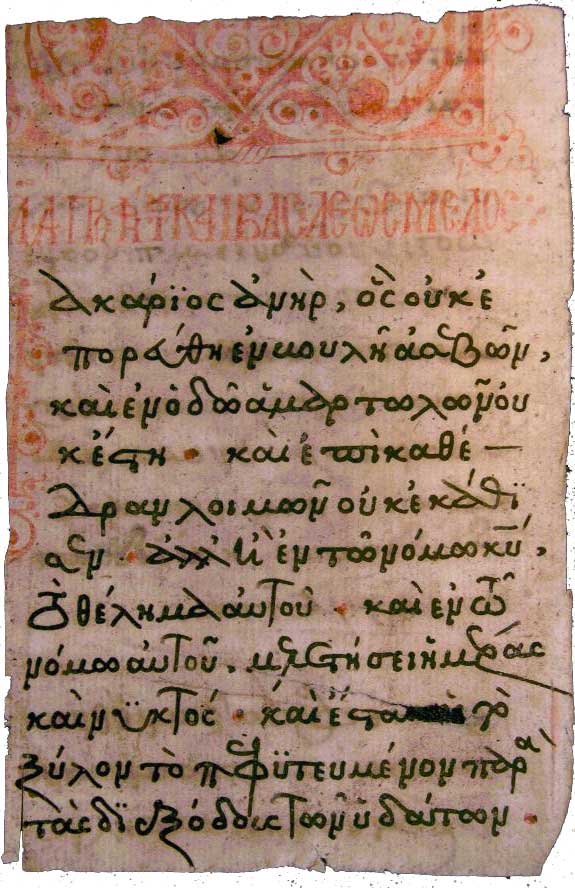
A book that I desire to delve into more deeply is Conybeare and Stock’s Grammar of Septuagint Greek. The grammar itself is short, and still leaves to be desired a fuller grammar of Septuagint Greek. But the selected readings have Septuagint text with reading helps at the bottom of each page, and make for a nice bridge into reading Old Testament Greek. The readings section looks like this (click to enlarge):

From the reading on Joseph

You can access the whole book for free (and legally) here. The format there is a little unwieldy, so you might also consider checking it out in print (affiliate link).

The grammar is pretty dense, and feels sparse in places, but I haven’t had a chance to examine the book thoroughly yet. The selected readings have helped me in improving my Greek, though. It’s recommended reading on this Septuagint Sunday.


Septuagint Studies Soirée #7: Mostly Just Links Edition

LXX decal

Welcome to the Septuagint Studies Soirée #7, covering February in the Septuagintablogosphere.

There is now a Septuagint podcast. Check it out here.

Via Jim West: There will be a Historical and Theological Lexicon of the Septuagint (HTLS), which you can read more about here and here. You can even read a sample article (pdf)!

Do you want to contribute to a Septuagint Dictionary? Then check this one out.

This is a review of the Joshua volume of the Septuagint Commentary Series (Brill).

Here’s Lawrence Shiffman on Isaiah and the Greek Septuagint.

Brian Davidson posted a rockin’ interview with the editors of the Lexham English Septuagint.

It’s the International Septuaginta Summer School 2014. It sounds incredible, and it’s on Greek Isaiah. If you have a benefactor, go (and then introduce him or her to me, and I’ll meet you there).

Into prizes? Submit an LXX paper here for a prize of $350.

UPDATE 3/3/14: Wayne Coppins writes about Dietrich-Alex Koch’s analysis of Paul’s use of the Septuagint.

Finally, here and here you can find more interaction with T. Michael Law’s When God Spoke Greek.

Did I miss anything? Feel free to leave more February 2014 LXX links of interest in the comments.

Happy International Septuagint Day!

International Septuagint Day

Happy International Septuagint Day! 

Read some Septuagint today, if you can, in Greek or English. Here’s why I think you need the Septuagint. And here are some more “rarely cited reasons” why the LXX is important, given by James Aitken and noted on Jim West’s blog.

goettingen septuagintOne good monograph to read on the Septuagint is First Bible of the Church. And if you want to get in-depth with the critical edition of the LXX, I have offered reviews of the Göttingen Septuagint in Logos and Accordance softwares. And, perhaps as important, I suggest how one might actually make sense of that critical edition, noted here and here, with an ever-elusive third part of the primer still to come.

But right now, I’m going to go play outside in the snow with my kids. Happy LXX Day!

How Jesus Used the Bible

Jesus and Scripure by MoyiseI still wonder what language(s) Jesus spoke. I know, I know. Easy: Aramaic…right? And possibly also Hebrew when he quotes Scripture?

I’m becoming increasingly open to the idea, however, that Jesus–at least on occasion–taught in Greek. At any rate, it is true that the Gospel writers that quote Jesus do so in Greek. There is also the fascinating question of what text form(s) Jesus used when he quoted Scripture, which he did frequently.

Last week I finished reading Steve Moyise’s Jesus and Scripture: Studying the New Testament Use of the Old Testament. It’s part of his de facto trilogy by Baker Academic on the New Testament’s use of the Old Testament. (I reviewed the other two volumes here and here.)

How Moyise Approaches Jesus’ Use of Scripture

As Moyise sees it, the task of studying Jesus’ use of Scripture is two-fold:

First, we must study what each Gospel writer has to say about Jesus’ use of Scripture and seek to determine his method and purpose.

To do this, Moyise briefly (yet substantively) surveys how each Gospel writer presents Jesus’ use of Scripture. For each of Mark, Matthew, and Luke, Moyise analyzes Jesus’ quotations of “the law,” “the prophets,” and “the writings.” For John he treats “the four explicit quotations” and scriptural allusions.

Moyise goes on:

Second, if we are to understand Jesus’ use of Scripture we must engage in historical criticism to decide what Jesus must have said to give rise to the various accounts we find in the Gospels.

To this end Moyise looks at three categories of scholars:

  1. Those with “minimalist views” on Jesus and history: Geza Vermes, John Dominic Crossan, and Marcus Borg. They more or less “do not regard Mark as an accurate record of what Jesus said and did, which has implications for the accuracy of Matthew and Luke.”
  2. Those with “moderate views”: James Dunn and Tom (N.T.) Wright. The moderate view “accepts that real events lie behind the Gospel stories but believes that they have been embellished as each Gospel writer adapts the tradition to meet his readers’ needs.”
  3. Those with “maximalist views”: Charles Kimball and Richard (R.T.) France.” Jesus must have said all of the sayings and … each Gospel has been selective in what it records. …its strategy for dealing with differences between the Gospels is to seek harmony.”

Moyise lays out the issues in the synoptic Gospels and John clearly and succinctly. He raises as many questions as he answers, but this is a good thing. Reading Jesus and Scripture made we want to delve deeper into the topic at hand.

An Evaluation

While the volume is accessible, it does not oversimplify complexities where they exist. For example, after saying that Jesus’ Aramaic sayings “were translated into Greek, including his quotations from Scripture,” Moyise highlights the existence already of a Greek translation of the Hebrew Bible (the LXX). He goes on:

The important question this raises is whether, when the translators recognized that Jesus was quoting Scripture, they translated his words for themselves or availed themselves of the translation already in circulation.

Gray shaded boxes throughout the book offer concise information about topics such as: “The text of the LXX known to Matthew,” “Hillel’s seven exegetical rules,” “Critical editions of Q,” and more.

Especially helpful for further study is Appendix 1: “Index of Jesus’ quotations in the Gospels,” which is listed in Old Testament book order. The select bibliography is short but a good starting point, too.

Of the three “views” he describes, Moyise writes about helping “readers decide for themselves which reconstruction they find the most convincing.” He excels here–phrases like “many scholars believe” are coupled with a fair spelling out of others’ views of Jesus and what he said. His even-handedness helps readers get the lay of the land in Jesus studies.

Phrases like “what Jesus actually said” got to be a bit tiresome to me after a while. Perhaps my maximalism shows through here, but I’m just not sure how productive or advisable a quest it is to try to ascertain what Jesus really said. (And if we did, wouldn’t we have to go back to retroverted Aramaic?) This is in part due to Moyise’s own “moderate views,” but he certainly does not push for them over France’s “maximalist views,” for example, which he describes charitably and even favorably. The reader can decide for herself or himself.

Jesus and Scripture would be perfect for a seminary course on the Gospels, or on the NT use of the OT. An advanced undergrad course would also do well to adopt this book. I’d also recommend it to a serious Bible reader–no biblical languages are needed here, and I found that even with my own knowledge gaps in historical Jesus studies, Moyise explained everything I needed to know.

Though this survey is short (less than 150 pages), Moyise gives plenty of sample passages and insights that have challenged me. I know this is a book I will come back to and want to read again in the future.

Thank you to Baker Academic for providing me with a review copy of the book. See its product page at Baker here. You can find it on Amazon here.

Septuagint Studies Soirée #6, and this Saturday

It’s a day late (I blame the groundhog), but not a dollar short: Here’s the blogosphere’s only Septuagint Studies Soirée… this one is #6.

Some Important Dates

Add it to your iCal
Add it to your iCal

First things first: This Saturday (February 8) is International Septuagint Day. Read some Septuagint that day, if you can, in Greek or English. Why not read Tobit? Here’s why I think you need the Septuagint.

Looking back, Jim West celebrates Mogens Müller’s January 25 birthday, he (the latter) of First Bible of the Church renown.

Coming up, James Aitken (via FB) notes the following:

THE GRINFIELD LECTURES ON THE SEPTUAGINT 2013-14, University of Oxford

NICHOLAS DE LANGE
Emeritus Professor of Hebrew and Jewish Studies, Cambridge

‘Japheth in the Tents of Shem: Greek Bible translations in Medieval Judaism’

(First series)
Hilary Term 2014 (6th Week)

Monday 24 Feb.: ‘New light on an old question’
Venue: Examination Schools at 5.00 pm
Members of the public are welcome to attend

Tuesday 25 Feb.: ‘Aquila fragments from the Genizah’
Venue: Seminar in Jewish Studies in the Greco- Roman Period, Oriental Institute, 2.30 – 4.00 pm

Thursday 27 Feb.: ‘The Successors of Aquila’
Venue: Ioannou Centre, 5.00pm – 6.00 pm

And T. Michael Law notes an upcoming symposium on Isaiah and the Beginnings of Christian Theology.

God is Still Speaking (Greek)

TML book

Didn’t get enough reviews of T. Michael Law’s When God Spoke Greek? Mosissimus Mose announces a review of the book in dialogic form. The first part is here, featuring Aaron White, W. Edward Glenny, and Christopher Fresch. They promise more dialogue in the future.

Law’s book made Michael F. Bird’s Top 5 for 2013.

More LXX Love on the Blogs

Suzanne at BLT has been writing about childshippe. I haven’t been able to fully digest it all, but given the preponderance of the word “son”/υἱός in the New Testament, I want to spend more time thinking through why so many translations opt for “son” when both male and female “children” seem to be in view. She writes more here and here.

Jim promises a review of de Gruyter’s Die Göttinger Septuaginta. And check out the Dust blog for a post called, “How much we take for granted, the publishing process and the Septuagint,” here.

Also, it wasn’t updated in January, but I just found out about what looks like a good LXX-related blog.

Did I miss anything? Feel free to leave more January 2014 LXX links of interest in the comments. And Happy (almost) International Septuagint Day!

A $5 Electronic Septuagint (and other sundry items)

Olive Tree logo

Olive Tree is offering a three-day sale on 200+ items. Among them is a $4.99 New English Translation of the Septuagint (NETS). Lots of commentary series and sets are deeply discounted, some half off. The Archaeological Study Bible notes (with full color images) are $9.99.

You can find more details here.

If you’re curious about Olive Tree or have never used it, find my reviews here.

Septuagint Studies Soirée #5

LXX Psalm 1
LXX Psalm 1

It’s the first day of a new month (and new year), which means that the Septuagint Studies Soirée has arrived. Here is a collection of what the LXX-blogosphere had to offer in December 2013.

Old School Script has an interesting post (with some good questions to think about) regarding lexicography and instincts. (E.g., “How much do we trust our (next-to-nothing?) intuitive powers?”)

J.K. Gayle asks the provocative question, “Was David a virgin when his soul was pregnant?” to “bring some attention to the way in Bible reading and translation we highlight gender and sex and motherliness so dogmatically.” Gayle seems to “know” a bit about the Bible’s “sex verbs,” as he discusses ἐγίνωσκεν in Matthew 1 here. One other post of his worth reading (all his posts are worth reading) says, “The Greek / Hebrew names here for the baby Jesus are rather political in contrast to the Empire of Alexander and the Empire of the Caesar.”

T. Michael Law’s book about the Septuagint made #2 on Near Emmaus’s year-end books list.

Though it wasn’t on a blog, per se, James K. Aitken posted a chapter on LXX neologisms (thanks, Jim, for the tip). He writes, “There is a need for more descriptors of so-called new words, identifying them as semantic extensions, unattested compounds, morphological extensions, foreign loans, and so on.” One other non-blog, LXX-related url, if you want a daily LXX fix via the Twitter, is here.

Brian Davidson at LXXI made a couple of short videos about using Logos for a sort of MT-LXX Two-way Index.

Speaking of Brian, he’s taking over Greek Isaiah in a Year (which just finished) and leading a group through Isaiah again in 2014! Join them here.

Did I miss anything? As prevalent as women are in Septuagint studies, I didn’t find any LXX blog posts by women in December, but I might have missed one! Feel free to leave more December 2013 LXX links of interest in the comments. And in case you didn’t see it, the first Septuagint Studies Soirée is here; the second one is here; the third one is here; the fourth one is here.

Greek Isaiah is… back?

The first few verses

On November 30 the group Greek Isaiah in a Year read the last verses of Isaiah 66. And what a rewarding experience it was to read slowly–over the course of a (church) calendar year–through Isaiah.

Blogger Brian Davidson wants to do it again. I’m going to be following the Facebook group (here, where all the action will be), but am not sure I can do the whole thing again in a year. We’ll see.

But if you started last time and didn’t finish, or are looking for a way to sharpen your Greek this coming calendar year, check it out.