They That Go Down to the Sea in Ships

Joy vs. Facts, Sleeping in a Storm

 
One place I like to go, from time to time, to rouse my spirits and draw me closer to the heart of God is Wendell Berry’s Manifesto: The Mad Farmer Liberation Front.

I’ve been chewing on one line in particular the last part of this week: “Be joyful though you have considered all the facts.”

Berry’s words are good for us to hear right now, because “all the facts” include the reality of living in a country with a deeply ingrained racism habit that we just can’t seem to kick. The Deacons and I were praying Wednesday night in the back of our sanctuary, right about the same time another group of believers was praying in a Charleston, South Carolina church…. People of color in this country continue to suffer at the hands of racist persons and racist systems that perpetuate their mistreatment.

But, Berry says, “Be joyful though you have considered all the facts.”

If Wendell Berry were narrating Jesus’ state of mind in Mark 4:35-41, he would have said, “Jesus relaxed and took a nap, though he had considered all the facts.”

The disciples are thinking, “Oooh, nice—we’re going to go out in a boat with Jesus into this serene lake:”
 

Sea of Galilee


Whereas Jesus probably knows that this was in the offing:
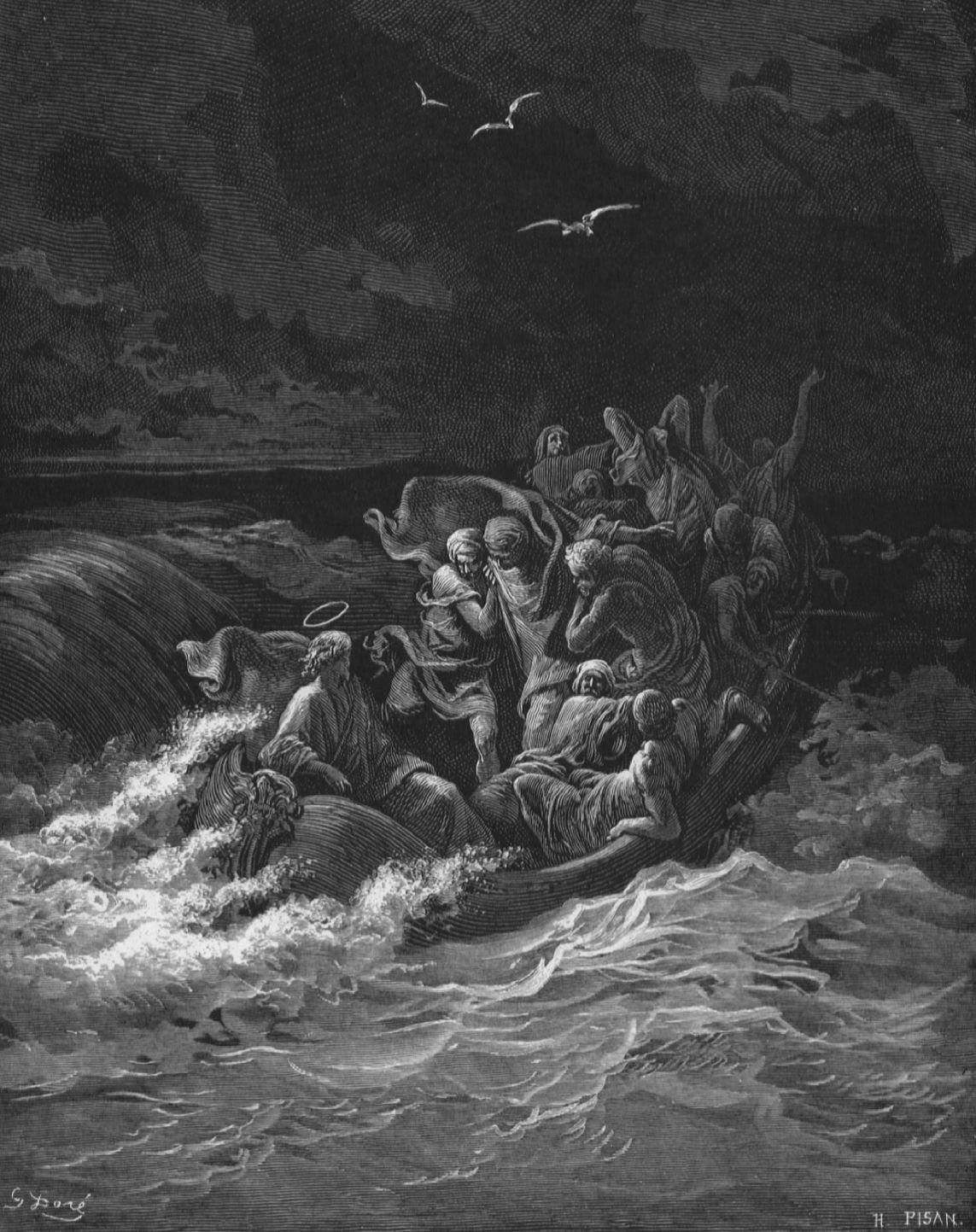
 

Jesus Calms the Storm, Gustave Doré


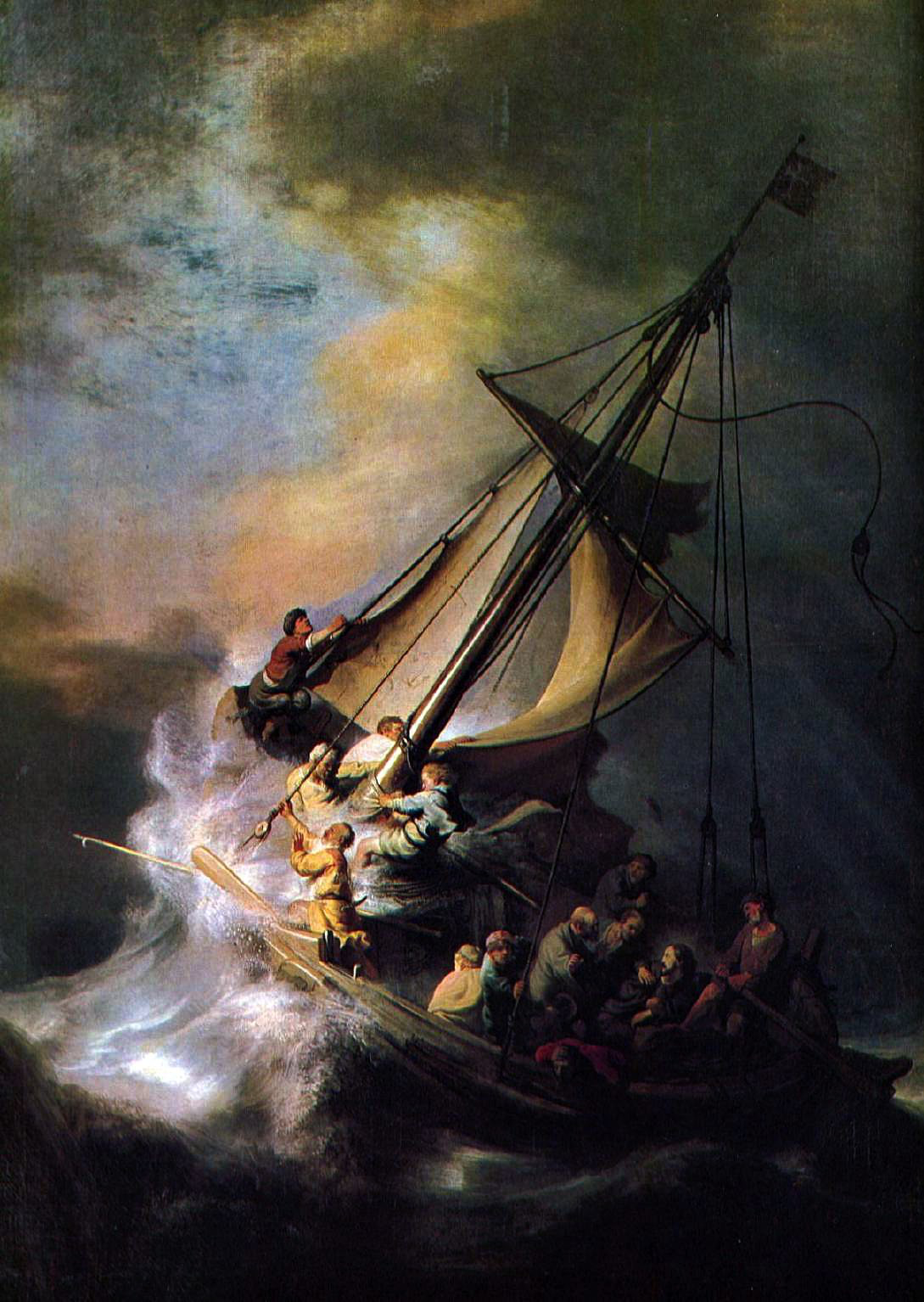
Here’s Rembrandt’s rendition of it:


The Storm on the Sea of Galiee


And yet Jesus “lies down and sleeps in peace,” as the Psalm says.


A Furious Squall…


Mark 4:35 says, “That day when evening came, [Jesus] said to his disciples, ‘Let us go over to the other side.’” From what I can tell, evening can be a good time to catch fish, but to traverse a lake…? When you’re out camping and sunset comes, you try to set up camp, not embark on a new leg of your expedition.

But God’s ways are not our ways, and Jesus’ ways are not the disciples’ ways, so off they go. Verse 36 says, “Leaving the crowd behind, they took him along, just as he was, in the boat. There were also other boats with him.”

“Just as he was”—it’s like when you’ve made a spontaneous decision to pick up a friend and go out for coffee, and you are in a hurry and you say, “Just come like that, just come how you are. Atomic Cafe doesn’t care if you wear your pajama pants and fleece-lined Crocs. Get in the car.”

Jesus and the disciples just went.

Next verse, verse 37: “A furious squall came up, and the waves broke over the boat, so that it was nearly swamped.”

I love this genius storytelling of Mark. If you’re reading or listening to this story, you don’t know yet where Jesus is. “A furious squall came up, and the waves broke over the boat, so that it was nearly swamped.” And then, you expect, verse 38 will say, “And Jesus, with power and authority, stood up and made the waves stand still.”

But, no, verse 38 says, “Jesus was in the stern, sleeping on a cushion.” He needed his introvert time. He found a pillow, or a big sandbag, and put his head on it.

The disciples take this as apathy, some kind of a cruel joke.

If the boat is nearly swamped, and Jesus is still sleeping, he must not be wet yet. It’s possible the stern was raised. The boat could have looked something like this:


Raised Stern


Which probably makes the disciples all the more upset. You wonder… if Jesus knew this storm was coming, is that why he was at the stern, elevated above the rest of the boat? And if so, the reader of this text wonders, why didn’t he quell the storm before it started? Or give the disciples a heads-up? Mark doesn’t tell us.

But his students ask, “Teacher, don’t you care if we down?”

The specific wording Mark uses in the text suggests that the boat was filled “to the extent of its capacity” (HT).

And doesn’t this imagery of a flooding boat go against the axiom that “God won’t give you more than you can handle?” Maybe it’s more like, “Sometimes we get more than we can handle, and God’s not necessarily the one who gave it to us, but he’ll be right by our side anyway.”


…And an Omnipotent God


If Mark’s given us the full humanity of Jesus—he was sleeping on a cushion—now we see his full divinity. Verse 39 says, “He got up, rebuked the wind and said to the waves, ‘Quiet! Be still!’ Then the wind died down and it was completely calm.”

“Who is this?” the disciples ask. “Even the wind and the waves obey him!”

The text says it goes from a “great” windstorm to a “great” calm.

Jesus talks directly to the wind and the waves. Can you think of another person in biblical history who talked to the waves and the sea, and told them to do something?

Jesus, they are starting to see, is more than just an amazing teacher. Listen to how God questioned Job:

Who shut up the sea behind doors
when it burst forth from the womb,
when I made the clouds its garment
and wrapped it in thick darkness,
when I fixed limits for it
and set its doors and bars in place,
when I said, ‘This far you may come and no farther;
here is where your proud waves halt’?

I don’t know if the disciples, in that moment of fear, would have had Job in mind, but the kind of thing Jesus is doing in this passage is the kind of thing that only the LORD God Almighty does.

Here he is. God himself, in the boat with the disciples.

Psalm 107 says, “He stilled the storm to a whisper; the waves of the sea were hushed.”
 

But They That Go Down to the Sea in Ships…


I wonder if Jesus had this Psalm in mind as he went out into the Sea of Galilee with his disciples. Maybe he thought, “Alright—it’s Psalm 107 time. Let me show these young ‘uns what I can do.”

Listen to part of Psalm 107 in the King James Version:

They that go down to the sea in ships,
that do business in great waters;
These see the works of the LORD, and his wonders in the deep.
For he commandeth, and raiseth the stormy wind,
which lifteth up the waves thereof.
They mount up to the heaven,
they go down again to the depths: their soul is melted
because of trouble.
They reel to and fro, and stagger like a drunken man,
and are at their wits’ end.
Then they cry unto the LORD in their trouble,
and he bringeth them out of their distresses.
He maketh the storm a calm, so that the waves thereof are still.

Did part of that ring a bell? You might recognize this guy:


FishermanMemorialGloucester


Here’s a close-up of the Fisherman Memorial overlooking the Harbor:


They That Go Down


“They that go down to the sea in ships,” the inscription reads, 1623-1923.

They that go down to the sea in ships, that do business in great waters;
These see the works of the LORD, and his wonders in the deep.


…These See the Works of the LORD


What about those who go unrescued?

And the Psalm goes on to describe the wind and the waves. Those at sea “reel to and fro… and are at their wits’ end.” Surely this describes the lives of those lost at sea from 1623 to 1923, and before and since.

Then they cry unto the LORD in their trouble,
and he bringeth them out of their distresses.
He maketh the storm a calm,
so that the waves thereof are still.

That very much sums up the experience of the disciples in Mark 4. They’re living out that Psalm with Jesus

But herein lies a theological difficulty. I don’t know how many fishermen cried “unto the LORD in their trouble” in stormy seas, but the memorial in Gloucester stands there to honor those who were not brought out of their distress… or at least, not brought out of a storm. There are some storms–literal and metaphorical–that God just does not make calm. Unlike the ones the Psalm 107 goes on to describe, these men and women that the man at the wheel stands for were not rescued.

“Teacher, don’t you care if [they] drown? …Why didn’t you save them?”

It’s one of the perplexing questions that confronts us—why a God who can and does intervene so often… just lets some things go… lets some evils move ahead. Allows men and women to get lost at sea.

That existential question has come up again this week in Charleston:
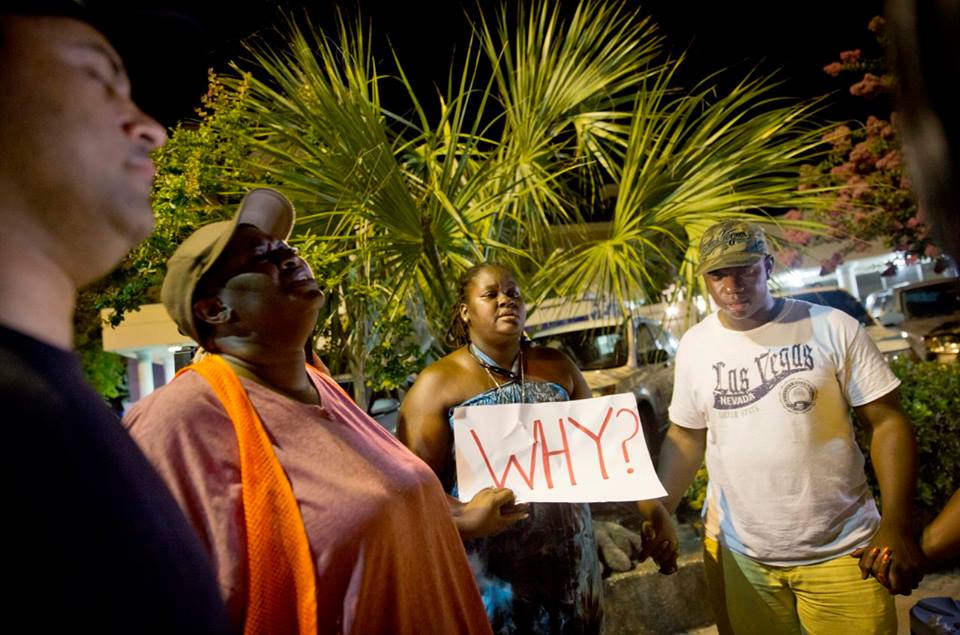
 

Why
Source: David Goldman (AP)


You can’t kill love

The 9 members of Mother Emanuel African Methodist Episcopal Church barely had time to “cry to the LORD in their trouble.” And though Jesus was in attendance at that Bible study and prayer time—“Where two or three are gathered in my name, there I am with them”—he didn’t stop the hateful actions of a deeply racist young man.

Surely those 9 didn’t have to die. I don’t know how many more of these things it will take for our nation and lawmakers to finally move ahead in a serious conversation about gun control. I don’t know how many more unarmed black people will have to die before our country wakes up to the pervasive racism in our midst.

They didn’t have to die. But, you know what? In the lexicon of the Kingdom of God, dead isn’t really dead.

Because you can kill a person, but you can’t kill love.
You can try to cut somebody down, but “the blood of the martyrs is the seed of the church.” From even horrible death can come new and powerful expressions of life.

Rev. Clementa Pinckney was the Pastor of Mother Emanuel, one of those who died. There’s a short YouTube video you can easily find: a couple years ago he welcomed a group of folks who were on tour in historic Charleston. Here’s what he said:

The African American Church… really has seen it as its responsibility and its ministry and its calling to be fully integrated and caring about the lives of its constituents and the general community. We… don’t see ourselves as just a place we come to worship, but as a beacon, and as a bearer of the culture and a bearer of what makes us a people.

But I like to say this is not unique to us. It’s really what America is about. Could we not argue that America is about freedom? Whether we live it out or not… but America’s about freedom, equality, and the pursuit of happiness. And that’s what church is all about. Freedom to worship and freedom from sin, freedom to be fully what God intends us to be… and have equality in the sight of God. And sometimes you gotta make noise to do that. Sometimes you maybe have to die… to do that.

We saw this week how the family members of the victims responded. They called on Dylann Roof to repent of his sins and believe in Jesus. As Rev. Pinckney suggested, they called him to a life of “freedom from sin, freedom to be fully what God intends [him] to be.” They said things like, “Though every fiber of my being is hurting, I forgive you.” And the nation watched, amazed at the witness of the families in that church.

And so God, working through the amazing mercy of the families, calms the storm, after all. The winds of hatred and the breaking waves of destruction die down as Christ works in the hearts of his disciples in Charleston who choose faith over fear.

When God’s children find themselves in choppy waters, our Lord, Jesus, is right there with us in the boat.

And because they know Jesus is in the boat with them, the families of Mother Emanuel have chosen to be joyful, “though [they] have considered all the facts,” though their loved ones have been lost at sea, as it were.

Not a sudden storm, not even a tragic shipwreck can keep Christ’s disciples from making it to the other side. There they see the works of the LORD, and their witness lives on.


The above is adapted from the sermon I preached today at church.

Galileans at Pentecost

"Pentecost," by Jan Joest van Kalkar (1505 – 1508)
“Pentecost,” by Jan Joest van Kalkar (1505 – 1508)


Pentecosts reminds us that God pours out the Holy Spirit on any and all persons who would receive… and he uses unexpected persons as his conduits!

The use of “Galileans” to help usher in the era of the Spirit is also a sort of breaking of barriers. It shows that when God chooses to do something marvelous, he does not necessarily wait till a person high in earthly esteem comes along. He does use such people, of course, as we see with God’s using Paul. But he is not limited to them.

The key to usefulness is the fullness of the Spirit, and the Spirit can bring life to anyone he chooses, provided that he or she is open to this enlivening.

(Ajith Fernando, Acts: The NIV Application Commentary)

Image above via Global Christian Worship.

After Luke and Acts: Part 3 of Luke’s Trilogy

As I’ve been working on the Book of Acts for my last few sermons, Acts has been working right back on me. I’m still thinking about my encounter with the Ethiopian eunuch. This last week, as the lectionary moved from Acts 8 and Acts 10 back to Acts 1 (for the Sunday after Ascension Day), I found myself thinking in terms of Acts 1:8 as a prequel for what had been happening so far.

Just before he ascends, Jesus tells the disciples to wait for the promised gift of the Holy Spirit.

He says:

But you will receive power when the Holy Spirit comes on you; and you will be my witnesses in Jerusalem, and in all Judea and Samaria, and to the ends of the earth.

They had wanted to know when the kingdom would be restored, but Jesus points them to a different when: the when of the Holy Spirit.

One implication of Jesus’ response, I think, is that we don’t have to know when or have life’s tensions resolved to be a witness right now to what we have seen in Jesus.

We don’t have to understand all the ins and outs of the kingdom of God–we may even think of its consummation as being a loooong ways away–to be able to make a contribution to it today, through the power of the Holy Spirit.

There’s an African proverb that says, “That which is good is never finished.”

The Book of Acts is like this. It’s not finished. If Acts 1 serves as a prequel for the whole narrative, Acts’s sequel is being written by men, women, boys, and girls who make up the church today.

The Story Luke TellsJusto Gonzalez comes at this another way in his excellent new book,The Story Luke Tells: Luke’s Unique Witness to the Gospel (Eerdmans, 2015).

He points out that Luke’s story in Luke-Acts doesn’t really end: “Paul has suffered countless vicissitudes. He has been shipwrecked. He has finally made it to Rome. He is awaiting trial before Caesar. And then—nothing!”

(This helps explain why after a recent read-through of Acts, I was at a loss to remember what happened to Paul at the end!)

Gonzalez goes on:

In telling his story and leaving it unfinished, Luke is inviting his readers to be part of it, to join the throng. ….But since the story is unfinished, it is more appropriate to conclude it with “RSVP,” like an invitation that awaits a response. This is what Luke demand from us: not satisfied curiosity about the past, but a response here and now. RSVP!

Pretty amazing, isn’t it?

We are the sequel to the two-part combo of Luke and Acts–the threequel, if you like. The story of the church in the world now becomes the third part in Luke’s trilogy. Luke-Acts-Us.

My Encounter with the Ethiopian Eunuch

Preaching so specifically about the Ethiopian eunuch the other week felt risky for at least two reasons:

  1. The eunuch in Acts 8:26-40 reads as a category-defying character, with a sort of in-between sex/gender identity and a home that was the unknown “ends of the earth” described in Acts 1:8.
  2. What even was a eunuch?

DeFranza EerdmansI found a great deal of help in understanding the eunuch and his identity from a just-published book from Eerdmans: Megan DeFranza’s Sex Difference in Christian Theology: Male, Female, and Intersex in the Image of God.

As the book treats sex difference widely, it examines the oft-misunderstood (or unknown!) category of intersex, with eunuchs providing a sort of historical case study in chapter 2. Did you know that Jesus spoke approvingly of eunuchs, and described three kinds?

The chapter was an immense boost to my appreciation of all the uncertainties that could have been at play as Philip encountered the eunuch, part of a group of people that DeFranza cites a 4th century poet as calling “exiles from the society of the human race, belonging to neither one sex nor the other.” They’re male, but not fully, at least not in the expected sense. And there were prohibitions in the Torah like this one in Deuteronomy 23:

 No one who has been emasculated by crushing or cutting may enter the assembly of the LORD.

Yet, as DeFranza and others have suggested, already in the broad sweep of Scripture, there seemed to be hope for eunuchs. Moving from the books of the Law to the prophets, Isaiah, just a few chapters after what the eunuch was reading in his chariot, there is:

To the eunuchs who keep my Sabbaths, who choose what pleases me and hold fast to my covenant—to them I will give within my temple and its walls a memorial and a name better than sons and daughters; I will give them an everlasting name that will not be cut off…. (Isa. 56:3ff)

But if he may not “enter the assembly of the LORD,” maybe he couldn’t be baptized, either?

Josephus, a first century historian, was no exchanger of pleasantries with eunuchs. He wrote:

Let those that have made themselves eunuchs be had in detestation; and do you avoid any conversation with them who have deprived themselves of their manhood, and of that fruit of generation which God has given to men for the increase of their kind….  (Antiquities 4:290)

It seems that the eunuch—a man probably used to giving orders and approval to decisions on the home front—in this poignant moment is asking Philip for his approval. Having heard the good news of Jesus as Philip explains the Scriptures to him, the eunuch wants to know, “Am I allowed in?” Am I excluded or included? Can I be baptized into Jesus?”

Philip had no problem baptizing him into the fellowship of Jesus. Philip surely knew of God’s promise through Isaiah to give the eunuch “a name better than sons and daughters” (which they could not have!). Philip surely had surmised that this man who had traveled from Ethiopia to Jerusalem–a great cost and sacrifice of time… and could he even get in at the temple?–was committed to worshiping God with his whole life. Philip had experienced the Holy Spirit’s presence in Jerusalem and all Judea and (just verses before) in Samaria… and now he must have thought, “Here are the very ends of the earth–the blurring and transcending of many categories–coming right here to this odd deserted road I’ve just been called to!”

Yes, the eunuch had to be baptized.


The chapter on eunuchs is as far as I’ve gotten in Megan’s book. (And if I’ve gone astray anywhere in the above, it’s my doing, not hers.) But I’ve found myself transformed by this vicarious encounter with the Ethiopian eunuch in Acts 8. As I told my congregation, I come back to this passage again, now asking these questions:

Where have I drawn my own borders? How open to re-examination am I in how I think about others and their place in the kingdom of heaven? How can I learn from the eunuch and allow that would-be outcast to change my heart? What do the people Jesus calls brother and sister really look like? Will I allow “the uncategorized” or marginalized or ignored ones to instruct me and lead me into deeper appreciation for the wideness of God’s mercy?

I don’t expect Megan to answer all these questions for me, but hers is a very important book, timed perfectly for this moment in the life of the church and society at large. I’m excited to read the rest of it, as my own encounter with God’s grace shown to the eunuch continues to work on my heart and mind.


Find Dr. DeFranza’s book here at Amazon. The publisher’s book page is here. Megan writes compellingly about the book’s coming into being here.

How to Use Accordance to Write Sermons

Accordance Live Online Training


Accordance Bible Software has just posted the video recording of a recent webinar I taught, Sermon Preparation in Action with Accordance. Here‘s the one-page handout so you can see what I cover in the just-over one hour presentation. Live webinars are coming up, and include a Q and A time not shown in the video below. (The next one is May 21–sign up or learn more here.)

Here’s the video, with Accordance’s description below. (If you’re reading this blog post via email, you may need to go to the original post to watch the video.)


In this previously recorded webinar, pastor Abram Kielsmeier-Jones demonstrates how he uses Accordance for sermon preparation. Anyone who preaches or teaches the Bible regularly will benefit from watching Abram’s presentation. Originally recorded on April 27, 2015.


Accordance has quite a few other online trainings coming up. Check them all out.

Kierkegaard: “Christ Enters Through Closed Doors”


Søren Kierkegaard, in an 1837 journal, wrote this about the so-called “doubting Thomas” post-resurrection Gospel account:

If Christ is to come in order to dwell in me, that has to transpire in accordance with the heading of the gospel for the day in the calendar: “Christ enters through closed doors.”

With Him in Death, With Him in Life

S 1


When I saw the Whoopie Pie truck in the drop-off lane of a local workout facility, I was reminded that life is full of oxymorons. Or at least things that go together that seem to be contradictory. (Chocolate and cream-filled power up for the elliptical? Yes, please!)

Jesus once said:

Whoever wants to be my disciple must deny themselves and take up their cross and follow me. For whoever wants to save their life will lose it, but whoever loses their life for me and for the gospel will save it.”

There’s another oxymoron for you—or at least it sure sounds like one. The disciples thought it was. “Lose your life to save it? If you lose your life, you’re dead.”

Jesus applied that idea to himself. Before he could rise again from the dead, he had to… well… die first. That you would have to die before you could come back from death is logical enough. But that Jesus even could come back once he was in the irreversible state of death sounded as oxymoronic to the disciples as a dessert delivery driver stopping by the morning Zoomba class.

Peter “knew better.” After his teacher’s death-to-life crazy-talk, Peter pulled Jesus aside and started to “rebuke him.” Jesus rebuked him right back, “Get behind me, Satan! You do not have in mind the concerns of God, but merely human concerns.”

Shortly after that episode with Peter, Jesus said again to his disciples, “‘The Son of Man is going to be betrayed into human hands, and they will kill him, and three days after being killed, he will rise again.’”

Once again, the Gospel of Mark tells us, “They did not understand what he was saying,” but this time they “were afraid to ask him.”


I-Thou: Why Jesus’ Death Was So Devastating


Peter and the others thought that death could only be the career-ending move that it has been, is, and will be for every other human being. It’s not something you come back from.

The idea of resurrection supersedes rationality and, generally, so-called empirical evidence.

And underneath Peter’s blockheaded attempt to tell Jesus who he really was and what he should do, there was a real love. Peter would confess Jesus as “the Messiah, the Son of the living God.”

The disciples didn’t understand Jesus’ teaching of, “I must die and you must die so that we together may truly live.” And even if they could grasp it intellectually, Jesus’ disciples were a group of men and women who had left home, jobs, ways of life to follow someone they believed was going to save them, guide them, and just be with them.

Someone you love that much is the last person you want to even think about dying, let alone hear that person repeatedly referring to their death and saying it has to happen. So there was, I’m sure, an emotional resistance on the disciples’ part to hearing Jesus talk about his own death.

The Jewish theologian Martin Buber offers some insight into why the death of a loved one is so difficult. In his I and Thou, Buber writes that the identity of the individual is constituted not just in isolation, but in relationship to others:

If Thou is said, the I of the combination I-Thou is said along with it.
The primary word I-Thou can only be spoken with the whole being.
There is no I taken in itself, but only the I of the primary word I-Thou.

The disciples’ sense of self was fully interdependent with their sense of who Jesus was. They knew, at least at some level, that they lived and died with him. When they heard Jesus talk about his own death, whether they kept living or not, they knew that a part of themselves would die with him.

It was that knowledge—that gut sense of their intertwined identity—that would lead Peter to say just before the crucifixion, “Even if I have to die with you, I will never disown you.”

Jesus’ death was devastating to his followers. Their sense of self and of the world would never be the same. How could they ever hope again? How could they ever trust? How could they dig out of the hole they now found themselves in?

In the Gospel John’s resurrection account, the stone is gone, but the disciples still don’t understand about Jesus’ dying-then-living. Even with the tombstone rolled away, it was all Mary Magdalene could do to stand “outside the tomb crying… [weeping].”


But There’s More Beneath the Surface


It seems like every time I walk back to our house from the church, I find something new in the driveway or yard. As the snow continues its slow, steady melt, we keep discovering things we forgot we lost. A whiffle ball bat. The pink plastic shovel that caused so much discord back when the kids were fighting over who would use it. Or that hand towel I was reaching for to wipe snotty noses in between shoveling piles of snow off the van several times a week.

I asked our Deacons if they, too, were able to testify to the signs of life emerging from underneath the snow, shooting up from the ground. And they were—let me show you.


B 1


B 3


S 2


S 3


There’s always more beneath the surface. Life is so rich and the universe so mysterious and wonderful that what you see on first glance isn’t all that’s there.

The workings of God exceed what we can comprehend. We may think or live as if he’s limited by natural laws. Yet the One who wrote those laws, who put them into place, can re-order the universe as he sees fit.

The one who breathed and still breathes life into creation does not find death to be an obstacle to his purposes.

What seems to be the end is not the end. What the disciples thought was the Last Supper they would ever have with Jesus was, in fact, the first communion meal, an observance that would be repeated countless times by Christians everywhere. That bread—in its brokenness‚ representing death—would be the very source of life to followers of Jesus throughout the ages. One early church father called the communion bread, “medicine of immortality” and “an antidote to prevent us from dying.”


I-Thou, Redux: With Him in Death, With Him in Life


Jesus’ death was heart-wrenching to his disciples. This is because, for them, participation in Jesus’ suffering and death was not a spiritual discipline, or a spiritual state to try to attain—it was their natural reaction to an immense loss. They died with him, as the fire in their hearts went out.

But if they died with Jesus that awful Friday we dare to call “Good,” they came right back life with him, at his resurrection.

“I have seen the Lord!” Mary Magdalene proclaimed. When Jesus came—in person—to the fear-struck, mourning disciples, John says they “were overjoyed when they saw the Lord.”

The disciples were buried with Christ, and they rose again with him to new life. Jesus breathed on them, gave them the Holy Spirit, and the book of Acts happened. The church spread at an amazing rate. Christ’s followers could not contain the joy of new life.

We who call ourselves disciples today also have participated in the death of Jesus. We take part with Jesus in his suffering any time we are compassionately attuned to the unjust treatment and oppression of others. We associate ourselves with Christ’s crucifixion again today when we receive the elements of communion. We join with the first disciples when we observe Holy Week, or practice austerity during Lent, and when we affirm that we, too, were there when they crucified our Lord.

One well-known disciple, Paul, would say, “Is not the cup of thanksgiving for which we give thanks a participation in the blood of Christ? And is not the bread that we break a participation in the body of Christ?”

We participate in Jesus’ death when we accept that it was a sacrifice made on our behalf, offered to bring us into communion with God. From the cross came life–our life, springing forth from the cold, dead ground.

Elsewhere Paul would write, “We were therefore buried with him through baptism into death in order that, just as Christ was raised from the dead through the glory of the Father, we too may live a new life. For if we have been united with him in a death like his, we will certainly also be united with him in a resurrection like his.”

If we have died with Christ, then we live with Christ. We have participated in his death, so we participate in his resurrection.


Conclusion: The Stone Has Been Rolled Away


The stone has been rolled away. Jesus did not stay in the land of the dead, but rose to the land of the living. When death gets the last word in the lives of the ones we love, we know that life actually has a rejoinder. Dead isn’t dead forever.

This is why the Psalmist, perhaps in anticipation of the coming Messiah, could say, “I will not die but live, and will proclaim what the Lord has done.”

So, like those beautiful buds and flowers that improbably spring forth from under an impossible mound of snow, come on out of the hole you’ve dug into the ground. The stone has been rolled away–Jesus himself has done this! There’s no more need to hibernate or hide out.

Jesus, thought to have breathed his last, springs forth from the grave, finds the disciples he so loves, and breathes his own new life on them, so that they can share with him in the resurrected life. The darkness of the tomb is now illuminated by the light of Christ. The somber purple of Lent has give way to the bright white of Easter.

Jesus is risen from the dead! Death is so last season. Resurrection is the new black.

Apparent endings can become starting points, seedbeds, for unexpected beginnings. We now have access to new life in Christ.

The world is lit up with the light of the resurrection of Jesus. Jesus died and lived through it. He took us with him from cross to grave to glory.

We who have died with Christ, who “were there” when they crucified our Lord, now share in the abundant, new life he gives us, through his resurrection from the dead. Thanks be to God!

A Tale of Two Eucharists

The Last Supper


I just got home from our congregation’s Maundy Thursday service of communion. We came forward, knelt down, and partook of the bread and the cup–the body broken, the blood poured out for us. The altar has now been stripped and the cross covered with black cloth.

Our church’s practice is to celebrate communion on the first Sunday of the month. This Easter, then, will be a Communion Sunday for us.

As we do not have communion every Sunday, the idea of two Eucharists in such close proximity–one on the betrayal-and-death side of the story, the other on the resurrection side–has been fascinating to me.

Below is an adaptation of a short message I wrote to our congregation last night.


I’m writing to invite you again to our Maundy Thursday communion service of worship tomorrow night at the church.

And Sunday is Easter Day, Resurrection Sunday, the most glorious day of the calendar year.

As it turns out, because April 5 is the first Sunday of the month, it is also a Communion Sunday for us.

This offers as a unique lens through which to experience this last half of Holy Week and Easter. We might even think of it as A Tale of Two Eucharists.


The First Eucharist

On Thursday Jesus broke bread and gave thanks (this latter verb is the underlying meaning of the Greek-based Eucharist). But even as he was filled with gratitude for his Father’s love, surrounded by the ones who loved him most, he knew there was a betrayer at the table.

In a more cosmic sense, the next day—Good Friday—he would be betrayed by all of the ones he came to save. Not I!, we protest with the disciples at the table. But we, too, “were there when they crucified our Lord.” We have been complicit.


The Second Eucharist

Yet Jesus forgives us of that complicity. Every other Eucharist that has taken place since that first Thursday Eucharist has been on the other side of Resurrection. Our moral failings, stubborn hearts, and forgetfulness in doing good have now all been put to death. We rise to new life with Christ, given a second (and a third, and a fourth…) chance to embody Jesus to a world that is as broken today as it was when our Savior was crucified.

Easter reminds us that the crucifixion was not the closing chapter the disciples thought it was. Rather, it was a preface (a “cold open,” as TV shows call it) to the real story of why Jesus came—to defeat sin and suffering and death through his resurrection, and to invite us into the resurrected life with him.

Just as we participate with Jesus in his death and suffering–Maundy Thursday’s bread of betrayal–we also participate with him in his glorious victory over darkness–Easter morning’s bread of new life.

Good Will Hunting and Making Space to Receive Love

Baseball is Finally Hair


Last week Major League Baseball pitchers and catchers started reporting for Spring Training. Spring Training, of course, takes place in Florida and Arizona. Red Sox pitchers and catchers reported last Friday in Fort Myers, Florida, where it will be in the 60s, 70s, and 80s all this week.

On the one hand, Spring Training team standings don’t mean much. How a team does in Spring Training is often not a predictor of how they’ll do in the regular season. Last year, for example, there were 21 teams with better Spring Training records than the Kansas City Royals, who very nearly won the World Series. But this 40-odd day period of preparation, exercise, and deliberate conditioning is essential to summer success in Major League Baseball.


Lent: Spring Training for Christians


We Christians actually invented Spring Training: except we call it Lent. There’s no Cactus League or Grapefruit League for us… more of a Penance League and a Snowstorm League.

Lent is the period of 40 days, plus Sundays, leading up to Easter—Resurrection Sunday—the most important date on the calendar for followers of Jesus, more important, even, than Opening Day.

5 Practices Fruitful LivingLent in 2015 at our church will allow us some opportunities to more deeply cultivate our sense of Christian identity, both as individuals and as a church. We’ll explore five key disciplines for those who walk with Jesus.

We’ll be reading a book—Five Disciplines of Fruitful Living—by Robert Schnase, a Methodist Bishop.

Each Sunday in church I’ll preach on one of the five practices. Then, the week following, we’ll read that corresponding chapter.

Here are the Five Practices:

• Radical Hospitality (“Receiving God’s Love”)
• Passionate Worship (“Loving God in Return”)
• Intentional Faith Development (“Growing in Grace”)
• Risk-Taking Mission and Service (“Loving and Serving Others”)
• Extravagant Generosity (“The Grace of Giving”)

Today’s focus is Radical Hospitality, our hospitality and receptivity to God’s grace toward us. This discipline is all about how we receive God’s love. I think you’ll really appreciate this chapter if you make time to read it this week.


Receiving God’s Love


God is many things, but Love is God’s most fundamental characteristic.

“The LORD is compassionate and gracious, slow to anger, abounding in love”—a sort of mantra of the Old Testament that finds expression in books as diverse as Exodus, Nehemiah, Joel, and the Psalms.

“God is love,” John says, multiple times in 1 John 4.

And any love we experience or share is rooted in God’s love for us: “We love because he first loved us.” “God is love.”

God declared his love for Jesus at Jesus’ baptism: “You are my Son, whom I love. With you I am well-pleased.” Through our baptism and faith we are adopted into God’s family. Not only do we call God Father, but we call Jesus brother, and share in his inheritance of the Father’s love and good pleasure.

The love that God declared for Jesus has been bestowed on us, lavished on us, 1 John says. “See what great love the Father has lavished on us, that we should be called children of God!”

We are God’s children, whom he loves.

That God is love and that we are loved by God is the most foundational aspect of reality, what philosophers have for thousands of years sought after as “the really real.”

How do we know God loves us? Here’s 1 John again:

This is how God showed his love among us: He sent his one and only Son into the world that we might live through him. This is love: not that we loved God, but that he loved us and sent his Son as an atoning sacrifice for our sins.

And so I appreciate that the first of these five disciplines that Robert Schnase suggests is not so much a habit to take on or a practice to engage, but just plain love to receive.

Of course we don’t hoard it or keep it to ourselves, so the other practices of Christian faith include loving God back and serving others in this great love.

But it’s worth stopping just to ask: Am I receiving God’s love? Am I carving out space in my life where I can listen, call to mind, welcome, and accept God’s lavish love for me?

Each year I’m usually pretty consistent about taking on a couple of Lenten disciplines. I especially like pairing the practice of “giving up” something—a distraction that keeps me from awareness of God—with “taking on” something—a new practice or renewed effort to keep God’s presence more top of mind.

This year, however, I’m still catching up on my New Year’s resolutions, so it’s been hard to think about starting a new Lenten discipline.

If you’re in the same boat, or if you didn’t realize until today that we’re already 4 days into Lent, and you want to do something, I encourage you to think just in terms of this coming week, and to carve out some time and space to receive God’s love. Make space to receive God’s love.

One of my New Year’s resolutions I fell behind on the second week of January was reading the Bible all the way through in a year. I’m not giving up, though. This week, as I was supposed to be wrapping up Leviticus, I read Exodus 25. God has raised up Moses, Aaron, and Miriam, and led this new covenant people out of miserable slavery in Egypt. They’re on their way to the promised land.

After God gives Moses and the people the 10 Commandments and many other instructions, there comes this beautiful pivot point in Exodus 25 that sets up so much of Israel’s wilderness journey: God says, “And let them make Me a sanctuary that I may dwell among them.”


Tabernacle Model, Via Ruk7 at Wikipedia Commons


See, God can dwell wherever and whenever and however he chooses, but he calls his people from the very beginning to carve out a space for him, where they can honor his presence and receive his love. Hospitality toward God is all about making room for God. Hospitality toward God is about receptivity, open hands, a willing heart. As our author will put it, it’s about saying, “Yes” to God.

This “practice of fruitful living,” we’ll see, drives all the other practices and undergirds them.


External Obstacles


But how many obstacles are there that stand between us and God’s love?

For one, we have a dizzying array of technological distractions available to us at any moment.

Or maybe we get our viewing and clicking habits under control, only to find out that the real, live human beings we know have a whole host of demands and expectations of us. Whether co-workers, clients, professors, children, bosses, siblings, or students, we often acutely feel that our time is not our own.

Furthermore, we have been shaped, for better or for worse, by hurts imposed upon us by others, by pain past and present, some things resolved, others unresolved. These can make us guarded, and give us pause when it comes to opening the door of our hearts to God.


Internal Obstacles


And then there’s us. We get in the way of our own receiving of God’s love for us. We undermine our own efforts at radical hospitality toward the grace of God. We do this by neglect, out of fear, due to pride, because of overworking, or just sheer lack of putting forth the effort required to make a space where we can commune with God.

As I’ve thought this week about the many barriers that keep us from more fully embracing God’s love, I’ve found some illumination in a somewhat unlikely place: one of my all-time favorite movies, Good Will Hunting.

Will Hunting—played by Matt Damon—is a genius, a mathematical prodigy who proves an impossible theorem on an MIT chalkboard while he’s mopping the floor as janitor.

He gets into trouble for hitting a police officer, and then is assigned therapy as part of his deal to not have to go to prison.


Good Will Hunting Public Garden


His therapist, Sean, is played by Robin Williams… an amazing performance by both men.

Sean realizes very early with Will that there are two poles, both of which keep Will from opening himself to receiving—and giving—love.

On the one hand, Will undermines deep relationships by his lack of effort, through willful stubbornness and arrogance.

On the other hand, Will is an orphan; he was abused by his foster dad and the foster system itself. One can hardly blame him for wanting to keep distance from all humanity.

Sean points out, “We get to choose who we let into our weird little worlds,” as he watches Will pursue a love interest while also keeping her at bay.

At their first therapy session, Will pompously tries to psychoanalyze his therapist, Sean, based on the books, pictures, and a single painting in his office.

Next session, Sean leads Will out of his office and to a park bench at the Boston Public Garden.

He points out that Will is really just practicing avoidance. As they sit there in that iconic scene, Sean says,

I can’t learn anything from you, [that] I can’t read in some __ book. Unless you want to talk about you, who you are. Then I’m fascinated. I’m in.

But you don’t want to do that do you sport? You’re terrified of what you might say.

Your move, chief.

He walks away.

We know what it is to be “terrified of what [we] might say,” if we were truly vulnerable in the presence of God. We can also be scared of what we might hear, what God might ask of us, or of getting a reminder of what God has already asked of us, that we’re not doing.

But if Will Hunting’s avoidance is partly his own doing, there is also a sense in which he has been so malformed by his past, that he really doesn’t know how to love, and how to be loved.

One of the culminating scenes in the movie is where the therapist Sean has to turn in a report on Will to the court. (You can watch it here.)

Will says, “So, uh, what is it, like, Will has an attachment disorder? Is it all that stuff?”

Sean nods.

Will goes on, “Fear of abandonment? Is that why I broke up with Skylar?”

Sean says, “I didn’t know you had.”

Sean says, “Hey, Will? I don’t know a lot. You see this? All this [stuff]?

He holds the file up and then drops it down on his desk.

Sean says, “It’s not your fault.”

“Yeah, I know that.”

“Look at me, son,” says Sean. “It’s not your fault.”

Will nods, but Sean just keeps repeating that line, “It’s not your fault; it’s not your fault; it’s not your fault,” till finally Will breaks down, sobbing, and reaches out to hug his therapist.


Make Space This Week to Receive God’s Love


Bishop Schnase in his book talks about these two poles Sean identified in Will. He doesn’t talk about Good Will Hunting, but it’s the same dynamic. Schnase calls them “elements of distance, both inherited and willful,” that keep us from receiving God’s love.

Whether “It’s not your fault,” or whether “It’s your move, chief,” a combination of fear, guilt, neglect, deep pain, and disobedience almost actively seeks to prevent us from carving out spaces where God can dwell, and where we can simply bask in his love.

We need more time, more openings, more gaps, and wider margins where we can slowly churn over God’s words that are for us, too:

“You are my child, whom I love. With you I am well-pleased.”

“You are my child, whom I love.”

“You are my child, whom I love.”

Give yourself permission—starting today and tomorrow—to dedicate time and space to gratefully receive God’s love. If you can’t give yourself permission, you’ve got my permission. Consider it the pastor’s equivalent of a doctor’s note—a pastoral exhortation.

“Listen!” Jesus says, “I am standing at the door, knocking; if you hear my voice and open the door, I will come in and dine with you, and you will dine with me.”

Give yourself permission to do as God’s first people did, to make little sanctuaries of time and space where you can meditate on God’s lavish love for you, and receive his grace.

Not just so you can run off and give it to someone else—that’s next week’s practice…but so that you can know how deep, how strong, how rich, how unrelenting, how comforting, how amazing, how replenishing, how good, and how perfect is the love of Jesus… for you.


The above is adapted from the sermon I preached at my church last Sunday.

Alleluia! To Us a Child Is Born!

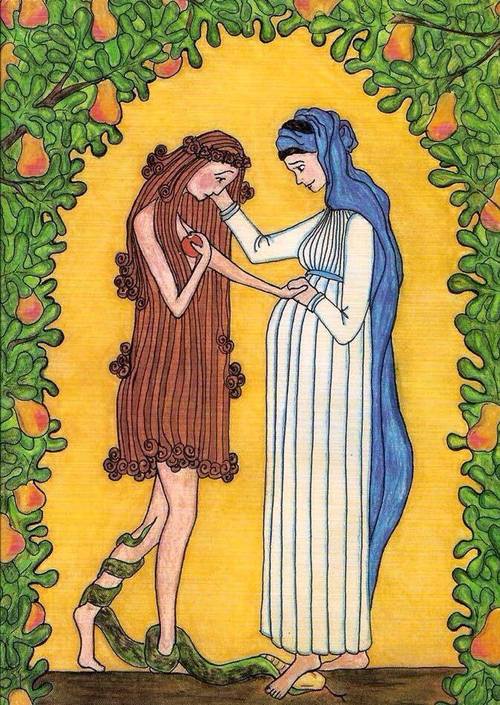
"Virgin Mary Consoles Eve," Sister Grace Remington, www.mississippiabbey.org
“Virgin Mary Consoles Eve,” Sister Grace Remington, via http://www.mississippiabbey.org


Behold, the dwelling of God is with humankind. He will dwell with them, and they shall be his people, and God himself will be with them, and be their God.
Revelation 21:3

During Advent our congregation read the book of Jonah, that sometimes-ignorant, sometimes-faithful, always-stubborn prophet who called the wayward city of Nineveh to turn away from their past and accept God’s second chance.

We’re complex people like Jonah. Sometimes we’re even like the people of Nineveh, we don’t know our left from our right, or up from down.

Whether we’ve created our own difficult reality by our actions, or whether others have put us in a tight spot, we all know what it is to live and walk in darkness.

So we look for light. We pray earnestly for second chances. We ask for God’s mercy to come even to lowly folks such as ourselves. We yearn to see God’s justice executed on those who actively work against it.

We grasp about for light, and we long to behold Jesus.

Alleluia! To us a child is born!
Come, let us adore him! Alleluia!

But it’s easy to get confused about Jesus. Not because Jesus is confusing or because God is unknowable. But because we’re an easily confused people.

Having seen so many paintings of a crucified Jesus, young Asher Lev asked his mother whether this was the Messiah.


Marc Chagall, "White Crucifixion," 1938
Marc Chagall, “White Crucifixion,” 1938


“No,” she says, “He was not the Messiah. The Messiah has not yet come, Asher. Look how much suffering there is in the world. Would there be so much suffering if the Messiah had really come?”

A trenchant critique, to be sure.

Time and again we look for Jesus to come in glory, in power, to right wrongs on a different timetable than God seems to have in mind… but time and again Jesus insists on coming in humility, in squalor, in seemingly insignificant interactions, even showing up in the midst of a fight. He doesn’t eliminate suffering; he gets born right into it, and takes part it in it himself.

Alleluia! To us a child is born!
Come, let us adore him! Alleluia!

Still, some days we’d rather skip past his first coming and go straight to the ending, his second coming when he makes everything right.

We keep wanting him to show up in full majesty, draping white robes behind him, as he smites the naysayers and draws his people out of a dark world and unto himself.

But year after year he keeps being born in a stable, to an unwed mother, next to unbathed animals, with astrologers as front-pew worshipers.

Alleluia! To us a child is born!
Come, let us adore him! Alleluia!

One poet sums it up nicely in four lines:

They all were looking for a king
To slay their foes, and lift them high:
Thou cam’st a little baby thing
That made a woman cry.

Rather than eliminate suffering in his first coming, Jesus participates in it. He takes on vulnerable, imperfect human flesh. He becomes one of the so-called least of these. A child. A poor child.

He doesn’t vanquish the darkness all at once… he’s born into it, and lets loose every now and then with a ray of light, a glimmer of hope. Indeed, for those who have eyes to see it, there is great light coming from the most unlikely birthing story you’ve ever heard.

Jesus was born into this world as it is, not yet as it should be. This is good news for our confused and dark souls. Even our hearts can become a home in which the Christ-child can dwell. Even we can bear Jesus as Mary did and bring him to all the world. Christ has come, a “little baby thing” to dwell with us, as we are, to be our God, to make us his own.

Alleluia! To us a child is born!
Come, let us adore him! Alleluia!

The Episcopal Bishop of Pittsburgh, Bishop Dorsey McConnell, is a favorite preacher and writer of mine. He says it well for all of us:

But the Christ Child has a life of His Own, and He will be born even in as dark a stable as that of my own heart. …I suppose I will just have to let Him have His way….And I know He will have His way with you as well. Whatever you’re afraid of in your own life or soul, just remember: He’s been born in darker places. Give Him so much as a square inch of your shadows, and He will fill you with His light.

Alleluia! To us a child is born!
Come, let us adore him! Alleluia!