Betrayed


Who betrayed Jesus? People, institutions, and… God? Who has betrayed you? And how can the cross speak to your betrayal?

I was honored to be invited to preach at The 7 Last Words of Jesus Christ worship service at St. John Missionary Baptist Church in Roxbury, MA, hosted by the Black Ministerial Alliance Ten Point Coalition.

I preached on: “My God, My God, why have you forsaken me?” Recording above (with an awesome congregation of saints), transcript below.


Jesus was betrayed

Who betrayed Jesus?

Judas comes to mind.

Judas would move from a loving disciple and a safe person, to a treacherous informant. Judas would not protect Jesus but would turn him over. Judas betrayed Jesus.

Who betrayed Jesus?

Peter betrayed him, too.

Peter was even part of an inner circle of Peter, James, and John. Peter had VIP access to miracles and teachings. If anyone should defend Jesus, if anyone should show up for him, it’s Peter.

Yet when Jesus predicts his own death and resurrection, Peter rebukes him! Even before Holy Week Peter starts to deny Jesus: “Far be it from you, Lord!,” he says. “This shall never happen to you” (Matt. 16:22). That’s a betrayal of Jesus and his mission.

Peter’s betrayal of Jesus would go even deeper, when he denied Jesus—publicly and loudly—three more times during Holy Week.

More: when Jesus gets to the Garden of Gethsamene, he pleads with his disciples, “My soul is overwhelmed with sorrow to the point of death. Stay here and keep watch” (Mark 14:34). He just wanted his disciples to stay awake with him, to show some solidarity. 

He was “overwhelmed with sorrow to the point of death”—that’s the language of the traumatized, even before Jesus was arrested.

Jesus finds his crew sleeping. “Could you not keep watch for one hour?” (Matt. 26:40) he says. Betrayed by loved ones, yet again!

Surely Jesus’s family would stick with him.

Very early in Jesus’s adult ministry. Jesus appoints the 12, pulls them together, and then (Mark 3:21): “When his family heard about this, they went to take charge of him, for they said, ‘He is out of his mind.’”

His family—whom he relied on for safety and support and nurture for 30+ years—tried to seize him. And they called him crazy!

I get we might say, “Well, family is crazy.” But his family’s “intervention” was also a betrayal. They want to sideline Jesus, clip his wings, undermine his God-given mission.

Jesus Christ was betrayed at just about every turn—by one of his 12, by one of his 3, even by family.

That’s just at the personal level.

There’s still more to Who betrayed Jesus?

Jesus also experienced “institutional betrayal.”

I only learned that phrase recently: institutional betrayal. But as soon as I heard it I thought—oh, I know what that is!

There were institutions that were supposed to provide for and protect Jesus but didn’t, in the end.

Like: the temple. Like: the religious leadership, the chief priests and the elders and the Bible scholars of his day that he amazed at age 12 when he taught them.

Jesus was as observant and as close to God as you could get, and yet time and time again, he found himself betrayed by the religious institutions that were supposed to treat him with dignity. Many religious leaders handed him over, and parts of his religious community shouted “Crucify!”

And then, Jesus found himself betrayed by the political institutions of his day. The Roman Empire had the power to actually do something. Jesus deserved a fair trial. He deserved an advocate in Pontius Pilate, and instead he got, I wash my hands of him.

Jesus betrayed again, by a person, Pilate, and with the full weight of the institution of the Roman empire behind him.

The researcher Jennifer Freyd says institutional betrayal is a “fail[ure of institutions] to intervene,” on behalf of people who depend on those institutions.

Institutional betrayal is when ones appointed to protect and to serve instead neglect and betray.

And it’s so much worse when all these people—Judas, Peter, Jesus’s family—and these institutions—the Temple, Rome… they all have provided Jesus with support… until they withdraw it. They all loved him and nurtured him and respected his rights… until they betrayed those rights. They were all so trusted and trustworthy… until they weren’t.

So when Jesus cries out from the cross, “My God, My God, why have you forsaken me?” behind those words is the weight and pain and trauma of a lifetime of betrayals.

And now, even you, O LORD, are forsaking me? Et tu, Yahweh?

The personal betrayal was bad enough.

The institutional betrayal put Jesus up on this cross.

And now, Jesus asks, with the whole world listening: is there divine betrayal, too?

What happened to “I and the Father are one?” What happened to, “This is my Son, whom I love; with him I am well pleased”???

Whatever we make of the theology of it, Jesus’s prayer is a powerful portrayal of how a deeply traumatized person feels:

Abandoned.

Disoriented.

Fragmented.

Fractured.

Alienated.

A stranger to the world. A stranger to yourself.

“My God, My God, why have you forsaken me?”

You have been betrayed

Maybe, on some level, you can relate to this Jesus who knew so much betrayal. Maybe you have held in your body the overwhelming pain that betrayal trauma causes.

Like Jesus, do you know what it feels like to be betrayed by a friend or a family member? Have you been working with colleagues for a common cause, and you thought you were together, only to have them undermine what you had all agreed to?

Like Jesus, do you know what it feels like to be betrayed and exploited by the institutions that were supposed to be there for you? Have you brought your deep pain to the institution we call Church, only to get hurt even more? Have you been betrayed by a religious leader or political leader, when you turned to them for safety, and instead they tried to devour you?

And like Jesus, after all this betrayal you’ve felt, have you prayed—or wanted to pray—“My God, my God, why have you forsaken me?” Have you wondered if God—whom you trusted—had betrayed you?

However we wrestle with the theology of Jesus’s prayer, we know this: Jesus said it. Jesus prayed that prayer for all to hear: “My God, My God, why have you forsaken me?”

So Jesus knows that prayer when he hears it from you. 

Jesus knows what you feel like, when you’ve been betrayed: by people, by institutions, when you wonder if you’ve been betrayed by God.

When you ask Jesus to get you out of this “Godforsaken mess,” Jesus remembers the cross.

Resurrection, already on Good Friday

After Jesus prays, “My God, My God, why have you forsaken me?” he cries out again, he dies, and then…

“Behold! The curtain of the temple was torn in two from top to bottom. The earth shook, the rocks split and the tombs broke open. The bodies of many holy people who had died were raised to life.” (Matt. 27:51-52). 

“Raised to life”!

Jesus just died. We are just seconds away from betrayal trauma and torture overwhelming his faculties to the point of death, and we hear:

“The bodies of many holy people who had died were raised to life.”

Something with resurrection happened, not just Sunday at the tomb, but Friday at the cross. Something must have happened with that prayer—“My God, My God, why have you forsaken me?” Because already Jesus’s death was bringing wholeness, power, and resurrection.

The temple curtain ripped. The temple—that institution that had betrayed Jesus. A dividing curtain is ripped in half.

The ground shook and rocks split in two—this is a new, powerful world that only Jesus can bring. “Even the rocks will cry out” with life.

Those tombs—that included saints of old who were betrayed unto death—those tombs opened up. The dead were raised to life.

Being betrayed and feeling Godforsaken… violates even your ability to make meaning of life. Yet Jesus’s betrayal, Jesus’s trauma at the cross, Jesus’s cry of Godforsakenness… gives new meaning to all pain and suffering.

The cross means you have new life, right now, even when you are betrayed and feel like you’re dying. Even on your Good Friday, the cross means resurrection.

Bodies are already raised to life, even while Jesus is still on the cross.

The cross means that even when people and institutions betray you, God will, in fact, not betray you, because the dead—even the dead are raised! God will not forsake you. God will not leave you for dead.

God has brought you back to life, and God will bring you back to life as many times as you need,

so you can breathe again,

so you can walk again,

so you can live again,

so you can trust again.

There is resurrection even on Good Friday. “My God, My God, why have you forsaken me?”

And the answer comes—even before Easter! The answer to Jesus’s fourth word on the cross comes on Friday:

Here I am, tearing the curtain in two!

Here I am, shaking the earth. Here I am, splitting the rocks!

Here I am breaking open the tombs. Here I am, raising the dead to life!

Here I am, raising your bodies, your bodies that have known so much hurt and have held so much injury and have borne so much pain.

Here I am, raising your bodies that have been betrayed again and again and again.

Here I am raising your body to new life, right now, even on Good Friday.

anImage_2.tiff

The above is cross-posted at Healing Pastors.

Why do we call it GOOD Friday? Should we stop?

“I think Job’s friends should have gone to therapy school.” –my pre-teen


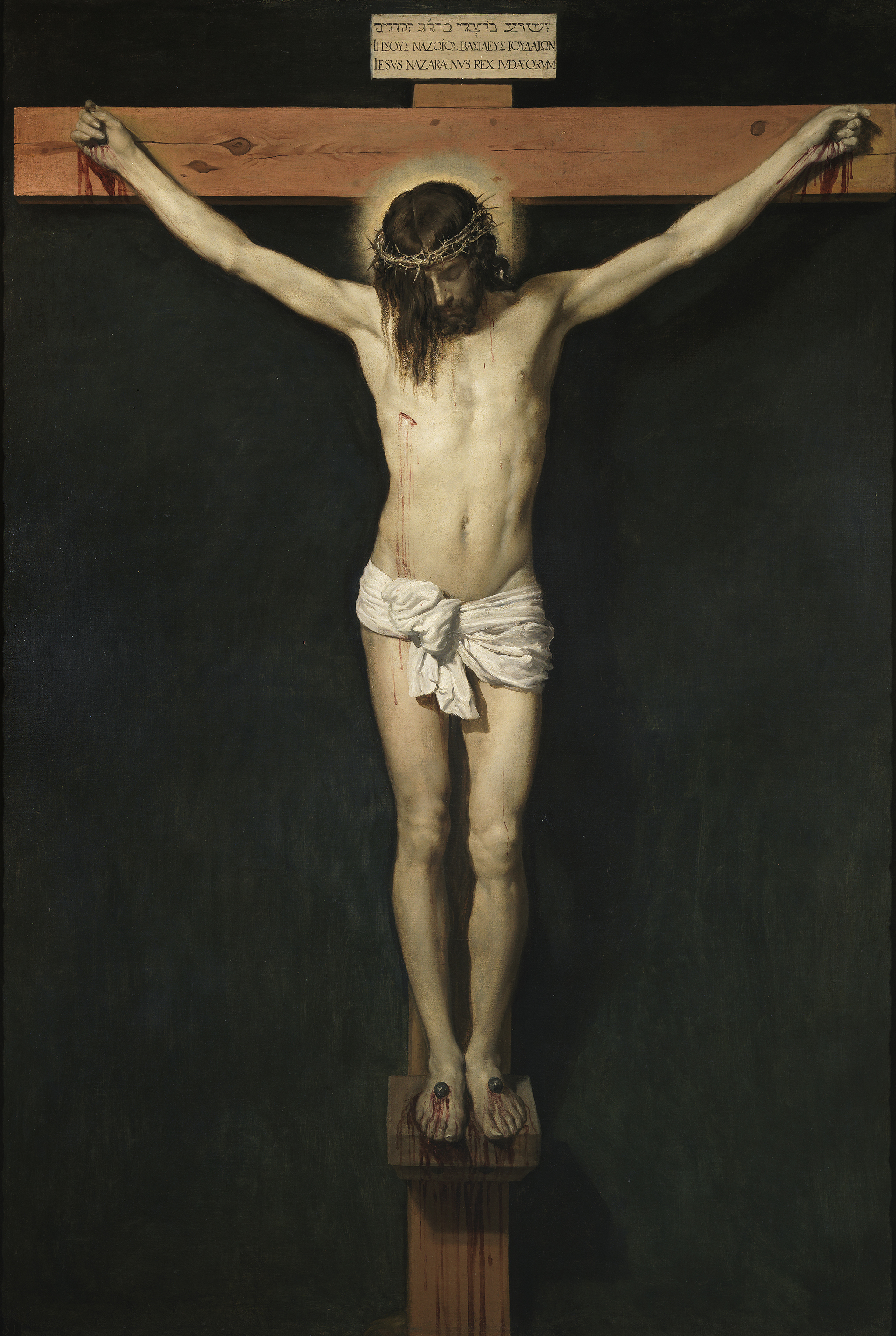
Christ Crucified, Diego Velázquez (17th cent.)

Around this time every year, I join my voice to the chorus of dressed-up church children everywhere, asking: “Wait, why do we call it GOOD Friday?”

My stock answer goes something like this: Even though Jesus died on Friday, he came back to life on Sunday, defeating sin and death, and giving the promise of new, resurrection life to all people! His death on Friday became good, even though it didn’t look so good at first.

And there are implications for us: what looks not-so-good at first, even suffering and death, can turn into good, especially when God is at work. In Genesis 50:20 Joseph says to his brothers: “You intended to harm me, but God intended it for good to accomplish what is now being done, the saving of many lives.” God brought wholeness out of harm, good out of evil. Joseph, without meaning to, foreshadows what would happen with Jesus on Easter weekend.

I still stand by this understanding of “Good” Friday. But I also worry about a human tendency to underestimate suffering, or to fetishize it. Theologian Christopher B. Hays says, “Indeed, there are times when suffering is simply evil, and must be resisted rather than embraced. The suggestion that other people’s suffering is redemptive is particularly dangerous; it risks making the observer complicit in the evil.”

Job’s friends wanted to find “other people’s suffering” (Job’s) redemptive, somehow. They wanted to see a cause-and-effect answer to why Job lost everything. Eliphaz, Bildad, and Zophar went to great lengths and used many, many words to try to find greater meaning in Job’s suffering. 

They must have really wanted to turn his Terrible, Horrible, No Good, Very Bad (Fri)Day into Easter Sunday. 

Maybe their pontifications weren’t for Job’s sake, but to ease their own theological cognitive dissonance.

After hearing one too many times that “Everything happens for a reason,” Job said: “I have heard many things like these before. What miserable comforters are you all!” (Job 16:2) 

Thou shalt neither minimize nor romanticize my suffering, in other words.

We can be like Job’s friends: downplaying suffering because we can’t handle how awful it is, or over-glorifying it because of the power of post-traumatic growth. Both are strong human impulses—in which I’m sure I’ve participated.

But even with Good Friday soon to give way to Resurrection Sunday, the horrors of crucifixion invite—even demand—that we take seriously pain and suffering and loss and trauma and torture and abuse.


The church traditions of The Stripping of the Altar and not-celebrating Eucharist on Good Friday are embodied ways of locating ourselves at the foot of the cross, as if in real time. 

If you’ve ever sat in a quiet and dark sanctuary with an eerily bare altar in Holy Week, you might have felt trapped in time. Or dislodged from your day-to-day travels through the space-time continuum. You might have even been able to inhabit a space where—even if only for a moment—you couldn’t conceive how it was going to all turn out.

I think we need such quiet moments. They help us avoid a triumphalism that skips past Good Friday and goes right to Easter, that skips death and goes right to life. So we linger at the cross a little longer, before we run to the tomb. We actually observe Good Friday.

But this Holy Week I’m wondering about going a step further. Even within Good Friday, what if I slowed down some aspects of the day itself?

I am asking: 

How might my participation in Good Friday change if I tarried a little longer with Jesus’s suffering, and with the suffering of the world borne on his shoulders? 

What would a Good Friday be like that didn’t hurry to ascribe greater cosmic significance to Jesus’s suffering, but just took it in, looking the crucified, tortured, abused Lord in the eyes? 

What if I tried to neither minimize Christ’s suffering (because I can’t handle the atrocity of it) nor romanticize Christ’s suffering (because I need suffering be redeemed)?

What if, this Good Friday, I put the meaning-making on hold and tried to just sit quietly with Jesus in his agony?

anImage_2.tiff

The above is cross-posted at Healing Pastors.
Confronting a Sex Offender in the Park After Church

We hadn’t been able to track him down until he unexpectedly showed up at worship one day.


Content warnings: child abuse, sexual abuse, evil, deception


Our church learned that an occasional attendee had repeatedly sexually abused a minor some decades ago.1 The one who shared was courageous to do so. The abuser had not confessed or taken accountability for his heinous behaviors.

Believing the report of the abuse, church leadership prayed and worked through a plan for talking to the offending man about what we had learned. Then we tried to find him—without success.

One Sunday, after a long absence from our church, he showed up at the public park where we were worshiping… mid-service. It was the first time I’d seen Ned Notrealname since learning of the abuse he perpetrated. I had to finish the sermon before I could talk to him.

I preached with one eye on the congregation and another eye on Ned. His presence that day was a surprise, but we were prepared for this moment.

After the service I approached him. With two church elders standing next to me, I told him we knew that he had sexually abused a minor, and that what he did is not okay. I called him to repentance.

Ned not only admitted it, he doubled down and said he was proud of what he did.

He was exulting in how he sexually abused a dearly loved child of God.

I’ve seen some things in 20+ years of ministry, but this was the most evil I’ve ever been face to face with.

Given Ned’s response, I told him he could not be present at our church. We were clear with him that what he did was awful. Here he was not only unrepentant, not only defending himself, but he was calling evil good. It was the actual worst.

Already agitated and combative, Ned looked poised to aggress. A member of the church offered to call the police. The police came and (kind of?) helped de-escalate the situation. Ned eventually left.

I planned to share with the congregation what happened. As a special announcement at the beginning of the next week’s service, I would be clear and open about what we’d learned about Ned and about how he responded to us. I wanted our people to know what was actually going on. And to know what kind of a church we would be when confronted with abuse in our midst.

That following Sunday, outside in the park again, I was in the middle of my planned, “You may have seen us talking last week after the service with Ned….” Before even my third sentence, a couple folks in the congregation motioned toward me to look behind them. There was Ned.

He was keeping a distance from us, and I hoped it would stay that way, but I was amplified through a speaker and he could have heard me. I cut the announcement short. I would have to put all this in a letter to the congregation.

So I did. Later that day I wrote:

Beloved Church,

This is a fuller version of the announcement I started to give in church today but chose to cut short because the person in question showed up, and I didn’t want another combative response from him. Note that the below has potentially triggering content around abuse. In the end I hope you receive it as a message of assurance.

If you were at the park in person last week, after church you saw or maybe even experienced a difficult interaction with Ned, who has a long on-and-off history with our church. I want you all to know what happened:

We heard a report earlier this year that Ned had repeatedly sexually abused a minor some decades ago. …

According to the plan we elders had set out, I was confronting Ned over his acts of abuse. I told him: we know about it, what he did is not okay, and I invited him to repentance. Instead he doubled down and said he was proud of what he did.

Any anger you may have seen toward Ned on Sunday wasn’t anger toward him for his mental condition, nor even for his being difficult to talk to, both in the past and again Sunday. Rather, we were angry at him for the acts of abuse he committed, and that he was now exulting in how he hurt a dearly loved child of God.

We do not see Ned as a safe person, and our church will be a physically safe environment, as best as we can make it. Consequently I told Ned that he may not be present at our church. If he does try to come around again, please do not engage him.

As I’ve spent time listening and praying through this, I want to share with you my heart for our church:

We will be a church that stands up for those who have been abused or harassed or hurt.

We will be a church that does our best to come alongside the wounded for their healing, and that calls oppressors to repentance.

We will be a church that–with God’s help–does the right thing in uncomfortable situations, especially where children and other vulnerable people are involved.

This difficult topic can open up past trauma for folks, especially if you have abuse in your past. If that is the case for you, please know that I am here and willing to listen. ___ is here and willing to listen, as well. Please don’t hesitate to reach out.

Empowered by the Holy Spirit, let’s keep on being a loving church and a place of safety, of hope, and of healing.

Yours in the strong and healing name of Jesus,

Pastor Abram

Let me repeat what I said in another post, where I expressed skepticism at any time a church leader is the hero (or just protagonist) in their own story:

Not that the above makes me heroic—trauma sensitivity is a bare minimum expectation we should have of the Church!

The above collective actions—and the supportive response of the congregation—encouraged me in my hope for the church. The interaction with Ned lit a fire under an already existing vision I had for the church. I wanted to be clear in communicating that vision again.

Even so, I believe that such a response is the bare minimum expectationany of us should have for how the Church responds to disclosures of sexual abuse.

And it grieves me that it seems to take so much to get churches to stop enabling abuse. Let alone respond to it in a way that centers the ones harmed and prioritizes everyone’s safety.

We ALL have work to do here.

May any of us with influence in the Church be found faithful before God in how we respond to abusers and care for the abused in our midst.

anImage_2.tiff

The above is cross-posted at Healing Pastors.

RESOURCES:

National Child Abuse Hotline  1-800-4-A-CHILD (1-800-422-4453)

GRACE (Godly Response to Abuse in the Christian Environment)


  1. I don’t say “occasional” or “some decades ago” to minimize the situation but to describe it. Abuse is abuse and people disclose (or don’t!) on their own timeline, and long-delayed disclosure of abuse is common. This is a documented and knowable phenomenon, one that I don’t understand why churches and pastors continue to overlook or deny. The church should be lovingly responsive to those who disclose abuse, no matter what—bare minimum, no excuses. I conclude the post this way too. ↩︎

Healing Pastors

An image of a pier, the ocean, and the sun.


This is my third post in a row pointing to other places I’m writing. I haven’t abandoned Words on the Word, but I am excited to have started a new blog that had been an idea for months: Healing Pastors.

What it’s about:

Healing Pastors helps pastors bring greater trauma sensitivity to their congregations, while also helping pastors process and heal from their own trauma.

So far there are five posts:

    1. Healing Pastors: A Fragmentary Manifesto   
      Cometh the hour, cometh the (hu)man.

    2. Trauma-Informed Worship Leading of “It Is Well”: Something I Think Worked, Something that Definitely Didn’t   
      What if it’s not “well with my soul”?

    3. Prayer that Despairs, Even of God?   
      “I want to hit you… and hug you… and run away… all at the same time!”

    4. 4 Bluebirds Before an Interval Run: The Easy Yoke of Healing   
      The only way out is through? Tell it to the birds.

    5. Speaking—or Not—in the Aftermath: (Post) Trauma Rock   
      A genre of music that needs to be a THING.


Substack has paid subscriptions available. Anyone can become a “paid subscriber” to Healing Pastors, which as of now offers the sole benefit of supporting the work. Everyone can read everything there for free.

And more will follow. (Now writing: Where are the Psalms of Bathsheba?)

Find it all here, and feel free to subscribe to have future posts delivered to your probably already overcrowded inbox, but I hope that Healing Pastors emails/posts will be life-giving to you!


I’m Writing at The Broken Road

A screenshot of The Broken Road Substack home page
still here


This blog has been quiet, but I am still writing.

I’ve been focusing especially on spiritual abuse in church settings—recognition, prevention, response, and healing. I’ve been privileged to join my friend Mindelynn in launching her Website and Substack, The Broken Road. There we seek to offer resources and connection to folks who have experienced harm, especially in church and religious settings.

Substack is new to me. It’s both a blog and an email newsletter subscription. The subscribe link gives you paid options, but for now everyone can access everything free.

Each post has something Mindelynn or I have written, followed by a collection of resources we are fans of. Here are the posts where I’ve written the lead article:

You Are Not Alone
Right, Just Not Right Enough (with wisdom from Flannery O’Connor)
Spiritual Abuse: It’s Not Fetch (with wisdom from Mean Girls)
What Grounds Definitions of Spiritual Abuse?

The Broken Road has new posts every Monday. In tomorrow’s post I’ll share some reflections on advocacy.


Why don’t people go to church?

Photo by Abhishek Koli on Unsplash


I was invited to reflect recently: Why don’t people go to church?

In this post I list reasons I’m aware people don’t attend Christian services of worship.

(Note: there’s recent research on this question, which I consulted only after writing the below. I base my answers on personal experience and the experience of others.)

For a one-page printable PDF of the below, click here.


Why don’t people attend worship services? Some bullet points, in no particular order, some of which combine with and build on each other:

  • don’t want to
    • our task: to ask and learn why
    • maybe someone wants to go to church, but not as much as they want to do something else: coffee and read, sleep in, go to the beach, kids’ soccer, etc.
    • church is boring? (either actually, or perceived)

  • aren’t able to
    • ability/disability-related reasons
    • accessibility challenges: transport, having to work an inflexible job on a Sunday, not having a spouse or family interested in going, etc.

  • don’t feel safe (aren’t safe)
    • in particular, due to being abused by someone at/from church, whether physically, spiritually, or otherwise
    • church drama and church trauma—both are real and painful
    • burned out on the whole church experience

  • aren’t even thinking about church (Romans 10:14: “How, then, can they call on the one they have not believed in? And how can they believe in the one of whom they have not heard?”)… this points to the need for sharing the good news with others

  • disincentivized by Christians
    • we may fail to be warm and welcoming
    • we may not be culturally sensitive or trauma-informed
    • we may be well meaning but say less than helpful things (e.g., “God doesn’t give you more than you can handle.”)
    • we may not be intentional with our connection/discipleship pathway (e.g., here)
    • we may not be giving people Jesus!

  • Church’s reputation (deserved or not)
    • e.g., reputation of being close-minded, shallow, brainwashing, homophobic, sexist, politically bought off, etc.

  • larger cultural forces
    • individualism: idea that “I don’t need other people to be spiritual”
    • “have it your way”: piece together one’s own spirituality without restrictions and commitments of a church
    • COVID: idea that “During COVID, I realized I didn’t really need church anyway.”
    • mistrust of institutional authority (and of the Church specifically)

  • spiritual forces
    • I’d want to be wise and discerning in how we talk about this, but surely there is a spiritual battle—seen and often unseen—that influences if/when/how people come to church
    • are there ways we churches are quenching the Holy Spirit?

There are more reasons, including ones I’m not aware of or am slow to admit to, as a long-time churchgoer and pastor! I want to be open to learning here. I asked a dear friend of mine—who doesn’t go to church anymore—why he doesn’t, and he just sent me this.

What would you add to the list above, or push back on?

Discipleship… What’s the Pathway?

Photo by Ugne Vasyliute on Unsplash


I have been thinking more about intentional discipleship. There are the classic questions of scope and sequence to consider. And the end results: if we are seeking to make disciples of Jesus—in this youth ministry, in this church, in this denomination—what does a disciple look like? What does a disciple know, do, and feel? What are the identity and characteristics of one?

Then there are programmatic questions to answer. How do we walk into the future where these disciples exist? How do we get there? In other words, what is the “discipleship pathway” of our ministry/church/denomination? What is the process we hope people will engage in to grow as disciples of Jesus? Here’s one church’s answer.

Thinking through a pathway for the congregation I pastor, I got excited because I came up with (or thought I came up with) a possible sequence that all starts with the same letter: Gather, Grow, Give, Go.

Turns out, lots of churches are already on that!

Once a framework is in place, the real fun begins. What opportunities do we provide to just gather? Worship services, parties, meals, etc. And what settings do we create where we invite people to grow? Membership class, life groups, and so on.

I starting thinking about a discipleship pathway again, because I’m reading a book called 8 Virtues of Rapidly Growing Churches. The authors Matt Miofsky and Jason Byassee make a case for the importance of having a specific, articulated discipleship process. Although the Holy Spirit can do anything, anywhere, any-how, discipleship tends not to just randomly happen:

“One thing rapidly growing churches (RGCs) do is they have a clear and effective discipleship process. Some call it connections, some assimilation, others new members orientation—but the purpose is the same—to help a new guest become a deeply committed follower of Christ. They make this discipleship process transparent for what they want people to do. User friendly, accessible, clear. They don’t shower listeners with a thousand options for nice things they might do. They focus: do this, not that. They keep it simple, often linear. Start with this class. Next join a small group. Finally serve here. Think of the difference between sitting down and eating at the Cheesecake Factory, which famously boasts over 250 different menu options made from scratch, or eating at a cozy French bistro with a prix fixe menu. One offers a dizzying amount of choice; the other leads you through one carefully curated, skillfully crafted, and masterfully presented meal. RGCs act more like the prix fixe restaurant. They work on a simple, effective, and clear process that helps new people become disciples of Jesus. Everything and anything that takes away from that focus is cut. As Matt often puts it, rapidly growing churches are like ducks. They look placid on the water. But underneath they’re paddling like crazy! The work is not so much in getting people in the door. It’s in laying out for those people the next obvious steps to take in being a disciple.”

I realized, too, that a tool I used to use in consulting—the Logic Model—can be powerful here. More on that in a future post.

In the meantime, I’d love to hear in the comments how your ministry, church, denomination, and especially how you think your own life might be following some kind of discernible discipleship “pathway”?

Complicating the process is that I’d imagine most of us look back down the road and see lots of zigs and zags… not quite sure how you “program” for that reality!

Rethinking “Curriculum”: What We Teach Is Not Enough

Photo by Kenny Eliason on Unsplash


For any of us who write, curate, or teach curriculum, it’s good to remember that what we usually call “curriculum” is just one of (at least) four kinds of curricula that shape all of us.

One of the best seminary textbooks I read was Teaching the Faith, Forming the Faithful: A Biblical Vision for Education in the Church. The book is so rich that even its footnotes are thought-provoking.

In one footnote, authors Gary A. Parrett and S. Steve Kang talk about three kinds of curriculum:

  1. explicit curriculum: this includes documentation around vision, the scope and sequence of teaching curriculum, and what we hope students will be, know, feel, and do.
  2. implicit curriculum: I think of this as not just what’s formally “taught” but what’s “caught.” It’s the ethos or environment that a person feels as they encounter the explicit curriculum. Implicit curriculum includes the actions (culture) that “speak louder than words.”
  3. null curriculum: this is what we don’t teach. Better, it’s: “what a teaching institution chooses not to teach at all” (my emphasis). If what we teach is a choice, so is what we don’t teach. Parrett and Kang quote Elliot W. Eisner: “Ignorance is not simply a neutral void; it has important effects on the kinds of options one is able to consider, the alternatives that one can examine, and the perspectives from which one can view a situation or problems.”

To consider one example of null curriculum: trauma responses may not make sense to someone who is not trauma-informed, so if something like “trauma and its effects” or “where Jesus is present in trauma” are not in a church’s explicit curriculum, they are now null curriculum, and a student may not have robust categories and language to process difficult events.

I’d add a #4 to the above three kinds of curriculum.

The church doesn’t do spiritual formation in a vacuum. So we also want to ask: what is the external curriculum all our people are already being formed by, in their other 160+ hours/week?

There is family, greater society, school, friends, advertising, media, etc. But this “curriculum” is only “external” from the vantage point of the church. These character-shaping forces move from external to internal for all of us. We have an internalized curriculum that has formed and is forming us. And we each bring our formed self to any event, group, gathering, or relationship where explicit curriculum is present. There are no blank slates.

As a full-time vocational minister for 20+ years, knee-deep in the life of a church or Christian community for 40+ hours a week, I’ve tended to focus on #1 and #2—explicit and implicit curriculum.

That’s necessary, but I’m realizing it’s not enough. I want to pay more attention to null curriculum and external curriculum.

Even in strategic planning and documenting discipleship pathways, how can we take into account all four of these kinds of curricula?

As we go about learning and growing in the faith, we can ask: what areas have we missed, glossed over, or refused to engage in (null curriculum)? Are there things we Christians need to un-learn, or re-learn? What other lived contexts do we need to take more seriously as we do spiritual formation (external curriculum)?

And—most important—how does the good news of Jesus speak into all of the contexts that shape us?

Attending to more than just explicit and implicit curriculum requires more creative thinking and deeper work, but the result—more fully formed disciples of Jesus— is worth it.


Demystifying Culture Change: Realizing “Culture” Is Really Only One Thing

Photo by Nathan Dumlao on Unsplash


15 years ago, I kept another blog. Because the Internet is forever, it’s still up.

I particularly enjoyed writing a four-part post about youth culture. I noted four elements (HT: Whis Hays) that make up culture:

  1. Artifacts
  2. Behaviors
  3. Ideas
  4. Language

While I still think all those categories are relevant, I’ve been thinking in simpler terms lately:

Culture = Behavior

That’s it! Culture = Behavior.

This idea comes from the awesome Manager Tools podcast, that I have listened to since the days of my early blog.

They put it this way:

“Culture is nothing more than the sum total of all the behaviors of all of the people in your organization.”

Culture = Behavior.

And behaviors come from specific people.

More from Manager Tools:

“We managers are the guardians of an organization’s culture, because we can see and hear the individual behaviors that make up its culture. The organization’s leaders… really can only proclaim, pronounce, educate, tout… and they can hopefully set an example. The key is: managers are the ones who make culture happen by communicating about effective vs. ineffective behaviors.”

And:

“As managers, as leaders, we have to do what we can with what we’ve got. And the way we can do that is at a behavioral level, where the results (are what) matter anyway.”

Of course, an organization has its own life, more than just “the sum total” of its parts. This is why the Yankees (and the Red Sox, for that matter) still can’t buy their way to a World Series. Systems dynamics matter.

But something as amorphous as “culture change” comes much sharper into focus when considering that culture change = behavior change.

So the leader looking to preserve organizational culture can ask: what specific behaviors are working well for us, creating this irresistible environment, and advancing our mission? And the leader can find specific actors who practice those behaviors, to hold them up as examples.

Similarly, the leader looking to improve organizational culture can ask: what specific behaviors are hurting us, creating this harmful environment, and working against our mission? And the leader can address those specific behaviors and actors, starting with one-on-one conversations.

Mobilizing others (and ourselves) for behavior change is still hard work. But at least it’s more specific than the more intimidating “culture change.”


Václav Havel on Coming to Our Senses

Here are great lines from Czech playwright and activist Václav Havel (shown also in the image above):

A genuinely fundamental and hopeful improvement in “systems” cannot happen without a significant shift in human consciousness, and… it cannot be accomplished through a simple organizational trick. It’s hard to imagine the kind of system I’ve tried to describe here coming about unless man [sic], as I’ve said, “comes to his senses.” This is something no revolutionary or reformer can bring about; it can only be the natural expression of a more general state of mind, the state of mind in which man can see beyond the tip of his own nose and prove capable of taking on—under the aspect of eternity—responsibility even for the things that don’t immediately concern him, and relinquish something of his private interest in favor of the interest of the community, the general interest. Without such a mentality, even the most carefully considered project aimed at altering systems will be for naught.

I think he’s right. As a leader who seeks to effect change in systems (and in individuals), I find this sobering and ultimately liberating. There’s only so much change any one person can actually bring about. In the end, each needs to take responsibility for themselves.

(It’s been a long time since I read this quote in context, so I don’t know if Havel makes this connection, but the Parable of the Prodigal Son uses this same phrase to describe the younger son’s turnaround in Luke 15:17–“he came to his senses.”)

As a Christian, I would add, there is the power of the Holy Spirit at work in the “senses” of humankind. That can significantly change any person, system, and organization–if we would let it.