You Have 10 Days to Get Yourself a Bonhoeffer Hoodie or T-Shirt

This is easily the most awesome piece of clothing I have ever seen:


Bonhoeffer Hoodie


And the Teespring “campaign” that offers it has enough pre-orders that it will go into production again! So you can order one now before the window closes.

Read details about Teespring and how it works here. You can go get the shirt ($20) or hoodie ($30) here.

A First Look Inside Bonhoeffer Works, Volume 17 (VIDEO)

DBWE17

After nearly 20 years the Dietrich Bonhoeffer Works (English edition) is complete.

Yesterday I received the concluding Volume 17, Index and Supplementary Materials. Take a look inside–this is a fittingly well-done volume to complete the set. (Make sure you click the gear icon to watch in HD.)


I describe the volume more in detail here.

To learn more about Fortress Press’s giveaway of the entire 17-volume Bonhoeffer Works, go here.

This Just Went to the Top of My Reading Stack

Bonhoeffer as Youth Worker


For months I’ve been waiting for this book to come out. Today I received it in the mail. As it weds two of my loves in life–youth ministry and Bonhoeffer–it’s going straight to the top of my reading stack.

About Bonhoeffer as Youth Worker:

The youth ministry focus of Dietrich Bonhoeffer’s life is often forgotten or overlooked, even though he did much work with young people and wrote a number of papers, sermons, and addresses about or for the youth of the church. However, youth ministry expert Andrew Root explains that this focus is central to Bonhoeffer’s story and thought. Root presents Bonhoeffer as the forefather and model of the growing theological turn in youth ministry. By linking contemporary youth workers with this epic theologian, the author shows the depth of youth ministry work and underscores its importance in the church. He also shows how Bonhoeffer’s life and thought impact present-day youth ministry practice.

With appreciation to Baker Academic. I’ll post a review here this fall. Check out the Table of Contents and first chapter here. You can also pre-order the print book on Amazon or the Kindle edition.


Bonhoeffer’s Life Together for $2.99, Chance to Win 17 Bonhoeffer Works

DBWE Life Together


For $2.99, Fortress Press is selling Bonhoeffer’s Life Together, the purchase of which also gives you chance to win all 17 volumes of Dietrich Bonhoeffer Works (English Edition). This includes the new, forthcoming Volume 17: Index and Supplementary Materials.

Life Together is a powerful and heart-transforming book. I just finished reading it at the end of the summer, and reflected:

Bonhoeffer’s Life Together is substantial evidence that this servant of God saw himself as belonging to the church. The short, powerful book is both a gift and a challenge to any Christian who will take the time to study it.

My full review of the book is here.

Go here to check out Life Together for $2.99, as well as to have a chance to win the whole DBWE hardcover set.

Bonhoeffer’s Life Together: A Review

A scroll through some of my recent Facebook statuses shows the quotability of Bonhoeffer’s Life Together and its impact on me:

And:

Also, this one:

And, just for fun, here’s some Bonhoeffer from a letter quoted in Eberhard Bethge’s biography of him:

Bonhoeffer’s Life Together is substantial evidence that this servant of God saw himself as belonging to the church. The short, powerful book is both a gift and a challenge to any Christian who will take the time to study it.

I have just finished reading it through all the way for the first time. Though it’s true that there is a focus on how one can be a faithful member of a Christian community, the application to the Christian-as-individual is rich, as well.
 

How Life Together is Structured

 
There are five main sections of Life Together:

  1. Community
  2. The Day Together
  3. The Day Alone
  4. Service
  5. Confession and the Lord’s Supper

Bonhoeffer was, in fact, writing with his own seminary community in mind (see “Benefits of the DBWE Critical Edition,” below), but he also intended with Life Together something more universal:

We are not dealing with a concern of some private circles but with a mission entrusted to the church. Because of this, we are not searching for more or less haphazard individual solutions to a problem. This is, rather, a responsibility to be undertaken by the church as a whole.

Throughout each of the sections, the focus of the book is “life together under the Word” (my emphasis, but also an ongoing emphasis of Bonhoeffer). An editor’s footnote explains that “life together” can also be translated from German as “common life.”

Christians in community are a sort of sacrament to each other, a theme throughout Life Together:

The prisoner, the sick person, the Christian living in the diaspora recognizes in the nearness of a fellow Christian a physical sign of the gracious presence of the triune God. In their loneliness, both the visitor and the one visited recognize in each other the Christ who is present in the body.

Through prayer and worship together, intentional solitude, service to each other, hearing confession of sins and–ultimately–through participation in the Lord’s Supper, the purpose and aim of Christian communities is “to encounter one another as bringers of the message of salvation.”
 

Bonhoeffer’s Dialectic of Solitude and Community

 
Throughout the book Bonhoeffer explores the dialectic between living in community (“The Day Together”) and the individual’s time alone (“The Day Alone”). He suggests that the ones who will do best living in community are those who already do well alone. Those who cannot already live at peace with themselves will not do well in community:

Those who take refuge in community while fleeing from themselves are misusing it to indulge in empty talk and distraction, no matter how spiritual this idle talk and distraction may appear.

On the other hand, “the reverse is also true.” Discipleship is best when not received, experienced, and lived just as a solitary endeavor. Bonhoeffer says, “Whoever cannot stand being in community should beware of being alone” (emphasis in original).

Both solitude and the company of others, then, are needed:

We recognize, then, that only as we stand within the community can we be alone, and only those who are alone can live in the community. … It is not as if the one preceded the other; rather both begin at the same time, namely, with the call of Jesus Christ.

Bonhoeffer’s characteristic and refreshing forthrightness brings the point to a head:

Those who want community without solitude [Alleinsein] plunge into the void of words and feelings, and those who seek solitude without community perish in the bottomless pit of vanity, self-infatuation, and despair.

Whoever cannot be alone should beware of community. Whoever cannot stand being in community should beware of being alone.


Benefits of the DBWE Critical Edition

 
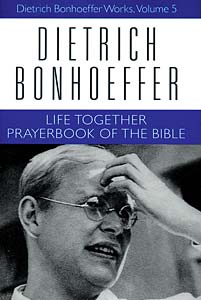
Bonhoeffer Life TogetherLife Together is Volume 5 of Fortress Press’s Dietrich Bonhoeffer Works (English Edition); it’s also the first one published (1995) in the series.

In addition to its being a new translation from Bonhoeffer’s German, there is an Editor’s Introduction to the English Edition, Editors’ Afterword to the German Edition [abridged], and an extensive (though not distractingly so) set of footnotes as part of an explanatory critical apparatus.

Though one could certainly read Life Together in its own right, editor Geffrey B. Kelly’s introduction is a great set-up. From the very beginning he highlights the fascinating history of the book:

It was because [the Gestapo] had shut down the preachers’ seminary at Finkenwalde that Dietrich Bonhoeffer was finally persuaded to compose his thoughts on the nature and sustaining structures of Christian community, based on the “life together” that he and his seminarians had sustained both at the seminary and in the Brothers’ House at Finkenwalde. … With the closing of the seminary at Finkenwalde and the dispersal of the seminarians, however, Bonhoeffer felt compelled not only to record for posterity the daily regimen and its rationale, but also to voice his conviction that the worldwide church itself needed to promote a sense of community like this if it was to have new life breathed into it.

Kelly brings to light more about the historical situation leading to Life Together (including the Finkenwalde seminary), as well as ties it in with some of Bonhoeffer’s earlier writing that undergirds the book. Kelly notes that Life Together is ultimately a highly Christocentric work. Indeed, Bonhoeffer writes:

Christian community means community through Jesus Christ and in Jesus Christ. There is no Christian community that is more than this, and none that is less than this. Whether it be a brief, single encounter or the daily community of many years, Christian community is solely this. We belong to one another only through and in Jesus Christ.

The critical footnotes are excellent and seem to be placed at just the right spots. They include biblical references, historical background, explanations of German-to-English translations, and descriptions, where needed, of the larger body of Bonhoeffer’s thought that informs a given passage.

For those wanting to read Life Together, there’s a nice bonus with the Fortress Press DBWE edition: it includes also Bonhoeffer’s Prayerbook of the Bible: An Introduction to the Psalms. Given his emphasis already in Life Together on the importance of the Psalms for the prayer life of the community (“The Psalter is the great school of prayer”), its inclusion in this volume is perfectly fitting. The text itself is just above 20 pages, with the addition of an English editor’s introduction and German editors’ afterword.
 

One More Bonhoeffer Quote,
and How to Get the Book

 
The last word of this review goes to Bonhoeffer. Here it is:

The fact that Jesus Christ died is more important than the fact that I will die. And the fact that Jesus Christ was raised from the dead is the sole ground of my hope that I, too, will be raised on the day of judgment. Our salvation is “from outside ourselves” (extra nos). I find salvation not in my life story, but only in the story of Jesus Christ. Only those who allow themselves to be found in Jesus Christ—in the incarnation, cross, and resurrection—are with God and God with them.

If you don’t already own Life Together, you should. If you do own it in an old paperback edition, you should get the Fortress Press Dietrich Bonhoeffer Works edition, if possible, whether through purchase or library check-out.

If you really want to go in depth, Geffrey B. Kelly (lead English editor of DBWE 5) wrote Reading Bonhoeffer, which includes a reading companion to Life Together.

Many thanks to Fortress Press for the review copy, given to me with no expectation as to the content of my review. You can find Life Together and Prayerbook of the Bible here on Amazon (affiliate link), or here at Fortress Press.


Bonhoeffer: If You Can’t Listen to Others, You Won’t Listen to God

Bonhoeffer Life Together

I’m reading Dietrich Bonhoeffer’s Life Together for the first time. As I near completion of the book, here is a convicting passage that jumped out at me:

But Christians who can no longer listen to one another will soon no longer be listening to God either; they will always be talking even in the presence of God. The death of the spiritual life starts here, and in the end there is nothing left but empty spiritual chatter and clerical condescension which chokes on pious words. Those who cannot listen long and patiently will always be talking past others, and finally no longer will even notice it. Those who think their time is too precious to spend listening will never really have time for God and others, but only for themselves and for their own words and plans.

You can find the book here (affiliate link) or here (they sent me a review copy). I’ll post again soon when I finish.

Got a Theology of Justice?

Justice ScaleI had a seminary professor who rightly noted the lack of ministers and churchgoers with a fully developed theology of justice.

“What’s your theology of justice?” he asked at the beginning of the class, which was met with blank but curious stares.

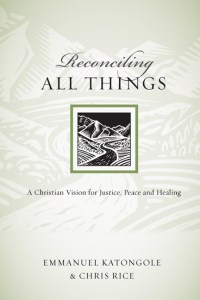
Reconciling All Things: A Christian Vision for Justice, Peace and Healing, more than any other book besides the Bible, has shaped my theological understanding of justice. Authors Emmanuel Katongole and Chris Rice develop a Christ-centered, Scripture-shaped, journey-oriented theology of justice reconciliation.

The authors urge that we slow down and take the time that is needed for true reconciliation—as a journey—to take hold. A question that permeates the book is, “Reconciliation toward what?” Katongole and Rice are aware that “reconciliation” calls to mind various “prevailing visions,” many of which lack theological rootedness in the Biblical story of God saving his people.

Reconciliation is, they suggest, a God-given gift to the world and the ultimate goal of the “journey with God from old toward new.” They write,

The journey of reconciliation hangs or falls on seeing Jesus. …For Christians, the compass for the journey of reconciliation is always pointing toward Jesus Christ.

Katongole and Rice make heavy use of Paul’s words to the Corinthians:

All this is from God, who reconciled us to himself through Christ and gave us the ministry of reconciliation: that God was reconciling the world to himself in Christ, not counting people’s sins against them. And he has committed to us the message of reconciliation. We are therefore Christ’s ambassadors, as though God were making his appeal through us. We implore you on Christ’s behalf: Be reconciled to God.  (II Corinthians 5:18-20, TNIV)

Seen as a gift, then, reconciliation becomes something that is “not for experts only,” but something that God calls all his children to. To equip us for the journey God gives us gifts: a cloud of witnesses, communion, peace and harmony, Sabbath, and the gift of Scripture, which is to shape us as God’s story in the world.

Midway through the book the authors arrive at a biblically understood definition of justice:

Justice is an aspect of God’s shalom, a notion that carries with it the idea of completeness, soundness, well-being and prosperity, and includes every aspect of life—personal, relational and national.

Justice, they say, is to include the interpersonal, relational aspect; yet it must also attend to structural considerations. To speak about justice so holistically, against dichotomies that might otherwise render our work ineffective, is wise and instructive for our journey toward reconciliation.

Reconciling All ThingsAlthough written by a black, Catholic, African academician and a white, Protestant, American practitioner, the book does not specify what issues in reconciliation may occur between any two specific groups and how those groups (or individuals) might think about moving forward. The authors do give helpful anecdotal evidence of reconciliation that bridges and heals divides of race, class, and ethnicity. But the reader wanting, for example, to mend and redress the brokenness in black-white relations in the United States may have to look to supplemental reading for more practical hints.

However, in its development of a fairly robust theology of reconciliation and justice, Reconciling All Things lays the important groundwork on top of which such future work can be built. Its chapters on lament (“The Discipline of Lament”) and leadership (“The Heart, Spirit, and Life of Leadership”) are profound in their call for Christians to slow down, locate themselves (emotionally and physically) among the broken places of the world, and to mourn and lament in those places, together with those who mourn and lament.

The one who would lead, then, is less concerned with specific techniques, tools, and strategies, and more concerned with seeing a gap, being deeply moved in response, and belonging to the gap, long before she or he would make proposals to initiate change and issue directives. In laying this groundwork, Katongole and Rice actually leave the work of developing techniques and specific reconciliation “skills” to the reader.

In the end, “You find that God has surprised you and your companions over and over with all that you needed to go on….” The assurance of this ongoing gift of God’s provision gives the Christian who would practice reconciliation all she needs to begin discerning her role in practicing reconciliation in everyday life.

I bought this book. You should, too, or check it out from your local library. Here at Amazon; here at IVP.

Accept the Incompleteness of Your Work

28102-Sabbath in the City_pYesterday I preached on Sabbath-keeping and what I think is the real reason it’s so hard for us to engage such a life-giving practice. As I’m reflecting further this week on cultivating a Sabbath-oriented mindset throughout my days, I remembered a book I read a few years ago that nourished me. It’s called Sabbath in the City: Sustaining Urban Pastoral Excellence.

Bryan P. Stone and Claire E. Wolfteich wrote this short yet compelling book on “what constitutes pastoral excellence in the urban context” and “what sustains it.” The authors use results from their project, “Sustaining Urban Pastoral Excellence,” which piloted a program of rest and renewal for 96 urban pastors across the country. According to Stone and Wolfteich, there are four primary activities or modes of being that make up pastoral excellence (which they also refer to as “virtue”):

  1. The cultivation of holy, life-giving friendships, particularly with other pastors;
  2. Regular Sabbath practices of rest that allow for acts of both creation and liberation;
  3. A renewal of the spirit through disciplines like prayer, reading Scripture, and silence;
  4. Study and reflection on the theology and practice of ministry (the authors tie this in with the above activity, renewal of the spirit).

While the authors note that pastoral excellence thus constituted is applicable to other, non-urban settings, they emphasize the uniqueness of the urban context and how it can challenge and fatigue urban pastors. They describe the city as “a place of distractions, busyness, and frenzied activity.” In contradistinction to more affluent suburban parishes, the urban church is likely to function as a full-service institution that addresses the variegated needs of the city in which it resides. The authors follow the group of 96 participants and show how the four practices listed above helped them to cultivate and sustain pastoral excellence.

Reading the book was itself an act of refreshment. Two aspects were most helpful to me:

First, the authors highlight the importance to pastors of cultivating holy, God-focused friendships. They write, “Friendships, then, are not simply a means of supporting a more healthy spiritual life. As some of the pastors in our project put it, ‘They are our spiritual life.’” The old African proverb is apropos here:

If you want to travel fast, travel alone. If you want to travel far, travel together.

Second, Sabbath-keeping is easier idealized than practiced. Stone and Wolfteich write,

[The] advice to accept the incompleteness of our work may be difficult to enact.

Though I didn’t have Sabbath in the City in mind at the time, the sermon I’ll post later this week interacts at length with this idea, i.e., why it is that we don’t take the Sabbath we know we want to take.

The book is intended for pastors in an urban setting, but even a suburban-dweller who is not involved in pastoral ministry will find rest and hope in Sabbath in the City.

You can find it on Amazon here and at Westminster John Knox Books here.

Fall 2014: A New Dietrich Bonhoeffer Book (DBWE 17!)

DBWE17

This October Fortress Press will publish a new–and the final–volume of the Dietrich Bonhoeffer Works (English edition). This is Volume 17: Index and Supplementary Materials.

Here is the description from Fortress Press:

The completion of the Dietrich Bonhoeffer Works, the definitive English translation of the Critical Edition, represents a milestone in theological scholarship. This wonderful series is a translation from the German editions of Dietrich Bonhoeffer Werke. The product of over twenty years of dedicated labor, the comprehensive and thoroughly-annotated sixteen-volume series will be the essential resource that generations of scholars will rely upon to understand the life and work of this seminal thinker in the wider frame of twentieth-century thought and history.

Now, the editorial team has offered an essential companion to the entire series in the form of an index volume.

Here are the book’s contents. It is more than just an index, per se:

General Editor’s Foreword to the Dietrich Bonhoeffer Works, English Edition—Victoria J. Barnett
The Translation of the Dietrich Bonhoeffer Works, English Edition: An Overview—Victoria J. Barnett
The Dietrich Bonhoeffer Works, English Edition: A Retrospective—Clifford J. Green
The Dietrich Bonhoeffer Werke: Afterword to the German Edition—Wolfgang Huber

Part I: Additional Letters and Documents

Part II: Comprehensive Chronology and Master List of Documents
1. Chronology 1906–1945
2. Master List of Documents for DBWE 8–17

Part III: Master Indexes
1. Master Index of Scriptural References
2. Master Index of Names
3. Master Index of Subjects

New to Bonhoeffer? I collected some reflections on his writings after spending much of Lent reading him. All my Bonhoeffer posts are gathered here. I’m currently reading Life Together and Prayerbook of the Bible (DBWE 5) and will post a review some time this summer.

As for DBWE 17, here is its product page at Fortress Press. It’s also here at Amazon.

My understanding is that the “Additional Letters and Documents” (Part I) have been published elsewhere, but not necessarily in English, and not in the German Dietrich Bonhoeffer Werke. So DBWE 17 will include material that is new to the Works series, some of it appearing in English for the first time anywhere.

The Dietrich Bonhoeffer Works series in English is described here, available for purchase (hardcover) through Fortress Press here. Fortress Press tells me that once DBWE 17 is published, there will be a discounted purchase rate available for the whole set for a short time this fall.

One Year to Better Preaching

One Year to Better Preaching

Here’s a recommended preaching resource for you: One Year to Better Preaching: 52 Exercises to Hone Your Skills, by Daniel Overdorf (Kregel, 2013).

A couple of weeks ago I reviewed the inspiring Preaching in an Age of Distraction. Whereas that book took a largely big picture approach, building on itself chapter by chapter, One Year to Better Preaching contains 52 exercises (plus a few “Bonus Exercises”) that give preachers a tangible, nuts-and-bolts set of practices to engage.

Overdorf wants to help preachers “sharpen preaching skills.” Just “an hour or two of effort” is required for most of these practices, so it’s an easy book to pick up, get right into, and use right away in preparing next week’s sermon.

The 52 exercises can be weekly ones for a year, or can easily be spread out over more than a year. Overdorf wisely suggests that preachers could focus on exercises that help them overcome their particular preaching weaknesses.

To try to achieve a “process similar to cross-training,” the 52 exercises are grouped into eight categories:

  1. Prayer and Preaching
  2. Bible Interpretation
  3. Understanding Listeners
  4. Sermon Construction
  5. Illustration and Application
  6. Word Crafting
  7. The Preaching Event
  8. Sermon Evaluation

Exercises include an introduction and setup to that exercise, a description of the exercise itself, an “I Tried It” testimonial section, and “Resources for Further Study.” A preacher could easily make the benefits of this book stretch out beyond a year.

To take just one example, Exercise Two, “Balance Your Biblical Diet,” suggests that preachers be sure they are preaching from both Testaments and from a variety of literary genres. Overdorf suggests charting out recent sermons to see where they fall, and shows a chart of his last 175 sermons in various biblical genres as an example. As balance in this sense is one of my preaching priorities, I appreciated this section.

Overdorf also makes the welcome suggestion that even a preacher’s illustrations be well-balanced:

Additionally, you may consider charting your recent illustrations. What aspects of life have you used most to illustrate biblical truth? How many illustrations have come from the world of sports? From your family? How many stories have you told from the Civil War, or from popular movies? How often have you quoted Tozer, Bonhoeffer, or your favorite contemporary authors?

Other exercises that I found helpful (and have tried put to use in the pulpit) have been: “Show, Don’t Tell” (on phrasing), “Have Listeners Evaluate You,” “Listen to a Storyteller,” and especially, “Craft Evocative Words.”

Despite how truly thorough the book is, one lack I noticed was any mention of the lectionary. For as many preachers as use the lectionary, some reference to it would have been useful. Or especially for preachers who don’t ever use the lectionary, suggesting they at least try it for a while would have been a good exercise.

One Year to Better Preaching is the kind of book you put right on your desk (not your bookshelf) where you can reference it repeatedly. I’m looking forward to continuing to mine its riches in the weeks and months of preaching ahead.

Thanks to Kregel for the review copy, offered with no expectation as to the content of this review. Find the book on Amazon here (affiliate link), at Kregel’s site here, and check out a pdf sample of the book here.