The Westminster Dictionary of Theological Terms, Reviewed

Westminster Dictionary of Theological Terms


The Westminster Dictionary of Theological Terms (Westminster John Knox Press, 2014) is a succinct compendium of key theological words and concepts.

One obvious advantage to the book is its portability. It’s less than 400 pages and easy to carry around in a satchel… though since receiving it, I’ve kept it on my desk with a few other works I reference a lot.

What sorts of “theological terms” does this dictionary cover? The publisher’s product page notes:

This second edition of The Westminster Dictionary of Theological Terms provides a comprehensive guide to nearly 7,000 theological terms—1,000 more terms than the first edition. McKim’s succinct definitions cover a broad range of theological studies and related disciplines: contemporary theologies, biblical studies, church history, ethics, feminist theology, global theologies, hermeneutics, liberation theology, liturgy, ministry, philosophy, philosophy of religion, postcolonial theology, social sciences, spiritually, worship, and Protestant, Reformed, and Roman Catholic theologies.

There is also a short annotated bibliography, list of works consulted, and set of abbreviations at the back of the book. The “Major Topics and Distinctive Terms and Concepts” section at the beginning gives the reader a framework of overarching topics into which the dictionary’s terms will fit. (E.g., “Bible,” “theology,” “worship,” “ethics and moral theology,” and so on.)

McKim himself has overseen much larger dictionaries. An initial point of skepticism for me was whether a theological dictionary this small and short could still be substantive. Definitions are somewhere in the 15-75 word range, depending on the term.

Yet as a quick-reference guide, it does well. Consider McKim’s definition of feminist criticism:

A critical approach to reading the Bible that focuses on the political, social, and economic rights of women. Diverse goals and methods are employed, with a common recognition that all texts are gendered. This implies not only that they reflect sexual differences between males and females, but also that they involve power. Feminist criticism seeks to make clear culturally based presuppositions found in texts.

Here’s another example, the entry for “agrapha,” a term one finds shortly after delving into studies of the Gospels:

(Gr. “unwritten sayings”) Sayings attributed to Jesus that circulated as traditions during the period of the early church. Also those sayings attributed to Jesus found outside the canonical Gospels.

The reader will also find terms like “Griesbach hypothesis,” “haggadah,” “Muratorian Canon,” perspectivalism,” “cuneiform,” “body-soul dualism,” “Trisagion,” “interiority,” “rechte Lehre” (German for “right teaching on doctrine”), and many more.

McKim’s goal was to provide a “wider, synthetic work that gives short, identifying definitions over a more comprehensive range of theological disciplines,” as opposed to something more “specialized” and “extensive.” The beginning theological students that McKim seeks to reach will find such a dictionary an especially useful entry point into the large and growing world of biblical and theological studies. McKim seeks to be more “broad” than “deep”; in this he succeeds, but the definitions are still plenty substantive to be useful to students at various stages.

The annotated bibliography is just five pages and glosses over important works (e.g., the commentaries section lists Anchor but omits Hermeneia). It does include a good page on Web-based resources for theological studies. The abbreviations include a couple pages of textual criticism abbreviations (including Latin), which will save the new reader of the Hebrew Bible from having to look most terms up elsewhere.

One feature I felt to be missing was a lengthier set of introductory essays on the nature and methods of theological study. I’m assuming Dr. McKim didn’t include this because it might exceed the intended scope of the work, but perhaps future editions could include–as many dictionaries do–at least two or three introductory essays to further orient the reader to theological study.

I’ve had the dictionary at my desk all summer, and each time I’ve looked up a word or phrase, I’ve found what I was looking for (with the exception of dereliction or “cry of dereliction”).

Especially for its price and accessibility, The Westminster Dictionary of Theological Terms is an excellent starting point for seminary students or for pastors who want to stay up-to-date on theological terminology.

Many thanks to WJK Press for the review copy, given to me with no expectation as to the content of my review. You can find the dictionary here on Amazon (affiliate link), or here at WJK Press.

Bonhoeffer’s Life Together: A Review

A scroll through some of my recent Facebook statuses shows the quotability of Bonhoeffer’s Life Together and its impact on me:

And:

Also, this one:

And, just for fun, here’s some Bonhoeffer from a letter quoted in Eberhard Bethge’s biography of him:

Bonhoeffer’s Life Together is substantial evidence that this servant of God saw himself as belonging to the church. The short, powerful book is both a gift and a challenge to any Christian who will take the time to study it.

I have just finished reading it through all the way for the first time. Though it’s true that there is a focus on how one can be a faithful member of a Christian community, the application to the Christian-as-individual is rich, as well.
 

How Life Together is Structured

 
There are five main sections of Life Together:

  1. Community
  2. The Day Together
  3. The Day Alone
  4. Service
  5. Confession and the Lord’s Supper

Bonhoeffer was, in fact, writing with his own seminary community in mind (see “Benefits of the DBWE Critical Edition,” below), but he also intended with Life Together something more universal:

We are not dealing with a concern of some private circles but with a mission entrusted to the church. Because of this, we are not searching for more or less haphazard individual solutions to a problem. This is, rather, a responsibility to be undertaken by the church as a whole.

Throughout each of the sections, the focus of the book is “life together under the Word” (my emphasis, but also an ongoing emphasis of Bonhoeffer). An editor’s footnote explains that “life together” can also be translated from German as “common life.”

Christians in community are a sort of sacrament to each other, a theme throughout Life Together:

The prisoner, the sick person, the Christian living in the diaspora recognizes in the nearness of a fellow Christian a physical sign of the gracious presence of the triune God. In their loneliness, both the visitor and the one visited recognize in each other the Christ who is present in the body.

Through prayer and worship together, intentional solitude, service to each other, hearing confession of sins and–ultimately–through participation in the Lord’s Supper, the purpose and aim of Christian communities is “to encounter one another as bringers of the message of salvation.”
 

Bonhoeffer’s Dialectic of Solitude and Community

 
Throughout the book Bonhoeffer explores the dialectic between living in community (“The Day Together”) and the individual’s time alone (“The Day Alone”). He suggests that the ones who will do best living in community are those who already do well alone. Those who cannot already live at peace with themselves will not do well in community:

Those who take refuge in community while fleeing from themselves are misusing it to indulge in empty talk and distraction, no matter how spiritual this idle talk and distraction may appear.

On the other hand, “the reverse is also true.” Discipleship is best when not received, experienced, and lived just as a solitary endeavor. Bonhoeffer says, “Whoever cannot stand being in community should beware of being alone” (emphasis in original).

Both solitude and the company of others, then, are needed:

We recognize, then, that only as we stand within the community can we be alone, and only those who are alone can live in the community. … It is not as if the one preceded the other; rather both begin at the same time, namely, with the call of Jesus Christ.

Bonhoeffer’s characteristic and refreshing forthrightness brings the point to a head:

Those who want community without solitude [Alleinsein] plunge into the void of words and feelings, and those who seek solitude without community perish in the bottomless pit of vanity, self-infatuation, and despair.

Whoever cannot be alone should beware of community. Whoever cannot stand being in community should beware of being alone.


Benefits of the DBWE Critical Edition

 
Bonhoeffer Life TogetherLife Together is Volume 5 of Fortress Press’s Dietrich Bonhoeffer Works (English Edition); it’s also the first one published (1995) in the series.

In addition to its being a new translation from Bonhoeffer’s German, there is an Editor’s Introduction to the English Edition, Editors’ Afterword to the German Edition [abridged], and an extensive (though not distractingly so) set of footnotes as part of an explanatory critical apparatus.

Though one could certainly read Life Together in its own right, editor Geffrey B. Kelly’s introduction is a great set-up. From the very beginning he highlights the fascinating history of the book:

It was because [the Gestapo] had shut down the preachers’ seminary at Finkenwalde that Dietrich Bonhoeffer was finally persuaded to compose his thoughts on the nature and sustaining structures of Christian community, based on the “life together” that he and his seminarians had sustained both at the seminary and in the Brothers’ House at Finkenwalde. … With the closing of the seminary at Finkenwalde and the dispersal of the seminarians, however, Bonhoeffer felt compelled not only to record for posterity the daily regimen and its rationale, but also to voice his conviction that the worldwide church itself needed to promote a sense of community like this if it was to have new life breathed into it.

Kelly brings to light more about the historical situation leading to Life Together (including the Finkenwalde seminary), as well as ties it in with some of Bonhoeffer’s earlier writing that undergirds the book. Kelly notes that Life Together is ultimately a highly Christocentric work. Indeed, Bonhoeffer writes:

Christian community means community through Jesus Christ and in Jesus Christ. There is no Christian community that is more than this, and none that is less than this. Whether it be a brief, single encounter or the daily community of many years, Christian community is solely this. We belong to one another only through and in Jesus Christ.

The critical footnotes are excellent and seem to be placed at just the right spots. They include biblical references, historical background, explanations of German-to-English translations, and descriptions, where needed, of the larger body of Bonhoeffer’s thought that informs a given passage.

For those wanting to read Life Together, there’s a nice bonus with the Fortress Press DBWE edition: it includes also Bonhoeffer’s Prayerbook of the Bible: An Introduction to the Psalms. Given his emphasis already in Life Together on the importance of the Psalms for the prayer life of the community (“The Psalter is the great school of prayer”), its inclusion in this volume is perfectly fitting. The text itself is just above 20 pages, with the addition of an English editor’s introduction and German editors’ afterword.
 

One More Bonhoeffer Quote,
and How to Get the Book

 
The last word of this review goes to Bonhoeffer. Here it is:

The fact that Jesus Christ died is more important than the fact that I will die. And the fact that Jesus Christ was raised from the dead is the sole ground of my hope that I, too, will be raised on the day of judgment. Our salvation is “from outside ourselves” (extra nos). I find salvation not in my life story, but only in the story of Jesus Christ. Only those who allow themselves to be found in Jesus Christ—in the incarnation, cross, and resurrection—are with God and God with them.

If you don’t already own Life Together, you should. If you do own it in an old paperback edition, you should get the Fortress Press Dietrich Bonhoeffer Works edition, if possible, whether through purchase or library check-out.

If you really want to go in depth, Geffrey B. Kelly (lead English editor of DBWE 5) wrote Reading Bonhoeffer, which includes a reading companion to Life Together.

Many thanks to Fortress Press for the review copy, given to me with no expectation as to the content of my review. You can find Life Together and Prayerbook of the Bible here on Amazon (affiliate link), or here at Fortress Press.

Bonhoeffer: If You Can’t Listen to Others, You Won’t Listen to God

Bonhoeffer Life Together

I’m reading Dietrich Bonhoeffer’s Life Together for the first time. As I near completion of the book, here is a convicting passage that jumped out at me:

But Christians who can no longer listen to one another will soon no longer be listening to God either; they will always be talking even in the presence of God. The death of the spiritual life starts here, and in the end there is nothing left but empty spiritual chatter and clerical condescension which chokes on pious words. Those who cannot listen long and patiently will always be talking past others, and finally no longer will even notice it. Those who think their time is too precious to spend listening will never really have time for God and others, but only for themselves and for their own words and plans.

You can find the book here (affiliate link) or here (they sent me a review copy). I’ll post again soon when I finish.

Got a Theology of Justice?

Justice ScaleI had a seminary professor who rightly noted the lack of ministers and churchgoers with a fully developed theology of justice.

“What’s your theology of justice?” he asked at the beginning of the class, which was met with blank but curious stares.

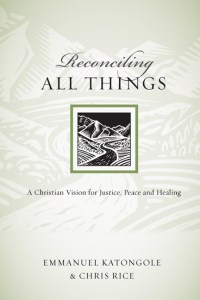
Reconciling All Things: A Christian Vision for Justice, Peace and Healing, more than any other book besides the Bible, has shaped my theological understanding of justice. Authors Emmanuel Katongole and Chris Rice develop a Christ-centered, Scripture-shaped, journey-oriented theology of justice reconciliation.

The authors urge that we slow down and take the time that is needed for true reconciliation—as a journey—to take hold. A question that permeates the book is, “Reconciliation toward what?” Katongole and Rice are aware that “reconciliation” calls to mind various “prevailing visions,” many of which lack theological rootedness in the Biblical story of God saving his people.

Reconciliation is, they suggest, a God-given gift to the world and the ultimate goal of the “journey with God from old toward new.” They write,

The journey of reconciliation hangs or falls on seeing Jesus. …For Christians, the compass for the journey of reconciliation is always pointing toward Jesus Christ.

Katongole and Rice make heavy use of Paul’s words to the Corinthians:

All this is from God, who reconciled us to himself through Christ and gave us the ministry of reconciliation: that God was reconciling the world to himself in Christ, not counting people’s sins against them. And he has committed to us the message of reconciliation. We are therefore Christ’s ambassadors, as though God were making his appeal through us. We implore you on Christ’s behalf: Be reconciled to God.  (II Corinthians 5:18-20, TNIV)

Seen as a gift, then, reconciliation becomes something that is “not for experts only,” but something that God calls all his children to. To equip us for the journey God gives us gifts: a cloud of witnesses, communion, peace and harmony, Sabbath, and the gift of Scripture, which is to shape us as God’s story in the world.

Midway through the book the authors arrive at a biblically understood definition of justice:

Justice is an aspect of God’s shalom, a notion that carries with it the idea of completeness, soundness, well-being and prosperity, and includes every aspect of life—personal, relational and national.

Justice, they say, is to include the interpersonal, relational aspect; yet it must also attend to structural considerations. To speak about justice so holistically, against dichotomies that might otherwise render our work ineffective, is wise and instructive for our journey toward reconciliation.

Reconciling All ThingsAlthough written by a black, Catholic, African academician and a white, Protestant, American practitioner, the book does not specify what issues in reconciliation may occur between any two specific groups and how those groups (or individuals) might think about moving forward. The authors do give helpful anecdotal evidence of reconciliation that bridges and heals divides of race, class, and ethnicity. But the reader wanting, for example, to mend and redress the brokenness in black-white relations in the United States may have to look to supplemental reading for more practical hints.

However, in its development of a fairly robust theology of reconciliation and justice, Reconciling All Things lays the important groundwork on top of which such future work can be built. Its chapters on lament (“The Discipline of Lament”) and leadership (“The Heart, Spirit, and Life of Leadership”) are profound in their call for Christians to slow down, locate themselves (emotionally and physically) among the broken places of the world, and to mourn and lament in those places, together with those who mourn and lament.

The one who would lead, then, is less concerned with specific techniques, tools, and strategies, and more concerned with seeing a gap, being deeply moved in response, and belonging to the gap, long before she or he would make proposals to initiate change and issue directives. In laying this groundwork, Katongole and Rice actually leave the work of developing techniques and specific reconciliation “skills” to the reader.

In the end, “You find that God has surprised you and your companions over and over with all that you needed to go on….” The assurance of this ongoing gift of God’s provision gives the Christian who would practice reconciliation all she needs to begin discerning her role in practicing reconciliation in everyday life.

I bought this book. You should, too, or check it out from your local library. Here at Amazon; here at IVP.

Accept the Incompleteness of Your Work

28102-Sabbath in the City_pYesterday I preached on Sabbath-keeping and what I think is the real reason it’s so hard for us to engage such a life-giving practice. As I’m reflecting further this week on cultivating a Sabbath-oriented mindset throughout my days, I remembered a book I read a few years ago that nourished me. It’s called Sabbath in the City: Sustaining Urban Pastoral Excellence.

Bryan P. Stone and Claire E. Wolfteich wrote this short yet compelling book on “what constitutes pastoral excellence in the urban context” and “what sustains it.” The authors use results from their project, “Sustaining Urban Pastoral Excellence,” which piloted a program of rest and renewal for 96 urban pastors across the country. According to Stone and Wolfteich, there are four primary activities or modes of being that make up pastoral excellence (which they also refer to as “virtue”):

  1. The cultivation of holy, life-giving friendships, particularly with other pastors;
  2. Regular Sabbath practices of rest that allow for acts of both creation and liberation;
  3. A renewal of the spirit through disciplines like prayer, reading Scripture, and silence;
  4. Study and reflection on the theology and practice of ministry (the authors tie this in with the above activity, renewal of the spirit).

While the authors note that pastoral excellence thus constituted is applicable to other, non-urban settings, they emphasize the uniqueness of the urban context and how it can challenge and fatigue urban pastors. They describe the city as “a place of distractions, busyness, and frenzied activity.” In contradistinction to more affluent suburban parishes, the urban church is likely to function as a full-service institution that addresses the variegated needs of the city in which it resides. The authors follow the group of 96 participants and show how the four practices listed above helped them to cultivate and sustain pastoral excellence.

Reading the book was itself an act of refreshment. Two aspects were most helpful to me:

First, the authors highlight the importance to pastors of cultivating holy, God-focused friendships. They write, “Friendships, then, are not simply a means of supporting a more healthy spiritual life. As some of the pastors in our project put it, ‘They are our spiritual life.’” The old African proverb is apropos here:

If you want to travel fast, travel alone. If you want to travel far, travel together.

Second, Sabbath-keeping is easier idealized than practiced. Stone and Wolfteich write,

[The] advice to accept the incompleteness of our work may be difficult to enact.

Though I didn’t have Sabbath in the City in mind at the time, the sermon I’ll post later this week interacts at length with this idea, i.e., why it is that we don’t take the Sabbath we know we want to take.

The book is intended for pastors in an urban setting, but even a suburban-dweller who is not involved in pastoral ministry will find rest and hope in Sabbath in the City.

You can find it on Amazon here and at Westminster John Knox Books here.

The Gay Bonhoeffer?

Strange Glory
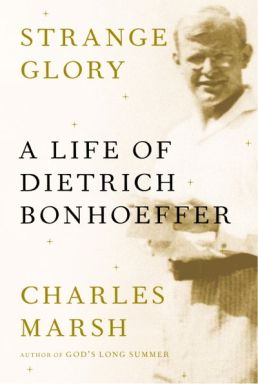
Was Bonhoeffer gay? That’s been a focus of inquiry and discussion since Charles Marsh has suggested the possibility in his new biography of Bonhoeffer, Strange Glory: A Life of Dietrich Bonhoeffer.

There is an excellent summary of the discussion from Sarah Pulliam Bailey here, which links to the major reviews of Strange Glory thus far, as well as offers insight on Bonhoeffer’s sexuality from a few Bonhoeffer scholars. (Her section heading “Speculation without confirmation” seems appropriate, though one could also question the appropriateness of the speculation itself.) There is also this New York Times review of the book, just published on the newspaper’s site today.

Wesley Hill offers some valuable and nuanced perspective (as does Charles Marsh, whom he quotes) in this post at the Spiritual Friendship blog.

Of course, Marsh’s biography covers much more territory than just the nature of Bonhoeffer’s relationship with Eberhard Bethge. I have the Marsh biography, though have yet to complete the Bethge biography. I look forward to reading Marsh firsthand soon.

Fall 2014: A New Dietrich Bonhoeffer Book (DBWE 17!)

DBWE17

This October Fortress Press will publish a new–and the final–volume of the Dietrich Bonhoeffer Works (English edition). This is Volume 17: Index and Supplementary Materials.

Here is the description from Fortress Press:

The completion of the Dietrich Bonhoeffer Works, the definitive English translation of the Critical Edition, represents a milestone in theological scholarship. This wonderful series is a translation from the German editions of Dietrich Bonhoeffer Werke. The product of over twenty years of dedicated labor, the comprehensive and thoroughly-annotated sixteen-volume series will be the essential resource that generations of scholars will rely upon to understand the life and work of this seminal thinker in the wider frame of twentieth-century thought and history.

Now, the editorial team has offered an essential companion to the entire series in the form of an index volume.

Here are the book’s contents. It is more than just an index, per se:

General Editor’s Foreword to the Dietrich Bonhoeffer Works, English Edition—Victoria J. Barnett
The Translation of the Dietrich Bonhoeffer Works, English Edition: An Overview—Victoria J. Barnett
The Dietrich Bonhoeffer Works, English Edition: A Retrospective—Clifford J. Green
The Dietrich Bonhoeffer Werke: Afterword to the German Edition—Wolfgang Huber

Part I: Additional Letters and Documents

Part II: Comprehensive Chronology and Master List of Documents
1. Chronology 1906–1945
2. Master List of Documents for DBWE 8–17

Part III: Master Indexes
1. Master Index of Scriptural References
2. Master Index of Names
3. Master Index of Subjects

New to Bonhoeffer? I collected some reflections on his writings after spending much of Lent reading him. All my Bonhoeffer posts are gathered here. I’m currently reading Life Together and Prayerbook of the Bible (DBWE 5) and will post a review some time this summer.

As for DBWE 17, here is its product page at Fortress Press. It’s also here at Amazon.

My understanding is that the “Additional Letters and Documents” (Part I) have been published elsewhere, but not necessarily in English, and not in the German Dietrich Bonhoeffer Werke. So DBWE 17 will include material that is new to the Works series, some of it appearing in English for the first time anywhere.

The Dietrich Bonhoeffer Works series in English is described here, available for purchase (hardcover) through Fortress Press here. Fortress Press tells me that once DBWE 17 is published, there will be a discounted purchase rate available for the whole set for a short time this fall.

Zondervan Theology Collection (Logos Software) Giveaway

Logos Zondervan TheologyWant to enter for a chance to get some free theology books? These ones won’t even take up shelf space. I’m joining with a few other bloggers and Logos Bible Software for a giveaway of Logos’s Zondervan Theology Collection.

What’s Up for Grabs

The collection can be found here. It includes these books:

How to Enter the Giveaway

Logos will choose the winner at random on August 1, with the collection sent to that person’s Logos account. If you don’t have a Logos account, you can register for free here. An iOS app for Logos (and other mobile apps can be found here, also free.

To enter, log in below using either your email address or Facebook account, and the Punchtab widget walks you through the rest. You can choose which methods of entry to use. Each prompted action is its own entry.

Logos has this disclaimer: By entering this giveaway you consent to being signed up to Logos’ “Product Reviews” email list.  (This just means you’d get emails with Logos-related content written by bloggers such as yours truly.)

UPDATE: WordPress doesn’t want to show the Punchtab widget for some reason. For now you can enter here.

Geffrey B. Kelly’s Reading Bonhoeffer

I’m a sucker for biblical and theological studies with an unapologetically doxological posture. So it was with excitement that I read John W. Matthews’s concluding sentence in his foreword to Geffrey B. Kelly’s Reading Bonhoeffer: A Guide to His Spiritual Classics and Selected Writings on Peace. Matthews writes:

I believe both the author and the subject [Bonhoeffer] would be disappointed if this book did not somehow draw you, the readers, closer to Jesus Christ and to your neighbor.

Kelly’s short yet substantive book does very much that. His first encounter with Bonhoeffer is intertwined with a beautiful story of his own re-awakening to Jesus. He says in the Preface:

Through Bonhoeffer’s inspirational words Jesus’ Sermon on the Mount seemed to be addressed to me personally for the first time. I was hooked.

Reading Bonhoeffer has four major sections:

  1. Dietrich Bonhoeffer: A Biographical Sketch
  2. On Reading Bonhoeffer’s Spiritual Classic, Discipleship
  3. Life Together: Bonhoeffer on Christian Community
  4. Selected Writings on Peace: An Ecumenical Conference and Two Sermons

The Preface, after describing Kelly’s transformative first read of Discipleship, offers some helpful background information and resources for Bonhoeffer studies. Kelly mentions, for example, his involvement with the International Bonhoeffer Society, English Language Section. He writes about the International Bonhoeffer Congress. And he discusses the genesis of the Dietrich Bonhoeffer Works series (English translation), published by Fortress Press.

1. A Riveting Biographical Sketch

Kelly’s “Biographical Sketch” is longer than Renate Bethge’s short work, and (obviously) a much quicker read than Eberhard Bethge’s monumental biography. 28 pages follow Bonhoeffer through his life, writings, and ministry.

Reading BonhoefferThere are a few things that stand out about Kelly’s short biography. For one, though it’s scant on details of Bonhoeffer’s early life (to be expected, given its length), the overview is thorough and really orients the reader well to Bonhoeffer. Kelly has a knack for succinctly summarizing Bonhoeffer’s writings in understandable language–even Bonhoeffer’s challenging Sanctorum Communio!

Second, Kelly’s biography is itself a gripping narrative. There is real movement as he progress through the various pastoral and academic positions Bonhoeffer held, from Berlin to London, from the seminary at Finkenwalde to the church struggle, Bonhoeffer’s arrest, and his imprisonment. I found myself wanting more dates in places (e.g., “Once back in Berlin…”–when?), but perhaps this omission was deliberate to keep the narrative moving. I was not able to put the book down until I had finished the page-turner of a biography.

Third, Kelly describes many of Bonhoeffer’s key terms and concepts, both in this first section and throughout Reading Bonhoeffer. Even a reader with little or no Bonhoeffer background will walk away from the biographical sketch with confidence to read any of Bonhoeffer’s writing.

Fourth, Kelly is clearly in awe of his subject, and rightly so. This, in turn, allows the reader to be inspired by Bonhoeffer. Kelly includes a treasure trove of Bonhoeffer quotations, some familiar, and some more off-the-beaten path. To wit:

I was quite pleased with myself. Then the Bible, and in particular the Sermon on the Mount, freed me from that. Since then everything has changed…. It was a great liberation. It became clear to me that the life of a servant of Jesus Christ must belong to the church, and step by step it became plainer to me how far that must go.

2. Kelly on Bonhoeffer’s Discipleship

Kelly served as co-editor, with John D. Godsey, of Discipleship, volume 4 in the (English) Dietrich Bonhoeffer Works series (DBWE). This second section of Reading Bonhoeffer offers more than 60 pages of commentary on that well-loved Bonhoeffer book, known also as The Cost of Discipleship.

After a brief “history of the text” Kelly proceeds section-by-section through Discipleship. In short, according to Kelly,

Discipleship is a book in which Bonhoeffer uses Jesus’ own words as recorded in the gospels and the exhortations of the apostle Paul to confront readers with the uncushioned challenges to all their inaccurate ideas, falsified by Nazi propaganda, of what it means to be a follower of Jesus Christ.

DBWE DiscipleshipReaders of Discipleship will of course already know that much of the book exposits Jesus’ Sermon on the Mount, but Kelly’s unique contribution as a commentator here is in highlighting the historical context that makes Bonhoeffer’s writing even more remarkable. Not only does Kelly note a particular Nazi evil to which Bonhoeffer may have been alluding, he also points ahead in Bonhoeffer’s life to instances where he would live out the call of his own writings.

As Kelly was co-editor of the DBWE volume, to read his chapter-by-chapter commentary on Bonhoeffer’s Discipleship is to have a guided tour by a leading expert, complete with summary statements and key quotes from that book. It’s well-footnoted with reference to the page numbers in the DBWE edition, so following up in Bonhoeffer’s text is easy. It’s an essential companion.

3. Kelly on Bonhoeffer’s Life Together

The first Bonhoeffer book to be published in the DBWE series was Life Together, which appears as volume 5, bound together with Prayerbook of the Bible. Kelly served as editor of that volume, which includes an introduction and critical apparatus (i.e., lots of informative and orienting footnotes).

DBWE Life TogetherAs with the previous section of Reading Bonhoeffer, Kelly’s commentary on Life Together, although significantly briefer in its section-by-section analysis, serves as a really useful reader’s guide. Its introductory section in this book is thorough, drawing on Kelly’s introduction in the DBWE edition. This sets up the reader well to better understand Bonhoeffer’s important work on community life in the Church.

Kelly, for example, points to “Bonhoeffer’s distinction between being with and being for the others in community.” He traces Bonhoeffer’s interest in building a community, going back even to socio-theological themes in Sanctorum Communio, Bonhoeffer’s first doctoral dissertation. Kelly summarizes and comments on each of the five sections of Life Together in turn: Community, The Day Together, The Day Alone, Service, and Confession and the Lord’s Supper.

4. Peace Writings

Kelly notes the tension that many students and readers of Bonhoeffer experience when they realize a conspirator against Hitler was a peace activist. After tracing the development of Bonhoeffer’s concern for peace, via an overview of his friendship with pacificst Jean Lasserre, Kelly looks at “three texts in which Bonhoeffer reveals himself as an uncompromising advocate for peace on the troubled earth where Nazism ruled with tactics of fear, violence, and the promise of a return to German military glory.” These include a 1932 conference lecture in Switzerland (with excerpts), a 1932 sermon (also with excerpts), and Bonhoeffer’s address to the Ecumenical Council of Christian Churches at Fanø, Denmark in 1934.

Together these orations display Bonhoeffer’s boldness and even impatience at times with inaction around him. In the address in Denmark, for instance, Bonhoeffer says,

Why do we fear the fury of the world powers? Why don’t we take the power from them and give it back to Christ? We can still do it today. The Ecumenical Council is in session; it can send out to all believers this radical call to peace.

Kelly helps Bonhoeffer’s call to peace come alive for the reader many decades later.

Concluding Remarks

There is little to critique in Kelly’s book. However, I was distracted by a number of sentences that were long (multiple modifying prepositional phrases) and comma-less. For example:

[Bonhoeffer] recognizes the danger posted by abandonment of Christ’s vision for the world and the manner in which even basically good people can succumb to the temptations to fall into the compromises in morality for which worldly attitudes are particularly prone, business and government plaudits given to acts of avarice and violence serving as prime examples of why it is necessary to be single-minded in following Christ.

A re-read of every such sentence showed that it was generally clear enough. But additional punctuation or shorter sentences would have helped. If there are future printings of this fine book, perhaps this and a few other minor editorial oversights could be re-visited.

Woven throughout Reading Bonhoeffer are “the twin aspects of Bonhoeffer’s spiritual legacy: scholarly expertise and pastoral care.” Kelly himself writes as one in the academy whose own pastoral sensitivity and concern is fully on display. I can only imagine how engaging and inspiring a Bonhoeffer course with him must be.

Reading Bonhoeffer would be a stimulating read for pastors, theologians, seminary students, and Christians who are intent to more faithfully follow Jesus in both individual and community contexts. The discussion questions at the end of each section will facilitate this book’s use in a small group, Sunday school, or classroom setting.

Kelly writes about Bonhoeffer, yes, but Bonhoeffer points so often and so clearly to Jesus, that a good commentary on Bonhoeffer (which this book is) will do the same. I am grateful for this short, hearty work that Kelly has written, and hope that more DBWE volumes receive similar treatment in the future.

By the way–I’m also grateful to Wipf and Stock Publishers for the review copy. They’ve provided a 40% off coupon code to readers of this blog, good toward the purchase of Reading Bonhoeffer or anything else on Wipf and Stock’s site. Simply use the code LETTERS at checkout. It’s good through the end of May.

How to Teach a New Worship Song to a Congregation

The below is a re-post from September 2012. I’m posting it again because it strikes me that summer could be a good time to try something new in your church services, including learning new songs together. Here are some suggestions for teaching a new worship song to a congregation or other group of people.

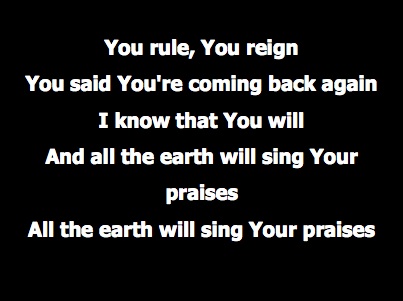
This morning I had the privilege of teaching our worshiping community this song:

Because I had guessed it would be new to the majority of our congregation, I decided to teach the song before we sang it all the way through. There are at least six things I like to try to do when teaching a new song:

1. Split it into pieces. I had the chorus for All the Earth Will Sing Your Praises on two Powerpoint slides. So I sang through the first half of the chorus (one PPT slide), stopped, and invited the congregation to sing that same part with me:

Then I repeated that same process for the second half of the chorus:

This way the congregation had heard the chorus once and sung it once.

2. Teach it not in order. This helps me and hopefully others remember that we’re actually working on learning the song. It also keeps us attentive to what part of the song we’re working on. We’ll piece it all together only once we’ve learned the component parts.

3. Highlight the lyrical content. If the tune is new, the lyrics likely are, too. At least they were in this case. So because this song speaks of Christ’s death, resurrection, and ascension, I took the opportunity to highlight that. I actually read some of the song lyrics before teaching it, and connected them to something my church says in our weekly worship: “Christ has died, Christ is risen, Christ will come again.” I mentioned that like 1 Corinthians 15 and Luke 24, this is one of the great summaries of our faith that can unite us across multiple denominations and Christian backgrounds.

4. Teach it with a conversational tone. I can’t think of any other way to teach a song than by actually talking with the congregation about it, what we’re doing, what we’re about to do, etc. I find a friendly, inviting, conversational tone works best. At least it feels right to me when I am teaching a song!

5. Affirm the congregation. Our worshiping community picked this song up so fast today (some knew it already, I think) that this was easy to do. I actually cut short the process of teaching the song so that we could begin from the beginning singing it all the way through. This was due to the fact that as I began teaching the verse (i.e., “I’ll sing so you can hear it”), I could already hear folks singing along. It would certainly not be out of place to sincerely say something like, “You all are good singers!” (Provided it’s true.)

6. Have them hear the song even before I teach it. For example, I had All the Earth will Sing Your Praises played over the speakers as they were leaving worship Monday, knowing we’d be learning it today (Wednesday). It’s a little thing, but it helps. Other options could have been playing it as the prelude today, emailing everyone a Web link to the tune, etc.

The bottom line for me is: if we’re doing a song that I think will be new to most in the room, we highlight it as such and carve out time to work to learn it together. Then singing the new song from start to finish is not only easier, but feels like something we have worked at together in a way that draws us closer as we worship.