What makes a worship song good for congregational singing?

What makes a worship song suitable for use in a corporate worship service?

I’ve been mulling this question over lately, trying to articulate what is often largely an intuition for me as a worship leader. Here’s a first go at it. (Thanks to my friend Steve for sharing some good thoughts with me on this.)

The song needs to be neither too low nor too high. Worship leader Jamie Brown has what I’ve found to be a helpful guideline for what range of notes to cover: “From C to shining C.” He puts it well, so I quote him here:

My rule of thumb is “C to shining C”…, meaning that the lowest a song should generally go is a C (one octave below middle C on a piano) and the highest it should go is one octave up from there. I’ll still use songs that dip a bit lower than a middle C or jump up to a D, Eb, or even an E from time to time, but I want to make sure the song isn’t “hanging out” up in the stratosphere or down in the depths.

Chris Tomlin and Hillsong United both sing their songs pretty high. Just try doing “From the Inside Out” in its original key!  (Or, rather, don’t. Drop it down a few steps before leading a congregation in it.) Same with Charlie Hall–love his music, but I often change the key before leading others in his songs. And that’s okay! In fact, it’s an important part of my job as a worship leader to make sure the range of the song is singable for a congregation.

The rhythm and lyrical cadence ought to be simple. Too many dotted eighth notes or too-fast moving lyrics are difficult for a group of folks to sing well together. I often slow down “Blessed Be Your Name” and “Everlasting God” when I lead them for this very reason. I want to make sure we have time to savor the lyrics we’re singing, and not feel rushed to squeeze them all in to the song.

If it’s new, teach it first. I wrote about this last week here.

“More stepwise motion and fewer big leaps up or down.” This one is from Steve. It articulates well what is often intuition for worship leaders. Simpler is better. An example:

Thanks to some students with whom I lead worship in a Christian college setting, I’ve really gotten into the band Gungor recently. I love their song “Dry Bones.”

This song has quite a few “big leaps up or down” and not a lot of “stepwise motion.” It’s hard for me to imagine a congregation singing this in a worship service. But I will blast it through my speakers when I am feeling the need for God to breathe life into my dry bones! I might even rock out to it on guitar with a fellow worship leader, or in a jam session. Great for in car, perhaps not for in the chapel.

I hesitate to use Gungor as a foil, especially since he’s one of the most thoughtful contemporary music worship leaders I know of. His We Will Run, on the other hand, is a great song for congregational singing–especially with its focus on repentance of sin and corporate turning back to God. Listen to it if you like:

Notice that “We will run” is one note, then “to you” is just a half step down:

That same pattern is then repeated a few notes higher: “Turning from our” is one note, “our sin” is just a whole step down.

Simple.

What would you add to this list?

Teaching a new worship song to a congregation

This morning I had the privilege of teaching our worshiping community this song:

Because I had guessed it would be new to the majority of our congregation, I decided to teach the song before we sang it all the way through. There are at least six things I like to try to do when teaching a new song:

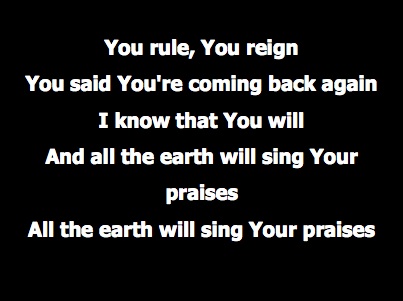
1. Split it into pieces. I had the chorus for All the Earth Will Sing Your Praises on two Powerpoint slides. So I sang through the first half of the chorus (one PPT slide), stopped, and invited the congregation to sing that same part with me:

Then I repeated that same process for the second half of the chorus:

This way the congregation had heard the chorus once and sung it once.

2. Teach it not in order. This helps me and hopefully others remember that we’re actually working on learning the song. It also keeps us attentive to what part of the song we’re working on. We’ll piece it all together only once we’ve learned the component parts.

3. Highlight the lyrical content. If the tune is new, the lyrics likely are, too. At least they were in this case. So because this song speaks of Christ’s death, resurrection, and ascension, I took the opportunity to highlight that. I actually read some of the song lyrics before teaching it, and connected them to something my church says in our weekly worship: “Christ has died, Christ is risen, Christ will come again.” I mentioned that like 1 Corinthians 15 and Luke 24, this is one of the great summaries of our faith that can unite us across multiple denominations and Christian backgrounds.

4. Teach it with a conversational tone. I can’t think of any other way to teach a song than by actually talking with the congregation about it, what we’re doing, what we’re about to do, etc. I find a friendly, inviting, conversational tone works best. At least it feels right to me when I am teaching a song!

5. Affirm the congregation. Our worshiping community picked this song up so fast today (some knew it already, I think) that this was easy to do. I actually cut short the process of teaching the song so that we could begin from the beginning singing it all the way through. This was due to the fact that as I began teaching the verse (i.e., “I’ll sing so you can hear it”), I could already hear folks singing along. It would certainly not be out of place to sincerely say something like, “You all are good singers!” (Provided it’s true.)

6. Have them hear the song even before I teach it. For example, I had All the Earth will Sing Your Praises played over the speakers as they were leaving worship Monday, knowing we’d be learning it today. It’s a little thing, but it helps. Other options could have been playing it as the prelude today, emailing a Web link to the tune, etc.

The bottom line for me is: if we’re doing a song that I think will be new to most in the room, we highlight it as such and carve out time to work to learn it together. Then singing the new song from start to finish is not only easier, but feels like something we have worked at together in a way that draws us closer as we worship.

And God planted a garden…

[R]econciliation has too often been discussed in Christian circles as if it took place in a vacuum, as if only people and not trees, rivers, mountains and farms are swept up in God’s redemptive drama. Our aim, then, is to point our attention back to the land, to say what a faithful life on it might look like, and to show that the land–indeed, the entire cosmos–is inextricably bound up in God’s salvation through Jesus Christ (see Col 1:20).

–Fred Bahnson & Norman Wirzba in Making Peace with the Land

The newest offering from IVP Books’ Resources for Reconciliation series is Making Peace with the Land: God’s Call to Reconcile with CreationThe Resources for Reconciliation series pairs a practitioner with an academician, who then together address the theology and practice of reconciliation in a given sphere of life. The first book in the series, Reconciling All Things, profoundly influenced my development of a Biblical theology of justice and reconciliation.

Practitioner Fred Bahnson is an agriculturalist and writer (and excellent theologian); academician Norman Wirzba is a theology professor at Duke Divinity School (and grounded practitioner). Making Peace with the Land makes the Biblical case that “redemption is cosmic,” and so extends to the whole created order, not just humanity. God wants all creatures (“human and nonhuman”) to be “reconciled with each other and with God.” In other words, our Biblical theology of reconciliation is anemic if it does not extend to a loving stewardship of the whole of God’s creation. The authors warn against “ecological amnesia.”

Our “ecological amnesia” is at its core a theological issue. God is God of the soil, a gardener who loves the soil and brings forth life through it (as noted in Genesis). But we have worked against the land in developing systems and structures for farming that draw heavily on “our own agricultural scheme” and “monocultures of annual crops.” Instead we need to “look to nature as a model for how to practice agriculture,” engaging in what Bahnson calls regenerative agriculture, founded on the truth that “the ecosystems in which we find ourselves–created by God and deemed ‘very good’–are far more adept at growing things than we are.” The profile in chapter 6 of the work of ECHO (Educational Concerns for Hunger Organization) both astounded and inspired me. (Check out ECHO here.)

Bahnson and Wirzba are compelling: “Surely it is a contradiction to profess belief in the Creator while showing disregard or disdain for the works of the Creator’s hands.” After reading a lengthy description of how Chicken McNuggets are made, I was about ready to become a vegetarian. Regardless of how the phrase “animal rights” makes you feel, animal torture is not possibly justifiable by those who have been called to co-steward the creation with God.

At times I desired more exegetical nuance when the authors dealt with Scripture. For example, though the prologue is convincing enough that we ought to view God as gardener, to accept that God’s gardening work is “the most fundamental and indispensable expression of the divine love that creates, sustains, and reconciles the world” is difficult for me to… well… reconcile with the expression of divine love on the cross. In the end, it’s all of the above. That said, Bahnson’s note on the acacia tree in Isaiah 41:18-19 as a nitrogen-fixing tree and thus “divine agroforestry advice” was awesome. And the authors do affirm elsewhere that reconciliation begins with the person and work of Jesus–it is in Jesus that all things hold together, as they point out from Colossians 1.

Many of us practice “a sort of gnostic disdain for manual labor, soil husbandry, caring for physical places and living within our ecological limits.” If I make enough money to simply buy food, I don’t need to get close to that food except to pick it up at the store (or restaurant!). Then I eat it and keep going with my work, however disconnected I may be from the source of that food. However,

Reconciliation with the land means learning to see the land as part of God’s redemptive plan and acknowledge God’s ongoing presence there. That will require putting ourselves in proximity to the land and staying there long enough to be changed.

After reading this book, I’m unsettled. I’m a lot farther from “the land” than I perhaps should be. I’m not sure what to do with that. And my theology of reconciliation has often not been robust enough. But I’ve been thinking more about my food, its sources, and my connection to God’s land now that I’ve read Making Peace with the Land. I’m not suggesting that we engage carbon offsets as a solution. (Slight detour: does this not look eerily like indulgences?)

But if I’m unsettled, I’m also inspired. What if I allowed my having been reconciled with Christ to inform a ministry of reconciliation not limited to other people? What if we followed Wirzba’s advice to allow our weekly “Eucharistic eating” to “not only transform the eating we do with people,” but to also transform “the entire act of eating, which means [changing] the way we go about growing, harvesting, processing, distributing, preparing and then sharing the food we daily eat”?

That would be an abundant life.

Thank you to IVP for the free review copy, in exchange for an unbiased review, and–as it turns out–a re-examined life. Find more about Making Peace with the Land here (IVP) or here (Amazon). Highly recommended.

Tonight’s theological questions at dinner from the 4-year-old

There were two:

Does Jesus make people do stuff?

and

What does “crucified” mean?

My answer to the first question (after a long pause): “Jesus can make people do stuff. Jesus can do anything he wants to. But he usually doesn’t make people do stuff. He lets them decide.” Some will disagree with this. But I think it has pretty good Scriptural warrant. I’m sure this question will come up again. And I thought the sex question was hard!

The second question I answered as specifically and succinctly as I could. I actually got a little teary-eyed as I described crucifixion to him. His response to my answer was appropriate, I thought: “Why did they do that?”