Tonight’s theological questions at dinner from the 4-year-old

There were two:

Does Jesus make people do stuff?

and

What does “crucified” mean?

My answer to the first question (after a long pause): “Jesus can make people do stuff. Jesus can do anything he wants to. But he usually doesn’t make people do stuff. He lets them decide.” Some will disagree with this. But I think it has pretty good Scriptural warrant. I’m sure this question will come up again. And I thought the sex question was hard!

The second question I answered as specifically and succinctly as I could. I actually got a little teary-eyed as I described crucifixion to him. His response to my answer was appropriate, I thought: “Why did they do that?”

“Septuagint” is the wrong word to use


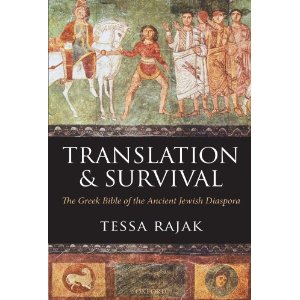
“Septuagint” is perhaps the wrong word to use to describe the Greek translation of the Hebrew Scriptures. Just about every author I’ve read so far on the Septuagint is quick to point this out. In the mail the other day I was happy to receive my review copy of Tessa Rajak’s Translation & Survival: The Greek Bible of the Ancient Jewish Diaspora (Oxford University Press, 2009). She puts it this way:

The term “Septuagint” does not appear in the title of this book, and that is no accident. It is in fact an inappropriate description for the Jewish Bible in Greek. The problem is that “Septuagint” is a term which evolved in the usage of the early Church and refers to the corpus created there as we find it in the great biblical codices of the fourth century CE. It is precisely these layers of reception that we shall need to strip away, at any rate until the last chapter of this book. But even were we to resolve to stick with the name, as one of convenience, we would soon find that the ambiguities and complications of its usage outweighed that convenience. (14-15)

Larry Hurtado recommends the book here. Keep checking back here–I’ll have a full review up some time next month.

Words on the Word Interview with Leslie C. Allen, Author of Liturgy of Grief

Not long ago I reviewed Leslie C. Allen’s Liturgy of Grief: A Pastoral Commentary on Lamentations. The book gently yet steadily coaches the reader in processing grief, expositing and drawing on the rich Biblical tradition of lament. I interviewed Dr. Allen this week.

You write, “Contemporary Western culture provides little space for grief.”  Why do you think this is?

A very good question. Perhaps, in reflection of a technologically advanced and relatively stable society, our culture expects comfort, convenience, and control, and won’t face up to anything contrary. Medication is assumed to be the answer to psychological as well as physical ills. So we feel embarrassed by grieving (and dying) people.

How can churches and worshiping communities better attend to the grieving processes of their community members? In addition to Lamentations and the rest of the rich Biblical tradition, are there other resources available to worship leaders and liturgists to better help them guide their communities through experiences of grief?

One example comes to mind. When I moved my home and started attending a new church some years ago, I found the associate minister’s morning prayer each Sunday was prayed on behalf of those present who were suffering in various ways. It was a different prayer each week, always wide reaching and beautifully crafted. I (and doubtless others) appreciatively felt she was praying for me, at a time when I needed prayer but found it difficult to pray.

You say, “‘Why?’ in the complaint psalms is never an intellectual request for information but a loaded rhetorical question that conveys emotional bewilderment and protest.”  Is there ever an appropriate time for the pastor/chaplain to address questions like “Why did this evil happen?” through a more deliberately theological-philosophical lens?  If so, how does the chaplain discern if and when it’s appropriate to go there?

C.S.Lewis’s The Problem of Pain evidently brought him no help as he penned A Grief Observed. Lamentations felt free to eventually tackle theological issues, using prophetic revelation as the guideline, whereas we and those we try to help are not living in the immediacy of such a situation when prophecy was being directly fulfilled. And Lamentations is able to give a variety of answers, perhaps in the hope that some at least would be found helpful. If a grieving person truly seeks an intellectual answer, one may tentatively broach some thoughts to be tried on for size. Otherwise, it is better considered when the emotional passion of grief does not intrude.

You mention the New Testament story (Mark 4:35-41) where Jesus’ disciples ask, “Teacher, don’t you care if we drown?”  Especially given Jesus’s reply (“Why are you so afraid? Do you still have no faith?”), how can we who worship God know when it’s appropriate to lament or complain in prayer and when it’s not?  This is the “how far is too far?” question with relation to lament and prayer!

If our prayers are to be real, we must pray from where we are, emotionally and in other ways. We miss a tone of voice in the written form of biblical revelation. I suspect Jesus’ reply was mainly meant as reassurance, rather than rebuke, like the examples of “Do not fear” in Isaiah 40:9; 41:13, 14; 43:1-2; 44:2, etc.

I happened to read Allen’s book just before the Colorado movie theater shootings. Reading it inspired me to find and pray two lament prayers in response (here and here). As a Professor of Old Testament and hospital chaplain, Allen in his book provides the reader with good space for grief and Biblically-inspired means to lament.  A Liturgy of Grief is available here.

My 4-year-old son reviews his first book, Alpha Oops! The Day Z Went First

Following on the heels of a great guest post from Timothy Dean Roth Wednesday, I’ve invited another guest to post at Words on the Word, this time for Family Friday: my four-year-old son. Here is his review of a book he particularly enjoys, Alpha Oops! The Day Z Went First. I’ve typed it up, but the words are all his.

A always goes first, but Z wants to go, and Z and Zebra are sick of the “last in line stuff.” W sits on a whale spout. Z has a zebra jumping. “O is for owl,” “N is for night,” and everyone else thinks it’s not H’s turn, but it really is… right? (Yeah.) He goes right where he goes, because that’s just how the alphabet goes.

I like that Z goes first. A goes last and the alphabet goes backwards. B is “bouncing on… a brisk breeze.”

I didn’t like “D is for dragon and damsel in distress,” because she might get hurt. (I don’t really want to get hurt.)

Our new neighbors would like this book. We could give it to someone else, and then tell everyone in the world to give it to someone else, after they read it.

Alpha Oops! is available at Amazon, or, I’m sure, at your local library.

Review of The Greek of the Septuagint: Supplemental Lexicon

This, then, is the single dominant characteristic of the LXX vocabulary: it is normal, idiomatic Greek. I base my construal of it on this hypothesis whenever I can.

–Gary Alan Chamberlain in The Greek of the Septuagint: A Supplemental Lexicon

Not long ago I noted that “the challenging nature of Septuagint vocabulary is … one reason why even students of New Testament Greek stay away from the Septuagint. How can one make her or his way through the Septuagint in Greek in a way that is not entirely frustrating?” To begin, you could read about why you need the Septuagint here, and some helpful resources here to get started. Also, I recently reviewed Bernard A. Taylor’s Analytical Lexicon to the Septuagint: Expanded Edition, a one-stop reference work to guide readers through the LXX.

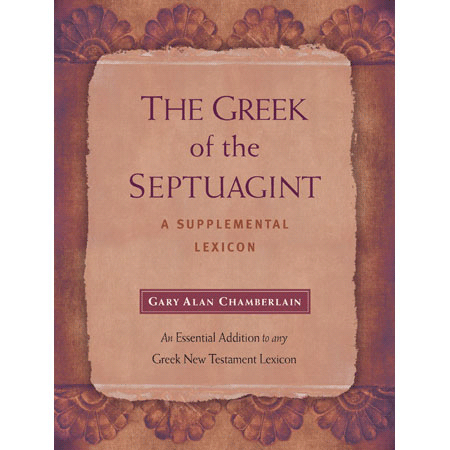
I have now had the occasion (and privilege) to spend some time with The Greek of the Septuagint: A Supplemental Lexicon, by Gary Alan Chamberlain. (Thanks to Hendrickson for the review copy, provided in exchange for an unbiased review.)

Chamberlain intends his lexicon to be a supplemental one, an addition to any Greek New Testament lexicon. (He has BDAG specifically in view.) The vocabulary of the Septuagint is more expansive and potentially different enough from New Testament vocabulary that a lexicon like this is warranted. Many Greek students, especially Biblical studies ones, come to the LXX after first studying the New Testament. So if they already own BDAG or some other New Testament lexicon, the potential need for something like this to “fill in the gaps” could make sense.

The Greek of the Septuagint contains lexicon entries for 5,000 LXX words not in the NT, as well as 1,000 words with LXX-specific uses that a NT lexicon would not carry. For the latter, Chamberlain simply adds to the BDAG numbering system, so that the entry for καθίστημί, for example, begins, “3.b. seek to establish, declare.” Words that the lexicon does fully treat have morphological information (e.g., principal parts for verbs) and citations of word usage in the LXX and beyond.

There is “no treatment of the most common words” in the LXX, so not just a cursory knowledge but a solid grasp of Greek vocabulary would be needed to use this lexicon on its own. I.e., a first- or second-year Greek student really would have to use this as the “supplemental” lexicon it intends to be. “Throughout this work,” Chamberlain notes, “I have assumed that the user has sufficient command of ancient Greek to cope with articular infinitives, genitive absolutes, and the varied means of expressing volition and command. The thousand or so most common LXX words should convey relatively few difficulties.” This work won’t serve the Greek initiate, in other words, but Chamberlain does not intend for his work to be “elementary.”

One might ask, Why not just purchase a full-on Septuagint lexicon? Here is where Chamberlain makes the “distinctive contribution…to LXX studies” that he aims to make.

The dense 19-page introduction explains several classifications of LXX words, and is complemented by an exceedingly useful set of word lists in the appendices. (Hendrickson has the intro in pdf here.) Chamberlain includes word lists and discussion of:

  1. Precise parallels between the LXX and extrabiblical texts. This is where he asserts that LXX vocab is “normal, idiomatic Greek.” He accounts for what others have claimed are examples to the contrary (e.g., “Semitisms”) with the following categories.
  2. Transliterations of the Hebrew into Greek.
  3. Hapax Legomena–Greek words that occur once in the LXX and nowhere else in ancient Greek literature, as well as words that occur multiple times in the LXX but nowhere else (he notes all this and all these categories throughout the lexicon in the appropriate entries, a sample pdf of which is here).
  4. Greek words that occur first in the LXX.
  5. Words with no parallel in other ancient Greek sources.
  6. Stereotypical translations (“calques,” where “translators faced severe challenges in rendering a few common Hebrew terms for which no equivalent was possible within the framework of Greek language”).
  7. Mistranslations (where “LXX translators misconstrued the meaning of their sources’ words, through a confusion of roots or a misunderstanding of meaning of the source”).
  8. Textual variants (more than 200 instances, including his suggested emendations, helpfully organized in canonical order).
  9. More complicated words “involving multiple factors” (“We are simply trying to explain how a Greek word was placed in a context that does not make good sense if we read it as a Greek sentence”).

Having read the descriptions of each of these categories and looked through the corresponding word lists, this reader is convinced that The Greek of the Septuagint offers something that neither BDAG nor any other LXX lexicon on the market (of which I’m aware) currently does. Even without the actual lexicon entries, the word lists and explanations are an invaluable contribution to LXX studies. (The lexical entries themselves are appropriately concise yet substantive.)

His Appendix II is the place to start when looking up a word. It shows (through the use of bold, italics, and regular font) if a word is in this lexicon but not BDAG; if it is in BDAG and supplemented here; or if the word is sufficiently covered in BDAG and therefore not in Chamberlain’s lexicon. Appendix III has a neat listing of LXX book titles in English and Greek, as well as a table that shows the differing versification between the two.

The Greek and English fonts are clear and easy to read (the Hebrew font is a bit small).

I found The Greek of the Septuagint to be a lexicon one has to work at. In other words, it’s not like Taylor’s lexicon, which one could easily pick up and use right away off the shelf. Carefully reading the 4-page preface and 19-page introduction is pretty much required to be able to make use of Chamberlain’s work. But that’s true of BDAG, too, and sort of the point of a preface and introduction in the first place. So that’s not at all a strike against this lexicon. In fact, the user who is willing to put in the work will find great reward in a deepened understanding of the LXX and its vocabulary.

Chamberlain concludes his introduction in this inspiring way:

For many years I have been reflecting upon and experimenting with the question of what the faithful reading of Scripture is in relation to life lived very much “in the world.” Both the method and the goal of preparing this lexicon have been the reading of the LXX text itself (alongside the Hebrew Bible, the Greek NT, and not infrequently the Vulgate) with the prayerful attention the Benedictines call lectio divina. I have made constant and grateful use of the astonishing resources of biblical and classical scholarship, with an embarrassed and hopeless inability to be in any sense in command of those resources. I want simply to apprehend the text, and beyond that to engage the living reality of which the text intends to speak.

Chamberlain’s lexicon is available here.

Porn is a gateway drug

My blogging friend Dave (who also has a daughter Junia) just blogged about pornography as a gateway drug.

He writes:

Porn is not an isolated evil.  It is connected to the growth of sex trafficking in our world.  One thing we talk about often at meetings of Freedom and Restoration for Everyone Enslaved is that if men did not buy women, there would be no forced prostitution.  Yet along with that, men do not just wake up one day and decide to buy a woman.  Porn is a factor for it teaches men that women are objects to be used for his enjoyment.  Like any other addiction, eventually a stronger dose is needed and stronger doses are more and more available in the form of women and girls forced into prostitution.

Read the whole thing here.

Prayer in the liturgy: Is it worth it?

Today’s post comes from Timothy Dean Roth, author of The Week That Changed the World: The Complete Easter Story (amzn). There are few people whose words inspire, challenge, and fill me with a sense of God’s presence more than Tim’s. His book has been an excellent aid to my experience of Holy Week these last two years. He’s given me some of my best sermon ideas. Etc., etc. He’s a great dialogue partner and friend. As Words on the Word addresses themes of worship and liturgy on Wednesdays, Tim asks today: “Prayer in the liturgy: Is it worth it?”

If you go to a Church that has a time when a lector reads prayers and the congregation responds after each one-sentence prayer, “Lord, hear our prayer,” you may wonder sometimes whether the Lord really does hear our prayer, especially if you were spacing out and can’t even remember what the prayer was. The answer is that God does indeed hear these prayers, and he responds to them.

Here’s why. These prayers are themselves written by liturgists in a spirit of prayer in response to the needs of the times we live in. The Holy Spirit himself prompts liturgists who are attuned to his voice to write down these prayers. I have never heard a prayer read to the congregation that could be considered outside God’s will (and hopefully you haven’t either), and we know that God favorably answers prayers that are in accordance with his will. We also know that God the Father answers the prayers of the righteous, just like he answered the prayers of his own Son, though only if prayed in a spirit of steadfast faith and without doubt, which is the hard part.

Fortunately for those of us with weak faith, there are some crazy people out there who do believe that when we pray outlandish things like, “That you may increase peace in the Middle East” or, “That you may help all politicians recognize the value of life,” these things are actually going to happen. God hears these people, even if we can’t quite figure out how. What if a suicide bomber changes his mind the day before blowing up a mosque because enough people like the one right next to you sincerely said, “Lord, hear our prayer”? We can’t know how these prayers are answered, but they are. God’s word promises us that. Every little prayer counts, every little prayer brings a little more good into the world and a little less evil, and even the tiniest difference in the chaotic, unpredictable daily stock market fluctuations of good versus evil is worth the effort.

God is going to answer these prayers with or without your participation, so why not participate, why not fully abandon yourself to these prayers? Through these prayers, he’s inviting every one of us, from greatest to least, to join the battle, to actively participate in his work of transforming this world.