Free Book! Ephesians commentary by Arnold (Zondervan)

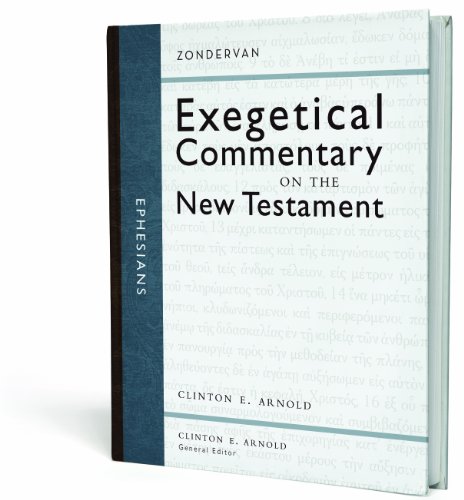
I am giving away a book at Words on the Word this weekend. It’s a commentary on Ephesians by Clinton E. Arnold, from Zondervan’s Exegetical Commentary on the New Testament series.

Last weekend I reviewed Luke from that same series. You can read that review to find out more about the structure and layout of each book in the series. Anyone who is preaching, teaching, or just studying their own way through Ephesians will find this book illuminating. Those who know even a little Greek will benefit most from this book, but Arnold translates everything, so those who know no Greek will benefit, too.

I will choose a winner at random. To enter the drawing, comment on this blog post with your answer to the question, “If you had a chance to sit down for a cup of coffee or tea with the apostle Paul today, what is the first thing you would ask him?” (I know what I would ask!)

Then if you link to this post on your Facebook, Twitter, blog, etc., come back here to tell me in the comments section that you did, and you’ll receive a second entry. I will announce the winner on the blog first thing Monday morning.

If you want to skip the giveaway contest and just buy the book for yourself, you can find it here.

Talking to a four-year-old about sex?

How do you talk to a four and a half-year-old about sex?

Before I had kids, I would have said… you don’t.

But then my four-year-old son started asking about whence his younger brother (and now a younger sister) came.

My wife, good science student that she is, opted for the straight-up biological explanation: There is an egg, it gets fertilized, baby grows inside mommy, baby comes out.

That held him for a little while. But then today, this conversation ensued:

4.5-year-old son: Daddy, how did you fertilize the egg?

Me (stammering): Uh… egg?

He: Yeah, how did you fertilize mommy’s egg?

Me: Well, there’s just a special way that mommy and daddy show love to each other that makes that happen.

He: Can I watch?

Me: No, it’s private.

He: Then can I watch from the wall?

That’s as far as I’m willing to go in explaining sex to a kid that young… on the one hand, I want him to hear it from me before he hears heaven-knows-what descriptions from his peers when he starts going to school all day. On the other hand, I’m not sure he’d be able to handle all the details (or that it’s appropriate to share them at this point). I can see him sharing his newfound knowledge with someone else at an inopportune time.

So parenting pros (or even parenting novices)… how do you talk to your kids about sex? How much do you say and when?

Zondervan Book Giveaway

Head over to Koinonia, Zondervan Academic’s blog, for another Wednesday giveaway. This time they are giving away the forthcoming Four Views on the Apostle Paul. Details are here.

I’m especially grateful to Zondervan for their featuring one of my reviews on their blog recently.

Koinonia is accepting submissions until Thursday midnight.

All you need is your Septuagint and this (LXX+ALS=Septuagint Success)

I wrote a few days ago about why you need the Septuagint. I noted:

For students of Greek, the LXX is a good way to challenge oneself in Greek beyond the New Testament. There is a fuller and deeper vocabulary in the Septuagint that helps Greek students grow in their knowledge of the language.

While this is true, the challenging nature of Septuagint vocabulary is also one reason why even students of New Testament Greek stay away from the Septuagint. How can one make her or his way through the Septuagint in Greek in a way that is not entirely frustrating?

I’ve listed some helpful Septuagint resources here, including vocabulary helps. But what if someone just wants to read through the Septuagint in Greek, unencumbered by multiple resources at hand? One thing I value is not having to use four or five additional reference works to understand the first reference work.

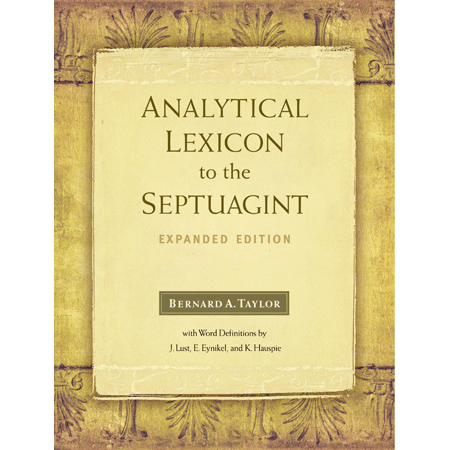
Enter Bernard A. Taylor’s Analytical Lexicon to the Septuagint: Expanded Edition (Hendrickson, 2009).

Taylor lists every single word found in Rahlfs Septuagint, the standard LXX text, as it appears (inflected) in the text. Each word then has full parsing information and the basic word meaning taken from Lust, Eynikel, and Hauspie’s Greek-English Lexicon of the Septuagint [GELS].

This means that the user of this expanded edition (ALS, hereafter) does not need an additional lexicon at hand to get basic word meanings. To be sure, Taylor notes:

The abridged GELS entries in this volume include only the basic word definitions, not the contextual meanings found in the subsequent paragraphs of many of that work’s entries. The word definitions included are glosses, or translation equivalents, rather than [full] descriptions of each word’s meaning.

If you’re looking to read the Septuagint and do word studies, you’ll need an additional resource. But if you need only the basic meaning (what most people want who are reading straight through), Taylor’s lexicon covers all your needs. (And he certainly doesn’t claim that the glosses in his ALS are anything more than that, glosses.) You get full parsing information, which then refers you to the lexical form of the word, which then has the basic word meaning from GELS. Especially helpful is the inclusion of proper nouns, so that there is really no word in the LXX that is left untouched by this lexicon.

ALS is intuitive, well-laid out, and easy to use. The Greek font is clear and big enough to read easily. The lexical forms of words (i.e., where the basic word definitions are) are in bold for easy reference. The book is not very heavy (two pounds), so it travels well. More than 20 pages of introductory material clearly and concisely explain the features of the lexicon, abbreviations, suggestions for use, and overview notes on various parts of speech, transliterations, and so on. The introductory materials are instructive and easy to read, yet ALS presents its information so well that its user can easily put it to work right away.

It’s tempting to debate the merits of a work like this in print, when all that Taylor offers (and more) can be had in electronic Bible programs like BibleWorks. However, to do that would not be to review this lexicon in its own right. Of course an electronic database (that can parse and provide lexical meanings of words) is faster to use, but a print copy is easier on the eyes, you don’t have to wait for it to boot up, etc. That’s all beside the point, though. The important thing about Taylor’s expanded edition is that it has morphological and lexical analysis, so it functions as an all-in-one supplement to guide the reader through the Greek of the Septuagint.

Analytical Lexicon to the Septuagint: Expanded Edition is now on my bookshelf right next to my Rahlfs Septuagint. It’s hard to imagine a more useful Septuagint resource than Taylor’s.

I thank Hendrickson Publishers for the review copy of this book, which was provided to me free of charge in exchange for an unbiased review. Taylor’s lexicon is available here.

One-Stop Site for Worship Planning


In January I had the privilege of taking two college students with me to join with a gathering of worship leaders from many backgrounds at the Calvin Symposium on Worship. I’m still making use of the things I learned while there.

The Calvin Institute of Christian Worship has a fantastic Website. It’s a good place to spend some time, and on this Worship Leading Wednesday at WotW, I heartily recommend it. One of their resources that I’ve found most helpful as a worship planner is their “Plan Worship” space. Here you can, in their words:

The CICW also provide links to help in the crafting of music, prayers, and art for worship services.

Why do you blog?

Image source: http://www.winsonyeung.com/internet-marketing/blog-management-made-easy/

In the last month I’ve had at least five close friends ask me why I’m blogging so much (or at all). Two of those friends have since started their own blogs (here and here, both highly recommended!)

Shortly after the blog’s formal launch, we had our third child (Junia!). I work full-time as worship director at a fantastic Christian college. I am taking two seminary classes. All at the same time. So how and why am I blogging?

The how part is easy: although it is work to keep a blog going, I enjoy it. You know those 4 hours a day that North Americans supposedly spend watching TV?  I spend half of them blogging (and the other half with family). It’s what I do in my free time.

But why? And why now?

First, it’s a creative outlet for me. I enjoy it and it feels good to express myself and share that with others. I am receiving so much input (learning through seminary, through my job, through parenting) that I thought it was time to more deliberately contribute some output to the world.

Second, with the blog I am able to request and receive free review copies of books from various publishers. This is a win-win for everyone: free publicity for the publisher/author, and a free book for me. You get to read the review! This is also a good way for me to stay current on what’s being published in the world of Biblical studies. Hence, Magnificent Monograph Mondays.

Third, and perhaps most important, in some sense this blog is my way of holding on to my identity–particularly the part of me that is so interested in Biblical studies. With all else that is going on, especially the birth of our third child, I see potential for my identity to be overrun by other things. (If you have children, “overrun” will make perfect sense to you.) I don’t want that to happen.

Of course I will give sacrificially to my family, and three children under the age of five don’t really give me the choice–e.g., “DAD!!!  MY BROTHER IS BUGGING ME!!!!!” Or just, “WWWWAAAAAAAHHHH!!!!” (That’s Junia.) But even as the needs of the children can be all-consuming at times, I find myself saying subconsciously (and now consciously) as I blog, I… will… not… be… consumed! I need to have some “me” left over at the end.  The blog is that, in a lot of ways, for me.

(Can any other parents relate to this?)

Finally, blogging is a good way for me to test the waters with writing. I know writing is not exactly the most lucrative business in the world, but they do say the best way to get better is just to practice. I want to see how the whole writing thing might work out for me (beyond what I’ve already had published), and the blog is a small step towards that.

If you’re thinking about blogging, I recommend it! Just make sure you’ve changed all the diapers that need to be changed before you start writing.

Should I get a PhD?

Should I get a PhD? If you’ve asked yourself this question, especially about a PhD in Biblical Studies, you should read Nijay K. Gupta’s book. In Prepare, Succeed, Advance: A Guidebook for Getting a PhD in Biblical Studies and Beyond (Wipf and Stock), Gupta walks through the stages of applying for a PhD (prepare), working on a PhD (succeed), and using one’s PhD to find work (advance).

In Prepare, Succeed, Advance, Gupta seeks to “provide a series of responses to a host of questions that one may encounter when travelling down the path towards a PhD in biblical studies and beyond.” The book is right on the money in this sense. While it reads through nicely, it is also the sort of work that one will want to refer to time and again–especially someone who is trying to advance through the stages of the PhD process.

In the Prepare section, Gupta guides the reader through how to select a program, including what factors to consider, such as cost, location, school prestige, and so on. Perhaps the most useful section of the book is the second chapter, in which he counsels PhD applicants in how to prepare for a PhD–what languages they’ll need to know, what reference works with which to familiarize themselves, and so on. The bibliography he provides (with comments) is a time-saver to many. He concludes the section with nuts-and-bolts advice for how to fill out a PhD program application.

The second part of the book, Succeed, is all about how to do well in a PhD program, once accepted. Gupta goes in depth with regard to how to work with one’s supervisor, how to write and plan for the dissertation, and how to prepare for the oral dissertation defense. He writes:

The point of a dissertation is not that your argumentation and evidence will convince everyone, but rather that you have made a sufficiently plausible argument using methods and evidence that are appropriate to your field and generally accepted.

(He coaches to reader on how to do this, too.)

Finally, for the one who has earned her or his PhD, the final section of Advance covers everything from how to interview for a job, how and where to get teaching experience, conference involvement and article publishing (with helpful lists of journal series to shoot for), and dissertation publishing.

There is much to appreciate about this book. As a book reviewer, I particularly appreciated his section on how (and where) to write book reviews. He covered the basics well. (Key point: measure a book against its own standard; that is, does it advance its thesis successfully?)

If I have any criticism of the book (and this is hard to come by), it’s that Gupta’s section on writing the actual body of the dissertation could have included more. He gives advice like, “Individual chapters should be relatively freestanding and stand as an independent contribution to the overall argument,” but doesn’t spend much time on how to go about writing each individual chapter in the dissertation’s body. Perhaps Gupta assumes that other books on the market adequately cover how to write a dissertation, or that it varies so much from topic to topic that no general advice can be given. But something more about how to organize the argument of the dissertation and make sure its logical flow is clear and cogent would have been a good addition to the book. But this is a minor quibble. There is not much that Gupta does not cover thoroughly and winsomely.

Gupta blogs at Crux Sola. Portions of his book (PhD advice) can be found on his blog here. He writes about his book here. More (PhD Survival Guide) here. Even with all that is available on his blog, this guide is indispensable to anyone thinking about a PhD. Should that day ever come for me, I plan to have this within reach on my bookshelf.

I am grateful to Wipf and Stock for the free review copy, provided in exchange for an unbiased review.

How to memorize stuff better

Have you ever struggled to memorize something? Or been looking to commit text to memory, word-for-word? It can be a tedious process for some.

From the site Productivity501:

Memorizing does not have to be as hard as most people make it. The problem is that most people only know how to memorize by reading the same thing over and over again. You have to learn to memorize. In this post we are going to look at how the brain remembers and then show how to use that knowledge to come up with a method for memorizing verbatim text.  Any tip or trick that will improve your memory even slightly is well worth the effort.

In this article we are going to focus on a technique that will let you easily:

  1. Memorize a speech
  2. Memorize the Bible
  3. Memorize lines
  4. Memorize Scripture

Read the rest here.

Why you need the Septuagint

I recently had somebody ask me, in so many words, why the Septuagint?  Why bother with the Greek Septuagint when we have the Old Testament in Hebrew, in which it was first written? English translations of the Bible in most churches use the Hebrew text as a base, anyway.

Before giving my top 10 reasons why, here are a couple ways to access the Septuagint (often abbreviated LXX after the tradition of the 70(+2) who were said to have translated it). This site has the whole Septuagint in Greek with an English translation. And here‘s a good, up-to-date English translation of the whole thing. (For hard copies, the standard Greek text is the Rahlfs Septuagint, and a recent English translation is the NETS.)

Here are 10 good reasons to pay attention to the Septuagint:

10. It helps us read Scripture in new, fresh ways.

9. You get to use fun words like Septuagint, intertextuality, and urtext.

8. It’s the Bible the New Testament writers used and quoted. (See here for more about this.)

7. For students of Greek, the LXX is a good way to challenge oneself in Greek beyond the New Testament. There is a fuller and deeper vocabulary in the Septuagint that helps Greek students grow in their knowledge of the language.

6. The Septuagint was translated from a set of Hebrew texts that are centuries earlier than the Hebrew text underlying most English Old Testaments. This helps us get closer to the “original” text.

5. There are books that, while additional to the Protestant canon, still shed light on life. (I’m looking at you, Wisdom of Solomon!)

4. The Odes. This is a collection of texts appended to the end of the Psalms. It compiles some beautiful prayers found in the Old Testament (and apocryphal books). A few of these are in the Book of Common Prayer’s Morning Prayer canticles.

3. It connects us to the broad sweep of history in the Church. This was not only the Bible of the New Testament writers; it was the Bible of the Greek-speaking early church.

2. Books like 1 Maccabees, especially, fill out the intertestamental gap between Malachi and Matthew. I’ve been working my way through 1 Maccabees lately, and it’s really helping me better understand Jewish expectation of a conquering Messiah who would expel oppressive Roman rule.

1. Jesus used it. I’m intrigued by this, and want to explore it more. [UPDATE: This is a complex issue, especially since Jesus spoke Aramaic and knew and used the Hebrew Bible. I am reading this now.] But it does seem to me that his use of the Septuagint constitutes at least an implicit endorsement of it. If it was good enough for Jesus….
        [UPDATE 2: Perhaps it’s more accurate to say that the Gospel writers quote Jesus sometimes using a Septuagint text that differs from the Hebrew/proto-Masoretic Text. Many say this means only that the Gospel writers–not Jesus himself–used the Septuagint. Did Jesus himself not “use” the Septuagint, then? I will research this more and blog about it at a future date.]