Now Available in Accordance: Discovering the Septuagint: A Guided Reader (Jobes)

Discovering the LXX


The last two years have seen the appearance of two significant resources for Septuagint reading: the recently released reader’s Septuagint and Karen Jobes’s Discovering the Septuagint: A Guided Reader (Kregel, 2016). I reviewed Jobes’s volume here when it came out. Today Accordance Bible Software has released its edition.

A couple of quick notes: (1) Accordance set me up with a review copy so I could write about it and (2) much of the below draws on or quotes my review of the print edition, albeit with an eye toward the use of the Guided Reader in Accordance specifically.

Short, one-sentence version: Accordance takes an already good (and long-awaited) resource and significantly enhances its usability for readers of the Septuagint.

Below is a longer review of the resource, in Q & A format.


What books of the LXX are covered?

There are ten readings, meant to “give readers a taste of different genres, an experience of distinctive Septuagintal elements, and a sampling of texts later used by writers of the New Testament” (9). Discovering the Septuagint treats nearly 700 verses from:

  1. Genesis (80 verses)
  2. Exodus (79 verses)
  3. Exodus 20:1–21 // Deuteronomy 5:6–21 (The 10 Commandments)
  4. Ruth (85 verses)
  5. Additions to Greek Esther (73 verses)
  6. Psalms (67 verses)
  7. Hosea (56 verses)
  8. Jonah (48 verses)
  9. Malachi (55 verses)
  10. Isaiah (81 verses)


For whom is this book?

Jobes says it “contains everything needed for any reader with three semesters of koine Greek to succeed in expanding their horizons to the Septuagint” (8). This felt right as I worked through the resource. I found the book easy to understand (though I’ve had more than three semesters of Greek).


How is the book structured?

Each LXX book has a short introduction followed by a selected bibliography. Here, for example, is the intro to Jonah, shown on the Mac version of Accordance:


(tap or click to enlarge image)


Next there is the passage itself, verse by verse, with the Greek text re-printed in full. Under each verse are word-by-word and phrase-by-phrase comments on the vocabulary, usage, syntax, translation from Hebrew (the book is strong here), and so on. Following each passage is the NETS (English translation) and mention of any NT use (if applicable) of the LXX passage.

The end of the book has a three-page, 33-term glossary and a two-page “Index of New Testament LXX Citations” for the books included in the reader.


What does a sample entry look like?

Here’s Jonah 4:6 in print…


jobes-on-jonah-lxx


… and in Accordance, which I got to in under a second by setting the search field to “Reference” and typing in “=Jon 4:6”:


What’s commendable about Discovering the Septuagint?

The very existence of this resource is a boon to Greek readers. There long has existed Conybeare and Stock, as well as some passages in Decker’s Koine Greek Reader, but readers of the Septuagint have far fewer resources than readers of the Greek New Testament.

While the text edition has plenty wide margins for students to jot down their own parsings, translations, and notes, the margins of the Accordance edition give you a plus icon that will allow you to do the same in Accordance.

Notes on the verses are often answers to questions I’ve had as I’ve read the Greek text. In this sense the reader is a great guide. For example, here is a comment from Genesis 1:4:

ἀνὰ μέσον…ἀνὰ μέσον | Idiomatic prep phrase, “between.” This is a Hebraism, so there is no need to translate the second of the pair as NETS does.

And another helpful nugget from Genesis 1:11:

κατὰ γένος | Prep + neut sg acc (3rd dec) noun, γένος, kind. Remember the nom and acc forms are identical in this paradigm. Agrees with and modifies σπέρμα.

Accordance adds hyperlinks to abbreviations, so that you only have to hover over them to see what they stand for.


What is lacking? (And how does the Accordance edition make up for it?)

The glued binding didn’t do justice to a book like this, but that’s obviously not an issue here. Plus, portability is high, and you can read your Septuagint passages at night in dark mode on iOS!


As I noted in my review of the print edition, there is a peppering of vague statements like this one on “the image of God” in Genesis 1:26: “See a commentary or study Bible” (31). And the book introductions could have done more to talk about specific Greek issues in that given book. Accordance, however, makes it super-easy to get from this resource to another, whether a study Bible or any other. Just selecting a word, for example, gives you options to search it in another resource. Like this on iOS:


All in all, Discovering the Septuagint is worth owning, and the Accordance edition significantly increases its value. There is a lot of Greek help to be had here.

Discovering the Septuagint is available in print from Kregel and here from Accordance, where it is currently on sale.

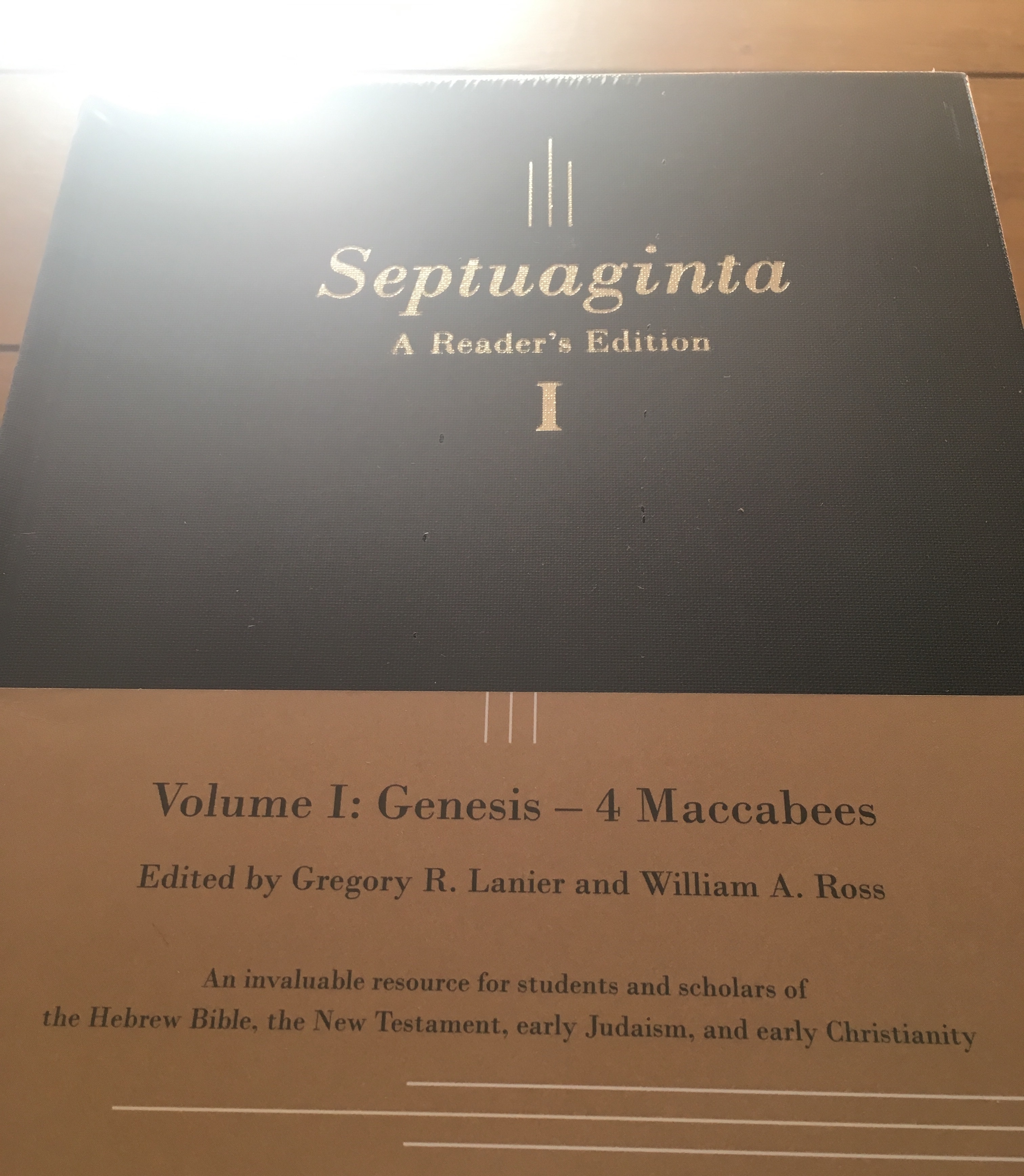


Today I Read Psalm 1 from… a Reader’s Septuagint!

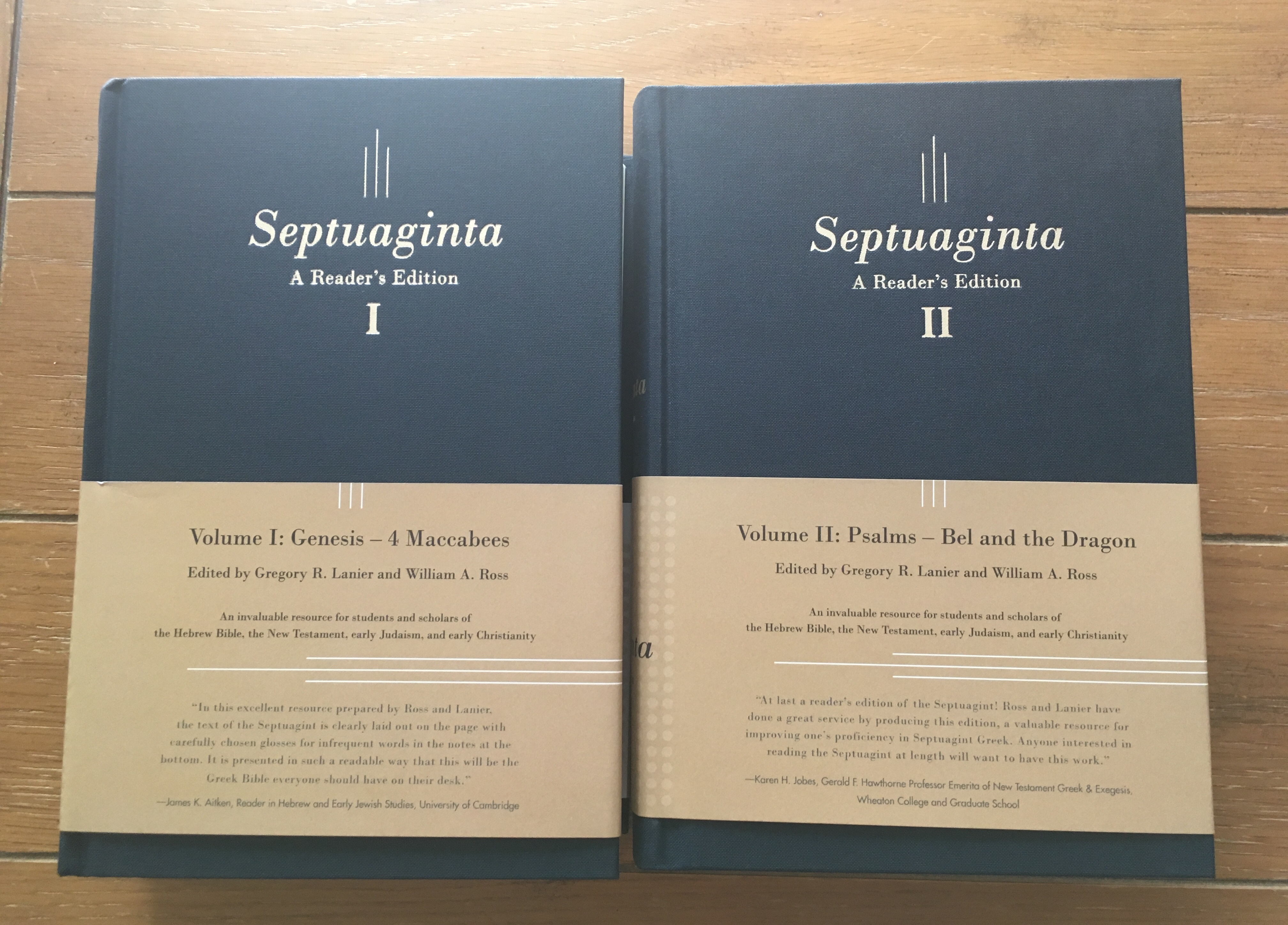
Today I read Psalm 1 out of the just-released Septuaginta: A Reader’s Edition, and it was just as wonderful as I’ve long imagined it would be!

First and foremost, this is due to the power of Scripture itself. The Psalms are just amazing. And there’s something about reading the Bible in its first languages that fosters (at least for me) a deeper sense of connection to the church throughout time and space.

But until this month, Bible readers and original language students could only read the Septuagint with the aid of a lexicon or Bible software. Other than a few tools with selected passages, there was no edition of the Septuagint with footnoted vocabulary and parsings throughout, so that you could pick up one book and read, with all the help you needed at the bottom of the page.

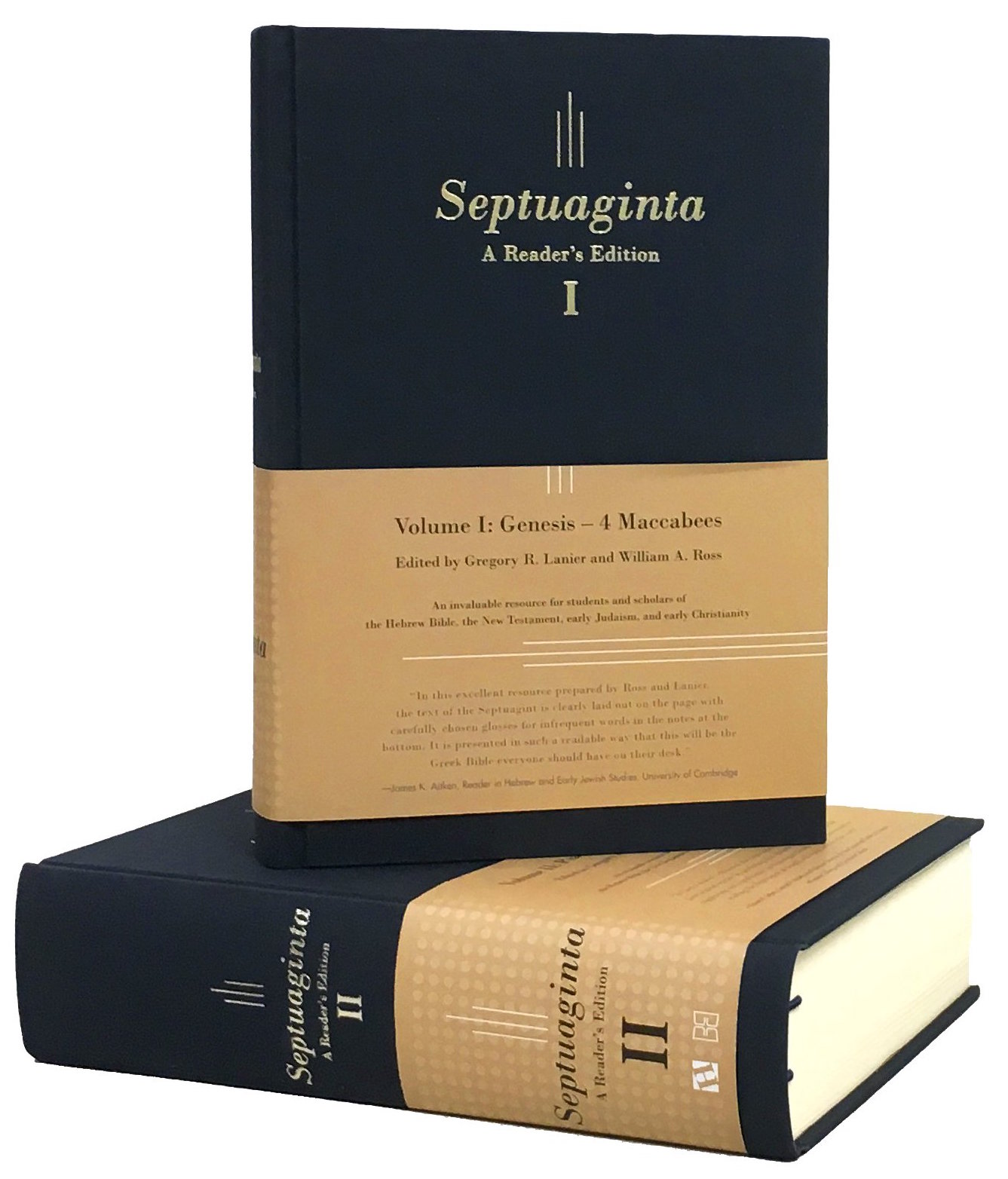
Readers of this blog are likely aware of the existence of a reader’s Hebrew Bible and a reader’s Greek New Testament. I have pined for a reader’s edition of the Septuagint, and now it exists. Mine arrived in the mail today.

It’s heavy, beautiful, and awesome.


What light through yonder Bible breaks?


So big (3300+ pages!), it had to be two volumes


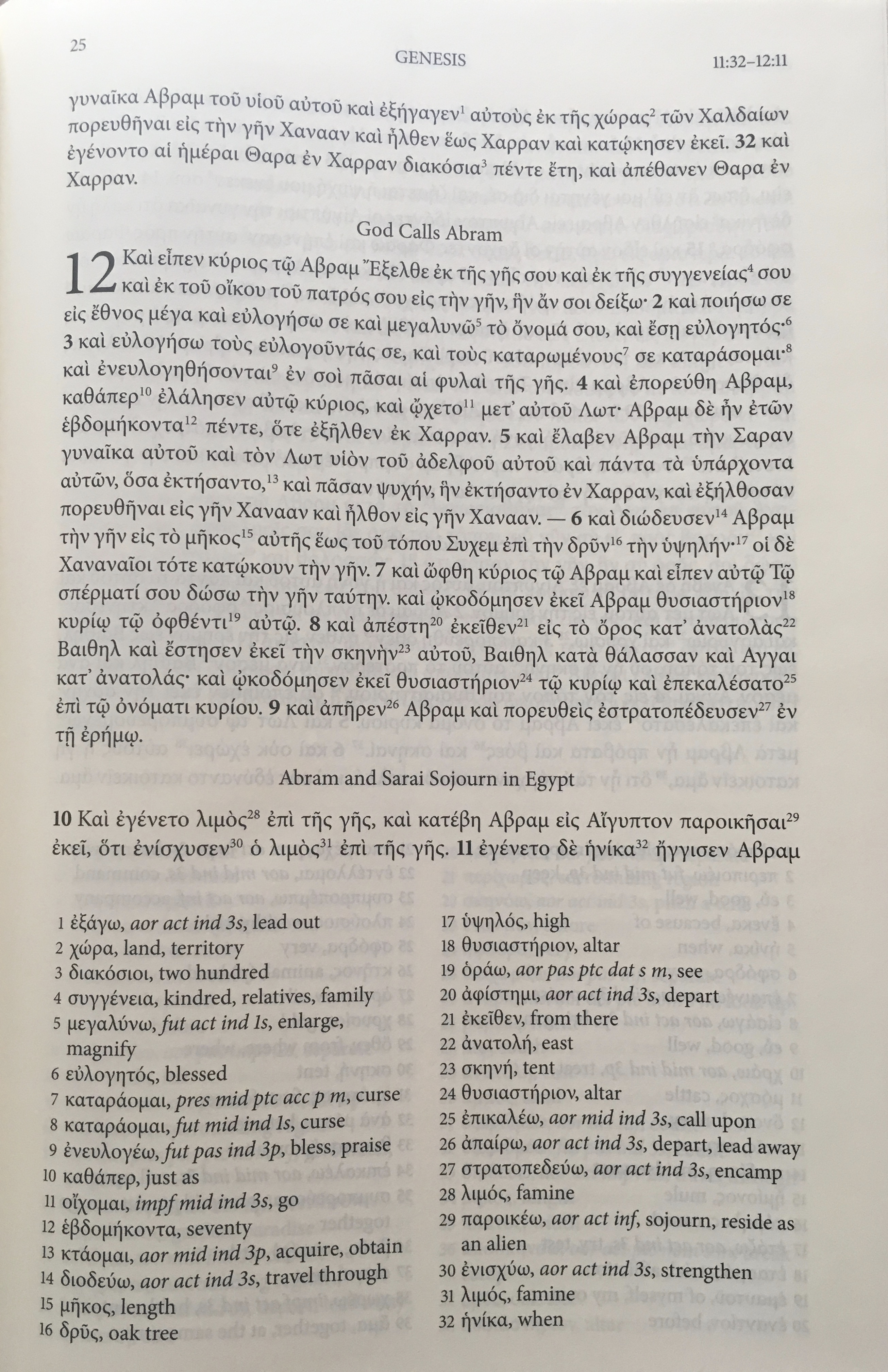
I fully applaud the decision to make this a two-volume work. (How could it be otherwise?) Included underneath the text is an apparatus:

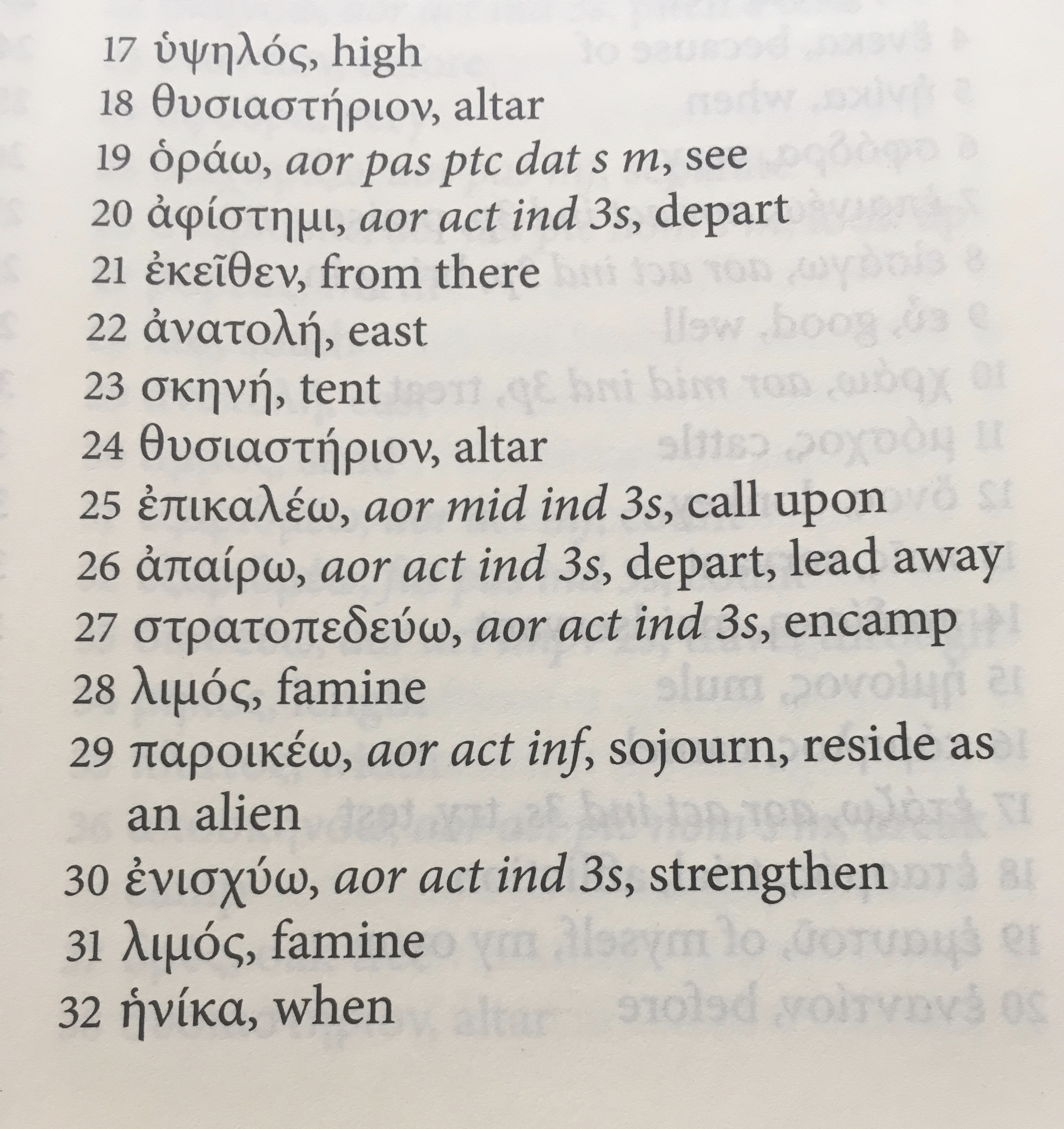
In order to facilitate natural and seamless reading of the text, every word occurring 100 times or fewer in the Rahlfs-Hanhart text (excluding proper names)—as well as every word that occurs more than 100 times in the Rahlfs-Hanhart text but fewer than 30 times in the Greek New Testament—is accompanied by a footnote that provides a contextual gloss for the word and (for verbs only) full parsing.

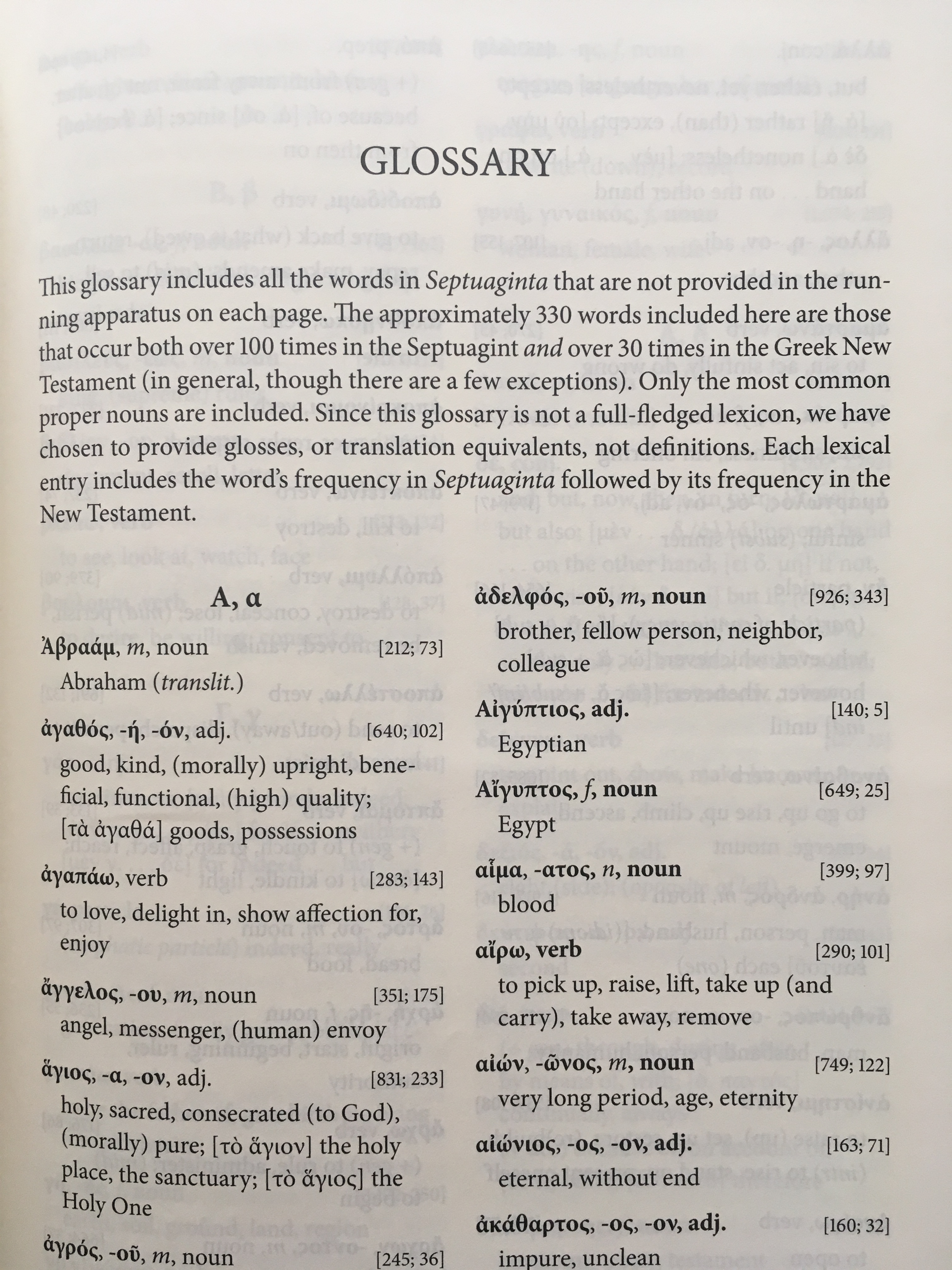
For everything else there is a Glossary at the back of each volume.


Everything is beautifully typeset–much better-looking than the Rahlfs-Hanhart Septuagint text (all due respect to that typesetter!). The font is aesthetically pleasing and easy to read. The pages are cream-colored (which looks great) and not at all the wispy-thin Bible paper I was expecting. AND the binding is sewn. This Septuagint will last a lifetime.


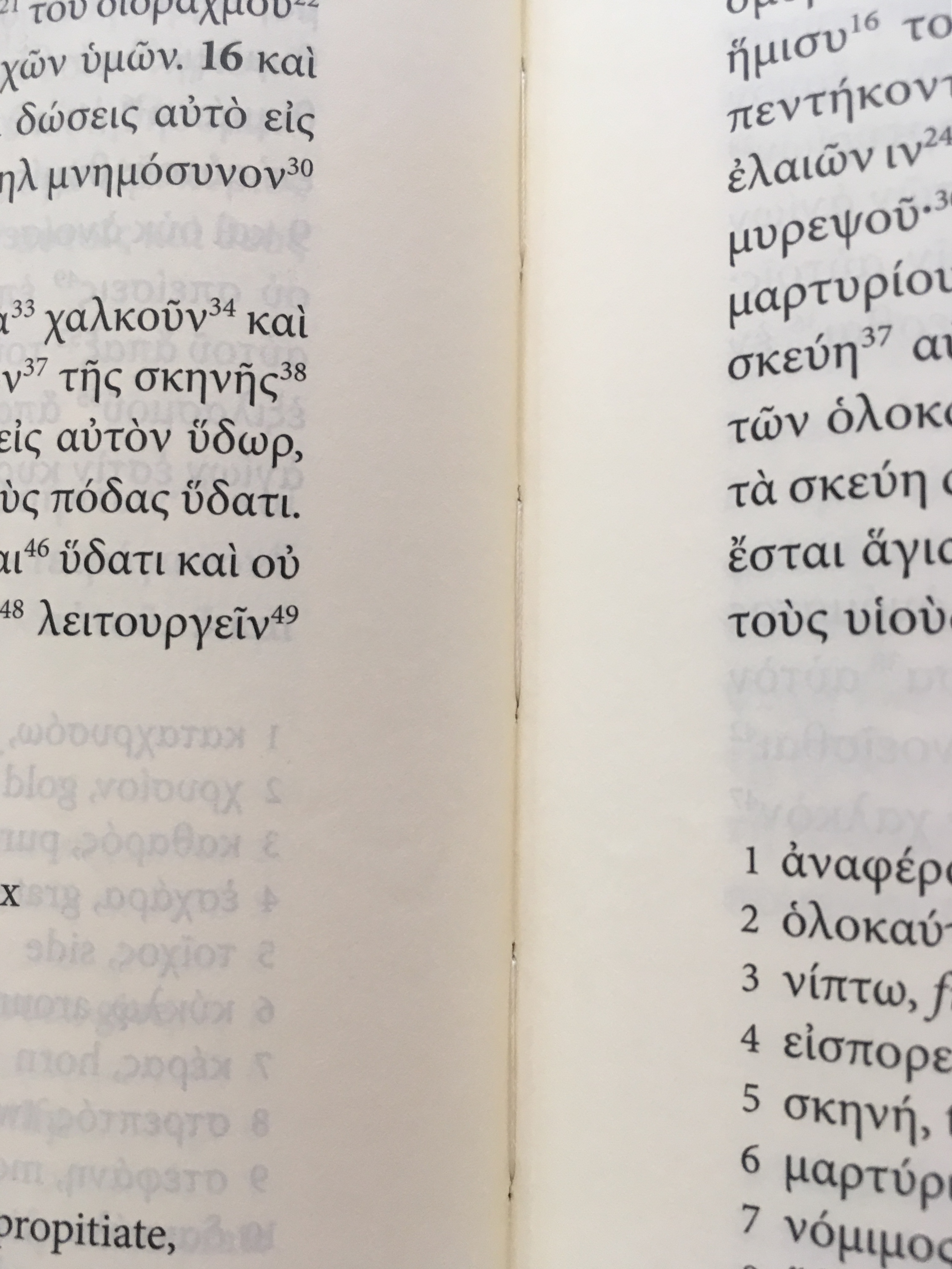
Sewn binding


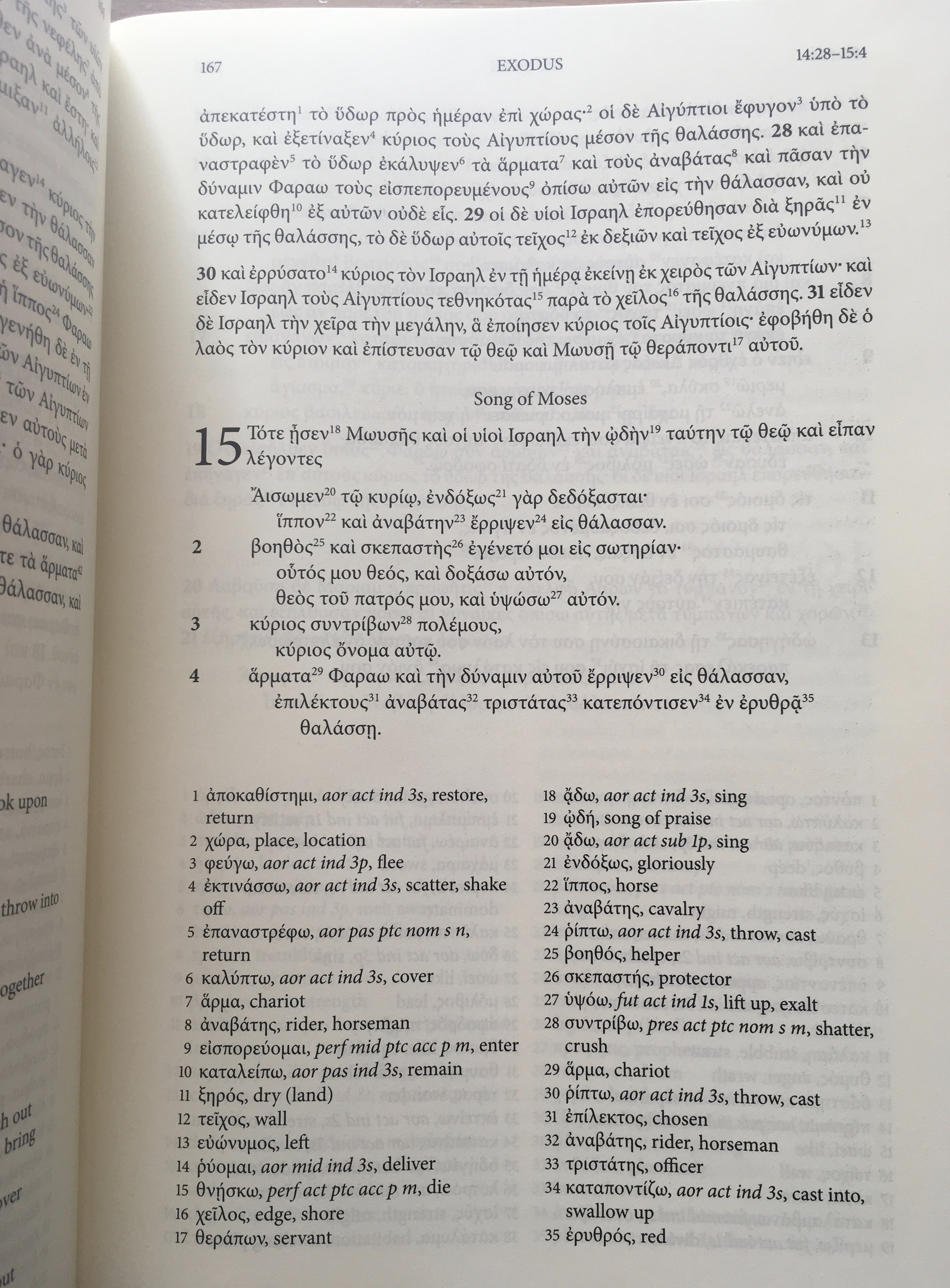
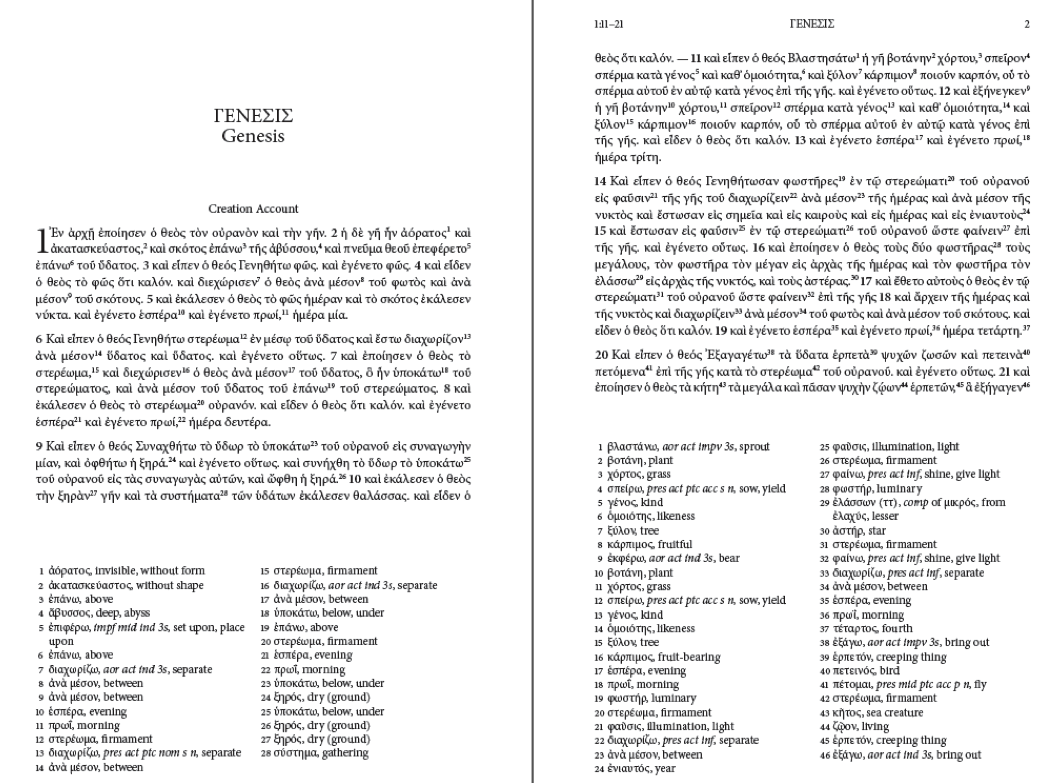
What does the text itself look like, you wonder?


One of my favorite passages, for obvious reasons


The only thing I have approximating lack of complete satisfaction with these beautiful volumes is the exclusion of the Odes that are in the Rahlfs-Hanhart text. The decision of editors Greg Lanier and Will Ross is in keeping with a more attested LXX text; besides, other than the Prayer of Manasseh, which they include, the other Odes are already present elsewhere in the Septuagint. Best to think of the Odes as a sort of hymnal for the early church, rather than an actual “book” of the LXX. (The New English Translation of the Septuagint says in its introduction that the Odes have “dubious integrity as a literary unit.”) So I’ll be the first to acknowledge that this “critique” has no textual or methodological grounding whatsoever and is solely rooted in my own desire to read through the worshipful Odes with footnoted vocabulary and parsings. 🙂

Of course, if I know the right places to go, I still can read the Odes:


One of the “Odes,” here in its original context as Exodus 15


Now… about that apparatus! The two columns (rather than continuous lines) make it really easy to move back and forth between the vocab/parsings and the text itself. Again, A+ on typesetting and layout. And I so appreciate that Lanier and Ross have included verb parsings… not every reader’s Bible does. This way readers can work both on their vocabulary and their ability to parse less familiar verbs. Here’s a close-up:


I can’t begin to express my gratitude for the work Lanier, Ross, and others put in to this project. A major desideratum of Greek reading and Septuagint studies is finally here, and so far, it has far exceeded my expectations.

A full review is coming later. For now, check out this masterpiece here at CBD, where it is available for a totally-worth-it sale price.


Thanks to the awesome people at Hendrickson for the review copy, sent to me with no expectation as to the content of this review.

Word on the Street… the Reader’s Edition of the Septuagint Is Shipping!

708433


To quote the apostle Paul, “I know a person in Christ” who has received his reader’s edition of the Septuagint. (Whether Paul’s statement was self-referential or not, mine isn’t.) That means it’s now shipping from CBD, where it is also on sale for a great price. Check it out here, and see my previous post about this long-awaited edition here.

BibleWorks Announces Closing

20180601banner
Image via BibleWorks.com


I was surprised and saddened to receive an email the other day announcing that BibleWorks is closing:

BibleWorks has been serving the church for 26 years by providing a suite of professional tools aimed at enabling students of the Word to “rightly divide the word of truth”. But it has become increasingly apparent over the last few years that the need for our services has diminished to the point where we believe the Lord would have us use our gifts in other ways. Accordingly as of June 15, 2018 BibleWorks will cease operation as a provider of Bible software tools. We make this announcement with sadness, but also with gratitude to God and thankfulness to a multitude of faithful users who have stayed with us for a large part of their adult lives. We know that you will have many questions going forward and we will do our best to answer some of them here.

The use of Bible software has been integral to my sermon preparation and teaching and small group leading these last five years. BibleWorks was my first foray into Bible software and always will hold a special place in my heart. One of my very first blog posts was this one on BibleWorks and the Septuagint, followed by a post called “BibleWorks in the Pew?” That led to a six-part review of BibleWorks 9, followed by some posts on BibleWorks 10, the 2015 and most recent release. From there I reviewed Accordance and Logos, culminating in this 2012 comparative review, which is by far the most-visited post at this blog.

The BibleWorks transition to Mac has been a little bumpy, so I haven’t used it nearly as much in the last couple years, although I still remember buying a used PC laptop for the sole purpose of having a machine to run BibleWorks on!

In the meantime, BibleWorks 10 is set to receive support for existing users for the foreseeable future, and until June 15, you can purchase it at $199, by far the lowest price the program has ever been.

There is some ambiguity remaining with the program’s future, although founder Michael Bushell has since elaborated on a forum post here. It looks like either open-sourcing BibleWorks or selling it are not on the table.

BibleWorks has been a big part of my ongoing journey through the Bible via Hebrew and Greek, so like many others, I am sad to see it close. Thanks be to God and to the staff for the many years of ministry and good programming BibleWorks has offered!

At Last… A Reader’s Edition of the Septuagint

708433


Septuagint readers have wanted this resource for a LOOONG time, and now thanks to William A. Ross and Gregory R. Lanier, we only have to wait till November for…

…

…

a Reader’s Edition of the Septuagint.

Ross writes:

The basic idea behind a reader’s edition is to provide an edition of the ancient text – in our case Rahlfs-Hanhart’s – annotated with running footnotes with lexical information. Since most students and scholars of biblical studies are most familiar with New Testament vocabulary, picking up a Septuagint can make for a challenge. Our reader’s edition seriously reduces that challenge by providing the footnotes for rarer vocabulary, thereby making the reading experience much more seamless and less intimidating.

Here is a sample page, taken from the dedicated Website set up for the Reader’s LXX. Feast your eyes on this:


bookexample4


You can pre-order now through Amazon in hardcover or flexisoft=imitation leather (affiliate links) or through CBD.

In advance–many thanks to William and Gregory and all the others working so hard to bring this volume to completion and into our hands!

My Favorite Gospels Resource

Easter is near, the time of year where—if I haven’t already reached for it recently—I pull out my favorite Gospels resource: Synopsis of the Four Gospels.

There are three versions of this resource of which I’m aware:

– an all-Greek one (complete with Latin title: Synopsis Quattuor Evangeliorum)
– an all-English one
– the one linked above, which has both Greek and English

I love the color. The binding is secure. The size is beautifully large but not overwhelmingly so. My copy, though I got it used some years ago, even smells good. It might be the aroma of the Holy Spirit.

For those seemingly rare but delightful stories, parables, or teachings that all four Gospels treat, the Synopsis is a great way to see everything lined up together. Each year I choose whichever Easter account is the Gospel lectionary for the day, but I always look at all the Gospels side by side before preaching about the story of the resurrection.

Here are some pictures:


And if you really want to get into this text, check out this review—more of an homage, rightly—at the Bible Design Blog.

The Sole (and Very Interesting) Occurrence of “Mediator” in the LXX

God’s covenant people have always needed a mediator. And God—with limitless grace—has always sent mediators to the people.

A mediator joins two parties together, stands in the gaps, bridges their conflict. A mediator is “a go-between,” a re-negotiator, an arbitrator. An effective mediator is a miracle worker.

Scripture narrates a familiar pattern: God makes covenants with his people; his people break them; God uses mediators to make peace.

The Greek word for mediator is μεσίτης (mesitēs). Careful readers of Scripture know that “the idea of mediation and therefore of persons acting in the capacity of mediator permeates the Bible” (New Bible Dictionary, 3rd edition). However, the word mediator=μεσίτης (mesitēs) occurs only six times in the Greek New Testament.

Three of those uses are in Hebrews (8:6, 9:15, and 12:24). Two are in Galatians 3:19-20. And one is in 1 Timothy 2:5, a theologically rich verse:

For
there is one God;
there is also one mediator between God and humankind,
Christ Jesus, himself human….

The concept and practice of mediation (think: sacrifice, atonement) does indeed fill the pages of the Old Testament. Most of the New Testament uses of mediator, in fact, reference the old covenant. So I found it especially fascinating when I learned that mediator=μεσίτης (mesitēs) occurs only once in the Greek Septuagint.

It comes up in a striking passage in Job 9:33.

Job has already lost everything. But we remember as he utters these words in chapter 9 that the Bible describes him as “blameless and upright, one who feared God and turned away from evil.” It said he would “rise early in the morning and offer burnt offerings,” just in case his children had sinned. He covered all his bases. He kept at least the semblance of a covenant with God.

And yet Job senses a breach. All manner of tragedy has befallen him, and everyone around him tells him to curse God. He won’t, but still he feels at odds with God. Job says to the Lord:

… you are not a mortal like me, with whom I would contend,
that we should agree to come to trial.

Would that there were a μεσίτης/mesitēs/mediator for us and an investigator
and one to hear the case between us two.

(This is from the NETS translation, which translates μεσίτης as arbiter.)

Job longs for a mediator, an arbiter between him and God. An “umpire,” the NRSV says, translating the Hebrew.

Again, Job calls for a mediator, even though we have no narrative evidence that he broke a covenant with God! He acknowledges that he can’t “contend” with God as in court, but still yearns for a “mediator” to bridge the gap between him and God.

And now, for the pastoral payoff:

If Job, who led a blameless life, thought he needed a mediator to get to God, how much more do we, God’s not-blameless people, need a mediator to be in the presence of a perfectly holy God?

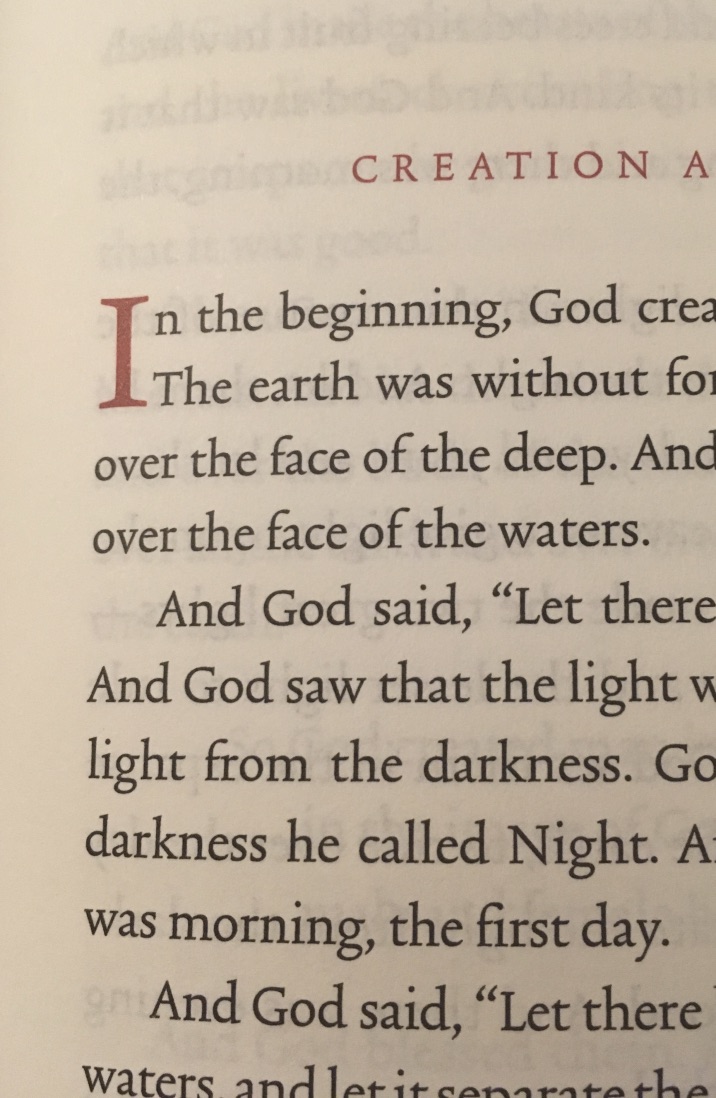
Getting Absorbed in the Beauty of Scripture: First Impressions of the ESV Six-Volume Reader’s Bible

Crossway Image.jpg
Image via Crossway


We who would read the Bible experience hindrances in our quest. I am interested especially in the competing values that create internal conflict, keeping us from Scripture reading. We do well to think through what other values we have that potentially undermine our goal of spending time reading the Bible.

Readers of this blog know how much I value reflection on and study of Scripture, down to the verse, word, and even ἰῶτα. I love reading Scripture atomistically. But I hope that kind of reading is always an accompaniment to (not replacement for) reading Scripture as a narrative, paying attention to its grand sweep. Reading Scripture slowly and word-by-word goes well with reading Scripture in big chunks.

Until recently I have underestimated the impact of chapter and verse divisions on my ability to engage Scripture fully. I have nothing against versification per se, but even the most casual Bible readers are likely to have a sense that those ways of marking the text are later additions and not present in the first manuscripts themselves.

Not that we can get back to some sort of pure, unadulterated “early church” experience of reading Scripture, but can we at least try to simulate the experience of original hearers.

An article by Ruth Graham in Slate recently reminded me of the advent of reader’s Bibles, which present the Bible in single-column, verse-less, novel-like format for more fluid reading.

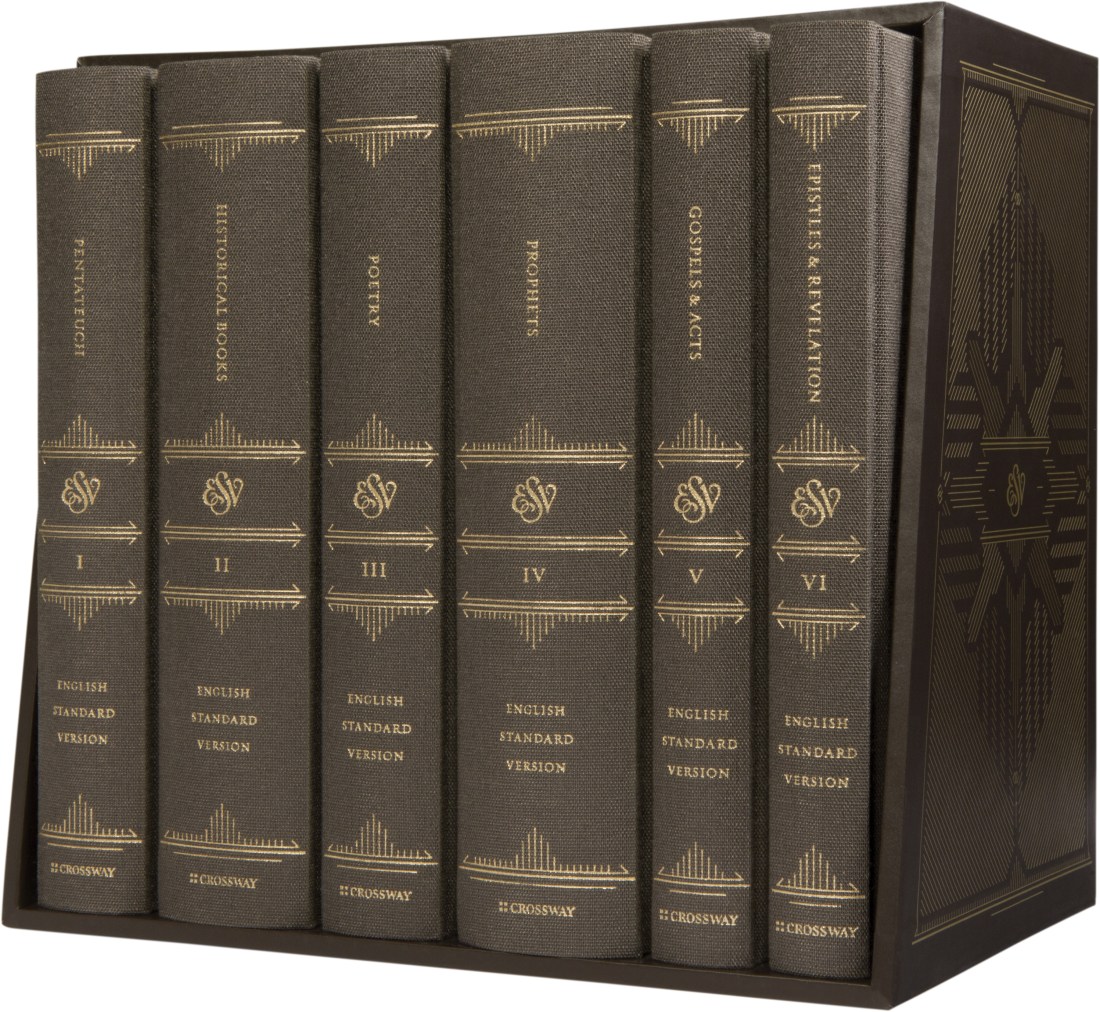
Crossway has been kind to send the ESV Reader’s Bible, Six-Volume Set for me to review. I’ll write more in the future, but for now I want to comment on my experience of reading Scripture with the ESV Reader’s Bible. I want to say just two things at the outset.


1. This Reader’s Bible is beautiful. The production and presentation of Scripture is unlike anything I’ve seen.


Behold:


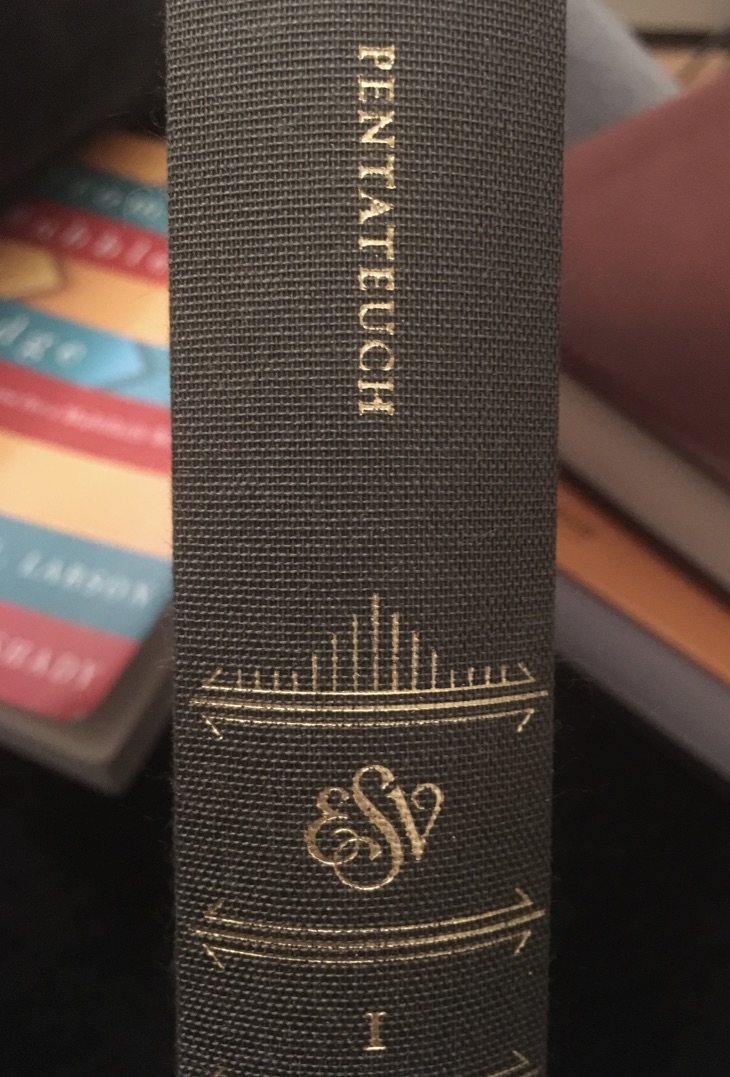
The binding, layout, and font are all gorgeous. I don’t love the graphic surrounding “ESV” on the binding, but that’s a minor quibble.


2. This Bible more than any other has facilitated my being fully absorbed in the biblical text.


I’ve had inspiring and Spirit-filled reading experiences already (and I’m only up to Genesis 22). To be clear, the experience is due primarily to the power of Scripture and the Holy Spirit who inhabits it. No binding or font choice can bring that about. But this reader’s Bible removes what I didn’t realize were distractions to prolonged reading: verses, chapters, headings, study notes, cross-references, etc. I don’t even know which chapter of Genesis I’m on sometimes, and I don’t want to stop reading. That’s a win on the part of Crossway, and (especially) a shout-out to the power of Scripture.

Here’s the link to the Reader’s Bible page at Crossway (here on Amazon). It’s not cheap, but it’s also reasonably priced considering its value (and the immense value of the Bible itself). This fall there is also a paperback version coming out, available now through CBD.

In future posts I’ll write more about the ESV translation itself, the font and layout specifics, and more, but for now I wanted to share how valuable and formative it’s been for me to use this edition for reading Scripture and getting caught up in its beauty.