Family Friday goes to the Olympics: Less ball sports, more boat sports

Image: John David Merce,, USA TODAY Sports

Olympic volleyball on the TV evoked two different reactions from our two boys the other day. The two-year-old started jumping up and down on the bed chanting, “Vol-ley-BALL! Vol-ley-BALL!”

This same two-year-old had at another time been lounging on the bed until he saw a gymnast come on, at which point he stood up on the bed and lifted his hands straight up in the air, high above his head. He tumbled forward in his best effort at a somersault.

The four-year-old, on the other hand, seeing volleyball on TV, said, “I don’t want to watch any more ball sports… I want to watch a BOAT sport.”

Son, I’m sorry you didn’t get to watch it yesterday, but you’ll be glad to know that the women’s eight rowing team has won the gold.

My 4-year-old son reviews his first book, Alpha Oops! The Day Z Went First

Following on the heels of a great guest post from Timothy Dean Roth Wednesday, I’ve invited another guest to post at Words on the Word, this time for Family Friday: my four-year-old son. Here is his review of a book he particularly enjoys, Alpha Oops! The Day Z Went First. I’ve typed it up, but the words are all his.

A always goes first, but Z wants to go, and Z and Zebra are sick of the “last in line stuff.” W sits on a whale spout. Z has a zebra jumping. “O is for owl,” “N is for night,” and everyone else thinks it’s not H’s turn, but it really is… right? (Yeah.) He goes right where he goes, because that’s just how the alphabet goes.

I like that Z goes first. A goes last and the alphabet goes backwards. B is “bouncing on… a brisk breeze.”

I didn’t like “D is for dragon and damsel in distress,” because she might get hurt. (I don’t really want to get hurt.)

Our new neighbors would like this book. We could give it to someone else, and then tell everyone in the world to give it to someone else, after they read it.

Alpha Oops! is available at Amazon, or, I’m sure, at your local library.

The hyphen in my last name, and, What happens when kids with hyphenated last names marry?

This post is not about sex or colonization.

NPR’s All Things Considered played a story yesterday called, “When Hyphen Boy Meets Hyphen Girl, Names Pile Up.” It’s Family Friday at Words on the Word, and in my family we all roll with the hyphenated last name (K-J). My wife was K, I was J, she wanted to be K-J, invited me to do the same (with no pressure), and I agreed. So we and our three kids are all K-J.

But we’ve often asked, what happens when they get married? What will they do with their last names? And what if they meet someone else with a hyphenated last name?

Read and listen to NPR’s story here.

It doesn’t offer much by way of answers to my questions above, but at least our children will not be alone.

Why did my wife and I opt for K-J? For me, it’s simple: joining our two last names together with the hyphen seemed a perfect “outward and visible sign of an inward and spiritual grace,” namely, what Jesus teaches–“the two will become one flesh” (Mark 10:8).

Is cloth diapering a waste of time?

It’s Family Friday here at Words on the Word. And nothing says “family” to me like diapers! We have two children in diapers right now, and our third has been fully potty-trained for just about a year or so. We know poop.

Cloth diapering has long been a value for us (here‘s a great place to get them). My wife and I just couldn’t stand the idea of throwing away so many disposable diapers to take up space in a landfill. As one site I read said, we don’t throw away our clothes (or dishes for that matter)… why would we throw away our children’s diapers?

There are other concerns, too, that led us to cloth diapers. Have you ever changed a diaper and all those little absorbent gel capsules had gotten loose and were all over your child’s nether-regions? Not cool, Pampers. And cloth, I’m convinced, just feels much better on a baby’s bum.  Further, cloth holds things in much better. The large majority of “leakages” I’ve encountered have been from so-called super-absorbent disposables.

But it was primarily a desire to do our part as responsible inhabitants of God’s creation that led us to cloth.

However.

What about the amount of water that we have to use to wash all that cloth? We like to line-dry whenever we can, but that’s tough to do in the winter or if it’s raining. What about all the energy used by running the dryer multiple times a week on cloth? Is cloth diapering just as eco-unfriendly as disposables, albeit in a different way?

I’m not sure how you compare different kinds of environmental impact–is it better to fill up landfills or use lots of water?

I’ve wondered about this for about five years worth of child-rearing now. For us, the other added benefits of cloth diapering (less chemicals, more absorbent, more comfortable, save money in the long run) seal the deal for us in our decision to keep using cloth.

But here‘s an article (with links to studies) that makes the assertion that either method is basically just as good. (!) More here, too.

So what’s a parent to do?

Junia

My wife and I just gave birth to our third child, Junia. The name Junia comes from Romans 16:7–she was an “outstanding” apostle, as noted by the apostle Paul.

There is nothing else about Junia in the New Testament except for the rest of what Paul says about her in that verse, the full text of which is, “Greet Andronicus and Junia, my fellow Jews who have been in prison with me. They are outstanding among the apostles, and they were in Christ before I was.”

What we know about Junia from Paul is:

  • She was a fellow Jew;
  • She is mentioned alongside Andronicus, presumed to be her husband and ministry partner;
  • She was in prison with Paul at some point;
  • She and Andronicus were “outstanding among the apostles”;
  • She and Andronicus were “in Christ” before Paul was.

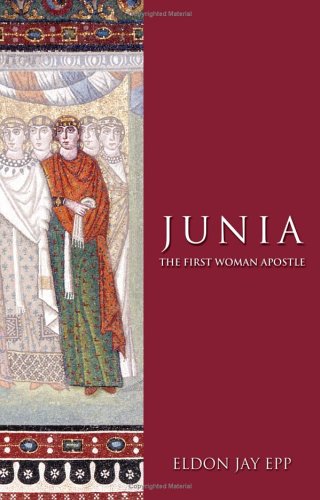
There is a little bit of literature about Junia. She is the source of a short but dense scholarly study by Eldon Jay Epp (the cover is pictured above). Epp explores the difference that comes up in some English translations–i.e., why Junia occasionally (but incorrectly, according to him) appears as a male “Junias.” There is also an investigative journalist’s take on Junia, exploring some of the church’s history as to how and why the apostle Junia has sometimes been understood in the text (incorrectly, she also says) as a male Junias.

Finally, Scot McKnight has just come out with a short Kindle-only monograph called Junia is Not Alone, which explores Junia’s contribution to the church, as well as other “overlooked” women in Scripture and church history. (The publisher’s description unfortunately calls the essay “fierce.” I’ve not yet read it, but all that I’ve read and heard from Scot is anything but fierce. (UPDATE: I review it here.) He is a gentle and caring Biblical scholar, not polemical. Unless they mean “that’s fierce” in a Project Runway sense.) He posts about his e-book here.

UPDATE: Read all my Junia posts here.

Seminary with Young Kids

I’ve been known to try to do too many things at once.

In the fall of 2010 I was working 20 hours a week in youth ministry at a local church, preaching monthly there on top of that, taking four seminary classes (all of which were either Biblical Greek or Hebrew-based), and doing a wee bit of youth ministry consulting work. Suffice it to say I wish I had not done so much then–even three classes instead of four would have been a welcome relief. I did do most of my schoolwork at home, which at the time seemed like a good idea, because I could be around my wife and kids as I worked… but in retrospect, they weren’t getting any more of my attention than they would have if I had been off somewhere studying. So maybe that actually made it worse, to have me there, but not really have me there.

On Monday my wife and I are scheduled to have our third baby delivered.  So this is perhaps an appropriate time to link to this great article, “How to Survive Seminary with Young Children.” It’s written from a mom’s perspective, though the bulk of this advice is also helpful for those who are trying to be faithful dads and good seminarians at the same time.