Preaching in an Age of Distraction

Preaching in an Age of Distraction

Any worship leader or preacher knows what it’s like to be distracted–either by something internally (himself or herself) or externally (something going on in the room).

“We live in the Age of Distraction,” says J. Ellsworth Kalas, Senior Professor of Homiletics at Asbury Theological Seminary, “and it seems to be accelerating.” Kalas notes that “the altar of the new” (a great turn of phrase) is constantly beckoning, but it is “a poor place to bow.”

Over the course of ten chapters, Kalas seeks to guide the preacher through distractions and distractedness, offering counsel as to how to prepare messages and preach to potentially distracted congregations.

The book started more slowly than I’d have liked. This could, of course, be a function of my own distractedness and lack of patience in reading. But there were more vague assertions than were helpful for building his case from the beginning, a trend which popped up again throughout the book. (E.g., “Sports have probably had a place in human life for as far back as we have any record” (ch. 2), and, “Surveys show that…” (ch. 4), and, “Some brain research indicates that…” (ch. 9), etc.)

Perhaps I was looking for more practical “take-aways.” And Kalas does give these as the book progresses.

However, at about chapter 3 or so, I realized that I was reading some reassuringly wise counsel. I received it as such. Kalas has generations of experience in preaching (and teaching about preaching). This allows him to see our current day in a fuller historical light. Distractions may change from generation to generation (TV vs. iPhone), but distractions themselves are not unique to the second decade of the 21st century. Kalas is worth quoting at some length here:

All of this reminds us that while the times have changed in some details–the sources of the distractions and the means by which those distractions are delivered–the pastor in his or her study has always been susceptible to distraction. Paul must surely have hoped that his guard would stop humming that first-century show tune. Bunyan no doubt had to deal with insects and assorted vermin as he thought his way through Pilgrim’s Progress. And who can guess the physical and emotional intrusions that assailed Dietrich Bonhoeffer day after day in his imprisonment!

There are significant recent changes to congregations, though. In chapter 3, “The Distracted Preacher,” Kalas notes that it “is no longer the world of our great-grandparents, where nearly all the people in the pews had the same occupation–say, dairy farming or working at the local factory–and essentially the same education.” Even if this overgeneralizes a bit, Kalas brings his point into focus by continuing, “Now the preacher looks out on vocations that did not exist a decade ago, let alone a century ago.” They are “more specialized.” Because no preacher can possibly “be a Renaissance person,” we preachers “must be highly discriminating in the knowledge we pursue.”

That itself is not a novel idea, but Kalas gives the preacher needed reminders (that we too often forget) like, “The Internet will take as much of our time as we allow it to have.” And to any preachers who may not think much about a pre-Internet world, Kalas suggests “reading across the centuries,” a practice he himself has obviously employed, as his book passes on some of the wisdom of those he has read.

An underlying theme of the book is that the ones who follow after distractions (whether preacher or congregation, or both) are “expressing the longing of a restless heart.” Kalas writes, “[W]hat gets our attention gets us.” The challenge is that not all distractions are harmful, per se; some stimulate creativity and pull us out of ruts. How to discern the difference? Kalas suggests asking:

Does this [distraction or thought] incline me toward Christ or away from him? If I pursue this thought, what will it do to my mind and spirit?

and:

Will this “distraction” lead to more life or to less?

If there is an antidote (or “counterforce”) to the distractions that lead to less of life, it is “excellence.”  How Kalas teases this out makes the book worth pursuing. Canned illustrations are okay, he suggests, but even better is “the excitement that comes when an idea springs forth after the preacher has wrestled with the Scriptures until a light has come on in the soul.” With the Holy Spirit as guide, director, and inspirer, the pastor also needs to remember that “preaching is a relationship,” so deliberate relationship-building with the congregation necessarily precedes good preaching.

Are you burned out on preaching? Get this book. Kalas doesn’t say he set out to write for burned-out preachers, per se, but I can’t think of anything better for such a preacher to read.

Are you not burned out, but looking to take a step forward in your preparation or delivery? Kalas gives a slew of sage advice and some practical suggestions to pursue excellence.

Are you distracted or unsettled when you go to prepare a sermon? Kalas offers soul care, and in the midst of a distraction-filled life helps the preacher take a look inward, and an awe-filled look outward to God.

Thanks to InterVarsity Press for the review copy, given to me so I could write this review, but with no expectation as to my assessment of the book. Find Preaching in an Age of Distraction here (publisher’s page) or here (Amazon affiliate link).

Geffrey B. Kelly’s Reading Bonhoeffer

I’m a sucker for biblical and theological studies with an unapologetically doxological posture. So it was with excitement that I read John W. Matthews’s concluding sentence in his foreword to Geffrey B. Kelly’s Reading Bonhoeffer: A Guide to His Spiritual Classics and Selected Writings on Peace. Matthews writes:

I believe both the author and the subject [Bonhoeffer] would be disappointed if this book did not somehow draw you, the readers, closer to Jesus Christ and to your neighbor.

Kelly’s short yet substantive book does very much that. His first encounter with Bonhoeffer is intertwined with a beautiful story of his own re-awakening to Jesus. He says in the Preface:

Through Bonhoeffer’s inspirational words Jesus’ Sermon on the Mount seemed to be addressed to me personally for the first time. I was hooked.

Reading Bonhoeffer has four major sections:

  1. Dietrich Bonhoeffer: A Biographical Sketch
  2. On Reading Bonhoeffer’s Spiritual Classic, Discipleship
  3. Life Together: Bonhoeffer on Christian Community
  4. Selected Writings on Peace: An Ecumenical Conference and Two Sermons

The Preface, after describing Kelly’s transformative first read of Discipleship, offers some helpful background information and resources for Bonhoeffer studies. Kelly mentions, for example, his involvement with the International Bonhoeffer Society, English Language Section. He writes about the International Bonhoeffer Congress. And he discusses the genesis of the Dietrich Bonhoeffer Works series (English translation), published by Fortress Press.

1. A Riveting Biographical Sketch

Kelly’s “Biographical Sketch” is longer than Renate Bethge’s short work, and (obviously) a much quicker read than Eberhard Bethge’s monumental biography. 28 pages follow Bonhoeffer through his life, writings, and ministry.

Reading BonhoefferThere are a few things that stand out about Kelly’s short biography. For one, though it’s scant on details of Bonhoeffer’s early life (to be expected, given its length), the overview is thorough and really orients the reader well to Bonhoeffer. Kelly has a knack for succinctly summarizing Bonhoeffer’s writings in understandable language–even Bonhoeffer’s challenging Sanctorum Communio!

Second, Kelly’s biography is itself a gripping narrative. There is real movement as he progress through the various pastoral and academic positions Bonhoeffer held, from Berlin to London, from the seminary at Finkenwalde to the church struggle, Bonhoeffer’s arrest, and his imprisonment. I found myself wanting more dates in places (e.g., “Once back in Berlin…”–when?), but perhaps this omission was deliberate to keep the narrative moving. I was not able to put the book down until I had finished the page-turner of a biography.

Third, Kelly describes many of Bonhoeffer’s key terms and concepts, both in this first section and throughout Reading Bonhoeffer. Even a reader with little or no Bonhoeffer background will walk away from the biographical sketch with confidence to read any of Bonhoeffer’s writing.

Fourth, Kelly is clearly in awe of his subject, and rightly so. This, in turn, allows the reader to be inspired by Bonhoeffer. Kelly includes a treasure trove of Bonhoeffer quotations, some familiar, and some more off-the-beaten path. To wit:

I was quite pleased with myself. Then the Bible, and in particular the Sermon on the Mount, freed me from that. Since then everything has changed…. It was a great liberation. It became clear to me that the life of a servant of Jesus Christ must belong to the church, and step by step it became plainer to me how far that must go.

2. Kelly on Bonhoeffer’s Discipleship

Kelly served as co-editor, with John D. Godsey, of Discipleship, volume 4 in the (English) Dietrich Bonhoeffer Works series (DBWE). This second section of Reading Bonhoeffer offers more than 60 pages of commentary on that well-loved Bonhoeffer book, known also as The Cost of Discipleship.

After a brief “history of the text” Kelly proceeds section-by-section through Discipleship. In short, according to Kelly,

Discipleship is a book in which Bonhoeffer uses Jesus’ own words as recorded in the gospels and the exhortations of the apostle Paul to confront readers with the uncushioned challenges to all their inaccurate ideas, falsified by Nazi propaganda, of what it means to be a follower of Jesus Christ.

DBWE DiscipleshipReaders of Discipleship will of course already know that much of the book exposits Jesus’ Sermon on the Mount, but Kelly’s unique contribution as a commentator here is in highlighting the historical context that makes Bonhoeffer’s writing even more remarkable. Not only does Kelly note a particular Nazi evil to which Bonhoeffer may have been alluding, he also points ahead in Bonhoeffer’s life to instances where he would live out the call of his own writings.

As Kelly was co-editor of the DBWE volume, to read his chapter-by-chapter commentary on Bonhoeffer’s Discipleship is to have a guided tour by a leading expert, complete with summary statements and key quotes from that book. It’s well-footnoted with reference to the page numbers in the DBWE edition, so following up in Bonhoeffer’s text is easy. It’s an essential companion.

3. Kelly on Bonhoeffer’s Life Together

The first Bonhoeffer book to be published in the DBWE series was Life Together, which appears as volume 5, bound together with Prayerbook of the Bible. Kelly served as editor of that volume, which includes an introduction and critical apparatus (i.e., lots of informative and orienting footnotes).

DBWE Life TogetherAs with the previous section of Reading Bonhoeffer, Kelly’s commentary on Life Together, although significantly briefer in its section-by-section analysis, serves as a really useful reader’s guide. Its introductory section in this book is thorough, drawing on Kelly’s introduction in the DBWE edition. This sets up the reader well to better understand Bonhoeffer’s important work on community life in the Church.

Kelly, for example, points to “Bonhoeffer’s distinction between being with and being for the others in community.” He traces Bonhoeffer’s interest in building a community, going back even to socio-theological themes in Sanctorum Communio, Bonhoeffer’s first doctoral dissertation. Kelly summarizes and comments on each of the five sections of Life Together in turn: Community, The Day Together, The Day Alone, Service, and Confession and the Lord’s Supper.

4. Peace Writings

Kelly notes the tension that many students and readers of Bonhoeffer experience when they realize a conspirator against Hitler was a peace activist. After tracing the development of Bonhoeffer’s concern for peace, via an overview of his friendship with pacificst Jean Lasserre, Kelly looks at “three texts in which Bonhoeffer reveals himself as an uncompromising advocate for peace on the troubled earth where Nazism ruled with tactics of fear, violence, and the promise of a return to German military glory.” These include a 1932 conference lecture in Switzerland (with excerpts), a 1932 sermon (also with excerpts), and Bonhoeffer’s address to the Ecumenical Council of Christian Churches at Fanø, Denmark in 1934.

Together these orations display Bonhoeffer’s boldness and even impatience at times with inaction around him. In the address in Denmark, for instance, Bonhoeffer says,

Why do we fear the fury of the world powers? Why don’t we take the power from them and give it back to Christ? We can still do it today. The Ecumenical Council is in session; it can send out to all believers this radical call to peace.

Kelly helps Bonhoeffer’s call to peace come alive for the reader many decades later.

Concluding Remarks

There is little to critique in Kelly’s book. However, I was distracted by a number of sentences that were long (multiple modifying prepositional phrases) and comma-less. For example:

[Bonhoeffer] recognizes the danger posted by abandonment of Christ’s vision for the world and the manner in which even basically good people can succumb to the temptations to fall into the compromises in morality for which worldly attitudes are particularly prone, business and government plaudits given to acts of avarice and violence serving as prime examples of why it is necessary to be single-minded in following Christ.

A re-read of every such sentence showed that it was generally clear enough. But additional punctuation or shorter sentences would have helped. If there are future printings of this fine book, perhaps this and a few other minor editorial oversights could be re-visited.

Woven throughout Reading Bonhoeffer are “the twin aspects of Bonhoeffer’s spiritual legacy: scholarly expertise and pastoral care.” Kelly himself writes as one in the academy whose own pastoral sensitivity and concern is fully on display. I can only imagine how engaging and inspiring a Bonhoeffer course with him must be.

Reading Bonhoeffer would be a stimulating read for pastors, theologians, seminary students, and Christians who are intent to more faithfully follow Jesus in both individual and community contexts. The discussion questions at the end of each section will facilitate this book’s use in a small group, Sunday school, or classroom setting.

Kelly writes about Bonhoeffer, yes, but Bonhoeffer points so often and so clearly to Jesus, that a good commentary on Bonhoeffer (which this book is) will do the same. I am grateful for this short, hearty work that Kelly has written, and hope that more DBWE volumes receive similar treatment in the future.

By the way–I’m also grateful to Wipf and Stock Publishers for the review copy. They’ve provided a 40% off coupon code to readers of this blog, good toward the purchase of Reading Bonhoeffer or anything else on Wipf and Stock’s site. Simply use the code LETTERS at checkout. It’s good through the end of May.

Top 10 Tasks for Which I Use Logos Bible Software

Here are, in no particular order, the top 10 tasks for which I use Logos Bible Software. Most of these uses are for preaching and teaching preparation, or for when I’m preparing to lead a Bible study. This post is a visual tour, so if you want to see any image in more detail, you can click to enlarge it or open it in a new tab or window.

10. To look up a word in a dictionary.

Here’s a word l00k-up in the Anchor Yale Bible Dictionary, which I can do from an already-open text, or as a stand-alone, searchable dictionary. Here I move from the article on Jesus I was reading to an article on “Tax Collector”:

Looking Up a Word in Anchor Bible Dictionary

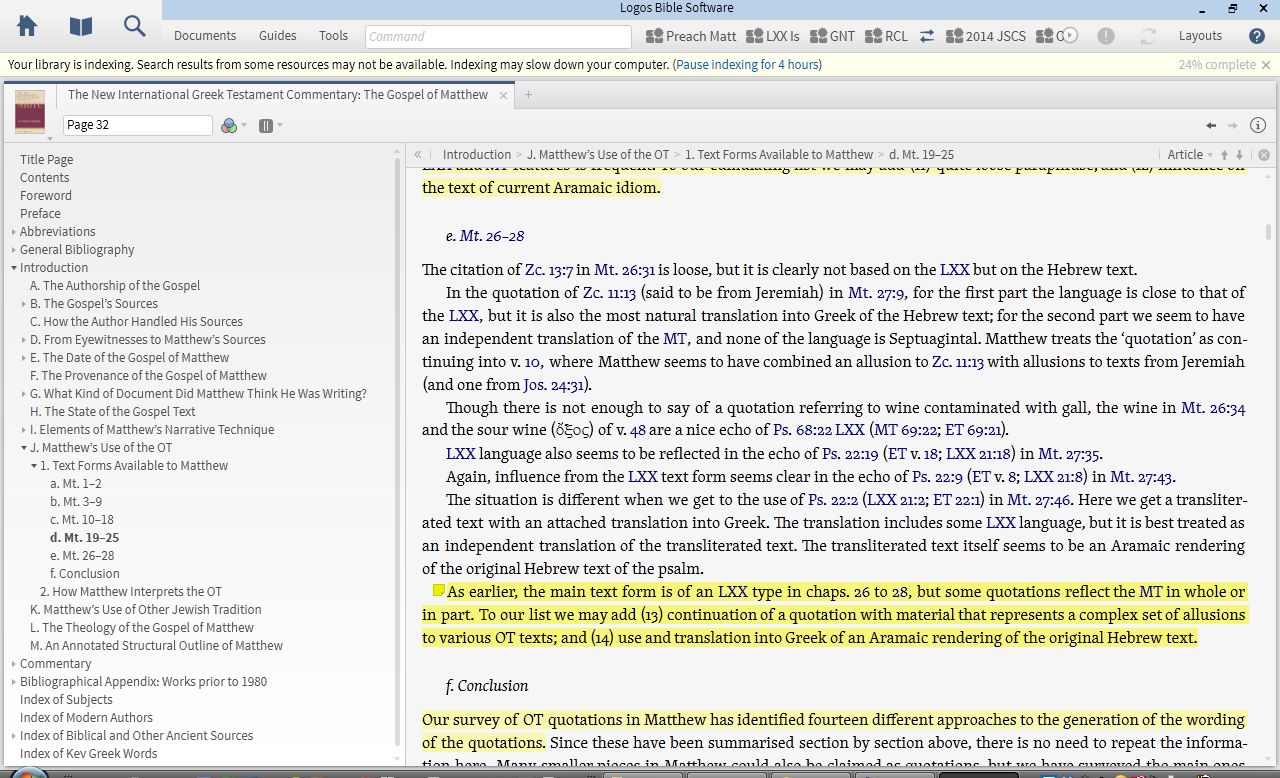
9. To annotate commentaries.

Here you can see both highlights (which sync seamlessly across devices) and a notes icon from where I have recorded my own reactions:

Commentary Reading on Logos on a PC

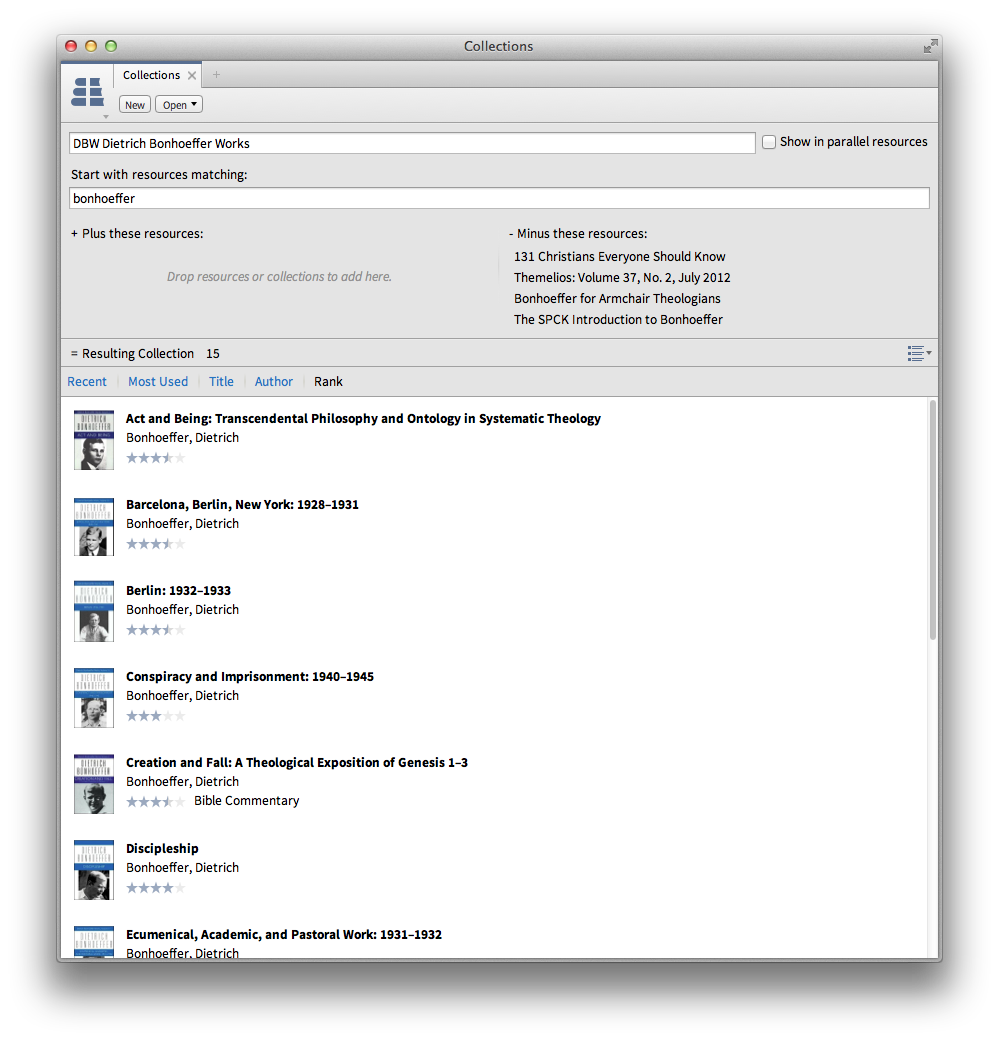
 8. To create (and then search) my own defined collection of resources.

This way I can search through all the volumes I have of the Dietrich Bonhoeffer Works:

Custom-Defined Collection in Logos for Mac

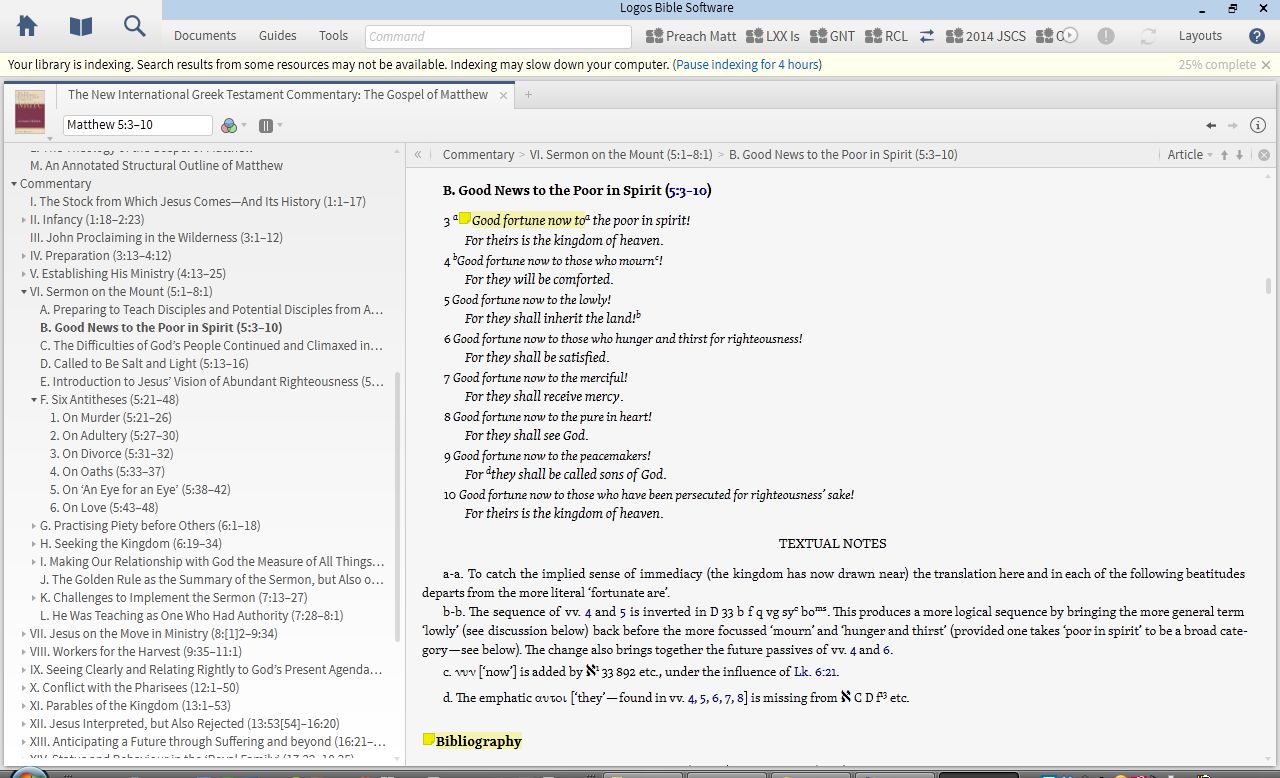
7. To navigate through a book via Table of Contents sidebar.

As at left here:

Sidebar Table of Contents

6. As a portable library.

Here’s the searchable library view in Logos in iOS, where one can access almost all of one’s library. In iOS you can access all of your resources with an Internet connection without having to download them. You can also download them, so that you don’t have to use data or a wireless connection. I like the flexibility that offers.

iOS Logos library
iOS Logos Library

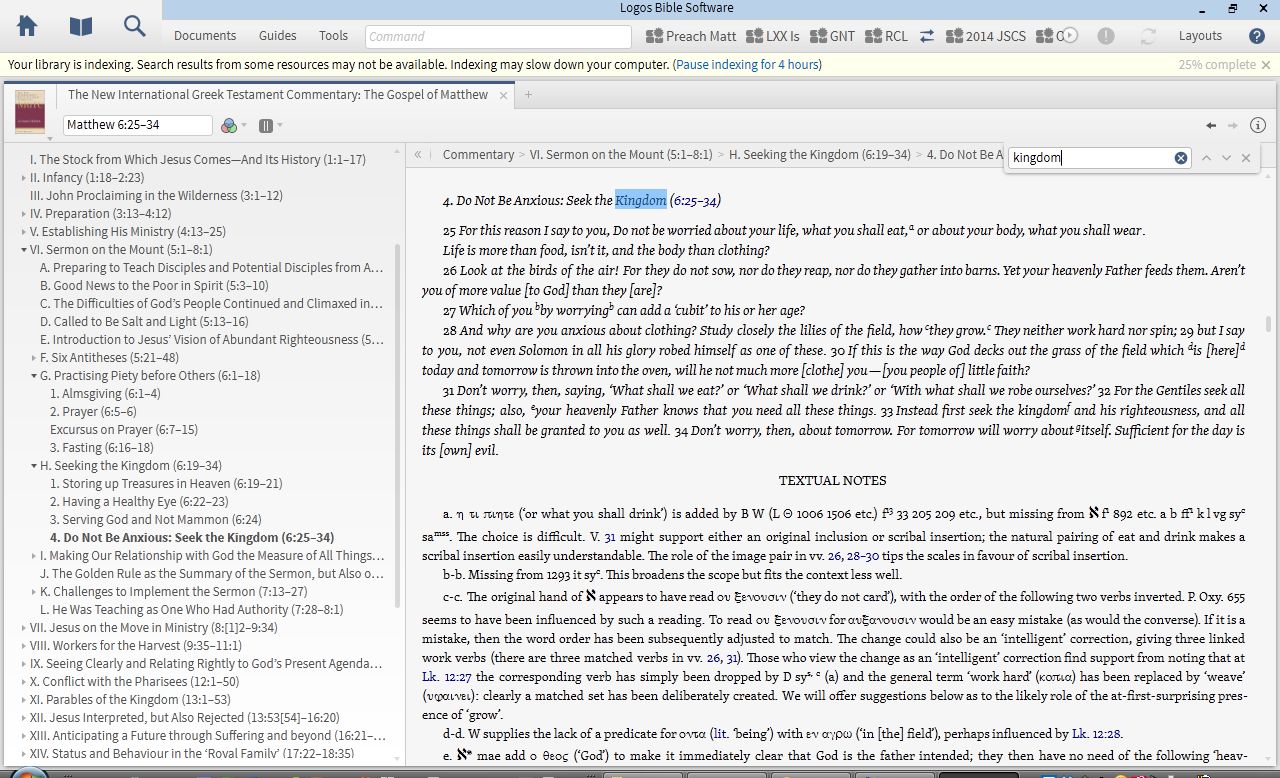
5. For keyword searching a commentary.

This is particularly useful when I want to know not just what a commentary says about a passage, but how it traces a theme throughout the book.

Keyword searching NIGTC Matthew for "Kingdom"
Keyword Searching NIGTC Matthew for “Kingdom”

4. Via Logos’s Biblia.com, for quick reference to my Logos library from anywhere with Web access.

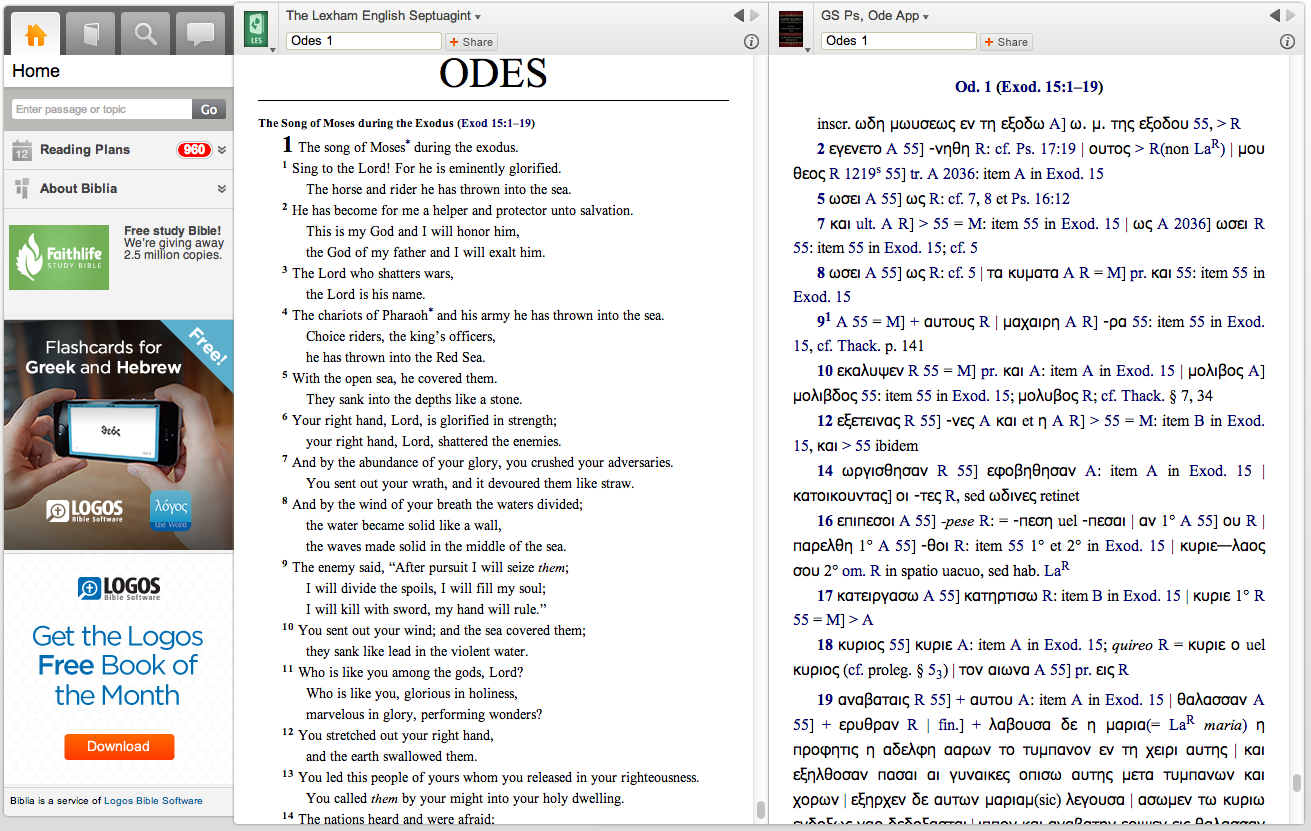
Here I am looking at the Odes in Greek and English translation:

Reading the Septuagint at Biblia.com

3. For pulling up at once all I have in my library on a given passage.

Logos’s Passage Guide is available on whatever device you have Logos in; here it is in iOS. Using a split screen, I can read one commentary (and highlight it), as well as see other hyperlinked options to explore:

Passage Guide in Logos iOS

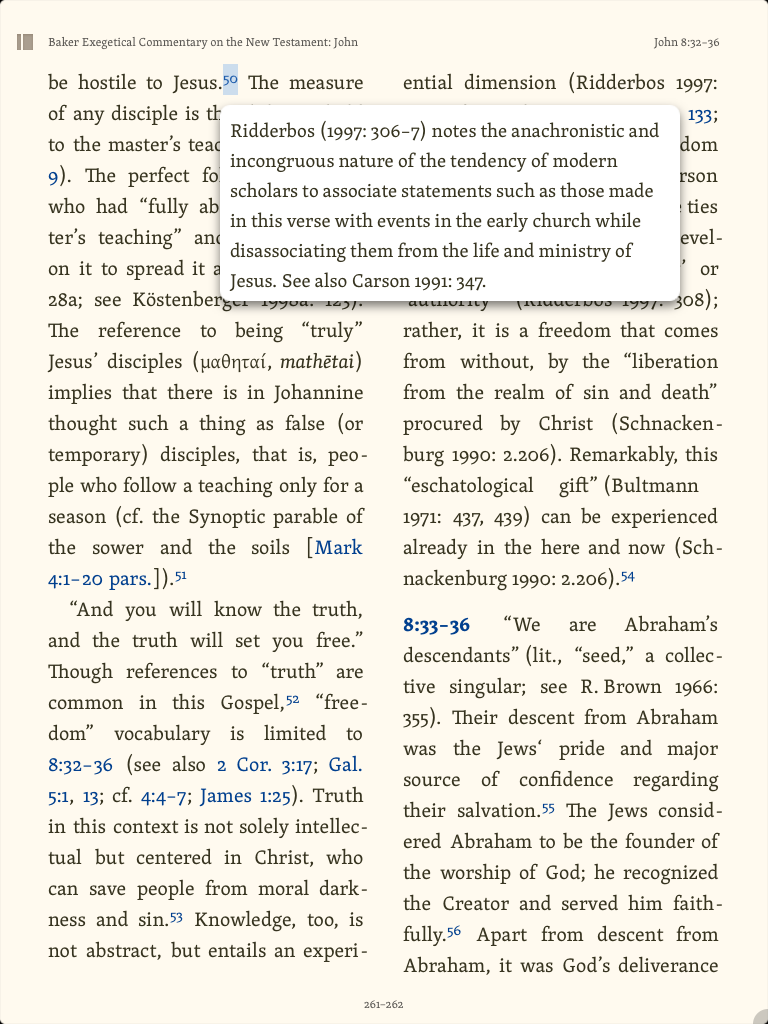
2. For touching footnotes to pull them up.

This I can do in iOS:

Tapping a Hyperlinked Footnote Brings It Up

1. For reading through a book of the Bible, with help.

Here is a layout I used often for when I read with a group of folks through Greek Isaiah in a Year. I could compare multiple Greek texts, a Hebrew text, English translations, lexicons, notes, and more:

Multi-Text and Multi-Resource Layout

The major advantages in Logos are its connections of resources to each other, system of hyperlinks, and ability to sync (notes, highlights, and where you left off reading) across devices. Not only that, but even compared to Amazon Kindle and iBooks, they have the most extensive store/library of resources for biblical studies that I know of. There’s a lot more you can do in Logos than what I’ve highlighted above. You can find all my Logos reviews gathered here.

Logos Free Book of the Month for May

Screenshot 2014-05-01 21.12.34This month’s free book in Logos Bible Software is 300 Quotations for Preachers from the Puritans. It is free as a stand-alone, and also part of a larger series I reviewed about a year ago, 1,500 Quotations for Preachers.

Here’s the link to the free 300 quotations book. Richard Baxter, John Bunyan, Jonathan Edwards, John Owen, and a number of others are included.

There is also a short commentary on James (from Logos’s Pastorum Series) available for $0.99, here.

A Short Review of R. Bethge’s Bonhoeffer: A Brief Life

Bonhoeffer_A Brief Life

Renate Bethge’s Dietrich Bonhoeffer: A Brief Life, is about as short a Bonhoeffer biography as there is. Renate’s husband was the late Eberhard Bethge, Bonhoeffer’s dear friend and biographer. Renate is also Bonhoeffer’s niece.

Whereas Eberhard’s bio is well over 900 pages, Renate’s Brief Life is under 90. It’s laid out nicely, with lots of photographs, wide margins, and quotations from Bonhoeffer’s writing and correspondence. Given how little text is actually on a page, it’s a quick read.

The book offers a succinct overview of Bonhoeffer’s life, yet it does not lack substance in its brevity. Highlights for me were the overview of his parents (and their character, and its effect on Bonhoeffer), a chapter called “Contacts with Jews,” and the personal touch of including some of Bonhoeffer’s correspondence. His beautiful poem “Who Am I?” is re-printed here in its entirety.

There are brief mentions of his writings: Life TogetherEthics, and Letters and Papers from Prison (but not, surprisingly, Discipleship). Page 87 offers a nice one-page summary chronology of Bonhoeffer’s life.

If you want to look at a couple sample pages from the book, Logos Bible Software has put some up here and here. (This book will soon be offered in Logos as part of its forthcoming Bonhoeffer Studies Collection.)

Someone looking for biographical detail will want to look elsewhere, but this only claims to be a “brief” biography, which has value especially for folks like me who are coming seriously to Bonhoeffer for the first time. As I continue to read through Eberhard Bethge’s biography, it was nice to put it aside for a bit to get a quick overview of all of Bonhoeffer’s life.

The above book was an unexpected  but welcomed gift from somebody (not a review copy from the publisher). It’s on Amazon here. See my other Bonhoeffer posts here.

Mark (NIGTC) in Logos’s Biblia.com

France NIGTC MarkFor an exegesis course in seminary, I was assigned R.T. France’s Mark in the New International Greek Testament Commentary (NIGTC) series. The assignment was to read the entire commentary that semester, and I read every one of its 700+ pages. It was that good.

Like the rest of the NIGTC series, France’s volume focuses first on the Greek text, including textual variants where they arise. France is a careful interpreter and keeps the other synoptic gospels in view throughout the commentary. This is not, however, to the exclusion of a keen awareness of and sensitivity to the literary context of Mark as its own book. Even as he unpacks the lexical range of a Greek word, he keeps the larger contour of Mark in view.

As I mentioned in another France review, despite the technical nature of Mark, France moved me deeply with his interaction with the text. He helped me to know and love Jesus more deeply, using the Greek text of Mark as a means to that end. You can find France’s commentary on Amazon (affiliate link) here. It’s in Logos here, where it is well-produced and thoroughly hyperlinked.

For as much as I’ve reviewed Logos Bible Software, I’ve barely mentioned Biblia.com. It’s a Web-based way of accessing Logos resources you own. This is especially helpful for those times when I just need to pull up a commentary (like France’s) but don’t want to wait for Logos to open, load, or index. It looks like this (click on image to enlarge):

NIGTC Mark in Biblia

I haven’t found a way to make the ads at lower left disappear. Nor is Biblia intended to be as full-bodied as Logos (note that it’s in Beta). Since you can access it through any Web browser, it’s fairly universally accessible. Only real downside I’ve experienced: unlike Logos on iOS, Mac, and PC, you can’t highlight or take notes in any resources. But for reading texts–two at a time, as shown above–it’s pretty handy.

You can see above how I’m reading France’s Mark on the right, with a Bible open on the left. Regarding the way that Mark introduces John the Baptist at Mark 1:9, France writes:

(ἐν ἐκείναις ταῖς ἡμέραις has an equally formal, ‘biblical’ ring; Mark stands in the tradition of the great chroniclers of the acts of God in the OT.) It introduces a new phase in the story and, in this case, a new actor in the drama.

This is one of many examples of France’s using Greek to help the reader better understand what Mark is up to in his Gospel. His command of Greek and obvious love for God make this the first commentary to reach for when reading, teaching, or preaching on Mark.

Thanks to Logos for the review copy of the NIGTC series. See also my post about NIGTC Matthew in Logos here.

Free Book in Logos: Jesus and Scripture, by Steve Moyise

Jesus and Scripure by MoyiseIn early February I finished reading Steve Moyise’s Jesus and Scripture: Studying the New Testament Use of the Old Testament. You can read what I wrote about it here. Here is the concluding portion of that review:

Jesus and Scripture would be perfect for a seminary course on the Gospels, or on the NT use of the OT. An advanced undergrad course would also do well to adopt this book. I’d also recommend it to a serious Bible reader–no biblical languages are needed here, and I found that even with my own knowledge gaps in historical Jesus studies, Moyise explained everything I needed to know.

Though this survey is short (less than 150 pages), Moyise gives plenty of sample passages and insights that have challenged me. I know this is a book I will come back to and want to read again in the future.

This month Logos Bible Software is offering their edition of the book for free. It’s a fantastic book, and I look forward to being able to use it now electronically (with keyword searchability and hyperlinked Scripture references throughout). You can get the book here.

What are the Best New Testament Commentaries?

NT Commentary Survey

D.A. Carson’s 2013 update to his New Testament Commentary Survey puts the book into its seventh edition. Having come six years since the last edition, the new edition is substantially revised and updated to include just about every significant commentary on every book of the New Testament. The Survey rarely misses a volume.

Carson goes book-by-book through the New Testament and suggests what he thinks are the best-written commentaries and why. He also offers introductory notes and principles for selecting commentaries and series, as well as 14 pages on New Testament introductions and theologies to consider. The number of books that Carson surveys is impressive.

I found Carson’s survey to be much more detailed and up-to-date than its Old Testament counterpart. He makes mention, for example, of the brand new Teach the Text commentary series. And he seems to have already examined the relevant ZECNT volumes that had been released before this survey went to press. So anyone using this book can be assured that not much ground is left uncovered.

Of course, it’s impossible in 175 pages or so to get detailed analysis of each commentary. For the most part, Carson is able, in just a couple of sentences, to give the reader a really good idea of what each commentary does well, and whether or not to consider adding it to one’s library. One always knows what top two or three commentaries Carson would suggest on a given book of the New Testament (and why).

There are times where Carson’s evaluations are left unexplained, or when he fails to evaluate a commentary in accordance with its own purposes. For instance, he criticizes a New Testament introduction on “Intertextual Development of the NT Writings” for focusing “so narrowly on intertextual connections that other axes are unhelpfully ignored.” Or a socio-rhetorical commentary on Matthew is faulted for not including enough “penetrating comment on structure, grammar, and sometimes theology.” The discerning reader can overlook this and not be deterred by it.

Carson’s writing style is engaging, enjoyable, and downright funny at times. Of his own commentary on John, he writes, “Carson’s work is rather more difficult for me to assess.” He pulls no punches in his critiques. A reviewer could multiply examples, but here are just a few quotations:

  • “…despite the superfluity of cutesy remarks that are in constant danger of distorting the picture of who Jesus is…”
  • “…his grasp of Greek is mechanical, amateurish, and without respect for the fluidity of the Greek in the Hellenistic period.”
  • “…the result is a disappointing monument to misplaced energy.”
  • “…his reconstruction of the church situation is so quirky that it cannot be recommended except to readers who are devoted to quirkiness.”

I was surprised that a short guide like this would contain such strongly expressed opinions, but the more I read on, the more useful I found them to be–even as I realized that some of Carson’s assessments are subjective and need to be weighed. (He too blithely, in my opinion, dismisses reader-response criticism.) He is an excellent writer and somehow manages throughout the book to avoid many reviewers’ clichés, which is no small accomplishment when covering this many commentaries!

Carson is (refreshingly) not at all reluctant to call out unacknowledged borrowing, which occurs in commentaries more often than one would hope.

Carson’s goal is:

to provide theological students and ministers with a handy survey of the resources, especially commentaries, that are available in English to facilitate understanding of the NT.

In this Carson has succeeded, even in entertaining fashion. If the reader is willing to overlook the few critiques mentioned above (as I largely have been), she or he will find this a good desk-side companion to help wade through the world of myriad commentaries.

Thanks to Baker Academic for the review copy of NT Commentary Survey. You can find it here (Baker Academic) and here (Amazon/affiliate link).
Of Paul, James, Mattathias, and Phinehas: Works and Reckoned Righteousness

From Jesus to the Church Welcome to today’s stop of the book blog tour of Craig A. Evans’s From Jesus to the Church: The First Christian GenerationI’m covering chapter 4, “Phinehan Zeal and Works of the Law: What Paul and James Are Really Saying.” Brian at Near Emmaus introduces the book here, and quotes from the introduction, which is worth repeating:

The present study is not a history of the early church; it is not even a history of its first generation. It is, rather, a study narrowly focused on the clash between the family of high priest Annas and the family of Jesus of Nazareth, a class inaugurated by a Jeremiah-related prophecy of the temple’s doom, uttered by Jesus, and ended by another Jeremiah-related prophecy, uttered by another man named Jesus.

The title, then, is a bit misleading, or at least more general than the actual contents of the book.

Continue reading “Of Paul, James, Mattathias, and Phinehas: Works and Reckoned Righteousness”

Scot McKnight’s Sermon on the Mount Commentary

SGBC SMount

Scot McKnight just released a commentary on the Sermon on the Mount. I’ll post a review in due time, but as I prepare my sermon for our church’s last Sunday in the Sermon on the Mount, I wanted to give props here to what is a really good commentary! McKnight blends careful exegesis with relevant application, and isn’t afraid to really wrestle with some of the challenges Jesus issues in the S.Mount. Highly recommended.