Where gospel difference is seen as a problem or weakness that calls for elaborate harmonization procedures or critical unmasking, the root cause is a dissatisfaction with canonical pluralism as such and a determination to reduce it to singularity. But that is to overlook the hermeneutical significance of the canon itself, which strives to integrate the voice of the individual witness into an encompassing polyphony. As an ancient tradition suggests in word and image, this evangelical polyphony echoes the song of the four living creatures around the divine throne.
I’m reviewing Watson’s book for an upcoming Bible Study Magazine issue. Watson’s comfort with the co-existence of history and theology–as if one could be devoid of the other in the case of gospel reception–is refreshing.
Recently I’ve been spending time with The Anchor Yale Bible Dictionaryin Logos Bible Software. In the coming weeks I’ll review it here, summarizing some of the articles, commenting on their content, and evaluating the dictionary’s presentation in Logos. (You can find my other Logos reviews here.)
The dictionary is massive, consisting of six volumes and somewhere in the ballpark of 7,000 total pages. Here are a few more features, taking from the dictionary’s publisher’s page:
– Includes six volumes of approximately 1,200 pages each
– More than 6,000 entries
– More than 7,000,000 words
– Nearly 1,000 contributors
– Multicultural and interdisciplinary in scope
– An unprecedented interfaith exploration of the Bible
– Illustrated throughout with easy-to-find references
– Extensively cross-referenced for comprehensive coverage of topics
– Easy-to-read article and chapter headings for speedy location of material
– Full bibliographical references following all major entries
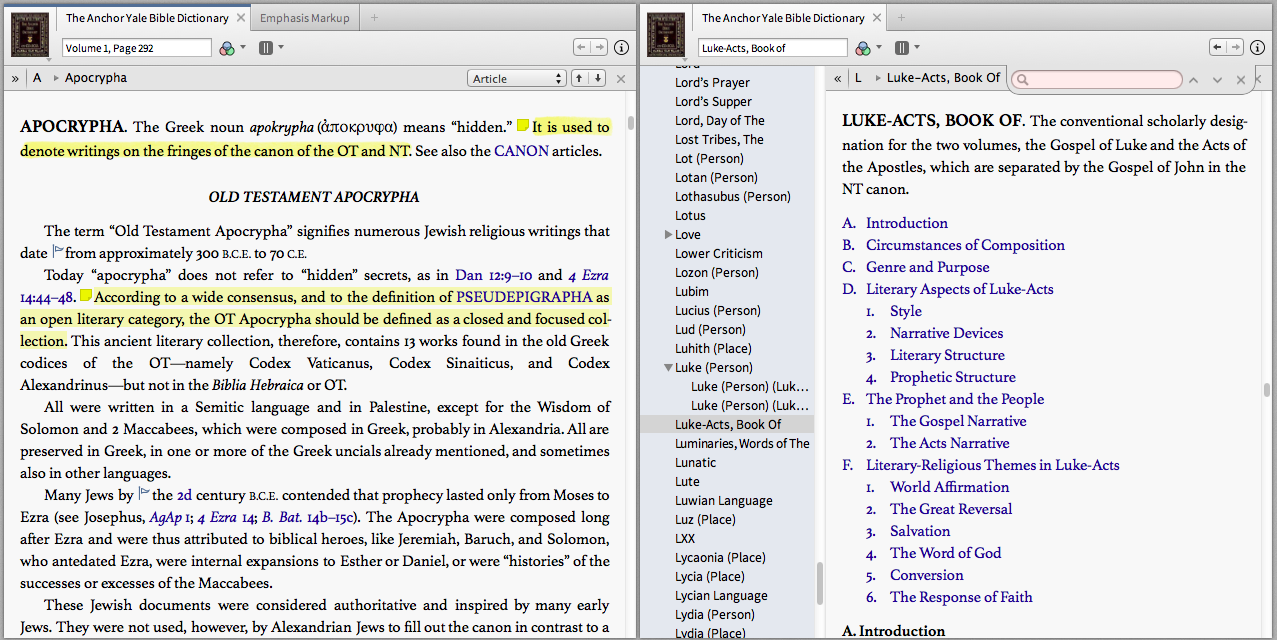
In Logos on a computer there is the added bonus of being able to open more than one entry at a time:
Two articles open at a time (click to enlarge)
As with the rest of Logos’s resources, all of the content in blue above is hyperlinked. So with the verse references you can hover over them for a popup of the verse text, or click on a hyperlink to open its contents in a new window. In the right half of the screen above, clicking on a section in the article takes you directly there.
I’m preaching this week on the Pharisee and the Tax Collector, so wanted to read a bit more about tax collectors. I type the entry name into the search bar to get there. Or I could navigate there via the left contents sidebar.
Looking something up
The “Tax Collector” article by John R. Donahue begins this way, with elaboration on each of the three mentioned “problems”:
Among the NT writings, only the Synoptic Gospels recount Jesus’ association with tax collectors (telōnai, KJV, “publicans”). Three problems attend this picture: (1) the identity and status of the telōnai, (2) the moral evaluation of them, and (3) the significance of Jesus as “a friend of tax collectors and sinners” (Matt 11:19; Luke 7:34).
In “Identity and Status” Donahue helpfully begins, “Etymologically telōnēs is a combination of telos in the sense of something paid for the purpose of the state, a toll, tax or duty; and ōneisthai (noun, ōnē), to buy or purchase.” I highlighted this sentence in Logos on my iPad and then moved to a computer, where the highlight had almost instantaneously synced to display there, too. Had I made a note at that sentence, it would sync, as well.
Donahue summarizes the Greco-Roman history of the term and office of the telōnēs, then moves into the details of how “Palestine was forced to pay tribute to Rome” after Pompey’s siege in 63 B.C.E. He differentiates between the different kinds of taxes (poll/census taxes, land taxes, etc.), as well as the different senses in which “tax collector” (telōnai) could be used. He concludes that the telōnai with whom Jesus interacts appear to be “toll collectors,” or, “minor functionaries fulfilling the orders of higher officials.”
In “Moral Evaluation” of the tax collectors, Donahue notes that “negative views” of this group of people occur outside the New Testament, as well (e.g., in rabbinic and secular literature). The author writes, “In Roman and Hellenistic literature they are lumped together with beggars, thieves, and robbers,” citing sources and giving examples. Knowing this helps me to better appreciate just how universally despised tax collectors were. This adds more punch to the parable in Luke. The New Testament itself (including Luke 18), as Donahue notes, mentions them in the same breath as “sinners” and “immoral people.”
“Jesus and the Tax Collectors” is the third and final section of the article. Multiple hyperlinked NT references in the article take the reader to places in the Synoptic Gospels where Jesus sits with and shows love to tax collectors. Citing Norman Perrin, Donahue notes:
Jesus’ association with them is viewed as an “acted parable” of his message of God’s mercy to sinners and “an anticipatory sitting at table in the kingdom of God” (Perrin 1967: 107).
A 15-source Biblography concludes the article.
Personally I’m not a big fan of the transliteration throughout the AYBD; I’d rather see τέλος than telos, for example. But that is the editorial decision of this dictionary. It’s not insurmountable, but does require a little extra work on the part of anyone who knows other languages but may not be used to seeing their transliterations.
Other than that quibble, Donahue’s article is indicative of what I’ve seen so far in the Anchor Dictionary: careful and top-notch scholarship that does not therefore suffer from dryness or inaccessibility. There is strength, too, in Donahue’s succinctness.
Evangelical scholars, pastors, and readers will want to be aware of and use their judgment regarding the dictionary’s “critical” approach to biblical studies. Donahue’s citation of “Q” will not be warmly accepted by all. (I and others still want to hear about manuscript evidence for Q.) But this generally does not make the dictionary any less useful or of lower quality.
Though I have other Bible dictionaries I use, when I’m studying, teaching, or preaching on a given topic, I’ll likely reach for (or, rather, click on) the Anchor Dictionary first.
Thanks to Logos Bible Software for the review copy of the Anchor Bible Dictionary. Find it here.
This year my three-year-old and six-year-old sons both started school (pre-school and kindergarten, respectively). So the recent arrival of Clara Vulliamy’s Martha Bunny Loves School (Albert Whitman & Company, 2013) was quite timely.
Here is a book trailer from the author’s Website, which gives you a glimpse of the color, font, layout, and movement of the book:
Martha Bunny Loves School is “a happy book all about Martha,” a bunny who is starting her first day of school. She has two bunny brothers (“one huge problem”), but before she gets to them, she shares her favorite color, popsicle flavor, hobbies, and (best of all) her “yellow-and-blue-and-orange-and-pink polka-dot rain boots,” which she wears even to sleep.
Martha’s bunny brothers are going to miss her when she goes. After eating breakfast–her brother Monty will only “eat his breakfast inside his box”–and getting dressed (“I don’t know what to choose”), she has to mollify two sad brothers who don’t know what to do while she’s away. So she founds the “Happy Bunny Club,” complete with badges, a sign, and a secret den.
After trying to fit all of her belongings into her backpack, Martha can’t fit through the door, so ends up packing just her Happy Bunny Club badge that her brothers make for her. At the end of her school day, she happily reunites with her brothers in the secret den.
When I asked my own three-year-old bunny what he thought about this book, he simply replied, “Good!”
“What happened?” I asked.
Martha have too much stuff in her backpack when she go, and she says, “SQUEEEEZE!” through the door. But her favorite stuff came out of the backpack.
Not long after reading Martha Bunny Loves School, my son went off to draw his own Happy Bunny Club badge.
There’s a lot to love about this book. The story is relatable, the plot and conflict and resolution are all compelling, and the characters (especially Martha’s) are well-developed. The illustrations and layout and font are stellar. The colors are vibrant. Here’s a sample page (note the graph paper background and creative use of space and text):
A look inside the book
The book aims at ages 4-7 (grades pre-school through 2nd). My 6-year-old thought he was too old for the book, but I don’t think he is. My three-year-old loved it, and older kids (especially with younger siblings) will appreciate it too.
Martha Bunny Loves School is a standout children’s book, one of the best we’ve read in a while. (And we read a lot around here.) It’s been a pleasure to read through it with our little guy, and I’m sure we’ll continue to return to it in the coming weeks and months.
Thanks to Albert Whitman & Company for the copy of the book to review. Its product page is here; at Amazon here. The author’s own site is worth checking out, too.
A hidden gem in BibleWorks is the “MacDonald Greek Transcription.”
BibleWorks comes with sentence diagrams for the Greek New Testament. They are also useful and look like this:
Luke 18:1-2 (click to enlarge)
The MacDonald transcriptions above, however, replicate something I haven’t seen in any other Bible software (EDIT/UPDATE: Logos has a “clausal outlines” module, minus the color coding), which is the sentence flow method of representing and visualizing a sentence. He uses color coding and spacing to line up parallel ideas and repeated words, making them easier to see than in just the text or even the diagrams.
It’s a great way to get at the motifs and important words of a given passage. And I’d forgotten about it until recently, but am now using it most weeks in sermon preparation.
The full title of the resource above is Syntactic and Thematic Greek Transcription of the New Testament, by William Graham MacDonald, 2008. BibleWorks is available here. Its full contents list is here.
And now a video review of a solid and versatile iOS app for learning Greek vocabulary. You can adjust the video setting in the bottom right part of the video below to watch in HD and full screen, if you like.
Thanks to Danny Zacharias for the app, given to me for the purposes of a review. Find out more about FlαshGrεεk here.
UPDATE: I made the video above using the handy Reflector app. Reflector mirrors your iOS device to a computer, from which you can record. (I added the audio later.)
“Bites on Bytes” is too trite, but Words on the Word does have a growing tech focus. I’ve reviewed software before, and have moved into iOS and its apps, and now gear. Here I’ll review a classy case for the iPad mini, with another case review to follow, some iOS app reviews on the way, and a forthcoming review of a Sony bluetooth wireless speaker. Stay tuned.
Here is the lengthily-titled 100% Genuine Brazilian Buffalo Hide Leather Dual Protection Folio Stand/Cover/Case for iPad Mini with Built-in Stand and Detachable Inner Silicon Cover (Black), by Bear Motion:
iPad mini in case, the full setup
This is really two cases in one. On the right in the photo below there is the silicon stand-alone backing, which I’d recommend just for home (but not travel) use. On the left is the folio with a hard back plastic shell that is attached to the leather case that wraps around and closes over the iPad mini. It’s got a sleep/wake feature that functions perfectly.
There is actually a third casing option, since the Bear Motion Dual Protection case comes also with a protective velvet sleeve. So your iPad would be well-protected here.
Let me break it down into pros and cons:
Pros
The construction quality is high
The stitching is careful and tight
The holes (to access camera, earbuds, etc.) are cut out just right; you can still access everything
The leather smells amazing (I am a notorious smeller of books… and of this case)
I can hold the iPad, while in this case, in one hand (results may vary according to hand size)
I haven’t test-dropped the iPad while in this case, but my money is on a safe landing, were some sort of accident to happen
There are three notches for standing it up (in landscape mode only) for viewing; these are sturdier than the typical origami-style construction in other cases… as here:
One of three settings
Cons
It’s not the slimmest option
It is heavier than some mini cases
It is bulkier than some
This cuts two ways:
On the one hand, it is sturdy and classy, a case you’d definitely take to your business meeting
On the other hand, the “package weight” Bear Motion lists is 0.7 pounds, which is just a touch more than the iPad mini itself. So you double your weight if you use this case
It is difficult to maneuver the case in order to take photo or video (it doesn’t just fold back)
There is no place to hold a stylus, which would be a nice feature in a case like this
All told, the pros significantly outweigh the cons. I’ve looked at a number of cases for the iPad mini (and have used four now, with another review to follow), and this is among the best you can get–if the weight is not a problem for you.
Thanks to Bear Motion for the review sample. They make plenty of other cases for various devices, too. The case reviewed above can be found at Amazon here.
Look at that! It’s an all-Greek Bible. Just like the one Jesus carried around! Okay, not quite, but it is very good to see the Greek Septuagint and the Greek New Testament together under one cover. Augustine would be pleased:
For Greek aficionados—a 2-in-1 resource that’s designed specifically for extensive research, textual criticism, and other academic endeavors. Featuring both the Rahlfs-Hanhart Septuagint (Greek translation of the Hebrew Old Testament) and the 28th edition of the Nestle-Aland Novum Testamentum Graece, this user-friendly tool includes critical apparatus, cross-references, and more. 3216 pages, hardcover from German Bible Society.
What It Looks Like
It’s a mere three pounds (in weight, not price). Amazon lists its dimensions as 7.5 x 5.7 x 2.8 inches.
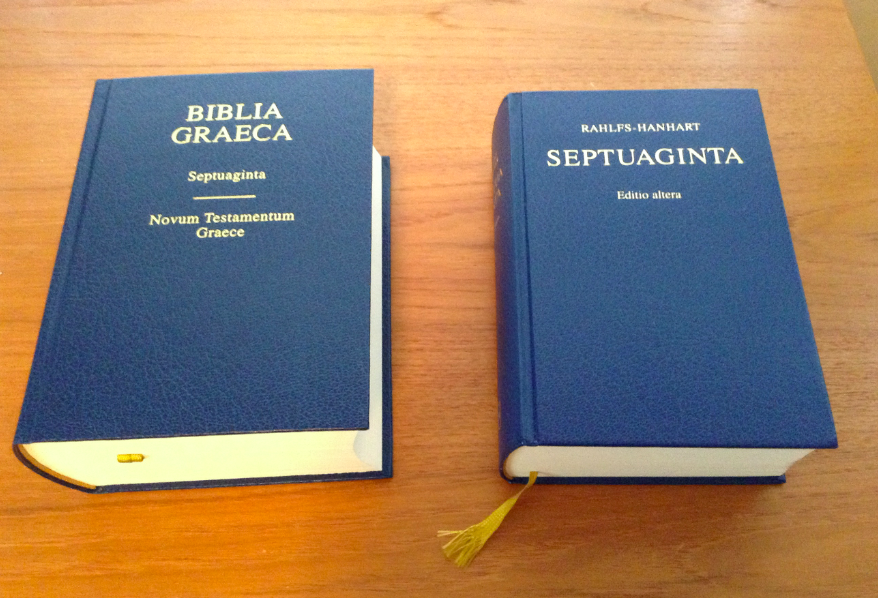
This impressive edition is two previously published Greek texts put together in one cover. It’s obviously thicker than the Septuagint alone, and just a little bigger in length and width. Here are the two side by side: the Septuagint alone on the right, and its “upgrade” version (with GNT) on the left:
v. 1.0 (at right) and v. 2.0 (at left)
Before receiving the volume, I was concerned that its 3,000+ pages would defeat Alfred Rahlfs’s initial intention to have a Handausgabe (i.e., a manual and portable edition). Indeed, Hanhart’s “Introductory Remarks to the Revised Edition” translate Handausgabe as “pocket-edition,” which this is decidedly not. (It would fit nicely in a purse or man-purse, though.) That said, the addition of the Greek New Testament really does not add a lot of bulk, as Rahlfs-Hanhart was already more than 2,000 pages. Biblia Graeca is still a (fairly) portable edition, though, if not literally pocket-sized. The sewn binding and hard cover appear that they will hold up under regular use. Here are v. 1.0 (LXX only) and v. 2.0 (LXX+GNT) stacked on top of each other:
You can barely make it out from the above photo, but the LXX/GNT combo comes (wisely) with two ribbon markers. Was it a coincidence that mine were both placed at the beginning of Odes? I think not.
The Greek Typesetting/Font
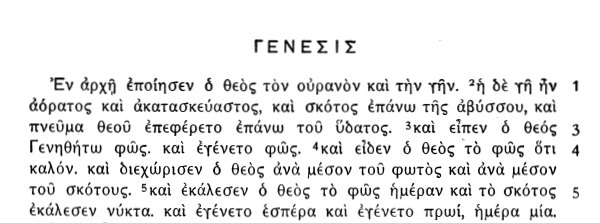
Rahlfs has not been re-typeset, so its Greek font is not as crisp or readable as that of the New Testament portion. Compare:
Genesis 1:1-5, from publisher’s pdf sample
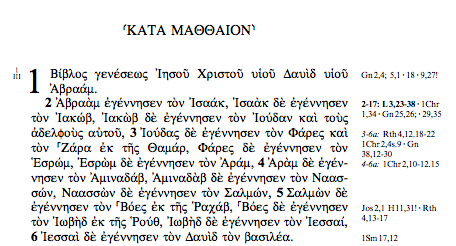
Here now is the Greek in the New Testament portion, which is clear and crisp:
Matthew 1:1-6, from publisher’s pdf sample
After reading enough Septuagint, one does get used to the Rahlfs font. It’s not too bad.
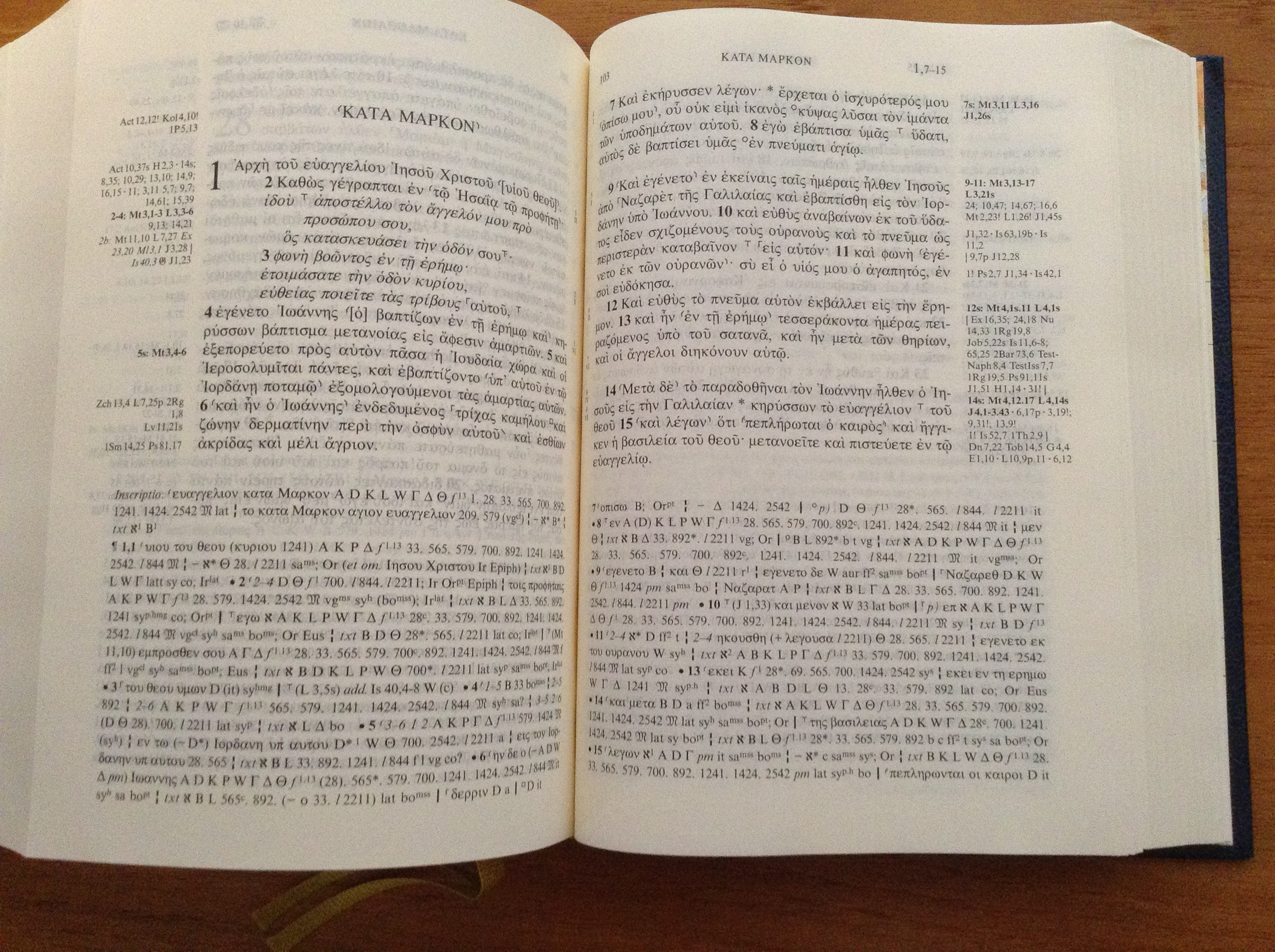
Always a concern with Bibles this big is that the requisite thin pages will mean bleed-through of text from the reverse side. This is noticeable to a degree here, but not in a way that negatively affects reading:
Mark 1
Rahlfs-Hanhart (Septuaginta)
The Rahlfs-Hanhart edition is not the go-to for extensive text-critical research that the Göttingen editions are, where they are present (on which, see my posts here and here on using Göttingen). Rahlfs is still useful, though, because it contains an entire Septuagint text, whereas Göttingen (published as individual volumes) does not.
It is probably the best starting place for readers of the Septuagint, even with its deliberately more limited apparatus. It is best thought of as a “semi-critical edition,” as noted here. Rahlfs “reconstructs” the text using, primarily, Codex Vaticanus (B), Codex Sinaiticus (S or א), and Codex Alexandrinus (A), a methodology that the revisor, Robert Hanhart, honors. Here is the apparatus for the first page, covering Genesis 1:1-14. This is a funny case, because of how much of Genesis is missing in B, so Genesis 1-46:28 up through the Greek word ηρωων is just based on A here. The rest (from πολιν in 46:28 to the end, chapter 50) take into account B and A.
Preceding the actual text and apparatus are Hanhart’s 2005 “Introductory Remarks to the Revised Edition” in German, English, and Greek. Then in German, English, Latin, and Greek follow three more sections: (1) Rahlfs’s “Editor’s Preface,” (2) an illuminating 10-page essay, “History of the Septuagint Text”, and (3) Explanation of Symbols. Everything you need to get started reading the Septuagint (minus the Greek lessons) is here.
The long-awaited 28th edition of the Novum Testamentum Graece has now been published. Once again the editors thoroughly examined the critical apparatus and they introduced more than 30 textual changes in the Catholic Letters, reflecting recent comprehensive collations. With the intent to make this book more user-friendly, the editors also revised the introductions and provided more explanations in English. This concise edition of the Greek New Testament, which has now grown to 1,000 pages, will continue to play a leading role in academic teaching and scholarly exegesis.
The NA28 has its own snazzy site here. (What a day we live in, when a Greek Bible gets its own Website! Its writers would be amazed.) Recent text-critical work on the New Testament has led to revisions in the Catholic Letters, but not elsewhere. So the Gospels and Pauline epistles, for example, retain the same text as the NA27. However, there are changes that affect the whole edition, as the publisher points out:
Newly discovered Papyri listed
Distinction between consistently cited witnesses of the first and second order abandoned
Apparatus notes systematically checked
Imprecise notes abandoned
Previously concatenated notes now cited separately
Inserted Latin texts reduced and translated
References thoroughly revised
As for the textual differences themselves, those are explained and listed here. There are more details to be digested about the new NA28 edition. I can do no better than to refer you to the writings/reviews of Larry Hurtado, Rick Brannan, Daniel Wallace, and Peter Williams.
All the quick-reference inserts you need to make sense of symbols and abbreviations are included:
Concluding Thoughts: Sell All You Have?
The product page for the beautiful Biblia Graeca is here for CBD, here at the German Bible Society, here at Hendrickson, and here for Amazon. And, best yet, you can look at a sample of the book here. If it’s just the text (and not the apparatuses) that you’re interested in, you can read the NA28 online here and the Rahlfs-Hanhart Septuagint here.
Rahlfs wrote in his preface that he sought to “provide ministers and students with a reliable edition of the Septuagint at a moderate price.” If you click the links above, you will see that this is not “a moderate price.” It’s significantly cheaper to buy the same critical editions of each Testament under separate cover.
But there are at least two major advantages to putting them together. First, when the New Testament writers quoted Scripture, they predominantly did so in a form that is closer to what we have now in a Septuagint text. Comparing a quotation (in Greek) with its source (in Greek) is facilitated by this edition. Second, that this edition exists is an important symbolic statement. Lovers of the Septuagint are fond of affirming that it was the Bible of the early Church. If that is so, why can we not have one, too? Now we can, printed and bound in a way that would shock the pre-printing press world that first heard all these Scriptures together when gathered for worship.
Professor Ferdinand Hitzig has often been quoted saying, “Gentlemen!” (and today, he would say, “Ladies!” too) “Have you a Septuagint? If not, sell all you have, and buy a Septuagint.”
In true biblical storytelling fashion, he is using hyperbole to communicate his point. But for those who are so inclined and able, if selling a few things to get a Septuagint is a good idea, how much more might someone like Hitzig encourage them to sell a few things for the Biblia Graeca?
Christians believe that the Septuagint has come to full fruition through the New Testament.
So it only makes sense to be binding the two together.
Many thanks to Hendrickson for the privilege of reviewing this fine work. A copy came my way for review, but with no expectation as to the nature of my review, except that it be honest.
The apostles said to the Lord, “Increase our faith!”
He replied, “If you have faith as small as a mustard seed, you can say to this mulberry tree, ‘Be uprooted and planted in the sea,’ and it will obey you.”
–Luke 17:5-6 (NIV 2011)
This Sunday I’ll preach on the above verses, taken from the lectionary reading of Luke 17:5-10. The rest of the passage goes on:
“Suppose one of you has a servant plowing or looking after the sheep. Will he say to the servant when he comes in from the field, ‘Come along now and sit down to eat’? Won’t he rather say, ‘Prepare my supper, get yourself ready and wait on me while I eat and drink; after that you may eat and drink’? Will he thank the servant because he did what he was told to do? So you also, when you have done everything you were told to do, should say, ‘We are unworthy servants; we have only done our duty.’”
My first three questions of the text were as follows:
How should I take Jesus’ statement about the mulberry tree? Should I really be trying to uproot trees (or move mountains, in a synoptic parallel)? Can I?











 Words on the Word