3 More Romans Monographs to Check Out

Abraham by Wordle 2

To add to the three books I mentioned in yesterday’s post, here are three more books about Romans I’ve enjoyed using the last couple months, with sample quotes.

Benjamin Schließer, Abraham’s Faith in Romans 4: Paul’s Concept of Faith in Light of the History of Reception of Genesis 15:6. (Tübingen: Mohr Siebeck, 2007.)

The foregoing overview of the interpretation of Gen 15:6 in Jewish theology has yielded a wide array of results and by no means a straightforward line of development in the way how the authors conceived of Abraham’s faith and God’s judgment on it.

Krister Stendahl, Final Account: Paul’s Letter to the Romans. (Minneapolis: Fortress, 1995.) (I reviewed Stendhal here.)

Consequently, Romans is central to our understanding of Paul, not because of its doctrine of justification, but because the doctrine of justification is here in its original and authentic setting: as an argument for the status of Paul’s Gentile converts on the model of Abraham (Romans 4).

Gerhard H. Visscher, Romans 4 and the New Perspective on Paul: Faith Embraces the Promise. (New York: Peter Lang, 2009.) Here is Visscher’s outline of Romans 4:

Rom. 4:3-8: Paul’s First Argument from Genesis 15:6
Rom. 4:9-12: Second Argument from Genesis 15:6: Faith, Circumcision, and Gentiles
Rom. 4:13-22: Third Argument from Genesis 15:6
Rom. 4:23-25: Fourth Argument from Genesis 15:6: “For us also…”

3 Great Off-the-Beaten Path Books about Romans

Abraham by WordleOver the past couple of months I’ve spent a good deal of time in Romans 4. The more I study Paul’s magnum opus, the more amazed I am by all that he packed in and the way he did it.

In my reading and writing on Romans, I’ve come across some great monographs. Here are three, with a sample quote from each. I’ll do three more tomorrow.

Pablo T. Gadenz, Called from the Jews and from the Gentiles: Pauline Ecclesiology in Romans 9-11. (Tübingen: Mohr Siebeck, 2009.)

In sum, Christians in the Church, stemming from Jewish and Gentile origins, can rejoice together in the salvation available by faith in Christ to all without distinction. “Rejoice, O nations, with his people!” (Rom 15:10). With humility, they can marvel at God’s plan for Israel, of which the Gentile-Christians in particular are beneficiaries. “O the depth of the riches and wisdom and knowledge of God! How inscrutable are his judgments and how unsearchable his ways!” (Rom 11:33) (p. 328)

Israel Kamudzandu, ‪Abraham As Spiritual Ancestor: ‪A Postcolonial Zimbabwean Reading of Romans 4. (Leiden: Brill, 2010.)

In Romans 4, Paul elevates Abraham as an ancestor of a new Israel, which includes Jews and Gentiles. …In this new situation, Paul gives a new meaning to the Torah as an integrator of all nations of the world. (p. 98)

Philip Francis EslerConflict and Identity in Romans(Minneapolis: Fortress, 2009.) I love this assessment. Before reading Esler, this is just how I had begun to understood Paul’s use of Abraham in Romans 4. Though he expresses it more eloquently than I could:

Above all, [the account of Abraham in Romans 4] carries forward Paul’s aim of recategorizing Judean and non-Judean Christ-followers in Rome into the new ingroup identity and does so by mobilizing collective memories to explain how both subgroups claim ancestry from Abraham in the same way—righteousness credited to them through faith. Abraham thus becomes the prototype of the new identity, portrayed by Paul in a manner peculiar to the needs of this communication and in the face of many rival construals of this patriarch that were possible in the ongoing processing of the past to serve the needs of the present. (p. 194)

Three more recommendations tomorrow.

Romans: Not Really about Justification by Faith?

Final AccountRomans…is not a theological tractate on justification by faith. It is not a pastoral letter dealing with the specific problems in Rome, as the Corinthian correspondence is with respect to Corinth. …Romans is Paul’s account of how his mission to the Gentiles was grounded not only in his call to be Apostle to the Gentiles but also in Scripture, the only Scripture the first Christians had, that is, the Old Testament.

–Krister Stendahl, Final Account: Paul’s Letter to the Romans

I didn’t need much convincing of the first sentence above. To be sure, Romans is a “theological tractate on justification by faith,” but it is not merely that. To read Romans as only about justification is to miss much of what Paul was about. But perhaps more on my own views about that later. For now, I offer here a review of Krister Stendahl’s Final Account: Paul’s Letter to the Romans (Fortress Press, 1995).

Final Account is a collection of Stendahl’s “notes and musings rescued from tapes.” That the five chapters contained here are based on lectures makes for engaging reading. Stendahl goes through Romans in more or less chapter order. Conspicuous is the absence of any treatment of Romans 16. At one point Stendahl speaks of “Romans 1-15” as a “think-piece epistle,” suggesting perhaps that he–along with other scholars–thinks chapter 16 does not really belong in the book.

The “final account” in Stendahl’s title is “Paul’s account of how his mission to the Gentiles fit into God’s total mission to the world, the tikkun, the mending of the creation…and hence particularly the redemption of Israel.” This account ends up being “final,” because Stendahl understands Paul’s execution at Rome as happening before he could write any more letters. Stendahl adds:

Consequently, Romans is central to our understanding of Paul, not because of its doctrine of justification, but because the doctrine of justification is here in its original and authentic setting: as an argument for the status of Paul’s Gentile converts on the model of Abraham (Romans 4).

In chapter 1, “Paul and Israel,” Stendahl notes Israel and its response to the Messiah as a primary concern of Paul: “How could it be that, while his mission to the Gentiles on the specific orders of Messiah grew spectacularly, Israel itself did not respond?” Chapter 2, “A Particular Letter and Sin Universal” covers Romans 1:1-3:20 and 15. Here Stendahl pushes harder against Lutherans who see only justification by faith in Romans, and against Calvinists who see it as just the breeding grounds for “the proper doctrine of predestination.” Instead, he contends, Romans addresses how Gentiles and Jews in that community are to relate to one another. Abraham is a key figure in the issue of Jew-Gentile relations, and “Paul’s Exegetical Find” of Stendahl’s chapter 3 is that Abraham was an uncircumcised Gentile in Genesis 15 when God “reckoned [his faith] to him as righteousness.”

Chapter 4 of Final Account addresses “Missiological Reflections by a Former Zealot,” covering the key section of Romans 9-11. Paul “thinks and feels and worries with his mind” about “his fellow Jews.” He wants them to “come toward salvation.” Stendahl highlights that Paul both identifies with Gentiles in Rome, including them in the salvation story, yet also warns them to not become arrogant–they are, after all, grafted in. Imperialism in missions today, by extension, should be avoided. Chapter 5 covers Romans 12-14: “Intellectual Worship and Respect for Conviction.” Here Stendahl looks at the “ethical admonitions” that Paul gives, which follow on the heels of the “great theological thought” Paul had had about justification.
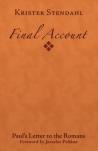
Final Account by Krister StendahlStendahl is to be lauded for situating justification by faith in a larger context. He compellingly provides evidence that Paul was concerned about the salvation of Israel, the place of the Gentiles, and his mission–and concerned about justification by faith as just a subset of those larger concerns.

On the other hand, Stendahl occasionally goes too far with his thesis:

In any case, Paul is moving West. He has plans to go to Spain, and on the way he hopes to visit Rome. That is clearly the reason for his writing.

It’s a reason for his writing, perhaps even the occasion. But to say that Paul wrote Romans with the sole purpose of explicating his Gentile mission goes too far, in my view. It’s all of the above.

Stendahl quotes Scripture rather loosely at times. He acknowledges as much: “Most of the references to the text are my rather free translations and paraphrases.” And the short book comes with the entirety of Romans 1-16 in the RSV, printed at back. Being able to look up verses handily is a great feature here. But the reader quickly finds that she or he will want to double-check such “free translations” against a relatively literal translation like the RSV.

One can easily, then, seek to corroborate Stendahl’s notion that in chapter 15, “[Paul] stressed with words upon words that he had no interest in telling the Romans anything–how to live, or how to think or what to do.” The “urge” or “appeal” (RSV) of Romans 12:1 and the “I have written to you very boldly” (RSV) of 15:15 are just two of a number of places that make the reader wonder how Stendahl came up with that read of the text. He rightly notes that Rome was not a church planted by Paul, and that he wrote to give a “final account” of his mission to the Gentiles. But this does not preclude Paul’s telling the Romans at times “how to live, or how to think or what to do.”

The reader of Final Account will have to read it with caution. But Stendahl offers a refreshing read of Romans, that at least intends to stay close to the biblical text (even if it doesn’t always). His exploration of Paul’s mission to the Gentiles and concern for Israel’s salvation help the student of Paul to more fully appreciate Romans. And his insistence on setting the doctrine of justification by faith in a larger context will be a good challenge to many who so appreciate Paul’s magnum opus.

My thanks to the folks at Fortress Press for the review copy. Find Final Account at Amazon here, or at its product page on the Fortress Press site here.

How to Read and Understand the Göttingen Septuagint: A Short Primer, part 2 (Apparatus)

The one who is serious about getting at the earliest attainable text of the Hebrew Bible will eventually find herself or himself face-to-face with a page like this:

Genesis 1 in Göttingen LXX
Genesis 1 in the Göttingen Septuagint

The Göttingen Septuagint is the largest scholarly edition of the Greek translation of the Hebrew Bible. Its full title is Septuaginta: Vetus Testamentum Graecum Auctoritate Academiae Scientiarum Gottingensis editum. Vandenhoeck & Ruprecht in Göttingen, 

Septuaginta.band 1

Germany publishes the series, which includes more than 20 volumes covering some 40 biblical books (counting the minor prophets as 12). Various editors are working toward the publication of additional volumes.

But if good coffee, fine wine, or well-aged cheese requires work on the part of the one taking it in, the Göttingen LXX makes its own demands of the reader who would use it. The critical apparatuses on each page have Greek, abbreviated Greek, abbreviated Latin, and other potentially unfamiliar sigla. The introductions in each volume are in German.

How to read and understand the Göttingen Septuagint, then? To begin, here is the sample page from above:

Genesis 1 in Göttingen LXX_key
Genesis 1:4-9, reprinted with publisher’s permission

There are four main parts to the page, marked in the image above by the numbers 1 through 4.

  1. The reconstructed Greek critical text (“Der kritische Text”)
  2. The Source List (“Kopfleiste”) (note: not every Göttingen volume has this)
  3. The First Critical Apparatus (“Apparat I”)
  4. The Second Critical Apparatus (“Apparat II”)

In part 1 of my primer, I covered numbers 1 and 2 above. To summarize a bit:

1. With verse references in both the margin and in the body of the text, the top portion of each page of the Göttingen Septuagint is the editorially reconstructed text of each biblical book.

2. The Kopfleiste comes just below the text and above the apparatuses. Wevers notes it as a list of all manuscripts and versions used, listed in the order that they appear in the apparatus on that page. A fragmentary textual witness is enclosed in parenthesis.

Next are the two critical apparatuses. In his introduction to Genesis (conveniently translated into English here, from which I quote), editor John William Wevers speaks of the critically reconstructed text as an “approximation of the original” and “hopefully the best which could be reconstructed.” I previously noted:

[Göttingen] editors have viewed and listed the readings of many manuscripts and versions. The critical apparatuses are where they list those readings, so the user of Göttingen can see other readings as they compare with the critically reconstructed text. (Because the Göttingen editions are critical/eclectic texts, no single manuscript will match the text of the Göttingen Septuagint.)

The International Organization for Septuagint and Cognate Studies (IOSCS) notes (from here):

The Göttingen Septuagint features two apparatuses (as does the Larger Cambridge Septuagint), the first for LXX/OG textual evidence proper and the second for so-called hexaplaric evidence, i.e. “rival” translations/revisions of the translated LXX/OG (such as circulated under the labels “Theodotion,” “Aquila,” and “Symmachus”), preserved largely through the influence of Origen’s Hexapla. For LXX/OG research the importance of both apparatuses is second only to the critical text itself.

The challenge, of course, is that to make sense of the apparatuses and their abbreviations.

3. The First Critical Apparatus (“Apparat I”)

The “textual evidence proper” consists of any readings that the editor deems as variant to the reconstructed text. The editors follow a consistent order in the witnesses they cite. (There is minor variation, volume to volume.) In Genesis Wevers writes:

The witnesses for a variant are always arranged in a set order: a) the uncial texts in alphabetic order; b) the papyri in numerical order; c) the witnesses of the O‘ mss [AKJ: the “hexaplaric group”]; d) the witnesses of the C‘’ mss [AKJ: the “Catena group”]; e) the remaining text families (comp Section B I above) in alphabetical order; f) the rest of the Greek evidence in the following order: N.T. witnesses, Ios [AKJ: Josephus], Phil [AKJ: Philo], followed by the rest of the Greek writers in alpha­betic order; g) La (or the sub-groups, for ex. LaI Las, etc.) [AKJ: Old Latin versions], followed by the other versions in alphabetic order; h) citations of the Latin Fathers, introduced by the sign Lat (these witnesses always stand in opposition to La or a sub-group of La); i) other witnesses or commentaries.

To look at an example of the first critical apparatus, Deuteronomy 6:5 in the Göttingen edition reads:

καὶ ἀγαπήσεις κύριον τὸν θεόν σου ἐξ ὅλης τῆς διανοίας σου καὶ ἐξ ὅλης τῆς ψυχῆς σου καὶ ἐξ ὅλης τῆς δυνάμεώς σου.

(And you shall love the Lord your God with all your mind and with all your soul and with all your strength.)

The apparatus for that verse, in part, has:

om καί  Arab Sa17 | αγαπησης 30; αγαπη σε 527 | κύριον τόν] bis scr 120* | om σου  Tht Dtap | ἐξ 1°—διανοίας] εν ολη τη καρδια Matth 22:37 |

With each unit broken up by line here, the apparatus gives this information about its manuscripts:

  • Arab and Sa17 omit (om) the first () use of καί
  • 30 has αγαπησης; 527 has αγαπη σε
  • 120* has κύριον τόν written (scr) twice (bis)
  • Tht Dtap omits (om) the first () use of σου
  • From the first use () of ἐξ through () the word διανοίας, Matthew 22:37 has rather (]) εν ολη τη καρδια

One has to go to the introduction for information about the manuscripts “Arab” (Arabic version), ” Sa17” (from the Sahidic version), “30” and “527” (minuscule manuscripts), “120*” (also a minuscule manuscript, where the asterisk * refers to “the original reading of a ms,” as opposed to a “correction”), and “Tht Dtap” (Tht=Theodoretus (“Cyrensis=Cyrrhensis”); Dt=his Quaestiones in Deuteronomium; ap refers, Wevers notes, “to readings (variants) in the apparatus of editions”).

Miles Van Pelt has produced a concise two-page summary of sigla and abbreviations. I offer appreciation and gratitude to Miles that I can link to that pdf here. That offers further instruction as to deciphering the apparatuses (both the first and second) in the Göttingen volumes. The introductions to given volumes contain the signs/symbols and abbreviations (“Zeichen und Abkürzungen”), as well.

Boromir had it right:

One Does Not Simply One Does not SimplyOne Does Not Simply

So I’ll write about the Second Critical Apparatus (“Apparat II”) in a future post. Until then….

Thanks to Brian Davidson of LXXI for his helpful suggestions on an earlier draft of this post and the part 1 that preceded it. He is not to be blamed for the inclusion of Boromir in this post.

Review of Beale’s Handbook at The Blog of the Twelve

I’ve just recently learned about The Blog of the Twelve. Based on what I’ve seen so far, it’s recommended reading, especially for folks with an interest in the Minor Prophets.

There is a good book review from that blog of G.K. Beale’s Handbook on the New Testament Use of the Old Testament. (That book was a text for one of my classes this semester.) An excerpt:

The usefulness of this book can hardly be stated for those seeking to rightly handle the Scripture, whether student, pastor, or laity. Beale’s clear writing style, in addition to the uncharacteristic conciseness of the book, makes the method accessible to a wide audience. Furthermore, Beale, while emphasizing the indispensable value of learning the biblical languages, formats the book in such a way that those not familiar with Hebrew and Greek are able to profit just as well from the work.

Read the whole thing here.

Creating your own commentary in Accordance 10 (or just taking notes)

I’ve just this week gotten into a particular feature of Accordance Bible Software: the User Notes. As I’m doing some research and writing in the book of Romans right now, recording and storing my notes in Accordance itself is very easy–and fun.

I didn’t write about User Notes when I reviewed Accordance 10. It’s a standout feature, though, and very elegantly and smoothly produced by the developers.

In short, you can use User Notes to essentially create your own running commentary on the Bible–whether this is notes about various translations, insights into the original language, or thoughts about how a given text applies to you and the people with whom you are in community.

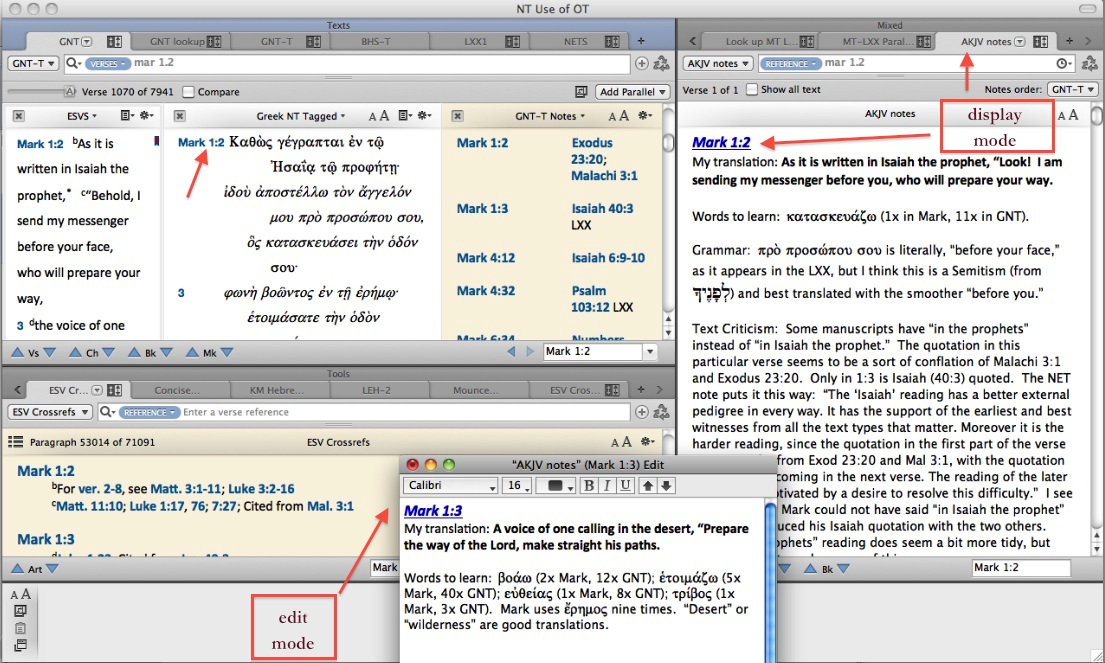
You can have the User Notes set up as a parallel text (i.e., in the image below, I can replace “GNT-T Notes” with my own notes) or as a tool in a different zone altogether. You can tie the tool to a text so that everything scrolls together verse-by-verse. This latter setup is how I prefer to work, as here (open image in new tab to see at full size):

User Notes Mark 1.2

Edit mode allows you to take notes on any verse. You simply go to a verse in the text, press the shortcut (command key + U), add your note, then click on update, and you’ve got a note. To edit an existing note, go to your notes that are in display mode, click and start typing. The edit window then opens.

You can automatically hyperlink any verse reference you list in a note. So in the “AKJV notes” that are in “display mode” above for Mark 1:2, I simply have to highlight Exodus 23:20, then click on “Make Link” for it to become hyperlinked. And as with other tools, it is easy to search notes by reference or content.

At present it is not possible to hyperlink to anything else in a note besides a verse. (So you can’t hyperlink to a Website, for example, though this would take you outside of the Accordance program anyway.) And live editing does not currently exist in User Notes (see here for more). But the ease with which I’ve been able to begin using and continue to make extensive use of the User Notes is commendable. I really like what Accordance has done here.

More details about User Notes can be found here in the Accordance online help files. And you can watch this video tutorial about the User Notes, too.

My full Accordance review is here.

Amazon “cracking down” on reviewers… but not really

five stars

From the Sunday New York Times:

After several well-publicized cases involving writers buying or manipulating their reviews, Amazon is cracking down. Writers say thousands of reviews have been deleted from the shopping site in recent months.

Amazon has not said how many reviews it has killed, nor has it offered any public explanation. So its sweeping but hazy purge has generated an uproar about what it means to review in an era when everyone is an author and everyone is a reviewer.

The world of reviewing is certainly open to abuse and violations of ethics. (Not long ago I read a story about a British mystery writer who, under a fake name, wrote torching reviews of his competitor’s works, praising instead his own.)

So I understand the desire to regulate here. But what’s odd to me is this quote from an Amazon spokesman:

We do not require people to have experienced the product in order to review.

It would be difficult to prove “experience” of the product one way or the other, but I certainly don’t put any stock in reviews that say, “I haven’t read this yet, but….”

As one commenter on this article noted, what I often find most helpful in shopping on Amazon–whether for books or other products–is the negative reviews.

That doesn’t mean that 5-star reviews, however, are not all to be trusted. There’s a bit of self-selection that goes on here. To wit, I tend to only request review copies of books that I think will be worth my time, so my ratings are most often four and five stars. But honesty comes first, so three stars and lower is not out of the question, and has happened before. And I am not always right that I book I want to review ends up being as good as I might have thought.

It’s a no-brainer to me that someone ought “to have experienced the product” before reviewing it. But what are some other principles of reviewing that should constitute a good ethic for product reviews?

Going for the Gold (base package) in Logos 5

It’s been interesting to watch Bible software companies make a final sales push before Christmas–Logos and Accordance seem to have been the most active that I’ve noticed. I’ve compared the “Big Three” Bible softwares here, which is hopefully of help to someone trying to decide which Bible software program is best for her or him.

Focusing for a moment again on Logos: I wrote a multi-part review of Logos 4 here, then did a review of Logos 5 when it released on November 1. At that time I had the Silver base package to review. I’ve now received a review copy of Gold, so here I offer some initial observations on that base package.

Everything in Silver and below comes in Gold. So like Silver, the Gold base package has:

  • Features like Bible Facts, Passage Guide, Bible Word Study, Exegetical Guide, Sermon Starter Guide, Timeline, and so on
  • Clause Search–this deserves its own bullet point; I have written about it here
  • The entire New American Commentary set
  • The Pulpit Commentary set
  • The Lexham Analytical Lexicon to the Septuagint (and to the Greek NT)
  • Greek and English Apostolic Fathers
  • Theological Lexicon of the OT, Theological Lexicon of the NT
  • A new English translation (!) of the Septuagint, The Lexham English Septuagint, which I’ve already been using regularly in my reading through Greek Isaiah in a Year

The Gold base package adds:

There’s more in Gold, so this is just what stands out to me on first use. See the full contents of Gold here. Compare all of the base packages in Logos 5 here.

Perhaps the best I can offer in a review of a base package like this is two implications that stem from my belief that Christians are called to be good stewards of their money:

  1. On the one hand, a package like Gold in Logos 5 really does offer great savings. You couldn’t possibly get all the resources in Logos 5 Gold in print (even used) for the same price. It might not even be close.
  2. On the other hand, one should be cautious not to buy just because there is great savings at hand. The key question is always, what resources will I use, and can I afford them now?

Logos occasionally receives criticism of offering packages that are bloated. Gold does have more than I think I’d want to use in a lifetime, and the “print value” metric is to be taken with a grain of salt, since the real question is of what value will a given resource be to the user. I still have mixed feelings about the new names and groupings found in Logos 5 base packages (as compared to Logos 4). I think it’s an oversight on the part of the company that there is no longer an Original Languages Library advertised on the Website. This was a market-driven decision, from what I understand, but I doubt scholars of Biblical Studies will appreciate it. (The user forums note that you can purchase an original languages package by phoning the sales department at Logos.)

Compatibility issues are also at play in one’s purchasing decisions. Logos for now is the only major Bible software program that can run natively (without an emulator, bottle, etc.) on any platform: Mac, PC, iPad, mobile, etc. It also is set up such that all your resources, notes, and even screen layouts sync automatically across platforms. However I close Logos on my PC is how it looks when I open it back up on my Mac. That kind of flexibility is great to have.

Gold is not a cheap package, but a lot comes with it. It makes a good long-term investment, if you’re comfortable building your library electronically. But using a resource in Logos is much more than just reading a commentary on a Kindle or as a pdf on a computer. References and abbreviations are hyperlinked throughout, and you can use the search features and “Data Sets” in Logos to more fruitfully explore any given resource. So it’s not just library-building, but information sorting, textual analysis, flexible searching of multiple resources, data manipulation, etc.

If as a pastor, professor, seminarian, or Bible translator you do a good amount of research and writing on the Bible, the Gold base package in Logos 5 combines a wealth of resources and features that could be of benefit. I’m especially eager to dig more into the UBS Handbooks, the Exegetical Summaries, the N.T. Wright works, and the Bible Sense Lexicon. I’ll post more about Gold before long. (UPDATE: See concluding part of Gold review here.)

Thanks to Logos for the gratis review copy of Gold, given me with the sole expectation that I review it honestly here on my blog.

Devotions on the Greek New Testament: one day left to enter giveaway

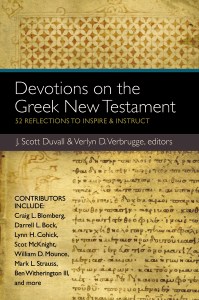
Devotions GNT

There is still time to enter my giveaway for Zondervan’s new resource, Devotions on the Greek New Testament.

If you want to check out the book before you decide to enter, my review of it is here.

To enter the giveaway, go here.

Free book giveaway: Devotions on the Greek New Testament

Devotions GNTYesterday I reviewed Zondervan’s new resource, Devotions on the Greek New Testament.

I have an extra copy to give away (not my review copy). I recommend this volume, for either you or the Greek language-lover in your life.

To enter the giveaway, simply comment on this blog post and say why it is you would want to win a copy. I will accept entries through next Monday afternoon, December 17, with 3pm EST being the cutoff.

Then if you link to this post on your Facebook, Twitter, blog, etc., come back here to tell me in the comments section that you did, and you’ll receive a second entry. I will announce the winner just before 5pm EST Monday.

If you want to check out the book before you decide to enter, my review of it is here.