I’m increasingly finding myself drawn to the high-quality goods of manufacturers in New York (here and here) and San Francisco.
WaterField Designs is based in SF. They make an excellent keyboard slip case, which I covered here. For the last few weeks I’ve been carrying around their super-slim and stylish Spike Wallet.
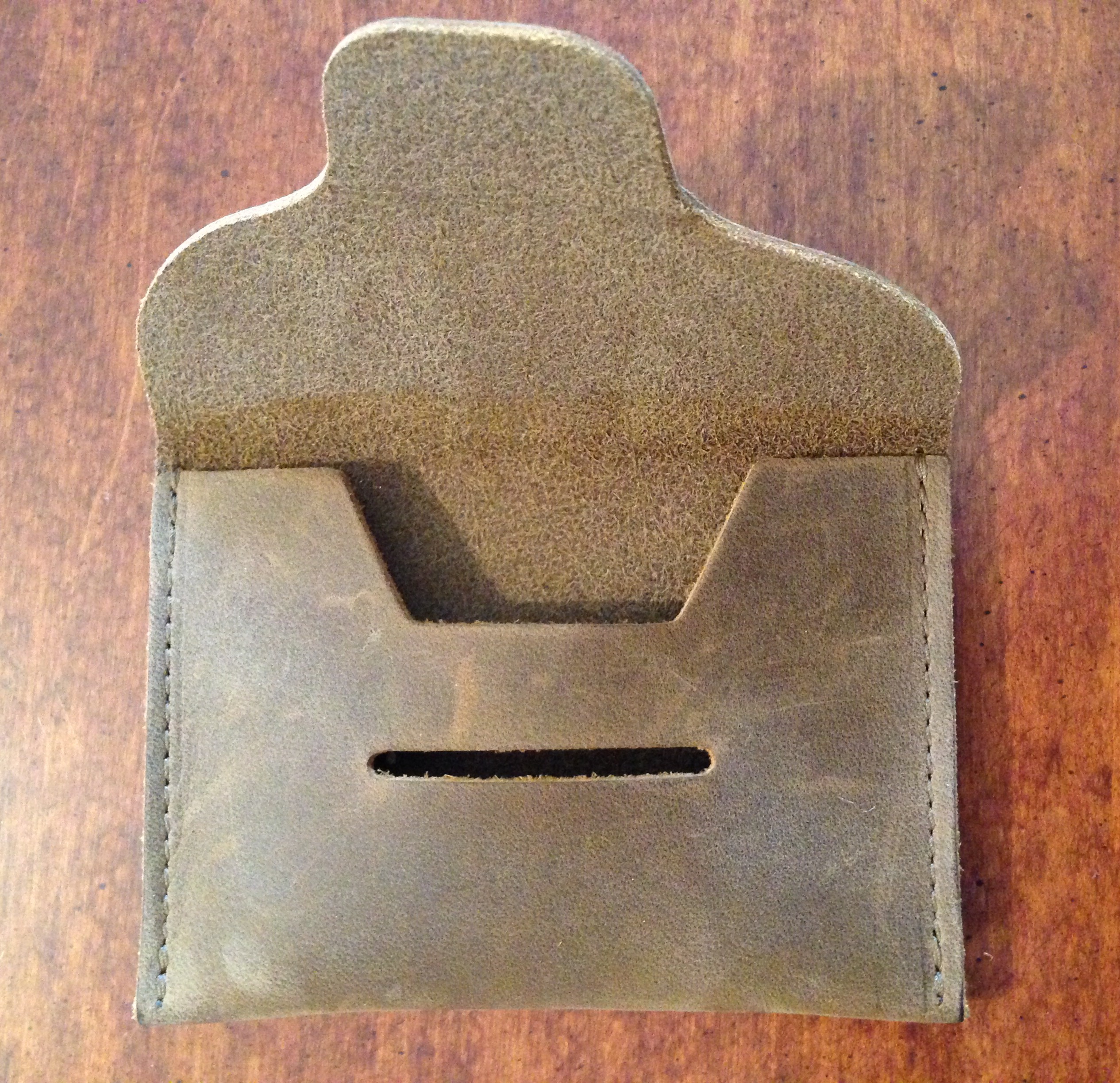
It looks like this:
The best thing about it is its size–it’s small! It’s about the size of an iPhone 5, so it actually fits really comfortably into a front pocket, right next to a phone. Actual dimensions: 4.3″ x 3″.
This can’t be your hold-everything wallet, of course. I’ve been able to easily fit into it: two debit cards, some cash, an insurance card, and my driver’s license. This is what I need most days. However, the kids’ insurance cards or any gift cards I have still have to go in another, larger wallet. (Or just in my satchel somewhere.)
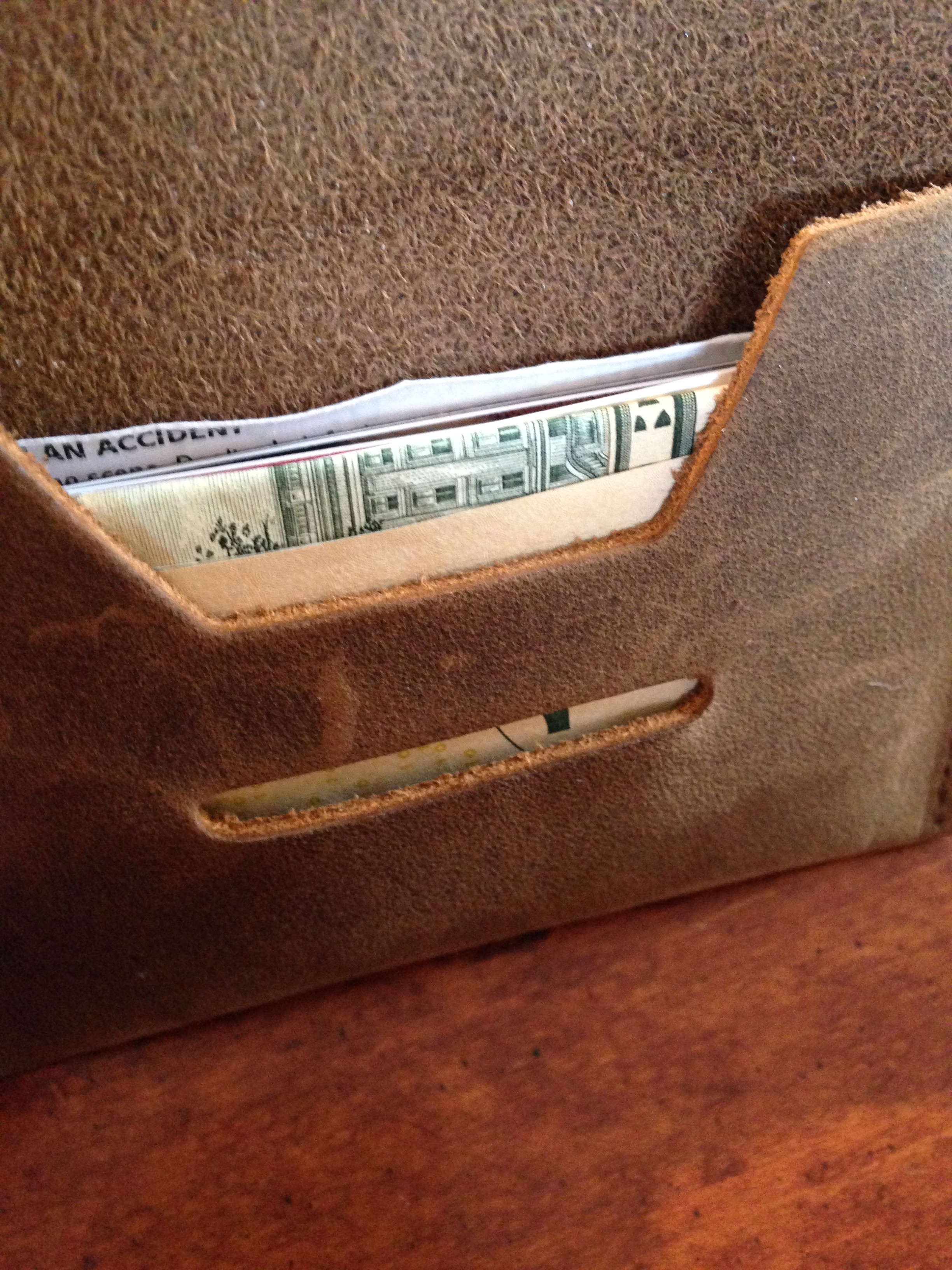
Getting things in an out was a bit tough at first, but the full-grain leather continues to soften with use. Here’s what it looks like filled:
The closure mechanism is minimalist and slides right into place, easily and snugly. It’s perfectly executed.
There’s only a little bit of branding, and it’s on the back. I probably would have preferred something more subtle, like on the inside flap of the wallet, for example.
The leather feels great in the hands, the stitching is secure, and the size is right for daily use. This piece of gear has been truly enjoyable to use.
WaterField makes a lot of other great-looking gear, which you can learn more about here. Find the Spike Wallet here. Retailing at $25, it comes in “Wallet”/large size (which I’ve featured here) as well as “Business Card”/small size.
Thanks very much to WaterField for the product review sample, given to me for purposes of review, but with no expectations or influence on the review’s content.
One of my New Year’s resolutions is to write 8 minutes (or more) every day. At least three days a week I plan to write by hand. Less than 10 minutes seems doable, modest even, but also enough to build on itself. Yesterday, without really meaning to, I wrote for an hour. This morning was just 10 minutes.
I’ve got at least these two other notebooks to fill up, but for every-day writing I’ve been using a nice 5″x8″ softcover dot grid notebook from Northbooks. I know this is psychological, but that its softcover means I feel more free to just jot things down quickly than I would in a leather or even hardbound journal. So it’s been perfect for my 8 minutes.
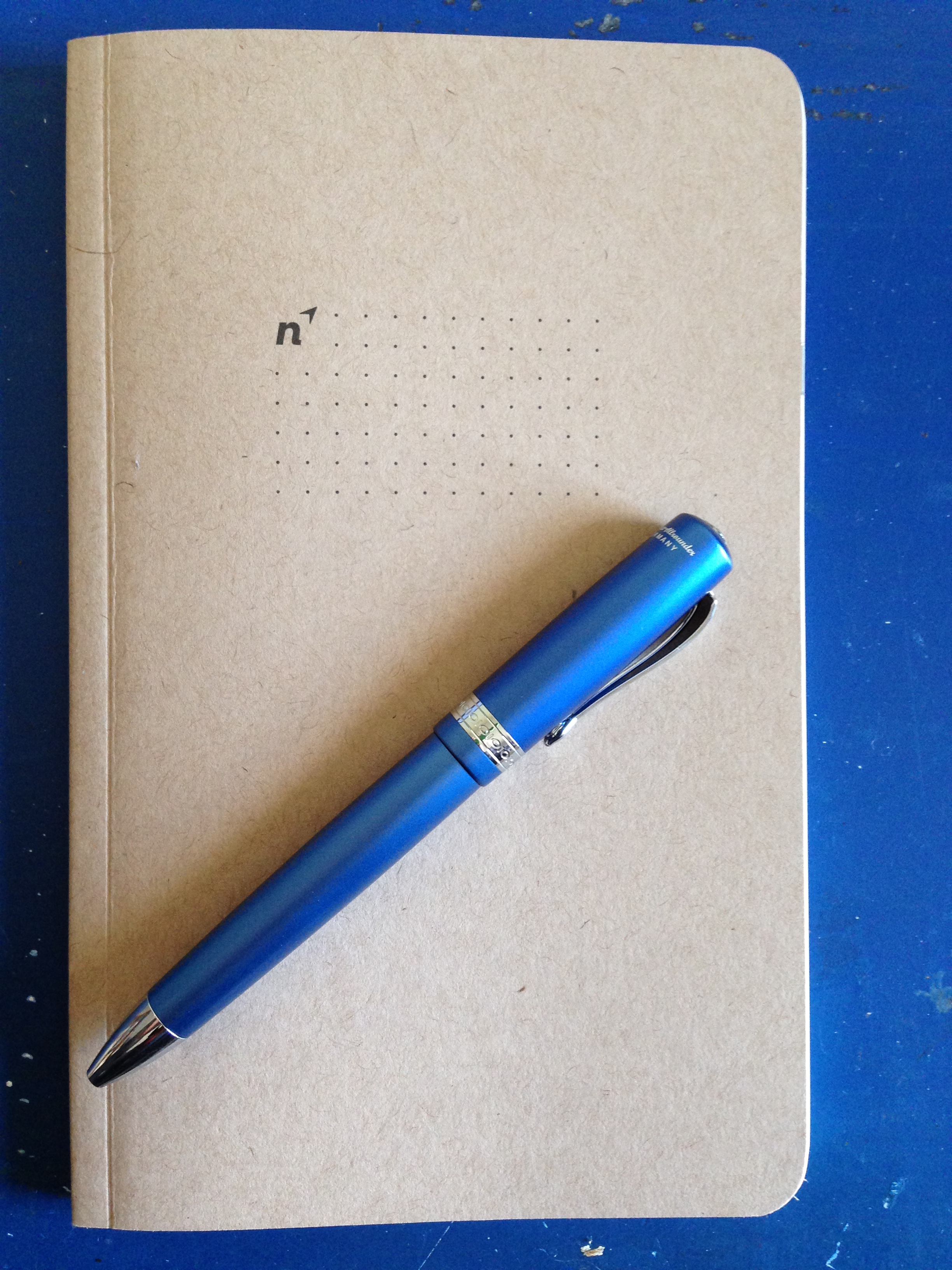
It looks like this:
I love the size. It will fit into a large jeans pocket and is easy to stash in a satchel or purse. I really like the look and feel of it.
The cover logo is minimalistic. If you have a ruled notebook, you see lines instead of dots. A nice touch. You could easily title your notebook and write it on the cover.
And I’m a big fan of the dot grid pages:
These will also be sketch-friendly.
The acid-free paper is of high quality and made in the U.S.A. The paper is 50% post-consumer, smooth but not too smooth, and the perfect thickness. There is no significant bleed-through, even when using a fine fountain pen. I was impressed by this.
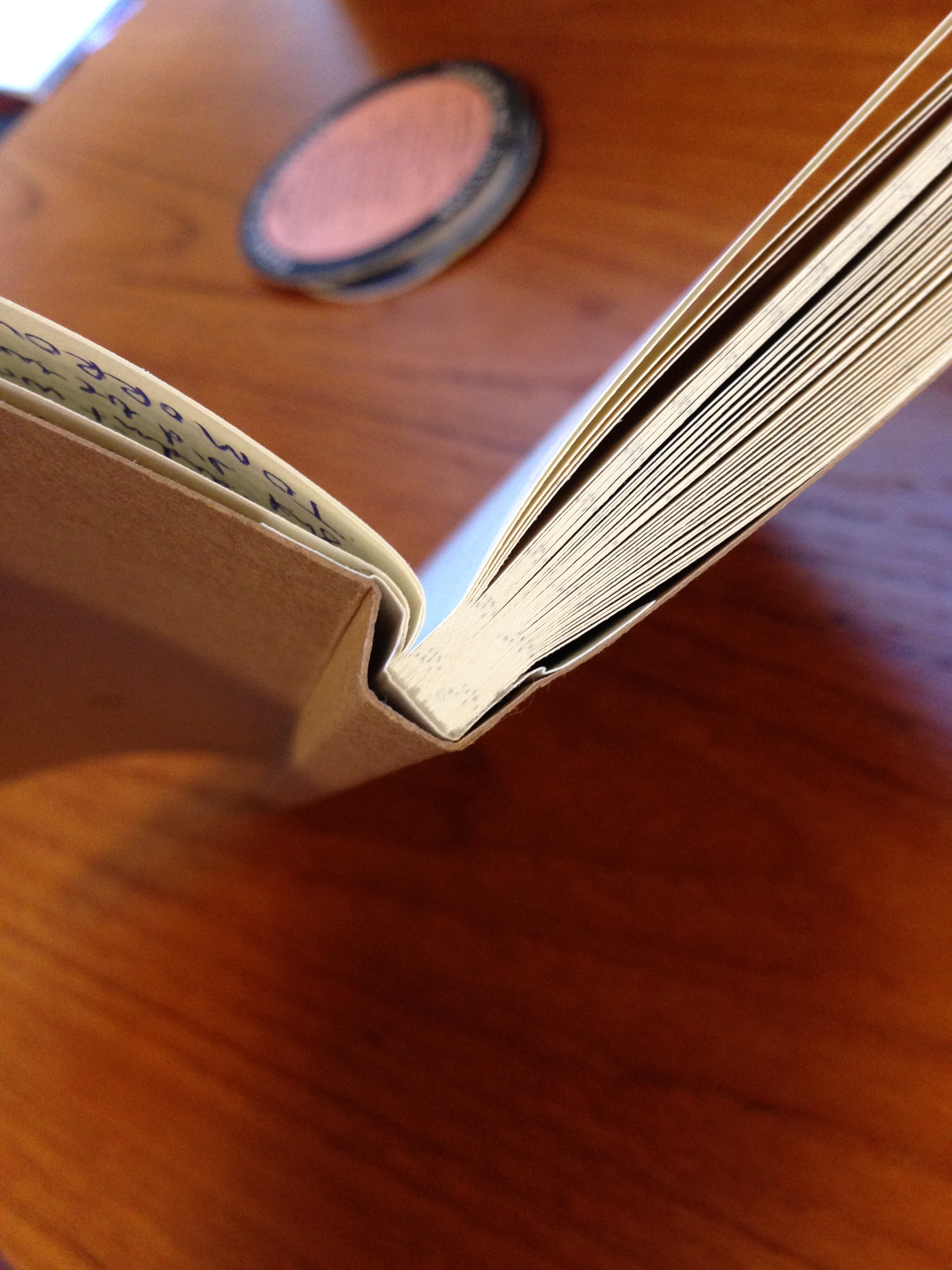
Northbooks’s product page touts a lay-flat binding:
Lays Flatter Than Most Notebooks: Binding is not attached to the external cover, so our notebook opens flatter than a typical glued binding. Makes for fuss-free writing/reading.
The binding is plenty secure, as is the cover:
But binding and cover are intentionally separate, as seen here:
This does, of course, mean flatter opening than a cover and binding that are glued together, but I still had to hold down one side of the notebook to be able to write in it. It does not lay flat on its own. (I’m not sure anyone would expect a softcover notebook this size to lay flat anyway.)
There’s plenty of room, even in this compact and portable notebook–96 pages (48 sheets)–for ideas, plans, to-do lists, art, and anything else.
You can learn more about the notebook here. One pays perhaps a higher price than expected for this notebook, but it is, of course, more expensive to make everything in the U.S. And this is a notebook that looks ready to stand the test of time. The 5-pack is significantly discounted, compared to buying a single one. You can see more Northbooks notebooks here.
Many thanks to the fine folks at Northbooks for the notebook for review! Check them out here.
I have mixed feelings about Logos marketing–some criticisms expressed here–but I still do, at least for now, participate in an affiliate program of theirs. This helps, among other things, to pay for some of this blog’s minimal expenses and has even in the past funded seminary coursework.
I have no intention to shill, but I do want to share for interested readers that the rate of 15% off any base package in Logos is changing as of tomorrow (12:00 a.m. PST) to 10% off. So if you’re thinking of upgrading, you can do it for cheaper today than tomorrow. If you don’t have money to do it, don’t sweat, pour yourself a cup of tea, and read this post instead. If you do purchase, Logos feeds a percentage of the purchase back to me. If you’re interested, you just order a base package (new or upgrade) through this Logos landing page.
Or use the promo code ABRAMKJ6 when you check out with a base package in your Logos cart. My review of Logos 6 is here.
As much as I like a good app for writing, I’ve become even more enamored lately of good paper, pens, and related writing gear.
You don’t know this, because I haven’t finished and posted the review, but I’ve been using some sweet fountain pens from Kaweco in Germany. Where shall I put these newfound friends?
In this lovely case from Saddleback Leather, of course:
It’s technically a “Soft Sunglass/Pen Case,” but it’s way too cool for me to not use for holding writing utensils, which I use every day. (I think one of the kids ran off with my last $5 pair of sunglasses.)
I’ve only reviewed a little bit of leather at Words on the Word, but the case is easily the most beautiful piece I’ve seen or held. Here’s what it looks like stocked:
It can easily fit three good-sized pens and three pencils, and still close comfortably.
The (removable) tie closure is awesome, too–you can wrap it around and thread it through the hole, or just wrap it around a few times to keep the case closed.
Here’s the view from the back:
And a look inside:
The Saddleback logo on the front is subtle and classy, certainly not a kind of branding that will bother the user.
And these folk live and breathe quality craftsmanship. Here’s a close-up of the stitching:
The case could easily fit in your back pocket, or go into the pouch of a messenger bag. It looks great right next to a notebook or journal, too.
I’ve been accused of smelling books before (but only because I smell every single new book I get). But this case I smell and softly press against my cheek to keep me warm and happy. It might be my favorite single piece of gear I’ve reviewed so far.
* * * * * *
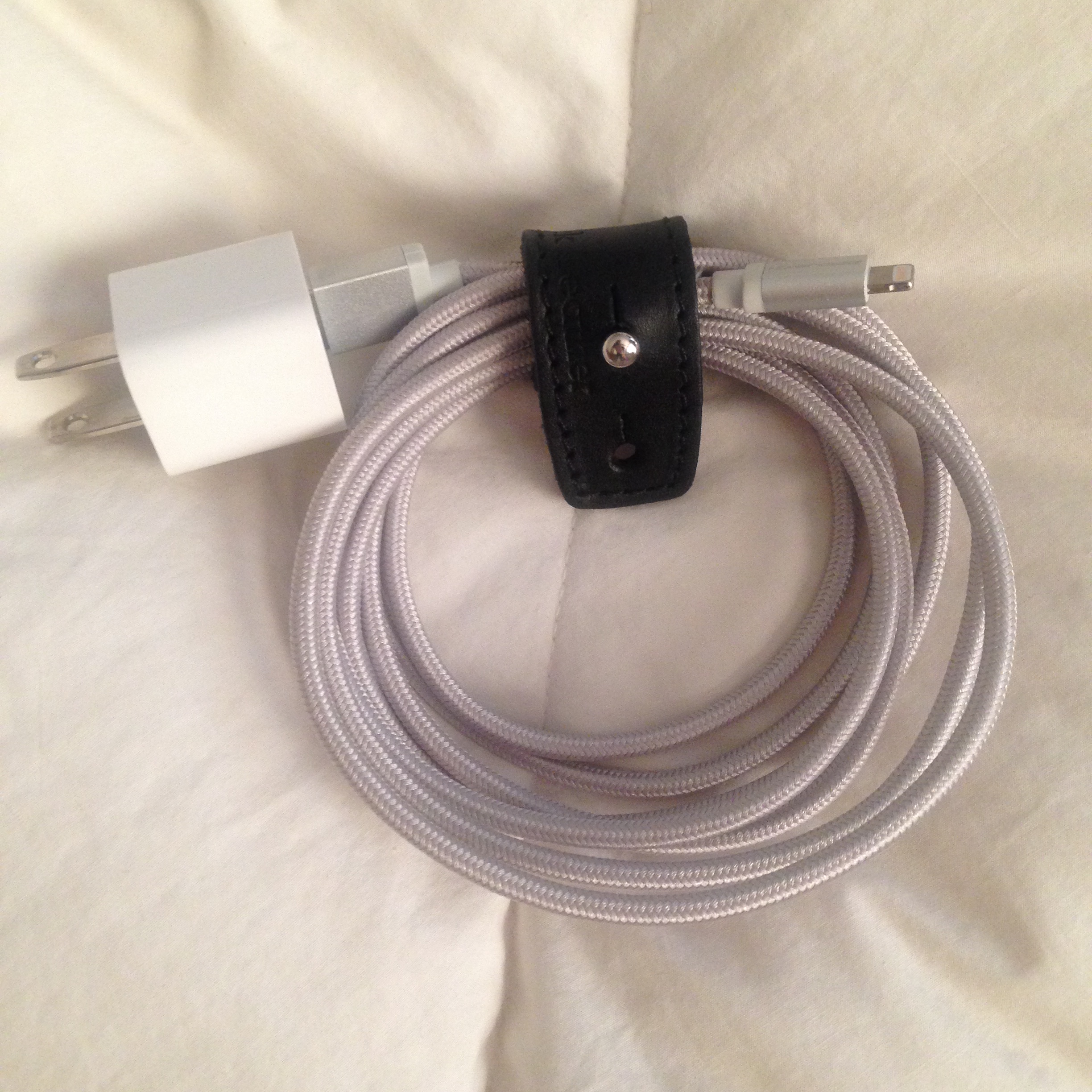
Saddleback was also kind to set me up with some cord wraps, an item I honestly thought was cool but superfluous… until I started using them every day to wrap my actually-long-enough iPhone charger cord:
There is a 100-year warrantee on these bad boys. Here’s the image from Saddleback of the three sizes you’d get in a set of three:
I’m using them for charging cords of three different sizes at the moment.
Saddleback’s site is here, with a ton of products that will make you want to convert to an all-leather lifestyle. You can purchase the above pen/sunglasses case here, and the cord wraps here.
Many thanks to the wonderful people at Saddleback Leather for the case and cords for review! I’m really grateful they sent them, though that did not influence the objectivity of the review.
I don’t know what your New Year’s Resolutions are, but if one of them is to play more video games (uh…), you should start with Alto’s Adventure.
Four traits especially stand out that make the game enjoyable:
1. The graphics are gorgeous.
2. The music is excellent–it evokes the old Final Fantasy scores, but sounds more like 2015.
3. Playing it is really relaxing.
4. Being a flipping snowboarder (especially if you can’t do it in real life) is fun.
It’s what reviewers call an “endless runner” game, which means you could go a gazillion meters on your run with Alto, which of course you never will, since you’ll hit a rock or get knocked down by an elder or fall into a ravine or ____ first.
But that won’t keep you from tapping “Play Again” multiple times.
The main stat to go for is “distance travelled.” But you can boost your trick store through a series of bunting grinds, flips, and the like. There are coins to collect (with magnets to help!), llamas to chase, and chasms to jump.
Here’s the score screen (for all images in this post, click to enlarge):
And a couple looks at the game:
The background changes from sunny and clear to dark and rainy, which adds a level of challenge (and fun) to the gameplay:
If you accomplish three goals (smash three rocks, land two triple flips in one run, and so on), you move up a level. Move up enough levels and you unlock new characters:
You can use your coins to buy workshop items:
The gameplay is smooth and responsive. (Though flying with the wingsuit is tricky.) You only have to tap to jump, so the controls are easy enough to learn, but staying up for a long run is no easy feat.
Alto’s Adventure is currently $0.99 (on sale) at the App Store. It’s easily one of the best games for iOS.
Thanks to the makers of Alto’s Adventure for the review copy of the app, given to me for this review but with no expectation as to its content.
Daniel Tiger (a.k.a., “D. Tiger,” according to our three-year-old) continues to be a hit around here. I expressed some skepticism two-and-a-half years ago toward a tiger replacing Mr. Rogers (see here). And of course no one could ever fill those shoes and that sweater. But Daniel Tiger–both the character and the show–has turned out to be pretty awesome.
Now… Books!
Yes, we enjoy the show. And the music is a favorite soundtrack at home. Last year our three-year-old (then two) got the toy trolley and some character figurines for Christmas.
I wonder whether the franchise has been slow to merchandise since heavy consumerism isn’t exactly a Daniel Tiger’s Neighborhood value. However, I have wished on numerous occasions for D. Tiger books to read to my daughter. Now Simon & Shuster and The Fred Rogers Company are releasing a slew of volumes for children.
Daniel’s Grr-ific Stories! (6 of Them!)
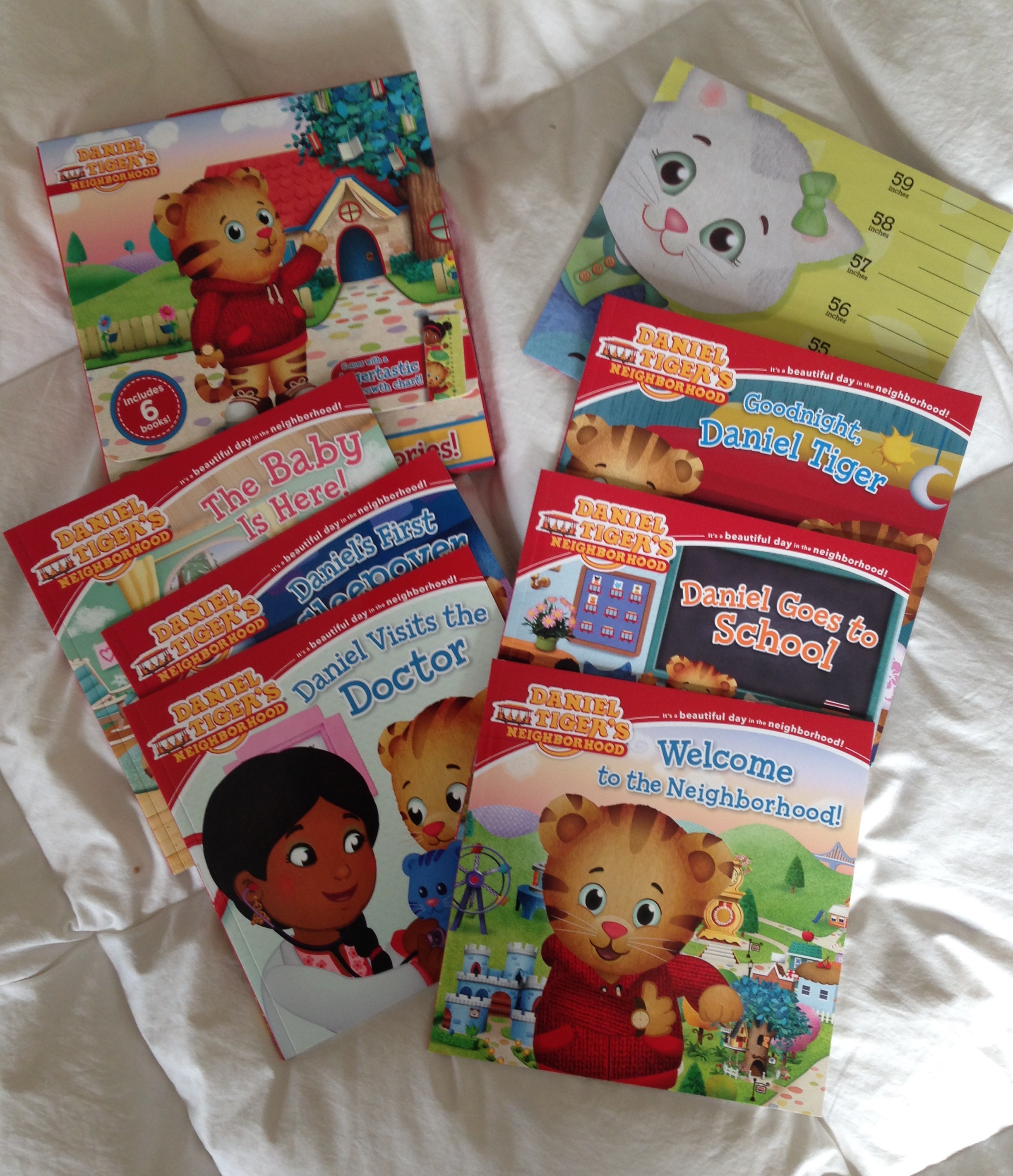
One such release is the surprisingly affordable six-book boxed set: Daniel’s Grr-ific Stories. It includes six short stories (22 pages of story text in each) with full-color illustrations:
Welcome to the Neighborhood!
Daniel Goes to School
Goodnight, Daniel Tiger
Daniel Visits the Doctor
Daniel’s First Sleepover
The Baby Is Here!
As with the show, each book uses an interesting (and, let’s admit it, cute) narrative to help children deal with the many and diverse feelings that life throws their way.
Daniel is a big helper with the new baby–he helps get her room ready, holds her when she’s born, and even helps change a diaper! Smoother sailing then one might expect when a new baby comes and shakes up a family dynamic. (This may be one reason Honest Toddler does not like Daniel Tiger.)
The books are true to the show, which is nice–you’ll see, for example, familiar songs here:
Daniel is not sure what he’s going to do at the sleepover. He sings, “When we do something new, let’s talk about what we’ll do!”
Daniel and Prince Wednesday have a pajama dance party and brush their teeth together, but then Daniel gets scared:
Now it’s time to turn out the light and go to sleep. But wait! There is a great big shadow on the wall. It looks scary to Daniel! What could it be?
But, lest you worry our own child should get scared, the authors are on it:
Daniel remembers, if something seems scary, “See what it is. You might feel better.”
Sure enough (spoiler alert), “It’s just Mr. Lizard!” It was only a stuffed animal.
“When we do something new, let’s talk about what we’ll do!” comes up, too, when Dr. Anna sings it to Daniel in his check-up. Nothing to fear. He’s growing stripes just as he should!
All six of the books are of the quality you’d expect. (Though, be advised: they’re paperback.) Your kid may want you to read all six before going to bed, but one or two or three will probably fill 10–15 minutes easily enough. There’s a lot of good content here.
The illustrations are well-done, too:
Plus, A Super-Cute Growth Chart
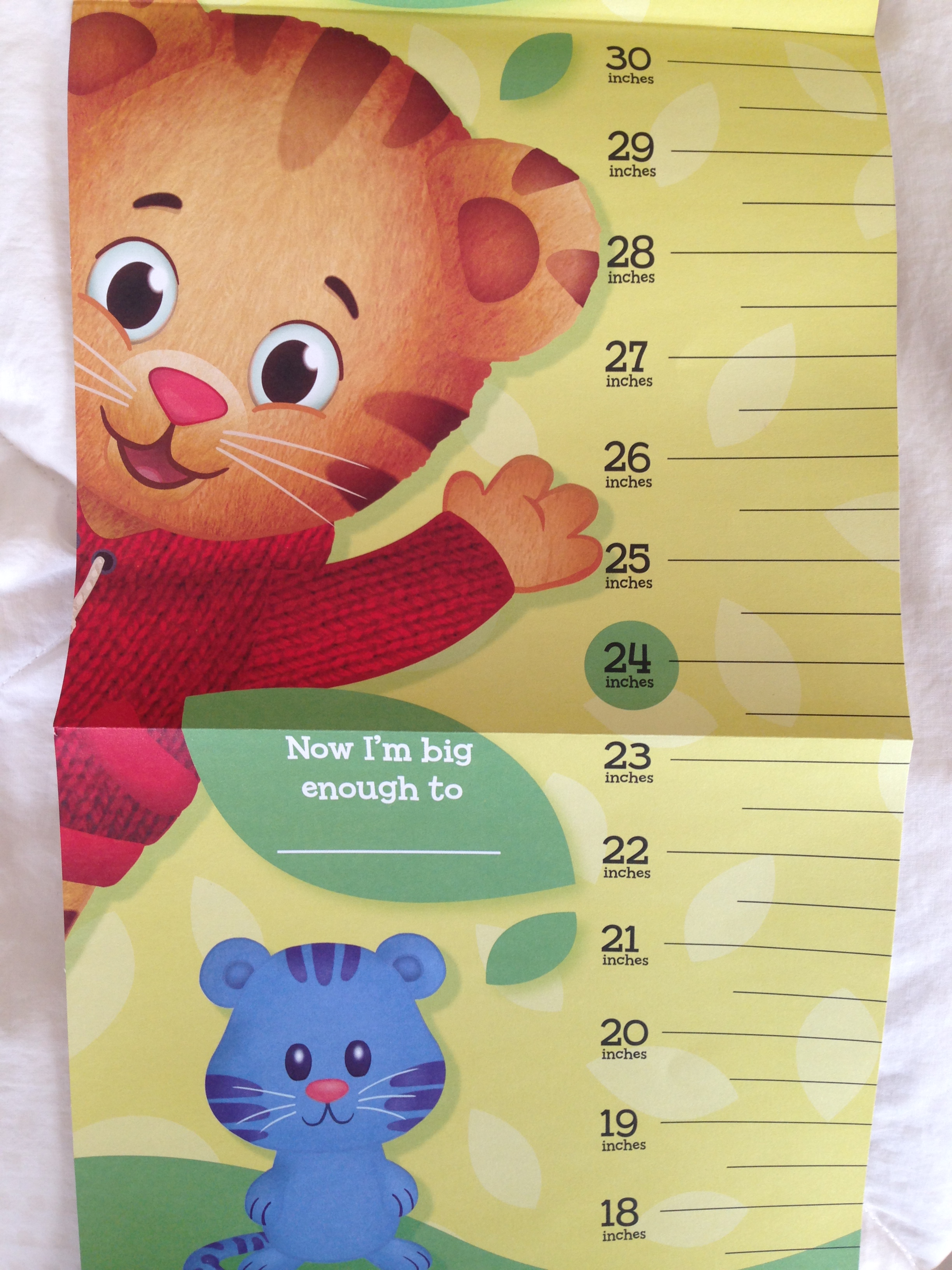
Also included in the six-book box is a full-color growth chart parents can put on the wall. It starts at 17 inches (so you hang it 16 inches above the floor) and goes up to 59 inches. Daniel, Miss Elaina, Prince Wednesday, O the Owl, and Katerina Kittycat are all there cheering for your growing wee one. A nice touch is that at three parts there is, “Now I’m big enough to _” that you can fill in.
Where to Get It
Here’s what the whole thing looks like:
You can find the boxed set at the publisher’s page here, and here at Amazon.
For how much is here, both the list price and the discounted price on Amazon make it easily worthwhile.
Thanks to the good folks at Simon & Schuster for sending the boxed set for review, though that did not influence my opinions.
Yes, I’m aware that it’s probably better to practice Greek reading with a Reader’s Bible (N.T. Wright even told me that!) than with a Greek-English diglot.
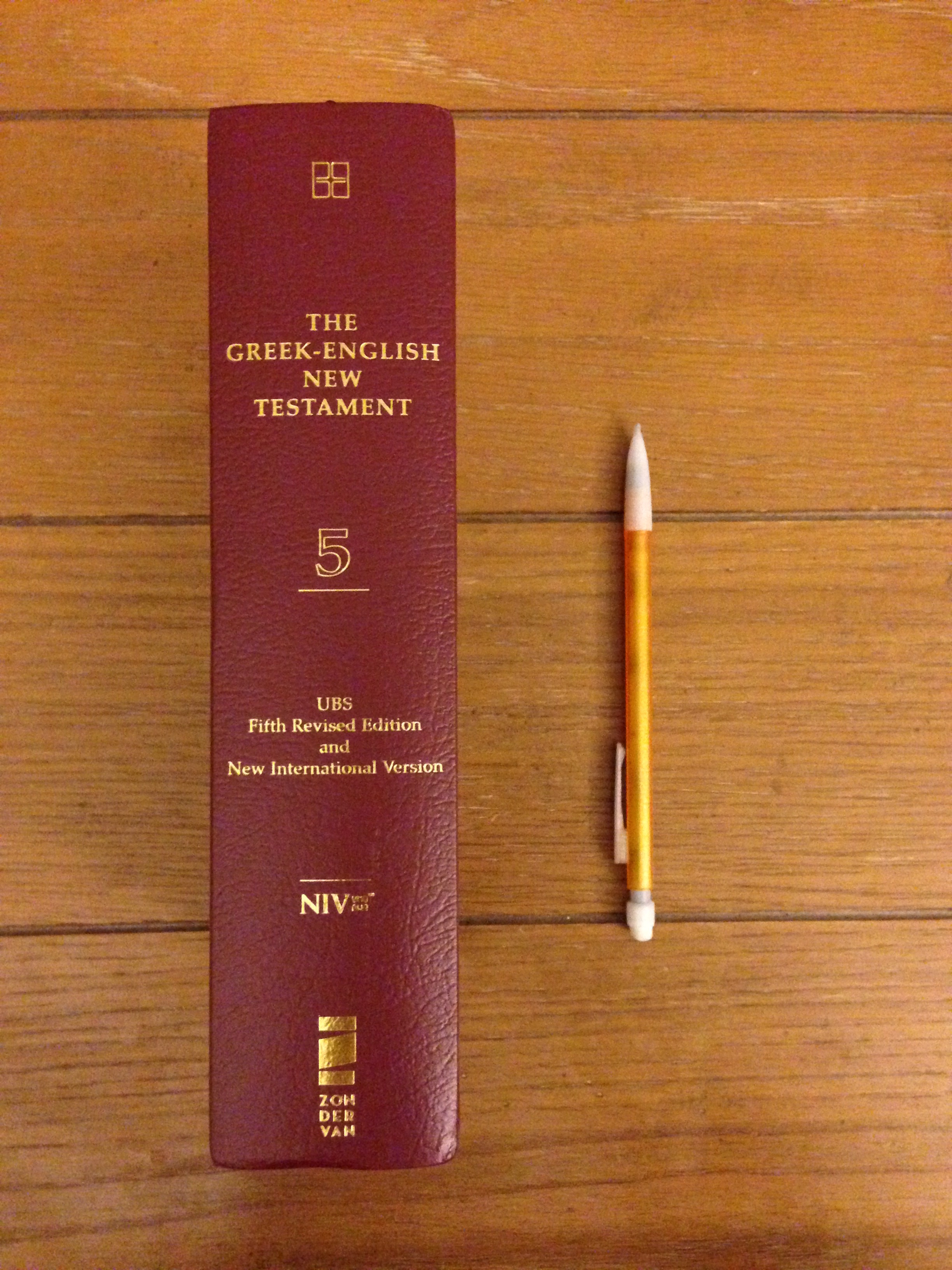
That said, Zondervan’s new NIV11-UBS5 diglot is an excellent Greek Bible to have on hand and use for both reading and research.
What It Is
Zondervan’s recently revised New International Version 2011 is the English text. Read more about the 2011 NIV here
The Greek text is the United Bible Societies’ updated 5th edition of the Greek New Testament. If you haven’t familiarized yourself yet with this edition and the changes it contains (summary: general epistles), check out this post, especially the infographic
The UBS5 text is accompanied by the full critical apparatus
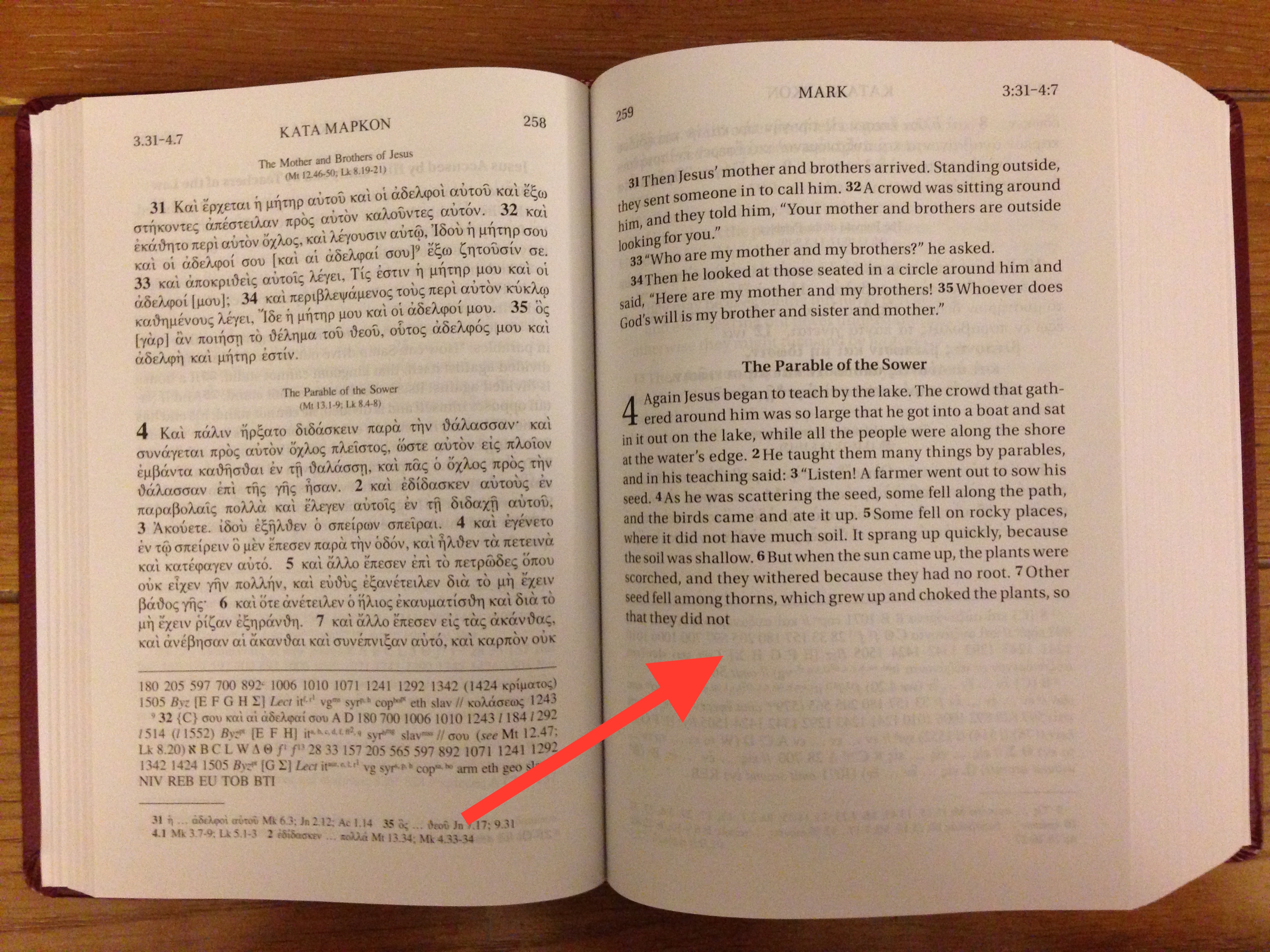
Unlike other diglots I’ve seen, the Greek is always on the left page and the English on the right page
Both texts are in single columns
What I Like About It
Overall this edition is really nicely produced. Here are some highlights:
The pages are thicker than I expected–this makes for a better reading experience
It’s light and portable
The exterior of the book is classy :
It lays flat! Even when you’re reading the prefatory material
Old Testament quotations are in bold font
There’s a really nice ribbon marker
And… the Greek font looks great. Check it out:
What Could Have Been Better
No bullet points here–just one major critique. In a deliberate move, the English on a page may cut off mid-sentence to try to more exactly match the Greek. Of course a one-to-one match is impossible because of the differences between the two languages (not the least of which is word order), but the intention is good, if not always perfectly executed in terms of matching English to Greek. Regardless, the unexpected editorial decision leads to awkward looking pages like this one (click image to enlarge):
To each their own, I guess, but I still haven’t gotten used to it, even after reading through full chapters of text.
But everything else (layout, font, book construction, feel, etc.) is spot on. I’m a fan of this Bible, and while I’m pushing myself to use a Reader’s edition (Greek only), when I want English and Greek side-by-side, this is my new go-to.
You can learn more at the Bible’s product page here. It’s on sale at Amazon here.
Thanks to Zondervan for the copy, provided to me as part of a series of ongoing posts about the 2011 NIV–though there was no expectation as to the content of my review.
I just finished two systematic theology courses this semester. Phew! One resource that was really helpful to be able to reach for was Intervarsity Press’s 5-Volume Ancient Christian Doctrine.
It’s similar to the 29-volume Ancient Christian Commentary on Scripture set–like ACCS, Ancient Christian Doctrine compiles primary sources from early church theologians as a running commentary. ACD, however, is a full-blown compendium of commentary on the Nicene Creed.
It was an excellent resource, too, for helping me think through this last week’s sermon in my church’s Advent preaching series: “Who is This Jesus We Are Waiting For?”
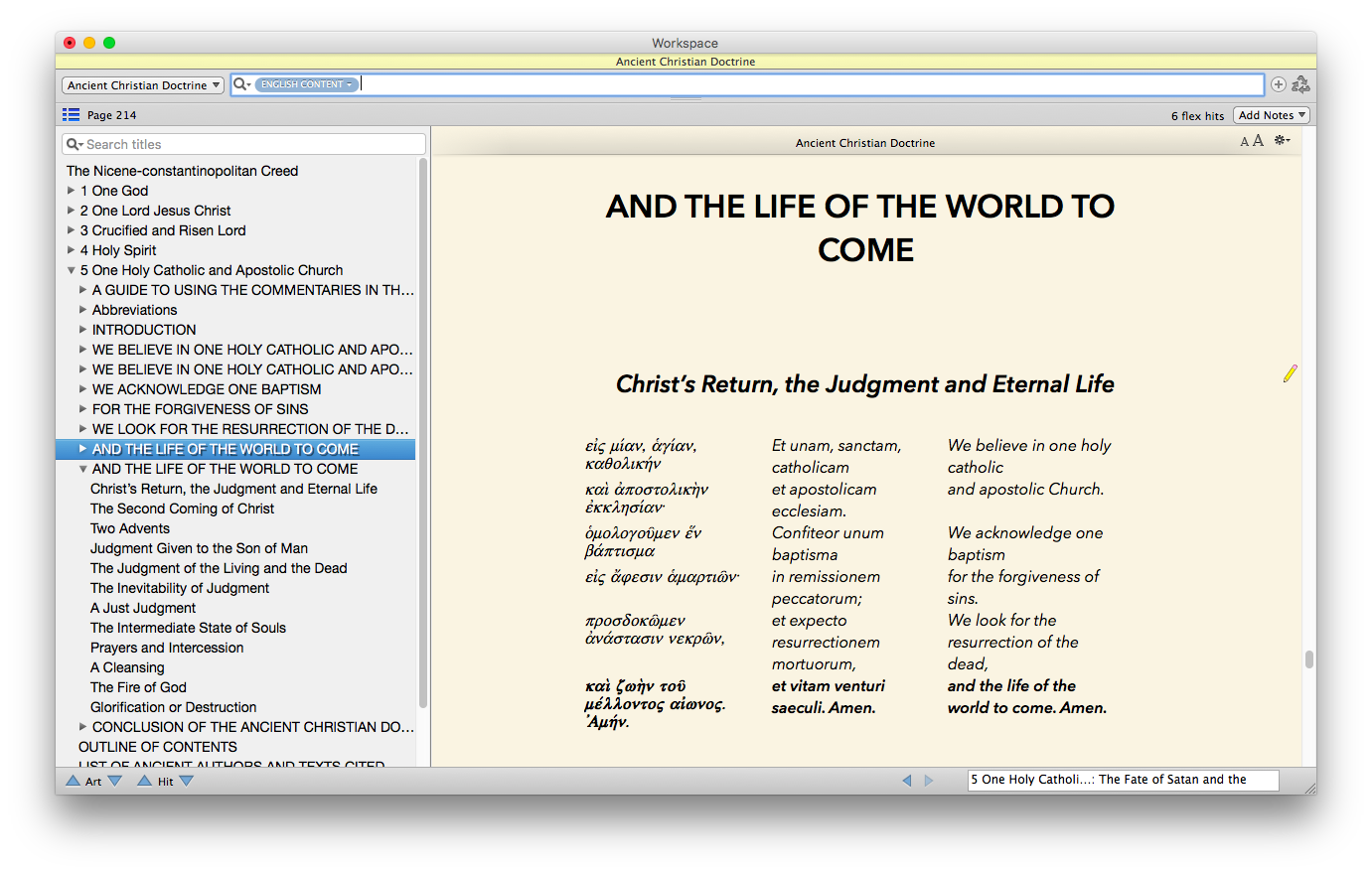
I skipped ahead in my research to the Creed’s final phrase, “…the life of the world to come.” Here’s what you see at the beginning of the section in the Accordance edition I’ve been using:
Click to enlarge image
You get the Creed in Greek, Latin, and English. Then, as you can see in the sidebar Table of Contents at the left, there is the commentary on that phrase–categorized helpfully in the volumes into sections like, “Two Advents” and, “The Intermediate State of Souls.”
Here was a powerful piece from Tertullian from that section:
We affirm that, as there are two conditions demonstrated by the prophets to belong to Christ, so these two conditions presignified the same number of advents. One of the advents, and that being the first, was to be in lowliness when he had to be led as a sheep to be slain as a victim and to be as a lamb dumb before the shearer, not opening his mouth, and not fair to look on. For, says the prophet, we have announced concerning him, “He is like a tender plant, like a root out of a thirsty ground; he has no form nor comeliness; and we beheld him, and he was without beauty: his form was disfigured,” “marred more than the sons of men; a man stricken with sorrows, and knowing how to bear our infirmity,” “placed by the Father as a stone of stumbling and a rock of offense,” “made by him a little lower than the angels,” declaring himself to be “a worm and not a man, a reproach of men, and despised of the people.” Now these signs of degradation suit his first coming quite well, just as the tokens of his majesty do his second advent when he will no longer remain “a stone of stumbling and a rock of offense” but after his rejection become “the chief cornerstone,” accepted and elevated to the top place of the temple, even his church, being that very stone in Daniel, cut out of the mountain that was to strike and crush the image of the secular kingdom. Of this advent the same prophet says, “Behold, one like the Son of man came with the clouds of heaven, and came to the Ancient of days; and they brought him before him, and dominion and glory were given to him as well as a kingdom so that all people, nations, and languages should serve him. His dominion is an everlasting dominion, which will not pass away; and his kingdom is that which will not be destroyed.”
I’ve gotten this resource in Accordance so I can preview it at some of my upcoming Accordance Webinars, the schedule for which is soon to be posted. And I’ve also found it quite helpful in writing pieces of theology and sermon preparation.
Let me leave you with this inspiration from Hilary of Poitiers:
He is born as man, while remaining God: this is in contradiction of our natural understanding. That he should remain God, though born as man, does not contradict our natural hope. For the birth of a higher nature into a lower state gives us confidence that a lower nature can be born into a higher condition.
See my other Accordance posts (there are many) gathered here.
2015 Hess Fire Truck and Ladder Rescue (Image via Hess)
Only the Hess toy trucks at the babysitting room at our local Y have convinced our two boys to accept a drop-off there. They’re much better built and way cooler to play with than one might otherwise expect from a toy made by a gasoline station.
Hess, it turns out, has been producing its Toy Truck line since 1964. The first make was a tanker trailer, modeled after the ones that brought gas to the stations. For $1.29 (including batteries!) you could put the tanker trailer under the Christmas tree for your little one.
2015’s model is especially awesome:
This year’s Hess Toy is a red Fire Truck with oversized tires, swiveling chrome-detailed fire hose nozzles, LED lights including a high-powered pivoting LED searchlight, a slide-out ramp and 4 realistic sound effects. The accompanying Ladder Rescue features a rotating extension ladder with a movable nozzle and push-activated friction motor. (source)
Here it is (click on any image in this post to enlarge):
You’re really getting two trucks for the price of one. Which is good, because the toy is $30.99. That’s more than most parents I know would want to spend on a truck for their kid, but it also includes free shipping and batteries. Given its high-quality construction, the truck looks like it will last a long time, so I don’t think it’s an unfair–if high–price, especially considering all its features.
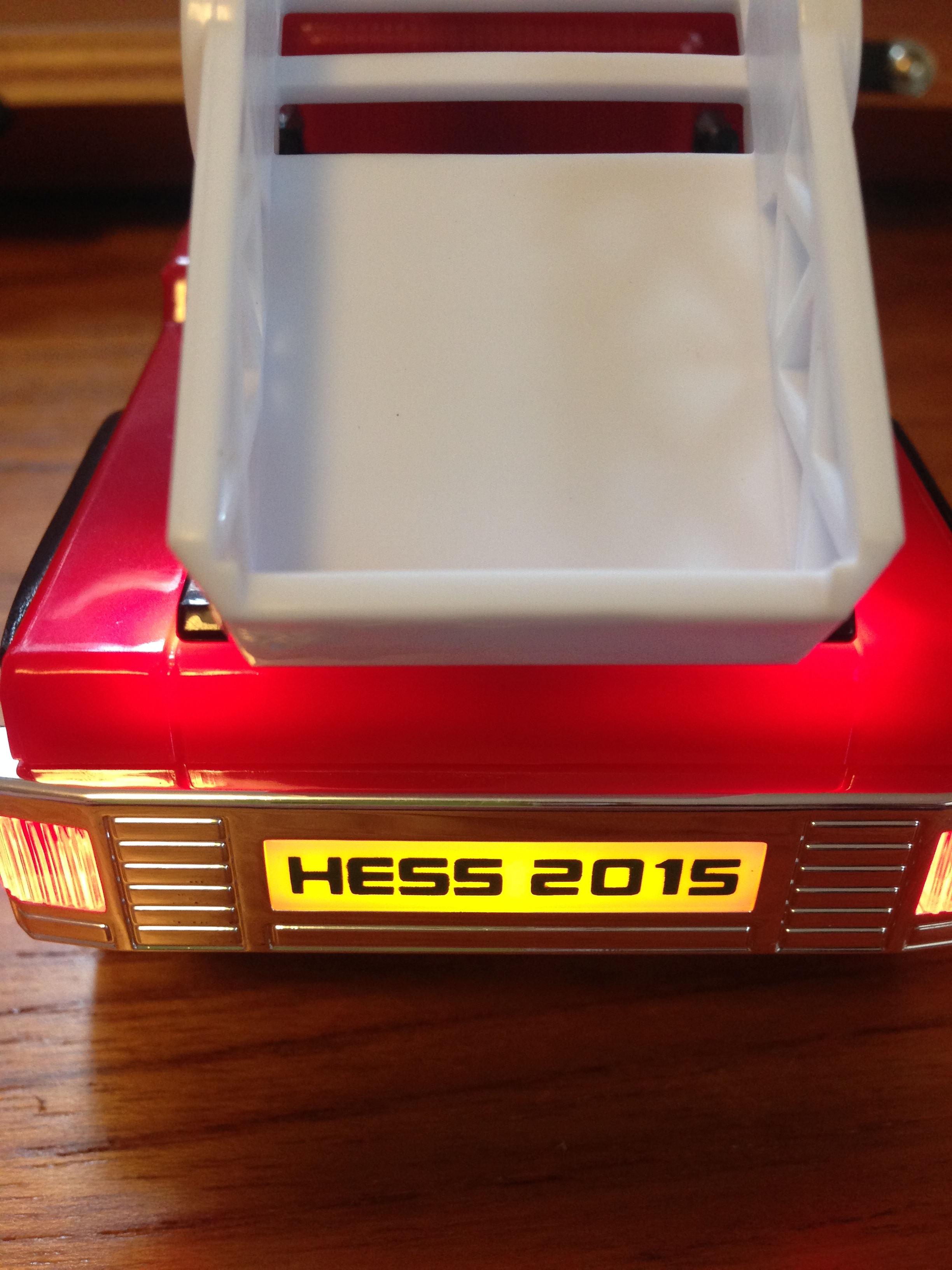
Here’s what the trucks look like with lights on:
I got quite a start when I pulled out the ramp at the back of the larger truck–it makes a robust sound that you’d expect from a real-life mechanical ramp. It’s not the kind of annoying sound that will bug you when on repeat, but this might be a toy for kids to take out of their brother’s bedroom and into the living room when they wake up at 6:30 a.m. to play. The ramp makes for an easy entrance/exit for the Ladder Rescue truck to go do its own thing.
The Fire Truck has more sounds than the ramp. There is also an Ignition button (very realistic), a Horn, and a Siren. Each sound plays for about 10 seconds and is–this is worth repeating–not something to play with while baby sister is napping. But that makes the toy all the more fun and awesome. The horn sounds like there’s a real emergency at your house. (Not to mention the siren!) If need be, you don’t have to wait 10 seconds for it to stop; you can just push the button again to silence it. (That’s a thoughtful feature!) So long as your neighbors know it’s just the Hess Toy Truck and don’t go calling 9-1-1 on you, you’ll be fine.
You can turn just the lights on via the switch under the truck. There are two options: you can have the lights solidly on, or turn them on in flasher mode. Regardless of what you do at the bottom of the truck, turning on any sounds causes the lights to flash. There’s also a button on top of the truck that turns just the spotlight on.
The wheels are on both trucks really securely, so you can run them across the kitchen floor at full speed and not worry about it running into the fridge. It’s a smooth ride.
The smaller Ladder Rescue truck is fun in its own right. It’s got a fully extendable plastic ladder with a small water spout (not real!) on the end. Both trucks are sturdy and made of hard, solid plastic. The trim pieces (mirrors, ladder hose, front visors) feel a little flimsier than one might hope, but it would take a child’s deliberate act to break anything here. (Not outside the realm of possibility.) The ladder swivels a full 360 degrees and can be snapped into place when not extended.
The Ladder Rescue truck also lights up via an on/off switch on the bottom of the truck. What this means for parents is that your child will turn off all the lights and find the darkest place in the house right away, so as to test the truck properly. 🙂 Parents will also want to make sure to turn the toy off at night so as to not let the batteries drain.
You can’t open the doors to either truck, so your LEGO minifigures will have to latch on somewhere else, but there is plenty of room for them to hop on and go fight fires.
This is really an awesome toy, and the more I played with it (yes, I played with it), the more I enjoyed it. Hours of countless fun for children are inevitable. Both trucks are thoughtfully designed and excellently executed. And the Fire Truck is pretty giant as far as children’s toy vehicles go, so you could do well to make this the “big” present you’re getting your child(ren) this Christmas.
One other cool thing: Hess has made 100 individually numbered Silver Editions of the Fire Truck and Ladder Rescue toy. I got the expected red one and was not disappointed.
You find out more and purchase the truck here. You can find the Hess Toy Truck on social media (#2015HessToyTruck) here: Facebook/Twitter/Instagram.
Many thanks to the fine folks doing PR for Hess who set me up with the free product sample for review, with no expectations as the the review’s content.






















 Words on the Word