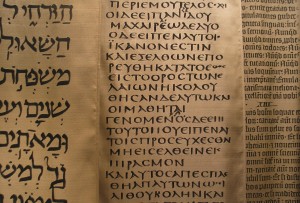
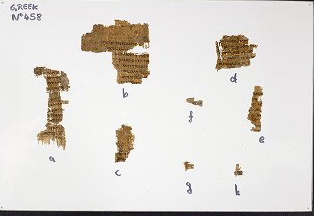
Septuagint Sunday: What IS the Septuagint? Why “LXX”?

click on image to go to source

Of all the Septuagint bloggers in the world, Brian Davidson is perhaps my favorite. He is now also a fellow BibleWorks user, as he begins his review of it here.

For this week’s Septuagint Sunday, I send you to Brian’s brief but informative posts on Septuagint terminology:

  • Here he explains the use of the word “Septuagint” and its ambiguities
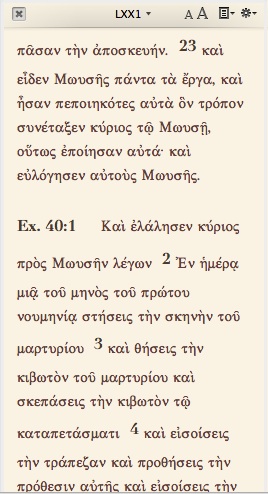
  • Here he writes about what the number 70 (“LXX”) has to do with it

Thanks for your blog, Brian!

The Original Languages Collection in Accordance 10 meets Septuagint Sunday

Here I look closely at a “workspace” I’ve set up in Accordance 10 to study the Septuagint.

This series of reviews has been made possible by my having received a review copy of Accordance 10, Original Languages Collection. I have not been asked or expected to provide a positive review–just an honest one. See the first three parts of my review here (installation and setup), here (4 cool features), and here (3 powerful ways to search). UPDATE: Here is part 5, “Bells and Whistles.” UPDATE 2: part 6, “More Bells and Whistles.”

Here’s what my Septuagint workspace looks like (click for larger):

I’ve got three texts open–the Hebrew on the left, the Greek in the middle, and the English on the right. These each come with the Original Languages Collection. With hyperlinks to Accordance’s product info page, they are:

As I mentioned in a previous post, the NETS, while not perfect, is the best English translation of the Septuagint on the market. I have been really glad to be able to access it. The Original Languages Collection also includes the older and still helpful Brenton English translation of the Septuagint.
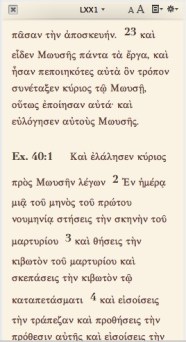
By going to “Set Text Plane Display” (available easily by right clicking from within a pane, or from Accordance’s “Display” menu, or by the shortcut T), you can change the theme/color of the individual text. If you wanted the LXX to stand out, for example, you could change it to the “Vintage” theme which makes it a nice, pleasing yellow, as in the picture at right. In fact, I’ve changed the colors on my Greek Tools (the LEH Lexicon) and Reference Tools (The IVP New Bible Commentary)–just so they stand apart a bit more as references. Being a long-time user and now reviewer of BibleWorks, I have been fine with the keep it simple but powerful philosophy. However, it really is a nice touch–especially if you’re looking at a screen for a long time–to be able to customize themes and colors.

Here are a few neat things I can do with the Septuagint setup above:

  • Triple-clicking on a verse reference automatically pulls up the accompanying text in the IVP commentary. This would be of slightly limited value for books that are in the Septuagint but not the Protestant canon that commentary covers. But…
  • …I can open up Conybeare and Stock’s Septuagint Grammar right next to the LEH lexicon
  • Triple-clicking on a word automatically displays the entry for that word in the lexicon

There are other ways to do searches without triple-clicking (for example, Amplify, which I discuss here), but triple-clicking is the quickest way I’ve found so far.

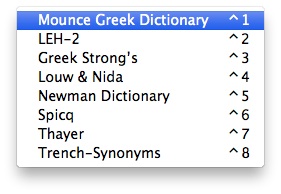
At this point I did run into a little bit of difficulty. Mounce’s Greek Dictionary is set as the default Greek lexicon. And triple-clicking always goes to the default lexicon, i.e., whatever is first in the list.

Working with the LXX, I wanted the LEH lexicon to be the one a triple-click would look up. But Mounce comes by default in the first position. So even with the LEH open, triple-clicks would look up in Mounce. 15 minutes searching through menus, icons, and Preferences and 10 more minutes in Accordance’s help section gave me no solution. Finally I turned to the Accordance Forums and–voila!–my answer. Not an immediately intuitive way forward, but I was grateful for the help.

That done, I now have my LXX workspace just how I like it.

Speaking of help, Accordance has multiple sources of support, from active user forums (in which Accordance staff participate) to extensive help files. The podcasts are good, too (index here). Because the layout/interface change from Accordance 9 to 10 was pretty significant, I looking forward to hopefully seeing updated podcasts for 10 that reflect this. Right now there is this episode on Accordance 10.

I have a Greek New Testament workspace set up similarly. The Original Languages Collection has the Greek dictionaries/lexicons you can see above–Mounce works well for the NT, and I love that it has word frequency counts. (Although you can easily get this and more from Accordance for any given word.) As far as I can tell, I have to change the default Greek dictionary back to Mounce when I’m in my NT workspace, if I want triple-clicking on a word to lead there.

For my Hebrew Bible study, the Original Languages Collection gives me the Hebrew MT (mentioned above) and these solid lexicons:

The Original Languages Collection also comes with Ross’s Hebrew Grammar.

The Concise Dictionary of Classical Hebrew (Concise DCH) is a relatively new publication. Its inclusion is a highlight of this package. From Accordance’s product page:

This Dictionary (CDCH) is an abridgment of the 8-volume Dictionary of Classical Hebrew (DCH), the first volume of which appeared in 1993. The DCH was the first dictionary of the Classical Hebrew language ever to be published. Unlike other dictionaries of the ancient Hebrew language, which cover only the texts of the Hebrew Bible, either exclusively or principally, DCH records the language of all texts written in Hebrew from the earliest times down to the end of the second century CE. That is to say, it includes not only the words used in the Hebrew Bible, but also those found in the Hebrew Book of Ben Sira (Ecclesiasticus), the Dead Sea Scrolls, and all the ancient Hebrew inscriptions.

Previous versions of Accordance had tiered-levels within individual collections, so that the Library collection still had intro, standard, and premier. So, too, with the Scholar’s collection: intro, standard, and premier. I found this time-consuming to navigate whenever I’d look at Accordance 9 on their Website, so the simplification in Accordance 10 (there is no tiering in the Original Languages Collection) is a huge improvement. It streamlines the decision-making process for those looking to get into Accordance.

The Original Languages Collection, as the Accordance site notes, has resources close to a $2,000 print retail value. That’s not a padded figure reflecting already electronically free public domain resources, either. I am impressed with the $299.99 price tag on this collection.

And I’m especially impressed that I can have all I currently need to use for text-based Septuagint research in one place. Two thumbs up for this collection.

Review of Malachi (Baylor Handbook on the Hebrew Text), part 1

“Because of you I will rebuke your descendants; I will smear on your faces the dung from your festival sacrifices, and you will be carried off with it. And you will know that I have sent you this warning so that my covenant with Levi may continue,” says the Lord Almighty.

–Malachi 2:3-4 (NIV)

Although Words on the Word has since taken fuller shape, two primary motivations in my beginning this blog were (a) to read and review good books and commentaries and (b) to interact with the original Biblical languages. This post offers a good opportunity to do both. Here I review Malachi: A Handbook on the Hebrew Text by Terry W. Eddigner (Baylor University Press, 2012).

The Hebrew prophet Malachi holds a significant place in the Hebrew Bible. Malachi is the last prophet of the Book of the Twelve (minor prophets) and the last book in the Hebrew Bible/Old Testament. The last two verses of Malachi are Yahweh’s promise to send the prophet Elijah–a promise fulfilled, Christians believe, by John the Baptist. It sets up the beginning of the Gospels well.

The Baylor Handbook on the Hebrew Bible series is a deliberately unique contribution to the field of commentaries on the Hebrew Bible. Okay, I suppose all commentary series intend to make unique contributions, but this one really does. It fills a void. Although the student of the Hebrew of the minor prophets is fortunate to perhaps be able to access Baker’s fine exegetical commentary (Malachi is in this volume), there is still a dearth in general of OT commentaries that comment extensively on the Hebrew text and grammar. In that sense I’ve been happy to see the careful attention this series gives to the Hebrew text. (Bonus: this book and some the others in the series that I’ve briefly glanced through give good treatment of discourse analysis.)

It’s important to note from the outset that Malachi (as a book in this series) is not a “full blown commentary.” It’s a “Handbook on the Hebrew Text,” which does “not attempt to replace the second step of consulting commentaries and secondary literature….” In keeping with this aim, Terry W. Eddinger gives the reader a short (five pages) introduction, yet it is plenty to be able to work well within the Hebrew text of Malachi. (And a bibliography with references throughout points readers in the direction of other Malachi-related literature.) Eddinger especially emphasizes the structure and “literary forms and devices” in Malachi. He views the structure of Malachi as consisting of a superscription, six oracles, and two appendices. Literarily, Eddinger says, Malachi is a prose and poetry hybrid, “perhaps the best example of such in the Hebrew Bible.”

There is a linguistic glossary at the back of the book, so when Eddinger says, “Hortatory style is the predominate literary form and is found in all but two verses,” the uninitiated reader can quickly determine that hortatory means “a word, clause, or sentence of direct dialogue.” This is perhaps an over-general or vague definition (the Jonah book in this series has, “Hortatory discourse is meant to exhort someone to act in a particular manner”), but I found that not to be the norm for the succinct and useful glossary.

One commendable feature is the “key words” chart at the beginning of each oracle. Malachi is the first book in this series to offer such a feature. Eddinger highlights important words that the reader will want to know as he or she makes his or her way through a pericope. Then–in what was my favorite part of this book–Eddinger has a chart at the back of the book that lists every Hebrew word in Malachi and verse references for all its occurrences. (Future printings or editions of this book could soup up this chart even more with English glosses of the Hebrew words, for the purposes of vocabulary acquisition.) Several times in making my way through Malachi and this handbook, I referred to the Hebrew word chart.  A second appendix lists all the times the “divine messenger formula” (e.g., אָמַר יְהוָה צְבָאוֹת) occurs in Malachi.

Eddinger begins each passage with his own English translation, then analyzes the Hebrew text verse by verse. In part 2 of this review (to post Monday), I’ll look at the guts of Eddinger’s handbook, that is, the verse-by-verse exposition, including his explanation of the verses that led off this post.

UPDATE: Part 2 of the review is here.

Thank you to Baylor University Press for providing me a free copy, in exchange for an unbiased review (which ends up being a two-part review in this case–by my choice). You can find the Baylor product page for Malachi: A Handbook on the Hebrew Text here. It’s on Amazon here.

Septuagint Sunday: I Heart Maccabees


I’d give away half a bookshelf worth of books to see Mark Wahlberg or Matt Damon star in a film adaptation of 1 Maccabees. Judas Maccabeus (“Hammer” will be his nom de film) and his Hasmonean family drive out imperial powers and call the Jewish people back to faithful observance of the Torah. They do it with great violence, against all odds. (This would be an action movie, and not for small children.)

Here’s how Jonathan A. Goldstein, in his 1 Maccabees Anchor Bible commentary, begins his introduction. Try to call to mind that deep male voice that does movie trailer voice-overs:

The faithful Israelite living in Judaea under the rule of the Ptolemies and the Seleucids in the third and second centuries B.C.E. learned from childhood that the LORD’s chosen people had nothing to fear if they kept the LORD’s commandments. Subjection to the great empires of Persia and the Hellenistic kings had brought stability and security over long periods, which in part compensated for galling exploitation and servitude and for episodes of devastating warfare. Then, under the Seleucid Antiochus IV from 167 to 164 B.C.E., obedience to the LORD’s commandments became a crime punished with extreme severity. No harsher trial ever tested the monotheistic faith of the Jews.

[Cue music swell.] Goldstein/our movie trailer goes on:

The outcome was entirely unexpected: the desperate resistance of the Jews prevailed, and for a time the “yoke of foreign empires” was lifted from the Jews as they became independent under the Hasmonaean dynasty. After the centuries of heartbreaking delay, were the glorious predictions of the prophets of a mighty restored Israel being fulfilled?

That’s got to be good watching, folks. It’s certainly making for great reading! (I’m focusing on the first four chapters for a directed study for one of my seminary classes.) Here is a “Quick and Dirty Summary” of 1 Maccabees from Gordon College professor Ted Hildebrandt.

As I wrote in an earlier post about the Septuagint:

Books like 1 Maccabees, especially, fill out the intertestamental gap between Malachi and Matthew. I’ve been working my way through 1 Maccabees lately, and it’s really helping me better understand Jewish expectation of a conquering Messiah who would expel oppressive Roman rule.

Good book. Would make an awesome movie. The Maccabean Identity? Or, perhaps, simply: I Heart Maccabees.

“Septuagint” is the wrong word to use


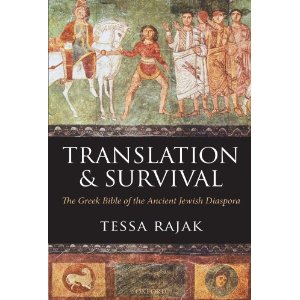
“Septuagint” is perhaps the wrong word to use to describe the Greek translation of the Hebrew Scriptures. Just about every author I’ve read so far on the Septuagint is quick to point this out. In the mail the other day I was happy to receive my review copy of Tessa Rajak’s Translation & Survival: The Greek Bible of the Ancient Jewish Diaspora (Oxford University Press, 2009). She puts it this way:

The term “Septuagint” does not appear in the title of this book, and that is no accident. It is in fact an inappropriate description for the Jewish Bible in Greek. The problem is that “Septuagint” is a term which evolved in the usage of the early Church and refers to the corpus created there as we find it in the great biblical codices of the fourth century CE. It is precisely these layers of reception that we shall need to strip away, at any rate until the last chapter of this book. But even were we to resolve to stick with the name, as one of convenience, we would soon find that the ambiguities and complications of its usage outweighed that convenience. (14-15)

Larry Hurtado recommends the book here. Keep checking back here–I’ll have a full review up some time next month.

BibleWorks in the pew? (Not quite, but the next best thing)

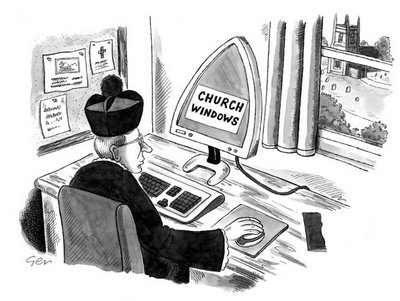
[GEEK ALERT] In an effort to integrate my learning of Biblical languages with church attendance and participation, I can be spotted at my church carrying this and this around. If I had an extra hand, I’d bring this, too. At first I feared it would look pretentious–it still may–but my motives are just to use my Greek and Hebrew in the context of corporate worship, while Scripture is being read aloud (in English, in my church’s case). So I follow along the Scripture readings, as best I can, in the original languages.

By Gerard Whyman (http://www.gerardwhyman.co.uk/)

To take it a step further, some time ago on the BibleWorks forums there was a user-initiated discussion about whether it is appropriate to have a laptop with BibleWorks open in the middle of a church service.

While I personally find the idea of a pew-sitter with a laptop tacky, I do understand the sentiment behind wanting to look at the Bible in the original languages while it’s being read and exposited in church. Hence my solution of having a print Bible with me. That’s not quite as out of place as a laptop would be.

So having my Greek and Hebrew Bibles with me is the next best thing to having BibleWorks open during church. However, there are two other next best things that do involve BibleWorks. First, there is a free user-created module that has the Revised Common Lectionary, linked to texts in BibleWorks. I rarely have time to use it on Sunday morning as we rush out the door, but I have at times been able to look ahead to the texts we’d be reading in church that week and use BibleWorks to work my way through them. The RCL module is really nifty. More about it here.

Today I found myself with the unexpected blessing of some time to play around with BibleWorks a bit. (I just received BibleWorks 9 in exchange for an unbiased review, which I will be offering in parts in coming weeks. Consider this a prologue of sorts.) Using the Report Generator, I was able to create a “Reader’s” version of Jeremiah 23:1-6, the Old Testament reading in church from the RCL this morning. Here’s the screen shot of how to get there, which also shows how I have my BibleWorks set up for Septuagint study. (Click on image for larger, or open it in a new tab.)

Once there, I set the Report Generator in the following way:

Then I clicked on “Build Report” and got a report with the text of Jeremiah 23:1-6 in Greek, followed by the listing of all words used in that passage, with frequency counts, followed by lexicon entries. After some manual organizing, I ended up with the below. Resources like this exist for the Hebrew Bible and the Greek New Testament (what I take to church with me), but there is not as of yet a “Reader’s” Septuagint.

Fellow language-lovers… what do you think? And do you take your languages with you to church? If so, how?

Jeremiah 23:1-6 (Rahlfs Septuagint)

–with footnoted vocabulary (glosses) for words that appear less than 200 times in entire Greek Bible (LXX+NT together). Glosses from here: print / BibleWorks module.

1 Ὦ[1] οἱ ποιμένες[2] οἱ διασκορπίζοντες[3] καὶ ἀπολλύοντες τὰ πρόβατα τῆς νομῆς[4] μου.
2 διὰ τοῦτο τάδε λέγει κύριος ἐπὶ τοὺς ποιμαίνοντας[5] τὸν λαόν μου Ὑμεῖς διεσκορπίσατε[6] τὰ πρόβατά μου καὶ ἐξώσατε[7] αὐτὰ καὶ οὐκ ἐπεσκέψασθε[8] αὐτά, ἰδοὺ ἐγὼ ἐκδικῶ[9] ἐφ’ ὑμᾶς κατὰ τὰ πονηρὰ ἐπιτηδεύματα[10] ὑμῶν·
3 καὶ ἐγὼ εἰσδέξομαι[11] τοὺς καταλοίπους[12] τοῦ λαοῦ μου ἀπὸ πάσης τῆς γῆς, οὗ ἐξῶσα[13] αὐτοὺς ἐκεῖ, καὶ καταστήσω αὐτοὺς εἰς τὴν νομὴν[14] αὐτῶν, καὶ αὐξηθήσονται[15] καὶ πληθυνθήσονται·
4 καὶ ἀναστήσω αὐτοῖς ποιμένας[16], οἳ ποιμανοῦσιν[17] αὐτούς, καὶ οὐ φοβηθήσονται ἔτι οὐδὲ πτοηθήσονται[18], λέγει κύριος.
5 Ἰδοὺ ἡμέραι ἔρχονται, λέγει κύριος, καὶ ἀναστήσω τῷ Δαυιδ ἀνατολὴν δικαίαν, καὶ βασιλεύσει βασιλεὺς καὶ συνήσει[19] καὶ ποιήσει κρίμα καὶ δικαιοσύνην ἐπὶ τῆς γῆς.
6 ἐν ταῖς ἡμέραις αὐτοῦ σωθήσεται Ιουδας, καὶ Ισραηλ κατασκηνώσει[20] πεποιθώς, καὶ τοῦτο τὸ ὄνομα αὐτοῦ, ὃ καλέσει αὐτὸν κύριος Ιωσεδεκ[21].


[1] ὦ (109) woe (to)
[2] ποιμήν (99) shepherd
[3] διασκορπίζω (64) scatter
[4] νομή (39) pasture
[5] ποιμαίνω (65) shepherd
[6] διασκορπίζω (64) scatter
[7] ἐξωθέω (31)  force out
[8] ἐπισκέπτομαι (181) visit
[9] ἐκδικέω (97) exact vengeance
[10] ἐπιτήδευμα (58) practice, way of living
[11] εἰσδέχομαι (20) gather
[12] κατάλοιπος (98) remnant
[13] ἐξωθέω (31)  force out
[14] νομή (39) pasture
[15] αὐξάνω (63) grow
[16] ποιμήν (99) shepherd
[17] ποιμαίνω (65) shepherd
[18] πτοέω (39) tremble
[19] συνίημι (144) have understanding
[20] κατασκηνόω (70) dwell, settle
[21] Ιωσεδεκ (18) proper noun (name)

Hipster Septuagintalist

The Septuagint has become cool–or at least a bit hip.

–Ben Wright in “The Septuagint and Its Modern Translators,” from Die Septuaginta—Texte, Kontexte, Lebenswelten

(quoted in Wolfgang Kraus’s excellent review of the New English Translation of the Septuagint)

I’m not sure that a Septuagintalist (yet another word you can use when you study the Septuagint!) is necessarily the best judge of what’s cool or hip… but I’m going to concur with Wright. As yet another LXX post on Words on the Word is attesting (Happy Septuagint Sunday!), the Translation of the Seventy is at least becoming very hip with me. Also, with this guy:

BibleWorks and the Septuagint

I recently blogged on why you need the Septuagint. And here are some great resources to begin and further pursue Septuagint study.

One indispensable resource for Septuagint study that I use almost daily is the computer program BibleWorks. I have not yet made the upgrade from version 8 to version 9, but much if not all of what I have to say here will still be applicable to users of version 9 (and 7, for that matter).

Here is what my BibleWorks looks like for 1 Maccabees (click or open in a new tab to view larger):

The following features help me navigate my way through the Septuagint:

  • A nice, big Browse Window (middle column in the top window) so that I can see the whole Greek verse easily at once, with English translations below. Both the LXA (Brenton’s Septuagint with Apocrypha, in English) and the NRS (NRSV, which includes the Apocrypha) are part of BibleWorks.
  • A stand-alone Word Analysis Window (bottom right of the screen) so I can better use my other columns. I set the default lexicon to LEH (Lust/Eynikel/Hauspie’s Greek-English Lexicon of the Septuagint, Revised Edition).
    Not only is this a fantastic Septuagint-specific lexicon; it also includes word frequency counts. What I particularly like about this is that I can use the Stats window (in the Analysis Window, the right column in the top window) to find out how many times a word appears in the whole Greek Bible (LXX+New Testament). Then using the LEH frequency counts, I can get a quick number on how many times a word is used in the LXX and the NT. This is helpful if I see an LXX word that occurs 200+ times, have never heard of it, and then see it only appears 10 times in the NT.
  • The Resource Summary Window (bottom left of the screen). Here I can access Conybeare’s Grammar of Septuagint Greek, which comes with BibleWorks and is hyperlinked both by part of speech and Scripture index. Another nice feature is that I can pull up BibleWorks paradigms quickly for a given part of speech–a helpful grammatical refresher! The IVP Dictionary of Jesus and the Gospels in that window is an add-on from WordSearch, but their IVP Dictionary package has a bunch of great Septuagint articles.
  • Note: There is no punctuation in the BibleWorks Septuagint text. This is not a display error; it’s just how it is. There are accents and breathing marks, though. And, the way I see it, even if Rahlfs in print has punctuation, the original manuscripts did not, so no huge loss.
  • I hesitate to write too much more about the Analysis window (right column in the top window), because BibleWorks 9 has significantly changed (=improved) the layout. In fact, there are now four columns, as seen here. However, for anyone using 8 or less, the above configuration allows you to work with the LXX profitably. For BibleWorks 9, I’m sure you could use the above layout as is (BW9 lets you use just three columns if you want, I believe) or make whatever modifications you wanted in BW9.

1 Maccabees has no existing Hebrew text. The scholars I’ve read on it all think that the Greek of 1 Maccabees has the flavor of translation Greek, and so translated a Hebrew original. But we don’t have it. (BibleWorks is powerful, but not quite that powerful!)

How I use the LXX when there is a corresponding Hebrew text (e.g., when I’m reading Micah) looks a little different. For example, in addition to the above, I’ll have the Hebrew text and English translation displayed. BibleWorks has the amazing Tov-Polak Parallel Hebrew/LXX Database, too, that comes with the base package.

BibleWorks allows me to read through the Septuagint in Greek with English translations displayed underneath. (I can also hide them–that’s what my “No Eng.” tab is in the left column of the top window.) It gives me instant word analysis (its parsing and then word definition and frequency count through LEH). I get grammatical helps from Conybeare and BibleWorks paradigms. I can search on a word to see how it’s used throughout the Septuagint and/or New Testament (note the highlighted word above). And with the IVP add-ons, I get historical background, too.

Using BibleWorks is a fabulous way to read through the Septuagint. I feel very blessed to have access to such a tool as this.

And I know there is much more BibleWorks can do. Fellow BibleWorks users and lovers of the Septuagint, how do you use BibleWorks for LXX success?

Septuagint Sunday is a regular feature of Words on the Word. All my LXX posts are here. The full contents of BibleWorks (now in version 9) are listed here. You can buy the program here or here.

Why you need the Septuagint

I recently had somebody ask me, in so many words, why the Septuagint?  Why bother with the Greek Septuagint when we have the Old Testament in Hebrew, in which it was first written? English translations of the Bible in most churches use the Hebrew text as a base, anyway.

Before giving my top 10 reasons why, here are a couple ways to access the Septuagint (often abbreviated LXX after the tradition of the 70(+2) who were said to have translated it). This site has the whole Septuagint in Greek with an English translation. And here‘s a good, up-to-date English translation of the whole thing. (For hard copies, the standard Greek text is the Rahlfs Septuagint, and a recent English translation is the NETS.)

Here are 10 good reasons to pay attention to the Septuagint:

10. It helps us read Scripture in new, fresh ways.

9. You get to use fun words like Septuagint, intertextuality, and urtext.

8. It’s the Bible the New Testament writers used and quoted. (See here for more about this.)

7. For students of Greek, the LXX is a good way to challenge oneself in Greek beyond the New Testament. There is a fuller and deeper vocabulary in the Septuagint that helps Greek students grow in their knowledge of the language.

6. The Septuagint was translated from a set of Hebrew texts that are centuries earlier than the Hebrew text underlying most English Old Testaments. This helps us get closer to the “original” text.

5. There are books that, while additional to the Protestant canon, still shed light on life. (I’m looking at you, Wisdom of Solomon!)

4. The Odes. This is a collection of texts appended to the end of the Psalms. It compiles some beautiful prayers found in the Old Testament (and apocryphal books). A few of these are in the Book of Common Prayer’s Morning Prayer canticles.

3. It connects us to the broad sweep of history in the Church. This was not only the Bible of the New Testament writers; it was the Bible of the Greek-speaking early church.

2. Books like 1 Maccabees, especially, fill out the intertestamental gap between Malachi and Matthew. I’ve been working my way through 1 Maccabees lately, and it’s really helping me better understand Jewish expectation of a conquering Messiah who would expel oppressive Roman rule.

1. Jesus used it. I’m intrigued by this, and want to explore it more. [UPDATE: This is a complex issue, especially since Jesus spoke Aramaic and knew and used the Hebrew Bible. I am reading this now.] But it does seem to me that his use of the Septuagint constitutes at least an implicit endorsement of it. If it was good enough for Jesus….
        [UPDATE 2: Perhaps it’s more accurate to say that the Gospel writers quote Jesus sometimes using a Septuagint text that differs from the Hebrew/proto-Masoretic Text. Many say this means only that the Gospel writers–not Jesus himself–used the Septuagint. Did Jesus himself not “use” the Septuagint, then? I will research this more and blog about it at a future date.]