

My new favorite sandwich is a chicken salad BLT. There’s also a good biblical studies blog called BLT (Bible, Literature, Translation). This month they host the Biblical Studies Carnival, which you can find here.
A guest post by my wife, Sarah K-J:
For the third time, I handed my two-year-old son his homemade lantern and hoped the wind would allow a few minutes more of light. We were on our first “lantern walk.”
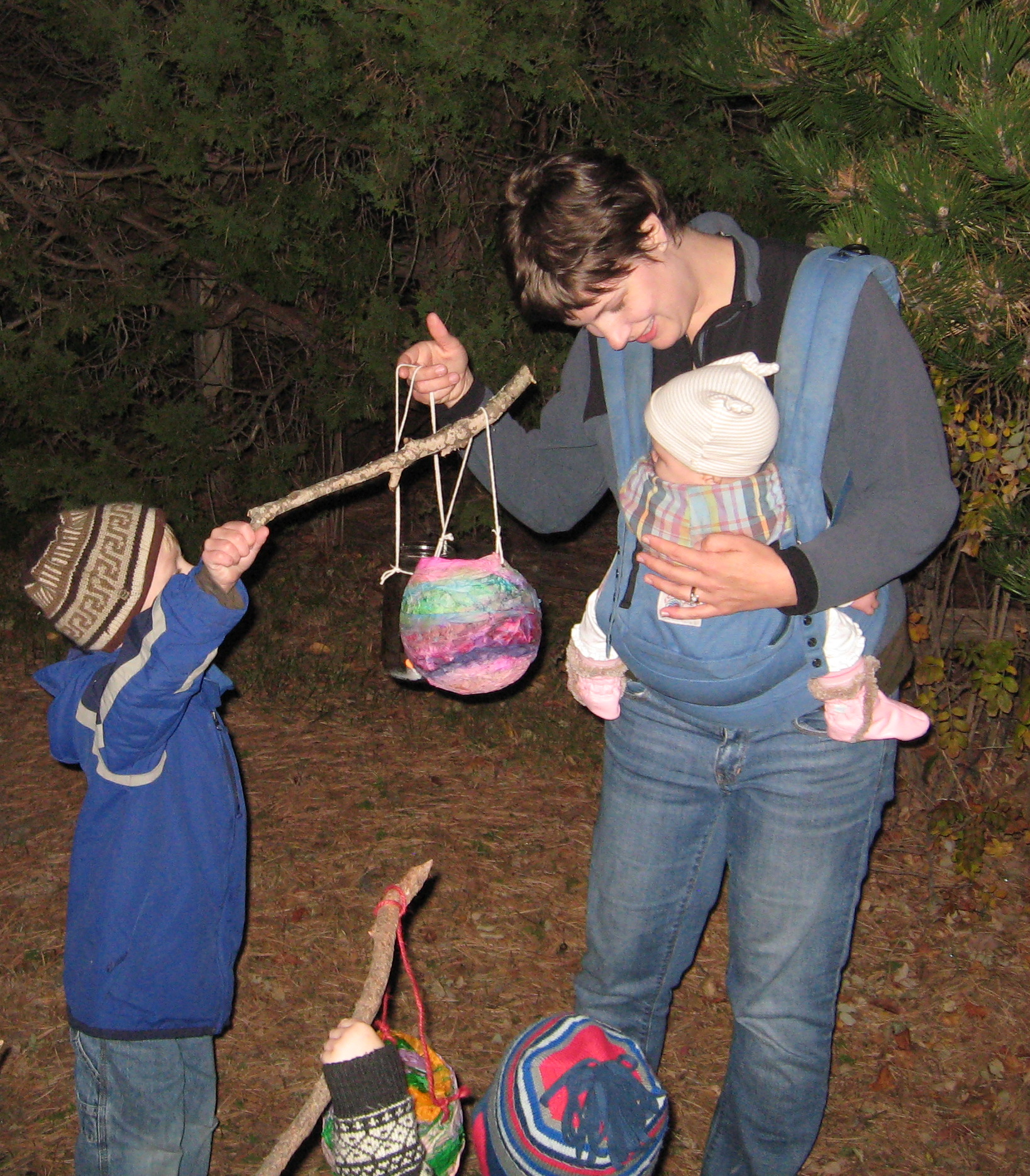
Guided by another young family with experience in this ancient tradition honoring St. Martin of Tours, we stepped out into the dark. Each young child bore a homemade lantern and eagerly watched the wind catch and play with the flame. We periodically stopped to relight each one. In the darkening dusk we walked along the beach, flickering orbs bobbing in front of young, expectant faces.
I was amazed at how gentle the wind was, how perfect the setting. The stars began to gain strength, and distantly echoed the scattered constellation of lanterned children. The waves stood back and gave us firm ground to walk on.
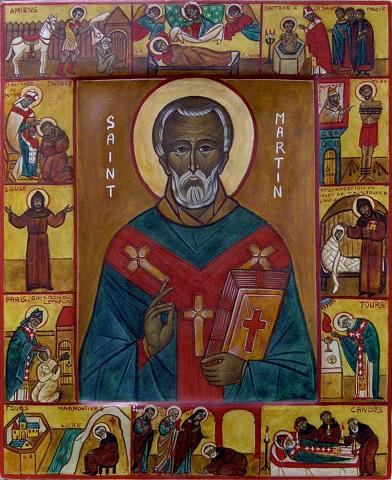 Our lights were small and inconsistent in the north Atlantic wind, but their hope a meaningful tribute to St. Martin. A Roman solider, Martin met a starving beggar at the city gates of Amiens. Moved with compassion, he tore his cloak in two, giving half to the beggar. That night in his sleep, Christ appeared to him dressed in the half-cloak. He was soon baptized and later became a bishop in the Church.
I’m unsure how much of the beauty and meaning the children were able to absorb, but the excitement and courage with which they carried their fragile paper lanterns in the wind of the North Atlantic gives me hope.
 Their small lights were extinguished several times, but they kept asking for their lanterns to be lit again. Whenever their light withstood the wind, they joyfully announced it to all around, and fixed their eyes upon its hopeful, persistent light.

In studying the Septuagint, I’m regularly curious about how often the LXX translators used the same Greek word to translate a given Hebrew word. How often, for example, does καρδία translate the Hebrew לבב? And what other Greek words are used to translate it? Similarly, I wonder, for occurences in the Greek text of καρδία, what other Hebrew words might it be translating?
Takamitsu Muraoka has made such questions an emphasis of his scholarly writing and publishing throughout his career. His Greek-English Lexicon of the Septuagint is one of the standard lexicons in the field, and his Greek-Hebrew/Aramaic Two-way Index to the Septuagint is the best thing I’ve seen in print for Hebrew-Greek lexical studies in the Septuagint.
Preceding that latter work was Muraoka’s Hebrew/Aramaic Index to the Septuagint: Keyed to the Hatch-Redpath Concordance. I’ve had a chance to use the work in Logos Bible software; this post contains my review.
Muraoka notes the impetus for the work in the Introduction. The Hatch-Redpath Concordance (hereafter HR), published around the turn of the 20th century, listed all Greek words used in the Septuagint with the Hebrew they were thought to have translated. At the back of the concordance was a list that basically noted the reverse, showing Hebrew words alphabetically with the Greek words used to translate them… or, rather, a key to the Greek words in question. As Muraoka notes, you would have this entry in HR:
אָמַר qal 37 c, 74 a, 109 c, 113 c, 120 a, 133 a, 222 a, 267 a, 299 b, 306 b, 313 a, 329 c, 339 b, 365 a, 384 a, 460 c, 477 a, 503 c, 505 c, 520 b, 534 c, 537 b, 538 b, 553 b, 628 b, 757 b, 841 c, 863 c, 881 c, 991 b, 1056 b, 1060 a, 1061 a, 1139 a, 1213 b, 1220 c, 1231 b, c, 1310 b, 1318 b, 1423 c, 1425 b, 69 b, 72 b, 173 a, 183 b, c, 200 a (2), 207 c, 211 b.
Whereas the Greek to Hebrew portion of HR lists the Hebrew words underlying the Greek of the LXX, the Hebrew to Greek portion at the back just has page and column reference numbers, as above. So the user of HR would have to turn to page 37, column c, page 74, column a, etc., etc., in order to see what Greek words were in those locations. Only in that tedious way could the user of HR see all the Greek words used to translate the Hebrew אָמַר.
Muraoka’s wife (who is a true co-author of this work) tediously wrote out (yes, by hand) each Hebrew to Greek entry so that instead of page and column numbers, it contained actual Greek words. The above, then, would look more like this:
אָמַר qal αἰτεῖν (37c), ἀναγγέλλειν (74a)…
…and so on. The HR page and column numbers are retained, but now the user doesn’t have to flip back and forth, since the Greek words are all in one place.
T. Muraoka then took his wife’s data and critically examined HR’s assessments in as many places as he could, drawing on advances in the past century in textual criticism, manuscript availability (like the Dead Sea Scrolls), and adding in analysis of “apocryphal” books, which HR had not fully included. The resulting revision updates both HR’s work and his wife’s manual collation.
What results, then, is an eminently helpful work where one can look up any Hebrew word and see all the Greek words used to translate it across the Septuagint. To be able to do this is valuable, and Muraoka makes it easy.
There are two things that lack here, though neither one of them is really the goal of the work, so I don’t actually criticize it for these omissions. First, there are not frequency numbers. It could be especially helpful to know not only what Greek words translate a given Hebrew word, but how many times each does, so that the user can get a sense of the distribution of each. Muraoka doesn’t have this. Second, he doesn’t have glosses or translation equivalents for words, so there is no English in this index.
But this is an index, and marked as one, so neither of those is a flaw in Muraoka’s book. In fact, here is where using Muraoka in Logos is especially helpful: you can tie tabs together so that a simple click from Greek or Hebrew in his index takes you to a corresponding Greek or Hebrew lexicon in Logos, where you can see that word’s meaning. Logos in this way really enhances Muraoka’s tool. And, of course, frequency statistics are easy to come by in Logos.
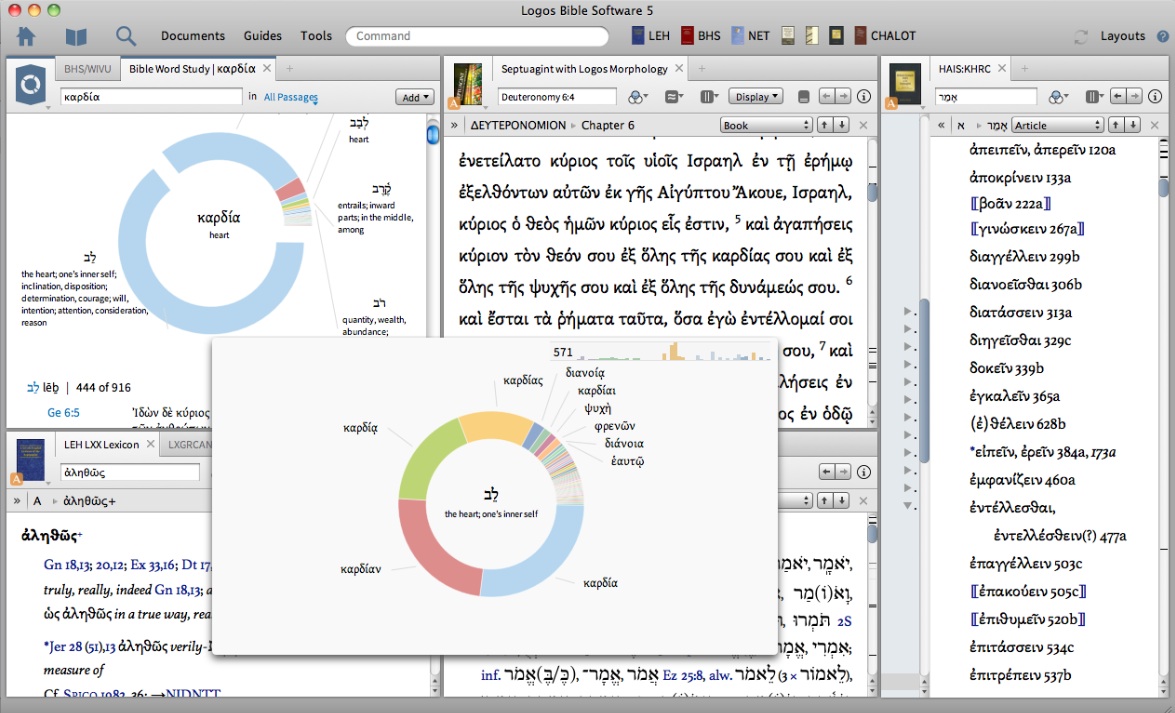
This is a good resource, and worth owning for students and professors of the Septuagint. A question remains: with all that Logos can already do, is it superfluous to purchase Muraoka’s index? Using the Bible Word Study feature in Logos, for example, I can see all of the Hebrew words that a given Greek word is used to translate, as well as all of the Greek words used to translate a given Hebrew word, as here (click to enlarge):
This may be sufficient for what many people need, especially since you can also search for a Hebrew lemma from within the Greek Septuagint text in Logos and receive results in Greek, so that you have before you all the verses with all the various Greek words that translate that Hebrew lemma. (I just learned this today from the user forums-very cool.)
But if you’ve got the money (especially if you qualify for an academic discount), and are sitting on the fence about Muraoka’s resource, I recommend it. It’s nice to have easily at hand a listing of all Greek words used to translate a Hebrew word in the Septuagint, even if there are other ways to get that information in Logos. Here it’s consolidated.
One other nice feature is that all the abbreviations throughout the index are hyperlinked to what they stand for, which you can bring up just by mousing over them:

You can see there are no verse references given, which are useful for in-depth study of Greek translations. Muraoka’s more thorough Greek-Hebrew/Aramaic Two-way Index to the Septuagint offers more depth in this regard than this 1998 Hebrew/Aramaic (one-way) index. No Bible software currently offers the two-way index, but it would be great if Logos were able to make it available in the future.
All in all Muraoka’s Hebrew/Aramaic Index to the Septuagint is a solid resource. And its digitization in Logos has been well done, too. Logos can already accomplish much of what’s in this index, but the one serious about the Septuagint may want to have any and all tools at her or his disposal. In that case, this is a worthy addition to one’s library.
Thanks to Logos for the free review copy of this work, offered without any expectation as to the positive or critical nature of my review. Muraoka’s Hebrew/Aramaic Index to the Septuagint is available in Logos here.

Breaking news: the new Archbishop of Canterbury, Justin Welby, is on Twitter. (He’s funny, too.)
He comes to the Anglican Communion’s highest position from a post as Bishop in Durham, where N.T. Wright previously served.
A piece on him in the New York Times is here.
And the BBC has published an article with “10 lesser-known things” about the new Archbishop. I found this one particularly poignant:
4. He set up a special day for bereaved parents in Coventry Cathedral. There is now an annual service commemorating the lives of children who have died. A book with the names of lost children is always on display in the cathedral – anyone who has lost a child under any circumstances can ask for their child’s name to be added to the book.
Bishop Welby’s own eldest daughter, Johanna, died when she was just seven months old in a car crash in France in 1983. He has previously said her death brought him and his wife Caroline closer to God. The couple have five other children.
The rest of the BBC article is here.
 My 4-year-old son is now my 5-year-old son. We thought it would be a good idea for him to review his new favorite show, Wild Kratts. Here he is:
I watched it on TV and then I noticed it on there, and it became my favorite movie to watch.
It’s about Martin and Chris, and they are the Wild Kratts. Their colors are blue and green. Chris is green; Martin is blue.
Aviva, Koki, and Jimmy are in Wild Kratts, too. Aviva makes motions, like materials to help the Wild Kratts. Koki writes stuff up and checks what’s happening around the world. Jimmy controls his controller and it gets the miniaturizer to do stuff. Like, he pushed the top level button and it just, like, gets the miniaturizer to get going.
People stand on it and turn it on, and when you turn it on, it goes shoop! and then you’re that small. One of them or the other of them or two of them [Chris and Martin] get small. When they get small they check out little creatures, like a worm. That was one of them that they did a miniaturizer for.
My favorite part about the show is seeing new animals, like: a spider, a hort-hog [AKJ: warthog, he means], and… a horse. I don’t know if they have a horse one.
The tortuga is a flying kind of turtle. They get in it and it helps them fly around. They fly to wherever the rescue needs to be. (They rescue creatures.)
It’s on at 3:30 on channel number 3, PBS Kids Go. All those kids movies are called PBS Kids Go.
My brother likes it. He really sings it a lot. Now I think he really likes that one.

Last week I posted some initial impressions of the just-released Logos 5. Having had a little more time with it now, here are some further impressions I have.
The Data Sets guide the user through resources nicely and can do some unique things.
The Logos 5 Data Sets are what most stand out to me on further use. Two in particular to note:
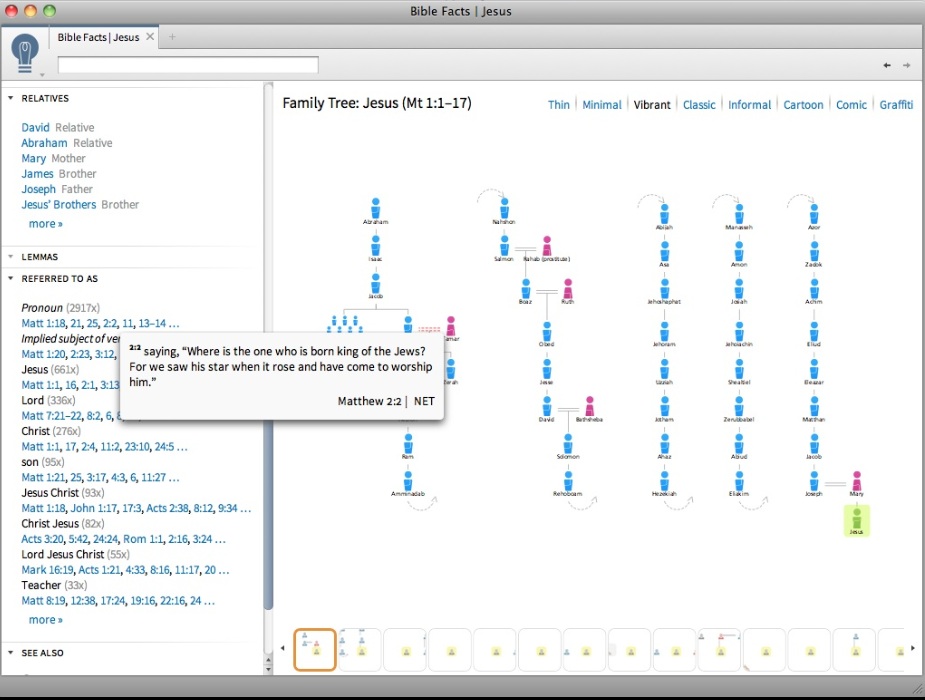
Bible Facts (People): this allows me to search by a referent and not just by the actual wording in the text. For example, by going to “Tools” from the home screen, then “Bible Facts,” I can type in “Jesus” to see not just where that word occurs in the text, but also where the text is referring to Jesus, whether by “he,” as “Christ,” “Son,” and so on. It’s a lovely and very impressive feature. Take a look, and click on the image to see larger:
Clause Search: Another you-have-to-use-it-to-believe-it feature. Here I can find (in less than a second) every time Paul is the subject of a clause, whether “Paul” occurs in the text or not. This means I can search on Paul in Acts, but also on the things Paul says about himself (using just “I” in the text) in his epistles. Or, I can search at the clause level for times when Jesus is the subject and his disciples are the object. As here:
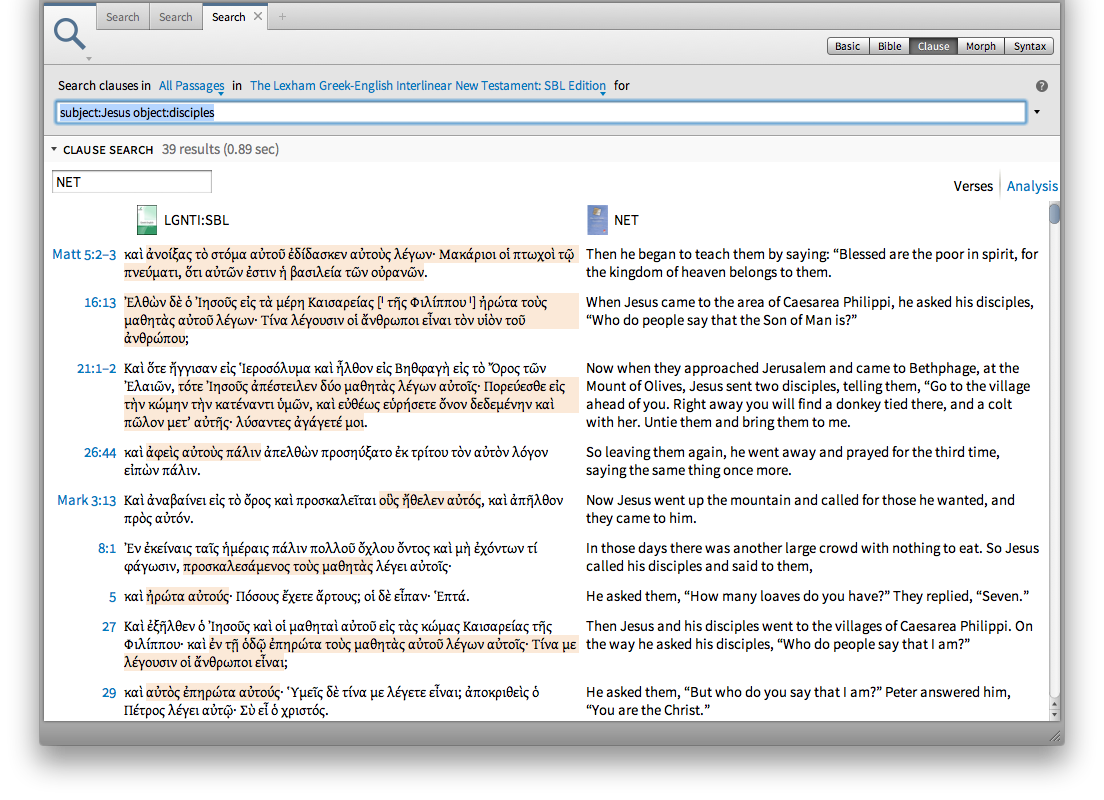
Note that the first result is Matthew 5:2-3, where the words “Jesus” and “disciples” don’t even appear in the text (!) but the “he” refers to “Jesus” and “them” to his disciples. Of course, there is some interpretation at play here in the results. The disciples are the closest referent to “them” in the text, but Matthew 5:1 also mentions the crowds, who could also be what “them” refers back to. But the fact that the Clause Search can, in under a second, return these kinds of results is astounding. It’s searches like this that are why Logos markets itself as “powerful.”
The search speed of the program has improved (though is still not the fastest on the market).
Logos 5 is an overall faster program than Logos 4. (I use Logos primarily on a Mac.) The clause searches I’ve done, for example, have been lightning fast. But Logos is still not quite as fast at returning results for original language word searches as BibleWorks or Accordance. I wondered with Logos 4 whether this might be because Logos has a large library of resources. Whatever the reason, the multi-second waits for search results to come up are less common in 5 than in 4. Most of my searches have been showing results in a second or less, even the clause searches that I’d expect to take longer. Accordance and BibleWorks, however, give near instantaneous search results. Logos, with v. 5, is at last in the same ballpark with regard to speed.
The contents of the base packages have changed significantly.
This does not affect previous Logos users necessarily, in that you always keep your Logos resources with you (for life). So if you upgrade to Logos 5 via a new base package, anything you had bought previously stays with you, even if it’s not in the new base package. For someone like me who primarily uses Bible software to study biblical languages, the Original Languages Library in Logos 4 was great (except, perhaps, for its lack of an English translation of the Septuagint). Even with its retail price under $500, that package still included the full 10-volume Theological Dictionary of the New Testament (TDNT), making it a good deal, and a great deal with the academic discount.
Now to have TDNT in a base package (if you don’t already own it), you have to buy the “Gold” package at a retail price of just over $1,500. The Silver package in Logos 5, that I received to review, includes the entire New American Commentary set, the full Pulpit Commentary set, the Lexham Analytical Lexicon to the Septuagint (and the same to the Greek NT), several Greek and English Apostolic Fathers texts, the Theological Lexicon of the OT (and that of the NT), as well as many more resources for a retail price of about $1,000. I was particularly excited to see a new English translation of the Septuagint, coming from the Lexham suite by Logos. Users will simply have to weigh whether the included resources in a package justify its cost. The Silver package seems to be worth the price. (Though note that the fairly standard Rahlfs Septuagint text is not included in Silver; Swete’s text is.)
This video from Logos gives a good overview of what’s new in Logos 5, with special focus on the Data Sets:
See also my initial impressions of Logos 5 in an earlier review.
Thanks to Logos for the review copy of Logos 5 with the Silver package, provided to me simply with the expectation that I offer my honest impressions of the program.

What a great way spend a day this Tuesday! We had our annual Day of Prayer at Gordon College. (Here is the schedule of events for the day.)
As I wrote before, I’m struck by how the Day of Prayer is a microcosm of an important aspect the school’s life together: we are one and we are many. There are more than 40 denominations and Christian traditions represented at Gordon. On the Day of Prayer we prayed as one body—lived out in the morning and evening services in the chapel—and we prayed in diverse ways (for example, in the Orthodox tradition, through hymns, in the Catholic tradition, by reading Psalms together around a fire pit, in the dark, with artistic expressions, through dancers leading worship, a Gospel Choir, and more).
The picture above (via a Gordon student) is of a rock cairn that the students added to throughout the day. Students, faculty, and staff wrote prayers of gratitude and thanksgiving on a rock, which they then placed next to the entrance of the chapel. Watching the rocks pile up throughout the day, as praises going up to God, was a highlight for me. These rocks cry out!
See student response to Day of Prayer (with pictures) via the Twitter hashtag #GCDayofPrayer.

The Telegraph reports that the new Archbishop of Canterbury has been named: Justin Welby, Bishop of Durham.
Sources have confirmed that the Eton-educated bishop will be announced as successor to Dr Rowan Williams as early as Friday, after the Crown Nominations Commission put his name forward to Downing Street.
It marks a meteoric rise for the former oil executive who has been a bishop for only a year, but insiders described Welby as “the outstanding candidate”.
The full article is here.

Tomorrow (Tuesday) at Gordon College is the Day of Prayer. Here is the schedule for the day. We’ve been working hard in preparation for this day, and I’m excited now that it’s here at last.
Day of Prayer at Gordon is a dedicated day–no classes or regularly scheduled events–where we remind ourselves of who we are in Christ: a body of believers that can join together in prayer to give God praise and request his continued provision in our lives and in the world.
I’m struck by how the Day of Prayer is a microcosm of an important aspect the school’s life together: we are one and we are many. There are more than 40 denominations and Christian traditions represented at Gordon. On the Day of Prayer we pray as one body—lived out in the morning and evening services in the chapel—and we pray in diverse ways (for example, in the Orthodox tradition, through hymns, in the Catholic tradition, by reading Psalms together around a fire pit, in the dark, with artistic expressions, and so on).
Philosophers talk about the problem of “the one and the many.” At Gordon, we get to experience the blessing in Christ of being one and many.
You can follow Day of Prayer via the Twitter hashtag #GCDayofPrayer. (Gordon College on Twitter is @GordonCollege.) Read the Day of Prayer press release here.
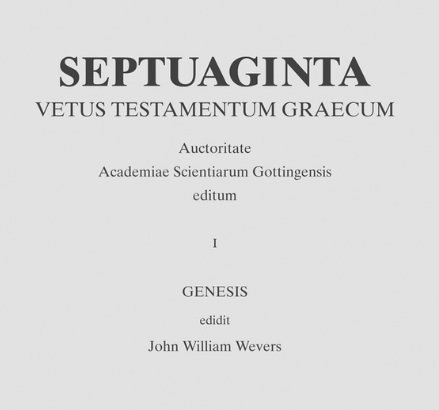
The Göttingen Septuagint is the Cadillac of Septuagint editions. It’s the largest scholarly edition of the Greek translation of the Hebrew Bible. Its full name is Septuaginta: Vetus Testamentum Graecum Auctoritate Academiae Scientiarum Gottingensis editum, published by Vandenhoeck & Ruprecht in Göttingen, Germany. The Göttingen Septuagint has published more than 20 volumes spanning some 40 biblical books (counting the minor prophets as 12), and publication of additional volumes is in progress.
But the Göttingen Septuagint is not for the faint of heart, or for the reader who is unwilling to put some serious work in to understanding the layout and import of the edition and its critical apparatuses. A challenge to using Göttingen is the paucity of material available about the project, even in books about the Septuagint. An additional challenge is that the critical apparatuses contain Greek, abbreviated Greek, and abbreviated Latin. The introductions to each volume are in German, though below I cite from English translations of the introductions to the volumes of the Pentateuch.
It is my intention with this post, and a second to follow, to give a short primer or user’s guide to the Göttingen edition. Here I offer suggestions on how to read and understand the text, the apparatuses, the sigla/abbreviations, the introductions, and point to additional resources that will be of benefit to the Göttingen user.
I recently put together a basic orientation to the scholarly editions of the Hebrew Bible and the Greek translation of the same. That is here. It is worth noting again that the International Organization for Septuagint and Cognate Studies (IOSCS) has a good, succinct article on the various editions of the Septuagint. Below, “OG” stands for “Old Greek.” They write:
The creation and propagation of a critical text of the LXX/OG has been a basic concern in modern scholarship. The two great text editions begun in the early 20th century are the Cambridge Septuagint and the Göttingen Septuagint, each with a “minor edition” (editio minor) and a “major edition” (editio maior). For Cambridge this means respectively H. B. Swete, The Old Testament in Greek (1909-1922) and the so-called “Larger Cambridge Septuagint” by A. E. Brooke, N. McLean, (and H. St. John Thackeray) (1906-). For Göttingen it denotes respectively Alfred Rahlfs’s Handausgabe (1935) and the “Larger Göttingen Septuagint” (1931-). Though Rahlfs (editio minor) can be called a semi-critical edition, the Göttingen Septuaginta (editio maior) presents a fully critical text….
In other words, rather than using a text based on an actual manuscript (as BHS, based on the Leningrad Codex, does), Göttingen utilizes a reconstructed text informed by a thorough examination of manuscript evidence. Göttingen has two critical apparatuses at the bottom of the page of most volumes. Because it is an editio maior and not an editio minor like Rahlfs, a given print page can have just a few lines of actual biblical text, with the rest being taken up by the apparatuses. Here’s a sample page from Genesis 1. Note the #s 1-4 that I’ve added to highlight the different parts of a page. Below I explain #1 and #2; the rest comes in a follow up post.

1. The reconstructed Greek critical text (“Der kritische Text”)
With verse references in both the margin and in the body of the text, the top portion of each page of the Göttingen Septuagint is the editorially reconstructed text of each biblical book. In the page from Genesis 1 above, you’ll notice that the text includes punctuation, accents, and breathing marks.
Like the NA27 (and now NA28) and UBS4 versions of the Greek New Testament, Göttingen is a critical or “eclectic” edition, which “may be described as a collection of the oldest recoverable texts, carefully restored book by book (or section by section), aiming at achieving the closest approximation to the original translations (from Hebrew or Aramaic) or compositions (in Greek), systematically reconstructed from the widest array of relevant textual data (including controlled conjecture)” (IOSCS, “Critical Editions”).
Of the critical text, John William Wevers, in his introduction to Genesis in Göttingen, writes:
Since it must be presupposed that this text will be standard for a long time, the stance taken by the editor over against the critical text was intentionally conservative. In general conjectures were avoided, even though it might be expected that future recognition would possibly confirm such conjectures.
It must be clearly evident that the critical text here offered labored under certain limitations. The mss, versions and patristic witnesses which are available to us bring us with few and small exceptions no further back than the second century of our era. Although we do know on the basis of second and third century B.C.E. papyri something about the character of every day Greek used, our knowledge of contemporary literary Greek is very limited indeed. In other words, the critical text here offered is an approximation of the original LXX text, hopefully the best which could be reconstructed on the basis of the present level of our knowledge. The editor entertains no illusion that he has restored throughout the original text of the LXX.
One cannot simply say, “The LXX says…,” because then inevitably an appropriate response is, “Which LXX? Which manuscript? Which or whose best attempt at reconstruction?” So “approximation of the original” and “hopefully the best which could be reconstructed” are key phrases here.
All the same, especially in the newer Göttingen editions, the volume editors have viewed and listed the readings of many manuscripts and versions. The critical apparatuses are where they list those readings, so the user of Göttingen can see other readings as they compare with the critically reconstructed text. (Because the Göttingen editions are critical/eclectic texts, no single manuscript will match the text of the Göttingen Septuagint.) And although scholarly editions of the Greek New Testament also present an eclectic text, neither the NA27 nor UBS 4 is an editio maior, as Göttingen is. (The Editio Critica Maior is just recently begun for the GNT.) Serious works in Septuagint studies, then, most often use the Göttingen text, where available, as a base.
2. The Source List (“Kopfleiste”)

Not every volume has this feature, but the five Pentateuch volumes, Ruth, Esther, and others do. The Kopfleiste comes just below the text and above the apparatuses. Wevers notes it as a list of all manuscripts and versions used, listed in the order that they appear in the apparatus on that page. A fragmentary textual witness is enclosed in parenthesis.
In the above Kopfleiste, the parentheses around 912 mean that papyrus 912 is fragmentary. The “-” preceding it, Wevers notes, means that its text ends on the page in question. So although this particular Göttingen page has Genesis 1:4-9 reconstructed in the critical text (“Der kritische Text”), “(-912)” in the Kopfleiste indicates that the fragmentary papyrus 912 does not actually contain text for all the verses on the page. Looking up papyrus 912 in Wevers’s introduction to Genesis, in fact, confirms that this third to fourth century papyrus contains only Genesis 1:1-5.
By contrast, the “(D-)” here

indicates that the uncial manuscript D has its text beginning on the page in which it appears in Göttingen. The above shot is from the Göttingen page containing Genesis 1:9-13. The first time D has anything to offer (since it is fragmentary, indicated by its enclosure in parentheses) is at 1:13. This alerts the reader that D has no witness to Genesis 1:1-12. Wevers’s introduction then gives more information about the contents of that manuscript. So, too, with the minuscule manuscript 128 above–the introduction says of 128, “Init [=Latin initium=the beginning] – 1,10 is absent.”
Wevers adds:
Should a piece of text be lacking due to some external circumstance in a particular ms, this is noted in the Source-List. For example if ms 17 lacks the text this is shown as O-17. What this means is that the entire O except 17 (which belongs to O) has the text in question. The abbreviation al (for alia manuscripta) refers to the mss which belong to no particular group, i.e. the so-called codices mixti as well as mss which are too fragmentary to allow classification. The expression verss designates all the versions which have the complete text of Genesis. Versions such as Syh to (31,53) and Pal, whose texts are not complete, are listed at the end of the Source-List (Kopfleiste).
In terms of the order of citing Greek textual witnesses:
In the apparatus the citation of Greek sources appears in the following order: First place is occupied by the uncial texts in alphabetical order, and characterized by a capital letter. Then the papyri are cited in the order of 801 to 999. Then the hexaplaric group [AKJ: “O” above] is given as well as the Catena groups [AKJ: C‘’], with the mss groups following in order as: b d f n s t y z; then the codd mixti, followed by the mss without a Rahlfs number. Next come the NT citations, and finally, the rest of the patristic witnesses in alphabetic order.
In the next part of this Göttingen Septuagint primer, I’ll explore #3 and #4 above, the First Critical Apparatus (“Apparat I”) and the Second Critical Apparatus (“Apparat II”), as well as take a closer look at the contents of the Introductions in the Göttingen editions (“Die Einleitung”).
UPDATE: Part 2 of the primer is here, with still more to follow.
Thanks to Brian Davidson of LXXI for his helpful suggestions on an earlier draft of this post.


 Words on the Word