“Bringing our Pain to God” (Michael Card)

We’re afraid of other people’s pain. Like Job’s friends, we’re afraid when we don’t have answers. Job doesn’t get any answers for his sufferings, but he gets God.

–Michael Card, from this great article on Biblical lament in worship.

He’s got an album called The Hidden Face of God, which you can hear at Grooveshark for free (or click on the album image to the left). It kicks off with a great Gospel-flavored track called, “Come Lift Up Your Sorrows.”

July 2012 Biblical Studies Carnival

Head over to Reading Acts for the July “Biblical Studies Carnival.” It’s a compilation of many, many posts on all things Biblical studies on the blogosphere in July. There is some really good stuff there, and Phil has done a great job gathering some informative links. I’m thankful to have received mention in the carnival (of my July posts here, here, and here).

“I Don’t Understand,” by Doran Stambaugh (song in response to the Aurora, Colarado shooting)

Doran Stambaugh, formerly of the Chicagoland band w a t e r w o r k s , has written a song, “I Don’t Understand,” as a response to the mass shooting at the Dark Knight screening a week and a half ago. This is a good lament.

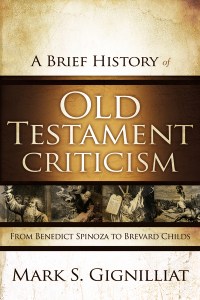
A Brief History of Old Testament Criticism: From Benedict Spinoza to Brevard Childs, Reviewed

The world of Old Testament interpretation can feel vast and complex, teeming with concepts and terms like “historical-critical,” Sitz im Leben, and documentary hypothesis. Admission into that field of ideas is potentially cost-prohibitive, not to mention time-consuming.

Mark Gignilliat, Associate Professor of Divinity at Beeson, has greatly simplified a student’s entrance into the realm of Old Testament interpretation. His new book, A Brief History of Old Testament Criticism: From Benedict Spinoza to Brevard Childs, explores major Old Testament interpreters and themes in the modern period. Gignilliat begins with Spinoza (b. 1632) and concludes with Childs (d. 2007) in his “picture gallery tour of sorts.” Gignilliat writes, “This is a book for students. …The intended audience of this book is anyone who is interested in the Bible, its history of interpretation, and the particular problems and approaches to Old Testament studies in the modern period.”

The “picture gallery tour” surveys OT criticism through the lens of seven major characters: Spinoza, de Wette, Wellhausen, Gunkel, von Rad, Albright, and Childs. The author makes “no comprehensive attempt at expounding the very complex history of Old Testament interpretation,” but he does go beyond even his seven major subjects in detailing the ideas of other important thinkers, too. Gignilliat gives each interpreter his own chapter, which includes a short biography and a survey of ideas and writings. Chapters end with a “For Further Reading” section that the interested reader can pursue.

Gignilliat in his introduction immediately shows himself to be humble, gracious, and warm in tone, which continues throughout the book. He is aware of the limitations of a “brief history” like this (perhaps overly aware), though his concerns are not warranted, since this book accomplishes what it sets out to do.

One thing the author does particularly well is analyzes major interpreters in their life context. Of Spinoza, for example (to whom he traces the beginning of the denial of Mosaic authorship of the Pentateuch), he writes:

But it is important to understand, even if somewhat minimally, the community values Spinoza was reacting against and the intellectual currents of the day that influenced his thought. Modernity’s most cherished claims–autonomous intellectual pursuits, dismissal of dogmatic tradition, naturalism, and affirmation of the Cartesian “I” (I think therefore I am)–were advanced by Spinoza’s philosophical and hermeneutical outlook.

He notes that Spinoza’s emphasis on rationalism and the knowing self may have been, in part, a reaction to the “religious dogmatism, military might, and political ambition” that “made for a toxic combination throughout the Thirty Years War.”

Gignilliat’s ability to understand thinkers in context helps the reader to better appreciate what led to their contributions. With the above in mind, I could better understand why Spinoza sought to turn “sola scriptura into nuda scriptura, that is, Scripture stripped of any theological or ecclesial context.” (I thought this was a brilliant line.) Gignilliat does not follow Spinoza this far, but he gives a fair shake to the ideas of Spinoza and others throughout the book.

The author treats the documentary hypothesis and its development, beginning with Wellhausen. Though many evangelicals bristle at J, E, D, and P, Gignilliat does a good job showing how Wellhausen and those after him developed the notion that the Pentateuch has a complex redaction history. One key implication of the hypothesis is that someone like von Rad can conclude (in Gignilliat’s words):

The Hexateuchal [Pentateuch+Joshua] traditions do not give us a historical account of Israel that will satisfy modern attempts at history making. What these traditions do give is insight into Israel’s ancient faith and how that faith was continually actualized in Israel’s history of salvation.

Childs is the climax of the book: He is both “confessional and critical.” That is, he integrates historical-critical insights that have preceded him, yet with a confessional understanding of the Bible as Scripture. The canon matters to Childs, and his belief in the Bible as God’s Word–not just an object of historical study–influences his approach.

Gignilliat finally stands with Childs. For Gignilliat, “[A] confession of faith shapes, if not determines, the way we go about reading the Old Testament as Holy Scripture.” Readers who are nervous about some of the tendencies of Old Testament criticism to minimize (or ridicule) this view of the Bible as Scripture can rest assured with Gignilliat as their tour guide. Readers who are nervous about a Zondervan author writing a history of a field that has not exactly been dominated by evangelicals can also be rest assured by Gignilliat’s fair treatment of ideas and interpreters.

One great strength of A Brief History of Old Testament Criticism is Gignilliat’s consistent use of primary source materials. He does what every good philosopher should do: examines thinkers’ own writings, not just others’ writings about their writings. In this way he is able to describe his subjects in their own terms.

As I read I found myself occasionally distracted by what came across as an overly conversational tone. Although this is not present in all parts of the book, some sections overused, I thought, phrases like “all to say,” or, “it will be remembered that,” or, “at the end of the day.” The writing would have been stronger without that kind of verbal filler–and the author certainly had no need of hedging anything he said in such ways, since his brief history is a cogent, readable, and enjoyable one.

An evangelical doing Old Testament criticism may often feel how de Wette did–“lost in the middle” and in “a theological no-man’s land,” as Gignilliat describes it. But evangelicals should also know that Gignilliat is in that same territory, honoring the insights of those who have gone before, yet holding a high view of the Bible as God’s words to humanity, for then and for now. He quotes Herman Bavinck: “[Holy Scripture] was not only ‘God-breathed’ at the time it was written; it is ‘God-breathing.'”

A Brief History of Old Testament Criticism has its Zondervan product page (including sample pdf) here. It’s on Amazon here.

I received a review copy of this book from Zondervan in exchange for an unbiased review.

Always read the conclusion first: More about how to speed read


I’ve learned a few more things about speed reading since I first started. In addition to what I already posted here, here are a few more methods I’ve found to be effective. I have always thought of myself as a slow reader and serial book non-finisher. If I can do these things, just about any other reader can. The below observations have come with further practice.

I read the conclusion before I read the book. I wrote before, “I glance through the entire book I’m about to read before diving in.” I’ve fine-tuned this process a bit. I still look at the table of contents and try to find the thesis of the book (if there is one) in the introduction and first chapter. Now–spoiler alerts be danged–I also read the conclusion or last chapter before reading the book. This way I know where the author is trying to go, and I can better evaluate along the way how he or she is doing in getting there. This is particularly useful for writing book reviews.

Along similar lines, I read the beginning and end of each chapter before I read that chapter. This works especially well for well-written books. I can then head into a chapter with a better idea of its thesis and conclusion. This applies only to non-fiction, which is all I’ve been reading as of late. Of course it would be a bad way to read a mystery novel!

I especially push myself to read faster with familiar subject content. Speed reading is all about consistently pushing oneself to read faster than is comfortable. I seek to really take advantage of this when I’m already familiar with the subject a book treats. For example, I can read a book on ethnic identity much faster than I could read a book on how to repair a car.

I read the first and last line of a given paragraph the most slowly. This presupposes good writing, but who of us is going to deliberately read a poorly written book? I slow down just a bit at the beginning and end of each paragraph to make sure I’m tracking well with the author.

I read chunks of words, not single words at a time. I actually saw one Website refer to this as “chunking.” (No, I thought, chunking is what my baby daughter does on my shoulder when I burp her.) HT to Brian Davidson for his comment in my last post about this. This goes along with the idea I mentioned earlier of “silencing the inner narrator’s voice” you may hear as you read. One thing I’m working on now–which may prove impossible–is reading whole clauses at a time. This is difficult to do when reading something for the first time (identifying what constitutes a clause takes a little work). But reading at least three or four words at a time helps speed things along.

In speed reading, “practice makes perfect” applies. Or, in this case, practice makes faster.

Systems Thinking and Gentrification: Review of The New Urban Renewal

How do neighborhoods change? How does a forgotten ghetto become an urban hotspot?

Derek S. Hyra answers these questions in The New Urban Renewal: The Economic Transformation of Harlem and Bronzeville (published by University of Chicago Press, 2008).

Hyra presents a careful comparative study between two economically gentrifying communities: Harlem (New York) and Bronzeville (Chicago). He takes a “systems thinking” approach (though he does not call it that) to see how global and national forces interact with municipal political structures, which interact with community organizational structures, which all work together to affect local conditions. These are the lenses through which he views gentrification in those two communities.

He notes that while Bronzeville and Harlem are gentrifying economically, their racial composition is not changing–they both remain primarily African American neighborhoods. So Hyra also analyzes intraracial, cross-class conflict.

Hyra’s interest is especially in displaced, non-home-owning residents of each community. He keeps this population in mind throughout the book and makes recommendations at the end for how to minimize resident displacement in gentrifying communities.

The New Urban Renewal is not very concise–typographical errors and run-on sentences are surprisingly common for a University of Chicago Press Book. But this can be overlooked. The concepts in Hyra’s book are well worth understanding and exploring.

Words on the Word Weekend Recap

Sad the weekend is over? Relive it a little bit with a Words on the Word weekend recap. Friday through Sunday at WotW had the following:

Family: My 4-year-old reviews his first book, Alpha Oops! / Same 4-year-old asks me some theological dinner-time questions

Interview: WotW interview with Leslie C. Allen, author of Liturgy of Grief

Bible: BibleWorks 9 coming to PC tablets / “Septuagint” may be the wrong word to use

Books: How I fall asleep / Bookshelves I dream about while I’m sleeping

Magnificent Monograph Monday is today… look for a post later on. (UPDATE: here it is.)

Tonight’s theological questions at dinner from the 4-year-old

There were two:

Does Jesus make people do stuff?

and

What does “crucified” mean?

My answer to the first question (after a long pause): “Jesus can make people do stuff. Jesus can do anything he wants to. But he usually doesn’t make people do stuff. He lets them decide.” Some will disagree with this. But I think it has pretty good Scriptural warrant. I’m sure this question will come up again. And I thought the sex question was hard!

The second question I answered as specifically and succinctly as I could. I actually got a little teary-eyed as I described crucifixion to him. His response to my answer was appropriate, I thought: “Why did they do that?”

“Septuagint” is the wrong word to use


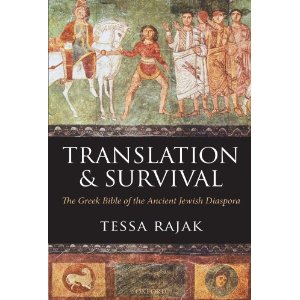
“Septuagint” is perhaps the wrong word to use to describe the Greek translation of the Hebrew Scriptures. Just about every author I’ve read so far on the Septuagint is quick to point this out. In the mail the other day I was happy to receive my review copy of Tessa Rajak’s Translation & Survival: The Greek Bible of the Ancient Jewish Diaspora (Oxford University Press, 2009). She puts it this way:

The term “Septuagint” does not appear in the title of this book, and that is no accident. It is in fact an inappropriate description for the Jewish Bible in Greek. The problem is that “Septuagint” is a term which evolved in the usage of the early Church and refers to the corpus created there as we find it in the great biblical codices of the fourth century CE. It is precisely these layers of reception that we shall need to strip away, at any rate until the last chapter of this book. But even were we to resolve to stick with the name, as one of convenience, we would soon find that the ambiguities and complications of its usage outweighed that convenience. (14-15)

Larry Hurtado recommends the book here. Keep checking back here–I’ll have a full review up some time next month.