Prophetic Whiplash…God of Mercy or God of Wrath?

Reading the Biblical prophets (like Micah) can give the reader emotional whiplash. The prophets often alternated abruptly between communicating God’s good news and bad. So which one is it: does God graciously forgive his people’s sins, or does he harbor his anger against them in judgment?

The prophets didn’t feel a need to necessarily resolve this tension; both are true in some measure. But in the end the witness of the Hebrew Bible–very much confirmed in the New Testament–is summed up in Exodus 20:5-6 (AKJV):

Do not worship any idol, and do not serve them, for I am Yahweh your God, a zealous God. For the sins of parents I hold accountable their children, to the third and fourth generations of those who hate me. But I show covenant loyalty to thousands of generations of those who love me and who keep my commandments.

Insofar as the tension between God’s mercy and God’s anger finds resolution, the Bible indicates that mercy is the overriding attribute of God.

Micah’s bifid structure, alternating as it does between woe and weal, seems to resolve at the end in favor of God’s mercy to his unfaithful people. This is Septuagint Sunday at Words on the Word, so a bit of Greek is in order. (You don’t have to know Greek to follow here.)

Micah 1:1 is the book’s superscription (=title page, essentially) where Micah identifies himself as a messenger of Yahweh, who has received his word to give to his people. The very first prophetic utterance, in the next verse (AKJV, from the Greek), is,

Hear these words, people, and let the earth and all that is in it pay attention. The Lord will serve as a witness (εἰς μαρτύριον) against you, the Lord from his holy dwelling place.

What follows in chapter 1 is fairly damning lawsuit language that calls God’s people into a courtroom setting for their transgressions of God’s covenant… where, of course, they have no defense. The woe-weal or wrath-mercy alternation continues through the rest of the book, until Micah concludes in 7:18-20 with a hymn of praise to God (AKJV again, from Greek):

Who is a God like you, who forgives injustices and overlooks the sins of the remnant of his inheritance?

He does not retain his anger as a witness (εἰς μαρτύριον), for he is one who delights in mercy. He will turn and have compassion on us. He will sink our injustices and hurl all our sins into the depths of the sea.

You will give truth to Jacob and mercy to Abraham, just as you swore to our ancestors from ancient days.

Of special note is how εἰς μαρτύριον (“as a witness”) serves as bookends for the book. In the first few verses, God himself is a witness against his people that they have committed sin against him. But in the final verses, he chooses not to call himself (specifically, his anger) to the stand as a witness (εἰς μαρτύριον) against his people. Rather, he overlooks (ὑπερβαίνων) their sins, sinking them into the depths of the sea.

Quite a different use of εἰς μαρτύριον to close out the book! In his last verses, Micah echoes the Exodus passage, that God forgives our wrongdoings and shows mercy, even with all he has to call as a witness against us.

God’s wrath is real, and our sins deserve it, yet in the end he has chosen to have mercy on his people.

Is cloth diapering a waste of time?

It’s Family Friday here at Words on the Word. And nothing says “family” to me like diapers! We have two children in diapers right now, and our third has been fully potty-trained for just about a year or so. We know poop.

Cloth diapering has long been a value for us (here‘s a great place to get them). My wife and I just couldn’t stand the idea of throwing away so many disposable diapers to take up space in a landfill. As one site I read said, we don’t throw away our clothes (or dishes for that matter)… why would we throw away our children’s diapers?

There are other concerns, too, that led us to cloth diapers. Have you ever changed a diaper and all those little absorbent gel capsules had gotten loose and were all over your child’s nether-regions? Not cool, Pampers. And cloth, I’m convinced, just feels much better on a baby’s bum.  Further, cloth holds things in much better. The large majority of “leakages” I’ve encountered have been from so-called super-absorbent disposables.

But it was primarily a desire to do our part as responsible inhabitants of God’s creation that led us to cloth.

However.

What about the amount of water that we have to use to wash all that cloth? We like to line-dry whenever we can, but that’s tough to do in the winter or if it’s raining. What about all the energy used by running the dryer multiple times a week on cloth? Is cloth diapering just as eco-unfriendly as disposables, albeit in a different way?

I’m not sure how you compare different kinds of environmental impact–is it better to fill up landfills or use lots of water?

I’ve wondered about this for about five years worth of child-rearing now. For us, the other added benefits of cloth diapering (less chemicals, more absorbent, more comfortable, save money in the long run) seal the deal for us in our decision to keep using cloth.

But here‘s an article (with links to studies) that makes the assertion that either method is basically just as good. (!) More here, too.

So what’s a parent to do?

Verses of Scripture to Pray for Youth

I’m convinced that one of the best things youth ministers can do is to pray for their youth. In fact, in my 10 years of church-based youth ministry, when people asked me how they could help the youth ministry, the first answer I always gave was: please pray for our young people.

God has given youth workers influence over the teenagers in their midst, but God changes hearts and reaches people before any of us ever do.

One of the best ways I have found to do this is to pray particular Scriptures over students. With some help from the mom of one of my small group guys some time ago, here is a compilation of Bible passages that can help direct our praying for youth and their families.  To use these prayers in a public worship setting, simply substitute the youth’s name into the passage of Scripture.

Can’t be perfect? Do what you can.

I’ve been reading the Didache lately, an important discipleship treatise in the early church. It was probably written in the late first century.

It quotes a good deal of Scripture, and speaks primarily to would-be disciples about choosing between “two ways, one of life and one of death.” The early church held it in high regard, considering it to be at least comparable to canonical Scripture and worthy of study. I’ll have a chance to post more about the Didache this summer.

Here’s some great advice from Didache 6:2: “For if you are able to bear the whole yoke of the Lord, you will be perfect. But if you are not able, do what you can.”

That much I can do.

Book Review: The Next Evangelicalism, by Soong-Chan Rah

Soong-Chan Rah writes, “As many lament the decline of Christianity in the United States in the early stages of the twenty-first century, very few have recognized that American Christianity may actually be growing, but in unexpected and surprising ways.”

In The Next Evangelicalism: Freeing the Church from Western Cultural Captivity, Rah posits that mainstream evangelicalism in the United States has been too monocultural in its worldview–“white” and “Western,” he says. It has been “taken captive” by individualism, consumerism and materialism, and racism. This captivity is pervasive, he writes, as seen in the megachurch movement, the emerging church movement (which Rah rightly argues pays too much attention to just white voices), and through cultural imperialism. Looking at Native American, African American, immigrant, and multicultural communities, Rah offers hopeful alternatives for evangelicalism’s future.

Every evangelical Christian should read this book. Rah has the courage to say hard things the church needs to hear. His excellent treatment of racism, especially, should be preached from the pulpits and studied in small groups.

However, there are at least two key points where I take issue with Rah.

First, a distraction is Rah’s equating “white” with “Western” as he discusses the church’s captivity. But these two are not always synonymous words, and sometimes when the author uses “white” he really means (or should mean) “Western” instead. Rah mentions T.D. Jakes as a megachurch pastor who is emblematic of the church’s captivity to (“white”) numerical pragmatism. But Jakes is “Western” and not “white.”  And there are non-white sectors of the Western church deserving of Rah’s critique (for example, Creflo Dollar and other “health and wealth gospel” African American pastors should be included in Rah’s critique of Western consumerism and materialism). Rah’s arguments would have more force (and been more accurate) if he simply had referred to “Western cultural captivity.”

Second, I struggled to accept some final remarks: “The shift in American evangelicalism is well under way. The white churches are in significant decline.” I will grant the first assertion. But as to the second, Rah does not define further what he means by “decline” and provides barely any evidence of it that I could see. In fact, if he means numerical decline, he is using a standard previously rejected in his book. (Church health ought to be measured not by buildings built or number of attendees alone, he notes, but by taking the spiritual pulse of the congregation.) Is a Church feeding the poor?  Welcoming visitors?  Caring for the sick? (Etc.?) If so, Rah would say, it is a healthy church. By this standard, the predominantly “white” church at which I recently served as youth minister, for example, is very healthy. Members of that church, and of many others I know that are like it, might read lines like this and ask, “What decline?”

Even so, I don’t want to overly fault Rah for those objections. As a reader I do not demand that Rah say everything perfectly before I accept the force and truth of his overarching claims. All in all, The Next Evangelicalism issues a clarion call to the church to end racism, embrace the growing ethnic diversity of the body of Christ, hear voices that have been overlooked and marginalized, and more accurately reflect the church the Bible calls us to be.

Bifid

The prophets in the Hebrew Bible knew how to throw down. They often ran the risk of death for their faithfulness in sharing God’s message with others. But that didn’t stop them.

One potentially confusing thing about the prophets is their frequent and sometimes abrupt transition between good news and bad news. Scholars refer to prophetical books like Micah as “bifid,” meaning that it has two primary kinds of prophecies: woe and weal. Woe prophecies are prophecies of bad things that will come to those who do injustice, who disobey God, who oppress the poor in their midst, etc. Weal prophecies are the comforting good news to God’s people: that though they are sinful and fall far short of God’s commands, yet he will have compassion and forgive.

The alternation between woe and weal in the prophets can be pretty unsettling to the reader, as I imagine it was to the people who first heard the prophecies. (“Oh, hey, cousin Asher… everything is cool! God’s going to forgive us. Wait… what’s he saying now? We’re going to perish in our transgressions?”)

Micah is a bifid book. One fairly common structural understanding of the book, which I first learned from my Hebrew professor, but have since seen elsewhere, has the book split up something like this:

1:1                Superscription (i.e., title) identifying Micah as a messenger of Yahweh

1:2-2:11       Punishment, part 1 (Woe):
Yahweh will punish Israel (the North) and Judah (the South) for their Idolatry

2:12-13        Restoration, part 1 (Weal):
Yahweh will gather the remnant of Israel like a flock

3:1-12           Punishment, part 2 (Woe):
Leaders, rulers, prophets, and priests are all corrupt, distorting justice.
Darkness will come over them and Jerusalem will be razed.

4:1-5:8          Restoration, part 2 (Weal):
Many nations will come to the mountain of Yahweh to worship the God of Jacob.
There will be peace.

5:9-7:6         Punishment, part 3 (Woe):
Yahweh will cut off idolatry from the land, destroying the unfaithful cities of Israel.

7:7-7:17      Restoration, part 3 (Weal):
The enemy will be trampled, the cities of Israel rebuilt.

7:18-7:20      Hymn of praise to God

There’s a particularly striking relationship between the first few and the last few verses of the book, that I think helps to resolve some of the tension that the reader experiences in the back-and-forth prophecies of Micah.

Reading through a short prophetical book like Micah with the above outline in hand can be a useful exercise in deepening one’s own understanding of Scripture and the character of God. Even as I’ve grown to deeply appreciate the book of Micah, I’ve found it quite challenging to work through.

I’ll post again in the future about how I think 1:1 and 7:18-20 work together to frame the book into a unified whole.

Restoration in the Wilderness

From the wilderness comes restoration.

The wilderness for Israel was all too often a place of dissension and lack of trust in God’s promises.

Exodus 17:7 says, “Moses called the name of the place Massah and Meribah, on account of the quarreling of the children of Israel, and on account of their testing Yahweh, which they did by saying, ‘Is Yahweh in the midst of us or not?'” (AKJV) Massah means testing and Meribah means strife or quarreling. “Whining” would not be an inappropriate translation for Meribah. Psalm 78 (go here and scroll down to 78) details the repeated lack of faith Israel had in their delivering God.

(Disclaimer: I am not claiming I would have done better or have done better in wilderness settings.)

In the Gospels, however, Jesus redeems and transforms the wilderness experience on behalf of the entire people of God. In the New Testament Jesus serves as a stand-in for the people of God, both in the wilderness and on the cross.

One of Mark’s first καὶ εὐθὺς statements has Jesus going into the wilderness to be tempted by Satan. But unlike the people of God in Exodus, Jesus did not sin when he was tempted to walk away from God and worship another. I once heard a preacher say that where Adam failed, where Israel failed, and where all humanity failed… Jesus succeeded on behalf of all people when he refused to listen to Satan in the wilderness.

The wilderness, isolated place that it is, connects with hope to the whole of salvation history.  John the Baptist, the “voice of one crying in the wilderness,” hearkens back to Old Testament prophets that “prepare the way of the Lord.”  John self-identifies as the prophet par excellence who prepares the way for Jesus. The wilderness may be lonely and despairing, but it is also the place to which Jesus comes.

As R.T. France writes, “The wilderness was a place of hope, of new beginnings…in the wilderness God’s people would again find their true destiny.”

From the wilderness comes restoration—even if it’s only the beginning of the process of restoration. Saint Mark’s first listeners/readers saw the wilderness motif immediately at the beginning of the Gospel (no birth narrative!), with John as prophet in the wilderness and with Jesus conquering Satan’s temptation in the wilderness. This alerted them that something significant was about to happen.

“Is God in our midst or not?”

I confess I’m too quick to ask that question with Israel when I find myself in a proverbial desert. But the desert wilderness is the exact place to which God saw fit to send John, preaching the good news of forgiveness and calling people to a baptism of repentance. The desert wilderness is the exact place to which God saw fit to drive Jesus, so that he could resist the devil’s temptations, beginning to win for us a victory we could never win for ourselves. God in Jesus restores what we have made “Massah” and “Meribah” by our lack of trust and rush to complaint.

Next wilderness I come to, I’m going to try to ask myself… what restoration is on the other side of this?

Junia

My wife and I just gave birth to our third child, Junia. The name Junia comes from Romans 16:7–she was an “outstanding” apostle, as noted by the apostle Paul.

There is nothing else about Junia in the New Testament except for the rest of what Paul says about her in that verse, the full text of which is, “Greet Andronicus and Junia, my fellow Jews who have been in prison with me. They are outstanding among the apostles, and they were in Christ before I was.”

What we know about Junia from Paul is:

  • She was a fellow Jew;
  • She is mentioned alongside Andronicus, presumed to be her husband and ministry partner;
  • She was in prison with Paul at some point;
  • She and Andronicus were “outstanding among the apostles”;
  • She and Andronicus were “in Christ” before Paul was.

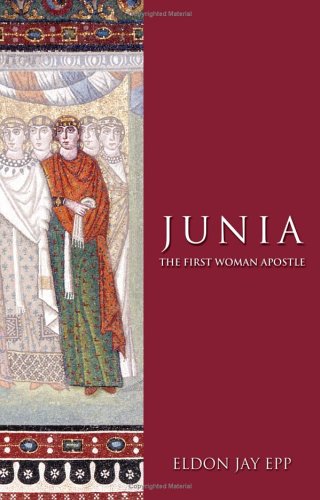
There is a little bit of literature about Junia. She is the source of a short but dense scholarly study by Eldon Jay Epp (the cover is pictured above). Epp explores the difference that comes up in some English translations–i.e., why Junia occasionally (but incorrectly, according to him) appears as a male “Junias.” There is also an investigative journalist’s take on Junia, exploring some of the church’s history as to how and why the apostle Junia has sometimes been understood in the text (incorrectly, she also says) as a male Junias.

Finally, Scot McKnight has just come out with a short Kindle-only monograph called Junia is Not Alone, which explores Junia’s contribution to the church, as well as other “overlooked” women in Scripture and church history. (The publisher’s description unfortunately calls the essay “fierce.” I’ve not yet read it, but all that I’ve read and heard from Scot is anything but fierce. (UPDATE: I review it here.) He is a gentle and caring Biblical scholar, not polemical. Unless they mean “that’s fierce” in a Project Runway sense.) He posts about his e-book here.

UPDATE: Read all my Junia posts here.