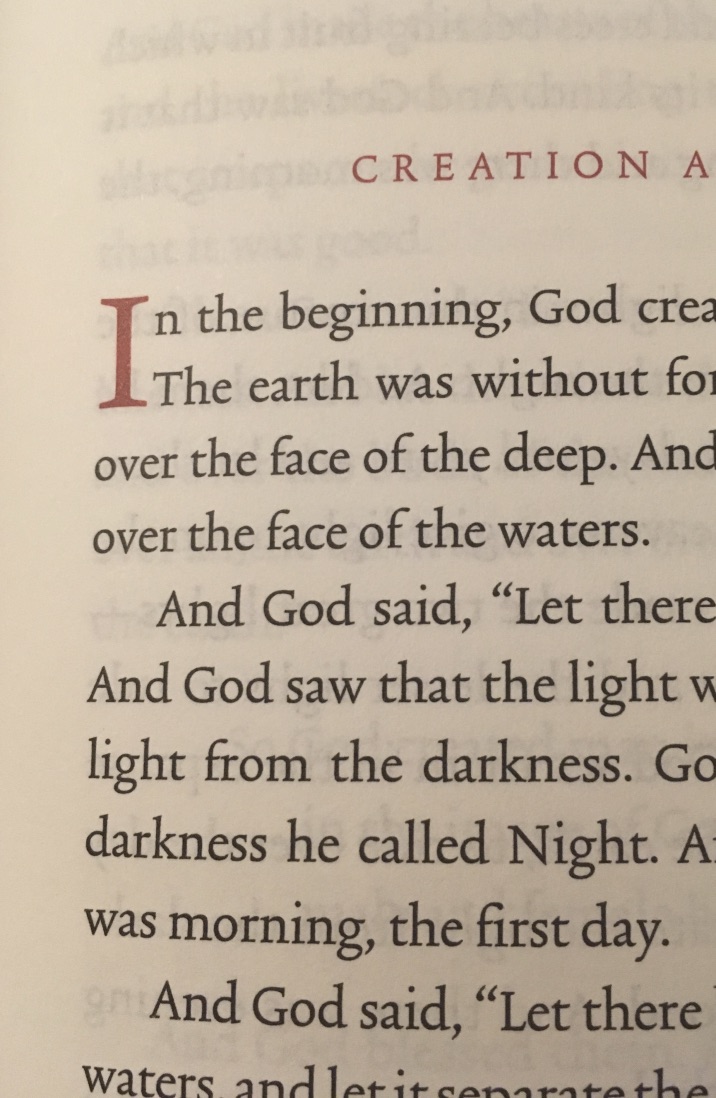
In both Genesis 12 and Genesis 20 a sojourning, scared, and self-preserving Abraham urges his wife Sarah to lie and say she is his sister.
Confronted by Abimelech about his lie (the second one), Abraham says,
I did it because I thought, There is no fear of God at all in this place, and they will kill me because of my wife. (Gen. 20:11)
Amazingly, Abraham goes on to say:
Besides, she is indeed my sister, the daughter of my father but not the daughter of my mother; and she became my wife.
At this point Abraham has been caught a second time in his lie. The truth of his marriage to Sarah has been revealed, and he is not going to be killed. So he has no real motivation to lie about being half-sibling to Sarah.
Still, he’s proven himself not trustworthy on this front already, so why believe him?
Going back to Genesis 11:31:
Terah took his son Abram and his grandson Lot son of Haran, and his daughter-in-law Sarai, his son Abram’s wife, and they went out together from Ur of the Chaldeans to go into the land of Canaan; but when they came to Haran, they settled there.
Abraham has just claimed that Sarah is Terah’s daughter by another mother. But when Genesis introduces Sarah (then Sarai) in relation to Terah, it says “his daughter-in-law Sarai.” If Abraham is telling the truth that Sarah is Terah’s daughter, might we not expect the text to have said so in Genesis 11:31? Instead, she is just “daughter-in-law, his son Abram’s wife.” Not “daughter.”
This admittedly could be an argument from silence—arguing for a claim just because a text doesn’t say something. That’s generally to be avoided, but at the same time it seems remarkable that in Sarai’s relationship to Terah, her being his daughter is not mentioned.
I see three potential ways to make sense of this:
- Abraham is lying about Sarah being his half-sister.
- The biblical text contradicts itself.
- Abraham is telling the truth and the biblical text is not contradictory, but selective (if oddly so) in what it mentions.
On theological, evidential, and many other grounds, I do not believe that Scripture contradicts itself. (There’s a post for another time!)
Is it possible that the genealogy in Genesis 11 mentions Sarai as daughter-in-law and just misses the chance to identify her also as daughter to Terah? Yes, but that seems unexpected, given how detailed other Genesis genealogies are with family relations.
I conclude, then, if tentatively, that Abraham is lying again in claiming Sarah as half-sister. He has little motivation to (save face?), but his untrustworthiness in claiming her as full sister (to save his own life!) means his credibility on this point is shot.
Interestingly, having wondered about this in my own reading already, it took about 10 commentaries before I finally found one that is open to the possibility that Abraham continues to lie. (I was amazed at how many commentators just take Abraham’s “half-sister” claim in Genesis 20:12 at face value.) Here is Victor P. Hamilton on the question:
Abraham now proceeds to share with Abimelech a bit of family biography. He reminds the king that Sarah is indeed his half-sister, for she and Abraham have the same father, but not the same mother. But Gen. 11:27ff., where one would expect to find the details of this kinship, gives no genealogy for Sarah. She is never mentioned there as the daughter of Terah. One wonders why Abraham did not volunteer this information earlier, when he first came to Gerar. Had he been honest about their situation, he would have saved Sarah and himself a lot of shame, and Abimelech a lot of guilt. Then again, the writer may have intended it as a total fabrication on Abraham’s part.
Hamilton and I could both be wrong in our wonderings, but I see no compelling reason to trust Abraham’s follow-up claim that Sarah was his half-sister.
Please feel free to weigh in via the comments section below.







 Though the book is more philosophical in nature, Karp delves just enough into the science to convince the reader-runner that he knows what he’s talking about. I can only imagine how invigorating it would be to have Dr. Karp as a coach. For example, he says, “The amount of time spent running is more important than the number of miles, since it’s the duration of effort (time spent running) that our bodies sense” (151). And I love the idea of “developing an inner GPS and becoming an expert ‘feeler’ of our runs” (70), even if it takes more time and work than The Inner Runner might imply.

 The listener expects that the band will, at some point, break through the wall of distortion and into a hard-rocking groove, much as “So More It Be” transitions to “Blackout” on their album Out of the Angeles, or as the final 40 seconds of “Road Eyes” prepares us for the almost danceable beat that begins “Flashlight Planetarium” on the Road Eyes LP.


 Yes, the book you’ve always wanted to read (and that I

 I just posted this short review to Brooks’s site, and thought I’d share here, too.