One Year to Better Preaching

One Year to Better Preaching

Here’s a recommended preaching resource for you: One Year to Better Preaching: 52 Exercises to Hone Your Skills, by Daniel Overdorf (Kregel, 2013).

A couple of weeks ago I reviewed the inspiring Preaching in an Age of Distraction. Whereas that book took a largely big picture approach, building on itself chapter by chapter, One Year to Better Preaching contains 52 exercises (plus a few “Bonus Exercises”) that give preachers a tangible, nuts-and-bolts set of practices to engage.

Overdorf wants to help preachers “sharpen preaching skills.” Just “an hour or two of effort” is required for most of these practices, so it’s an easy book to pick up, get right into, and use right away in preparing next week’s sermon.

The 52 exercises can be weekly ones for a year, or can easily be spread out over more than a year. Overdorf wisely suggests that preachers could focus on exercises that help them overcome their particular preaching weaknesses.

To try to achieve a “process similar to cross-training,” the 52 exercises are grouped into eight categories:

  1. Prayer and Preaching
  2. Bible Interpretation
  3. Understanding Listeners
  4. Sermon Construction
  5. Illustration and Application
  6. Word Crafting
  7. The Preaching Event
  8. Sermon Evaluation

Exercises include an introduction and setup to that exercise, a description of the exercise itself, an “I Tried It” testimonial section, and “Resources for Further Study.” A preacher could easily make the benefits of this book stretch out beyond a year.

To take just one example, Exercise Two, “Balance Your Biblical Diet,” suggests that preachers be sure they are preaching from both Testaments and from a variety of literary genres. Overdorf suggests charting out recent sermons to see where they fall, and shows a chart of his last 175 sermons in various biblical genres as an example. As balance in this sense is one of my preaching priorities, I appreciated this section.

Overdorf also makes the welcome suggestion that even a preacher’s illustrations be well-balanced:

Additionally, you may consider charting your recent illustrations. What aspects of life have you used most to illustrate biblical truth? How many illustrations have come from the world of sports? From your family? How many stories have you told from the Civil War, or from popular movies? How often have you quoted Tozer, Bonhoeffer, or your favorite contemporary authors?

Other exercises that I found helpful (and have tried put to use in the pulpit) have been: “Show, Don’t Tell” (on phrasing), “Have Listeners Evaluate You,” “Listen to a Storyteller,” and especially, “Craft Evocative Words.”

Despite how truly thorough the book is, one lack I noticed was any mention of the lectionary. For as many preachers as use the lectionary, some reference to it would have been useful. Or especially for preachers who don’t ever use the lectionary, suggesting they at least try it for a while would have been a good exercise.

One Year to Better Preaching is the kind of book you put right on your desk (not your bookshelf) where you can reference it repeatedly. I’m looking forward to continuing to mine its riches in the weeks and months of preaching ahead.

Thanks to Kregel for the review copy, offered with no expectation as to the content of this review. Find the book on Amazon here (affiliate link), at Kregel’s site here, and check out a pdf sample of the book here.

Septuagint Studies Soirée #9 and #10: Buy One, Get One Free Edition

How would you do on this exam?

The Septuagint Studies Soirée is back. You can find all previous months gathered here, where I post links to what I find around the blogosphere in Septuagint studies. This soirée covers two months: April and May.

T. Michael Law continues to dominate the Septuagintablogosphere with his Septuagint Sessions podcast. Since the last soirée he posted episode 4 (on Greek Isaiah’s style), episode 5 (“Your BHS is safe with me!”), and episode 6 (“about a problem in research on the LXX that stems from a canonical bias”).

Suzanne McCarthy at BLT asks whether Judith was originally written in Greek or Hebrew. She also looked at our two “prototypical parents” in Greek Genesis 3 and 4. Her co-blogger J.K. Gayle examined the use of “baptism” in Plato and the LXX. BLT is one of the more substantive biblioblogs I read. You would do well to bookmark BLT’s Septuagint tag page, which includes even more recent LXX-related posts. (Also, add this one to your slate of BLT posts to read.)

Linguae Antiquitatum posted a nice review (with some interesting pedagogical musings) of a book about teaching beginning Greek and Latin. The same blog posted the first ever “Ancient Languages Carnival.”

Mosissimus Mose continues an ongoing review of  T. Michael Law’s When God Spoke Greek. Chapter 5 posted in May.

William Ross posted about papyri.info, and offered this and this post as to how to use it for LXX research.

Summer beach reading?

Brian Davidson at LXXI suggests some summer reading. If you have made it this far in reading this post, you might even consider his recommendations to be good beach reading.

Here is Ed Gallagher on “The Greek Bible among the Jews.” And here he is with an illuminating post on the word “deuterocanonical.”

We’ve been in Easter season. And the LXX may have had “an increasing awareness of resurrection theology.” Read a short but fascinating post about it here.

Allow me to make a plug again for The International Organization for Septuagint and Cognate Studies (IOSCS), which publishes a yearly journal. I’m excited to say that the forthcoming issue will include a fairly lengthy review article I’ve written about the use of Bible software for Septuagint studies.

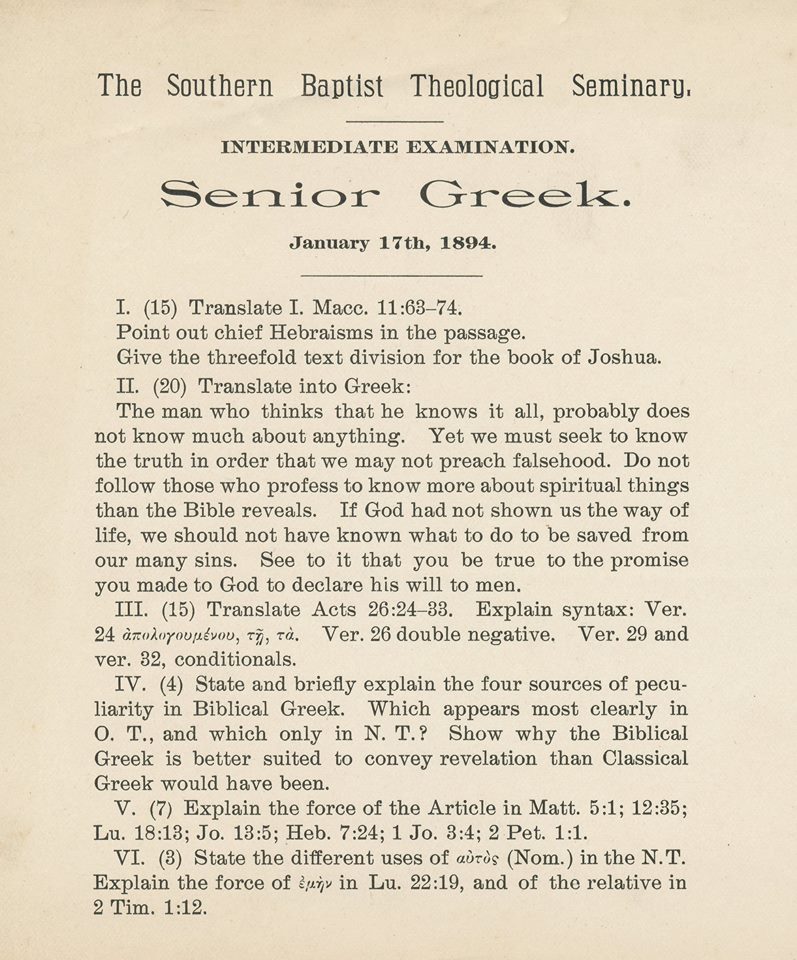
Finally, check out Jacob Cerone’s post of a Greek exam given in the late 19th century by John Broadus and A. T. Robertson (pictured at the top of this post). He even takes part of it and posts his answers. Nice work, Jacob!

One last note–Rod Decker passed away this last month. Read a note from his family here. I’ve found his Koine Greek Reader and Septuagint-related vocabulary lists quite helpful. He will be missed.

Did I miss anything? Feel free to post an LXX-related link in the comments. Until next time!

Free Download of New Mac OS X Yosemite (Beta)

OS X Yosemite

Today Apple announced its new OS X update, Yosemite, to be released this fall. They have also offered free access to the beta version, which is available not only to developers but also to others.

Check out more about Yosemite at the Apple site here, from which the above screen capture comes. The full press release is here.

More information about the Beta Seed Program is here. Here’s what you’ll see once you sign up:

OS X Yosemite Beta

As with any beta testing, there are caveats to consider, but those who want access to the new OS this summer can check it out:

To join the OS X Beta Program, just sign up using your Apple ID. When the beta software is ready, you’ll receive a redemption code that will allow you to download and install OS X Yosemite Beta from the Mac App Store. Then go ahead and start using it. When you come across an issue that needs addressing, report it directly to Apple with the built-in Feedback Assistant application.

Sunday School That Really Excels, Reviewed

Any undertaking by the body of Christ for the cause of Christ should be done with excellence. Our Lord and Savior deserves the very best from his redeemed people. Therefore, the church of Jesus Christ ought to excel.

So writes Allan Taylor, the Minister of Education at First Baptist Church in Woodstock, GA, in the Foreword to Sunday School That Really Excels: Real Life Examples of Churches with Healthy Sunday Schools.

Both Prescriptive and Descriptive

The book is both prescriptive and descriptive. It aims to (prescriptively) suggest how a church’s Sunday School can excel by (descriptively) offering case studies and anecdotes from churches.

The book begins with the chapter, “The State of Sunday School Today,” in which editor and author Steve R. Parr interviews Dr. Thom Rainer. Thankfully there is an early and concise definition of “Sunday school” offered in that chapter: it “consists of Bible study groups for all ages that ordinarily meet on Sunday mornings in conjunction with a worship experience either before or aftewards.”

Rainer notes three key features that successful Sunday school programs should have:

  1. The lead pastor’s support.
  2. “A strong core of lay leaders” that receive solid training.
  3. A sense of Sunday school as “a hero of the church.”

Following the helpful wisdom of Rainer, the next 14 chapters note some specific settings and ways in which Sunday school programs should and do excel. These range from Sunday school that “Excels in the Middle of Nowhere” to Sunday school that “Excels on the Heels of a Crisis,” and more. Contributors generally reinforce Rainer’s assessment of what is needed for a robust Sunday school.

Sun School that Really ExelsThe last two chapters offer a few more short case studies and some general concluding principles for how to help move a Sunday school program forward.

Initial Observations

The case studies come predominantly (but not exclusively) from Baptist churches in the South. So ministers in other traditions may need to do some cultural adaptation in seeking to implement some of what’s recommended here. The more than dozen contributors are all male, and almost all “white.” (Southern) Baptist Sunday School That Really Excels, As Told By Mostly White Males would have been a more accurate title. (No snark intended–I had just expected more diversity of background and perspective.)

All the same, there are plenty of inspiring stories and recommendations for building healthy Sunday schools. Whether it’s the call to make sure a church has clarified the purpose of their Sunday school, or specific suggestions as to how to teach with various learning styles in mind (Ken Coley’s chapter 15–probably the best chapter), anyone reading this book will find herself or himself making a running to-do list as they read. (This is what I did.) The anecdotes from various churches were at times inspiring.

Some Lacks and Disagreements

There wasn’t much about Sunday school for young children or youth, something I had hoped this book would include. And there is what I consider to be some unsound (maybe even dangerous?) missions advice in one chapter about a Sunday school program’s effort to reach out to families at a local trailer park: “They need to see the church as a place where we will help you even if you hate us for doing it.” Good intentions, for sure, but probably bad advice as so-called development efforts go.

And I found it hard to believe that some of the evangelism efforts described would actually have positive long-term results. One contributor (whose chapter seems not to relate much to Sunday school, per se) suggests “Accountability Evangelism,” practiced by a pastor who “planned to reach the lost friends of his members” by asking “everyone to invite a neighbor to the new building and get their friend to promise attendance by filling out a ‘Yes’ card. Their signature and ‘Yes’ indicated they would be present.”

That’s: get the potential visitor (not the church member) to fill out a “Yes” card.

No doubt–God can and does choose to bless efforts of every stripe, even misguided ones. And I want to be reluctant to criticize another Christian’s evangelism efforts, but the approach described above, which also refers to said neighbors as “prospects,” just strikes me as odd, off-putting, and counter-productive.

While Sunday School That Really Excels does describe “growth” in terms of spiritual depth, the underlying assumption seems to be that healthy and excelling Sunday schools are growing numerically–and exponentially is even better. I won’t engage that presupposition at length here, but it passes as a critically unexamined axiom in this book that I don’t think is always true. I.e., “bigger” is not always and necessarily “better.”

Finally, I was surprised that none of the contributors addressed theories of culture change. To help a languishing Sunday school to excel could require a re-orientation and re-creation of the culture surrounding Sunday school. Programmatic fixes may not be enough. I’d have liked to see part of the book address how pastors and ministry leaders can help a church to navigate the change process itself, keeping systems and culture in mind.

Conclusion

So I found some things lacking and a lot to disagree with here, some of which I thought was unsound in a prescriptive sense, even if it had worked in a church in a descriptive sense.

But there were some helpful ideas and reminders to me of things I as a pastor can be contributing in my own church’s setting, as we seek to have a healthy and thriving Sunday school program. For that I’m grateful, even if on the balance I might not recommend the book as a great read for someone seeking to help a Sunday school truly excel.

If you want to see more, there is a pdf excerpt here, including Table of Contents, list of contributors, introduction, and chapter 1.

Thanks to Kregel for the review copy, offered with no expectation as to the content of this review. Find the book on Amazon here (affiliate link), or through Kregel here.

Free in Logos: Brueggemann on the Psalms

Free Brueggemann on Psalms

I was checking to see what Fortress Press books Logos was offering, when I saw–to my very pleasant surprise–that they are offering Walter Brueggemann’s Spirituality of the Psalms for free. You can get it by clicking the image above.

I’ll be preaching through some Psalms this summer, so will be glad to have this short volume at hand. I’ll also be reviewing it from a print edition from Fortress, so keep an eye out for that in the coming months, too.

Just a Few More Days of 40% Off at Wipf and Stock

Reading Bonhoeffer

A reminder: Wipf and Stock Publishers is offering Words on the Word readers 40% off anything in their online store through the month of May. Just use the coupon code LETTERS at checkout. Last week I reviewed their Reading Bonhoeffer (pictured above). Here are a couple of ideas of books you could get from them.

Translating Jude Clause by Clause

Translating Jude Clause by Clause

It’s been fun to watch the Baylor Handbook series progress, with volumes on both the Hebrew Text and the Greek Text. Not only do we who are currently engaged in Hebrew and Greek reading have amazing technological tools at our fingertips, but there are also series like Baylor’s that focus specifically on the original languages.

Herbert W. Bateman IV inaugurates a new series of his own, via his Cyber-Center for Biblical Studies, with Translating Jude Clause by Clause: An Exegetical Guide. More volumes of these EBooks for Translating the New Testament have been projected to release in 2014 and 2015.

Jude is a difficult book. It receives far less teaching and preaching attention than most New Testament books. It has clear references to “apocryphal” literature, about which Protestants, in discussions on canonicity, seem to feel compelled to say, “Jude is not citing such as Scripture.”

And the Greek is tough. Paul’s letters are easier! In Jude’s 25 verses, there are more than a dozen hapax legomena (words that occur only once in a body of literature, here understood as the New Testament). Because words are best defined by their context and usage, this doesn’t give the student of the New Testament much to go by for understanding these words.

So a guide to Jude’s Greek text is welcomed by anyone who wants to work through that book. In this post I review Bateman’s Translating Jude. I was eager to receive and work my way through the book, since I found Bateman’s Charts on the Book of Hebrews to be “a top-notch resource for an important biblical book.”

What Is Translating Jude Clause by Clause?

There are three primary sections in Translating Jude Clause by Clause:

  1. Introduction
  2. Clausal Outlines for Translation
  3. Clausal Outlines Translated and Syntax Explained

1. Introduction. Bateman’s first section packs a punch. After I reading it I felt very well set up to begin working my way through Jude’s Greek. In the introduction Bateman explains the layout of his uniquely structured book, includes a substantive section on independent clauses (of three types) vs. dependent clauses (of four types), and suggests “Tips for Translating Jude.” That last section explores some unique characteristics of Jude’s style, such as his frequent use of participles, long sentences, and parallel constructions (among other features).

2. Clausal Outlines for Translation. Here is where the reader will do the work of translating Jude. Bateman understands Jude as consisting of five main sections (vv. 1-2, vv. 3-4, vv. 5-16, vv. 17-23, and vv. 24-25), which is then further broken down into nine total passages, according to which Translating Jude is set up.

In addition to the robust introduction to Jude, each section of the clausal outlines begins with Contextual Orientation to the passage, which I found to be the most consistently excellent part of Bateman’s work. It is “a summary statement based on Jude’s flow of thought in order to provide some contextual orientation to the Greek paragraph to be translated.” It delivers each time.

After that there is the Greek Text for Verbal Recognition, where Bateman reprints the Greek text of Jude so that readers can mark it up to identify the various verbs and verbal forms.

Then there is the Clausal Outline for Translating Jude. Here Bateman spaces out and appropriately indents the various clauses in a passage so that the reader can visualize the flow of Jude’s thought. There’s plenty of space to write in one’s own translation, too. Here is a screenshot from the sample pdf of the interactive edition (i.e., you can fill in the blanks by typing).

Translating Jude

3. Clausal Outlines Translated and Syntax Explained. The final section serves as a sort of answer key for the section above. Bateman shows the clausal structure of Jude again (with indentations), this time with his English translation below the Greek. His “Syntax Explained” offers explanation along the lines of “grammatical function, syntactical function, and semantical function.” Bateman often cites and points to other Greek grammars, which helps enable further study.

What I Found Helpful

The book is highly interactive throughout. Even in a static, print book, I often had the feeling that I was being coached through Jude by an experienced and knowledgeable Greek professor. For those who haven’t used clausal outlining, I recommend it! Bateman walks the reader through the method well.

I especially appreciated how much the third section went from grammatical observation to exegetical insight. For example, Bateman notes the use of a constative aorist in Jude 11. He concludes:

Jude alludes to the behavior of the godless as a whole or in a summary fashion. Thus the godless have made their bed and currently lie in it.

The introduction offered far more than I expected from a book of this length. In addition to the insights noted above, Bateman includes a number of grammatical summary charts in the introduction that I found myself referring to often as I worked my way through Jude.

What I Found Not as Helpful

The user of Translating Jude will have to overlook an unexpectedly large number of misprints and typos, as well as a couple of Greek errors. I found this to be a major distraction that detracted from what is otherwise a good book. Fortunately, I understand that future printings will include corrections. (And the electronic version of Translating Jude will be easy to correct and update.)

By about verse 8 or so of the “Syntax Explained” section, I started to experience the format of the translation notes as repetitive. Perhaps their predictability serves a value–e.g., a Greek verb receives a parsing, its lexical form is noted, there is a brief BDAG gloss, and then there are sentences beginning with, “Syntactically,” “Semantically,” and, “Thus,” each in turn. But something that felt a little less boilerplate would have been more engaging, at least to me personally. Others may not find it an issue.

Finally, simply because it seemed remarkable to me, I was surprised at Bateman’s proposal for understanding the “fault finders” and “grumblers” of verse 16: “two words that might be summed up into one: bitching. They bitch regularly.” It could be just my own sensitivities, but I think that word has enough potentially derogatory connotations (surely unintended here) that leaving it out of a commentary and suggesting another English word would have been better. I otherwise appreciated the English translations.

Concluding Evaluation

Of course one wants to know how Translating Jude compares to the Baylor Handbook on the Greek Text series, especially since Baylor has a volume by Peter H. Davids on II Peter and Jude (review forthcoming!). Davids does not aim to do what Bateman does in terms of clausal outlining and written-out reader translations–Bateman is more interactive in that sense. Davids is more thorough when it comes to explaining the Greek text. Bateman does note that his translation notes focus on verbs and verbals, but Davids has more detail overall, even in defining and explaining the usage of various verbs.

Bateman writes that Translating Jude “is not a commentary. It is a tool designed to help translate and visualize Jude’s train of thought.” With its emphasis on clausal outlines–and with how clearly they are presented and explained–the book succeeds in its aim.

Apart from my (hopefully constructive) criticisms noted in the section above, I’d recommend this book to students of Greek, especially any who have become over-reliant on using Bible software for parsing and translating. Anyone whose Greek or grammar is rusty will also benefit from the clear introduction to Translating Jude and its verse-by-verse explanations.

Thanks to the Cyber-Center for Biblical Studies for the review copy. Prof. Bateman’s other books are here. You can find Translating Jude Clause by Clause at Amazon here (affiliate link). A sample pdf of the book is here.

Preaching Needs to Be Exciting to the Preacher

Preaching in an Age of Distraction

Preaching in an Age of Distraction has really stuck with me since I finished reading it a few days ago. I’ll be turning back to its pages in the weeks and months to come to remind myself of some of its winsome insights into the preaching process. Here is one:

A preacher would do well to set up this inner standard: that every sermon will have in it some insight, some personal awe, some wonder of Scripture that is for him or her quite new—and therefore quite exciting. Obviously I’m not suggesting insights outside scriptural and doctrinal integrity; rather, I’m calling for insights that make the familiar idea come alive with a new glory, like a suit or dress that reveals a personality not formerly apparent in the wearer. The longer a preacher serves a given congregation, the more important it is that this kind of creativity mark the pulpit fare.

See my review of the book here. The above quotation can also be found in the press kit for the book (PDF), which contains a lengthy excerpt.

Preaching in an Age of Distraction

Preaching in an Age of Distraction

Any worship leader or preacher knows what it’s like to be distracted–either by something internally (himself or herself) or externally (something going on in the room).

“We live in the Age of Distraction,” says J. Ellsworth Kalas, Senior Professor of Homiletics at Asbury Theological Seminary, “and it seems to be accelerating.” Kalas notes that “the altar of the new” (a great turn of phrase) is constantly beckoning, but it is “a poor place to bow.”

Over the course of ten chapters, Kalas seeks to guide the preacher through distractions and distractedness, offering counsel as to how to prepare messages and preach to potentially distracted congregations.

The book started more slowly than I’d have liked. This could, of course, be a function of my own distractedness and lack of patience in reading. But there were more vague assertions than were helpful for building his case from the beginning, a trend which popped up again throughout the book. (E.g., “Sports have probably had a place in human life for as far back as we have any record” (ch. 2), and, “Surveys show that…” (ch. 4), and, “Some brain research indicates that…” (ch. 9), etc.)

Perhaps I was looking for more practical “take-aways.” And Kalas does give these as the book progresses.

However, at about chapter 3 or so, I realized that I was reading some reassuringly wise counsel. I received it as such. Kalas has generations of experience in preaching (and teaching about preaching). This allows him to see our current day in a fuller historical light. Distractions may change from generation to generation (TV vs. iPhone), but distractions themselves are not unique to the second decade of the 21st century. Kalas is worth quoting at some length here:

All of this reminds us that while the times have changed in some details–the sources of the distractions and the means by which those distractions are delivered–the pastor in his or her study has always been susceptible to distraction. Paul must surely have hoped that his guard would stop humming that first-century show tune. Bunyan no doubt had to deal with insects and assorted vermin as he thought his way through Pilgrim’s Progress. And who can guess the physical and emotional intrusions that assailed Dietrich Bonhoeffer day after day in his imprisonment!

There are significant recent changes to congregations, though. In chapter 3, “The Distracted Preacher,” Kalas notes that it “is no longer the world of our great-grandparents, where nearly all the people in the pews had the same occupation–say, dairy farming or working at the local factory–and essentially the same education.” Even if this overgeneralizes a bit, Kalas brings his point into focus by continuing, “Now the preacher looks out on vocations that did not exist a decade ago, let alone a century ago.” They are “more specialized.” Because no preacher can possibly “be a Renaissance person,” we preachers “must be highly discriminating in the knowledge we pursue.”

That itself is not a novel idea, but Kalas gives the preacher needed reminders (that we too often forget) like, “The Internet will take as much of our time as we allow it to have.” And to any preachers who may not think much about a pre-Internet world, Kalas suggests “reading across the centuries,” a practice he himself has obviously employed, as his book passes on some of the wisdom of those he has read.

An underlying theme of the book is that the ones who follow after distractions (whether preacher or congregation, or both) are “expressing the longing of a restless heart.” Kalas writes, “[W]hat gets our attention gets us.” The challenge is that not all distractions are harmful, per se; some stimulate creativity and pull us out of ruts. How to discern the difference? Kalas suggests asking:

Does this [distraction or thought] incline me toward Christ or away from him? If I pursue this thought, what will it do to my mind and spirit?

and:

Will this “distraction” lead to more life or to less?

If there is an antidote (or “counterforce”) to the distractions that lead to less of life, it is “excellence.”  How Kalas teases this out makes the book worth pursuing. Canned illustrations are okay, he suggests, but even better is “the excitement that comes when an idea springs forth after the preacher has wrestled with the Scriptures until a light has come on in the soul.” With the Holy Spirit as guide, director, and inspirer, the pastor also needs to remember that “preaching is a relationship,” so deliberate relationship-building with the congregation necessarily precedes good preaching.

Are you burned out on preaching? Get this book. Kalas doesn’t say he set out to write for burned-out preachers, per se, but I can’t think of anything better for such a preacher to read.

Are you not burned out, but looking to take a step forward in your preparation or delivery? Kalas gives a slew of sage advice and some practical suggestions to pursue excellence.

Are you distracted or unsettled when you go to prepare a sermon? Kalas offers soul care, and in the midst of a distraction-filled life helps the preacher take a look inward, and an awe-filled look outward to God.

Thanks to InterVarsity Press for the review copy, given to me so I could write this review, but with no expectation as to my assessment of the book. Find Preaching in an Age of Distraction here (publisher’s page) or here (Amazon affiliate link).