How Jesus Used the Bible

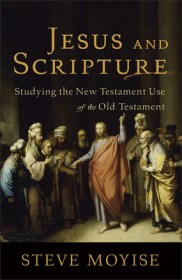
Jesus and Scripure by MoyiseI still wonder what language(s) Jesus spoke. I know, I know. Easy: Aramaic…right? And possibly also Hebrew when he quotes Scripture?

I’m becoming increasingly open to the idea, however, that Jesus–at least on occasion–taught in Greek. At any rate, it is true that the Gospel writers that quote Jesus do so in Greek. There is also the fascinating question of what text form(s) Jesus used when he quoted Scripture, which he did frequently.

Last week I finished reading Steve Moyise’s Jesus and Scripture: Studying the New Testament Use of the Old Testament. It’s part of his de facto trilogy by Baker Academic on the New Testament’s use of the Old Testament. (I reviewed the other two volumes here and here.)

How Moyise Approaches Jesus’ Use of Scripture

As Moyise sees it, the task of studying Jesus’ use of Scripture is two-fold:

First, we must study what each Gospel writer has to say about Jesus’ use of Scripture and seek to determine his method and purpose.

To do this, Moyise briefly (yet substantively) surveys how each Gospel writer presents Jesus’ use of Scripture. For each of Mark, Matthew, and Luke, Moyise analyzes Jesus’ quotations of “the law,” “the prophets,” and “the writings.” For John he treats “the four explicit quotations” and scriptural allusions.

Moyise goes on:

Second, if we are to understand Jesus’ use of Scripture we must engage in historical criticism to decide what Jesus must have said to give rise to the various accounts we find in the Gospels.

To this end Moyise looks at three categories of scholars:

  1. Those with “minimalist views” on Jesus and history: Geza Vermes, John Dominic Crossan, and Marcus Borg. They more or less “do not regard Mark as an accurate record of what Jesus said and did, which has implications for the accuracy of Matthew and Luke.”
  2. Those with “moderate views”: James Dunn and Tom (N.T.) Wright. The moderate view “accepts that real events lie behind the Gospel stories but believes that they have been embellished as each Gospel writer adapts the tradition to meet his readers’ needs.”
  3. Those with “maximalist views”: Charles Kimball and Richard (R.T.) France.” Jesus must have said all of the sayings and … each Gospel has been selective in what it records. …its strategy for dealing with differences between the Gospels is to seek harmony.”

Moyise lays out the issues in the synoptic Gospels and John clearly and succinctly. He raises as many questions as he answers, but this is a good thing. Reading Jesus and Scripture made we want to delve deeper into the topic at hand.

An Evaluation

While the volume is accessible, it does not oversimplify complexities where they exist. For example, after saying that Jesus’ Aramaic sayings “were translated into Greek, including his quotations from Scripture,” Moyise highlights the existence already of a Greek translation of the Hebrew Bible (the LXX). He goes on:

The important question this raises is whether, when the translators recognized that Jesus was quoting Scripture, they translated his words for themselves or availed themselves of the translation already in circulation.

Gray shaded boxes throughout the book offer concise information about topics such as: “The text of the LXX known to Matthew,” “Hillel’s seven exegetical rules,” “Critical editions of Q,” and more.

Especially helpful for further study is Appendix 1: “Index of Jesus’ quotations in the Gospels,” which is listed in Old Testament book order. The select bibliography is short but a good starting point, too.

Of the three “views” he describes, Moyise writes about helping “readers decide for themselves which reconstruction they find the most convincing.” He excels here–phrases like “many scholars believe” are coupled with a fair spelling out of others’ views of Jesus and what he said. His even-handedness helps readers get the lay of the land in Jesus studies.

Phrases like “what Jesus actually said” got to be a bit tiresome to me after a while. Perhaps my maximalism shows through here, but I’m just not sure how productive or advisable a quest it is to try to ascertain what Jesus really said. (And if we did, wouldn’t we have to go back to retroverted Aramaic?) This is in part due to Moyise’s own “moderate views,” but he certainly does not push for them over France’s “maximalist views,” for example, which he describes charitably and even favorably. The reader can decide for herself or himself.

Jesus and Scripture would be perfect for a seminary course on the Gospels, or on the NT use of the OT. An advanced undergrad course would also do well to adopt this book. I’d also recommend it to a serious Bible reader–no biblical languages are needed here, and I found that even with my own knowledge gaps in historical Jesus studies, Moyise explained everything I needed to know.

Though this survey is short (less than 150 pages), Moyise gives plenty of sample passages and insights that have challenged me. I know this is a book I will come back to and want to read again in the future.

Thank you to Baker Academic for providing me with a review copy of the book. See its product page at Baker here. You can find it on Amazon here.

Septuagint Studies Soirée #6, and this Saturday

It’s a day late (I blame the groundhog), but not a dollar short: Here’s the blogosphere’s only Septuagint Studies Soirée… this one is #6.

Some Important Dates

Add it to your iCal
Add it to your iCal

First things first: This Saturday (February 8) is International Septuagint Day. Read some Septuagint that day, if you can, in Greek or English. Why not read Tobit? Here’s why I think you need the Septuagint.

Looking back, Jim West celebrates Mogens Müller’s January 25 birthday, he (the latter) of First Bible of the Church renown.

Coming up, James Aitken (via FB) notes the following:

THE GRINFIELD LECTURES ON THE SEPTUAGINT 2013-14, University of Oxford

NICHOLAS DE LANGE
Emeritus Professor of Hebrew and Jewish Studies, Cambridge

‘Japheth in the Tents of Shem: Greek Bible translations in Medieval Judaism’

(First series)
Hilary Term 2014 (6th Week)

Monday 24 Feb.: ‘New light on an old question’
Venue: Examination Schools at 5.00 pm
Members of the public are welcome to attend

Tuesday 25 Feb.: ‘Aquila fragments from the Genizah’
Venue: Seminar in Jewish Studies in the Greco- Roman Period, Oriental Institute, 2.30 – 4.00 pm

Thursday 27 Feb.: ‘The Successors of Aquila’
Venue: Ioannou Centre, 5.00pm – 6.00 pm

And T. Michael Law notes an upcoming symposium on Isaiah and the Beginnings of Christian Theology.

God is Still Speaking (Greek)

TML book

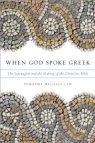
Didn’t get enough reviews of T. Michael Law’s When God Spoke Greek? Mosissimus Mose announces a review of the book in dialogic form. The first part is here, featuring Aaron White, W. Edward Glenny, and Christopher Fresch. They promise more dialogue in the future.

Law’s book made Michael F. Bird’s Top 5 for 2013.

More LXX Love on the Blogs

Suzanne at BLT has been writing about childshippe. I haven’t been able to fully digest it all, but given the preponderance of the word “son”/υἱός in the New Testament, I want to spend more time thinking through why so many translations opt for “son” when both male and female “children” seem to be in view. She writes more here and here.

Jim promises a review of de Gruyter’s Die Göttinger Septuaginta. And check out the Dust blog for a post called, “How much we take for granted, the publishing process and the Septuagint,” here.

Also, it wasn’t updated in January, but I just found out about what looks like a good LXX-related blog.

Did I miss anything? Feel free to leave more January 2014 LXX links of interest in the comments. And Happy (almost) International Septuagint Day!

One Way to Improve Your Biblical Hebrew Is…

…to beef up your knowledge of vocabulary in the Hebrew Bible. But reading through the detailed instructions on building the tabernacle (Exodus 26 and following) can feel like too much of a vocab stretch. It seems like every other word is a rare one. Using an alphabetically organized lexicon for such passages really slows down the reading. Also, readers who have a way to gauge how common a word is can decide if they should know it or not.

Back in Print

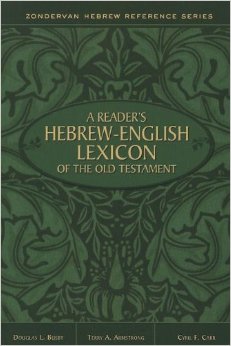
Readers Hebrew English LexiconA resource that has been out of print for some time is now back and available in a (cheaper) paperback edition. Zondervan’s Reader’s Hebrew-English Lexicon of the Old Testament offers verse-by-verse glosses (short translation equivalents) for rarely occurring words in the Hebrew Bible. The glosses are based on the Brown/Driver/Briggs (BDB) lexicon, with the context of each verse also taken into account. Organized in canonical order and covering the whole Old Testament, the lexicon lists each word that occurs 50 times or less in the Old Testament. Next to the word is the gloss and how many times that word appears in (a) a given book and (b) the whole Hebrew Bible. Each entry also has the page number in BDB, if you want to consult that additional work for a longer definition of a word. For verbs, the number of occurrences of that particular stem is also noted.

The lexicon follows the order of books that the Hebrew Bible does (i.e., the ordering differs from English Bibles). Only numbers and proper nouns are not included. The lexicon clocks in at 720 pages. It’s not as portable as when this single work was split into four volumes, but those are as hard to find as the four-volumes-in-one hardback had been. A Reader’s Hebrew-English Lexicon is intended to be a sort of counterpart to Kubo’s Greek lexicon by Zondervan. Here’s what it looks like:

HebrewI often struggle to remember Hebrew words that occur between 50 and 100 times in the OT, so the additional appendix is especially useful–it has Hebrew words that occur more than 50 times. There is also an Aramaic appendix.

How I Use It, Why I Like It

I’ve used this reader’s lexicon in tandem with Zondervan’s nicely laid out  “reader’s” edition of the Hebrew Bible. Though that Bible already footnotes rarely occurring words, the frequency counts in this lexicon help me know if it’s a word I should have known (e.g., one that occurs 45 times) or one I shouldn’t be surprised to not know (e.g., one that occurs three times).

The glosses are sufficient for rapid reading of the text. And the frequency counts add a nice orienting element not found in the reader’s Bible.

This edition is a reprint, so nothing has been re-formatted or changed in terms of the font. The font, while not always crisp on every page, is readable, both in Hebrew and English.

Yes, there are good Bible software options for reading the text, but I still like to read through the Hebrew Bible in print, and this reader’s lexicon makes for a convenient and trustworthy guide. For bettering one’s Hebrew vocabulary and reading, I heartily recommend it.

Thanks to Zondervan for the review copy of the lexicon. Its product page is here. It’s here on Amazon.

A $5 Electronic Septuagint (and other sundry items)

Olive Tree logo

Olive Tree is offering a three-day sale on 200+ items. Among them is a $4.99 New English Translation of the Septuagint (NETS). Lots of commentary series and sets are deeply discounted, some half off. The Archaeological Study Bible notes (with full color images) are $9.99.

You can find more details here.

If you’re curious about Olive Tree or have never used it, find my reviews here.

Before you preach a book of the Bible…

Preaching the NT

Some good advice here: before you preach a book of the Bible, try to live “inside” it first.

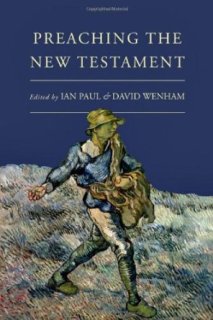
In line with the way one ought to prepare to preach any book of the Bible, the preacher needs to live inside a Gospel for a while before trying to preach any part of it. Reading it through at a single setting, several times, is a great way to begin; for those who have the training, working carefully through the text in Greek during preceding months will prove personally rewarding and homiletically enriching.

–D.A. Carson, “Preaching the Gospels,” in Preaching the New Testament (IVP Academic, 2013)

So far the above collection of essays is well-written and helpful. I’ll post more about it in the coming weeks and months.

What are the best Old Testament commentaries to get?

OT Commentary Survey

This is a meta-review of sorts: a review of a book that briefly reviews commentaries for each book of the Old Testament. I.e., here are some words on some words on some words on the Word.

Here is the publisher’s book description:

Leading Old Testament scholar Tremper Longman III provides students and pastors with expert guidance on choosing a commentary for any book of the Old Testament. The fifth edition has been updated to assess the most recently published commentaries, providing evaluative comments. Longman lists a number of works available for each book of the Old Testament, gives a brief indication of their emphases and viewpoints, and evaluates them. The result is a balanced, sensible guide for those who preach and teach the Old Testament and need help in choosing the best tools.

It’s a recurring question: What are the best Old Testament commentaries to get? To help answer that question, Longman rates an impressive host of commentaries on a 1-to-5 star scale:

One or two stars indicate that the commentary is inferior or deficient, and I discourage its purchase. Four or five stars is a high mark. Three, obviously, means a commentary is good but not great. I also use half stars in order to refine the system of evaluation.

One nice touch in this book is that all of the five-star commentaries are separately listed in an appendix in the back. Students or pastors looking to build a library might start there. Before turning to commentaries on individual books of the Bible, Longman briefly reviews one-volume commentaries (though this one is absent) and “commentary sets and series.” In addition to the stars, Longman notes whether a book is better suited for a layperson (L), minister/seminary student (M), or scholar (S), or some combination of those three.

To have a rating system is good, but there are some odd ways in which it is applied. One unlucky book got “no stars” on what the 1-to-5 star scale. And the comments (a paragraph’s length) under each commentary don’t always seem to match the rating. For example, a commentary on 1 Chronicles that has “a very helpful discussion of all aspects of the book” and other positive evaluation from Longman receives only 2.5 stars. A Genesis commentary whose author “shows great exegetical skill and theological insight” then receives 1.5 stars. As does another whose author “is insightful and knowledgeable.” One series receives four stars as a whole, but one of the individual commentaries that is “definitely one of the best volumes in the series thus far” receives just three.

There are also some things that were missed in updating the 2007 fourth edition to this 2013 fifth edition. The Berit Olam series was “just under way” in the fourth edition, and is so here, too. The New American Commentary series in both 2007 and 2013 editions is “relatively new,” even though it has a number of volumes published in the early 1990s. In the Proverbs section, Fox’s Anchor commentary still only consists of volume 1 (“Hopefully, we will not have to wait too long for the rest of the commentary to appear”), even though volume 2 was published in 2009. And there is also no mention of the Baylor Handbook on the Hebrew Text series, which had five volumes published by the time of this new edition of Longman’s work. Also, especially with the proliferation of commentaries now available through Bible software, an appendix covering electronic books would have been nice.

As far as his written evaluation of the commentaries, Longman is especially favorable toward Old Testament commentaries that discuss how a given passage is used in the New Testament. It’s not clear to me that–even for a Christian–this would be a requirement for a good Old Testament commentary, but I see his point, and am disposed to at least somewhat agree. He writes:

I continue to hope that future commentaries produced for use by Christian pastors in the church would include more reflection on how the Old Testament message is appropriated by the New Testament.

But, in my opinion, this criterion is perhaps over-applied, resulting in ratings penalties for what are otherwise strong commentaries, including ones that may have never set out in the first place to discuss the NT use of the OT.

One final critique: though there are not many commentaries on the Septuagint text of the Old Testament, a few series have begun. I can’t totally fault Longman for not having any Septuagint commentaries here, but I had hoped that the few that have been published might have been noted. I think also of John William Wevers’s Notes on the Greek Text series, which covers the Pentateuch.

Longman’s aim is for “this commentary survey [to] help students of the Bible choose the commentaries that are right for them,” and in that he is mostly successful. For example, he lets the reader know which commentaries date a given prophet according to “critical” or “evangelical” interpretations (I’m oversimplifying a bit here). He has helpful comments like, “If you get only one commentary on Joel, this should be it.” I finished this book feeling like I had a general lay of the land of Old Testament commentaries.

Despite a sometimes quirky or inconsistent rating system, and despite what appears to be a not really thoroughly updated volume, Old Testament Commentary Survey is unique, and one I already consult and will continue to consult whenever considering commentaries on a given Old Testament book. I just know I’ll have to supplement it with my own research and with seeking recommendations from others. The book works especially well as an introductory checklist that one can use as she or he is building a library of commentaries.

A sample pdf of the book, including introductory material and Longman’s take on one-volume commentaries and various commentary sets, can be found here.

Many thanks to Baker Academic for the review copy of OT Commentary Survey. You can find it here (Baker Academic) and here (Amazon).

N.T. Wright on My Computer

Wright for Everyone

I have been benefiting lately from the wisdom of N.T. Wright. His For Everyone series now covers every book of the New Testament, with each passage being preceded by Wright’s own translation of Scripture.

I describe the series here. And here I review the Luke volume in further detail. In this post I’ll review the usefulness of the series in Logos Bible Software, both on an iPad and on a computer.

Logos syncs automatically across multiple devices and platforms. Its iOS app for iPad is one of the apps I use the most. It’s just recently received a nice makeover. It looks like this:

(click image to enlarge)
Library view

Here’s how I set up Wright in the app. You can sync the two windows of the app so that they move together, passage-by-passage. I.e., if I advance the Bible text in the top window, the commentary at the bottom follows.

(click image to enlarge)
Reading Wright on iOS

You’ll also note that you can highlight as needed, which then shows up in Logos on any other device, almost instantaneously. The pop-up is a note I took (“Even if we know what’s coming, we’re surprised”) on this section of Wright’s commentary. Notes also sync automatically.

You could also view the Passage Guide for a given portion of Scripture and see all of your commentaries and resources (which would include Wright, in this case) with information on the passage to be studied. The Passage Guide stays open at the top while the bottom window cycles through various commentaries as you tap the selection in the Passage Guide.

The desktop/laptop version of Logos offers even more options for using Wright side-by-side with other resources:

(click image to enlarge)

The little “C” at the bottom left of each of the book images shows that I’ve linked resources together, so that they scroll in tandem. In the above, I can work through English and Greek texts, with Logos’s clausal outlines and Wright’s commentary all open. The other tabs to the left and right of Matthew for Everyone are other commentaries to consult. I have all of the above saved as a workspace called “Preach Matt,” to which I can come back at any time.

One feature I appreciate is that if I type “John 1:1” into the search window of one of the Bible texts, the N.T. Wright window automatically goes to Wright’s commentary on John, even though it’s a different book in the set. And you can see that my highlight and note from iOS automatically came over to this version.

In general I find Accordance commentaries a little easier and quicker to search with their specific content fields (where you can search by reference, by English content, by Greek content, etc.). But the command (or control) + F search box gets the job done just fine in these commentaries. (For more on searches and content fields, see the discussion on the Logos forums here.)

I write more in depth about using Logos for a commentary series here. I’ve found Logos to be more responsive on a PC laptop (and it seems to index less) than on a Mac laptop.

Whether it’s through iOS or at a computer, I recommend N.T. Wright’s companionship through the Bible. The print volumes, of course, do just fine, but the Logos edition of Wright’s commentary set has some nice features that enhance study of the New Testament and use of the For Everyone series.

Thanks to Logos Bible Software for the review copy of New Testament for Everyone (16 vols. here; 2 vols. upgrade here). You can find my other Logos reviews here.

A six-year-old and three-year-old bake a cake for Martin Luther King

Happy Birthday, MLK!

My six-year-old suggested over the weekend that we make a birthday cake for Martin Luther King, Jr.

So today, while our 1.5-year-old slept, my wife and I and two sons all went into the kitchen together. We made a carrot cake. (The part of the cake that is not frosted is because of the lactose intolerance of our littlest one.)

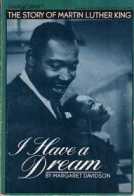
MLK bookWe’ve also been reading a short biography of King to our six-year-old, which is geared toward children. You can find it here. In that story, Martin was also six years old when he knocked on the door of some neighbor friends (where he had gone many times), only to hear the mom say:

It was all right for you to play together when you were younger. But now you’re all in school. So it’s best that you go your own different ways.

Martin quietly asked, “Why?” “Because you’re colored and we’re white,” the mom said, after which she shut the door.

It’s been interesting talking with our oldest son about MLK (and he learned about him in his kindergarten class at school, too). It can be hard to gauge how much a child is absorbing in such conversations, but I’m encouraged that his primary response to learning about Dr. King’s life has been a desire to celebrate him. We even sang “Happy Birthday” tonight.

Happy Birthday, Dr. King! We’ll bake you another cake next year.

Teach the Text: Luke by R.T. France

R.T. France
R.T. France

I’ve always had a hard time answering who my “favorite author” was (how could I pick just one?), but when it comes to people who have written about the Bible, R.T. France is definitely in the top three. I found myself moved to tears several times when reading through his highly technical (read: supposed to be dry) commentary on Mark.

So I was thrilled when I learned that Baker’s Teach the Text Commentary Series (TTT) had R.T. France as the author of its Luke volume. France died in February 2012, so to have this posthumous work of his is a real treat–especially since he already has a major commentary on Matthew and one on Mark. This rounds out France’s writing on the Synoptic Gospels.

So far the TTT series is a strong entry into the already highly populated world of commentaries. I reviewed the Romans volume here. Baker has a fantastic series Website here with plenty of information, videos, and samples from the series.

How France Teaches Luke

France divides the 24 chapters of Luke into 65 text units (or passages), each of which receives six pages of commentary. It breaks down in this way: 

“Big Idea” at the beginning of each commentary passage.This is a short Tweet-length summary of the passage. For example, the Big Idea for Luke 1:57-80 (“The Birth of John”) is: “Both the extraordinary circumstances of his birth and his father’s inspired utterance testify to John’s pivotal role in the plan of salvation.”

A “Key Themes” sidebar. This is a set of bullet points that gives the highlights of each passage.

“Understanding the Text.” Here France offers:

  • The Text in Context (one of his real gifts is a sense of always knowing the larger literary context, and reminding the reader of it)
  • Outline/Structure
  • Historical and Cultural Background
  • Verse-by-verse Interpretive Insights
  • Theological Insights

France is especially adept in the Theological Insights section. He is reliable, creative, and faithful to the text. His experience as both scholar and pastor seems to have helped here.

“Teaching the Text.” France offers specific suggestions for how the preacher might approach the sermon on each text.

“Illustrating the Text.” Whether it’s a personal story, someone else’s anecdote, history, literature, film, or art, France gives ideas for how the preacher or teacher can illustrate the message.

France’s introduction to Luke is a mere seven pages (which includes commentary on Luke 1:1-4), but his awareness of literary and biblical context throughout the book offers what one might otherwise miss by way of introductory matters.

How France Treats a Passage (Luke 17:1-19)

Luke by FranceTo explore a sample passage more in depth, France combines Luke 17:1-19 into one passage, on which he spends the requisite six pages. The decision to treat Luke 17:1-19 as a single passage limits how much he can offer, and occasionally the reader will experience the results of such space limitations in TTT. (This is part of the purpose of the series, though, and is perhaps just indicative of my desire for more France.) Luke 17:1-10 (itself consisting of “four separate units of teaching”) and 17:11-19 probably ought to be treated as two separate passages–the Revised Common Lectionary, among other places, does.

His “Big Idea” in this section (“True discipleship cannot be undertaken causally; the service of God demands all that we can bring to it”) is more relevant to vv. 1-10 than it is to vv. 11-19.  (By contrast, this similarly-targeted Luke commentary has, “Faith recognizes Jesus as the source of healing and expresses itself in gratitude and praise to him,” for vv. 11-19.)

Even so, France has this good insight to offer on verse 19:

This formula [‘your faith has made you well’] is often a ‘performative utterance,’ but not here, since the cure of the ten has already taken place, all of them presumably through similar ‘faith.’ But this man’s overt praise of God is evidence of a spiritual health that Jews would not expect to find in a Samaritan.

And his “Teaching the Text” portion does suggest ways to preach from vv. 1-10 and vv. 11-19 as separate passages. On the latter he writes:

France on Luke 17_1France on Luke 17_2

In “Illustrating the Text” France moves between a 1962 film (Days of Wine and Roses, about leading another into alcoholism), a personal anecdote on forgiveness by Cardinal Bernardin, and a quotation by author Lewis B. Smedes on gratitude and happiness.

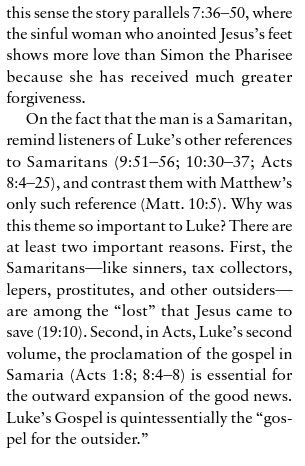
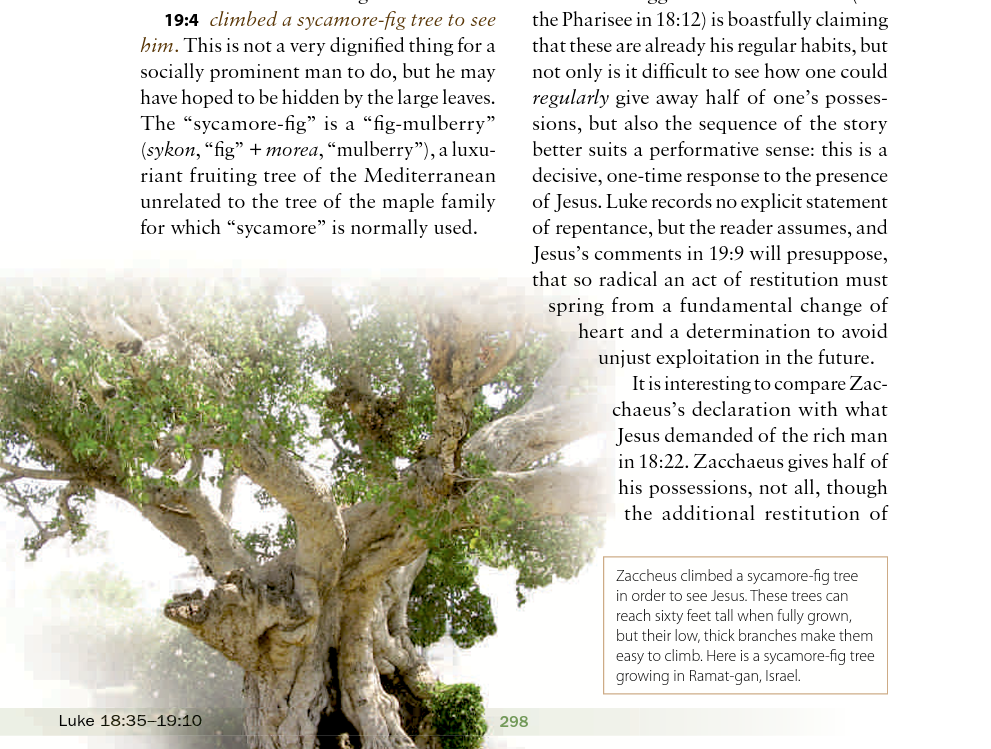
As with the Romans Teach the Text volume, the illustrations throughout help the reader better envision what’s going on in the biblical text. Here’s a portion from the passage that describes Zacchaeus’s encounter with Jesus:

Zacchaeus's Sycamore Tree
Zacchaeus’s Sycamore Tree

An added bonus is the high quality of the book materials. The hardcover looks pretty indestructible, the binding is sewn, and the pages are thick and glossy (but not too glossy to accept notes from a writing utensil). The full-color pages throughout are a nice touch, too. Translation: this commentary will make it through multiple series and preaching cycles on Luke. I’ve even been able to use it recently as I preach through Matthew, consulting the parallel passages here.

There are already five TTT volumes available, with more on the way. If the quality of this series continue to match that of France and Pate (Romans), I’ll want to keep consulting this series, and other preachers and teachers will want to, as well.

Thanks to Baker Publishing for the review copy of Luke. Its Baker product page is here, and it is for sale at Amazon here.

NICOT in Olive Tree, reviewed

NICOT in Olive TreeAsk a group of pastors, seminarians, professors, or serious Bible readers, “What one commentary series on the Old Testament would you most recommend?” and you’re likely to hear: “NICOT.” Eerdmans’ New International Commentary on the Old Testament blends scholarship with application in a readable and engaging manner. Few, if any, commentary series are consistently this good throughout the series. And I don’t know of any other series that has such broad ecumenical appeal.

NICOT in Olive Tree has 23 volumes, spanning 26 biblical books. The bundle includes the 2010 volume on Hosea. The only volume currently in print that is not here is The Book of Judges, by Barry G. Webb (2012). (Judges is not available in any other Bible software at the moment.)

General editor Robert L. Hubbard Jr. writes of the series:

NICOT delicately balances “criticism” (i. e., the use of standard critical methodologies) with humble respect, admiration, and even affection for the biblical text. As an evangelical commentary, it pays particular attention to the textʼs literary features, theological themes, and implications for the life of faith today.

As I preached through Isaiah this past Advent, John N. Oswalt’s two volumes on that book were the first commentary I turned to after spending time with the biblical text. While it was always clear that Oswalt knew Isaiah and his milieu well, the author would find himself swept up at times in praise of the God Isaiah preached. On Isaiah 2:2, for instance, he writes:

What Isaiah was asserting was that one day it would become clear that the religion of Israel was the religion; that her God was the God. To say that his mountain would become the highest of all was a way of making that assertion in a figure which would be intelligible to people of that time.

NICOT IsaiahOn that passage’s promise of peace among nations, he concludes:

Until persons and nations have come to God to learn his ways and walk in them, peace is an illusion. This does not mean that the Church merely waits for the second coming to look for peace. But neither does it mean that the Church should promote peace talks before it seeks to bring the parties to a point where they will submit their needs to God.

Oswalt is representative of the authors in NICOT, in that he loves the text (and its grammar, history, and background) and loves the God who inspired it.

NICOT in Olive Tree has hyperlinks to biblical references and commentary footnotes, which you can easily and quickly view in the Bible Study (computer) app through the Quick Details corner (by hovering over the hyperlink), or as a pop-up window (which can then also pop out and keep your place in a separate window). It’s just as easy to tap a hyperlink in the mobile app.

There are two ways I’ve used NICOT so far.

1. I use NICOT as my starting point in the main window.

After some time in the biblical text, I have made my way through parts of NICOT by starting from the commentary. I can use hyperlinks to read the verses being commented on, as well as any other references. I can keep a Bible open in the split window and have it follow me along as I read through NICOT.

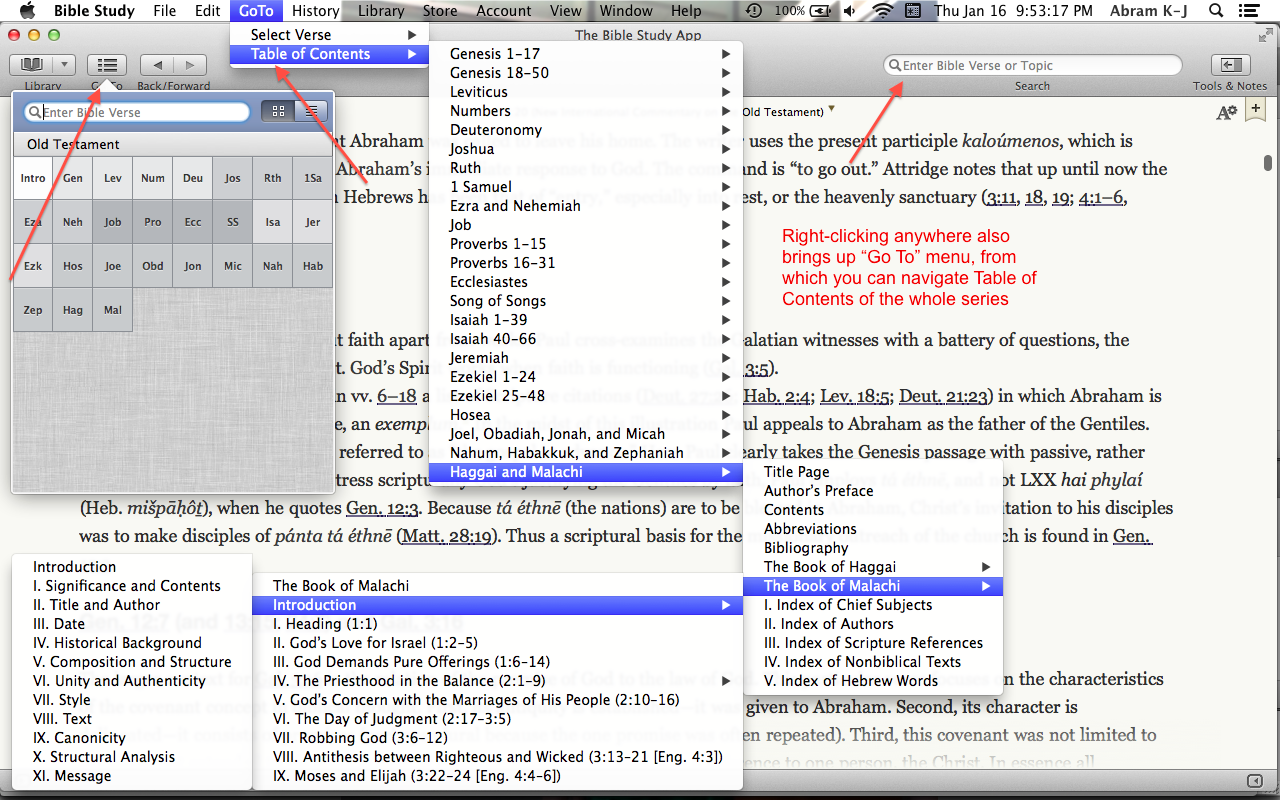
Using NICOT this way, there are quite a few ways to get around, both by looking up a verse in the commentary, and by navigating its Table of Contents. You only need to use one of these options at a time, but here they all are:

(click to enlarge image)

Note that from the Go To drop-down menu, I can keep following the sub-menus till I get to a specific place in the commentary (Introduction to Malachi in the instance above). One could also do this from the Go To item in the toolbar, which allows for both verse searching and Table of Contents navigation.

2. I use the Bible in the main window and NICOT as a supplement in the split window.

This has the advantage of letting me use NICOT as one among multiple resources in the Resource Guide, as shown (in part) here:

Resource Guide shows relevant library results (click to enlarge)

In both of the above setups you can take notes in NICOT, highlight, and bookmark your place. You can also do a search on a word or phrase in the commentary, with the results appearing almost instantaneously. One may wish, for example, to find all the times Oswalt refers to the “Suffering Servant” in Isaiah, which is an easy and fast search to run.

In reviewing Olive Tree I have found it to have the most versatile, smooth, and customizable Bible app I’ve seen on iOS. I write more about the Bible Study iOS app here. The fact that Olive Tree is cross-platform makes it appealing to many. Though the desktop app is well-designed, I would like to see a future update where you can create a saved workspace with multiple resources open in various tabs and windows. That, I think, would take the app to the next level.

But everything is here to help you work through NICOT in a way that you couldn’t in print. There are a couple of options (one free and one paid) for Hebrew Bibles, too, if you want to use NICOT in tandem with the original language. (NICOT uses transliterated Hebrew.)

NICOT volumes consistently top the charts of the Best Commentaries site. Preachers and professors, parishioners and pupils will all find much to mine here, as they seek to better understanding the Old Testament and to more faithfully love the God whose goodness its pages proclaim.

Thanks to Olive Tree for the New International Commentary on the Old Testament (NICOT), given to me for this blog review, offered without any expectations as to the content of the review. You can find the product here. For a little while longer, it’s $349.99 for the series, which is 50% off its regular price.