Here are a few blog posts from November, regarding the Septuagint, that are worth taking a look at:
J.K. Gayle considers the question of whether the Septuagint translator of the Hebrew Song of Songs might have been a woman, then raises some challenges inherent to that view, at least as it is presented by the NETS (see image at left). J.K. also offered insight into the possible motherliness of God and the patriarch Joseph. Suzanne responded here, preferring to talk about “wombly feelings” instead of “motherly” ones. Kurk writes back again, noting some “maternal” language (with help from Greek Isaiah) in the “Our Father.”
I’ve just this month learned of a blog called Old School Script, which focuses on linguistics and biblical languages. Check out as much as you can of that site, starting with an October post that I missed last month, “Word Order in Septuagint Judges.” Note also some extended exploration this past month about Paul’s use of the LXX. Said blog also pointed this month to Randall Buth’s thinking about an SBL session on the Greek perfect.
Also, this month Logos Bible Software released (for free) Codex Sinaiticus, includingits Septuagint portions.
Did I miss anything? Feel free to leave more November 2013 LXX links of interest in the comments. And in case you didn’t see it, the first Septuagint Studies Soirée is here; the second one is here; the third one is here.
One other thing to note–a reading group of nearly 200 folks on Facebook (and more who are not on Facebook) finished a reading plan last Friday through Greek Isaiah.
Let us now believe this. As we pray to be filled with the Spirit, let us not seek for the answer in our feelings. All spiritual blessings must be received, that is, accepted or taken in faith. Let me believe, the Father gives the Holy Spirit to His praying child. Even now, while I pray, I must say in faith: I have what I ask, the fullness of the Spirit is mine.
Let us continue steadfast in this faith. On the strength of God’s Word we know that we have what we ask. Let us, with thanksgiving that we have been heard, with thanksgiving for what we have received and taken and now hold as ours, continue steadfast in believing prayer that the blessing, which has already been given us, and which we hold in faith, may break through and fill our whole being. It is in such believing thanksgiving and prayer, that our soul opens up for the Spirit to take entire and undisturbed possession.
As a friend and I were geeking out over iPad mini cases lately, he recommended his to me. Since its arrival in my mailbox, I’ve rarely taken the mini out of this case. It’s got just the right combination of slim and sturdy for my tastes. It’s by INVELLOP, which I had never heard of. Here it is, closed, with no iPad mini in it:
The case closed, in landscape orientation
Here is what the inside looks like:
The inside of the case
The cutouts for earbuds, volume buttons, camera, etc. are all measured well. The material is “leatherette,” but smells fine and has held up well for the six or more weeks I’ve used it. The stitching is all still firmly in place. You can see in the above that the hard plastic back is connected to the front cover. When the screen flap closes, it puts the device to sleep; when it opens, it wakes it up. This function works just as it should (and is standard with these sorts of cases).
Here are a few more things I like about it:
This is the easiest time I’ve had holding my encased device with one hand–the case covers the device but does not extend past it much, so it’s low on bulk
The price on Amazon is at the moment $19.95, which is worth it for the quality
Good craftmanship
The screen flap is split into thirds so that you can set your iPad upright (in landscape mode) in two different positions (viewing or typing)
It has magnets that help the front cover snap even more securely onto the back case
The plastic back is stronger than other cases of this size
The inside’s microfiber has protected (and not scratched) the iPad
It’s easy to manipulate the front screen flap to take photo or video (it folds back quickly)
It’s thin and light, yet not at the expense of protecting a device (though I haven’t done a test drop)
There is really not much to critique. For the first few weeks the front cover didn’t lay flat very well. It still doesn’t lay flat perfectly, but that’s improved a good deal over time. And the magnets make sure the sleep/wake function isn’t compromised by this.
Most significantly, even though I’ve reviewed other iPad mini cases I could house my device in, this one is my go-to.
Thanks to INVELLOP for the review sample. The case reviewed above can be found at Amazon here. You can find my other iOS and gear reviews here.
Alas, the burden and the glory of preaching consist in proclaiming things that are not yet fully realized, but the hope for them holds a powerful grip upon the faithful imagination.
–Feasting on the Word
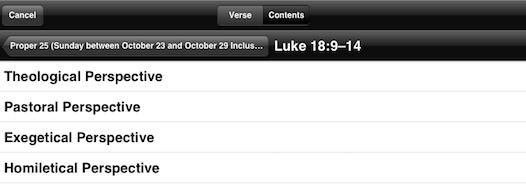
Here is a 12-volume commentary set that covers all the lectionary readings from multiple angles. Feasting on the Word offers four different “perspectives” (theological, pastoral, exegetical, and homiletical) for each lectionary passage in the weekly Revised Common Lectionary.
The 12 volumes cover the three-year lectionary cycle (A, B, and C), split into four volumes per year:
Advent through Transfiguration
Lent through Eastertide
Pentecost and Season after Pentecost 1 (Propers 3-16)
Season after Pentecost 2 (Propers 17—Reign of Christ)
The Scripture index makes it accessible to preachers who are not following the lectionary, too. From the Logos product page:
The editors and contributors to this series are world-class scholars, pastors, and writers representing a variety of denominations and traditions. And while the twelve volumes of the series will follow the pattern of the Revised Common Lectionary, each volume will contain an index of biblical passages so that non-lectionary preachers, as well as teachers and students, may make use of its contents.
Logos Bible Software has the full set in a format that is hyperlinked, laid out well, and easy to navigate by date or Scripture reference. Here’s the Table of Contents in the Logos iOS app for the current volume:
Table of Contents
Here’s how a given Sunday looks:
Four lectionary readings of Proper 25
And then each of the passages splits into the four “perspective” sections.
Four perspectives on Luke 18:9-14
Since being able to access Feasting on the Word, it’s actually jumped toward the beginning of my pile (or bytes) of resources that I consult when preaching. I try to pray through my preaching ideas from the text and in conversation with others before consulting commentaries, but the “Homiletical Perspective” (and the other sections, for that matter) do a good job of helping the preacher think about how to preach a text.
The Theological Perspective and Exegetical Perspective might be the best starting points in this commentary. Perhaps by design and due to the constraints of this resource, they are not as in-depth as you would find with a commentary on a given book of the Bible. But those two sections do show a general awareness of the major interpretive issues a preacher needs to be aware of.
The Pastoral Perspective differs from the Homiletical Perspective in that the former helps the preacher be aware of pitfalls and opportunities in preaching a text. For example, Stacey Simpson Duke offers the following pastoral suggestion on Isaiah 11:1-10 (which is the OT text for the 2nd Sunday of Advent in a couple of weeks):
Our fear for children’s safety and future is especially acute. Some in our congregations may have had the tragic experience of a child’s death; they may be particularly fragile when it comes to Isaiah’s images of vulnerable children living and playing in safety. That grief may not be confined to those who have suffered the loss of near ones. We are intimately acquainted with suffering children through heartbreaking images broadcast via the electronic media. This produces its own brand of grief. Isaiah’s word is for all, but the pastor must be sensitive to the grief in the room. Isaiah promises future security; how might this be a word of hope for those from whom security has already been stolen? Answers are not easy, but the pastor who wants to care for congregants in grief will want to wrestle with the question.
This has been the section of the commentary that I most consult.
I appreciate the overall depth and thoughtfulness of the series. This portion from the series introduction is apropos:
We also recognize that this new series appears in a post-9/11, post-Katrina world. For this reason, we provide no shortcuts for those committed to the proclamation of God’s Word. Among preachers, there are books known as “Monday books” because they need to be read thoughtfully at least a week ahead of time. There are also “Saturday books,” so called because they supply sermon ideas on short notice. The books in this series are not Saturday books. Our aim is to help preachers go deeper, not faster, in a world that is in need of saving words.
So far, I not only can recommend Feasting on the Word, but have begun drawing on it as a regular part of my preaching preparation each week. I’ll write more about the series in a future post.
Thanks to Logos Bible Software for the review copy of Feasting on the Word (12 vols.). Find it here. You can find my other Logos reviews here.
Where gospel difference is seen as a problem or weakness that calls for elaborate harmonization procedures or critical unmasking, the root cause is a dissatisfaction with canonical pluralism as such and a determination to reduce it to singularity. But that is to overlook the hermeneutical significance of the canon itself, which strives to integrate the voice of the individual witness into an encompassing polyphony. As an ancient tradition suggests in word and image, this evangelical polyphony echoes the song of the four living creatures around the divine throne.
I’m reviewing Watson’s book for an upcoming Bible Study Magazine issue. Watson’s comfort with the co-existence of history and theology–as if one could be devoid of the other in the case of gospel reception–is refreshing.
Reading through Isaiah, I’ve made connections between biblical texts that I never noticed before. I’ve posted about Philippians and Ephesians. Today I saw something in Isaiah 63:11 that seems to have inspired the author of Hebrews.
Isaiah 63:11
English: And the one who brought up from the landthe shepherd of the sheep remembered the days of eternity. Where is the one who put his holy spirit in them?
English: And the God of peace, who brought up from the deadthe great shepherd of the sheep, our Lord Jesus Christ, by the blood of the eternal covenant…
Though Hebrews has “great” in addition to “the shepherd of the sheep,” the latter phrase (τὸν ποιμένα τῶν προβάτωνin Greek) is identical in both passages.
The author of Hebrews seems to want to explicitly identify “the shepherd of the sheep” from Isaiah, which he/she does by noting that this “great” shepherd is “our Lord Jesus Christ.”
Did the author of Hebrews intend with “brought up from the dead” to echo Isaiah’s “brought up from the land”? The Greek verbs are different, but both have the ἀνα=up prefix, and both are in participial form.
If Hebrews’s bringing up is meant to evoke Isaiah’s bringing up, is Hebrews taking Isaiah’s exodus motif in Isaiah 63 and holding up Jesus as the leader of the new exodus?
Both passages have “eternity” (αἰώνιος) in view.
I haven’t checked commentaries yet, but after observing the above, I noticed that the critical apparatus (manuscript notes) in the Göttingen edition of the Septuagint notes that Hebrews 13:20 should be consulted.
I plan to see what others have written about this, but for now, the similarities above have me fairly convinced that this was a deliberate reference, and that the author of Hebrews was finding Jesus in Isaiah 63:11.
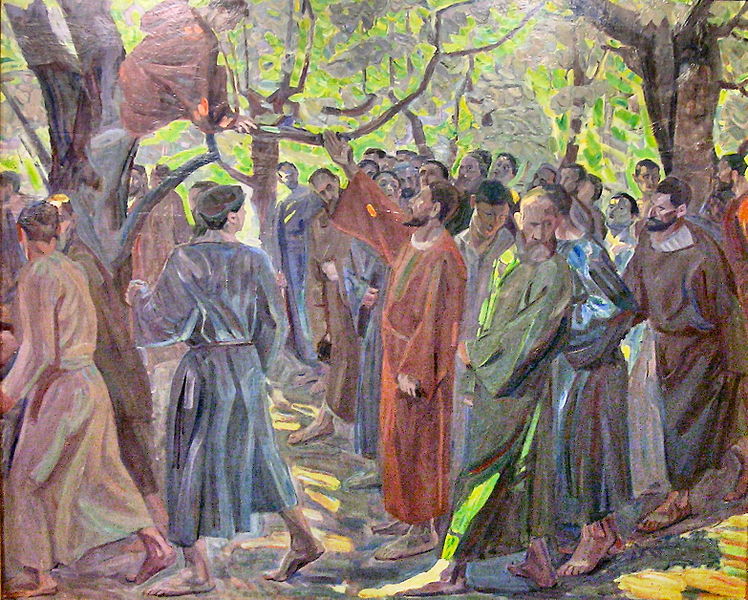
Even though Zacchaeus was “a wee little man”–he was not “wee” or “little” in terms of his financial standing.
Luke 19:1-2 Jesus entered Jericho and was passing through. A man was there by the name of Zacchaeus; he was a chief tax collector and was wealthy.
He was “a chief tax collector” and he “was wealthy.” Those two things are actually three strikes against Zacchaeus.
Strike one: He was a tax collector.
Tax collectors made out pretty well in Jesus’ day. They contracted with the Roman state to collect taxes from their fellow Jews. As long as the tax collectors paid the Romans a certain amount, they could charge whatever commission they wanted.
Strike two: He was a chief tax collector.
A chief tax collector oversaw other tax collectors. Zacchaeus had a prime position.
There was really little regulation here. This is sort of like pre-2008 subprime mortgage lending. Only it’s worse, because Zacchaeus as chief tax collector has a lot of other tax collectors doing the dirty work for him. And not only are they getting rich from people’s hard-earned cash, they’re even giving some of it to an imperial power–Rome. And who knows what non-kosher godlessness that money is going to!
Strike three: Zacchaeus was rich.
He was a tax collector, he was a chief tax collector, and he was rich. There’s nothing wrong with being rich, of course, but generally in Luke’s Gospel, the rich people Jesus meets have a hard time loving God on account of all their money.
Zacchaeus got rich off of other people’s money. Think: Ebenezer Scrooge.
As with the tax collector last week, the listeners expect this chief tax collector to be the antagonist.
So it’s no surprise in verse 3 when Zacchaeus can’t see Jesus. Sure, he’s short–probably not even 5 feet tall–but even if he were 6 feet tall, I’ll bet the crowd wouldn’t have made way for a guy like him.
Luke 19:3 He wanted to see who Jesus was, but being a short man he could not, because of the crowd.
Source: Adrienne Lavidor-Berman (Boston Globe)
These people are waiting to see Jesus! This is even more exciting than watching Big Papi and the Red Sox get on a duck boat! No way they’re going to make room for Zacchaeus.
The crowd blocks his line of sight. But Luke says he wanted to see Jesus. He seems to have these three strikes against him, but maybe this is a bit of character development here? Another translation says, “He wanted to see Jesus, who he was.”
He wants to figure out who Jesus is. He’s interested. He’s what church growth gurus in the 1980s and 90s referred to as “a seeker.”
The Motif of Urgency
Luke 19:4 So he ran ahead and climbed a sycamore-fig tree to see him, since Jesus was coming that way.
Zacchaeus runs ahead. He seems to be eager to see Jesus.
It wasn’t until I’d read this passage at least a dozen times and went for a long walk that I picked up on this motif of urgency.
The story picks up the pace at this point. Jesus is on his way to Jerusalem. He’s about to die. And rise again. He’s aware of what’s coming; his disciples are not, really.
But this is Jesus’ last face-to-face encounter till he gets to Jerusalem. So Luke as a writer is going to pack in as much as he can.
We’ve got lots of Luke’s themes here:
Wealth can keep you from God, or you can use it to worship him and serve others
Belief in God always leads to action and compassion for others
Jesus came to save the lost
God is a seeker, who goes after the ones he loves
In Luke this is a sort of final crescendo to close out this movement, before Jesus’ triumphal entry into Jerusalem, and then the events of Holy Week. All those themes are here, and Luke the storyteller notes that they are all important–urgently important.
verse 4: Zacchaeus runs ahead
verse 5: Jesus tells him to come down immediately…
verse 5 again: Jesus must stay at his house today
verse 6: Zacchaeus comes down at once
verse 8: Zacchaeus re-directs his giving and quits his cheating ways, and he metes out this retributive justice “here and now,” he says
“Today,” Jesus says in verse 9, “salvation has come to this house”
So keep that motif in mind as we work through the rest of the passage. Zacchaeus runs up the tree, and Jesus sees him.
Jesus Invites Himself Over
Luke 19:5b “Zacchaeus, come down immediately. I must stay at your house today.”
This culture valued hospitality, but there are still ways to do hospitality and ways not to do it. What you don’t do is invite yourself over to someone’s house. That’s still true today.
But Jesus has to–Jesus must–stay at his house. Forget the conventions of hospitality. Forget the conventions of not eating with unclean sinners. Forget that Zacchaeus was a traitor and that there were some in the crowd who just wanted Jesus to be Che Guevera and overthrow Rome.
How does Jesus know Zacchaeus’s name? Luke doesn’t tell us. Jesus other knew him through divine omniscience or through Zacchaeus’s reputation. But he’s got to get to Zacchaeus’s house.
Why? We’ll come to that in a bit.
Already we’re struck by Jesus’ offer of fellowship. His offer to fellowship with him is a standing offer, but as with Zacchaeus, it’s also an offer he wants us to take him up on right now. This very day. This very minute. Jesus wants to come to us, to enter the homes of our hearts and minds, and have communion with us.
God calls the ones he has made good. And when we go bad–as Zacchaeus did–he does not turn away from us, but continues to pursue us, and invite himself into our homes, our work, our daily routines, our lives.
Zacchaeus models a response to Jesus. He comes down with the same urgency Jesus had in calling him.
Luke 19:6 So he came down at once and welcomed him gladly.
He receives Jesus into his home as an esteemed guest. No delay. There’s not putting it off till another time. Zacchaeus comes down have fellowship with Jesus right now.
The people in the crowd don’t like this, of course.
Luke 19:7 All the people saw this and began to mutter, “He has gone to be the guest of a ‘sinner.’”
They grumble against Jesus. But haven’t they figured out by now that this is the sort of thing Jesus does? Have we learned that yet?
Zacchaeus’s Immediate Response
And then, more urgency:
Luke 19:8 But Zacchaeus stood up and said to the Lord, “Look, Lord! Here and now I give half of my possessions to the poor, and if I have cheated anybody out of anything, I will pay back four times the amount.”
Right now–on the spot, Zacchaeus pays it all back. Retributive justice, it’s called. He makes amends in a way that is appropriate to the crime. Redistribution of ill-gotten wealth was the only way for him to do this.
Saint Augustine once wrote of grace that it “is bestowed on us, not because we have done good works, but that we may be able to do them.”
This is another side of the coin when we consider last week’s tax collector and his uttered prayer. “God, have mercy on me, a sinner.” This prayer of faith made him right with God, Jesus said. Here, there is action, which always accompanies belief. Salvation has come, Jesus says, and that is evident because of what Zacchaeus is doing with his money.
He literally puts his money where his mouth is. His profession of faith is only truly complete as he acts on it. And he acts on it “here and now.”
He held his money loosely. He embodied that offertory prayer: “All things come from thee, O Lord, and of thine own have we given thee.”
Zacchaeus is going to lose a ton of money here–and think of all the logistics in making sure everyone gets repaid properly.
But no matter–he is eager to express his love toward God through his vocation and his giving.
Luke 19:9-10 Jesus said to him, “Today salvation has come to this house, because this man, too, is a son of Abraham. For the Son of Man came to seek and to save what was lost.”
Remember how Jesus said, “I must stay at your house today”? Or, as another translation puts it, “It is necessary” for Jesus to stay?
This is because Jesus’ fellowship with Zacchaeus was “mission-critical.” It was the core of Jesus’ mission to “seek and to save what was lost.” He’s doing that here. He has done that here. He sought Zacchaeus, and saved him– “Today salvation has come to this house.”
Zacchaeus did his part, of course–he climbed a tree, pledged to give back money he had extorted from people.
But Jesus is the ultimate initiator, I think. He could have passed by that tree… pretended not to see Zacchaeus.
The Prodigal Son Returns, Rembrandt
“The Son of Man [Jesus] came to seek and to save what was lost.”
The 1 sheep, lost and wandering away from the other 99. The 1 coin, lost on a dusty floor. The 1 son, lost in his youthful rebellion and waywardness. A despised chief tax collector. Prostitutes. People with diseases. Gentiles. You. Me. Jesus comes to seek and to get all of these.
Our Mission with Jesus
Jesus’ mission is “to seek and to save what was lost.”
This has now become the mission of the church, as the visible expression of Jesus’ body on earth.
Faith and action go hand in hand, as they did with Zacchaeus. For him, following Jesus necessarily entailed that he do all he could to bring about justice. The kingdom ethics of Jesus transformed the way he thought about his business relationships. It revolutionized the way he worked.
Zacchaeus responded to Jesus immediately. There was a sense of urgency in his desire to make things right before God.
And he responded to Jesus with joy.
May we be inspired by this unlikely hero. Zacchaeus allowed his whole life to be transformed by his encounter with Jesus, in the very moment of Christ’s coming to him. Salvation has come to our house today. Let’s receive him with joy.
The above is adapted from the sermon I preached this Sunday on Luke 19:1-10, covering the story of Zacchaeus’s encounter with Jesus. All Scripture quotations come from the NIV (1984). See my other sermons, if you desire, here.
Isaiah 1:1 reads, “The vision of Isaiah son of Amoz, which he saw concerning Judah and Jerusalem in the days of Uzziah, Jotham, Ahaz, and Hezekiah, kings of Judah” (NRSV).
Scholars remain divided as to whether or not this “vision of Isaiah” verse is meant to apply to all 66 chapters, or whether Isaiah might be the author of just the first 39 chapters, with other authors (in the tradition of Isaiah) having penned chapters 40-55 and 56-66.
I’ve long had my eye on The Eerdmans Companion to the Bible and have begun using it recently. Its introductory section to Isaiah had what I thought was a refreshingly balanced approach to the issue of authorship in Isaiah:
Taken as an introduction to the book as a whole, Isa. 1:1 identifies the contents of the subsequent 66 chapters as the “vision” of 8th–century Isaiah. But modern scholars have challenged the traditional view that considers him the source of all the material contained in the book that bears his name. Though chapters 40–66 echo certain themes contained in chapters 1–39, they also contain specific, predictive prophecies that some scholars doubt Isaiah foretold. For example, they consider it unlikely that an 8th–century prophet not only predicted the 6th–century Persian king Cyrus’s conquest of the Babylonian Empire but also named him specifically (see 44:28 and 45:1). Old Testament prophets normally directed their messages to contemporaries. For Isaiah to have directly addressed the Babylonian exiles (and perhaps returnees to Judah) pictured in chapters 40–66, his prophetic ministry would have to have extended well beyond the reign of Hezekiah (the last king mentioned in 1:1), and he would have to have lived for more than two centuries.
On the other hand, in this book God holds out his power to predict the future as proof of his divine supremacy (chs. 41, 44, 46, and 48). It is not unreasonable, therefore, to think that Isaiah mediated predictive messages as words from God and at times addressed audiences of future generations.
More details on this Bible guide are here at the Eerdmans page. I’m finding that it’s a concise yet substantive way to get myself oriented to a given book of the Bible.
Recently I’ve been paying more attention to the Dictionary of Classical Hebrew and its Concise counterpart (see here).
It took me a little while to figure out how to read the frequency stats in DCH/CDCH. So I’m posting this little tidbit here to save some folks a bit of time.
The introduction to the concise version of the lexicon reads:
2. Statistics. Next comes a notation of the number of occurrences of the word in each of the four corpora of ancient Hebrew: the Bible, Ben Sira, the Dead Sea Scrolls, and the Inscriptions. Thus the notation 334.5.13.32 means that the word occurs 334 times in the Bible, 5 times in Ben Sira, 13 times in the Dead Sea Scrolls and 32 times in the Hebrew Inscriptions. If there is only one number in the statistics, the word occurs only in the Hebrew Bible, and if the notation is, for example, 0.0.7, it means that it occurs only in the Dead Sea Scrolls, and that 7 times. In the case of verbs, occurrence statistics are also given for each of the voices (or, binyanim).
The entry for נתן has a frequency count of “2015.62.228.26.” That’s straightforward enough. But then with the entry for תרומה the frequency given is “76.2.18.” This means it occurs 76 times in the Bible, 2 in Ben Sira, 18 times in the DSS, and 0 times in the Inscriptions. Another entry that has “11.4″ means 11 times in the Bible, 4 times in Ben Sira, 0 in DSS and 0 in the Inscriptions.
What took me a little while to figure out is that some entries have counts like “376.0.1,” which means 376 occurrences in the Bible, 0 in Ben Sira, 1 in DSS, and 0 in the Inscriptions.
The 0s are not noted, then, if there is not still a number to come after it that is 1 or more. In other words, you’d have “376.0.1,” but never “376.1.0.0″ or even “376.1.0.” That would be abbreviated instead to “376.1.”
It would have been easier if all the 0s were inserted in every case, so that you were always looking at 4 actual numbers (thinking of 0 as a “number” for the moment), but I am guessing that this is because the longer DCH (at 8 volumes in print) likely couldn’t afford to be filled with 0s, where they could otherwise be deleted.
In summary, the four corpora in this lexicon are:
Hebrew Bible
Ben Sira
Dead Sea Scrolls
Hebrew Inscriptions
Committing that sequence to memory (and better understanding when a 0 is used and not used) makes use of the lexicon even easier. I appreciate DCH/CDCH’s inclusion of frequency statistics, as I use it to build my Hebrew vocabulary.
I use the Concise DCH for regular Hebrew reading in Accordance, but have just recently been really getting to know it as a lexicon. The print version of The Concise DCH is here; in Accordance it is here. The full 8-volume set from Sheffield Phoenix Press is here, found also here at Accordance.
HALOT has been the scholarly standard in Hebrew lexicons, but might that change?
The mammoth 8-volume Dictionary of Classical Hebrew (DCH) is another major lexical source for readers of biblical Hebrew to consult. What is unique about the DCH is that lexicons like HALOT and Brown-Driver-Briggs (BDB) cover solely the Hebrew found in the Hebrew Bible. DCH, by contrast, covers a wider corpus–“from the earliest times to 200 CE,” it says. According to its product page:
It is the first dictionary of the classical Hebrew language to cover not only the biblical texts but also Ben Sira, the Dead Sea Scrolls and the Hebrew inscriptions. It is the first dictionary to analyse the exact sense of every occurrence of every word, to follow every Hebrew word or phrase with an English equivalent, to print a frequency table of occurrences of each word, and to provide an English-Hebrew index.
Not least among its features is its addition of more than 3500 new words to the stock of the Hebrew lexicon, together with an extraordinarily rich bibliography surveying special lexicographical studies over the last century.
The Concise Version
The 8-volume set in print is high-priced, as one would expect. It is much more affordable (as “affordable” goes, in these contexts) in Accordance, which is currently the only Bible software to carry it. The concise version seems to be financially within the reach of many students and pastors.
What is remarkable about the concise version of the dictionary is: “All the words in the full Dictionary of Classical Hebrew are to be found in the CDCH.” Of course, there are less instances of a given word’s occurrence listed, but that every word of the 8-volume set is treated in its 500-some-page younger sister is impressive.
The CDCH thus contains not only the c. 8400 Hebrew words found in the standard dictionaries, but also a further 3340+ words (540 from the Dead Sea Scrolls, 680 from other ancient Hebrew literature, and 2120+ proposed words for the Hebrew Bible not previously recognized by dictionaries).
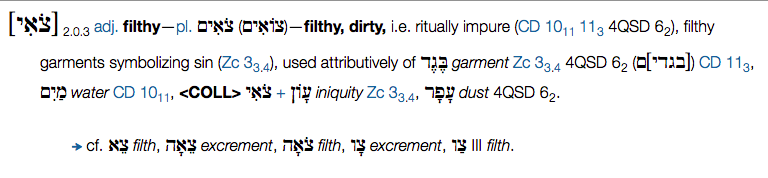
By way of comparison, here is an entry for the same (rarely occurring) word in the concise and full dictionaries, respectively:
Full DCHConcise DCH
I use the Concise DCH for regular Hebrew reading in Accordance, but have just recently been really getting to know it as a lexicon. (UPDATE: see another post here on word frequency statistics in the lexicon.) The print version of The Concise DCH is here; in Accordance it is here. The full 8-volume set from Sheffield Phoenix Press is here, found also here at Accordance.

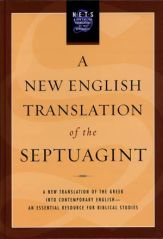 J.K. Gayle considers the question of whether the Septuagint translator of the Hebrew Song of Songs might have been a woman, then raises some challenges inherent to that view, at least as it is presented by the NETS (see image at left). J.K. also offered insight into the possible motherliness of God and the patriarch Joseph. Suzanne responded here, preferring to talk about “wombly feelings” instead of “motherly” ones. Kurk writes back again, noting some “maternal” language (with help from Greek Isaiah) in the “Our Father.”












 Words on the Word