Ephesians 6:10-11 says, “Finally, be strong in the Lord and in his mighty power. Put on the full armor of God….”
This “of” is perhaps best understood to mean, “the armor that God himself wears, that is also available to you.” Isaiah 59:17 talks about the Lord (“Yahweh”) putting on righteousness like a breastplate and a helmet of salvation. Ephesians 6 mentions these same items.
The “armor” we are called to put on, then, is God’s own armor. We “put on” the attributes and characteristics of God. Because of his righteousness, we are called righteous. Because he is a God of peace, we can be at peace and make peace with others. Because of the faithfulness of Jesus, we can have faith.
And, what is more, God-as-Warrior is going on ahead of each of us, wearing that “armor,” fighting spiritual battles before us. As we follow him, we are given his same armor to wear.
Though it was a quiet month in the Septuagint blogosphere, J.K. Gayle turned up the heat with some top-notch posts. Gayle looked at the phrase “ἄρσεν καὶ θῆλυ” (a “Greek frozen phrase”) in “Aristotle,” “Moses,” and Paul. Gayle writes:
As my son and my daughters grow into adulthood more in this world, I long for English counterpart terms like the Greek ἄρσεν καὶ θῆλυ and the Hebrew זכר ונקבה. These phrases do not have a default sex for the sex, the gender, of adult human beings the way our English “men and women” and “male and female” do. So I do tend to try to use “boys and girls” even when referring to adults, even though I always have to explain what I mean since the term applies to children not grown ups. I also like “masculine and feminine” since the phrase includes equal counterparts that does not place one over the other.
A section titled, “The Reception of ‘ἄρσεν καὶ θῆλυ’ in Contemporary Sexist Theology” concludes the post. Read it all here.
When I read Psalm 34 in the Greek (aka the Septuagint’s Psalm 33), I have lots of questions. For example, does the psalmist have a possibly-pregnant female soul?
Brian Davidson reviewed some Hermeneia volumes, including the one on 2 Maccabees by Robert Doran. Michael Bird reviewed T.M. Law’s When God Spoke Greek at Patheos.
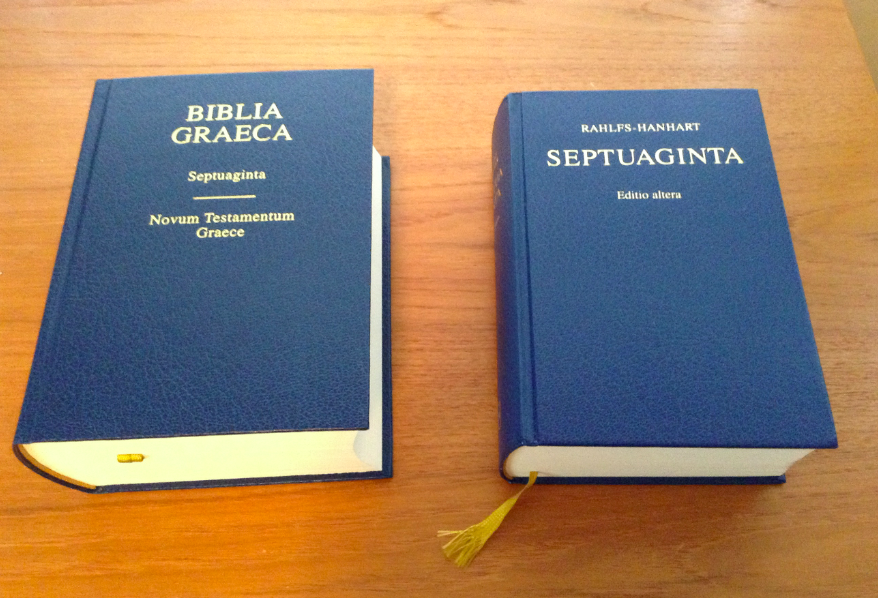
And this beauty is now available:
Jim West took a picture of it here. I reviewed it here.
To help alleviate October’s LXX lacunae–the dearth of Septuagint mirth–you could check out the Greek Isaiah in a Year group. We’re on Facebook here. It’s not too late to join! We’re just 60 chapters in.
Did I miss anything? (It seems I checked at least 70 or 72 blogs.) Feel free to leave more October 2013 LXX links of interest in the comments. And in case you didn’t see it, the first Septuagint Studies Soirée is here; the second one is here.
Amazon’s Kindle Matchbook program launches today. If you buy (or bought in the past) a book new from Amazon, the Kindle version is available at a discount–either $2.99, $1.99, $0.99, or free.
This would be advantageous, as I see it, in the following situations:
You lost a book you once purchased
It’s in storage but you want to read it again without going through seven boxes to find it
You want to easily keyword search a book on any device
You like it so much (or you like the author so much) you want to buy it again
Okay, so the last one is a stretch–I doubt this is raking in royalties for authors, but it’s a cool idea on Amazon’s part. All the available books are here.
The text will be, as usual, from R.R. Ottley’s Book of Isaiah According to the Septuagint(pictured above). Ottley is here in Logos (reviewed here) and here as a free, downloadable pdf in the public domain. The full reading plan for our group is here (pdf).
See here for more resources and links to texts for Greek Isaiah.
“Lord Jesus Christ, Son of God, have mercy on me, a sinner!”
“Lord Jesus Christ, Son of God, have mercy on me, a sinner!”
“Lord Jesus Christ, Son of God, have mercy on me, a sinner!”
It’s a surprising source, but I have J.D. Salinger to thank for introducing me to the Jesus Prayer in his book Franny and Zooey.
“Lord Jesus Christ, Son of God, have mercy on me, a sinner!”
In a simplified form, that is the prayer of the tax collector in Jesus’ parable of the Pharisee and the tax collector (Luke 18:9-14): “God, have mercy on me, a sinner.” It has become known as the Jesus Prayer.
The tax collector is a model for prayer, though if this character in Jesus’ story were worshiping with us today, he’d never let us hold him up as an exemplar.
Two Guys Walk into the Temple to Pray….
Luke 18:9 To some who were confident of their own righteousness and looked down on everybody else, Jesus told this parable:
Note the phrases, “confident of their own righteousness” and, “looked down on everybody else.”
The Old Testament prophet Isaiah speaks of such people:
They say, “Keep to yourself!
Don’t get near me, for I am holier than you!”
These people are like smoke in my nostrils,
like a fire that keeps burning all day long. (Isa 65:5)
Luke 18:10 Two men went up to the temple to pray, one a Pharisee and the other a tax collector.
Of these two men, who do the listeners think is going to be the hero? The Pharisee. Just about everyone hated tax collectors.
Oh, this is going to be good, the self-righteous listeners must have thought. Jesus is about to validate us, as he should!
Jesus isn’t out to bash Pharisees with this parable. We have to be careful about this as we read the Gospels. In fact, as one commentator points out, “The Pharisees were admired by the common folk for their piety and devotion to the Mosaic Law. Our contemporary equation of Pharisaism with hypocrisy would not have been made by a first-century Jew.”
It’s the same kind of setup as you get in the Good Samaritan parable–the religious person ends up showing us what not to do, while the real sinner becomes the example.
God Is Lucky to Have Him
Luke 18:11 The Pharisee stood up and prayed about himself: “God, I thank you that I am not like other men—robbers, evildoers, adulterers—or even like this tax collector.
Some of the listeners in the audience are saying, “Amen! Good prayer! Jesus gets it!”
This Pharisee starts his prayer out in the right way–“God, I thank you,” a typical beginning to Jewish prayers.
But it never really was an actual thanking of God for who God is. It was a thanking of God for who the Pharisee was.
He’s at the temple praying, standing up. This is a posture that suggests he was praying for others to hear him.
Note that it says he “prayed about himself.” This is much more soliloquy than prayer. Dear God–but enough about you. Here’s who I am and what I bring to the table. He mentions God, prays to him, but God quickly becomes just a footnote in the prayer. He continuses:
Luke 18:12 “I fast twice a week and give a tenth of all I get.”
What a good, religious guy! No, really–he is living an exemplary life, in terms of spiritual practices.
And he might well be sincere in his fasting and tithing. His fasting twice a week was more than was required. Designating a tenth of everything to God is an Old Testament practice that many continue today when they consider financial giving to their churches.
But he’s missing the point.
The primary subject and actor in this prayer is… the one praying. Not the one he prays to.
He addresses his prayer to “God,” but after that, he thanks God for who he is not. He’s telling God what he’s doing for God, and he’s also making sure to remind God of how rotten these other people are. God, you’re lucky to have me!
This guy’s understanding of himself is interesting to me. He defines himself before God in two primary ways:
(a) who he is not (these other people) and
(b) what he has done.
The guy has identity issues. Can he only be secure in himself by putting others down? Or maybe he’s a little more sincere than that. Maybe he’s like the older brother in the Prodigal Son story–he does his duty, says his prayers, fasts, tithes… but the people around him are moral slackers. And he just can’t stand it.
He’s still missing the point. The despised tax collector, however, really does get it.
He Can’t Even Look at God
The Pharisee and the Tax Collector, by Gustave Doré (1832–1883)
Luke 18:13 But the tax collector stood at a distance. He would not even look up to heaven, but beat his breast and said, “God, have mercy on me, a sinner.”
With the Pharisee, the primary subject and actor in his prayer was… the one praying. The subject and primary actor in this prayer is God. “God, have mercy on me, a sinner.”
That’s it. It’s much shorter prayer than the Pharisee’s prayer.
Before he even prays, he beats his chest, a sign of lament. He did not stand where everyone could see him. The Message version says he was “slumped in the shadows.”
Clearly he was “supposed to” be the antagonist of the story. A tax collector was in collusion with the Roman occupiers. Assuming he was Jewish, he took money from his own people to pay a foreign power, often with a kickback for himself.
He knows he’s supposed to be the antagonist in the story–he knows his sin too well. He confesses his sin to God.
An Old Testament prayer goes: “O my God, I am too ashamed and embarrassed to lift my face to you, my God, for our iniquities have risen higher than our heads, and our guilt has mounted up to the heavens” (Ezra 9:6).
But God–and all the listeners to this story knew this–God is a God who forgives wrongdoings. He welcomes the wayward sinner home.
Jesus concludes:
Luke 18:14 “I tell you that this man, rather than the other, went home justified before God. For everyone who exalts himself will be humbled, and he who humbles himself will be exalted.”
Remember how the story started? “To some who were confident of their own righteousness and looked down on everybody else, Jesus told this parable.”
They were confident in their own righteousness, their own right standing, their peace with God. But, look, Jesus says, you don’t get that from yourself, so stop trying. If you hold yourself up as righteous, you’ll humbled. But if you are humble, you will be exalted–not a sort of fame or glory with other people, but if you are humble, you will be truly justified before God. You will have peace with God.
“God, have mercy on me, a sinner.”
Where We Fit in the Parable
One writer (quoting another for the first portion below) says that because we know the end of the story:
“We identify with the tax collector and feel silent gratitude that we are decent and humble rather than being self-righteous like that shameful Pharisee.” We can be like the Sunday school teacher who goes through the lesson and says at the end, “Now, children, let us bow our heads and thank God we are not like that Pharisee.”
And that’s one of our reactions reading this text, isn’t it?
Well, yeah, I’d never actually name people in my prayer and say, “God, thank you that I’m not like him or her or those people.” And maybe that’s true. Maybe we don’t explicitly pray prayers like that, certainly not out loud.
But we might think thoughts like that. This same loathing of others that the Pharisee brings to God… we may do this in more subtle ways.
We might smugly watch the people going for long walks on a Sunday morning while we drive to church. We might watch the way a parent scolds their child and think: well, I would never do anything like that. We might work hard in the office or even here at the church, and secretly resent those who don’t seem to be as productive as we are. Or we might just look at someone with pseudo-pity and say to ourselves, “I am sure glad I don’t have to be that person.”
“God, have mercy on me, a sinner.” This is the sort of attitude, the kind of prayer that brings us into fellowship with God.
This prayer, in various forms, has inspired people ever since the tax collector prayed it. Ironically enough–the prayer of this humble man has been exalted and used by many.
What Salinger’s Franny Knew About Prayer
J.D. Salinger first wrote Franny and Zooey in the late 1950s as two separate shorts in The New Yorker magazine. Franny is a college student who is becoming disillusioned with college–not with her studies, per se, but with other college students. She thinks they’re fake, shallow, and egotistical. Her boyfriend Lane isn’t much better.
He’s a name-dropper, a complainer. He boasts in his own achievements–his good grades and his upcoming paper he’s going to publish. He’s sort of like the Pharisee in the parable.
What Franny read
Franny is in the middle of an existential crisis. At the recommendation of a prof, she’s been reading The Way of a Pilgrim, a 19th century Russian story about a pilgrim who wants to know how to “pray without ceasing,” as one verse says. He finally finds a spiritual advisor who tells him to repeatedly pray a version of the tax collector’s prayer: “Lord Jesus Christ, Son of God, have mercy on me, a sinner.” The idea is to make this prayer move from the lips to the heart, so that, as Salinger puts it, the prayer “becomes an automatic function in the person, right along with the heartbeat.”
Franny has been experimenting with the prayer, and at the end of the story, she faints. When she comes to, with boyfriend Lane by her side, she is mouthing the words: “Lord Jesus Christ, Son of God, have mercy on me, a sinner.”
Various Christian traditions suggest praying the prayer repeatedly, as the Russian pilgrim did, and as Franny tried to do.
As one devotes 5, 15, then 30 minutes to praying this prayer, different words stand out each time. Jesus Christ is Lord. Jesus is the Son of God. I am a sinner. Mercy–Jesus has mercy on us, or shows us grace when we don’t deserve it. “Lord Jesus Christ, Son of God, have mercy on me, a sinner.”
Some recommend breathing in as you pray the first half of the prayer–inhale with “Lord Jesus Christ, Son of God,” then exhale as you pray the second half–”have mercy on me, a sinner.” You internalize this prayer, so that its words become as natural to you as breathing.
But humility is a tricky thing. Just as soon as we think we are humble, we are tempted to congratulate ourselves on our humility. Maybe not loudly, but quietly. So we cling to the message of this parable, summarized elsewhere in Scripture: “God opposes the proud, but gives grace to the humble.”
I wonder if Salinger’s character Franny knew that: even as she saw occasion to criticize shallowness and inauthenticity around her, she clung to the prayer of humility. It moved from her lips to her heart. It became not just a prayer, but a posture. It wasn’t a formula, but her very breath.
It is Christ’s mercy, his “unmerited favor,” as some have defined it, that sets us right with God. We remind ourselves of that mercy each time we confess our sins and call on God for his aid.
“Not to us, Lord, not to us, but to your name be the glory.” (Ps. 115:1)
The above is adapted from the sermon I preached today on Luke 18:9-14, covering the Parable of the Pharisee and the Tax Collector. All Scripture quotations come from the NIV (1984). See my other sermons, if you desire, here.
Recently I’ve been spending time with The Anchor Yale Bible Dictionaryin Logos Bible Software. In the coming weeks I’ll review it here, summarizing some of the articles, commenting on their content, and evaluating the dictionary’s presentation in Logos. (You can find my other Logos reviews here.)
The dictionary is massive, consisting of six volumes and somewhere in the ballpark of 7,000 total pages. Here are a few more features, taking from the dictionary’s publisher’s page:
– Includes six volumes of approximately 1,200 pages each
– More than 6,000 entries
– More than 7,000,000 words
– Nearly 1,000 contributors
– Multicultural and interdisciplinary in scope
– An unprecedented interfaith exploration of the Bible
– Illustrated throughout with easy-to-find references
– Extensively cross-referenced for comprehensive coverage of topics
– Easy-to-read article and chapter headings for speedy location of material
– Full bibliographical references following all major entries
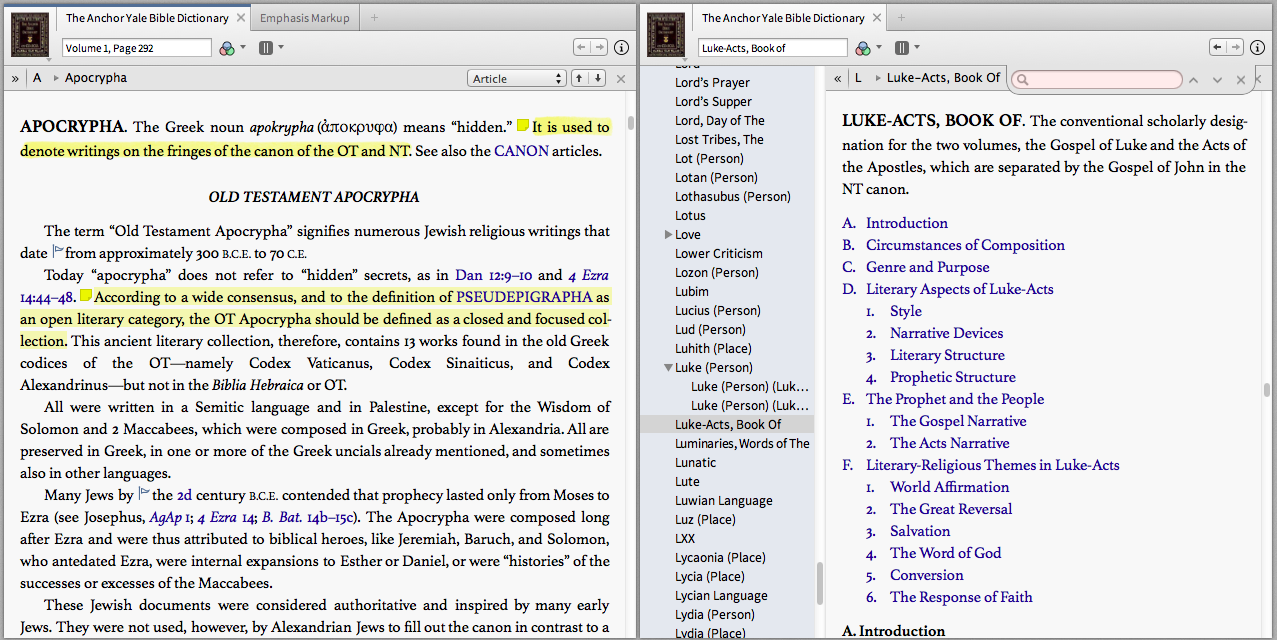
In Logos on a computer there is the added bonus of being able to open more than one entry at a time:
Two articles open at a time (click to enlarge)
As with the rest of Logos’s resources, all of the content in blue above is hyperlinked. So with the verse references you can hover over them for a popup of the verse text, or click on a hyperlink to open its contents in a new window. In the right half of the screen above, clicking on a section in the article takes you directly there.
I’m preaching this week on the Pharisee and the Tax Collector, so wanted to read a bit more about tax collectors. I type the entry name into the search bar to get there. Or I could navigate there via the left contents sidebar.
Looking something up
The “Tax Collector” article by John R. Donahue begins this way, with elaboration on each of the three mentioned “problems”:
Among the NT writings, only the Synoptic Gospels recount Jesus’ association with tax collectors (telōnai, KJV, “publicans”). Three problems attend this picture: (1) the identity and status of the telōnai, (2) the moral evaluation of them, and (3) the significance of Jesus as “a friend of tax collectors and sinners” (Matt 11:19; Luke 7:34).
In “Identity and Status” Donahue helpfully begins, “Etymologically telōnēs is a combination of telos in the sense of something paid for the purpose of the state, a toll, tax or duty; and ōneisthai (noun, ōnē), to buy or purchase.” I highlighted this sentence in Logos on my iPad and then moved to a computer, where the highlight had almost instantaneously synced to display there, too. Had I made a note at that sentence, it would sync, as well.
Donahue summarizes the Greco-Roman history of the term and office of the telōnēs, then moves into the details of how “Palestine was forced to pay tribute to Rome” after Pompey’s siege in 63 B.C.E. He differentiates between the different kinds of taxes (poll/census taxes, land taxes, etc.), as well as the different senses in which “tax collector” (telōnai) could be used. He concludes that the telōnai with whom Jesus interacts appear to be “toll collectors,” or, “minor functionaries fulfilling the orders of higher officials.”
In “Moral Evaluation” of the tax collectors, Donahue notes that “negative views” of this group of people occur outside the New Testament, as well (e.g., in rabbinic and secular literature). The author writes, “In Roman and Hellenistic literature they are lumped together with beggars, thieves, and robbers,” citing sources and giving examples. Knowing this helps me to better appreciate just how universally despised tax collectors were. This adds more punch to the parable in Luke. The New Testament itself (including Luke 18), as Donahue notes, mentions them in the same breath as “sinners” and “immoral people.”
“Jesus and the Tax Collectors” is the third and final section of the article. Multiple hyperlinked NT references in the article take the reader to places in the Synoptic Gospels where Jesus sits with and shows love to tax collectors. Citing Norman Perrin, Donahue notes:
Jesus’ association with them is viewed as an “acted parable” of his message of God’s mercy to sinners and “an anticipatory sitting at table in the kingdom of God” (Perrin 1967: 107).
A 15-source Biblography concludes the article.
Personally I’m not a big fan of the transliteration throughout the AYBD; I’d rather see τέλος than telos, for example. But that is the editorial decision of this dictionary. It’s not insurmountable, but does require a little extra work on the part of anyone who knows other languages but may not be used to seeing their transliterations.
Other than that quibble, Donahue’s article is indicative of what I’ve seen so far in the Anchor Dictionary: careful and top-notch scholarship that does not therefore suffer from dryness or inaccessibility. There is strength, too, in Donahue’s succinctness.
Evangelical scholars, pastors, and readers will want to be aware of and use their judgment regarding the dictionary’s “critical” approach to biblical studies. Donahue’s citation of “Q” will not be warmly accepted by all. (I and others still want to hear about manuscript evidence for Q.) But this generally does not make the dictionary any less useful or of lower quality.
Though I have other Bible dictionaries I use, when I’m studying, teaching, or preaching on a given topic, I’ll likely reach for (or, rather, click on) the Anchor Dictionary first.
Thanks to Logos Bible Software for the review copy of the Anchor Bible Dictionary. Find it here.
This year my three-year-old and six-year-old sons both started school (pre-school and kindergarten, respectively). So the recent arrival of Clara Vulliamy’s Martha Bunny Loves School (Albert Whitman & Company, 2013) was quite timely.
Here is a book trailer from the author’s Website, which gives you a glimpse of the color, font, layout, and movement of the book:
Martha Bunny Loves School is “a happy book all about Martha,” a bunny who is starting her first day of school. She has two bunny brothers (“one huge problem”), but before she gets to them, she shares her favorite color, popsicle flavor, hobbies, and (best of all) her “yellow-and-blue-and-orange-and-pink polka-dot rain boots,” which she wears even to sleep.
Martha’s bunny brothers are going to miss her when she goes. After eating breakfast–her brother Monty will only “eat his breakfast inside his box”–and getting dressed (“I don’t know what to choose”), she has to mollify two sad brothers who don’t know what to do while she’s away. So she founds the “Happy Bunny Club,” complete with badges, a sign, and a secret den.
After trying to fit all of her belongings into her backpack, Martha can’t fit through the door, so ends up packing just her Happy Bunny Club badge that her brothers make for her. At the end of her school day, she happily reunites with her brothers in the secret den.
When I asked my own three-year-old bunny what he thought about this book, he simply replied, “Good!”
“What happened?” I asked.
Martha have too much stuff in her backpack when she go, and she says, “SQUEEEEZE!” through the door. But her favorite stuff came out of the backpack.
Not long after reading Martha Bunny Loves School, my son went off to draw his own Happy Bunny Club badge.
There’s a lot to love about this book. The story is relatable, the plot and conflict and resolution are all compelling, and the characters (especially Martha’s) are well-developed. The illustrations and layout and font are stellar. The colors are vibrant. Here’s a sample page (note the graph paper background and creative use of space and text):
A look inside the book
The book aims at ages 4-7 (grades pre-school through 2nd). My 6-year-old thought he was too old for the book, but I don’t think he is. My three-year-old loved it, and older kids (especially with younger siblings) will appreciate it too.
Martha Bunny Loves School is a standout children’s book, one of the best we’ve read in a while. (And we read a lot around here.) It’s been a pleasure to read through it with our little guy, and I’m sure we’ll continue to return to it in the coming weeks and months.
Thanks to Albert Whitman & Company for the copy of the book to review. Its product page is here; at Amazon here. The author’s own site is worth checking out, too.
With St. Francis of Assisi, another patron saint of Italy
“When my goodness saw that you could be drawn in no other way, I sent him to be lifted onto the wood of the cross. I made of that cross an anvil where this child of humankind could be hammered into an instrument to release humankind from death and restore it to the life of grace. In this way he drew everything to himself: for he proved his unspeakable love, and the human heart is always drawn by love.”
–Catherine of Siena (1347-1380)
We are spending six weeks in our adult Sunday School with Foster and Smith’s Devotional Classics book. Here are the writers we’ve looked at each session:

 Ephesians 6:10-11 says, “Finally, be strong in the Lord and in his mighty power. Put on the full armor of God….”
















 Words on the Word