A hidden gem in BibleWorks is the “MacDonald Greek Transcription.”
BibleWorks comes with sentence diagrams for the Greek New Testament. They are also useful and look like this:
Luke 18:1-2 (click to enlarge)
The MacDonald transcriptions above, however, replicate something I haven’t seen in any other Bible software (EDIT/UPDATE: Logos has a “clausal outlines” module, minus the color coding), which is the sentence flow method of representing and visualizing a sentence. He uses color coding and spacing to line up parallel ideas and repeated words, making them easier to see than in just the text or even the diagrams.
It’s a great way to get at the motifs and important words of a given passage. And I’d forgotten about it until recently, but am now using it most weeks in sermon preparation.
The full title of the resource above is Syntactic and Thematic Greek Transcription of the New Testament, by William Graham MacDonald, 2008. BibleWorks is available here. Its full contents list is here.
This week’s Gospel lectionary reading is Luke 18:1-8. Quite a few commentaries have noted the (possible) connection between themes in Sirach 35 and Jesus’ parable. The two texts are below (NRSV):
Luke 18:1-8
Then Jesus told them a parable about their need to pray always and not to lose heart. He said, “In a certain city there was a judge who neither feared God nor had respect for people. In that city there was a widow who kept coming to him and saying, ‘Grant me justice against my opponent.’ For a while he refused; but later he said to himself, ‘Though I have no fear of God and no respect for anyone, yet because this widow keeps bothering me, I will grant her justice, so that she may not wear me out by continually coming.’” And the Lord said, “Listen to what the unjust judge says. And will not God grant justice to his chosen ones who cry to him day and night? Will he delay long in helping them? I tell you, he will quickly grant justice to them. And yet, when the Son of Man comes, will he find faith on earth?”
Sirach 35:17-22a
He will not ignore the supplication of the orphan,
or the widow when she pours out her complaint.
Do not the tears of the widow run down her cheek
as she cries out against the one who causes them to fall?
The one whose service is pleasing to the Lord will be accepted,
and his prayer will reach to the clouds.
The prayer of the humble pierces the clouds,
and it will not rest until it reaches its goal;
it will not desist until the Most High responds
and does justice for the righteous, and executes judgment.
The overlap of themes, of course, does not prove that either had/has impact on the other, but it is interesting to think about whether Jesus/Luke had the Sirach passage in mind when telling the parable in Luke.
Accordance Bible Software is coming to the Greater Boston area for two trainings at the end of October.
Here are the details on the free seminars from their Website:
Boston, MA area Saturday, October 26, 2013, 10am to 6pm
Gordon-Conwell Theological Seminary
Hamilton Campus
130 Essex Street, South Hamilton, MA 01982
Bld/Rm: AC240 (Academic Center-Rm #240)
** Special focus on Greek ** Directions Campus Map
Boston, MA area
Sunday, October 27, 2013, 1pm to 9pm
Brandeis University
415 South Street, Waltham, MA 02453
Bldg/Room: TBD
Instructor: Dr. Roy Brown (Developer of Accordance)
** Special focus on Hebrew ** Map & Directions Places to Stay Places to Eat
The schedule for the Gordon-Conwell training (subject to change) is:
10:00-11:30 Accordance Introduction, Interface, Library
11:30-11:45 Break
11:45-1:15 Search Tab, Basic Greek Searches, Symbols
1:15-2:45 Lunch on your own
2:45-4:15 Using Tools, Graphics, User Notes
4:15-4:30 Break
4:30-6:00 Greek searches and Commands
Accordance recommends the use of this 46-page hard copy Training Seminar Manual (which I have and find helpful: full-color screengrabs, clear explanations, etc.).
And now a video review of a solid and versatile iOS app for learning Greek vocabulary. You can adjust the video setting in the bottom right part of the video below to watch in HD and full screen, if you like.
Thanks to Danny Zacharias for the app, given to me for the purposes of a review. Find out more about FlαshGrεεk here.
UPDATE: I made the video above using the handy Reflector app. Reflector mirrors your iOS device to a computer, from which you can record. (I added the audio later.)
“Bites on Bytes” is too trite, but Words on the Word does have a growing tech focus. I’ve reviewed software before, and have moved into iOS and its apps, and now gear. Here I’ll review a classy case for the iPad mini, with another case review to follow, some iOS app reviews on the way, and a forthcoming review of a Sony bluetooth wireless speaker. Stay tuned.
Here is the lengthily-titled 100% Genuine Brazilian Buffalo Hide Leather Dual Protection Folio Stand/Cover/Case for iPad Mini with Built-in Stand and Detachable Inner Silicon Cover (Black), by Bear Motion:
iPad mini in case, the full setup
This is really two cases in one. On the right in the photo below there is the silicon stand-alone backing, which I’d recommend just for home (but not travel) use. On the left is the folio with a hard back plastic shell that is attached to the leather case that wraps around and closes over the iPad mini. It’s got a sleep/wake feature that functions perfectly.
There is actually a third casing option, since the Bear Motion Dual Protection case comes also with a protective velvet sleeve. So your iPad would be well-protected here.
Let me break it down into pros and cons:
Pros
The construction quality is high
The stitching is careful and tight
The holes (to access camera, earbuds, etc.) are cut out just right; you can still access everything
The leather smells amazing (I am a notorious smeller of books… and of this case)
I can hold the iPad, while in this case, in one hand (results may vary according to hand size)
I haven’t test-dropped the iPad while in this case, but my money is on a safe landing, were some sort of accident to happen
There are three notches for standing it up (in landscape mode only) for viewing; these are sturdier than the typical origami-style construction in other cases… as here:
One of three settings
Cons
It’s not the slimmest option
It is heavier than some mini cases
It is bulkier than some
This cuts two ways:
On the one hand, it is sturdy and classy, a case you’d definitely take to your business meeting
On the other hand, the “package weight” Bear Motion lists is 0.7 pounds, which is just a touch more than the iPad mini itself. So you double your weight if you use this case
It is difficult to maneuver the case in order to take photo or video (it doesn’t just fold back)
There is no place to hold a stylus, which would be a nice feature in a case like this
All told, the pros significantly outweigh the cons. I’ve looked at a number of cases for the iPad mini (and have used four now, with another review to follow), and this is among the best you can get–if the weight is not a problem for you.
Thanks to Bear Motion for the review sample. They make plenty of other cases for various devices, too. The case reviewed above can be found at Amazon here.
We are getting close to the end of Greek Isaiah in a Year. This week and next week cover Isaiah 55:7-Isaiah 58:9.
Below is the text from R.R. Ottley’s Book of Isaiah According to the Septuagint. Ottley is also here in Logos (reviewed here) and here as a free, downloadable pdf in the public domain. The full reading plan for our group is here (pdf).
See here for more resources and links to texts for Greek Isaiah.
“If the worth of our prayer life depended upon the maintenance of a constant high level of feeling or understanding, we would be in a dangerous place. Though these often seem to fail us, the reigning will remains. Even when our heart is cold and our mind is dim, prayer is still possible to us.”
–Evelyn Underhill (1875-1941)
For the first six weeks I am teaching/leading adult Sunday School at my church. We are spending those six weeks with Foster and Smith’s Devotional Classics book. Here are the writers for each session:
Week 4: Apocryphal Literature
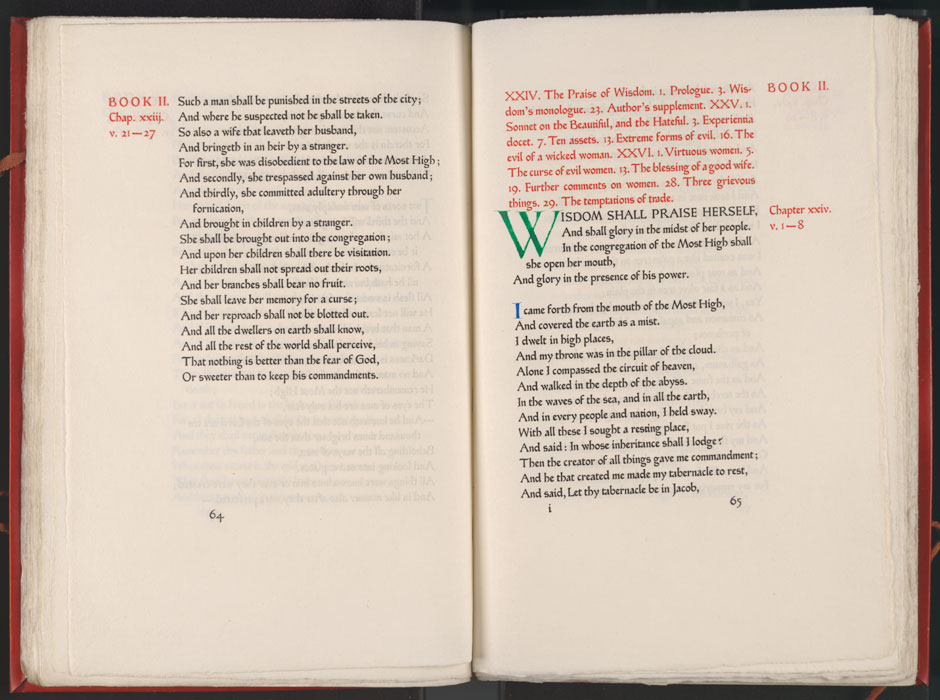
(This is not in Devotional Classics. But we’ll look at Ecclesiasticus (Sirach), Wisdom of Solomon, and the Prayer of Manasseh.)
Week 5: Catherine of Siena
Week 6: Kathleen Norris
Each week we do a short bio of the writer, some reading, some discussion, and some prayer.
Look at that! It’s an all-Greek Bible. Just like the one Jesus carried around! Okay, not quite, but it is very good to see the Greek Septuagint and the Greek New Testament together under one cover. Augustine would be pleased:
For Greek aficionados—a 2-in-1 resource that’s designed specifically for extensive research, textual criticism, and other academic endeavors. Featuring both the Rahlfs-Hanhart Septuagint (Greek translation of the Hebrew Old Testament) and the 28th edition of the Nestle-Aland Novum Testamentum Graece, this user-friendly tool includes critical apparatus, cross-references, and more. 3216 pages, hardcover from German Bible Society.
What It Looks Like
It’s a mere three pounds (in weight, not price). Amazon lists its dimensions as 7.5 x 5.7 x 2.8 inches.
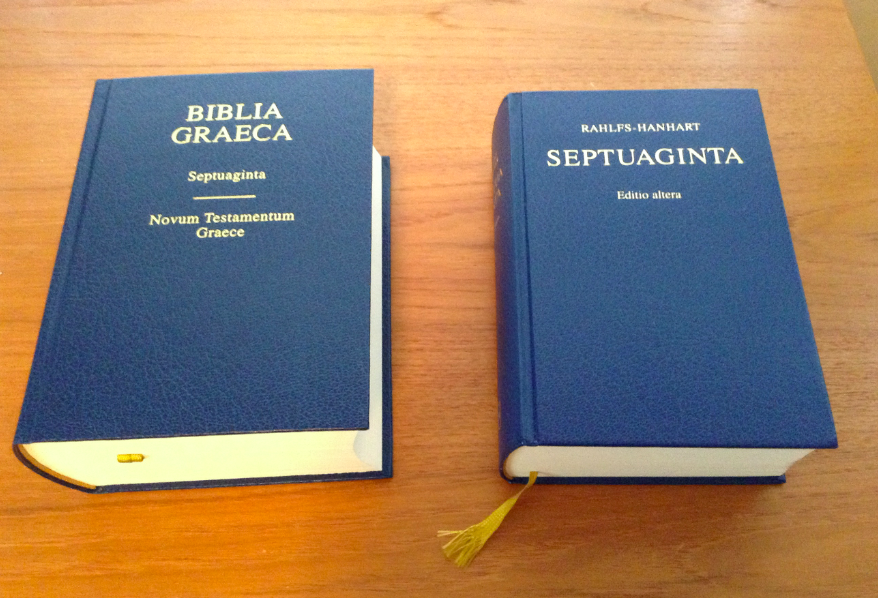
This impressive edition is two previously published Greek texts put together in one cover. It’s obviously thicker than the Septuagint alone, and just a little bigger in length and width. Here are the two side by side: the Septuagint alone on the right, and its “upgrade” version (with GNT) on the left:
v. 1.0 (at right) and v. 2.0 (at left)
Before receiving the volume, I was concerned that its 3,000+ pages would defeat Alfred Rahlfs’s initial intention to have a Handausgabe (i.e., a manual and portable edition). Indeed, Hanhart’s “Introductory Remarks to the Revised Edition” translate Handausgabe as “pocket-edition,” which this is decidedly not. (It would fit nicely in a purse or man-purse, though.) That said, the addition of the Greek New Testament really does not add a lot of bulk, as Rahlfs-Hanhart was already more than 2,000 pages. Biblia Graeca is still a (fairly) portable edition, though, if not literally pocket-sized. The sewn binding and hard cover appear that they will hold up under regular use. Here are v. 1.0 (LXX only) and v. 2.0 (LXX+GNT) stacked on top of each other:
You can barely make it out from the above photo, but the LXX/GNT combo comes (wisely) with two ribbon markers. Was it a coincidence that mine were both placed at the beginning of Odes? I think not.
The Greek Typesetting/Font
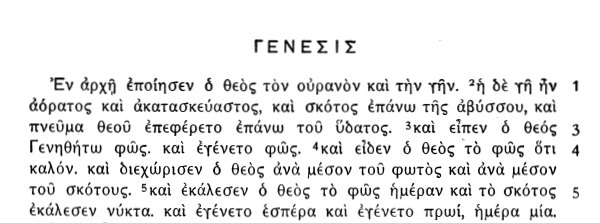
Rahlfs has not been re-typeset, so its Greek font is not as crisp or readable as that of the New Testament portion. Compare:
Genesis 1:1-5, from publisher’s pdf sample
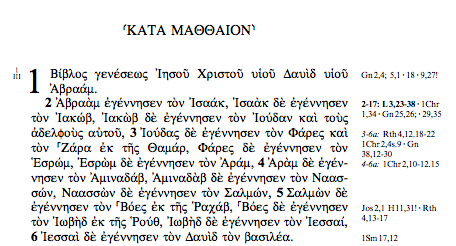
Here now is the Greek in the New Testament portion, which is clear and crisp:
Matthew 1:1-6, from publisher’s pdf sample
After reading enough Septuagint, one does get used to the Rahlfs font. It’s not too bad.
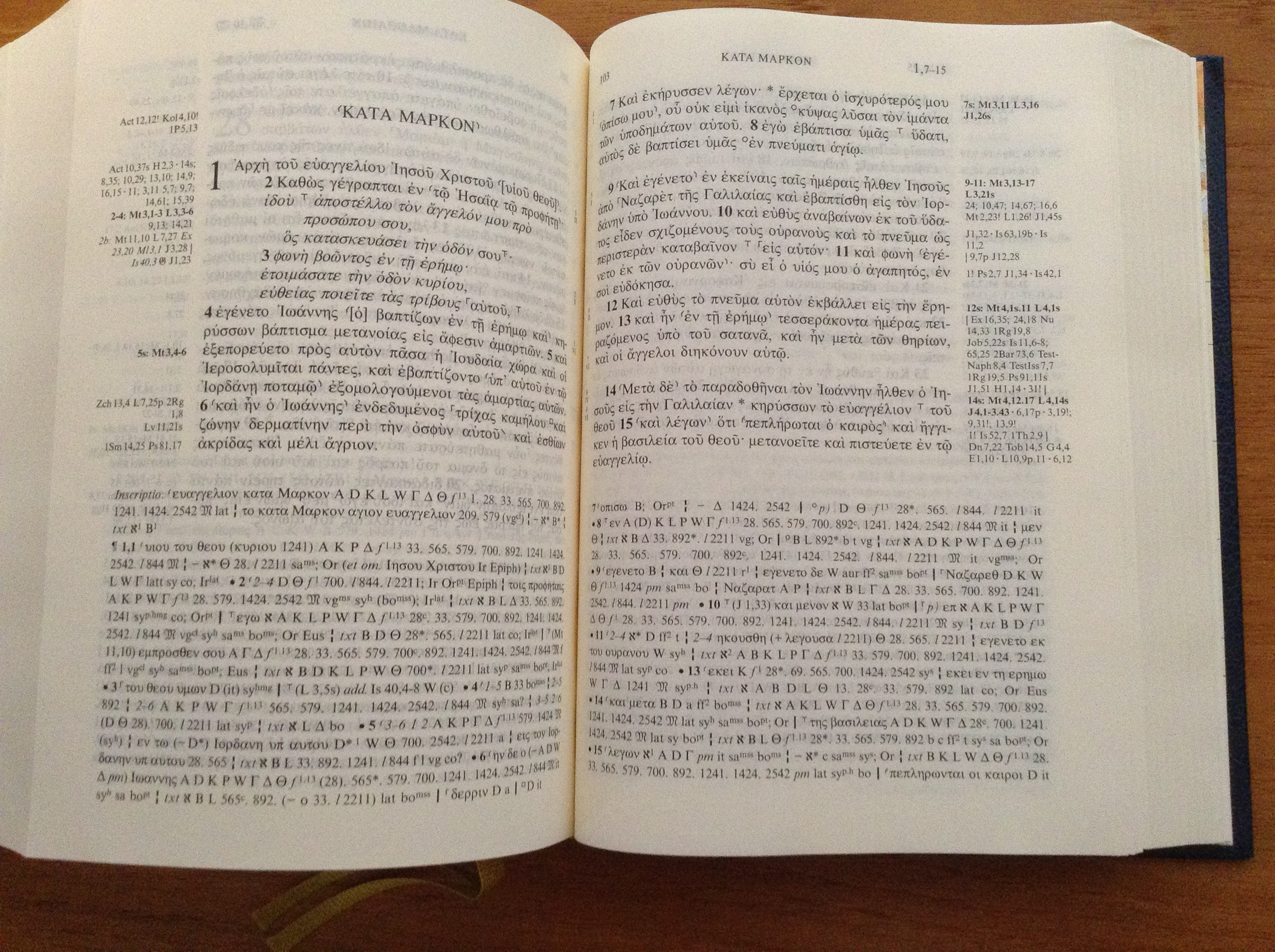
Always a concern with Bibles this big is that the requisite thin pages will mean bleed-through of text from the reverse side. This is noticeable to a degree here, but not in a way that negatively affects reading:
Mark 1
Rahlfs-Hanhart (Septuaginta)
The Rahlfs-Hanhart edition is not the go-to for extensive text-critical research that the Göttingen editions are, where they are present (on which, see my posts here and here on using Göttingen). Rahlfs is still useful, though, because it contains an entire Septuagint text, whereas Göttingen (published as individual volumes) does not.
It is probably the best starting place for readers of the Septuagint, even with its deliberately more limited apparatus. It is best thought of as a “semi-critical edition,” as noted here. Rahlfs “reconstructs” the text using, primarily, Codex Vaticanus (B), Codex Sinaiticus (S or א), and Codex Alexandrinus (A), a methodology that the revisor, Robert Hanhart, honors. Here is the apparatus for the first page, covering Genesis 1:1-14. This is a funny case, because of how much of Genesis is missing in B, so Genesis 1-46:28 up through the Greek word ηρωων is just based on A here. The rest (from πολιν in 46:28 to the end, chapter 50) take into account B and A.
Preceding the actual text and apparatus are Hanhart’s 2005 “Introductory Remarks to the Revised Edition” in German, English, and Greek. Then in German, English, Latin, and Greek follow three more sections: (1) Rahlfs’s “Editor’s Preface,” (2) an illuminating 10-page essay, “History of the Septuagint Text”, and (3) Explanation of Symbols. Everything you need to get started reading the Septuagint (minus the Greek lessons) is here.
The long-awaited 28th edition of the Novum Testamentum Graece has now been published. Once again the editors thoroughly examined the critical apparatus and they introduced more than 30 textual changes in the Catholic Letters, reflecting recent comprehensive collations. With the intent to make this book more user-friendly, the editors also revised the introductions and provided more explanations in English. This concise edition of the Greek New Testament, which has now grown to 1,000 pages, will continue to play a leading role in academic teaching and scholarly exegesis.
The NA28 has its own snazzy site here. (What a day we live in, when a Greek Bible gets its own Website! Its writers would be amazed.) Recent text-critical work on the New Testament has led to revisions in the Catholic Letters, but not elsewhere. So the Gospels and Pauline epistles, for example, retain the same text as the NA27. However, there are changes that affect the whole edition, as the publisher points out:
Newly discovered Papyri listed
Distinction between consistently cited witnesses of the first and second order abandoned
Apparatus notes systematically checked
Imprecise notes abandoned
Previously concatenated notes now cited separately
Inserted Latin texts reduced and translated
References thoroughly revised
As for the textual differences themselves, those are explained and listed here. There are more details to be digested about the new NA28 edition. I can do no better than to refer you to the writings/reviews of Larry Hurtado, Rick Brannan, Daniel Wallace, and Peter Williams.
All the quick-reference inserts you need to make sense of symbols and abbreviations are included:
Concluding Thoughts: Sell All You Have?
The product page for the beautiful Biblia Graeca is here for CBD, here at the German Bible Society, here at Hendrickson, and here for Amazon. And, best yet, you can look at a sample of the book here. If it’s just the text (and not the apparatuses) that you’re interested in, you can read the NA28 online here and the Rahlfs-Hanhart Septuagint here.
Rahlfs wrote in his preface that he sought to “provide ministers and students with a reliable edition of the Septuagint at a moderate price.” If you click the links above, you will see that this is not “a moderate price.” It’s significantly cheaper to buy the same critical editions of each Testament under separate cover.
But there are at least two major advantages to putting them together. First, when the New Testament writers quoted Scripture, they predominantly did so in a form that is closer to what we have now in a Septuagint text. Comparing a quotation (in Greek) with its source (in Greek) is facilitated by this edition. Second, that this edition exists is an important symbolic statement. Lovers of the Septuagint are fond of affirming that it was the Bible of the early Church. If that is so, why can we not have one, too? Now we can, printed and bound in a way that would shock the pre-printing press world that first heard all these Scriptures together when gathered for worship.
Professor Ferdinand Hitzig has often been quoted saying, “Gentlemen!” (and today, he would say, “Ladies!” too) “Have you a Septuagint? If not, sell all you have, and buy a Septuagint.”
In true biblical storytelling fashion, he is using hyperbole to communicate his point. But for those who are so inclined and able, if selling a few things to get a Septuagint is a good idea, how much more might someone like Hitzig encourage them to sell a few things for the Biblia Graeca?
Christians believe that the Septuagint has come to full fruition through the New Testament.
So it only makes sense to be binding the two together.
Many thanks to Hendrickson for the privilege of reviewing this fine work. A copy came my way for review, but with no expectation as to the nature of my review, except that it be honest.















 Words on the Word