Highlights in Baker Exegetical Commentary on the NT (Stein, Jobes, Köstenberger)

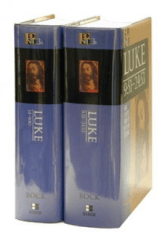
BECNT set

I’ve long benefitted from the 15-volume Baker Exegetical Commentary on the New Testament (BECNT) series. Recently I’ve been able to use it in Logos Bible Software. In this post I introduced the commentary, layout, and setup in Logos on a computer. Then I wrote again here about navigating BECNT for Logos on iPad. Finally, I interacted at length with a passage in Luke from Darrell L. Bock. That third post is here. This post is a fourth part of my BECNT series of posts, concluding my review. Here I highlight some other volumes in the series: Mark (Robert H. Stein), 1 Peter (Karen H. Jobes), and John (Andreas J. Köstenberger). Continue reading “Highlights in Baker Exegetical Commentary on the NT (Stein, Jobes, Köstenberger)”

Accordance Training in Greater Boston

accordance 10 lamp

Accordance Bible Software is coming to the Greater Boston area for two trainings at the end of October.

Here are the details on the free seminars from their Website:

  • Boston, MA area
    Saturday, October 26, 2013, 10am to 6pm
    Gordon-Conwell Theological Seminary
    Hamilton Campus
    130 Essex Street, South Hamilton, MA 01982
    Bld/Rm: AC240 (Academic Center-Rm #240)
    ** Special focus on Greek **
    Directions
    Campus Map
  • Boston, MA area
    Sunday, October 27, 2013, 1pm to 9pm

    Brandeis University
    415 South Street, Waltham, MA 02453
    Bldg/Room: TBD
    Instructor: Dr. Roy Brown (Developer of Accordance)
    ** Special focus on Hebrew **
    Map & Directions
    Places to Stay
    Places to Eat

The schedule for the Gordon-Conwell training (subject to change) is:

10:00-11:30 Accordance Introduction, Interface, Library
11:30-11:45 Break
11:45-1:15 Search Tab, Basic Greek Searches, Symbols
1:15-2:45 Lunch on your own
2:45-4:15 Using Tools, Graphics, User Notes
4:15-4:30 Break
4:30-6:00 Greek searches and Commands

Accordance recommends the use of this 46-page hard copy Training Seminar Manual (which I have and find helpful: full-color screengrabs, clear explanations, etc.).

More details and registration info are here.

Of Millstones and Mustard Seeds: Bock on Luke 17

"Magisterial" is perhaps not an exaggeration
“Magisterial” is perhaps not an exaggeration

The apostles said to the Lord, “Increase our faith!”

 He replied, “If you have faith as small as a mustard seed, you can say to this mulberry tree, ‘Be uprooted and planted in the sea,’ and it will obey you.”

–Luke 17:5-6 (NIV 2011)

This Sunday I’ll preach on the above verses, taken from the lectionary reading of Luke 17:5-10. The rest of the passage goes on:

“Suppose one of you has a servant plowing or looking after the sheep. Will he say to the servant when he comes in from the field, ‘Come along now and sit down to eat’? Won’t he rather say, ‘Prepare my supper, get yourself ready and wait on me while I eat and drink; after that you may eat and drink’? Will he thank the servant because he did what he was told to do? So you also, when you have done everything you were told to do, should say, ‘We are unworthy servants; we have only done our duty.’”

My first three questions of the text were as follows:

  1. How should I take Jesus’ statement about the mulberry tree? Should I really be trying to uproot trees (or move mountains, in a synoptic parallel)? Can I?
  2. What do verses 7-10 have to do with 5-6?
  3. What about Jesus as a servant? Is he here the one being served, and we are just dutiful servants, with no expectation of thanks or “well done” from God?  Continue reading “Of Millstones and Mustard Seeds: Bock on Luke 17”

Accordance Bible Software for Windows is here

Accordance10

Accordance Bible Software for Windows is officially released. I’ve reviewed Accordance for Mac at length here. It’s an excellent program, the Bible software I use the most.

Accordance writes:

For over ten years, Accordance has been available to PC users with the Basilisk II emulator. While the emulator version included most of the same features as Accordance for Mac, it was an imperfect solution. We have long desired to give Windows users the native version of Accordance they truly deserve, and now that day has finally come. We are pleased and excited to announce the release of Accordance for Windows.

There’s a free trial here. See all the details here.

LSJ Greek–English Lexicon in Logos (for iPad), reviewed (part 2)

The massive LSJ Greek-English Lexicon for Logos (9th ed. with revised supplement) is an invaluable resource for Greek lexicography, covering the classical and New Testament eras. I wrote more about the lexicon in Logos here. How does it look and work on an iPad?

Continue reading “LSJ Greek–English Lexicon in Logos (for iPad), reviewed (part 2)”

Liddell and Scott Greek–English Lexicon (LSJ) in Logos, reviewed (part 1)

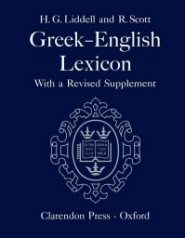
LSJ coverAs much as I still look back nostalgically on my early days of Greek and Hebrew reading–where I used only a paper lexicon to look up words I didn’t know–I don’t miss how time-consuming it was. I’m able to do more reading now, not just because of (hopefully!) increased language proficiency, but also because of computerized versions of the same lexicons.

The Liddell and Scott Greek–English Lexicon (LSJ) covers Greek of the classical variety (Homer, Plato, Aristotle, etc.) and of the Septuagint, New Testament, and early church variety. I’ve had the pleasure recently of accessing LSJ via Logos Bible Software.

And, to be clear, what Logos has is Continue reading “Liddell and Scott Greek–English Lexicon (LSJ) in Logos, reviewed (part 1)”

Baker Exegetical Commentary on the New Testament in Logos Bible, reviewed (part 1)

BECNT Logos

Something I immediately appreciated about the Baker Exegetical Commentary set is its clear statement of purpose in the Series Preface, found in each of the 15 volumes published so far:

The chief concern of the Baker Exegetical Commentary on the New Testament (BECNT) is to provide, within the framework of informed evangelical thought, commentaries that blend scholarly depth with readability, exegetical detail with sensitivity to the whole, and attention to critical problems with theological awareness. We hope thereby to attract the interest of a fairly wide audience, from the scholar who is looking for a thoughtful and independent examination of the text to the motivated lay Christian who craves a solid but accessible exposition.

This is an ambitious set of aims for a single commentary, but Continue reading “Baker Exegetical Commentary on the New Testament in Logos Bible, reviewed (part 1)”

What BibleWorks on iPad looks like

The headline is not in error. BibleWorks does not make an app for iPad, still, but Parallels has just released an app called Parallels Access that allows you to use an iPad to access any computer–PC or Mac, desktop and laptop alike. They write:

Parallels Access ‘applifies’ your Windows and Mac applications, letting you remotely access and experience them as if they were made for iPad.  Tapswipe, pinch and scroll any Mac or PC software application – even if they were not optimized for the iPad – and get more done on-the-go!

More about the Parallels Access app is here. It’s free in the App Store, and you get a two-week free trial. After that it’s a fairy expensive (as apps go) subscription rate of $80/year. I hope to offer further insights about the app in the future on this blog, but for now, I’m pretty impressed that you can use your desktop and laptop programs as if they were (more or less) native to the iPad.

And more to the interests of this particular blog, here is what BibleWorks (using Mac Public Preview) on iPad (!) looks like, via Parallels Access (click to enlarge):

BW on iPad

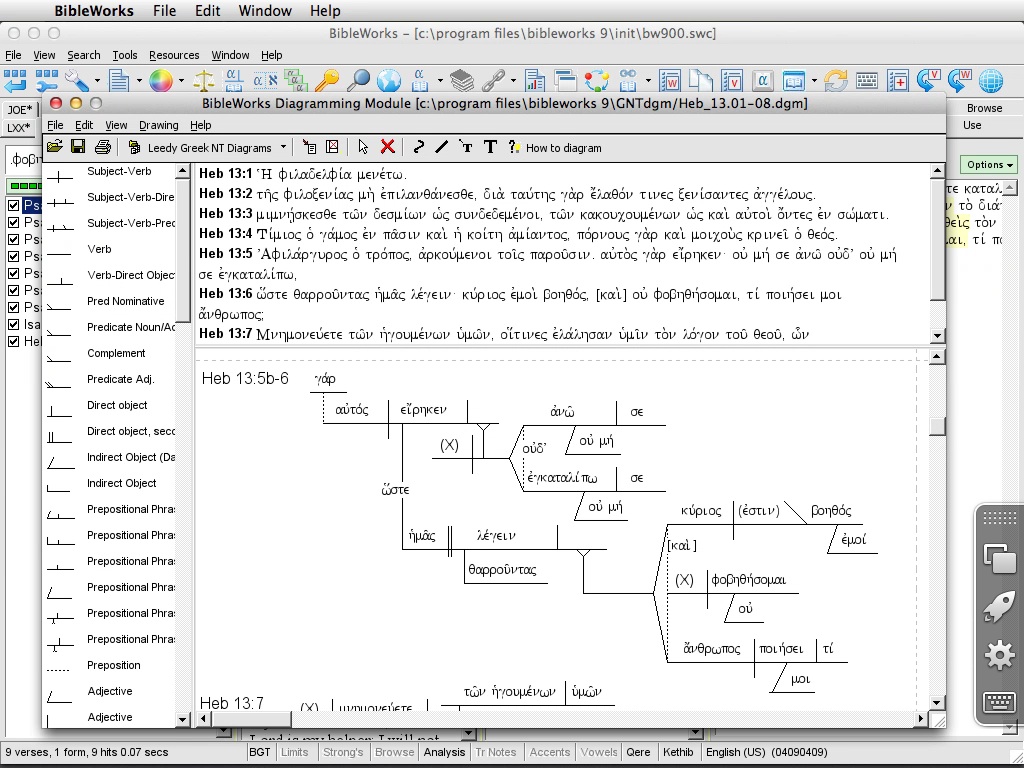
Here are the sentence diagrams. Click to enlarge, and notice how crisp everything looks. (This is on an iPad mini.)

bw diagrams

Most remarkable to me is that the Use Tab feature works–in the desktop/laptop version of the program, this works by hovering over a word. In the Parallels Access version of BibleWorks, a single click on a word in the Browse Window activates the feature.

Astounding. As my friend and long-time college roommate would say: We’re in the future.