One obvious advantage to the book is its portability. It’s less than 400 pages and easy to carry around in a satchel… though since receiving it, I’ve kept it on my desk with a few other works I reference a lot.
What sorts of “theological terms” does this dictionary cover? The publisher’s product page notes:
This second edition of The Westminster Dictionary of Theological Terms provides a comprehensive guide to nearly 7,000 theological terms—1,000 more terms than the first edition. McKim’s succinct definitions cover a broad range of theological studies and related disciplines: contemporary theologies, biblical studies, church history, ethics, feminist theology, global theologies, hermeneutics, liberation theology, liturgy, ministry, philosophy, philosophy of religion, postcolonial theology, social sciences, spiritually, worship, and Protestant, Reformed, and Roman Catholic theologies.
There is also a short annotated bibliography, list of works consulted, and set of abbreviations at the back of the book. The “Major Topics and Distinctive Terms and Concepts” section at the beginning gives the reader a framework of overarching topics into which the dictionary’s terms will fit. (E.g., “Bible,” “theology,” “worship,” “ethics and moral theology,” and so on.)
McKim himself has overseen much larger dictionaries. An initial point of skepticism for me was whether a theological dictionary this small and short could still be substantive. Definitions are somewhere in the 15-75 word range, depending on the term.
Yet as a quick-reference guide, it does well. Consider McKim’s definition of feminist criticism:
A critical approach to reading the Bible that focuses on the political, social, and economic rights of women. Diverse goals and methods are employed, with a common recognition that all texts are gendered. This implies not only that they reflect sexual differences between males and females, but also that they involve power. Feminist criticism seeks to make clear culturally based presuppositions found in texts.
Here’s another example, the entry for “agrapha,” a term one finds shortly after delving into studies of the Gospels:
(Gr. “unwritten sayings”) Sayings attributed to Jesus that circulated as traditions during the period of the early church. Also those sayings attributed to Jesus found outside the canonical Gospels.
The reader will also find terms like “Griesbach hypothesis,” “haggadah,” “Muratorian Canon,” perspectivalism,” “cuneiform,” “body-soul dualism,” “Trisagion,” “interiority,” “rechte Lehre” (German for “right teaching on doctrine”), and many more.
McKim’s goal was to provide a “wider, synthetic work that gives short, identifying definitions over a more comprehensive range of theological disciplines,” as opposed to something more “specialized” and “extensive.” The beginning theological students that McKim seeks to reach will find such a dictionary an especially useful entry point into the large and growing world of biblical and theological studies. McKim seeks to be more “broad” than “deep”; in this he succeeds, but the definitions are still plenty substantive to be useful to students at various stages.
The annotated bibliography is just five pages and glosses over important works (e.g., the commentaries section lists Anchor but omits Hermeneia). It does include a good page on Web-based resources for theological studies. The abbreviations include a couple pages of textual criticism abbreviations (including Latin), which will save the new reader of the Hebrew Bible from having to look most terms up elsewhere.
One feature I felt to be missing was a lengthier set of introductory essays on the nature and methods of theological study. I’m assuming Dr. McKim didn’t include this because it might exceed the intended scope of the work, but perhaps future editions could include–as many dictionaries do–at least two or three introductory essays to further orient the reader to theological study.
I’ve had the dictionary at my desk all summer, and each time I’ve looked up a word or phrase, I’ve found what I was looking for (with the exception of dereliction or “cry of dereliction”).
Especially for its price and accessibility, The Westminster Dictionary of Theological Terms is an excellent starting point for seminary students or for pastors who want to stay up-to-date on theological terminology.
Many thanks to WJK Press for the review copy, given to me with no expectation as to the content of my review. You can find the dictionary here on Amazon (affiliate link), or here at WJK Press.
By now many of you Words on the Word readers will have heard that the UBS edition of the Greek New Testament has recently been published in its fifth revised edition, the UBS5. See here for more.
Check out this smart graphic from Hendrickson Publishers announcing the edition (academia needs more good infographics):
Just as I reviewed the amazing LXX-NA28 combo, I will soon be reviewing the UBS5 Greek New Testament.
While I work my way through it, with just about a minute of your time and a few clicks, you can enter to win your own copy of the UBS5, thanks to the great people at Hendrickson Publishers.
You Can Earn Up to 8 Entries: Here’s How
Simply comment on this blog post with a short sentence on what interests you in the Greek New Testament. That will give you one entry.
If you share on Facebook and/or Twitter, and then come back and post the link to your share in the comments, you get two additional entries.
If you want to earn five additional entries, you can record a (however lo-fi) video of yourself answering the questions: Why does Bible translation matter? and: What does translating the Bible mean to you personally?
To receive those five additional entries, post the url to your video (whether you’ve uploaded to YouTube, Facebook, Vimeo, etc.) in the comments. Then others can see your video, too.
I’ll select two winners using a random number generator.
If you don’t want to wait for the results of the giveaway, you can find the UBS5 on sale at Amazon here (affiliate link) or through Hendrickson here.
A Bit of Fine Print
The giveaway is open through Sunday, September 7, 11:59 p.m. EDT. On Monday I’ll notify the winner and post about it both here and in the comments below. Then Hendrickson will mail you your UBS5 GNT! (Note: Only domestic/U.S. shipping addresses are eligible for this contest, with apologies to the rest of the world!)
Make sure in when you leave a comment that you include your email address—I can use that to contact you, and the email address isn’t public.
Happy entering, and the folks at Hendrickson and I look forward to seeing your videos. Drop me a line if you have any questions.
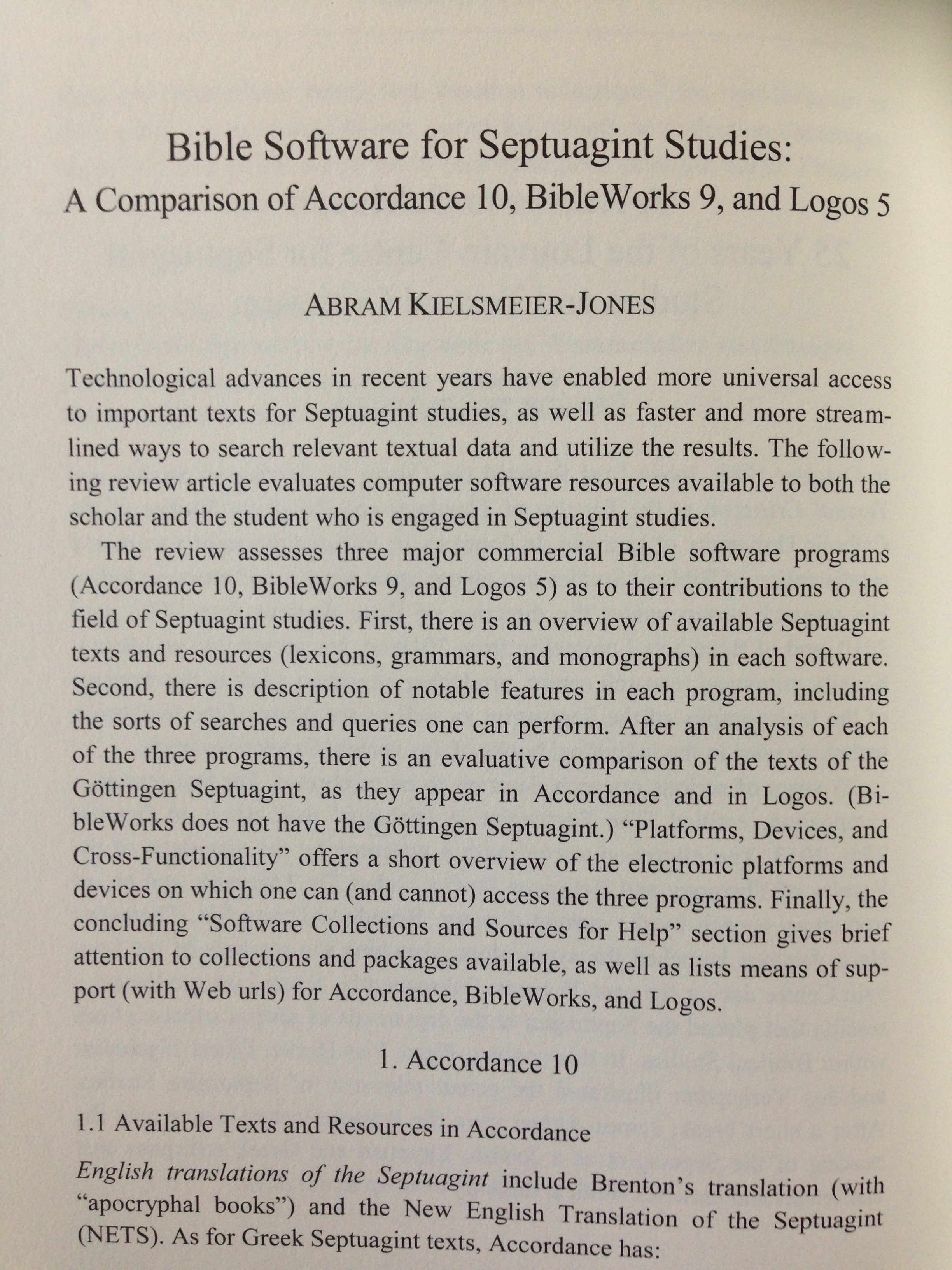
I’ve just come home to the new Journal of Septuagint and Cognate Studies (JSCS) in my mailbox. This volume (vol. 47, 2014) publishes an extensive comparative review I wrote of Bible software programs for Septuagint studies. In the review I consider and evaluate Accordance 10, BibleWorks 9, and Logos 5.
I’m excited to see it in press! Here are the journal cover, the contents, and the first page of the review. You can subscribe to JSCS at this link.
The Biblia Hebraica Quinta (BHQ) will supercede the current scholarly edition of the Hebrew Bible, the Biblia Hebraica Stuttgartensia (BHS).
I reviewed the BHS module in Accordance Bible Software here, and posted at length about the BHQ here, if you want a primer. Short version: Emanuel Tov says it is “much richer in data, more mature, judicious and cautious than its predecessors. It heralds a very important step forward in the BH series,” though he notes that its notations are “more complex” and “less user-friendly for the non-expert.”
Here is BHQ on Amazon; here it is at Hendrickson Publishers’ site.
Hendrickson sent out an update today with the BHQ publishing schedule as it currently stands. Most volumes are “in preparation,” but the schedule (available here) notes that Ezekiel (ed. by Johan Lust) is coming in 2016 and Numbers (ed. by Martin Rösel) is coming in 2017.
Especially since Eerdmans has a large number of resources in production right now at Logos Bible Software, I’ve started paying more attention to Logos’s Pre-Publication program.
Logos puts titles into “Pre-Pub” to help gauge user interest in various resources. When users pre-order a resource, that helps to cover the cost of production. If/when enough users pre-order, the title goes into development and the user gets it at the discounted pre-pub price when it “ships” (i.e., when it is completed).
Here is a short description from Logos’s Pre-Pub About page:
Prices start low and increase over time so the sooner you pre-order, the less you pay. We don’t charge you until your pre-order is ready, and we’ll send you a reminder email a few weeks before. If you decide you don’t want the resource anymore, you can cancel your pre-order at any time.
Here is a compilation of the newest Pre-Pub titles. (This one from Oxford University Press is pricey but looks good; here is When God Spoke Greek, which had enough pre-pub orders that it’s already under development and will probably ship within a month.)
Here is the Pre-Pub list sorted by Progress or “ship date,” so you can see which ones are almost ready to go–with the pre-order discount still applying, at least for now. There’s a bunch of Eerdmans stuff that will go out on August 6, including this collection that looks especially useful to pastors, including the book that is pictured above.
Here’s a short overview video of how Pre-Pub in Logos works:
My two-year-old gave me an unexpected opportunity yesterday to practice what I just preached Sunday. I noted in my sermon that I had been understanding Psalm 23 as a “counter-circumstantial prayer of defiance,” a “subversive prayer when you compare it to what you see around you.”
I mentioned some potential circumstances which make us feel far from the idyllic pastoral imagery of the Psalm, and then suggested that those are some of the best times to (defiantly) pray Psalm 23:
When you hear about wars and rumors of wars, say this Psalm.
When your best friend gets sick, say this Psalm.
When someone in your family grieves you by their seeming lack of care for you, say this Psalm.
When you don’t know what the next year of your life holds, say this Psalm.
An instance I didn’t think to include was:
When your two-year-old daughter draws with permanent marker all over the brand-new cork floor that the church graciously put in last year in the parsonage kitchen… say this Psalm.
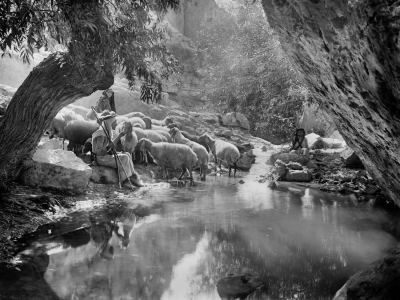
When I noticed the damage, this image is about the opposite of how I was feeling:
Image Credit: LifeintheHolyLand.com (Todd Bolen), used with permission
I was feeling more like this:
For at least 10 minutes as I frantically scrubbed, I didn’t even remember there was a Psalm 23, let alone think to say it.
But then I took a step back (by God’s grace) and began to quietly say–through gritted teeth:
The LORD is my shepherd, I shall not be in want.
He makes me lie down in green pastures,
he leads me beside quiet waters,
he restores my soul….
And when my gracious and patient wife came home, she gently reminded me of the “magic sponge” we have under the sink that takes permanent marker off of everything. Within minutes, the green marker drawing on the floor was gone. Gone. The cork floor is good as new.
True, there are much darker valleys in life to walk through, but I think sometimes in parenting those little mini-valleys of frustration and exasperation can add up pretty quickly. And for us parents, they can be the regular “stuff” of our everyday existence. We need good Psalms to pray for the big valleys, and good Psalms to pray for the little valleys.
For those moments–should my two-year-old again somehow elude my watch like she has been so eager to do lately–I will try again (and again) to remember to “say this Psalm.”
Psalm 23 is a Psalm of Trust. A Declaration of Confidence in God.
The imagery and tone of the Psalm are peaceful: “green pastures,” “quiet waters,” a restored soul, the promise of God’s presence even when death and darkness are near. The LORD is my shepherd: he provides, he guides, he restores, he is with his sheep, and he comforts.
“He makes me lie down in green pastures.” With God as my comforting shepherd, there is time to rest. Time to stop. Time to be still.
Image Credit: LifeintheHolyLand.com (Todd Bolen), used with permission
Typically a shepherd leads sheep to a pasture where they can graze. The sheep still do work; the shepherd does the leading but not necessarily the feeding. As the Psalm progresses, God as comforting shepherd becomes welcoming host, who sets out a whole banquet for his flock.
Image Credit: LifeintheHolyLand.com (Todd Bolen), used with permission
Psalm 23: It Just Got Personal
Psalm 23 is intensely personal. It’s a prayer of an individual to God; a song from one soul, who recognizes that the ruling king of the universe has taken the time to lead him to a restful spot to get a drink… to rest.
The LORD is my shepherd, I shall not be in want.
He makes me lie down in green pastures,
he leads me beside quiet waters,
he restores my soul….
David uses the first person singular pronoun throughout the Psalm. God is the shepherd of each individual who would follow him.
This may seem slightly unremarkable to us. We live in a North American society that already tends toward individualism. Our cultural construction of the self tends to be individually-focused.
The culture in which David found himself was much more communally-oriented. The sins of an individual and the corporate sins of the community were not always distinguished. A person’s sense of self was constructed and informed and shaped in a communal context.
Identity for a Hebrew man or woman had much more to do with being a part of a chosen and called-out community. A chosen people, plural.
Even in other Psalms, when God is prayed to as shepherd, there’s a sense in which he’s understood as a shepherd of a whole people:
For he is our God,
and we are the people of his pasture,
and the sheep of his hand.
So it’s at least a little remarkable, in the larger context of Hebrew worshiping society, that David begins–the Lord is MY shepherd.
The idea of God as personal shepherd is consistent with Jesus’ interpretation of himself as shepherd. You remember the Christlike image of the shepherd who–even though he has 100 sheep–will stop and go find the one who goes missing.
So it really is okay, and probably even closest to the original intent of this Psalm, to put your own name in there as you read it.
Psalm 23 as Prayer of Defiance
Maybe it’s because I’ve been reading this Psalm through the lens of the news this week, but I’m beginning more and more to see Psalm 23 not only as an affirmation of trust and confidence in God, but also as a counter-circumstantial prayer of defiance. It’s a subversive prayer when you compare it to what you see around you.
Verse 4 says, “Even though I walk through the valley of the shadow of death…” David seems to just take it as a given that life contains dark and death-filled valleys.
I saw in a bookstore yesterday a little book called 11,002 Things to Be Miserable About. It’s a work of satire, mostly, though not all of it is. Here are a few of the things it listed:
Exaggerated vows of love
Abysses of regret
Tipping over backward in your chair
The misery of goldfish
Heel pain caused by flip-flops
But we don’t need a book to think of all the ways in which life is full of dark valleys.
You’ve been in a dark valley before. Maybe you’re in one now. It can be a valley of darkness and shadows that you’ve found yourself in due to no choice of your own: some hurt or frustration someone has caused you; prayers that continue to go unanswered in the way you’d like to see answered; illness and physical ailment; unexpected and sudden grief.
You could be in a valley of darkness and shadows that is more of your own making, too. Maybe your whole life doesn’t feel like a valley, but maybe you’re aware of your “shadow side” that you wouldn’t dare bring to church, that part or those parts of you that you don’t want anyone to see. Maybe you’ve looked inside and seen something in your heart that—it pains you to see—doesn’t please God.
Or, to see some “valleys of the shadow of death,” you could just pay attention to global events this week. 4 children in Gaza—cousins—playing at the beach and shot dead from the ocean. An Israeli ground invasion into the Gaza Strip. Another Malaysian Airline plane crash full of passengers, this one shot down by a ground to air missile as it was flying over Ukraine.
And if you really want to lose some faith in humanity, you probably have already heard that that airplane had something like 100 of the world’s top HIV/Aids researchers on their way to an international Aids conference.
So, yes, there are plenty of valleys of the shadow of death and darkness that we walk through.
And yet, even though—“even though I walk through through the valley of the shadow of death, I will fear no evil, for you are with me.” “Even though,” David says, in a hope-filled prayer of defiance.
There’s an old story of a young preacher who was preaching in a rural church in Louisiana during the depression. This church had just one lightbulb coming down from the ceiling that gave light to the whole sanctuary. As Pastor Taylor was preaching, the electricity went out. He was a newish preacher and didn’t know what to do in the now-dark sanctuary. But an elderly deacon in the church, from the back of the room, shouted, “Preach on, preacher! We can still see Jesus in the dark.”
“We can still see Jesus in the dark.”
For whatever reason, when I hear “shepherd,” there’s part of me that thinks of a humble, young boy (or girl) walking sheep through beautiful country fields on a quiet, sunny day. And that’s right. Leading your sheep to serenity is part and parcel of what it means to be a shepherd.
But there’s this fascinating passage of Scripture, Micah 5, which says:
When the Assyrian invades our land
and marches through our fortresses,
we will raise against him seven shepherds, even eight leaders of men.
Maybe it’s just me, but reading about a coming invasion by an Assyrian superpower, my first reaction is: What kind of a country would send their shepherds out to battle?
But Micah is drawing on a rich tradition in the Scripture—especially in the Old Testament—of using “shepherd” imagery to describe kings, to describe commanders, to describe strong and mighty leaders.
When Micah says “shepherd,” he is talking about a ruling king who goes to battle for his people.
David, as a ruler himself, surely had this aspect of shepherding in mind. The readers and prayers and singers of this Psalm surely saw not just a shepherd to comfort me, not just a host to welcome me, but God as a ruler to protect me. This ruler won’t do away with all of life’s dark valleys—not yet, anyway—but he will be with me while I walk through them.
The Lord is my shepherd, and his rod and his staff—weapons of protection in the hands of a skilled shepherd—fend off that which would attack us.
When Jesus describes himself as the Good Shepherd, we see his gentleness in his willingness to lay down his life for the sheep, and we see his ferocity, his power, his authority over all things when he says, “No one can snatch them out of my hand.”
Even the presence of enemies in verse 5 cannot keep this ruling shepherd from playing banquet host, setting out a feast for the ones he loves.
So good shepherds are not to be trifled with, because they protect their flock. They walk with them through darkness. The Good Shepherd is a ruling king, and he keeps our modern-day enemies—shame, guilt, fear, anxiety, the accusations of others, stress, hatred… he keeps our modern-day enemies at bay. Even though life is full of valleys of the shadow of death, tens of thousands of things to potentially be miserable about, Jesus the Good Shepherd is a ruling king who STILL is sovereign over all he has made, no matter how fouled up it gets.
“We can still see Jesus in the dark.”
So—when you’re riddled with doubt and self-loathing, or just questioning your worth? Say this Psalm.
When you hear about wars and rumors of wars, say this Psalm.
When your best friend gets sick, say this Psalm.
When someone in your family grieves you by their seeming lack of care for you, say this Psalm.
When you don’t know what the next year of your life holds, say this Psalm.
When you have to do the hard work of reconciling with someone you have hurt or that has hurt you, say this Psalm.
When you can’t pay your mortgage on time, say this Psalm.
When you don’t want to get out of bed in the morning, say this Psalm.
When you get scared of the dark, say this Psalm.
As a holy act of defiance against the darkness,
as an affirmation of trust and confidence in Jesus,
when you come up on one of life’s dark valleys, get ready to walk through….and say:
The LORD is my shepherd, I shall not be in want.
He makes me lie down in green pastures,
he leads me beside quiet waters,
he restores my soul.
He guides me in paths of righteousness
for his name’s sake.
Even though I walk
through the valley of the shadow of death,
I will fear no evil,
for you are with me;
your rod and your staff,
they comfort me.
You prepare a table before me
in the presence of my enemies.
You anoint my head with oil;
my cup overflows.
Surely goodness and love will follow me
all the days of my life,
and I will dwell in the house of the LORD
forever.
The above is adapted from the sermon I preached today. Scripture quotations are from the 1984 NIV. See my other sermons gathered here, including the first Psalm of Summer sermon here.
This summer we’re going to delve more deeply into the Psalms. “The Psalms of Summer,” I’m calling the preaching series. (Or, as a pastor friend of mine called it, the Psalms of Psummer.)
We’ll find ourselves here in these poems and see our heart’s desires expressed in the Psalms. Some days we’ll walk out of church with new prayers to pray: prayers we’ve been longing to pray and have already been feeling, but maybe couldn’t put words to.
We’ll seek, too, to be shaped and formed by these prayers.
Psalm 1 as Preface, and Picking a Password
Psalm 1 is, as one early church theologian called it, the “foundation” of the house. It sets up the whole book of 150 Psalms. You could almost even think of it as a sort of “Psalm 0.”
The ones who are blessed, this Psalm says, the ones with the richest, most God-filled lives, the ones who flourish, are the ones who meditate on God’s word. Over and over.
Blessed are those… who delight in the law of the LORD and meditate on his law day and night.
I found myself this week being redirected to an article on NBC’s Today Website, because I had to click on the link that said, “How a password changed one man’s life for the better.”
Mauricio Estrella had just gone through a painful divorce and was depressed. He says:
One day I walk into the office, and my computer screen showed me the following message:
“Your password has expired. Click ‘Change password’ to change your password.”
His work required a change of password every 30 days. He writes:
I was furious that morning. A sizzling hot Tuesday, it was 9:40 a.m and I was late to work. I was still wearing my bike helmet and had forgotten to eat breakfast. I needed to get things done before a 10 a.m. meeting and changing passwords was going to be a huge waste of time.
As the input field with the pulsating cursor was waiting for me to type a password — something I’d use many times during every day — I remembered a tip I heard from my former boss.
And I decided: I’m gonna use a password to change my life.
He reasoned like this–he has to type in his password several times a day–when his screen saver came up or his lock screen kicked in when he was away from his desk for extended periods of time.
So, freshly wounded from the divorce, he set a password: “Forgive her.”
Except he had to have at least one capital letter, one lowercase letter, one symbol, and one number, so it was “Forgive@h3r.”
Every day for a month he wrote, “Forgive her.” And Estrella said:
That simple action changed the way I looked at my ex wife. That constant reminder that I should forgive her led me to accept the way things happened at the end of my marriage, and embrace a new way of dealing with the depression that I was drowning into.
A month later, his password expired, so his new password–reflecting a new mantra he wanted to take on–became: Quit@smoking4ever.
It was a great article–a little self-help-y for my tastes, and it is true that we find ourselves in way too many situations that we can’t just positive think our way out of. But Mauricio Estrella knew what the writer of Psalm 1 knew–what we meditate on has the power to transform us.
Two Ways
Here is one way of outlining Psalm 1:
What are the two ways? (Ps. 1:1-2)
What are they like? (Ps. 1:3-4)
What do they lead to? (Ps. 1:5-6)
This Psalm tells us, especially, that what we meditate on has the power to transform us.
What are the two ways? (Ps. 1:1-2)
Ps 1:1 Blessed are those who do not walk in step with the wicked or stand in the way that sinners take or sit in the company of mockers,
2 but who delight in the law of the LORD and meditate on his law day and night.
Or, get this–I’d never read Psalm 1 in this translation until this week:
Happy the man
who did not walk by the counsel of the impious,
and in the way of sinners did not stand,
and on the seat of pestiferous people did not sit down.
(Stay away from the pestiferous ones!)
Walk… stand…sit. There’s a progression into wickedness here. At first you might be walking on by, just taking a look at–thinking about–going down a road you shouldn’t. If you slow down enough to stand there and look at the way of the wicked–that’s worse… when you stop to sit in the chair of those pestiferous people, well, then… you’re done for. Because what we meditate on has the power to transform us. And the ones that we spend time with also have the power to transform us, for better or for worse.
These are the two ways: the way of the wicked, the way of the righteous.
Righteous ones “delight in the law of the LORD and meditate on [it] day and night.”
Remove@clothingm1ldew?
Later Psalms will echo this. In Psalm 119, verse 97, it says, “Oh, how I love your law! I meditate on it all day long.” Then in verse 103, the Psalmist writes, “How sweet are your words to my taste, sweeter than honey to my mouth!”
I suspect that this idea of loving the law of God can sound a bit strange to us. We all see the value in laws and rules and regulations, sure, but to love somebody’s laws more than the summer season’s first ice cream?
We hear the word “law” and might think about some of the detailed instructions given in, say, Leviticus, regarding physical hygiene and ritual purity, such as Leviticus 14, which is about cleansing from infectious skin diseases and what to do when you notice mildew on your clothes.
So your new computer password becomes: Remove@clothingm1ldew.
Or we hear the word “law” and think of it as opposed to “grace.” They were living under “law”; we are living under “grace.”
So what’s the Psalmist talking about?
He’s talking about his equivalent to our Bible. The Torah–the first five books: Genesis, Exodus, Leviticus, Numbers, Deuteronomy. This is “the Law”–it’s “God’s Word.” And not just the laws part of God’s law–but the revelation of God that it brings, the story that it tells of a compassionate God who is, in fact, slow to anger and eager to show compassion on all he has made.
In meditating on God’s law–God’s very words–the Psalmist is meditating on God: his guidance, instructions, blessings, love, character.
And I think Psalm 1 is self-referential, too–those who meditate on these Psalms will be blessed, will experience the favor of God.
What are they like? (Ps. 1:3-4)
3 [The righteous] are like a tree planted by streams of water, which yields its fruit in season and whose leaf does not wither— whatever they do prospers.
4 Not so the wicked! They are like chaff that the wind blows away.
Those who meditate on God’s word are rooted, strong, nourished, bearers of good and visible fruit to all who walk by them. The wicked–in this case those who ignore God’s truth and go their own way–they are the chaff that has fallen to the floor. The grain is kept and preserved, the chaff just blows away. No roots, no fruit, no nothing.
What do they lead to? (Ps. 1:5-6)
5 Therefore the wicked will not stand in the judgment, nor sinners in the assembly of the righteous.
6 For the LORD watches over the way of the righteous, but the way of the wicked will be destroyed.
Then in verses 5 and 6 there is what one interpreter calls a “parting of the ways.” God watches over them. What we meditate on has the power to transform us, so the righteous one now is a rooted and well-watered tree, bearing fruit like it should. She or he receives God’s blessing, God’s preservation.
The wicked one has been transformed by the bad company he keeps, so he just floats away with the next wind, on his way to judgment.
It’s God who does the planting and watering and blessing here, but it’s the righteous person who has done his or her part to meditate on God’s word. And that meditation has caused a transformation.
Scripture Memory
Over the last month or so I’ve gotten back into Scripture memory. I have these little cards I bring in my pocket with verses on them. The pocket is a great place for them because I might reach for my phone to check for messages, and I’ll feel the little packet of cards instead. This is a prompt for me to either pull a card out and learn a verse, or if I already know it, to try to say it and pray it.
There are many ways to meditate on God’s Word. We’re going to try one particular way this summer, and that is Scripture memory….
[AKJ note: Here we looked at some Scripture memory cards I made up for Psalm 1:1-2, as a way to put into practice what this Psalm preaches. Make your own, using this document, if you want!]
The above is adapted from the sermon I preached last Sunday. Scripture quotations are from the TNIV. See my other sermons gathered here.
One of many cool things about Carta’s Sacred Bridge atlas is its use of original/source languages.
For example, when The Sacred Bridge (TSB) cites Eusebius’s Onomasticon (a 4th century list of Bible place names), it does so both in its original Greek and in English translation.
This, of course, got me to wondering about Eusebius in Greek. Using The Sacred Bridge in Accordance, I can easily pull up all the times TSB cites Eusebius (more on this later).
Then I wanted to know where to find more Onomasticon in Greek.
After a short hunt, I found this digital edition of the Onomasticon in Greek. I thought I would pass it on in case anyone else using the atlas in English wanted to be able to access the Greek.
Eusebius’s Onomasticon (in English translation, and with English translation of Jerome’s Latin translation/expansion of Eusebius) is here in Accordance, here on Carta’s site, and here at Eisenbrauns, Carta’s North American distributor.
Tim Keller’s For You series now includes contributions from other authors. I reviewed Keller’s Romans 1-7 For Youhere. In this post I review Tim Chester’s Titus For You.
But allow me to allow Chester to introduce the book. Here he is:
The books in the For You series claim to not be commentaries. Instead, the Titus For You product page describes what kind of book it is:
Written for people of every age and stage, from new believers to pastors and teachers, this flexible resource is for you to:
• READ: As a guide to this wonderful letter, exciting and equipping you to live out the truth in your life.
• FEED: As a daily devotional to help you grow in Christ as you read and meditate on this portion of God’s word.
• LEAD: As notes to aid you in explaining, illustrating and applying Titus as you preach or lead a Bible study.
The book is short and its tone conversational. Chester begins with a short introduction to the book, then divides Titus into seven units (each of them split again into two parts) for comment. Reflection questions throughout help the reader digest the book, and could also be used in small group settings. At the close is a short glossary and six-book bibliography of sorts.
What folks will find most beneficial about Chester’s book is his ability to re-state Paul in easy-to-understand terms. For example, when discussing Titus 1:7-11 Chester says:
There are two common dangers in pastoral ministry and Paul is alert to both of them. They are what we might call over-pastoring and under-pastoring.
He elaborates on each kind of pastoring to help explain Paul’s exhortations to Titus in this first chapter.
Similarly helpful was Chester’s description in the section on Titus 2 (especially verse 14) of the Christian’s identity:
In Christ, we are members of the royal family of the universe. That is our status, and we cannot lose it. And our behaviour should match who we are. Royal children have royal manners.
One can easily see Chester’s concern with practical application of Paul’s letter in broader contexts. This makes it suitable as a go-to for devotional reading.
The introduction to Titus was not as substantive as I’d have liked. Or, at least, I wouldn’t feel prepared to lead a small group through the book from just having read this short introduction. (There was hardly anything about Crete, Titus’s setting.) Even the introduction in a good Study Bible (of similar or shorter length) could be more elucidating as to how to understand and read Titus.
I appreciated Chester’s interpretation of Titus as having to do with church “succession planning.” He (rightly, in my opinion) distinguishes between instructions for church structures that are “context-specific” and those that are “for ministry in every time and place.”
Nonetheless, I disagree with Chester’s interpretation that eldership in the church is to be male-only. This is a piece of Paul’s letter that I take to be context-specific and not universally binding–though I’m not sure Paul even intended in Titus to be talking about an elder’s sex, as such. Even as I tried to have an open mind on the issue, I didn’t think that the author made much of a case for his interpretation of Titus. And the idea of men as “good leaders in their home” does not really appear in Titus at all–not even in a context-specific instance.
UPDATE, 6/30/14:I glossed over this before, but wanted to mention (along similar lines as the above) that I found his application of Titus 2 to be offensive. I’m sure he didn’t intend it to be, but nonetheless: “It is not that younger women cannot have a career. But if they are wives and mothers, home is the primary place where they are to serve.” On the contrary, this is not a biblical mandate, and God calls plenty of “wives and mothers” to serve outside of the home, even to have robust careers… just as God calls “husbands and fathers” to the same!
There are some typos scattered throughout the book (including erroneously spelled Greek, as was also true in the Keller Romans volume) that the reader will have to try to ignore.
I did find Titus For You a largely worthwhile read (in spite of interpretive disagreements I had at other spots, too), but I think that for background and Bible study and teaching preparation, readers might want to start elsewhere. Then, perhaps, one could turn to Titus For You for some helpful suggestions as to how to understand and teach the application of the passages–theological caveat above notwithstanding.