Free Bonhoeffer Book in Logos Bible Software

Bonhoeffer for Armchair Theologians

This month Bonhoeffer for Armchair Theologians is free in Logos Bible Software. You can find it here.

Here is part of the product description from Logos:

This volume in the ever-popular W. J. K. Armchair series turns its sights on contemporary theologian Dietrich Bonhoeffer (1906–1945). Born in Breslau, Germany, Bonhoeffer led quite an intriguing life. This book, with dozens of illustrations by artist Ron Hill, highlights Bonhoeffer’s background and theological education; his time at Union Seminary in New York City; his involvement in the resistance movement against Adolf Hitler; and his participation in the plot to assassinate Hitler.

Review of Luke (Baylor Handbook on the Greek Text)

Luke Baylor

Luke: A Handbook on the Greek Text is part of an expanding series by Baylor University Press that walks a reader through each word, phrase, and verse of the Greek New Testament. Of the series Baylor writes:

What distinguishes this series from other available resources is the detailed and comprehensive attention paid to the Greek text of the New Testament. Each handbook provides a convenient reference tool that explains the syntax of the biblical text, offers guidance for deciding between competing semantic analyses, deals with text-critical questions that have a significant bearing on how the text is understood, and addresses questions relating to the Greek text that are frequently overlooked or ignored by standard commentaries, all in a succinct and accessible manner.

The Luke volume is some 800 pages of lexical, grammatical, and syntactical detail. Language nerds will love it. The Baylor Handbook on the Greek New Testament series (BHGNT) “is designed to guide new readers and seasoned scholars alike through the intricacies of the Greek text.”

The Approach

Luke begins with a 15-page Introduction, with the following section headings:

  • Luke’s Style: “a mix of styles” and “higher on the literary scale than Matthew, Mark, or John”
  • Verbal Aspect: aorist tense verbs encode perfective aspect, generally used for mainline narrative events; imperfect tense verbs encode imperfective aspect, generally used for background events; present tense (imperfective aspect) is for quoted speech… but these are “tendencies only, not hard and fast linguistic rules”
  • The Use of Conjunctions at the Discourse Level: the authors focus here particularly on καί and δέ, which “serve distinct functions that assist readers in tracking the flow and status of information through large blocks of text”
  • Participles: primarily context (not just syntax) “drives the analysis” throughout the handbook
  • Word Order: the Greek verb defaults to a position at the start of a sentence; anything preceding it is “fronted” (which does not, the authors note, always imply emphasis)

Additionally, the Series Introduction addresses deponency, a label often given to middle/passive verbs with “active” meanings, but considered now by a number of scholars (and by the BHGNT series) to be an unhelpful concept “leading to imprecise readings of the text.” As a result,

users of the BHGNT will discover that verbs that are typically labeled “deponent,” including some with -θη- morphology, tend to be listed as “middle.”

The body of the handbook offers an English translation of each section of biblical text. Next there is the full Greek text of a given verse. Then follows a word-by-word (and/or phrase-by-phrase) analysis of the Greek text. One advantage to this structure is that, without having to have recourse to any other books, the user of this handbook has the full Greek and English texts of Luke in front of them.

There is also useful material at the back of the handbook: a glossary of nearly 50 grammatical terms and concepts, a bibliography, a grammar index (with grammatical concepts listed in English and words listed in Greek), and an author index. If I wanted to trace Luke’s use of the double accusative, for example, I’d see a list of verse references in the grammar index for further study.

An Example Passage: Zacchaeus in Luke 19:1-10

Luke 19:1-10 tells the well-known story of Zacchaeus’s encounter with Jesus. This handbook volume does comment on what a Greek phrase might “literally” mean, yet not (thankfully) to the point of making its English translation overly wooden, at least not on a regular basis. The translation is generally smooth, with additional comments on meaning throughout the notes.

Luke 19:1, for example, reads, “After entering Jericho, Jesus was passing through the city.” The handbook entry on that verse is as follows:

19:1 Καὶ εἰσελθὼν διήρχετο τὴν Ἰεριχώ.

Καὶ. The conjunction closely links this pericope with the preceding one, while the rest of the verse marks a shift in scene.
εἰσελθὼν. Aor act ptc masc nom sg εἰσέρχομαι (temporal).
διήρχετο. Impf mid ind 3rd sg διέρχομαι. The first three verses supply background information for the narrative that follows using imperfect verbs and equative clauses (διήρχετο; ἦν, v. 2; ἐζήτει, ἠδύνατο, v. 3).
τὴν Ἰεριχώ. Accusative complement of διήρχετο. Lit. “entering, he was passing through Jericho.”

Sometimes the entries are not much more than parsing, with a brief description of function (as in εἰσελθὼν, above). Other times there is more detail, as in διήρχετο. This reflects a concern throughout the handbook with discourse analysis: the authors are regularly asking (and answering) the question, “Why did Luke choose these words here? Why this verb tense? Why this position? What does it do for the narrative and the reader-hearer’s experience of it?”

Though Luke is not meant to be a full-on commentary, the authors nonetheless interact with other literature (commentaries and grammars, especially). For example, on 19:3’s “he was short in stature” (Greek: τῇ ἡλικίᾳ μικρὸς ἦν), they have this note:

The meaning of the phrase is debated. It could refer to Zacchaeus’ age (Green, 669–70) or his physical stature (Fitzmyer, 2:1223). The phrase probably not only refers to Zacchaeus’ height, but also serves to characterize him in a negative fashion (see Parsons 2001, 50–57; 2006, 97–108).

Whether or not one agrees with the conclusion (that Luke is talking about height), Culy, Parsons, and Stigall present the options, give bibliographical information, and–most important–say what the function of this phrase is in Luke’s story. Similarly, the authors consider textual variants where they would impact the meaning of the text.

What Luke: A Handbook on the Greek Text Is Not

This is a specialized work and does not aim to situate each passage in its literary or historical context. For example, when I was preaching on the Parable of the “Good Samaritan”, I turned to that passage. There is no introductory comment that sets it up, neither there nor at the beginning of chapter 10. There is a note that ἰδοὺ “is sometimes used to introduce a major character in a narrative, as here,” but that’s it.

Since the commentary does not set out to provide literary context or structural outlines, it would be unfair to criticize it for not doing that. The reader should be aware that this book is really true to its series title: it’s a handbook (that at times feels like a collection of notes) on the Greek text. Given that even technical, Greek-oriented commentaries pass over some words and concepts in the Greek text, there is definitely a place for a book like this. Those who want to go in-depth with the Greek (word-by-word and phrase-by-phrase) will find many riches to appreciate here, as I have.

Even so, I was pleasantly surprised by some places (i.e., the difficult Luke 18:7) where Culy, Parsons, and Stigall did offer insight into how to understand a passage as a whole.

The handbook will not replace a good lexicon. Some words simply have parsing information given, with little to no elaboration on the word’s meaning. To be truly comprehensive in this regard would double the size of the book, so it’s an understandable decision. Just keep BDAG close by as you read. That said, in this handbook you will get detail even down to the level of Greek accents!

Concluding Evaluation

The series preface says:

Readers of traditional commentaries are sometimes dismayed by the fact that even those that are labeled “exegetical” or “critical” frequently have little to say about the mechanics of the Greek text, and all too often completely ignore the more perplexing grammatical issues.

I have definitely felt this way as a commentary reader and user (and wanna-be Greek nerd). To have a handbook (albeit one that requires large hands to hold!) devoted to the Greek and its grammar is a great aid to anyone wanting to maintain or deepen their use of biblical languages. The lexical analysis (with sensitivity to larger New Testament context), grammatical insights, and linguistic nuances make for a smart and challenging companion to the Greek text. I’m excited to see more coming from this series.

N.B.: I have also reviewed Malachi in the similar Baylor Handbook on the Hebrew Text series, in two parts: here and here.

Thanks to Baylor University Press for the review copy. You can find the book’s product page here. It is on Amazon (affiliate link) here, where you can also “look inside” the book.

Matthew (NIGTC) in Logos Bible Software

The below is adapted from my full-length review of the print edition of NIGTC Matthew. Here I reproduce some of the content of that post, but with an eye toward the commentary’s presentation and use in Logos Bible Software.

NIGTC MatthewReaders of this blog (and those with whom I worship on Sunday!) will know I’ve been preaching through Matthew this year. I have made profitable use of John Nolland’s commentary almost every week in my preparation.

This is what Nolland says about his commentary:

My central concern in this commentary is with the story Matthew has to tell and how he tells it. Though the reader will recognise that I have been influenced by some scholarly methods more than by others, my work is committedly eclectic.

Nolland comments on Matthew using redaction criticism, grammatical analysis, rhetorical criticism, and more. Though the NIGTC series does not seek to be devotional, per se, and though Nolland’s Matthew is not an application commentary, the author is consistently sensitive to the broader context of Matthew and his aims. (Nolland says he cares about “a close reading of the inner logic of the unfolding text.”)

Nolland’s Introduction to Matthew

The introduction includes the following sections (the bullet points below are all the author’s words):

  • authorship of the Gospel
  • the sources for the Gospel
  • the prehistory of the sources
  • the date and provenance of the Gospel
  • the kind of document the Gospel intends to be
  • the state of the Greek text of the Gospel
  • aspects of the author’s narrative technique
  • the Gospel’s use of the OT and of other Jewish tradition
  • and the theology of the Gospel of Matthew.

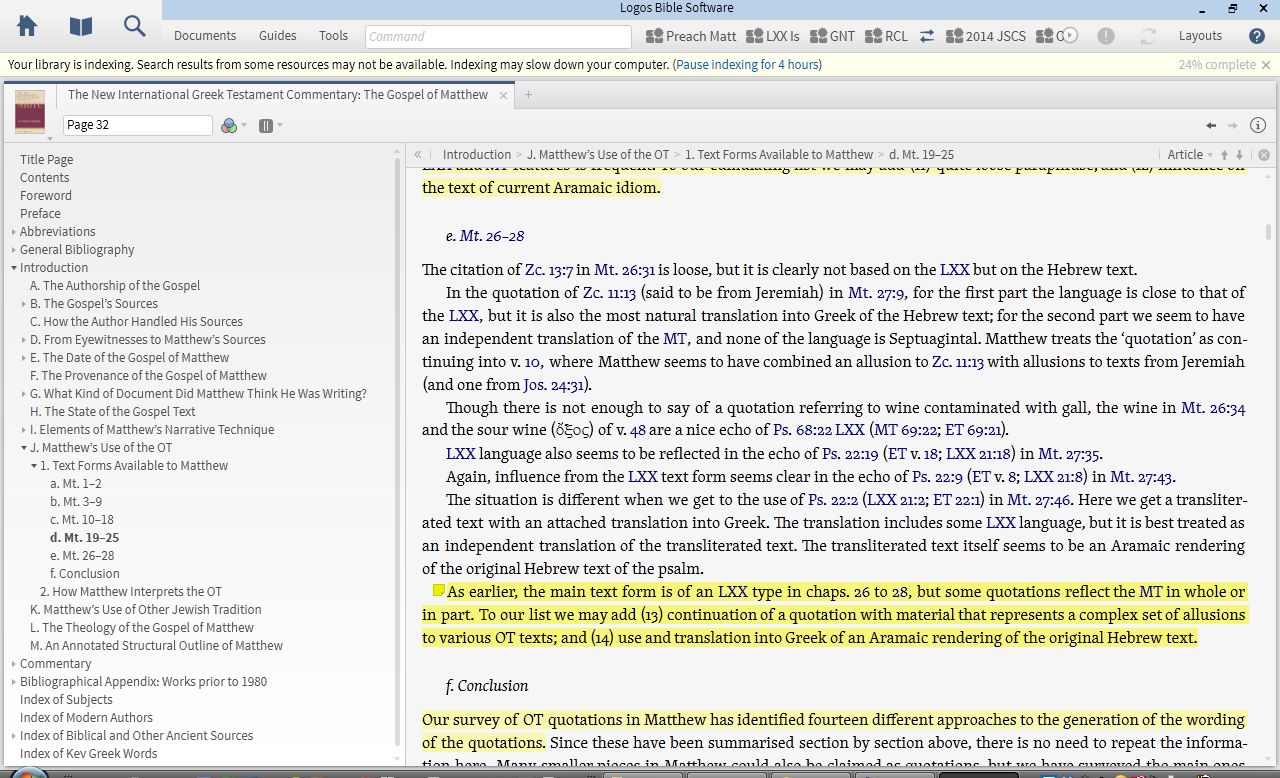
Here’s what it looks like in Logos on a PC. You can hide or show the table of contents at the left, and many of its sections have expand/collapse triangles (click or open in a new tab to enlarge the image below):

Introduction to Matthew

Any highlights or notes I add (which you can see above) automatically sync with any other devices that run the Logos app.

Like R.T. France, Nolland would rather elaborate on certain points in the body of the commentary itself, which makes the introduction accordingly shorter. I experienced this as a relief, because (a) I could get into the commentary proper more quickly and (b) when primarily coming to the commentary with a specific passage in mind, I found quite a bit of substance in the commentary proper, without having to go back to the introduction. Getting to a given passage via Logos is almost instantaneous.

Nolland on Matthew’s Use of the OT

There is more of note in the introduction, but “Matthew’s Use of the OT” is probably the most exceptional section (pictured above). It details both (a) what text forms Matthew might have had and (b) how he used them. Nolland lists 14 (!) “different approaches to the generation of the wording of the quotations.” And yet, amid the detail, he can conclude:

Though some of Matthew’s text forms come to him straight from the Gospel tradition, the overall impression is of a man who freshly scrutinises, at least on many occasions, the OT texts to which he appeals, and is able to do so in Greek, Hebrew (not always the Hebrew of the preserved MT), and occasionally in Aramaic. When it suits him to do so, he produces translations that reflect influence along more than one track of tradition.

Nolland then identifies eight different ways in which Matthew uses the OT. This section of the commentary alone is worth half the price of the commentary. A nearly 20-page “Annotated Structural Outline of Matthew” at the end of the introduction is quite impressive (and maybe even worth the other half of the price of the commentary).

The Author’s Translation of Matthew

Nolland admits that his translation of Matthew (located at the beginning of each section) “may at times be wooden,” and this woodenness is noticeable in a number passages. For example, the genealogy reads: “Abraham produced Isaac; Isaac produced Jacob….” Nolland acknowledges the “unfortunately impersonal and nonbiological” implications of that translation. Indeed, a better word is needed.

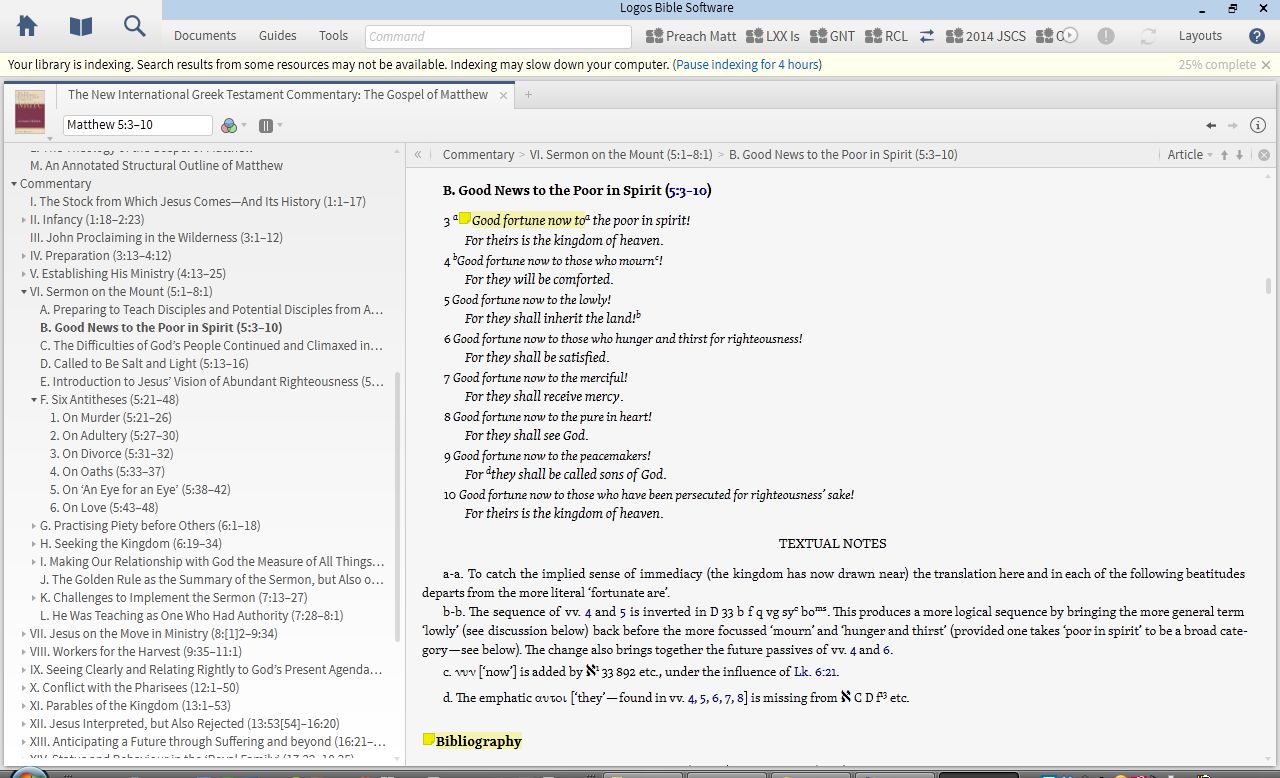
And for the Beatitudes (where the Greek μακάριος is admittedly difficult to translate), he has, “Good fortune now to….” I liked  the “now” part of this (it carries an “implied sense of immediacy”), but the more traditional “blessed” still seems to leave room in English for the divine blesser, who should be kept in view here. “Good fortune now” seems to miss that.

The commentary proper (with original translation)
The commentary (with original translation)

A more readable translation would not have compromised Nolland’s aims in producing a fairly literal rendering of the Greek. It wasn’t an enormous distraction from a well-written commentary, but it stood out, nonetheless.

The Commentary Proper

It would be impossible for Nolland to be comprehensive at every turn. There were some Greek words or passages of Matthew where I had hoped for more detail, but on the whole, Nolland is thorough.

For instance, in the narrative of the devil’s temptation of Jesus in Matthew 4, Nolland writes of verse 1:

The opening ‘then’, the role of the Spirit, and the Son of God language to come in vv. 2 and 6 create a strong link between 4:1–11 and 3:13–17.

and:

Because of the agency of the devil (and the specific temptations to come) πειρασθῆναι has been translated ‘to be tempted’, but there is in fact a play on the two senses of the πειραζ- root: ‘test’ or ‘tempt’.

This commentary matches literary sensitivity and Greek analysis with conclusions that can easily lead the reader to application. In the same passage: “[T]he devil suggests that sonship is a privilege to be exploited, that Jesus should use his opportunities to see to his own needs.”

Nolland often presents multiple scholarly interpretations of a given passage before offering his own–and even then, he does it humbly (though not unconvincingly). In the Beatitudes, for instance, he notes 11 different understandings of “poor” and four different understandings of “in spirit” for Matthew 5:3. One gets the sense that the author is just as interested in historical interpretation of given passages as he is with his own. This is a good thing.

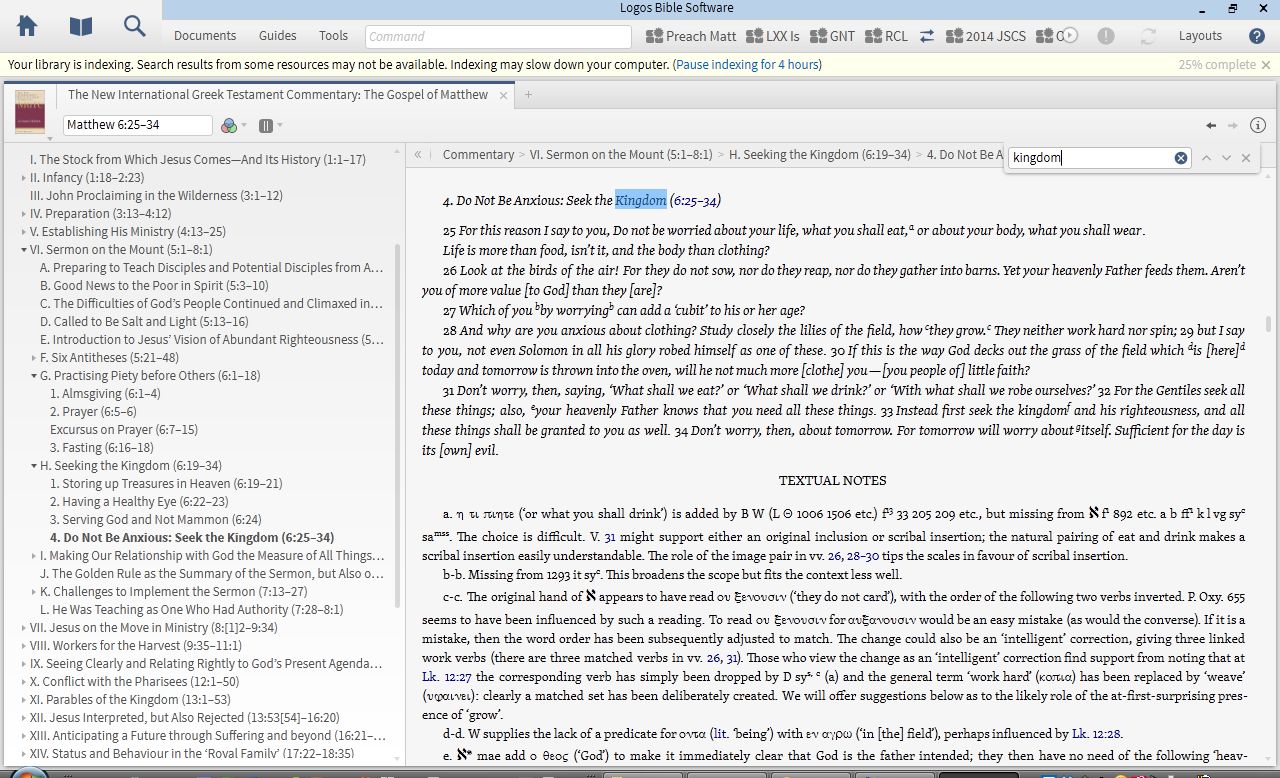
In Logos, one can search the commentary using control+F (PC) or command+F (Mac):

Keyword searching NIGTC
Keyword searching NIGTC for “kingdom”

One cool thing about this is that if you are already in Matthew 6:25 of the commentary (as above), the search results start right where you are (instead of going back to the beginning of the commentary). This way one can research a given word or theme as it unfolds in Nolland’s writing.

Concluding Evaluation

Despite the technical nature of the commentary (which I appreciated), the writing style is engaging and accessible, even inspiring in places. I loved this:

Jesus proclaims the imminent arrival of the kingdom of heaven. God now intends to establish afresh his rule among his people. If people are to be ready for this development, then repentance is urgent. Only a fundamental change of life direction will match the needs of the moment.

The bibliographies are a gold mine. One wonders if there’s any journal article or monograph on Matthew that Nolland hasn’t examined. Even so, he says in his preface that he had to trim his listing to accommodate the requirements of the editors!

My critique of the author’s translation notwithstanding, Nolland’s Matthew is a magnificent work, probably even one of the very first places one should go when doing in-depth study of Matthew’s text. Nolland does not disappoint in his technical analysis of words and passages, and yet he somehow is able to keep the Gospel as a whole before him and the reader as he expounds on its component parts. The reader cannot help but be impressed throughout the commentary, both with Nolland, and with Matthew’s Gospel which he describes.

Thanks to Logos for the review copy of the NIGTC series. I will post more in the future about the series and its use in Logos.

New OT Commentary Series: Hearing the Message of Scripture

HMS Obadiah by BlockZondervan has just published the first two volumes of a new Old Testament commentary series, Hearing the Message of Scripture. Here’s part of a brief description of its approach:

[W]hen dealing with specific texts, the authors of the commentaries in this series are concerned with three principal questions:

  1. What are the principal theological points the biblical writers are making?
  2. How do biblical writers make those points?
  3. What significance does the message of the present text have for understanding the message of the biblical book within which it is embedded and the message of the Scriptures as a whole?

The achievement of these goals requires careful attention to the way ideas are expressed in the OT, including the selection and arrangement of materials and the syntactical shaping of the text.

Zondervan introduces the series more fully here, with a listing of contributors here. Or, if you prefer a video introduction, here is Series Editor Daniel I. Block on the series:

You can see PDF samples from Obadiah (by Daniel I. Block) here and from Jonah (by Kevin J. Youngblood) here. Zondervan’s book pages for each title are here and here. I’ve read half of the Obadiah volume so far and will post a review shortly.

Isaiah (Tyndale Commentary) by Motyer, reviewed

Motyer TOTC Isaiah

J. Alec Motyer writes about his Isaiah (Tyndale Old Testament Commentaries):

I have set out to provide a ‘reader’s commentary’ on Isaiah – a companion to daily Bible reading – and I believe that those who use it this way will reap the largest rewards from it. This is not to say that it cannot be used to look up ‘spot’ verses or passages, for I have done my best not to evade difficulties and, in every such place, to ask what a reader, Bible in hand, would find most useful to know.

The series has “the serious Bible reader” as its intended audience. It blends exegesis, theology, history, and application nicely.

Motyer’s Introduction to Isaiah

Motyer’s brief (less than 25 pages) introduction contains these sections:

  1. Isaiah’s message: Motyer summarizes Isaiah in five pages.
  2. Isaiah’s thought: “Isaiah is the Paul…’Hebrews’…James of the Old Testament….”
  3. Isaiah’s book: Motyer highlights the canonical and literary unity of Isaiah, bluntly noting that using stylistic differences to identify different authors “is and always has been a nonsense.”
  4. Text: “The Hebrew Text (MT) of Isaiah has come to us in fine preservation without any real doubt what the text means or a serious necessity of emendation.”
  5. Isaiah and the New Testament: “The New Testament quotes Isaiah more than all the other prophets together….”

Following the introduction is a six-page “Analysis,” which is a fairly detailed outline of Isaiah. IVP and Motyer have made the commentary easier to work through by then using this outline to structure the commentary proper. Each of the headings, points, and sub-points appear at the appropriate spots in the commentary for easier navigation. You always know where you are in the larger context of Isaiah, as Motyer understands it.

The Commentary Proper

I’ve used the Tyndale commentaries in preaching and also individual Bible reading. Motyer is not only a good exegete; he’s engaging and funny (e.g., he refers to a “stink-fruit harvest” in Isaiah 5).

Theologically, Motyer is comfortable (as we all should be, I think) with the idea of predictive prophecy: “There is no need to find anything difficult or strange in Isaiah’s prediction of Babylonian captivity.” Yet he engages critical scholarship that reads the book differently. Motyer addresses the book’s authorship, but he is more concerned with the book in its current form than anything like redaction criticism.

Motyer’s application of Isaiah is inspiring. Of Isaiah 2:1-5 he says, “[I]f the world is ever to say Come, let us go up (3), the Lord’s people must heed the call Come … let us walk (5): the first requirement in evangelism is to have a church that is worth joining!” While Isaiah was not necessarily thinking in these terms, it’s a good way for us who read him today to apply his message.

I would have liked to see more comment on the Servant/Anointed One as Jesus, or on how the New Testament picks up and uses such imagery. There is some of this–for example, Motyer mentions that Isaiah 61:1-4 is the passage Jesus read in Luke 4, “establishing the messianic credentials of Isaiah’s presentation.” And this is not necessarily a given in an Isaiah commentary, but since this is a series for “today’s Christian church and reader,” I had been hoping Motyer would go further in application.

Regarding the beautiful Isaiah 61 Motyer uses a wonderful turn of phrase to talk about the reversal of fortunes Yahweh will bring about: divine replacement therapy. His take on verse 3 is especially compelling. Isaiah reads (NIV):

and provide for those who grieve in Zion—
to bestow on them a crown of beauty
    instead of ashes,
the oil of joy
    instead of mourning,
and a garment of praise
    instead of a spirit of despair.
They will be called oaks of righteousness,
    a planting of the Lord
    for the display of his splendor.

Motyer has this gem of a comment:

Note the downward movement of the transformation: from the crown (lit. ‘head-dress’; 3:20; cf. 61:10; Exod. 39:28), to the head (oil), to the clothing (garment). (Cf. the running down of Ps. 133:2–3, significant of heavenly outpouring.) Note also the inward movement of ashes, the visible evidence of grief (58:5; 2 Sam. 13:19), to mourning, grief in the heart, to the inner spirit of despair. The Lord thus acts to pierce progressively to the innermost need. 

The series and the author’s aims to give the serious Bible reader a guide for Bible study are successful. I’d heartily recommend Motyer’s Isaiah to anyone who is reading through the Bible’s “fifth gospel.”

Thanks to IVP for the review copy. Motyer’s Isaiah (TOTC) is on Amazon here. Its product page is at InterVarsity Press’s site here.

John Nolland’s Matthew (NIGTC) reviewed

NIGTC MatthewThe series preface to The New International Greek Testament Commentary (NIGTC) states:

At a time when the study of Greek is being curtailed in many schools of theology, we hope that the NIGTC will demonstrate the continuing value of studying the Greek New Testament and will be an impetus in the revival of such study.

This is a welcome series to those who want assistance in making good sense of the Greek text.

R.T. France’s volume in NIGTC (Mark) is not only one of my favorite commentaries of all time; it’s one of my favorite books. (I note it briefly here.) And Paul Ellingworth’s Hebrews volume greatly helped me through an exegesis course covering that epistle.

NIGTC: Matthew

Here I review John Nolland’s Matthew volume. I’ve been preaching through Matthew this year, and have used Nolland in my preparation almost every week.

This is how Nolland describes his commentary:

My central concern in this commentary is with the story Matthew has to tell and how he tells it. Though the reader will recognise that I have been influenced by some scholarly methods more than by others, my work is committedly eclectic.

In other words, Nolland looks at Matthew via redaction criticism, language, rhetorical criticism, and more. Though the series does not seek to be devotional, per se, and though NIGTC Matthew is not an application commentary, Nolland is consistently sensitive to the broader context of Matthew and his aims. (Nolland says he cares about “a close reading of the inner logic of the unfolding text.”)

Nolland’s Introduction to Matthew

The introduction includes the following sections (the bullet points below are all the author’s words):

  • authorship of the Gospel
  • the sources for the Gospel
  • the prehistory of the sources
  • the date and provenance of the Gospel
  • the kind of document the Gospel intends to be
  • the state of the Greek text of the Gospel
  • aspects of the author’s narrative technique
  • the Gospel’s use of the OT and of other Jewish tradition
  • and the theology of the Gospel of Matthew.

Like R.T. France, Nolland would rather elaborate on certain points in the body of the commentary itself, which makes the introduction accordingly shorter. I experienced this as a relief, because (a) I could get into the commentary itself sooner and (b) when primarily coming to the commentary with a specific passage in mind, I found quite a bit of substance in the commentary proper, without having to go back to the introduction.

That Matthew was actually the author of this Gospel seems to Nolland to be “most unlikely,” though I would have liked to see more support for Nolland’s conclusion. He doesn’t offer much. The “majority” (though not all) of sourcing for Matthew is attributed to “Mark and Q materials.” Refreshingly, Nolland has this to say about the idea of a historical Jesus:

These considerations do, however, suggest that we may have considerable confidence that the Jesus with whom the Gospels connect us is, and is in detail, the Jesus who actually operated in Palestine in the first century and not some mythical construct. The Gospel writers and those who supplied them their raw materials wanted people to get in touch with Jesus because of his potential significance for them, but they would feel no need to apologise for failing to meet all the needs of our historical curiosity.

Though aware of Gentiles, too, “Matthew writes for Jewish Christians who are very conscious of their Jewish identity.” Nolland writes, “Matthew seems to have understood himself to be creating a foundational text to which people would feel the need to return again and again.”

Nolland on Matthew’s Use of the OT

There is more of note in the introduction, but “Matthew’s Use of the OT” is probably the most exceptional section. It details both (a) what text forms Matthew might have had and (b) how he used them. Nolland lists 14 (!) “different approaches to the generation of the wording of the quotations.” And yet, amid the detail, he can conclude:

Though some of Matthew’s text forms come to him straight from the Gospel tradition, the overall impression is of a man who freshly scrutinises, at least on many occasions, the OT texts to which he appeals, and is able to do so in Greek, Hebrew (not always the Hebrew of the preserved MT), and occasionally in Aramaic. When it suits him to do so, he produces translations that reflect influence along more than one track of tradition.

Nolland then identifies eight different ways in which Matthew uses the OT. This section of the commentary alone is worth half the price of the commentary. A nearly 20-page “Annotated Structural Outline of Matthew” at the end of the introduction is quite impressive (and maybe even worth the other half of the price of the commentary).

The Author’s Translation of Matthew

Nolland admits that his translation of Matthew (located at the beginning of each section) “may at times be wooden,” and this woodenness is noticeable in a number passages. For example, the genealogy reads: “Abraham produced Isaac; Isaac produced Jacob….” Nolland acknowledges the “unfortunately impersonal and nonbiological” implications of that translation. Indeed, a better word is needed.

And for the Beatitudes (where the Greek μακάριος is admittedly difficult to translate), he has, “Good fortune now to….” I liked  the “now” part of this (it carries an “implied sense of immediacy”), but the more traditional “blessed” still seems to leave room in English for the divine blesser, who should be kept in view here. “Good fortune now” seems to miss that.

Finally, the regular use of brackets in the translation made it read even less fluidly than it already did in places. As in: “It is no more fitting that people should light a lamp and put it under the peck measure; rather, [they put it] on the lampstand, and it shines out for all in the house.”

The above is all to say: a more readable translation would not have compromised Nolland’s aims in producing a fairly literal rendering of the Greek. It wasn’t an enormous distraction from a well-written commentary, but it stood out, nonetheless.

The Commentary Proper

It would be impossible for Nolland to be comprehensive at every turn. There were some Greek words or passages of Matthew where I had hoped for more detail, but on the whole, Nolland is thorough.

For instance, in the narrative of the devil’s temptation of Jesus in Matthew 4, Nolland writes of verse 1:

The opening ‘then’, the role of the Spirit, and the Son of God language to come in vv. 2 and 6 create a strong link between 4:1–11 and 3:13–17.

and:

Because of the agency of the devil (and the specific temptations to come) πειρασθῆναι has been translated ‘to be tempted’, but there is in fact a play on the two senses of the πειραζ- root: ‘test’ or ‘tempt’.

This commentary matches literary sensitivity and Greek analysis with conclusions that can easily lead the reader to application. In the same passage: “[T]he devil suggests that sonship is a privilege to be exploited, that Jesus should use his opportunities to see to his own needs.”

Nolland often presents multiple scholarly interpretations of a given passage before offering his own–and even then, he does it humbly (though not unconvincingly). In the Beatitudes, for instance, he notes 11 different understandings of “poor” and four different understandings of “in spirit” for Matthew 5:3. One gets the sense that the author is just as interested in historical interpretation of given passages as he is with his own. This is a good thing.

Concluding Evaluation

Despite the technical nature of the commentary (which I appreciated), the writing style is engaging and accessible, even inspiring in places. I loved this:

Jesus proclaims the imminent arrival of the kingdom of heaven. God now intends to establish afresh his rule among his people. If people are to be ready for this development, then repentance is urgent. Only a fundamental change of life direction will match the needs of the moment.

The bibliographies are a gold mine. One wonders if there’s any journal article or monograph on Matthew that Nolland hasn’t examined. Even so, he says in his preface that he had to trim his listing to accommodate the requirements of the editors!

My critique of the author’s translation notwithstanding, Nolland’s Matthew is a magnificent work, probably even one of the very first places one should go when doing in-depth study of Matthew’s text. Nolland does not disappoint in his technical analysis of words and passages, and yet he somehow is able to keep the Gospel as a whole before him and the reader as he expounds on its component parts. The reader cannot help but be impressed throughout the commentary, both with Nolland, and with Matthew’s Gospel which he describes.

Thanks to Eerdmans for the review copy. Nolland’s Gospel of Matthew is on Amazon here. Its product page is at Eerdmans’s site here.

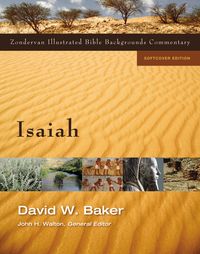
Isaiah (Zondervan Illustrated Bible Backgrounds Commentary)

Isaiah ZIBBCOTWhen I read through Isaiah last year, one resource I consulted whenever I could was the Isaiah section in the Zondervan Illustrated Bible Backgrounds Commentary. Zondervan has recently published it as a stand-alone book.

The sort of “backgrounds” that Isaiah describes are history, geography, culture, archaeology, and comparison to other Ancient Near Eastern texts and traditions. The introduction is quite short, but with its timelines of kings and map and historical overview, it provides a solid orientation to Isaiah.

David W. Baker’s comments on the first two words of Isaiah give a good sense of the approach of his commentary:

The vision (1:1). Most prophecies begin with a self-identification that can contain elements such as the type of literature, the identity of the prophet, and the time period. These indicate that they contain actual messages to a real audience addressing real-life issues they were facing. “Vision” is a form of divine revelation that did not necessarily involve the physical eyes, since here it involves primarily words rather than images (cf. 2:1). Prophets of Yahweh and pagan prophets experienced them. In Mesopotamia, even laypeople, both men and women, received visions or dreams from their gods.

The commentary does not reproduce the entire biblical text, but the words and verse to be commented on are marked in bold.

Isaiah 22:16 (NIV) reads:

What are you doing here and who gave you permission
to cut out a grave for yourself here,
hewing your grave on the height
and chiseling your resting place in the rock?

The verse makes some sense in its context already, but Baker’s concise comment adds more:

Hewing your grave (22:16). In Jerusalem, tombs were often hewn from the limestone rock, especially by people with means (e.g., Gen. 50:5; 2 Chr. 16:14; Matt. 27:60).

Baker has excursuses throughout the book that further illuminate themes like “Names and Naming” (Isaiah 9), “Assyrian Siege Tactics” (Isaiah 23), and “Divine Mercy” (Isaiah 54-55).

Swords shall be beaten into this (image from the book)

The ZIBBC series does not offer much by way of grammatical analysis or rhetorical criticism, but neither does it seek to. It ably accomplishes its purpose of giving the reader background information on the text, as well as sources for further reading.

To that end more than 1,700 (!) endnotes supply citations and bibliographic information that one can follow. (Note: I much prefer footnotes to endnotes, but with all of the sidebars and charts and photographs already in the body of the text, I think I see why the series uses endnotes.)

As the commentary progressed, I occasionally grew tired of the constant comparison of Isaiah to other Ancient Near Eastern parallels. On the one hand, it wouldn’t be entirely fair to criticize a “Bible Backgrounds” commentary for this, but the parallels sometimes felt a little strained.

Yet at other times the connections to ANE texts are illuminating, and downright fascinating. For instance, in a section called “Year of the Lord’s Favor,” covering Isaiah 61:1-11, Baker writes

Happiness and plenty are the goal of an ideal reign. A letter containing a prophecy addressed to Ashurbanipal foretells blessings from Shamash and Adad. These gods establish

a happy reign: days of justice, years of equity, heavy rains, water in full flood, a thriving commerce … Old men dance, young men sing, women and maidens are glad and make merry … Whom his crime has condemned to death, the king my lord has let live; who has been held prisoner many years, is set free; who were sick many days have recovered. The hungry have been sated; the lice-infested have been anointed; the naked have been clad in garments.

Many of these same elements characterize the anticipated messianic reign in Israel….

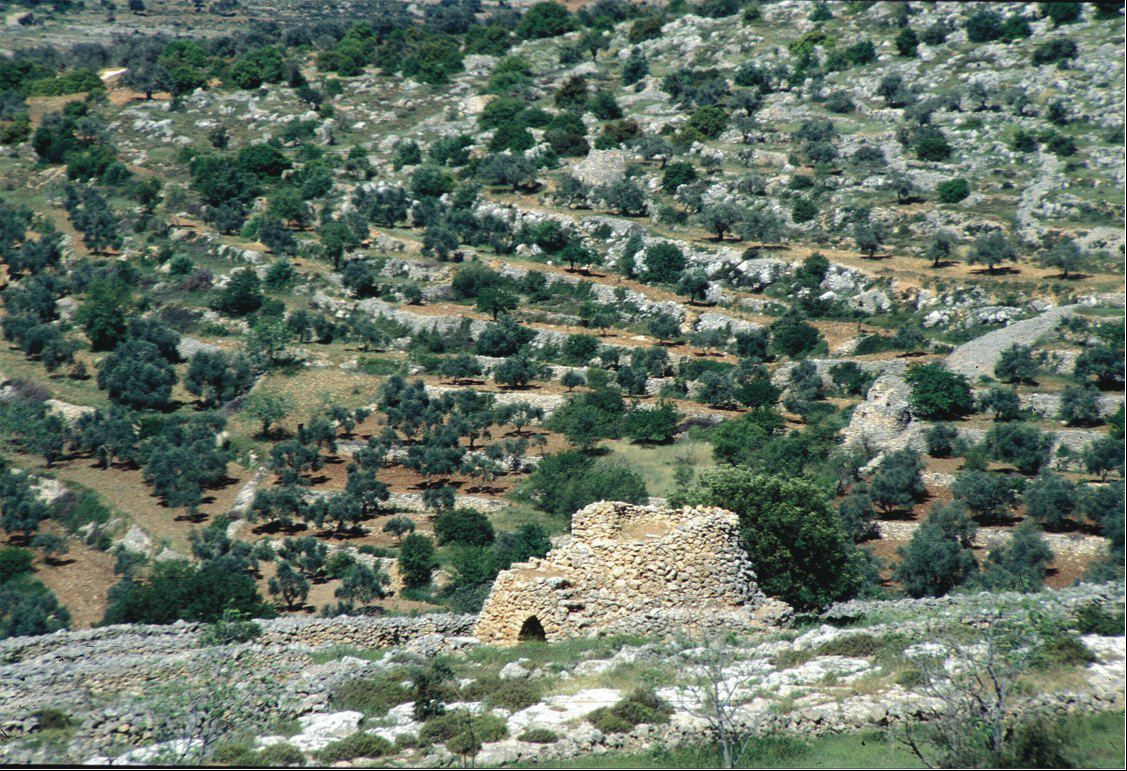
"He built a watchtower..." (Isa. 5:2/book image)
“He built a watchtower…” (Isa. 5:2/book image)

One can deduce, then, that the elements of this reign fulfill universally human desires (since they show up in other religious texts) for well-being and freedom. Understanding this enhances one’s read of Isaiah 61. The Messiah, one could say, fulfills a human longing that many cultures and religions have sought to express.

One missing piece in this single volume is the “Methodology: An Introductory Essay” by series editor John H. Walton, that can be found in the multi-book volumes. I would hope that future single volumes in this series include it.

The book is surprisingly well-constructed for a paperback that retails at $19.99. The glossy paper is of high quality, as are the full-color photographs, maps, and charts. The cover and binding are built to last. Regardless of your level of knowledge about the Old Testament or biblical background in general, Baker’s Isaiah is a good second book to have on hand when reading through the biblical book of Isaiah.

Thanks to Zondervan for the review copy. Find it here on Amazon, or at the publisher’s page here.

Timothy Keller’s Romans 1-7 For You

Timothy Keller introduces his Romans 1-7 For You:

The books in the For You series are accessible guides, useful for individual reading or for preparing to teach a group or lead a Bible study on a book of the Bible. The book’s product page puts it like this:

Written for people of every age and stage, from enquirers to new believers to pastors and teachers, this flexible resource is for you to:

• READ: As a guide to this wonderful letter, helping you appreciate the great gift of righteousness with God.
• FEED: As a daily devotional to help you grow in Christ as you read and meditate on this portion of God’s word.
• LEAD: As notes to aid you in explaining, illustrating and applying Romans 1–7 as you preach or lead a Bible study.

Whoever you are, and however you use it, this is… Romans 1-7 For You

I used Keller’s Galatians For You when preaching through Galatians this summer, and found it a helpful guide. Like the Galatians volume, Romans 1-7 generally succeeds in its aim to help readers “read, feed, and lead.” Keller presents his exposition of Romans in an accessible way. He says, “Romans is, at its heart, a letter about the gospel.”

From the first chapter the passage-by-passage comments bring the reader into the world of the text. Paul’s self-identification as “a servant of Christ Jesus” in Romans 1:1 means:

He has direct authority from Christ to teach. What he writes is Scripture. What follows is true.

Like many commentators before him, Keller takes Romans 1:16-17 to be “Paul’s nutshell summary of the gospel–his central thesis statement out of which flows the rest of the letter.” Throughout the rest of the book Keller refers to Paul’s gospel and shows how the rest of chapters 1-7 connect to the thesis statement. Keller not only shows a good sense of how the book fits together, but he also brings in other passages for a fairly robust biblical theology. This has helped me to see how Romans fits in with the rest of Scripture.

Romans 1-7 For You_KellerKeller’s writing is simple and engaging. There are some memorable lines, like this one, referring to the Old and New Testaments: “Every page that God wrote before outlines what he has now declared in full color.”

Each section concludes with “Questions for reflection,” which work well on an individual level and could also be employed in a group setting.

The devotional application is strong here, too. Readers rarely will have to wonder how a given text relates to them, and how it is calling them to live in light of it. This was perhaps what I most appreciated about the guide.

In so doing, however, the book does at times seem to go beyond what Paul himself is writing. For example, it wasn’t clear to me how Keller could conclude from Romans 1:16-17: “The gospel message is actually the power of God in verbal, cognitive form.” Though Keller is right, I think, that Paul says the gospel itself is power, I can’t find support in the text for its being explicitly verbal or “cognitive.” There were other times I felt Keller’s efforts at application or biblical theology went farther afield than Paul might have intended.

Though the series assumes no knowledge of biblical languages, there are a few Greek transliterated words and definitions. Unfortunately, three of those words are misspelled, which would make it difficult for someone who didn’t otherwise know Greek to look them up. There are a few other typos in the book, too–nothing egregious, but distracting, nonetheless.

There is a simple glossary at the back, as well as appendices. The appendices are three:

  • A detailed 11-page “Summary of Romans 1-7”
  • “Identifying the Idols of the Heart”
  • A few pages of Keller’s assessment of the “new perspective” on Paul

I’ve written more about Romans, and interacted with a number of Romans commentaries here.

The book’s accessibility, Keller’s obvious love for Jesus, and his emphasis on personal application all commend it, though I’d also suggest using it in tandem with something else (Moo and Stott come to mind, both listed in Keller’s bibliography) for the sake of balance and thoroughness.

Thanks to Cross-Focused Reviews and The Good Book Company for the review copy. You can find Romans 1-7 on Amazon here.

A Paradox I Encountered During my Sunday School and Sermon Prep

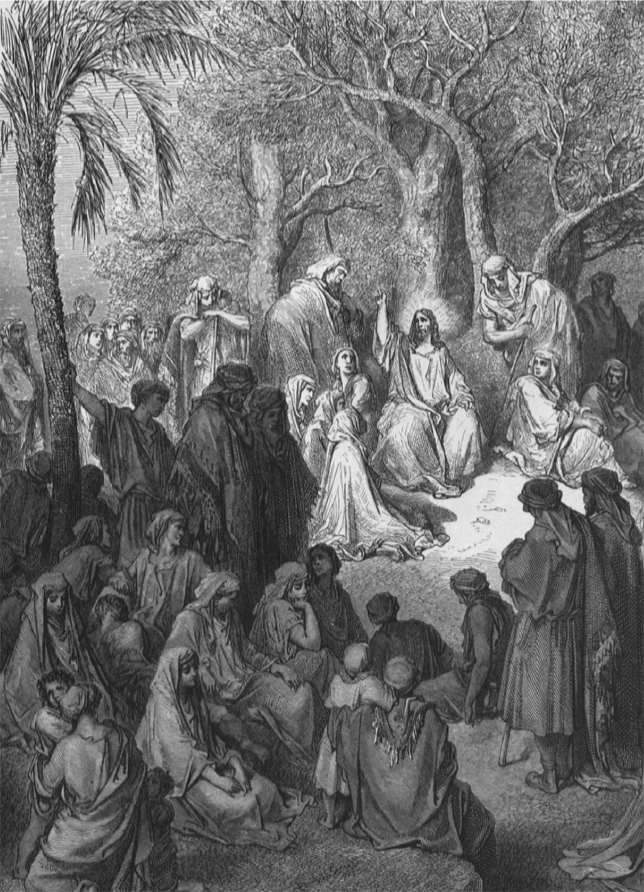
The Sermon on the Mount, by Gustave Doré (1832–1883.
The Sermon on the Mount, by Gustave Doré (1832–1883)

Annie Dillard (whom we are reading for this Sunday’s Sunday School class) writes:

I cannot cause light; the most I can do is try to put myself in the path of its beam.

And yet Jesus confidently tells his disciples (before they’ve even done much of anything): 

You are the light of the world. …Let your light shine before others, that they may see your good deeds and praise your Father in heaven.

Those lines of Jesus are from the Sermon on the Mount, on which I’m preaching. Holding those two ideas about light in juxtaposition has made for interesting preparation for this Sunday! On the face of it, they seem to contradict, but I don’t think they really do…. I’ll try to post more here next week, as I continue to work it out.

One Way to Improve Your Biblical Hebrew Is…

…to beef up your knowledge of vocabulary in the Hebrew Bible. But reading through the detailed instructions on building the tabernacle (Exodus 26 and following) can feel like too much of a vocab stretch. It seems like every other word is a rare one. Using an alphabetically organized lexicon for such passages really slows down the reading. Also, readers who have a way to gauge how common a word is can decide if they should know it or not.

Back in Print

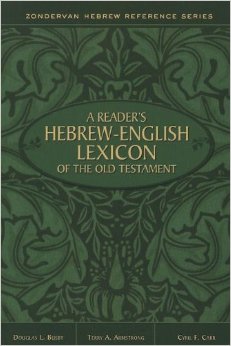
Readers Hebrew English LexiconA resource that has been out of print for some time is now back and available in a (cheaper) paperback edition. Zondervan’s Reader’s Hebrew-English Lexicon of the Old Testament offers verse-by-verse glosses (short translation equivalents) for rarely occurring words in the Hebrew Bible. The glosses are based on the Brown/Driver/Briggs (BDB) lexicon, with the context of each verse also taken into account. Organized in canonical order and covering the whole Old Testament, the lexicon lists each word that occurs 50 times or less in the Old Testament. Next to the word is the gloss and how many times that word appears in (a) a given book and (b) the whole Hebrew Bible. Each entry also has the page number in BDB, if you want to consult that additional work for a longer definition of a word. For verbs, the number of occurrences of that particular stem is also noted.

The lexicon follows the order of books that the Hebrew Bible does (i.e., the ordering differs from English Bibles). Only numbers and proper nouns are not included. The lexicon clocks in at 720 pages. It’s not as portable as when this single work was split into four volumes, but those are as hard to find as the four-volumes-in-one hardback had been. A Reader’s Hebrew-English Lexicon is intended to be a sort of counterpart to Kubo’s Greek lexicon by Zondervan. Here’s what it looks like:

HebrewI often struggle to remember Hebrew words that occur between 50 and 100 times in the OT, so the additional appendix is especially useful–it has Hebrew words that occur more than 50 times. There is also an Aramaic appendix.

How I Use It, Why I Like It

I’ve used this reader’s lexicon in tandem with Zondervan’s nicely laid out  “reader’s” edition of the Hebrew Bible. Though that Bible already footnotes rarely occurring words, the frequency counts in this lexicon help me know if it’s a word I should have known (e.g., one that occurs 45 times) or one I shouldn’t be surprised to not know (e.g., one that occurs three times).

The glosses are sufficient for rapid reading of the text. And the frequency counts add a nice orienting element not found in the reader’s Bible.

This edition is a reprint, so nothing has been re-formatted or changed in terms of the font. The font, while not always crisp on every page, is readable, both in Hebrew and English.

Yes, there are good Bible software options for reading the text, but I still like to read through the Hebrew Bible in print, and this reader’s lexicon makes for a convenient and trustworthy guide. For bettering one’s Hebrew vocabulary and reading, I heartily recommend it.

Thanks to Zondervan for the review copy of the lexicon. Its product page is here. It’s here on Amazon.