Reading through Isaiah, I’ve made connections between biblical texts that I never noticed before. I’ve posted about Philippians and Ephesians. Today I saw something in Isaiah 63:11 that seems to have inspired the author of Hebrews.
Isaiah 63:11
English: And the one who brought up from the landthe shepherd of the sheep remembered the days of eternity. Where is the one who put his holy spirit in them?
English: And the God of peace, who brought up from the deadthe great shepherd of the sheep, our Lord Jesus Christ, by the blood of the eternal covenant…
Though Hebrews has “great” in addition to “the shepherd of the sheep,” the latter phrase (τὸν ποιμένα τῶν προβάτωνin Greek) is identical in both passages.
The author of Hebrews seems to want to explicitly identify “the shepherd of the sheep” from Isaiah, which he/she does by noting that this “great” shepherd is “our Lord Jesus Christ.”
Did the author of Hebrews intend with “brought up from the dead” to echo Isaiah’s “brought up from the land”? The Greek verbs are different, but both have the ἀνα=up prefix, and both are in participial form.
If Hebrews’s bringing up is meant to evoke Isaiah’s bringing up, is Hebrews taking Isaiah’s exodus motif in Isaiah 63 and holding up Jesus as the leader of the new exodus?
Both passages have “eternity” (αἰώνιος) in view.
I haven’t checked commentaries yet, but after observing the above, I noticed that the critical apparatus (manuscript notes) in the Göttingen edition of the Septuagint notes that Hebrews 13:20 should be consulted.
I plan to see what others have written about this, but for now, the similarities above have me fairly convinced that this was a deliberate reference, and that the author of Hebrews was finding Jesus in Isaiah 63:11.
Isaiah 1:1 reads, “The vision of Isaiah son of Amoz, which he saw concerning Judah and Jerusalem in the days of Uzziah, Jotham, Ahaz, and Hezekiah, kings of Judah” (NRSV).
Scholars remain divided as to whether or not this “vision of Isaiah” verse is meant to apply to all 66 chapters, or whether Isaiah might be the author of just the first 39 chapters, with other authors (in the tradition of Isaiah) having penned chapters 40-55 and 56-66.
I’ve long had my eye on The Eerdmans Companion to the Bible and have begun using it recently. Its introductory section to Isaiah had what I thought was a refreshingly balanced approach to the issue of authorship in Isaiah:
Taken as an introduction to the book as a whole, Isa. 1:1 identifies the contents of the subsequent 66 chapters as the “vision” of 8th–century Isaiah. But modern scholars have challenged the traditional view that considers him the source of all the material contained in the book that bears his name. Though chapters 40–66 echo certain themes contained in chapters 1–39, they also contain specific, predictive prophecies that some scholars doubt Isaiah foretold. For example, they consider it unlikely that an 8th–century prophet not only predicted the 6th–century Persian king Cyrus’s conquest of the Babylonian Empire but also named him specifically (see 44:28 and 45:1). Old Testament prophets normally directed their messages to contemporaries. For Isaiah to have directly addressed the Babylonian exiles (and perhaps returnees to Judah) pictured in chapters 40–66, his prophetic ministry would have to have extended well beyond the reign of Hezekiah (the last king mentioned in 1:1), and he would have to have lived for more than two centuries.
On the other hand, in this book God holds out his power to predict the future as proof of his divine supremacy (chs. 41, 44, 46, and 48). It is not unreasonable, therefore, to think that Isaiah mediated predictive messages as words from God and at times addressed audiences of future generations.
More details on this Bible guide are here at the Eerdmans page. I’m finding that it’s a concise yet substantive way to get myself oriented to a given book of the Bible.
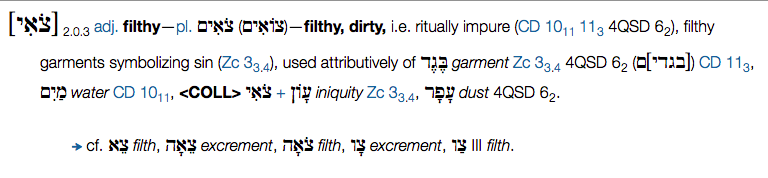
Recently I’ve been paying more attention to the Dictionary of Classical Hebrew and its Concise counterpart (see here).
It took me a little while to figure out how to read the frequency stats in DCH/CDCH. So I’m posting this little tidbit here to save some folks a bit of time.
The introduction to the concise version of the lexicon reads:
2. Statistics. Next comes a notation of the number of occurrences of the word in each of the four corpora of ancient Hebrew: the Bible, Ben Sira, the Dead Sea Scrolls, and the Inscriptions. Thus the notation 334.5.13.32 means that the word occurs 334 times in the Bible, 5 times in Ben Sira, 13 times in the Dead Sea Scrolls and 32 times in the Hebrew Inscriptions. If there is only one number in the statistics, the word occurs only in the Hebrew Bible, and if the notation is, for example, 0.0.7, it means that it occurs only in the Dead Sea Scrolls, and that 7 times. In the case of verbs, occurrence statistics are also given for each of the voices (or, binyanim).
The entry for נתן has a frequency count of “2015.62.228.26.” That’s straightforward enough. But then with the entry for תרומה the frequency given is “76.2.18.” This means it occurs 76 times in the Bible, 2 in Ben Sira, 18 times in the DSS, and 0 times in the Inscriptions. Another entry that has “11.4″ means 11 times in the Bible, 4 times in Ben Sira, 0 in DSS and 0 in the Inscriptions.
What took me a little while to figure out is that some entries have counts like “376.0.1,” which means 376 occurrences in the Bible, 0 in Ben Sira, 1 in DSS, and 0 in the Inscriptions.
The 0s are not noted, then, if there is not still a number to come after it that is 1 or more. In other words, you’d have “376.0.1,” but never “376.1.0.0″ or even “376.1.0.” That would be abbreviated instead to “376.1.”
It would have been easier if all the 0s were inserted in every case, so that you were always looking at 4 actual numbers (thinking of 0 as a “number” for the moment), but I am guessing that this is because the longer DCH (at 8 volumes in print) likely couldn’t afford to be filled with 0s, where they could otherwise be deleted.
In summary, the four corpora in this lexicon are:
Hebrew Bible
Ben Sira
Dead Sea Scrolls
Hebrew Inscriptions
Committing that sequence to memory (and better understanding when a 0 is used and not used) makes use of the lexicon even easier. I appreciate DCH/CDCH’s inclusion of frequency statistics, as I use it to build my Hebrew vocabulary.
I use the Concise DCH for regular Hebrew reading in Accordance, but have just recently been really getting to know it as a lexicon. The print version of The Concise DCH is here; in Accordance it is here. The full 8-volume set from Sheffield Phoenix Press is here, found also here at Accordance.
HALOT has been the scholarly standard in Hebrew lexicons, but might that change?
The mammoth 8-volume Dictionary of Classical Hebrew (DCH) is another major lexical source for readers of biblical Hebrew to consult. What is unique about the DCH is that lexicons like HALOT and Brown-Driver-Briggs (BDB) cover solely the Hebrew found in the Hebrew Bible. DCH, by contrast, covers a wider corpus–“from the earliest times to 200 CE,” it says. According to its product page:
It is the first dictionary of the classical Hebrew language to cover not only the biblical texts but also Ben Sira, the Dead Sea Scrolls and the Hebrew inscriptions. It is the first dictionary to analyse the exact sense of every occurrence of every word, to follow every Hebrew word or phrase with an English equivalent, to print a frequency table of occurrences of each word, and to provide an English-Hebrew index.
Not least among its features is its addition of more than 3500 new words to the stock of the Hebrew lexicon, together with an extraordinarily rich bibliography surveying special lexicographical studies over the last century.
The Concise Version
The 8-volume set in print is high-priced, as one would expect. It is much more affordable (as “affordable” goes, in these contexts) in Accordance, which is currently the only Bible software to carry it. The concise version seems to be financially within the reach of many students and pastors.
What is remarkable about the concise version of the dictionary is: “All the words in the full Dictionary of Classical Hebrew are to be found in the CDCH.” Of course, there are less instances of a given word’s occurrence listed, but that every word of the 8-volume set is treated in its 500-some-page younger sister is impressive.
The CDCH thus contains not only the c. 8400 Hebrew words found in the standard dictionaries, but also a further 3340+ words (540 from the Dead Sea Scrolls, 680 from other ancient Hebrew literature, and 2120+ proposed words for the Hebrew Bible not previously recognized by dictionaries).
By way of comparison, here is an entry for the same (rarely occurring) word in the concise and full dictionaries, respectively:
Full DCHConcise DCH
I use the Concise DCH for regular Hebrew reading in Accordance, but have just recently been really getting to know it as a lexicon. (UPDATE: see another post here on word frequency statistics in the lexicon.) The print version of The Concise DCH is here; in Accordance it is here. The full 8-volume set from Sheffield Phoenix Press is here, found also here at Accordance.
Ephesians 6:10-11 says, “Finally, be strong in the Lord and in his mighty power. Put on the full armor of God….”
This “of” is perhaps best understood to mean, “the armor that God himself wears, that is also available to you.” Isaiah 59:17 talks about the Lord (“Yahweh”) putting on righteousness like a breastplate and a helmet of salvation. Ephesians 6 mentions these same items.
The “armor” we are called to put on, then, is God’s own armor. We “put on” the attributes and characteristics of God. Because of his righteousness, we are called righteous. Because he is a God of peace, we can be at peace and make peace with others. Because of the faithfulness of Jesus, we can have faith.
And, what is more, God-as-Warrior is going on ahead of each of us, wearing that “armor,” fighting spiritual battles before us. As we follow him, we are given his same armor to wear.
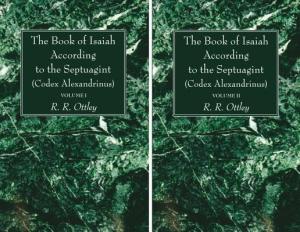
The text will be, as usual, from R.R. Ottley’s Book of Isaiah According to the Septuagint(pictured above). Ottley is here in Logos (reviewed here) and here as a free, downloadable pdf in the public domain. The full reading plan for our group is here (pdf).
See here for more resources and links to texts for Greek Isaiah.
Recently I’ve been spending time with The Anchor Yale Bible Dictionaryin Logos Bible Software. In the coming weeks I’ll review it here, summarizing some of the articles, commenting on their content, and evaluating the dictionary’s presentation in Logos. (You can find my other Logos reviews here.)
The dictionary is massive, consisting of six volumes and somewhere in the ballpark of 7,000 total pages. Here are a few more features, taking from the dictionary’s publisher’s page:
– Includes six volumes of approximately 1,200 pages each
– More than 6,000 entries
– More than 7,000,000 words
– Nearly 1,000 contributors
– Multicultural and interdisciplinary in scope
– An unprecedented interfaith exploration of the Bible
– Illustrated throughout with easy-to-find references
– Extensively cross-referenced for comprehensive coverage of topics
– Easy-to-read article and chapter headings for speedy location of material
– Full bibliographical references following all major entries
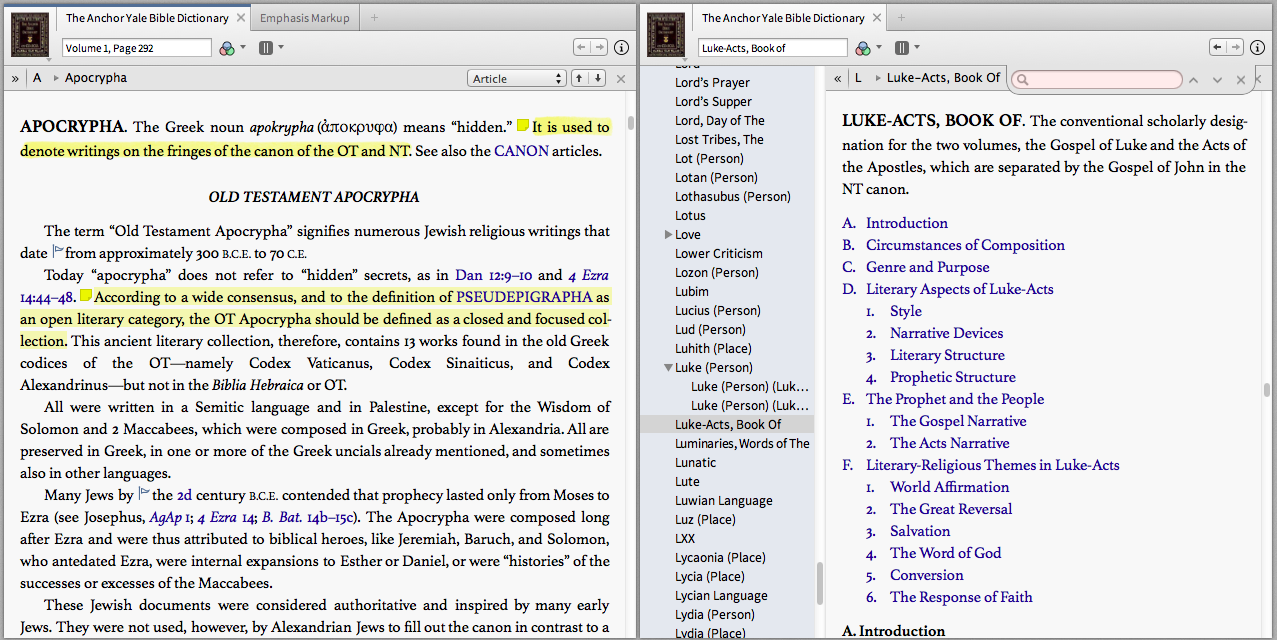
In Logos on a computer there is the added bonus of being able to open more than one entry at a time:
Two articles open at a time (click to enlarge)
As with the rest of Logos’s resources, all of the content in blue above is hyperlinked. So with the verse references you can hover over them for a popup of the verse text, or click on a hyperlink to open its contents in a new window. In the right half of the screen above, clicking on a section in the article takes you directly there.
I’m preaching this week on the Pharisee and the Tax Collector, so wanted to read a bit more about tax collectors. I type the entry name into the search bar to get there. Or I could navigate there via the left contents sidebar.
Looking something up
The “Tax Collector” article by John R. Donahue begins this way, with elaboration on each of the three mentioned “problems”:
Among the NT writings, only the Synoptic Gospels recount Jesus’ association with tax collectors (telōnai, KJV, “publicans”). Three problems attend this picture: (1) the identity and status of the telōnai, (2) the moral evaluation of them, and (3) the significance of Jesus as “a friend of tax collectors and sinners” (Matt 11:19; Luke 7:34).
In “Identity and Status” Donahue helpfully begins, “Etymologically telōnēs is a combination of telos in the sense of something paid for the purpose of the state, a toll, tax or duty; and ōneisthai (noun, ōnē), to buy or purchase.” I highlighted this sentence in Logos on my iPad and then moved to a computer, where the highlight had almost instantaneously synced to display there, too. Had I made a note at that sentence, it would sync, as well.
Donahue summarizes the Greco-Roman history of the term and office of the telōnēs, then moves into the details of how “Palestine was forced to pay tribute to Rome” after Pompey’s siege in 63 B.C.E. He differentiates between the different kinds of taxes (poll/census taxes, land taxes, etc.), as well as the different senses in which “tax collector” (telōnai) could be used. He concludes that the telōnai with whom Jesus interacts appear to be “toll collectors,” or, “minor functionaries fulfilling the orders of higher officials.”
In “Moral Evaluation” of the tax collectors, Donahue notes that “negative views” of this group of people occur outside the New Testament, as well (e.g., in rabbinic and secular literature). The author writes, “In Roman and Hellenistic literature they are lumped together with beggars, thieves, and robbers,” citing sources and giving examples. Knowing this helps me to better appreciate just how universally despised tax collectors were. This adds more punch to the parable in Luke. The New Testament itself (including Luke 18), as Donahue notes, mentions them in the same breath as “sinners” and “immoral people.”
“Jesus and the Tax Collectors” is the third and final section of the article. Multiple hyperlinked NT references in the article take the reader to places in the Synoptic Gospels where Jesus sits with and shows love to tax collectors. Citing Norman Perrin, Donahue notes:
Jesus’ association with them is viewed as an “acted parable” of his message of God’s mercy to sinners and “an anticipatory sitting at table in the kingdom of God” (Perrin 1967: 107).
A 15-source Biblography concludes the article.
Personally I’m not a big fan of the transliteration throughout the AYBD; I’d rather see τέλος than telos, for example. But that is the editorial decision of this dictionary. It’s not insurmountable, but does require a little extra work on the part of anyone who knows other languages but may not be used to seeing their transliterations.
Other than that quibble, Donahue’s article is indicative of what I’ve seen so far in the Anchor Dictionary: careful and top-notch scholarship that does not therefore suffer from dryness or inaccessibility. There is strength, too, in Donahue’s succinctness.
Evangelical scholars, pastors, and readers will want to be aware of and use their judgment regarding the dictionary’s “critical” approach to biblical studies. Donahue’s citation of “Q” will not be warmly accepted by all. (I and others still want to hear about manuscript evidence for Q.) But this generally does not make the dictionary any less useful or of lower quality.
Though I have other Bible dictionaries I use, when I’m studying, teaching, or preaching on a given topic, I’ll likely reach for (or, rather, click on) the Anchor Dictionary first.
Thanks to Logos Bible Software for the review copy of the Anchor Bible Dictionary. Find it here.
With St. Francis of Assisi, another patron saint of Italy
“When my goodness saw that you could be drawn in no other way, I sent him to be lifted onto the wood of the cross. I made of that cross an anvil where this child of humankind could be hammered into an instrument to release humankind from death and restore it to the life of grace. In this way he drew everything to himself: for he proved his unspeakable love, and the human heart is always drawn by love.”
–Catherine of Siena (1347-1380)
We are spending six weeks in our adult Sunday School with Foster and Smith’s Devotional Classics book. Here are the writers we’ve looked at each session:
A hidden gem in BibleWorks is the “MacDonald Greek Transcription.”
BibleWorks comes with sentence diagrams for the Greek New Testament. They are also useful and look like this:
Luke 18:1-2 (click to enlarge)
The MacDonald transcriptions above, however, replicate something I haven’t seen in any other Bible software (EDIT/UPDATE: Logos has a “clausal outlines” module, minus the color coding), which is the sentence flow method of representing and visualizing a sentence. He uses color coding and spacing to line up parallel ideas and repeated words, making them easier to see than in just the text or even the diagrams.
It’s a great way to get at the motifs and important words of a given passage. And I’d forgotten about it until recently, but am now using it most weeks in sermon preparation.
The full title of the resource above is Syntactic and Thematic Greek Transcription of the New Testament, by William Graham MacDonald, 2008. BibleWorks is available here. Its full contents list is here.