Carta Publishing: 3 New Titles, at Introductory Discount

Carta 25 Off Banner


Carta–one of my favorite publishers–has just announced the release of some new titles. As with anything I’ve seen from Carta, they each look fascinating and thorough, even if the books themselves are brief.

Thanks to Carta, readers of Words on the Word (and anyone, really) can get 25% off a Web order at Carta’s online store. Simply click on any cover image below to go to that title, and enter the code 25-off to receive the discount. The offer is good through December 15 (UPDATE: December 31) or so.

Jerusalem City of the Great King

1. Jerusalem: City of the Great King, by R. Steven Notley (whose excellent works I have reviewed here and here)

This volume, the second of four in The Carta New Testament Atlas series, presents the latest advances in the history and archaeology of Jerusalem. The last fifty years in particular have seen significantly increased efforts to discover the city’s past. New finds every year render what is previously written almost out of date before the ink is dry. With an acknowledgement of this reality, together with a recognition that much of the Old City of Jerusalem remains inaccessible to archaeological investigation, the present work lays its shoulder to the challenge.

2. Understanding the Boat from the Time of Jesus: Galilean Seafaring, by Shelley Wachsmann

Understanding the BoatYes, an entire book (even if only 40 pages) devoted to understanding the state of the boat in Jesus’ time. When I flipped it open yesterday, I found myself drawn to and reading the two-page glossary of terms first! It’s a good sign that even the glossary is interesting. I’m excited to dig in to this one. Here’s the publisher’s description:

The ancient boat from the Sea of Galilee exhibited at the Yigal Allon Museum at Kibbutz Ginosar speaks of pivotal times on the lake two millennia ago, when an itinerant rabbi walked its shores and sailed its waters with his followers, and changed the world forever.

This volume aims to give the non-expert reader an in-depth understanding of the boat, the story of her discovery and excavation and, most importantly, her significance for illuminating Jesus’ ministry by helping us better understand its contemporaneous milieu of seafaring and fishing on the Sea of Galilee.

3. Understanding the Life of Jesus: An Introductory Atlas, by Michael Avi-Yonah, updated by R.Steven Notley

Understanding the Life of JesusUnderstanding the land of Jesus is a necessary component to comprehending the message he proclaimed. From the beginning of the four Gospels until their end, the Evangelists assume that we possess an intimate knowledge of the historical and geographical stage onto which Jesus stepped.

For most Christian readers this is unfortunately not true. Many have not had the opportunity to visit the Holy Land. Even for those who have, it can prove to be a confusing experience. Much about life in this land has changed over the course of two millennia.…

It is hoped that the maps [in this book] and the brief texts that accompany them can serve as a guide for the Christian reader to navigate the geographical stages in the Gospel accounts. …May the reader be aided in their pursuit to follow the steps of the Master and to grasp more clearly the message he preached.

As I have a chance to explore these titles more, I’ll report back. Again, the code is 25-off at Carta’s online store. (UPDATE 2: This code is good for the titles above and anything else in the store, not the least of which is this beauty of a book.) Also, if you have 13 seconds, are on Twitter, and like to share your opinions about printed maps, check out this poll, which particularly has the last title above in mind.


View my reviews of Carta works here. Check out their site here, and go here to see their works via Hendrickson, their U.S. distributor. For the next few weeks, however, the titles above are only available through Carta’s site.

15% Off All Logos 6 Base Packages

Logos 6 Gold


I haven’t posted about this in a while, but you can get 15% off any base package in Logos 6 through Words on the Word. If you order a base package through this Logos landing page, Logos feeds a percentage back to me, which I use to support the work of Words on the Word. So if you’re going to buy a base package anyway…

…check it out here, or just use the promo code ABRAMKJ6 when you check out with a base package in your Logos cart. My review of Logos 6 is here.

Biblia Hebraica Quinta (BHQ): Genesis!!

Though it’s been long in coming, the Biblia Hebraica Quinta (BHQ) is meant to supercede the current scholarly edition of the Hebrew Bible, the Biblia Hebraica Stuttgartensia (BHS).

What is the BHQ? Start here and you’ll get a good grasp of it. I updated my readers in 2014 with what was then some new information. To my great surprise, in a .pdf from Hendrickson Publishers today, I saw a cover image for the Genesis volume!

Look on the far right:


BHQ Genesis


So new is it that Amazon and Hendrickson both don’t have it listed by ISBN or any other means. Hopefully it really will show up soon!

UPDATE: I have received word that the expected release date is Spring 2016.

How Accordance Can Help with Intermediate and Advanced Greek

LXX decal


Ever wonder how to do intermediate and advanced Greek searches and set up some high-octane Greek Workspaces in Accordance? Yesterday I led a Webinar on that very topic.

Here is the .pdf handout of what I covered, which includes some links to helpful resources. And Accordance allows you to share Workspaces with others, so if you want any of the Workspaces mentioned in the .pdf (notation is WS), just let me know in the comments or reach me here and I’ll set you up!

The Story on Gender and the NIV (1984), TNIV, and NIV (2011)

I keep coming back to the NIV translation of the Bible. The (now discontinued) TNIV and the 2011 NIV (which supersedes the TNIV) are constant companions in my Bible reading and sermon preparation.

Bruce Waltke anticipates that the NIV will be “ever more precise and always in the language of the people” as it continues to evolve. 50 years ago the Committee on Bible Translation (CBT) convened.


CBT (image via Zondervan)


The first three speakers in the following video–Doug Moo, Karen Jobes, and Mark Strauss–are all ones whose works I’ve consulted (literally) in the last two days!


There is an utterly fascinating history of how the translation has changed over the years. I am particularly interested in the discussion about how gender works in translation. I’m with Bruce Waltke on this one:

If you use “man” and part of your constituency is hearing it as male, and it wasn’t intended to be male, that’s bad translation.

So get this:

For the coming [1990s] edition, the CBT decided that where the Greek or Hebrew clearly referred to all people—male and female—the translation would have to find accurate contemporary English language to make this clear.

But before the CBT could release the update, a Christian magazine learned what the CBT was planning and published an article condemning the shift in language, initiating a firestorm of controversy.

Some Christians were unhappy about what the CBT was planning. They accused the CBT of a “feminist” agenda when, in reality, the only agenda CBT had was to accurately reflect the meaning of Scripture in modern English. But the heat of the controversy made it hard for people to understand what was really going on.

The issue became so heated that the International Bible Society (now Biblica) decided that it was not in the best interest of the translation to continue and chose not to publish the revisions. In the United States, Zondervan would keep printing the 1984 edition of the NIV.

Finally, in 2005, the TNIV was born. But the publisher wanted to unify the now two separate editions, paving the way for the 2011 NIV.

Read the whole history here–it’s not a quick read, but it’s quite interesting. And it’s also sad how parts of the Christian community pushed against what would be not just a gender-inclusive, but a more gender-accurate translation.

There are tons of NIV Bibles available, many of which are detailed here. I’ve had a chance to compare a number of the Bibles, so feel free to ask in the comments if you want to hear more… or share your own thoughts on the NIV translation.


It seems I’m blogging fairly regularly about Zondervan and its products. They have been gracious to provide copies of various products for my review purposes.

T Muraoka’s Biblical Aramaic Reader (2015)

Muraoka Aramaic


Any time you see a T. Muraoka volume that retails at under $30, it’s worth paying attention to.

Peeters has released the short but sure-to-be excellent volume, A Biblical Aramaic Reader: With an Outline Grammar.

Here’s the publisher’s description:

This reader is for anyone very eager to read the story of Daniel in the lions’ den and many other fascinating stories in their original language, Aramaic.

A brief outline of Biblical Aramaic grammar is followed by a verse-by-verse grammatical commentary on the Aramaic chapters in the books of Daniel and Ezra. Both the outline grammar and the grammatical commentary presuppose basic knowledge of the grammar and vocabulary of Biblical Hebrew. Constant references are made in the commentary to relevant sections of the outline grammar. The commentary is written in a user-friendly, not overtly technical language. Some grammatical exercises with keys and paradigms conclude the Reader. Also suitable for self-study.

At just under 100 pages, it looks great. Find it on Amazon here.

Brand New Accordance Webinar, This Wednesday

Accordance 11 Bible Study

This Wednesday I am leading a brand new Accordance Bible Software webinar: Key Resources for your Accordance Library. As I say in the webinar description, the session will:

• be appropriate for all levels: from beginner to advanced
• be interactive, with opportunities to ask questions as Abram is presenting
• offer an overview of what is available in the Accordance Web store, and how it is organized
• provide a hands-on demo of some resources in Accordance

Really looking forward to this one. Sign up info is here.


Outside the Bible (JPS): 3,000+ Pages in Accordance

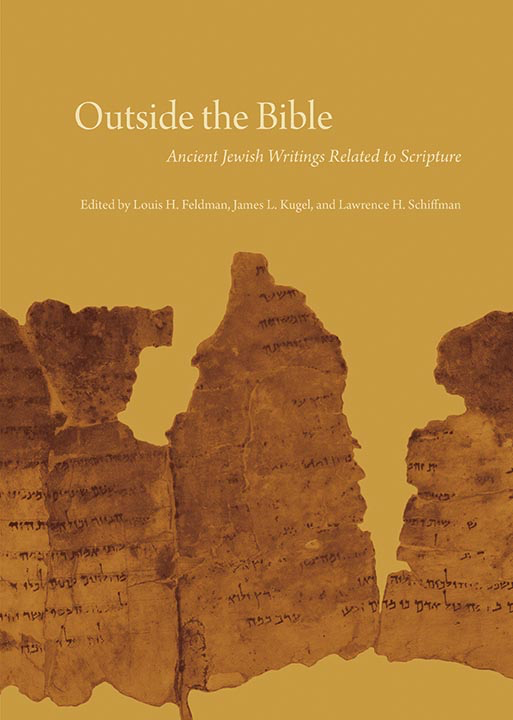
Outside the Bible

I’ve made no secret of my love of Jewish Publication Society’s works. The JPS Torah Commentaries have greatly enhanced my reading of the first five books of the Bible. I have particularly appreciated the seamless blend of critical scholarship and devotional posture that series offers.

In 2013 JPS published a massive, three-volume set, Outside the Bible: Ancient Jewish Writings Related to Scripture. The print edition has 3,302 pages. Accordance is the only Bible software program to have made the electronic edition available; it releases today.

Outside the Bible (hereafter referred to as OTB) covers an impressive array of Jewish extrabiblical texts from the 6th century B.C. to the 2nd century A.D. The texts in OTB are ones that were “for various reasons, taken off the official Jewish bookshelf.”


************


The editors of Outside the Bible are Louis H. Feldman, James L. Kugel, and Lawrence H. Schiffman. The skilled lineup of contributors includes: Harold W. Attridge, David E. Aune, John J. Collins, David A. deSilva, Michael V. Fox, Emanuel Tov, Benjamin G. Wright III, and many others.

Broadly speaking, the editors and contributors treat writings from the following groupings:

  • The Septuagint
  • The Apocrypha and Pseudepigrapha
  • Philo
  • Josephus
  • Dead Sea Scrolls

OTB begins with some of the best, most succinct introductory material you can find on each corpus. Emanuel Tov, for example, gets right to the heart (using few words) of the potentially vexing concept of LXX translation technique:

When trying to analyze the Hebrew and Aramaic words, the translators could not resort to tools such as dictionaries or other sources of lexical information; they had to rely on their living knowledge of these languages and on exegetic traditions relating to words and contexts. … By the same token, the identification of difficult words was often guided by the context. Such a procedure frequently was little more than guesswork, especially in the case of rare and unique Hebrew words.

Practically speaking the reader finds explanatory comments like this one (from 1 Samuel 2) throughout OTB:

*there is none holy besides you Cf. the MT: “There is no rock like our God.” As elsewhere in the LXX, the translator avoids the description of God as a “rock,” possibly because he did not like the comparison of God to a stone, and instead stresses his holiness as in the first part of the verse.

When it comes to the texts themselves, here is how OTB is organized:

Each text in Outside the Bible is preceded by a brief introduction that gives a summary of its contents, a history of its composition and transmission, its significance for Jewish (and sometimes Christian) history and biblical interpretation, and a guide to reading that highlights specific issues for understanding the text. A short list of additional readings points the interested reader to more detailed or focused treatments of the text.

You can see the Table of Contents here, via Accordance Mobile:


OTB iPad TOC


Included in OTB is an entire commentary on 1 Maccabees and 2 Maccabees, among other texts. Here is David A. deSilva, offering the reader of OTB guidance for working through 4 Maccabees:

The author gives two important cues concerning how to read his work. First, he asks us to read it as an essay that offers both argumentation and exemplary evidence for the proposition that the religiously trained mind can gain the upper hand over all the contrary forces within us and outside us that drag us away from doing what we know to be best before God. Second, he invites us to join him in admiring the outstanding achievements of nine Jewish martyrs, whose courageous and praiseworthy example rivals that of the heroes of any other culture or tradition and can encourage us to hold fast to virtue in our lesser contests.

I could multiply examples of how OTB strikes an excellent balance of brevity and substance. One could open the pages of OTB, having never heard of the Damascus Document–or any of more than 150 other texts–and walk away with a solid understanding of that writing’s legal and theological teachings.

OTB has a nice focus not only on the extrabiblical texts as such; it also addresses their import for biblical interpretation. Further, the editors and contributors are careful to point out how these non-canonical texts function as windows into the culture and beliefs of Judaism in the Second Temple period.

And the interplay OTB highlights between Judaism and Christianity is fascinating:

Philo’s writings had practically no influence on Judaism as it developed after the destruction of the Temple in 70 CE and the disastrous Jewish revolt in Egypt in 115–117 CE. … On the other hand his writings were warmly embraced by early Christian thinkers, who saw in him a kindred spirit. They were attracted to his use of the Greek Bible and the allegorical method, as well as to doctrines such as the transcendence of God, the creation of the cosmos, the Logos, and providence.

Anyone wanting to further chase down what OTB has to say about Christianity can perform a search to instantaneously pull up all the instances of “Christian,” “Christianity,” or even, “Christ.” (The search to use is simply Christ* in the English Content search field in Accordance.)

…which leads to why Outside the Bible is a resource especially suited for the Accordance format.


************


One obvious reason a person would want to consider the Accordance module (and not just the print edition) is the portability factor. JPS books tend to be bound beautifully and constructed well, so there’s nothing to complain about in their aesthetics. But you can’t really take 3,300 pages of awesomeness to the library, coffee shop, or office with you, at least not easily. Keeping OTB on a laptop, iPad, and/or iPhone is appealing.

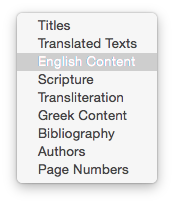
Another benefit to OTB on Accordance is the extensive system of tagging and hyperlinking the developers have used. For one, you can adjust the search field to search OTB in all of the following ways:


Search Fields


For another, where there is commentary on the texts, the Accordance module allows you to view it simply by hovering over a hyperlink. Causing my mouse to rest on an asterisk shown in the text of the Prayer of Manasseh calls up the corresponding commentary in the Instant Details at the bottom of the screen:


Prayer of Manasseh
(click to enlarge image)


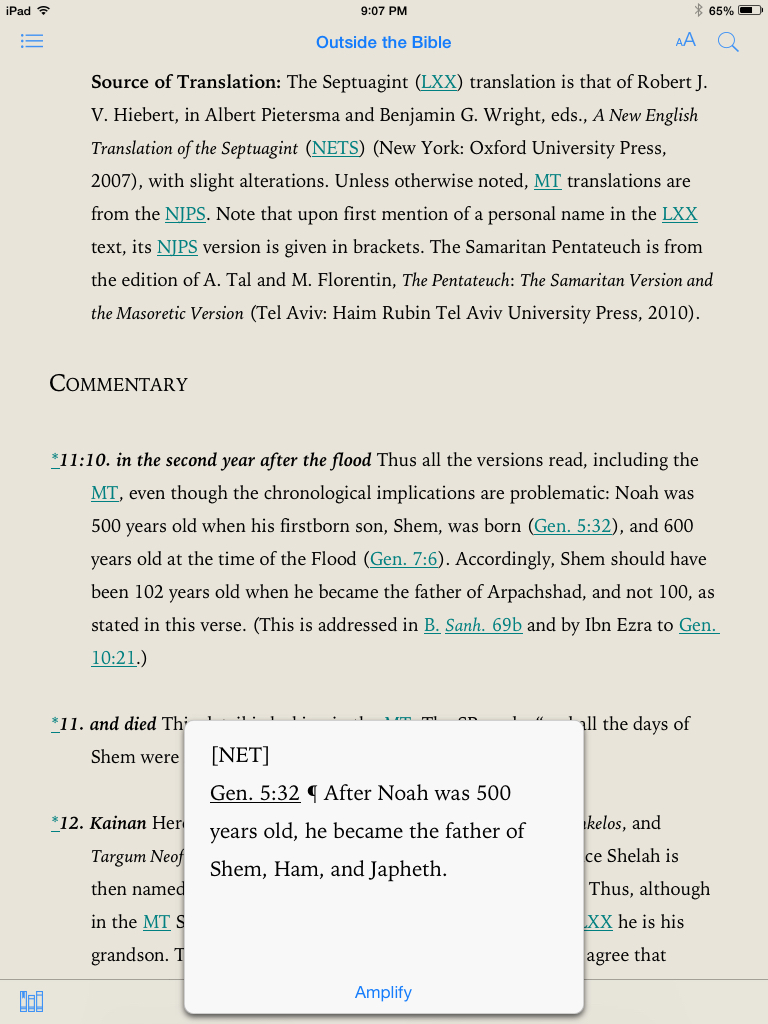
Hyperlinked content is, of course, just a tap away on the iPad:


FN on iPad


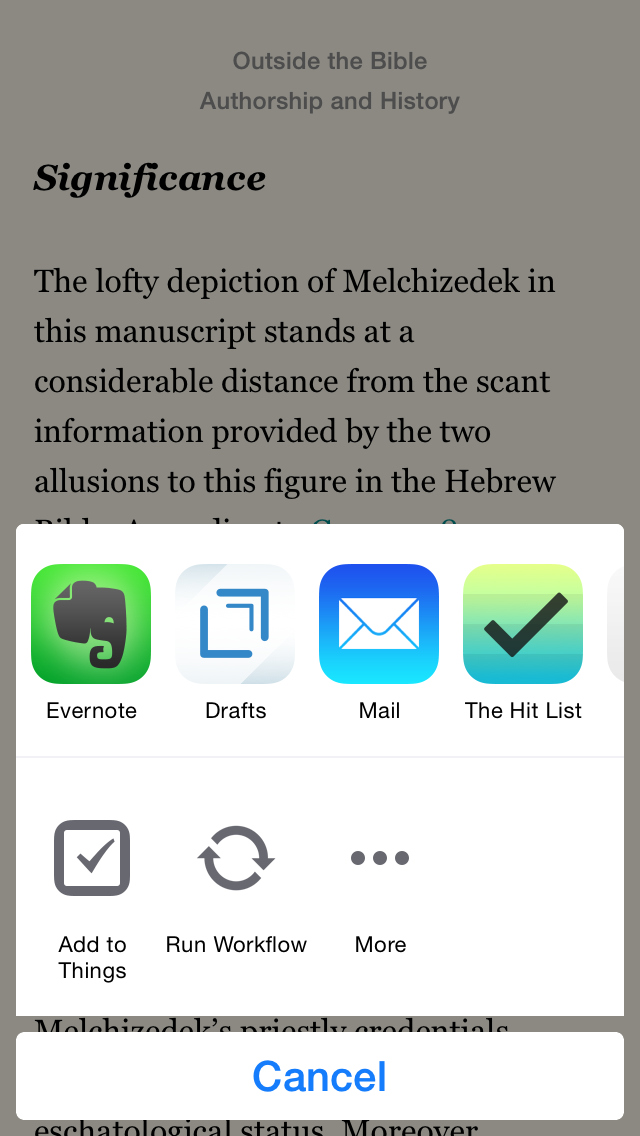
You can search just certain sections of OTB for a given word. You can highlight, take notes, and even share text via the share sheets in iOS–maybe you want to send some selected wording to Evernote or Drafts as part of your research. Just a few taps get me from 11QMelch (Melchizedek) into Drafts, a primary hub for my iOS research:


OTB Share 1


OTB Share 2


OTB Share 3


Using the share sheet, one could email information to oneself or others, or even share on social media. (And what says “rewritten Bible” better than Facebook and Twitter, amirite?)


************


Treat yourself to a perusal of the Table of Contents and some material on Jubilees (which interacts with Genesis) by following this link to a PDF excerpt. And, by all means, do go check out this majestic resource in Accordance here. Students, professors, and pastors… Jews, Christians, and agnostics–all who can access Outside the Bible are indebted to its editors and contributors for a thorough and engaging resource.


Thanks to Accordance for the review copy of Outside the Bible in Accordance 11. See my other Accordance posts (there are many) gathered here.