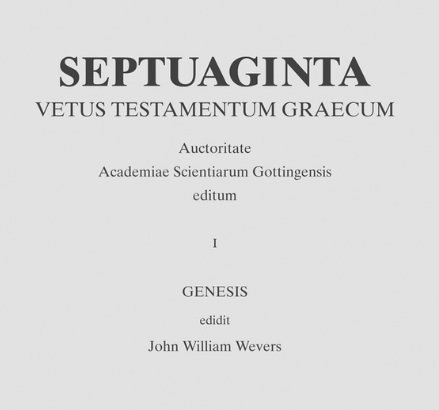
Accordance Bible has just released the Esther module in its Göttingen Septuagint. More volumes are on the way and scheduled for this month: Psalms with Odes, Jeremiah, the 12 Prophets, and Sirach. The Göttingen Septuagint is a text criticism workout. I’ve posted here and here about how to understand and use its apparatuses.
When I reviewed Göttingen in Logos earlier this year, I compared Isaiah modules between Logos and Accordance. At that time I wrote that the Logos text was more accurate to the print edition than the Accordance text, because it initially was. I was surprised, and saw this as a fluke for Accordance, whose texts–especially their original language ones–generally are the “research-grade” quality they seek to produce.
There’s been a recent update to Göttingen Isaiah in Accordance, so that it is now quite accurate in relation to the print edition. Accordance has also since dropped the price on its Isaiah module.
Search fields for Göttingen Isaiah Apparatus I
Where Accordance really excels in its presentation of Göttingen is the multiple ways it offers to search an apparatus. (See image at right.) The most helpful search field is “Manuscripts,” and one can also search by “Greek Content,” which greatly facilitates searching for a given text variant. Searching an apparatus in Logos doesn’t have nearly the options, and manipulating what search results one can get is more difficult.
The “List Text Differences” feature in Accordance is one I’ve used often, to see where Göttingen and Rahlfs differ on Isaiah, for example. Logos has a “Text Comparison” tool, similar to the “Compare” feature in Accordance, but “List Text Differences” is unique to Accordance.
One remaining fix in the Accordance apparatus (at least for the Isaiah module I’ve examined) is a symbol rendering issue. When the apparatus notes a case of homoioteleuton, what appears in print as 1°◠2° shows up in the apparatus as 1° 2°. (UPDATE: See Rick’s comment below; update is planned. UPDATE 12/14/13: This has now been corrected in Accordance.) This renders correctly in Logos.
Logos still doesn’t have the Kopfleiste (Source List) for the Göttingen volumes that have one in print, while Accordance does include it. On the one hand, the Kopfleiste makes most sense in a print edition, but one can imagine that serious students of the Septuagint may still want to be able to access it. Accordance’s Esther includes it, for example.
All the Göttingen volumes that have been published in print are in Logos already, but Accordance seems to be making fast progress of late in completing their own offering. Göttingen is more affordable in Logos (especially if you have their academic discount), but there are more advanced search options available in Accordance (both in the text and the apparatuses) that may make the user want to consider the latter software instead. If one wants just a single volume in Göttingen, that option is currently only available in Accordance.
Speaking of the Septuagint, I’ve just finished Greek Isaiah in a Year with a group of folks, and so will take recommendations for what to read next!
For the New Testament authors, the original text, that is, the text they drew on, was primarily the Septuagint. To make up the first part of the Bible which has the New Testament as the other part, the Old Testament in the shape it has in the Septuagint would therefore seem the obvious choice.
—First Bible of the Church: A Plea for the Septuagint, by Mogens Müller (p. 144)
Mogens Müller provocatively asks, “What caused the displacement of the Septuagint? …Today it is an open question whether the Septuagint should be reinstalled as the Old Testament of the Church” (p. 7). First Bible of the Church is part reception history, part biblical theology, and part apologetic work that suggests the Greek translation of the Hebrew Bible should be brought (back) into canonical status. It should be “at least part of a canon” (p. 122), if not the better choice than Biblia Hebraica for today’s “original text” of the Old Testament/Hebrew Bible.
What follows is a brief summary of the book’s contents, followed by some evaluative comments.
Müller’s Plea
Chapter 1 is the introduction to the book. In it Müller raises the question of just what should qualify as “the original text” of the Old Testament. If we see “what the early church regarded as its Bible” (p. 23), already one has to take the Septuagint seriously. This is not a question Müller addresses exclusively on textual grounds; for him the issue is also a theological one. To wit: In Isaiah 7:14/Matthew 1:23, “the ‘wrong’ text gains a significance of its own by being used” (p. 23).
Chapter 2, “The Jewish Bible at the Time of the New Testament,” looks at the canonization and textual history of the Jewish Bible, including various Greek recensions. Müller makes a key (and helpful) distinction in canonization between “the recognition of a writing as sacred” and “the final fixing of its wording” (p. 32). Evaluating various source materials, and dismissing the idea of an Urtext, the author notes the (accepted) fluidity of the process of textual transmission, where the actual wording in the sacred books only became important some centuries after the books themselves had become part of a canon. The implications of this, of course, are that New Testament writers may not have cared–in the way modernists do–about making sure they were using “the original” Hebrew text when quoting Scripture–if such a thing even ever existed as such.
Nonetheless, as chapter 3 points out, there was a very early historical concern about the authority of the Greek translation of the Hebrew Scriptures. Would the former be on par with the latter? Müller examines various defenses of the Septuagint (the Law books, specifically): Aristeas, Aristobulus, Philo, and Josephus. Chapter 4, “The Reception of the Septuagint Legend into the Church up to and Including Augustine” continues the historical inquiry into attitudes toward the Septuagint, especially when compared to the Hebrew text it was said to have translated. Justin and Irenaeus (among others) are given as examples of early interpreters who saw the Septuagint translation as inspired. Jerome, Müller suggests:
saw the Biblia Hebraica as the basic text as far as the Old Testament was concerned, and thus he contributed, at least for the Latin-speaking part of Christianity, to bring about the final abandonment of the Septuagint, which had very early come to be acknowledged as the Bible of the Gentile, Christian Church. (p. 86)
Biblia Graeca
Chapters 5 (“Hebraica sive Graeca Veritas?“) calls the Septuagint “a witness to the process of transmitting tradition” (p. 99), a process which Müller sees in ancient Judaism as having “a very creative character” (p. 104). Translation in antiquity included a measure of interpretation. The author’s foray into translation theory gives refreshing context to a world that valued lexical equivalency in translation less than many do today.
Chapter 6 (“Vetus Testamentum in Novo Receptum“) provides a short biblical theology, in which the New Testament is seen primarily as the story of Jesus, who himself fulfills what is written in the Old Testament. Müller notes that it is for this reason that the Hebrew Bible became the Old Testament, and yet its use by New Testament writers solidified its importance and sacredness for Christians. The Old Testament is necessary–“it remains the Holy Writ of the Christian community.” But it is not sufficient–“the Old Testament per se represents a limited epoch in salvation history” (p. 135).
The conclusion calls for the Septuagint to (re-)take its canonical place alongside the New Testament.
Is Müller’s Plea Worth Paying Heed To?
Yes. Readers of this blog and its Septuagint posts will not be surprised by my saying so. Müller makes a good case and generally succeeds in making a compelling plea for the LXX. If readers don’t accept his call to (re-)canonize the Greek OT, they will at least take seriously his petition to take it more seriously (as the NT writers did).
The book is short (some 150 pages) but dense. There is untranslated German and Latin in the footnotes, as one would expect in a scholarly monograph, but the writing is no less engaging for its density. The Greek font used throughout is easy to read, and the Greek is often translated into English.
Müller’s brief biblical theology at the end of the book is excellent. It left me wanting to read more. His notion of fulfillment as a motif that links together the OT and NT was convincing and well-articulated.
I found some typographical errors, as well as a number of sentences that just seemed to have wanted closer editing. This could be in part due to the book’s translation from a Danish manuscript. I was distracted in a few places as a result, but not consistently.
Evangelicals will find a few things they disagree with. For example, Müller cites Wellhausen approvingly to note that “the prophets were not reformers anxious to lead the people back to an original Mosaic religion.” The Law, then, “is not the starting-point but the result of Israel’s spiritual development” (p. 102). This line of reasoning is not essential to following the rest of Müller’s arguments, but his “redactional-critical attitude” (p. 100) does lead to a few assertions that some (including myself) don’t agree with.
Müller’s logic and historical inquiry is generally careful and robust, not to mention more readable than one might expect from a work of this nature. Perhaps it is due to the short length of the book, but there are still some unanswered questions. If “the Septuagint” is to comprise the Old Testament in Christian Bibles (as Müller suggests on p. 144, among other places), which Septuagint should we use? On which codex or codices should we base it? And given that Septuagint manuscripts vary on which books are included, how would we decide which books to place in a reconstituted OT? Simply those books that are now in the Hebrew OT, but in their Greek iterations? What about the Apocrypha?
And yet it appears that Müller’s aim is more to address “whether the Septuagint should be reinstalled as the Old Testament of the Church” (p. 7, my emphasis), not how and by what methodology such a reinstallation would take place. With this aim in mind, Müller’s short yet substantive book offers a compelling plea that deserves the reader’s careful consideration.
You can find First Bible of the Church: A Plea for the Septuaginthere at Amazon. Its publisher’s product page is here. Thanks to Bloomsbury for the review copy, given with no expectation as to the content of the review.
Recently I’ve been paying more attention to the Dictionary of Classical Hebrew and its Concise counterpart (see here).
It took me a little while to figure out how to read the frequency stats in DCH/CDCH. So I’m posting this little tidbit here to save some folks a bit of time.
The introduction to the concise version of the lexicon reads:
2. Statistics. Next comes a notation of the number of occurrences of the word in each of the four corpora of ancient Hebrew: the Bible, Ben Sira, the Dead Sea Scrolls, and the Inscriptions. Thus the notation 334.5.13.32 means that the word occurs 334 times in the Bible, 5 times in Ben Sira, 13 times in the Dead Sea Scrolls and 32 times in the Hebrew Inscriptions. If there is only one number in the statistics, the word occurs only in the Hebrew Bible, and if the notation is, for example, 0.0.7, it means that it occurs only in the Dead Sea Scrolls, and that 7 times. In the case of verbs, occurrence statistics are also given for each of the voices (or, binyanim).
The entry for נתן has a frequency count of “2015.62.228.26.” That’s straightforward enough. But then with the entry for תרומה the frequency given is “76.2.18.” This means it occurs 76 times in the Bible, 2 in Ben Sira, 18 times in the DSS, and 0 times in the Inscriptions. Another entry that has “11.4″ means 11 times in the Bible, 4 times in Ben Sira, 0 in DSS and 0 in the Inscriptions.
What took me a little while to figure out is that some entries have counts like “376.0.1,” which means 376 occurrences in the Bible, 0 in Ben Sira, 1 in DSS, and 0 in the Inscriptions.
The 0s are not noted, then, if there is not still a number to come after it that is 1 or more. In other words, you’d have “376.0.1,” but never “376.1.0.0″ or even “376.1.0.” That would be abbreviated instead to “376.1.”
It would have been easier if all the 0s were inserted in every case, so that you were always looking at 4 actual numbers (thinking of 0 as a “number” for the moment), but I am guessing that this is because the longer DCH (at 8 volumes in print) likely couldn’t afford to be filled with 0s, where they could otherwise be deleted.
In summary, the four corpora in this lexicon are:
Hebrew Bible
Ben Sira
Dead Sea Scrolls
Hebrew Inscriptions
Committing that sequence to memory (and better understanding when a 0 is used and not used) makes use of the lexicon even easier. I appreciate DCH/CDCH’s inclusion of frequency statistics, as I use it to build my Hebrew vocabulary.
I use the Concise DCH for regular Hebrew reading in Accordance, but have just recently been really getting to know it as a lexicon. The print version of The Concise DCH is here; in Accordance it is here. The full 8-volume set from Sheffield Phoenix Press is here, found also here at Accordance.
HALOT has been the scholarly standard in Hebrew lexicons, but might that change?
The mammoth 8-volume Dictionary of Classical Hebrew (DCH) is another major lexical source for readers of biblical Hebrew to consult. What is unique about the DCH is that lexicons like HALOT and Brown-Driver-Briggs (BDB) cover solely the Hebrew found in the Hebrew Bible. DCH, by contrast, covers a wider corpus–“from the earliest times to 200 CE,” it says. According to its product page:
It is the first dictionary of the classical Hebrew language to cover not only the biblical texts but also Ben Sira, the Dead Sea Scrolls and the Hebrew inscriptions. It is the first dictionary to analyse the exact sense of every occurrence of every word, to follow every Hebrew word or phrase with an English equivalent, to print a frequency table of occurrences of each word, and to provide an English-Hebrew index.
Not least among its features is its addition of more than 3500 new words to the stock of the Hebrew lexicon, together with an extraordinarily rich bibliography surveying special lexicographical studies over the last century.
The Concise Version
The 8-volume set in print is high-priced, as one would expect. It is much more affordable (as “affordable” goes, in these contexts) in Accordance, which is currently the only Bible software to carry it. The concise version seems to be financially within the reach of many students and pastors.
What is remarkable about the concise version of the dictionary is: “All the words in the full Dictionary of Classical Hebrew are to be found in the CDCH.” Of course, there are less instances of a given word’s occurrence listed, but that every word of the 8-volume set is treated in its 500-some-page younger sister is impressive.
The CDCH thus contains not only the c. 8400 Hebrew words found in the standard dictionaries, but also a further 3340+ words (540 from the Dead Sea Scrolls, 680 from other ancient Hebrew literature, and 2120+ proposed words for the Hebrew Bible not previously recognized by dictionaries).
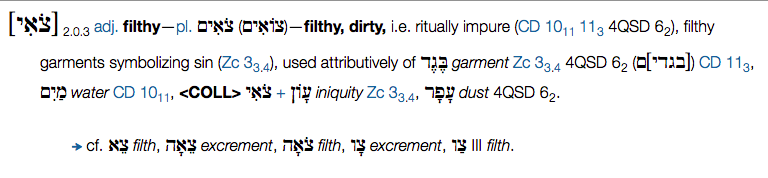
By way of comparison, here is an entry for the same (rarely occurring) word in the concise and full dictionaries, respectively:
Full DCHConcise DCH
I use the Concise DCH for regular Hebrew reading in Accordance, but have just recently been really getting to know it as a lexicon. (UPDATE: see another post here on word frequency statistics in the lexicon.) The print version of The Concise DCH is here; in Accordance it is here. The full 8-volume set from Sheffield Phoenix Press is here, found also here at Accordance.
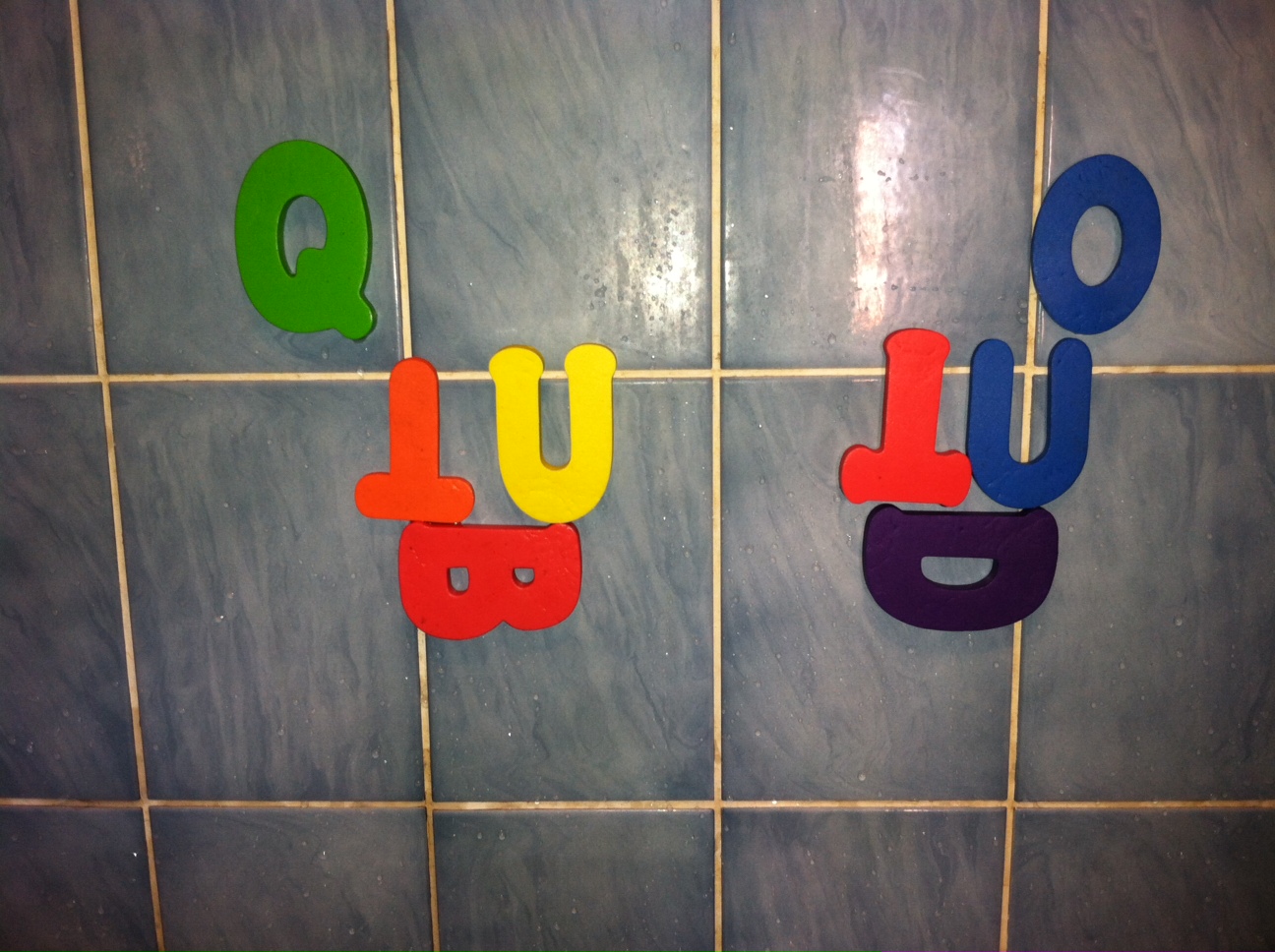
I mentioned a few weeks ago that my five-year-old son is learning Hebrew, using the materials from Sarah and David. Part of his learning process was to re-shape his English bathtub letters into Hebrew ones, as noted and pictured here. Now (thanks, Diana!) he has real ones:
And he’s pretty happy about them, too:
More updates on our Hebrew learning adventures soon!
I’m looking to sell the Hermeneia CD-ROM set (38 vols., 2006). It’s compatible with Logos/Libronix. $149 (and willing to consider offers). See here and here for details on the set.
If you want to contact me about a possible purchase, feel free to use this form, and we’ll talk. I generally do things through PayPal.
2014 UPDATE: I’ve still got the 38-volume set available to sell (unopened), if you’re interested.
Okay, so he’s not really reviewing the Hebrew language, but he is learning it. Wanting to spend more time with my kids this summer, and seeing a voracious appetite for learning in my five-year-old son, I offered to help him learn a language. I told him I could offer Hebrew (of the biblical variety), Greek (koine/New Testament), and Spanish.
He opted for Hebrew. Thinking about demographic trends in the U.S. these next few decades, I gently pushed back: How about Spanish? No. Hebrew. He wanted to learn Hebrew. So we’ve begun.
We’ve been using materials from Sarah and David, a publishing company that specializes in Hebrew language materials for children. The materials are organized in stages, with learning the letters first, then a focus on reading, then finally speaking Hebrew. Here’s a curriculum overview in their own words:
The Sarah and David curriculum was built backwards from Bar/Bat Mitzvah with the goal of addressing reading difficulties students continue to have with accuracy and fluency in the upper grades. Beginning with The Aleph Bet Story and through to The Bar/Bat Mitzvah Book, both teachers and students have a consistent approach to use from year to year to reinforce letters, vowels and reading skills.
Using the curriculum, schools have found that they can introduce the reading process early, teachers learn instructional cues to guide the learning and students practice skills that can be applied to any reading exercise or text. Used in religious schools across the county, the reading program has also proven to be helpful to resource room teachers, special needs and late-start students, and adult learners.
The very friendly folks at Sarah and David sent us most of the Part One materials for review (and set us up with a Web account, which you can purchase here). My five-year-old and I have had just over two weeks so far with The Aleph Bet Story, The Aleph Bet Story Activity Book,The Aleph Bet Story Workbook, The Sarah and David Read Hebrew Primer (from Part Two of the curriculum), and The Aleph Bet StoryAudio CD.
We’ll offer a multi-part review as we continue to work our way through the materials. For now, I offer praise for the effectiveness of the learning system. As they say, the proof is in the pudding. Or in the bathtub letters, in this case. After less than a week with the materials, my five-year-old son had used bath time to make this:
From right to left (how you read Hebrew), that’s shin and sin, which look like this:
Cool, huh? I never would have thought to do that.
My five-year-old loves these materials. Nearly every morning on his drive with me to pre-K, we listen to the CD. Nearly every night when I ask him to pick a book to read, he picks one of the Sarah and David books. And he often reads them on his own, or practices the writing and other exercises in the activity book and workbook. I don’t want to be *that dad* who makes his kids learn biblical languages before they can even read Captain Underpants, so I haven’t pushed much at all. He’s really enjoyed learning Hebrew with very little prodding from me.
This has all been really fun for us lately, and Sarah and David has made the learning process smooth and enjoyable.
Thanks to Sarah and David for the books and Web account for the purposes of review. I promised them only honesty, so they have not expected anything of our review. Expect more this summer as we continue to review the materials and learn Hebrew together.
I’m looking to sell 9 volumes of the Word Biblical Commentary set. I’ve listed them (with full condition details) here. If you want to contact me directly about a possible purchase (i.e., not through ebay), feel free to use this form, and we’ll talk. (UPDATE: Books are now sold.)
———
A few more books for sale:
IVP Bible Background Commentary: New Testament Like New
ISBN: 978-0830814053 Used just a few times. No markings. In great shape. $22 (SOLD)
Greek-English Lexicon of the New Testament (BDAG)
for BibleWorks Software Compatible with BibleWorks 5, 6, 7, 8, and 9. I’ve been in touch with BibleWorks to confirm that on completion of sale, one user license transfers to the buyer with no fee, so that you can use BDAG in your BibleWorks. (Must have purchased and own BibleWorks to be able to use this.) Significant discount from buying new (where it’s $150). $99 (SOLD)
Ezra and Nehemiah: Biblia Hebraica Quinta (BHQ) Like New Taken out of shrink wrap and used just once or twice.
Excellent condition. $40 (SOLD)
Greek Grammar Beyond the Basics
Very Good/Like New Just some edge and cover wear. Light blue cover as pictured, but same contents as dark blue cover. $22
Free shipping on all orders. If you’re interested in buying–or just have questions–you can reach me using this form, and we’ll go from there. (I use PayPal; shipping is free only domestically.)

 Accordance Bible has just released the Esther module in its Göttingen Septuagint. More volumes are on the way and scheduled for this month: Psalms with Odes, Jeremiah, the 12 Prophets, and Sirach. The Göttingen Septuagint is a text criticism workout. I’ve posted here and here about how to understand and use its apparatuses.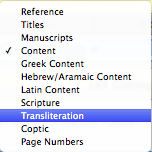











 Words on the Word