Scrivener is 50% off at the Mac App Store right now. Not sure how long this sale will last, but it’s now $22.99, which is well worth the value Scrivener looks to provide, especially to writers. I posted about writing a paper with Scrivener here. The link to the sale in the App Store is here. (HT: Brian Renshaw for pointing it out!)
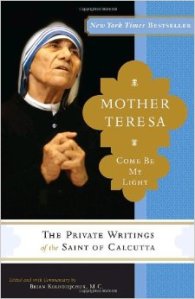
These are good but difficult words from Mother Teresa. They were noted today on Plough, the Website where I mentioned finding the free Oscar Romero book. I’ve just subscribed to Plough Quarterly and am already enjoying the content of the site greatly.
Today I came across this arresting, powerful, and difficult quote from Mother Teresa:
God cannot fill what is full. He can fill only emptiness – deep poverty – and your “yes” [to Jesus] is the beginning of being or becoming empty. It is not how much we really “have” to give – but how empty we are – so that we can receive fully in our life and let him live his life in us. In you today, he wants to relive his complete submission to his father – allow him to do so. Take away your eyes from yourself and rejoice that you have nothing.
Many Greek Septuagint manuscripts do not contain them, but the Odes are a fascinating collection of texts appended to the end of the Greek Psalter in Codex Alexandrinus and a few other manuscripts.
The Odes compile some beautiful prayers from Scripture. A few of them are in the Book of Common Prayer’s Morning Prayer canticles.
Good information on the Odes is hard to come by, though. In part this is because they are generally not accorded the same status as, say, the Psalms. The NETS introduction to the Psalms, for instance, has:
One “book” not included in NETS, however, is Odes since it has dubious integrity as a literary unit, and, in any case, almost all of the individual Septuagint odes have already been included in their native setting in other books. The sole exception is Ode 12 in Rahlfs’ edition, the Prayer of Manasses, which for that reason has been separately appended to the Psalter.
I’ve just discovered, however, that David Lincicum has a nice rundown of the Odes, their numbering, and their contents. He also includes a bibliography for further reading. Check it out here.
*HT to a member of the Yahoo! LXX email group for the idea of the Odes as a sort of “little hymnal.”
Peter Kirby has his now quarterly list of the Top 50 Biblioblogs, just published yesterday. You can find it here. There is some good reading to be found on that list!
“Beautiful is the moment,” Archbishop Oscar Romero said, “Beautiful is the moment in which we understand that we are no more than an instrument of God; we live only as long as God wants us to live; we can only do as much as God makes us able to do….”
The book above–La Violencia del Amor, or, The Violence of Love–is available as a free download from the publisher, here (Spanish) and here (English).
To get the discount, you’ll need to sign up here, using your .edu email address. Sign-ups are open through June 12. Baylor sends the discount code June 13. Then you can apply the discount code to orders placed from June 14-18.
The Septuagint Studies Soirée is back. You can find all previous months gathered here, where I post links to what I find around the blogosphere in Septuagint studies. This soirée covers two months: April and May.
T. Michael Law continues to dominate the Septuagintablogosphere with his Septuagint Sessions podcast. Since the last soirée he posted episode 4 (on Greek Isaiah’s style), episode 5 (“Your BHS is safe with me!”), and episode 6 (“about a problem in research on the LXX that stems from a canonical bias”).
Suzanne McCarthy at BLT asks whether Judith was originally written in Greek or Hebrew. She also looked at our two “prototypical parents” in Greek Genesis 3 and 4. Her co-blogger J.K. Gayle examined the use of “baptism” in Plato and the LXX. BLT is one of the more substantive biblioblogs I read. You would do well to bookmark BLT’s Septuagint tag page, which includes even more recent LXX-related posts. (Also, add this one to your slate of BLT posts to read.)
Linguae Antiquitatum posted a nice review (with some interesting pedagogical musings) of a book about teaching beginning Greek and Latin. The same blog posted the first ever “Ancient Languages Carnival.”
William Ross posted about papyri.info, and offered this and this post as to how to use it for LXX research.
Summer beach reading?
Brian Davidson at LXXI suggests some summer reading. If you have made it this far in reading this post, you might even consider his recommendations to be good beach reading.
Here is Ed Gallagher on “The Greek Bible among the Jews.” And here he is with an illuminating post on the word “deuterocanonical.”
We’ve been in Easter season. And the LXX may have had “an increasing awareness of resurrection theology.” Read a short but fascinating post about it here.
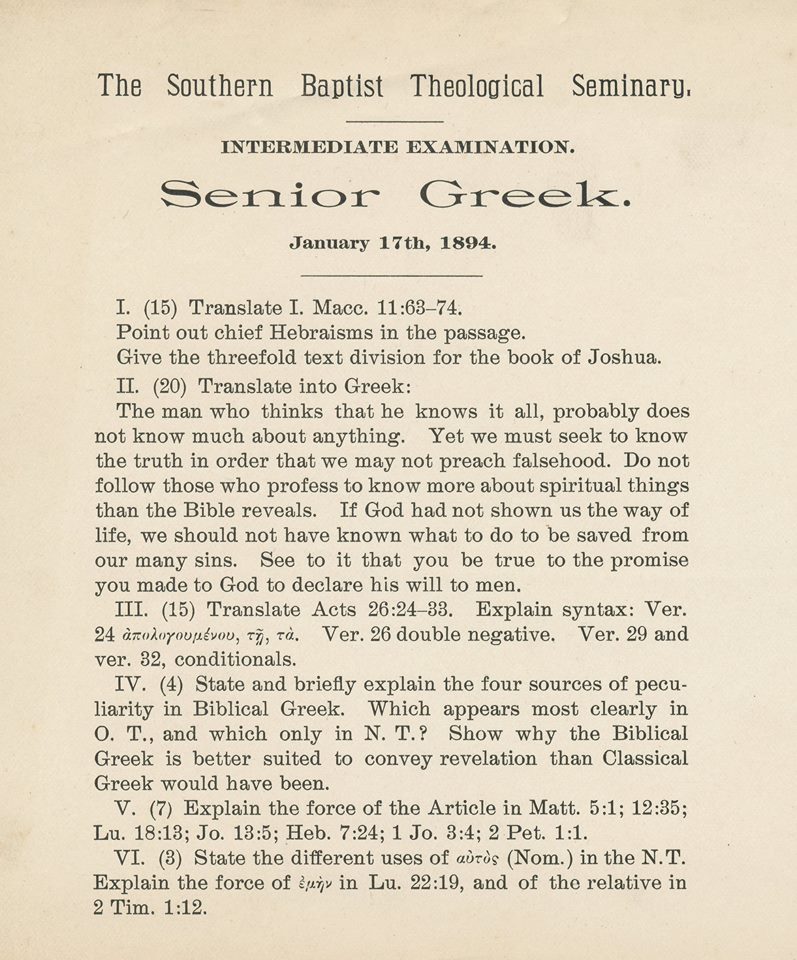
Finally, check out Jacob Cerone’s post of a Greek exam given in the late 19th century by John Broadus and A. T. Robertson (pictured at the top of this post). He even takes part of it and posts his answers. Nice work, Jacob!
Amazingly, I made it through high school and college without reading Elie Wiesel’s Night. Having just found a copy in good condition at a local used bookstore, I plan now to read it. My recent reading of Bonhoeffer has revived my interest in Holocaust and genocide studies.
(Yes, I know it's a reality of "white/male privilege" to be able to choose when to think about oppression and to make "studies" out of genocide.)
I may or may not report back here again about Night, but I expect it to be a powerful read.
T. Michael Law posted two more installments of his Septuagint Sessions podcast, here and here.
BLT blog wrote about God’s first Greek puns (brought to you largely by the letters γ and ν).
William Ross promises upcoming LXX Resource Reviews. You can see a resource page he has up now, here. Also, in the last soiree I missed his February review of Abi T. Ngunga’s Messianism in the Old Greek of Isaiah. (It’s on my shelf, too, and I’ve worked with it a little.) Here it is, in excerpted form.
Daniel Streett uses the LXX to venture an answer to the question: Did Enoch Die? He also mentions a couple options for a bound LXX-Greek NT combo.
Mosissimus Mose continues a review of T. Michael Law’s When God Spoke Greekin dialogic form. The fourth part posted in March.
Here’s a post on “ditching flashcards” (via here).
Jacob Cerone has been posting his way through LXX Jonah. See here, here, and here.
Did I miss anything? Feel free to post an LXX-related link in the comments.















 Words on the Word