A long-time family favorite has been The Jesus Storybook Bible (subtitle: Every Story Whispers His Name). Friend and fellow blogger Robbie and his wife gave us this sweet gift when our now four-year-old was born.
Following on the heels of his first book review, my four-year-old here reviews The Jesus Storybook Bible. (Cool thing: the author of the book he reviewed blogged about it here.)As before, I did the typing, but the words below are all his. For the purposes of this review, he focuses on “The terrible lie: Adam and Eve lose everything, from Genesis 3.”
This story is about a snake, and the two people that God told them not to eat the food on that tree… and they did. And a big lie–a really, really, really, really big lie–came into the world. And then it felt like everything was going to break. And I even know that story.
God had to send them out of the garden, because they were being naughty. God sent them away. God gave them a note that said that they were going to get back to their place. God said he was going to forgive them.
It’s wroten [written] good. This book has a bird on it. And bats might come into the house and might like the book, just in case if they come in the house. [Editorial note from dad: four-year-old son just saw a news story about bats.] It’s a good book. It could help somebody if they were crying, and if they were sad, and nothing could work… except only if a book could work, and only if someone said Jesus StoryBible Book and they could buy it.
Here’s a sample page of the Bible, from Zondervan’s product page (click for larger):
There’s a great accompanying website for The Jesus Storybook Bible, with sample pages, audio files from the audio version, and more. You can also find the book on Amazon.
“Never will I leave you; never will I forsake you.”
“I and the Father are one.”
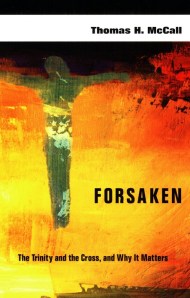
Wondering how these three verses of Scripture fit together? I often have. Cognitive dissonance finally got the better of me, and I decided I should try to think through this one a little more deeply. To that end I read Thomas H. McCall’s Forsaken: The Trinity and the Cross, and Why It Matters (InterVarsity Press, 2012). Here, on Magnificent Monograph Monday, I offer a review of the book. (Thanks to IVP for the free review copy, in exchange for an unbiased review.)
First, the very short summary of my review, if you want to cut to the chase and head off and do something else after this next paragraph.
McCall tackles some difficult questions: “Did God forsake Jesus [on the cross]? Did the Father turn his back on the Son in rage? Was the Trinity ruptured or broken on that day?” His answers and arguments are rooted in Scripture, the history of interpretation of that Scripture, and are consistently compelling. McCall really helped me through my own struggles to grasp some of these questions, leading me to a fuller understanding of the life of the Trinity and the relationship between its persons, particularly in terms of what happened on the cross. And he spells out the implications of his assertions beautifully. God is not divided, he concludes, but God–all of God–is for us. So we can rejoice and rest secure in that. Five stars, no doubt.
McCall writes “not for other scholars…but for pastors, students and friends–indeed, for anyone genuinely interested in moving toward a deeper understanding of God’s being and actions.” Forsaken is heavy theological lifting for a non-scholar (and not lightweight for a scholar, either), but the effort is well worth it. McCall answers some very common questions people ask (or are scared to ask and should ask) about the Trinity, also showing ramifications for our relationship to God.
Forsaken has four chapters. Each asks a theological question, addresses it, then concludes with some theological assertions to avoid, some to affirm, and why it matters.
The first chapter asks, “Was the Trinity Broken?” Here McCall discusses the theological concept of “dereliction,” or the idea that Jesus was abandoned by God on the cross. Recent theology notwithstanding, McCall makes a strong Scriptural case that God the Father did not forsake the Son on the Cross. Understanding Psalm 22 as an “interpretive key” to Jesus’ death, McCall writes:
No, the only text of Scripture that we can understand to address this question directly, Psalm 22:24, says that the Father did not hide his face from his Son. To the contrary, he has “listened to his cry for help.”
Not only that, the author argues, but if God truly had forsaken Jesus, why would Jesus bother–after his cry–to say, “Father, into your hands I commit my spirit”? Jesus “prefaces his last words with a sense of deep relational intimacy: Jesus addresses his ‘Father.'”
In chapter two McCall asks, “Just what are we to make of the biblical witness to the wrath of God? Is it opposed to his love? Is it a ‘dark side’ to God that is inconsistent with his holiness or with his mercy?” He makes a pretty hard-to-argue-with case that “the biblical witness does not set love and wrath in opposition to one another.” McCall, I thought, was at his best in this chapter when he highlighted multiple New Testament references to wrath–not only the wrath of God generally, but Jesus’ wrath specifically. So there’s no Old Testament God=wrath, New Testament God=mercy conclusion to be drawn from the Bible. The author utilizes the theological categories of divine impassibility and simplicity to show that “wrath” as God exhibits it is not what we might envision in human anger; rather, it is an expression of holy love.
McCall’s third chapter asks whether God’s divine foreknowledge means that God killed Jesus, since he knew it was going to happen, could have stopped it, but didn’t. “God’s plan was to use the death of Jesus for his purposes and for our good,” but God himself did not cause the death. As Acts so often makes clear, McCall points out, “The apostolic proclamation of the gospel places the fault and blame on the sinners who are responsible for the death of Jesus.”
Chapter four articulates a robust theology of justification (forensic; instantaneous; by which I enter into the life of God) and sanctification (separation unto God; progressive; by which I grow in communion with God). Page 145 and following has a brilliant interpretation of Paul’s famous Romans 7:14-25 passage where he (seemingly) wrestles with sin.
One difficult implication of this book for me as a worship leader (and coach of worship leaders) is that, if McCall is right, we may be singing some not-quite-right theology in two well-known songs. “How Deep the Father’s Love for Us” has a line that says, “The Father turns his face away.” And the song “In Christ Alone” says, “…till on that cross, as Jesus died, the wrath of God was satisfied.” McCall addresses these two claims head on and (in my opinion, successfully) refutes them. The Father did not turn his face away (see the block quote above). And to say that God the Son mollified the wrath of God the Father is to bifurcate the Trinity in some unorthodox ways. (!)
I’m not sure if it’s generally accepted for a book reviewer to admit to shedding tears when reading a review copy. (Objectivity! Right?) No matter. McCall’s concluding postscript (“A Personal Theological Testimony”) moved me to tears, as he recounted the difference “the trinitarian gospel” made for him and his family as they processed the death of his father.
Getting the theological details of the Trinity right (as best we can!) matters. It matters for our understanding of God, our relationship with him, and for all of life. In the life and truths of the Trinity–properly understood, and I think McCall a good guide here–there is great comfort. We see a God who, as McCall says, is for us. We find a God who has granted us victory over sin and death, making it possible for us to enter into communion with the triune God of love.
You can find Forsaken here at the IVP product page or on Amazon.
Head over to Reading Acts for the July “Biblical Studies Carnival.” It’s a compilation of many, many posts on all things Biblical studies on the blogosphere in July. There is some really good stuff there, and Phil has done a great job gathering some informative links. I’m thankful to have received mention in the carnival (of my July posts here, here, and here).
The world of Old Testament interpretation can feel vast and complex, teeming with concepts and terms like “historical-critical,” Sitz im Leben, and documentary hypothesis. Admission into that field of ideas is potentially cost-prohibitive, not to mention time-consuming.
Mark Gignilliat, Associate Professor of Divinity at Beeson, has greatly simplified a student’s entrance into the realm of Old Testament interpretation. His new book, A Brief History of Old Testament Criticism: From Benedict Spinoza to Brevard Childs, explores major Old Testament interpreters and themes in the modern period. Gignilliat begins with Spinoza (b. 1632) and concludes with Childs (d. 2007) in his “picture gallery tour of sorts.” Gignilliat writes, “This is a book for students. …The intended audience of this book is anyone who is interested in the Bible, its history of interpretation, and the particular problems and approaches to Old Testament studies in the modern period.”
The “picture gallery tour” surveys OT criticism through the lens of seven major characters: Spinoza, de Wette, Wellhausen, Gunkel, von Rad, Albright, and Childs. The author makes “no comprehensive attempt at expounding the very complex history of Old Testament interpretation,” but he does go beyond even his seven major subjects in detailing the ideas of other important thinkers, too. Gignilliat gives each interpreter his own chapter, which includes a short biography and a survey of ideas and writings. Chapters end with a “For Further Reading” section that the interested reader can pursue.
Gignilliat in his introduction immediately shows himself to be humble, gracious, and warm in tone, which continues throughout the book. He is aware of the limitations of a “brief history” like this (perhaps overly aware), though his concerns are not warranted, since this book accomplishes what it sets out to do.
One thing the author does particularly well is analyzes major interpreters in their life context. Of Spinoza, for example (to whom he traces the beginning of the denial of Mosaic authorship of the Pentateuch), he writes:
But it is important to understand, even if somewhat minimally, the community values Spinoza was reacting against and the intellectual currents of the day that influenced his thought. Modernity’s most cherished claims–autonomous intellectual pursuits, dismissal of dogmatic tradition, naturalism, and affirmation of the Cartesian “I” (I think therefore I am)–were advanced by Spinoza’s philosophical and hermeneutical outlook.
He notes that Spinoza’s emphasis on rationalism and the knowing self may have been, in part, a reaction to the “religious dogmatism, military might, and political ambition” that “made for a toxic combination throughout the Thirty Years War.”
Gignilliat’s ability to understand thinkers in context helps the reader to better appreciate what led to their contributions. With the above in mind, I could better understand why Spinoza sought to turn “sola scriptura into nuda scriptura, that is, Scripture stripped of any theological or ecclesial context.” (I thought this was a brilliant line.) Gignilliat does not follow Spinoza this far, but he gives a fair shake to the ideas of Spinoza and others throughout the book.
The author treats the documentary hypothesis and its development, beginning with Wellhausen. Though many evangelicals bristle at J, E, D, and P, Gignilliat does a good job showing how Wellhausen and those after him developed the notion that the Pentateuch has a complex redaction history. One key implication of the hypothesis is that someone like von Rad can conclude (in Gignilliat’s words):
The Hexateuchal [Pentateuch+Joshua] traditions do not give us a historical account of Israel that will satisfy modern attempts at history making. What these traditions do give is insight into Israel’s ancient faith and how that faith was continually actualized in Israel’s history of salvation.
Childs is the climax of the book: He is both “confessional and critical.” That is, he integrates historical-critical insights that have preceded him, yet with a confessional understanding of the Bible as Scripture. The canon matters to Childs, and his belief in the Bible as God’s Word–not just an object of historical study–influences his approach.
Gignilliat finally stands with Childs. For Gignilliat, “[A] confession of faith shapes, if not determines, the way we go about reading the Old Testament as Holy Scripture.” Readers who are nervous about some of the tendencies of Old Testament criticism to minimize (or ridicule) this view of the Bible as Scripture can rest assured with Gignilliat as their tour guide. Readers who are nervous about a Zondervan author writing a history of a field that has not exactly been dominated by evangelicals can also be rest assured by Gignilliat’s fair treatment of ideas and interpreters.
One great strength of A Brief History of Old Testament Criticism is Gignilliat’s consistent use of primary source materials. He does what every good philosopher should do: examines thinkers’ own writings, not just others’ writings about their writings. In this way he is able to describe his subjects in their own terms.
As I read I found myself occasionally distracted by what came across as an overly conversational tone. Although this is not present in all parts of the book, some sections overused, I thought, phrases like “all to say,” or, “it will be remembered that,” or, “at the end of the day.” The writing would have been stronger without that kind of verbal filler–and the author certainly had no need of hedging anything he said in such ways, since his brief history is a cogent, readable, and enjoyable one.
An evangelical doing Old Testament criticism may often feel how de Wette did–“lost in the middle” and in “a theological no-man’s land,” as Gignilliat describes it. But evangelicals should also know that Gignilliat is in that same territory, honoring the insights of those who have gone before, yet holding a high view of the Bible as God’s words to humanity, for then and for now. He quotes Herman Bavinck: “[Holy Scripture] was not only ‘God-breathed’ at the time it was written; it is ‘God-breathing.'”
A Brief History of Old Testament Criticism has its Zondervan product page (including sample pdf) here. It’s on Amazon here.
I received a review copy of this book from Zondervan in exchange for an unbiased review.
Hyra presents a careful comparative study between two economically gentrifying communities: Harlem (New York) and Bronzeville (Chicago). He takes a “systems thinking” approach (though he does not call it that) to see how global and national forces interact with municipal political structures, which interact with community organizational structures, which all work together to affect local conditions. These are the lenses through which he views gentrification in those two communities.
He notes that while Bronzeville and Harlem are gentrifying economically, their racial composition is not changing–they both remain primarily African American neighborhoods. So Hyra also analyzes intraracial, cross-class conflict.
Hyra’s interest is especially in displaced, non-home-owning residents of each community. He keeps this population in mind throughout the book and makes recommendations at the end for how to minimize resident displacement in gentrifying communities.
The New Urban Renewal is not very concise–typographical errors and run-on sentences are surprisingly common for a University of Chicago Press Book. But this can be overlooked. The concepts in Hyra’s book are well worth understanding and exploring.
Not long ago I reviewed Leslie C. Allen’s Liturgy of Grief: A Pastoral Commentary on Lamentations. The book gently yet steadily coaches the reader in processing grief, expositing and drawing on the rich Biblical tradition of lament. I interviewed Dr. Allen this week.
You write, “Contemporary Western culture provides little space for grief.” Why do you think this is?
A very good question. Perhaps, in reflection of a technologically advanced and relatively stable society, our culture expects comfort, convenience, and control, and won’t face up to anything contrary. Medication is assumed to be the answer to psychological as well as physical ills. So we feel embarrassed by grieving (and dying) people.
How can churches and worshiping communities better attend to the grieving processes of their community members? In addition to Lamentations and the rest of the rich Biblical tradition, are there other resources available to worship leaders and liturgists to better help them guide their communities through experiences of grief?
One example comes to mind. When I moved my home and started attending a new church some years ago, I found the associate minister’s morning prayer each Sunday was prayed on behalf of those present who were suffering in various ways. It was a different prayer each week, always wide reaching and beautifully crafted. I (and doubtless others) appreciatively felt she was praying for me, at a time when I needed prayer but found it difficult to pray.
You say, “‘Why?’ in the complaint psalms is never an intellectual request for information but a loaded rhetorical question that conveys emotional bewilderment and protest.” Is there ever an appropriate time for the pastor/chaplain to address questions like “Why did this evil happen?” through a more deliberately theological-philosophical lens? If so, how does the chaplain discern if and when it’s appropriate to go there?
C.S.Lewis’s The Problem of Pain evidently brought him no help as he penned A Grief Observed. Lamentations felt free to eventually tackle theological issues, using prophetic revelation as the guideline, whereas we and those we try to help are not living in the immediacy of such a situation when prophecy was being directly fulfilled. And Lamentations is able to give a variety of answers, perhaps in the hope that some at least would be found helpful. If a grieving person truly seeks an intellectual answer, one may tentatively broach some thoughts to be tried on for size. Otherwise, it is better considered when the emotional passion of grief does not intrude.
You mention the New Testament story (Mark 4:35-41) where Jesus’ disciples ask, “Teacher, don’t you care if we drown?” Especially given Jesus’s reply (“Why are you so afraid? Do you still have no faith?”), how can we who worship God know when it’s appropriate to lament or complain in prayer and when it’s not? This is the “how far is too far?” question with relation to lament and prayer!
If our prayers are to be real, we must pray from where we are, emotionally and in other ways. We miss a tone of voice in the written form of biblical revelation. I suspect Jesus’ reply was mainly meant as reassurance, rather than rebuke, like the examples of “Do not fear” in Isaiah 40:9; 41:13, 14; 43:1-2; 44:2, etc.
I happened to read Allen’sbook just before the Colorado movie theater shootings. Reading it inspired me to find and pray two lament prayers in response (here and here). As a Professor of Old Testament and hospital chaplain, Allen in his book provides the reader with good space for grief and Biblically-inspired means to lament. A Liturgy of Grief is available here.
Following on the heels of a great guest post from Timothy Dean Roth Wednesday, I’ve invited another guest to post at Words on the Word, this time for Family Friday: my four-year-old son. Here is his review of a book he particularly enjoys, Alpha Oops! The Day Z Went First. I’ve typed it up, but the words are all his.
A always goes first, but Z wants to go, and Z and Zebra are sick of the “last in line stuff.” W sits on a whale spout. Z has a zebra jumping. “O is for owl,” “N is for night,” and everyone else thinks it’s not H’s turn, but it really is… right? (Yeah.) He goes right where he goes, because that’s just how the alphabet goes.
I like that Z goes first. A goes last and the alphabet goes backwards. B is “bouncing on… a brisk breeze.”
I didn’t like “D is for dragon and damsel in distress,” because she might get hurt. (I don’t really want to get hurt.)
Our new neighbors would like this book. We could give it to someone else, and then tell everyone in the world to give it to someone else, after they read it.
Alpha Oops! is available at Amazon, or, I’m sure, at your local library.
This, then, is the single dominant characteristic of the LXX vocabulary: it is normal, idiomatic Greek. I base my construal of it on this hypothesis whenever I can.
–Gary Alan Chamberlain in The Greek of the Septuagint: A Supplemental Lexicon
Not long ago I noted that “the challenging nature of Septuagint vocabulary is … one reason why even students of New Testament Greek stay away from the Septuagint. How can one make her or his way through the Septuagint in Greek in a way that is not entirely frustrating?” To begin, you could read about why you need the Septuagint here, and some helpful resources here to get started. Also, I recently reviewed Bernard A. Taylor’s Analytical Lexicon to the Septuagint: Expanded Edition, a one-stop reference work to guide readers through the LXX.
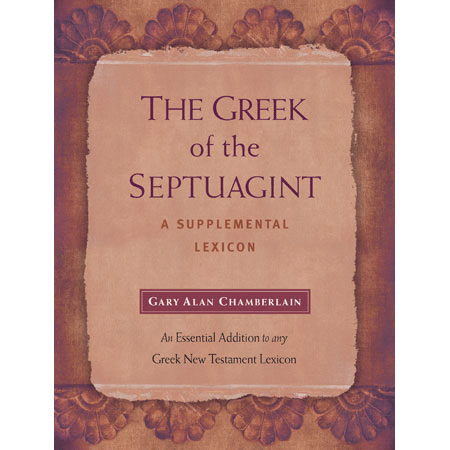
I have now had the occasion (and privilege) to spend some time with The Greek of the Septuagint: A Supplemental Lexicon, by Gary Alan Chamberlain. (Thanks to Hendrickson for the review copy, provided in exchange for an unbiased review.)
Chamberlain intends his lexicon to be a supplemental one, an addition to any Greek New Testament lexicon. (He has BDAG specifically in view.) The vocabulary of the Septuagint is more expansive and potentially different enough from New Testament vocabulary that a lexicon like this is warranted. Many Greek students, especially Biblical studies ones, come to the LXX after first studying the New Testament. So if they already own BDAG or some other New Testament lexicon, the potential need for something like this to “fill in the gaps” could make sense.
The Greek of the Septuagint contains lexicon entries for 5,000 LXX words not in the NT, as well as 1,000 words with LXX-specific uses that a NT lexicon would not carry. For the latter, Chamberlain simply adds to the BDAG numbering system, so that the entry for καθίστημί, for example, begins, “3.b. seek to establish, declare.” Words that the lexicon does fully treat have morphological information (e.g., principal parts for verbs) and citations of word usage in the LXX and beyond.
There is “no treatment of the most common words” in the LXX, so not just a cursory knowledge but a solid grasp of Greek vocabulary would be needed to use this lexicon on its own. I.e., a first- or second-year Greek student really would have to use this as the “supplemental” lexicon it intends to be. “Throughout this work,” Chamberlain notes, “I have assumed that the user has sufficient command of ancient Greek to cope with articular infinitives, genitive absolutes, and the varied means of expressing volition and command. The thousand or so most common LXX words should convey relatively few difficulties.” This work won’t serve the Greek initiate, in other words, but Chamberlain does not intend for his work to be “elementary.”
One might ask, Why not just purchase a full-on Septuagint lexicon? Here is where Chamberlain makes the “distinctive contribution…to LXX studies” that he aims to make.
The dense 19-page introduction explains several classifications of LXX words, and is complemented by an exceedingly useful set of word lists in the appendices. (Hendrickson has the intro in pdf here.) Chamberlain includes word lists and discussion of:
Precise parallels between the LXX and extrabiblical texts. This is where he asserts that LXX vocab is “normal, idiomatic Greek.” He accounts for what others have claimed are examples to the contrary (e.g., “Semitisms”) with the following categories.
Transliterations of the Hebrew into Greek.
Hapax Legomena–Greek words that occur once in the LXX and nowhere else in ancient Greek literature, as well as words that occur multiple times in the LXX but nowhere else (he notes all this and all these categories throughout the lexicon in the appropriate entries, a sample pdf of which is here).
Greek words that occur first in the LXX.
Words with no parallel in other ancient Greek sources.
Stereotypical translations (“calques,” where “translators faced severe challenges in rendering a few common Hebrew terms for which no equivalent was possible within the framework of Greek language”).
Mistranslations (where “LXX translators misconstrued the meaning of their sources’ words, through a confusion of roots or a misunderstanding of meaning of the source”).
Textual variants (more than 200 instances, including his suggested emendations, helpfully organized in canonical order).
More complicated words “involving multiple factors” (“We are simply trying to explain how a Greek word was placed in a context that does not make good sense if we read it as a Greek sentence”).
Having read the descriptions of each of these categories and looked through the corresponding word lists, this reader is convinced that The Greek of the Septuagint offers something that neither BDAG nor any other LXX lexicon on the market (of which I’m aware) currently does. Even without the actual lexicon entries, the word lists and explanations are an invaluable contribution to LXX studies. (The lexical entries themselves are appropriately concise yet substantive.)
His Appendix II is the place to start when looking up a word. It shows (through the use of bold, italics, and regular font) if a word is in this lexicon but not BDAG; if it is in BDAG and supplemented here; or if the word is sufficiently covered in BDAG and therefore not in Chamberlain’s lexicon. Appendix III has a neat listing of LXX book titles in English and Greek, as well as a table that shows the differing versification between the two.
The Greek and English fonts are clear and easy to read (the Hebrew font is a bit small).
I found The Greek of the Septuagint to be a lexicon one has to work at. In other words, it’s not like Taylor’s lexicon, which one could easily pick up and use right away off the shelf. Carefully reading the 4-page preface and 19-page introduction is pretty much required to be able to make use of Chamberlain’s work. But that’s true of BDAG, too, and sort of the point of a preface and introduction in the first place. So that’s not at all a strike against this lexicon. In fact, the user who is willing to put in the work will find great reward in a deepened understanding of the LXX and its vocabulary.
Chamberlain concludes his introduction in this inspiring way:
For many years I have been reflecting upon and experimenting with the question of what the faithful reading of Scripture is in relation to life lived very much “in the world.” Both the method and the goal of preparing this lexicon have been the reading of the LXX text itself (alongside the Hebrew Bible, the Greek NT, and not infrequently the Vulgate) with the prayerful attention the Benedictines call lectio divina. I have made constant and grateful use of the astonishing resources of biblical and classical scholarship, with an embarrassed and hopeless inability to be in any sense in command of those resources. I want simply to apprehend the text, and beyond that to engage the living reality of which the text intends to speak.
Luke and Acts, Darrell L. Bock says, is “a very Trinitarian story.” Indeed. The two volumes taken together go a long way to instruct the reader in the mutual relationship God shares as Father, Son, and Holy Spirit. They also detail the founding of the early church and show how it continued Jesus’ ministry and mission.
The above video is from Zondervan, in promotion of their blog tour of Bock’s new book, A Theology of Luke and Acts. Blog tour participants each select a chapter on which to focus their review, i.e., a major theological theme. (Posts from Round 1 of the tour are all here.)
I focus my review on chapter 16, “How Response to Jesus Divides: The Opponents, the Crowds, and Rome as Observer of Events in Luke-Acts.” Having last semester taken an exegesis course on Mark, I had already become interested in how groups of people could have such radically different responses to the same person and message.
But first, the book more generally.
A Theology of Luke and Acts consists of three parts. Part One briefly addresses introductory matters (context, unity of Luke-Acts, extensive book outlines, etc.). Part Two covers the theology of Luke-Acts. (For the Contents and a sample chapter, see the pdf here.) Part Three then briefly concludes with Luke-Acts’s place in and contribution to the New Testament canon.
Bock makes the case right away for why study of Luke and Acts is important:
The biblical material from Luke-Acts is probably the largest and most neglected portion of the NT. Of the 7,947 verses in the NT, Luke-Acts comprises 2,157 verses, or 27.1 percent. …In addition, only Luke-Acts tells the story of Jesus Christ from his birth through the beginning of the church into the ministry of Paul. This linkage is important, for it gives perspective to the sequence of these events. …So thinking biblically, it is important to keep Luke and Acts together and tell the story of Acts with an eye on Luke.
Bock has spent the last 30 years in Luke and Acts. Many (myself included) consider his Baker commentaries on each book (Luke here; Acts here) to be the standard among recent evangelical Luke-Acts commentaries. Bock writes that this new volume “has allowed me to put together in one place many things I have said before in many distinct volumes.”
The author balances in-depth scholarship (extensive footnotes and a 16-page bibliography give the reader more to explore) with winsome, practical insight into the Biblical text. Of “discipleship and ethics in the new community” (chapter 15), for example, he writes,
Discipleship is both demanding and rewarding. According to Luke, it is people-focused, showing love for God and then treating others with love that parallels the love of the Father. In Acts, one sees little of the church serving itself and much of the church reaching out to those who need the Lord. For Luke, the people in the highly effective early church look outward.
For the preacher, teacher, or student working his or her way through Luke and Acts, this is a book to have at hand.
Chapter 16 addresses “How Response to Jesus Divides: The Opponents, the Crowds, and Rome as Observer of Events in Luke-Acts.” Bock notes that in his pre-Jerusalem ministry, “it is the Pharisees and teachers of the law who interact the most with Jesus among representatives of official Judaism,” often occurring together in Luke as a pair: “Pharisees and teachers of the law” (οἱ γραμματεῖς καὶ οἱ Φαρισαῖοι). The Pharisees, who ridicule, question, and oppose Jesus, are “the key foil for Jesus until he gets to Jerusalem.” At that point, says Bock, “the chief priests and teachers of the law take over that role with much more hostility. …Their opposition is part of the picture of a divided Israel for Luke.” Jesus’ “new way” and claims of authority “brought reaction from those who liked the old wine.”
“Crowds” (ὄχλος), by contrast, “often note Jesus’ presence or press upon him in his ministry” in a non-oppositional way. Noting the blind man’s cry from the crowd of “Son of David” (“a messianic confession of great significance”), Bock says that those “on the fringe” or margins of the crowd are “often more sensitive” to the mission and message of Jesus. Jesus interacts with the crowd, Bock says, as teacher and healer, and yet “the crowd as a group thinks of him only as a prophet (Luke 9:18).” In Acts, the crowds are more easily swayed, “being incited or worked up to oppose the new movement.”
Rome is a mixed bag. “After Jesus, her actions protect the Christians from the hostile desires of Jewish leadership, but do so with an injustice that will not recognize their rights or release them.” And yet they are still for Luke “the unseen agent of providence in their acts,” even though they may not be aware of it.
It is easy to imagine Bock’s chapter on varied reactions to Jesus aiding the preacher or teacher, especially one who wants to elaborate on the famous “Who do you say that I am?” question of Jesus. Bock guides the reader through key texts in Luke and Acts to survey various Jewish, crowd, and Roman reactions to Jesus, whose coming, if nothing else, “generated a reaction.”
I can also easily envision someone referring to other similar chapters for a quick yet thorough overview of how Luke treats other theological themes: women and the poor (chapter 17), Israel (chapter 12), salvation (chapters 10 and 11), and so on. A Theology of Luke and Acts is worthy of Bock’s other work on those two texts, and serves as a useful reference guide.
See more about the book at Zondervan here. It is available for purchase through Amazon here.
As a blog tour participant, I received a free review copy of the book from Zondervan, but without obligation to write a positive review. The blog tour continues through the end of this week. You can follow it here.
“How do I get more out of my Bible reading? What was going on during the gap between the Old and New Testaments? How do all the books of the Bible fit together as a whole?”
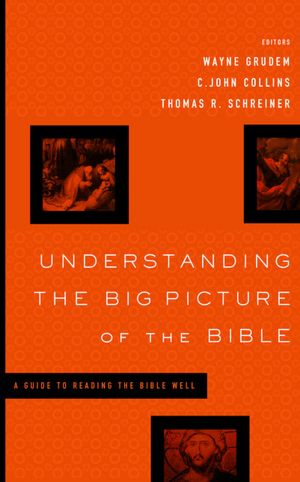
It is the aim of Understanding the Picture of the Bible: A Guide to Reading the Bible Well to answer those questions and put “clear, readable Bible study aids at your fingertips.” (All quotes from back cover and also found here.) Here I review the book for another installment of Magnificent Monograph Mondays.
The book begins with “An Overview of the Bible’s Storyline,” then continues with three parts, one for the Old Testament (subdivided into OT Theology, Pentateuch, Historical Books, Poetry/Wisdom Literature, and Prophets), one for New Testament background (intertestamental history and literature), and one for the New Testament (NT Theology, Gospels/Acts, Epistles, and Revelation). Each author gives a thorough yet concise overview of the section of the Bible he (all authors are male) treats. Each also discusses themes within a given section of the Bible and how they connect with the larger Biblical narrative.
What first stands out in Understanding the Big Picture of the Bible is that almost every author has a knack for simply explaining important concepts and terms. The summary overviews of sections of the Bible provide the reader with a firm foundation for better understanding the purpose and scope of that section. For example, Paul House’s excellent chapter on the prophetic books has an excursus on “pronouns in the prophets.” He begins: “As prepositions are to the letters of Paul, so pronouns are to the oracles of the prophets: crucial for meaning, but often puzzling” (72). In the five following pages he does much for the reader to make prophetic pronouns (and how they often shift person and gender) easier to understand. Other highlights are Gordon Wenham’s chapter on the Pentateuch and Dennis Johnson’s essay on Revelation.
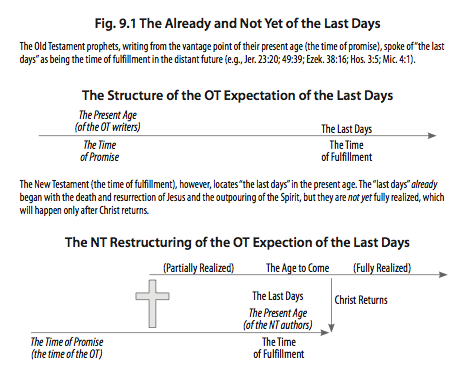
Timelines and charts throughout are a great feature. In addition to timelines in the back of the book covering all of Biblical history (including intertestamental times), there are charts throughout the book that aid the reader. Thomas Schreiner lists all the Epistles, their authors, dates, place of writing, and recipients. Johnson uses nine separate figures to visually (and clearly) display the differences in how Christians interpret Revelation. And House has a table that lines up the prophets with the kings during whose time they prophesied. (A couple of similarly simple and clear maps could be a great addition to future editions of this book.) Here’s an example (taken from a pdf sample of the book):
And then there’s the middle section, part two of Understanding the Big Picture of the Bible. That section alone makes this book worth more than its purchase price. It contains the following:
“The Time between the Testaments,” by J. Julius Scott Jr.
“The Roman Empire and the Greco-Roman World at the Time of the New Testament,” by David Chapman
“Jewish Groups at the Time of the New Testament,” by John Delhousaye
Take just this short quotation from Chapman as an example:
Amid this history, Jesus Christ launched his ministry in a Galilee governed by a Roman client king, a Judea under Roman procurators, and a Judaism tinged with Hellenism. After his crucifixion by the Romans and his resurrection, his gospel was carried by the apostles directly into the heart of Greek culture and Roman power. (94)
Having this background in mind when approaching the New Testament will greatly advance the efforts of any Bible reader. Most Bible overview guides that I’ve seen go right from Old Testament to New Testament. But what about all that time in between? I’ve written more here about why that time period is essential to NT understanding. This book really gets that, and covers that period well. Someone with no knowledge of NT background would find this section easy to follow, and even a budding scholar would appreciate the clarity of the historical overview.
While it’s hard to discern what is the work of the editors (this book has three: Wayne Grudem, C. John Collins, and Schreiner) and what is the work of the writers, this book could have benefitted from a little more careful editorial oversight. There are a few little typos scattered throughout the book (tehillah instead of tefillah for Hebrew prayer, e.g.). I found the use of the sex-specific “man” to refer to all of humanity–even when not quoting the ESV–distracting (although this may not bother other readers).
But there is a bigger editorial oversight. While the book excellently helps the reader to better understand the “big picture” of the Bible, it never directly answers the question it seeks to answer of “How do I get more out of my Bible reading?” The authors present all the necessary information to better understand the background (context) and foreground (content) of the Bible, yes. But understanding context and content is only necessary and not sufficient for “reading the Bible well.” I wish the editors would have made sure the book gave more attention to how one can read the Bible, for example, devotionally… or for transformation rather than just the receiving of information. In other words, I wanted this book, based on its title, to answer: How can I grow closer to God as I read the Bible? How can I allow the Bible to convict me of my sin? What about the importance of reading Scripture in community and corporate worship? David Reimer’s essay gets closest to this when he says, “[T]he art and craft of the Bible’s poems offers an invitation to read slowly, to have one’s vision broadened, once’s perception deepened… to see literary reflection in the service of worship and godly living” (54). I wanted to hear more about this. The key question for me is: Is overview knowledge of the Bible’s context and content sufficient to read the Bible well? Necessary, yes. Sufficient, no.
However, even if the book doesn’t execute its aim listed in the subtitle, it is still a valuable work to have in hand while reading through the Bible. Its unique contribution to works of this kind is in the middle section. I’d imagine this book sitting well on someone’s shelf next to his/her Bible and notebook. (It has on mine these last few weeks!) It would benefit a serious Bible reader to read, say, Darrell Bock’s essay on the Gospels and Acts before reading those Biblical books through.
Thank you to Crossway who provided me with a review copy of this book in exchange for an unbiased review. You can find Understanding the Bible Picture of the Bible at Amazon here.

 A long-time family favorite has been The Jesus Storybook Bible (subtitle: Every Story Whispers His Name). Friend and fellow blogger Robbie and his wife gave us this sweet gift when our now four-year-old was born.









 Words on the Word