Leslie C. Allen’s Liturgy of Grief for under $5 (ebook)

Leslie C. Allen’s Liturgy of Grief is under $5 this month in ebook form. It’s here on Amazon ($4.99) and here on CBD ($3.99). It’s a good deal for a great “pastoral commentary” on Lamentations.

I reviewed the book this summer, as well as interviewed the author.

Guest post: Robbie Pruitt on A.W. Tozer

Magnificent Monograph Monday this week features a guest blogger, Robbie Pruitt. I have guest posted on his blog (My Two Mites) before, and today he posts here. It’s a review of Knowledge of the Holy by A.W. Tozer. Robbie is a gifted youth minister, teacher, poet, reader, writer, and friend.

Nothing is more important than a right understanding of God, or “thinking rightly about God.”  In Knowledge of the HolyA.W. Tozer states, “The Church has surrendered her once lofty concept of God and has substituted for it one so low, so ignoble, as to be utterly unworthy of thinking, worshipping men.”  Tozer is addressing idol worship that many fall into by thinking wrongly about God.

It is into this reality that Tozer speaks in Knowledge of the Holy, which is an excellent study of the attributes of God. (See pdf of book here.)  Tozer describes in detail the importance of thinking rightly about God, going so far as asserting, “What comes into our minds when we think about God is the most important thing about us.”  When it comes to our thinking about God, everything is at stake.  We must think deeply and accurately about God if we are to know Him and worship Him rightly and truthfully.

According to Tozer, when we think about God, we are using the language and the concepts that our finite minds can grapple with.  Our understanding of God is limited, as God is infinite and we are finite.  We are also unaware of the fullness of God as there are attributes we have not had revealed to us yet, and which we do not currently have the capacity to comprehend.  Tozer says, “We learn by using what we already know as a bridge, over which we pass to the unknown. It is not possible for the mind to crash suddenly past the familiar into the totally unfamiliar.”

While Tozer is acutely aware of the magnitude of his subject, God, he is not deterred from writing a most excellent reflection on the attributes of God that we can understand and contemplate.  An attribute, simply stated by Tozer, is “whatever may be correctly ascribed to God.”  While there is ample evidence to conclude that what we do not know about God is vast, there is so much about God’s character and nature that we can accurately know.  To begin with, we can know His attributes, and we can ascribe these attributes to Him with confidence.

In thinking about the enormity of God, Tozer is quick to warn against idolatry and thinking wrongly about God.  He says, “To think of creature and Creator as alike in essential being is to rob God of most of His attributes and reduce Him to the status of a creature.”  We must not think of God in “human” terms, though we are using human brains and creation and are reasoning, to contemplate the essence of God.  In thinking of God we must proceed cautiously, reverently and prayerfully, in faith and in love, as we rest in God’s divine revelation to us.

If we are not cautious, the dangers are clear.  We can think of something less than God and find ourselves in idolatry, worshipping something less than God.  Tozer says, “If we insist upon trying to imagine Him, we end with an idol, made not with hands but with thoughts; and an idol of the mind is as offensive to God as an idol of the hand.”  The other danger in thinking about God is attempting to manipulate, control, or manage God, which essentially places us above God as “god.”  Tozer describes this phenomenon this way: “Left to ourselves we tend immediately to reduce God to manageable terms.  We want to get Him where we can use Him, or at least know where He is when we need Him.”

We must look to God with great anticipation and appreciation of God’s revelation to us.  It is adequate.  God has revealed Himself to us and God is knowable.  God, in His great love and mercy, has revealed Himself to us in His son Jesus and we can know Him in faith and in love.  Tozer asserts, “In Christ and by Christ, God effects complete self-disclosure, although He shows Himself not to reason but to faith and love. Faith is an organ of knowledge, and love an organ of experience.”   We can know God and we can experience God.  This revelation of God is a great mercy to us and is a gift to us in Jesus Christ, through His Holy Spirit, which leads us into all truth.

As Tozer says so eloquently, “For while the name of God is secret and His essential nature incomprehensible, He in condescending love has by revelation declared certain things to be true of Himself.”  These truths of God are, indeed, His attributes, and we can know them and study them.  Knowledge of the Holy is a great tool for this study as we seek to come to know the eternal, magnificent, and indescribable God that we seek to worship rightly.

An attribute study is a great way to come to know God more deeply and is a great way to explore the richness of the Scriptures in a more non-linear approach.  Knowledge of the Holy covers some essential thoughts and attributes of God, as well as doctrines, that every Christian should think about.  As Tozer rightly points out, “The study of the attributes of God, far from being dull and heavy, may for the enlightened Christian be a sweet and absorbing spiritual exercise. To the soul that is athirst for God, nothing could be more delightful.”  As we seek God and seek to have our thirsts for Him quenched, this book, in addition to Scripture, prayer, and community, is a great place to start.

A thorough reading of Knowledge of the Holy highlights so many truths about God.  We are plunged into the depths of God’s character and nature and are left in a state of awe and worship in the presence of an awesome God.  While we will spend a lifetime and an eternity seeking to know God completely and to worship Him rightly, we can know God and worship Him now.  To quote Tozer one last time, “To our questions God has provided answers; not all the answers, certainly, but enough to satisfy our intellects and ravish our hearts. These answers He has provided in nature, in the Scriptures, and in the person of His Son.”  How marvelous it is to wonder at His greatness and to think rightly about our God!

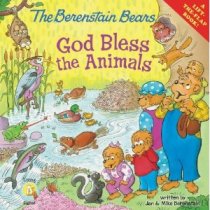
Another 4-year-old son review of The Berenstain Bears… this time: God Bless the Animals

Family Friday this week at Words on the Word comes on Saturday. Here my 4-year-old son reviews another Berenstain Bears book. See him review the first one here.

For this review, my 4-year-old son’s 2-year-old brother joined us. The 2-year-old’s comments are in parentheses below, usually also in all caps, because that’s how he speaks. Regular font is my 4-year-old.

This is a flap book.  (That’s a book!)

There’s a little baby who has a little rope on her head with a little heart on the front, and she has a little shirt with a heart on it. And Mama Bear walks the baby down the stairs. (MAMA BEAR! DADDY BEAR! DA DOOO!)

Are you writing goo-goo words?

Sister Bear is pointing under the lettuce, a little cabbage. Do you know what’s under the cabbage, daddy? There’s bunnies; I’ll count them. 1, 2, 3, 4. So there’s 4.  There’s a butterfly under some flower beds.

(NO NO NO NO! I WANT TO READ A CHOO-CHOO BOOK!)

Mr. Possum and Mr. Skunk–the skunk is in his hollow stump and looking at a book. And there’s a light so he can see and one little hole for one little window, and only just a chair.

There’s a squirrel that’s jumping from here to here.

Daddy, how about you write up some baby words? Whatever I say will be baby words, just to be funny. Are you ready for some baby words?

Goo goo ga ga. Bloo rah rah. Dada.

There’s one little frog and four bees. The bees are making a lot of light. Bzzz!!  (BEEEEZZZ!)

How about we surprise the other guys with this one? On this page can we surprise the guys? It’s okay if we just go to the next page. (2-year-old putting blanket on 4-year-old: GO TO BED!)

There’s a fish sliding across the stream. It’s going, “Weeee!!!” And it might bump into some of the rocks.

That’s all I want to do. So we totally book reviewed it.

I liked it because of everything. I felt good when we read the book.

Find more about The Berenstain Bears: God Bless the Animals at its Zondervan product page or on Amazon by clicking the book’s image above. Read the rest of my 4-year-old son’s reviews here. Jake wishes to comply with FTC guidelines and disclose that he received a review copy of this book from Zondervan, but not with any expectation as to the nature or content of the review.

frameworks (How to Navigate the New Testament): a review

Why the book frameworks? Author Eric Larson says,

frameworks, quite simply, is a book about Bible navigation and context, material that’s designed to build your confidence in your ability to negotiate the text and understand it. Think of it as a guidebook, a Bible companion, written for anyone who would like to have a personal biblical tour guide. This book can be used for self-study, in small group discussions or in classrooms to set the context for Bible reading and to lead you through it.

The emphasis in the book is on presentation and memorability. Larson uses rich and beautiful imagery (and “lots of refreshing white space”) to create a book that has a good home on a coffee/display table. Yet he doesn’t neglect solid content around each biblical book, either.

The introduction is short and sweet and covers essential territory like who the writers were, literary divisions of the book, and an especially helpful 7-part “Navigating Jesus’ Ministry” section with simple maps and narrative highlights. After an introduction to the New Testament in general, each book of the New Testament has these 10 sections: introduction, theme, purpose, outline, verses to note in that book (the best part of frameworks, I thought), navigation (a page of things to look for when reading a book-well done), unique things about that book, recap, questions, and a verse to apply right now.

There is a sample pdf of the table of contents and introduction here.

Charts, tables, photographs and other graphics are a strong point of this book. Some are as simple as this historical timeline, which is visually appealing:

Or take this visual outline of the book of Luke, from p. 92 of the book (and posted on the author’s blog):

(The spelling error in ascension is corrected in the book.)

This book will answer many questions people had about the New Testament but were afraid to ask–one of its intended purposes. For example, in Larson’s introduction to the Gospels (“Biographies of Christ”), he writes about the “four living creatures” that many have understood to represent the Gospels. (Lion, Ox, Man, Eagle.)

I’ve always seen Mark associated with the lion, but Larson has the lion with Matthew, the ox with Mark, the man with Luke, and the eagle with John. He notes that this is the order of the four living creatures in Revelation 4:6-7. But the order as it appears in Ezekiel 1:1-14 is what I’ve seen more typically, where it’s human, lion, ox, and eagle. I understand that Christian tradition varies here a bit.

This is not a huge deal, but it is indicative of a larger trend in the book–nuance seems to be prioritized at times less highly then presentation. Larson’s laudable goal is to engage “anyone who would like to have a personal biblical tour guide.” It’s about “navigation and context,” but readers will still want to look elsewhere for greater detail and clarification on some matters.

As far as a New Testament framework goes, Larson’s 4-1-9-4-8-1 scheme did not immediately strike me as easily memorable. He divides the NT this way:

  • 4 biographies of Christ
  • 1 history book (Acts)
  • 9 letters of Paul to the churches
  • 4 letters of Paul to people
  • 8 general letters
  • 1 book of prophecy (Revelation)

This is less memorable than the 4-1-21-1! chant I’ve used with young people. (See the pdf of it here, from Center for Youth Studies.) Larson’s 4-1-9-4-8-1 does have the advantage of dividing up the 21 letters/epistles into their types/authors, but as much as I wanted to latch on to 4-1-9-4-8-1, I never quite did. This is not too say it’s a bad thing to use; it is to say a reader might not pick it up as easily as some other NT “frameworks.”

One other critique I offer is that, although I appreciate the approach of using visual imagery and stories and examples rooted in culture to try to connect the ancient text to today, sometimes the connections feel a bit stretched. For example, the photograph accompanying the “history” title page (for the book of Acts) is an unfinished attic with a sawhorse in it and a window with light coming through. It’s a beautiful image. But what’s it trying to evoke? The upper room? The light as the Holy Spirit? Okay, but why the sawhorse? Other such images left me curious as to why they were selected, or how they were meant to visually reinforce the author’s text.

Similarly, while the story about Anne Sullivan and Helen Keller to begin the book of James is itself inspirational, its application to James and his audience sure felt reach-y. That James’s “self-indulged spiritual children” were “behaving badly and desperately need a spanking” is an odd way, indeed, to describe things! James would have never “spanked” his listeners. I know the author doesn’t mean that literally, but that image was distracting. I often found myself reacting this way in the introductions to each of the books.

Everything after a book’s introduction is generally solid–and creative. In Mark, for example, Larson has a selection of verses from that Gospel that he has the reader “read…without stopping to take a breath.” He puts in bold words like “at once,” “quickly,” and “immediately” (a favorite of Mark’s). Then he concludes, “If you feel out of breath, congratulations. Mark has succeeded in brining you into his fast moving narrative.” I thought this was a great way to draw the reader into the fast-paced action movie that Mark often feels like.

I like the approach to this New Testament introduction; it’s creative and will reach a larger audience then some less visually-oriented books on the same subject. The short descriptions of each book are generally solid, but the occasional lack of nuance and informal tone distracted me at times as I worked my way through the book. (In other words, as with any book, this one should be read critically.)

Yet I do think Larson’s efforts will guide the reader into deeper engagement with the biblical text. His emphasis on what to look for in a book, pulling out and quoting specific verses, and his constant admonition to “Read It!” are refreshing. He even gives an estimate for how long it takes to read through a book at a casual pace, which is an enormous aid to anyone who will commit to sitting down and doing reading through God’s Word.

I received a free copy of frameworks for review purposes. Thank you to the author and publicist for the chance to review it.

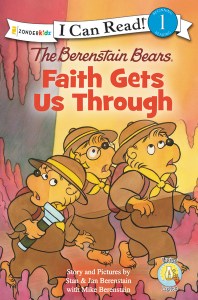
My 4-year-old son reviews The Berenstain Bears: Faith Gets Us Through

There’s three little cubs and Sister Bear says, “I’m scared.” And Brother says, “I’m scared.” And Fred says, “The Lord is my salvation.”

There’s lots of rocks. I’ll count them: 1, 2, 3, 4, 5, 6, 7, 8, 9, 10, 11, 12, 13. 1, 2, 3, 4, 5, 6, 7, 8, 9, 10, 11, on two sides. And there’s a mountain goat standing on one of them. One’s on one rock and the other one’s on another rock.

Then they [the Bears] go in the cave. One goat is up really high, on the top of the cave. And they go in the cave. Papa Bear is pointing at himself and saying, “I know all about caves.” Then they talk about caves.

Papa says, “Hello!” And it goes, “Hello! Hello!” That’s the echo.

Something [a stalactite] almost fell on Papa and killed him. But he jumped away.

Papa: “It’s okay, I left a string showing you the way.” The goat eats the string and they don’t know the way out. But they actually know the way out.

They all splash out, and what does Papa say? It starts with a Y. Does he say, “Help”? Or “Welp”? Um… he says, “YIEEE!”

[To father/typist] Hey, Daddy, do you know all about caves? I want to know.

They got in the water and then… weeeee!!! They got their badges. Kind of like Chuck and Friends. But Chuck and Friends don’t get weeee’d down the water. They’re just exploring. They mostly just look for stuff to help them do stuff. And the big, grown up monster truck teaches them.

[Back to the story….] I like that the goat eats the string and that they go down the water slide. It’s not a water slide. It’s actually a water fountain.

I didn’t like that Papa doesn’t know that there’s another way out. And that’s it.

I am glad I have this book. This book is good for four-year-old ages, and every age. Hey, daddy–let’s read!

Bye bye.

Find more about The Berenstain Bears: Faith Gets Us Through at its Zondervan product page or on Amazon by clicking the book’s image above. Read the rest of my 4-year-old son’s reviews here. Jake wishes to comply with FTC guidelines and disclose that he received a review copy of this book from Zondervan, but not with any expectation as to the nature or content of the review.

Enter in: One good reason to study how the New Testament uses the Old Testament

I’m reading the book shown at right for a seminary class I’m taking. The class is called “The Old Testament in the New.” Its syllabus is here (pdf).

I’ll offer a review of Beale’s Handbook on the New Testament Use of the Old Testament later, but for now, this:

The aim of this chapter [3], and indeed of this entire handbook, is to obtain a better understanding of the way the NT is related to the OT at just those points where the New refers to the Old. The ultimate purpose in this exercise is more clearly to hear and apprehend the living word of the living God (cf. Acts 7:38), so that we may encounter God increasingly and know him more deeply, and so think and do those things that honor God.

He notes that he realizes “that this purpose is not shared by all in the academic guild,” but I believe that if the biblical authors meant for their writings to be read in a “participatory mood,” we actually do some injustice to the text when we don’t read them that way.

One of my reviews to be published in Bible Study Magazine

I have written a book review that is slated to be published in an upcoming issue of Bible Study Magazine.

You can see what Bible Study Magazine looks like by flipping through this past issue.

The book I review is Lamentations and the Song of Songs, by Harvey Cox and Stephanie Paulsell. It’s the newest edition of Westminster John Knox Press’s Belief theological commentary series. (More about the book is here.)

Both authors suggest reading their respective biblical books in a “participatory mood.” Cox and Paulsell each highlight the timelessness of Lamentations and Song of Songs, surveying well their history of interpretation to help readers today apply them and enter in to the texts. A good commentary to have at hand, especially when preaching through either Lamentations or Song of Songs–something that probably doesn’t happen as often as it should.

New scholarly edition of the Greek New Testament

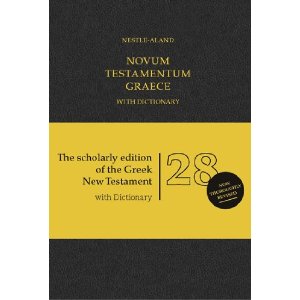
The Nestle-Aland Novum Testamentum Graece (Greek New Testament) releases in its 28th edition soon. Here is a description from the NA28 Website:

The long-awaited 28th edition of the Novum Testamentum Graece has now been published. Once again the editors thoroughly examined the critical apparatus and they introduced more than 30 textual changes in the Catholic Letters, reflecting recent comprehensive collations. With the intent to make this book more user-friendly, the editors also revised the introductions and provided more explanations in English. This concise edition of the Greek New Testament, which has now grown to 1,000 pages, will continue to play a leading role in academic teaching and scholarly exegesis.

Prof. Dr. Holgar Strutwolf speaks more about it here:

And check out this page for the digital Web-based version of the text, with apparatus and full manuscript information (via Evangelical Textual Criticism).

Review: Accordance 10’s Commentary on the New Testament Use of the Old Testament, by Beale and Carson (part 2 of 2: the content)

Commentary on the New Testament Use of the Old Testament, edited by G.K. Beale and D.A. Carson, is available as an add-on module in Accordance 10. In the first part of my review of the module, I focused on Accordance’s presentation of the commentary. Here I review the content of the commentary itself, but still with a close eye on how I’ve experienced it in Accordance.

I mentioned in my last post that for reading this commentary straight through (e.g., if I want to spend some time absorbing the introduction to any given book), I can easily detach it from a given workspace where it has shown up as a “Reference Tool.” I also noted that navigating through the various headings and sub-headings of the commentary is very easy, as Accordance lays it out.

To quickly view hyperlinks you can do a “Popover” for Instant Details by holding a click on a hyperlink or by pressing option-click. Or, as I’ve begun doing since my last post, you can just have the Instant Details always open. This way I can quickly read the text of a verse that is merely referenced in the commentary, and not lose my place in the body of the commentary.

Highlighting is also mercifully easy, so that my commentary currently looks like this:

One thing to appreciate about the content of the commentary right off the bat is that it succeeds in its hope that

Readers will be helped to think through how a particular NT book or writer habitually uses the OT; they will be stimulated to see how certain OT passages and themes keep recurring in the various NT corpora.

Take D.A. Carson’s introduction to 1 Peter, for example:

The OT is cited or alluded to in 1 Peter in rich profusion. In a handful of instances quotations are introduced by formulae: dioti gegraptai, “wherefore it is written” (1:16, citing Lev. 19:2), dioti periechei en graphē, “wherefore it stands in Scripture” (2:6–8, citing Isa. 28:16; Ps. 118:22; Isa. 8:14), or, more simply, by dioti, “wherefore” (1:24–25a, citing Isa. 40:6–8) or by gar, “for” (3:10–12, citing Ps. 34:13–17). About twenty quotations are sufficiently lengthy and specific that there is little doubt regarding their specific OT provenance. For a book of only five short chapters, there is a remarkable record of quotation. Yet the quotations tell only a small part of the story, for 1 Peter is also laced with allusions to the OT.

Andreas J. Köstenberger’s introduction to John is remarkably thorough in this regard, containing (among other things!) a table of introductory formulas John used for OT quotations, a comparison between how John uses a given OT text and how other NT writers use it, how John’s quotations relate to potentially underlying Hebrew and Greek texts, and so on.

As noted above, there are several ways I can easily use Instant Details to look up each of the verses mentioned in the commentary, without losing my place in the main body. Note that the commentary uses transliteration for Greek and Hebrew throughout. For those who are not huge fans of transliteration (myself included), this is offset by the ease with which I can look up any of those verses in Accordance in the original texts, right alongside the commentary.

In the below screen shot I have the GNT-T text at bottom left tied to the Beale-Carson Commentary. This is simple to set up with a right click on the tab, then going to “Tab Ties.” This means that as I advance through 1 Peter, for example, the GNT-T text follows me. In the instance below, I have the parallel NET open, so that a Greek-English diglot follows me through the commentary. In the “Context” zone at the right I have the Hebrew Masoretic Text and the Old Greek (LXX) open with my favorite corresponding English translations (NET and NETS) below.

One thing I sort of stumbled on that is really neat. Besides clicking on a hyperlinked verse in the text (to show me that single verse in the Context zone), command-clikcing on a hyperlinked verse gives me all the verses in my commentary’s paragraph that are hyperlinked. Note the “Verse 1 of 12” below, and how Isaiah 8:14 is right below Leviticus 19:2 in my LXX. What a nice feature!

Okay. Back to the content of the commentary itself. The introductions to each NT book, then, do well to orient the reader to trends in how that particular writer interacts with the OT text. The list of contributors is impressive–see it here. The commentary seeks to analyze not only instances where the NT quotes the OT, but also “all probable allusions” as well.

Generally speaking, each citation or allusion in question is organized around these facets:

  • The New Testament context: “the topic of discussion, the flow of thought, and, where relevant, the literary structure, genre, and rhetoric of the passage”
  • The Old Testament context of the source of the quotation or allusion–already things get interesting here, because NT writers do seem to feel free to recontextualize or resituate OT passages…
  • How early Judaism literature understood the given OT text. Even when there is little evidence of citation in early Judaism, there is still explanation. Köstenberger, for example, on John 2:17 briefly discusses the Jewish valuing of zeal, drawing on Phinehas, the Maccabees, and the Qumran community.
  • Textual issues, e.g., changes in verb tense from the LXX to the NT, and explorations of what text (proto-MT, LXX, etc.) or texts might inform the NT author’s quotation, including good discussion of textual variants (in the MT, LXX, and GNT!)
  • “How the NT is using or appealing to the OT,” i.e., are they so steeped in the OT that its language comes out naturally and not as a deliberate quotation? Does the NT writer have fulfilled prophecy in view? Etc.
  • The “theological use” of the OT by the NT writer

This last category ties much of the other content together. For example, on the theological use of Mark 1:2-3, Rick E. Watts says, “As such, eschatologically, in Jesus Isaiah’s long-delayed new-exodus deliverance of Israel has begun in Malachi’s great and terrible day of the Lord (Mal. 4:5).” Watts is dense here, but delightfully so, in my opinion. He develops these themes further–especially that of the new exodus–throughout his analysis on Mark.

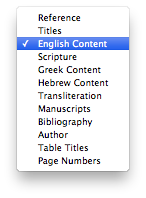
I mentioned in my last post that you can search this module in a dozen different ways. The search bar is similar to Google, in that you can search English content by a single word, but also by a phrase in quotation marks, so that that exact phrase comes up in your search. Unfortunately the “Greek Content” and “Hebrew Content” searches (which search using Greek and Hebrew letters) are not available in this module, but that’s no fault of Accordance’s, since the commentary uses transliteration.

Fortunately, “Transliteration” is a search option, so you can easily look up how the commentary treats a given Greek or Hebrew word. Searching hilastērion, I see that all seven of its uses in the commentary are at Romans 3:25.

There were a few times when I wanted to go deeper into a passage than the commentary allowed. For example, Paul’s citation of Malachi in Romans 9:13 has, “Jacob I loved, but Esau I hated.” It’s hard to imagine anyone using a commentary who doesn’t want at least a little explanation of “hated” here. The commentary, to be fair, does have, “This choice of Jacob meant the rejection of Esau,” but doesn’t connect this rejection with the verb “hate.”

This just means that Beale and Carson’s commentary won’t be the only place I turn for in-depth study of a passage, but all my seminary professors say don’t use just one commentary anyway! Not a major loss here. The book is already huge (though not on a computer, thankfully), and attempts to be only “reasonably comprehensive” (which it very much is), not exhaustively so.

Besides that, it took me about three seconds to find in Accordance the NET Bible note on Malachi 1:3:

The context indicates this is technical covenant vocabulary in which “love” and “hate” are synonymous with “choose” and “reject” respectively (see Deut 7:8; Jer 31:3; Hos 3:1; 9:15; 11:1).

This commentary is what we book reviewers like to call a monumental achievement. It sits in the carrel of many a student in my seminary’s library. For good reason. And Accordance has done a magnificent job if seamlessly integrating a rich and multi-facted commentary into its software. This is a five star commentary with five star integration into Accordance 10.

Beale and Carson say in their introduction:

If this volume helps some scholars and preachers to think more coherently about the Bible and teach “the whole counsel of God” with greater understanding, depth, reverence, and edification for fellow believers, contributors and editors alike will happily conclude that the thousands of hours invested in this book were a very small price to pay.

After consulting the original biblical texts, this commentary will always be the first place I turn when I am looking to better understand (and share with others) how the New Testament uses the Old. I am grateful for those “thousands of hours invested in this book.”

Thank you to Accordance for providing me with a copy of the Beale/Carson commentary module for review. Scroll through for all six parts of my Accordance 10 review here.

My 4-year-old son reviews The Beginner’s Bible: Bible Story Favorites

The first story is about Adam and Eve in the Garden. A sneaky snake came, and God said, “Don’t eat fruit from this tree!” Then a big lie comes into the world. Then they have to leave. And then Jesus will always come to save people from their sins.

The next story is about baby Moses. He got put in a basket, because he needed to be hided, because of the king. (He’s a mean one.) So he actually starts crying. Baby Moses starts crying. And I’ll show you, right there–there’s a dragonfly, right by the princess and the baby. Then the princess picked the baby up and said, “I want to keep you.” So Miriam prayed to God, “Please keep Moses safe.” God kept Moses safe, because he watched over Moses.

[The third story] First Joseph’s brothers think he’s bad. They sent him away, far away, to some men, two men riding horses, and the rope tied up to Joseph. And then he goes in jail. And then he meets a man in jail. The man says, “I used to work for the king.” He [Joseph] says, “I had a dream, I gave a drink to the king.” (He wasn’t mean.) Soon the man got out of jail. And then the man went back to work for the king, and he [the king] had a dream. Soon Joseph gets out of jail. And then the king says, “I have a dream. What does it mean?” “It means: save up food.” That’s what all the people did. Soon the food stopped growing. No one had any food, so they went to the king for help. And then Joseph says, “I am your brother.” And they did not know who he was. Joseph looked so different than he did before. “God is good!” Joseph’s brothers cheered. That’s the end.

I like everything about this book. This book is good for people who know Jesus. It comes with a CD that has all the stories that are in the book.

The last two stories are about Jonah (he gets spit out of a whale) and Jesus. Jesus saves everyone from their sins. That’s all I’m going to tell. That’s it. Good-bye! (You have to write “good-bye.”)

Find more about The Beginner’s Bible: Bible Story Favorites at its Zondervan product page or on Amazon by clicking the book’s image above. Read the rest of my 4-year-old son’s reviews here. Jake wishes to comply with FTC guidelines and disclose that he received a review copy of this book from Zondervan, but not with any expectation as to the nature or content of the review.