Work as “Partnership with God”: The Gospel-Centered Life at Work

Gospel Centered Life at Work PG


The Gospel-Centered Life at Work is “about the spiritual dynamics of work and life and how God uses our work in the lifelong process of making us more like Christ.” Robert W. Alexander says, “This study is a tool to help you build a bridge from your personal faith to your work. It will help you see how Jesus’s work for you applies to the work you do every day” (1). Through a combination of biblical study, good theology, practical application, and hands-on exercises, Alexander’s book is capable of helping any Christian living out faith at work.

What is work? Alexander says, “Work from a biblical point of view is whatever activity a believer pursues in the sight of God, for the glory of God, to the benefit of others” (3). The “vocation or calling of those who live by faith” is that “even the simplest tasks we perform by faith become acts of worship reflecting God’s character and ways” (8). Work is, ultimately, “a partnership with God” (10).

Having lain the foundation of work as partnership with God, Alexander addresses God’s work as Creator, Provider, and Redeemer. We, too, as participants in this work, create, provide, and redeem (10). Alexander is at his best in offering specific examples of each of these kinds of work. A biochemist, for example, is a provider because she or he says, “I help in harvesting and/or restoring of natural resources” (11). The book’s first exercise inspiringly calls for the reader to “jot down how your work reflects aspects of God’s work” (12).

If “vocation” is an imposing word or concept, Alexander helps demystify it. “Work” for Christians moves from being “a daily grind” to the locus of God’s work and presence, that space where we live out our faith (14). Vocation is discipleship, in other words, and the workplace is one of a few “chief laboratories of the gospel” (65).

Our jobs (whether inside the home or outside it) turn a mirror on our hearts, motivations, and idols (lesson 2). We are flawed and so either pretend or perform at work, if we’re not careful (lesson 3). But in our partnership with God (Creator, Provider, and Redeemer), the Gospel calls us to several roles: image-bearers (lesson 4), imitators (lesson 5), bond-servants (lesson 6), stewards (lesson 7), ambassadors (lesson 8), and messengers (lesson 9).

Alexander offers guidance and asks questions to help the reader think through each of these roles, which build on each other. For example, of image-bearing he asks, “How can Jesus’s work and presence in your life affect your own fears, expectations, desires, and goals?” (41) With this in mind the worker is more confident in his or her identity as image-bearer of God.

Gospel Centered Life at Work LGBoth the Leader’s Guide (pictured and hyperlinked at left) and the Participant’s Guide (pictured and hyperlinked up top) have a “Big Idea” introducing the lesson. The Leader’s Guide adds a “Lesson Overview” for small groups (complete with times!) and “Bible Conversation,” a guided tour (with ready-made questions) through relevant biblical passages that ground the topic at hand. One would hardly need to do much more supplemental preparation to lead a group through the material.

A few minor points in the book gave me pause. Alexander speaks of “housewives” (in 2016!) without mentioning “househusbands,” or the “stay-at-home mom” without considering the stay-at-home dad. And he inadvertently uses the Greek word diakonos in describing stewards. (The intended Greek word is oikonomos, which has to do with managing the economy of a house.) There are also a few points that feel Christian jargon-heavy.

But the spiritual meatiness of the book, coupled with practical questions and exercises, far outweigh any drawbacks. To take just one more example, Alexander offers a two-columned assessment a Christian can make of his or her day, including both a “To-Do” list and a “Done-For” list, which focuses on “the ways God worked through others to serve you as his beloved child” (66). I found this reassuring and motivating.

The final lesson on Sabbath-keeping is the best one in the book, alone making it worth the price of purchase, or the time it takes to go get it at the library. While the book is well-suited for individual use, Alexander has done small groups and small group leaders a service in writing his articles, exercises, and study guide.


Thanks to the kind folks at New Growth Press for the review copies. Check out the book’s product pages here and here, or find them at Amazon here and here.


Children’s Book Recommendation: Big Bot, Small Bot

Front cover


Marc Rosenthal’s Big Bot, Small Bot: A Book of Robot Opposites is short and simple, but wonderfully executed.

The book is just what it says: through colorful images and some imaginative flap-lifting, kids and parents follow some “retro-futuristic robots” through opposites like wet/dry, full/empty, and so on.

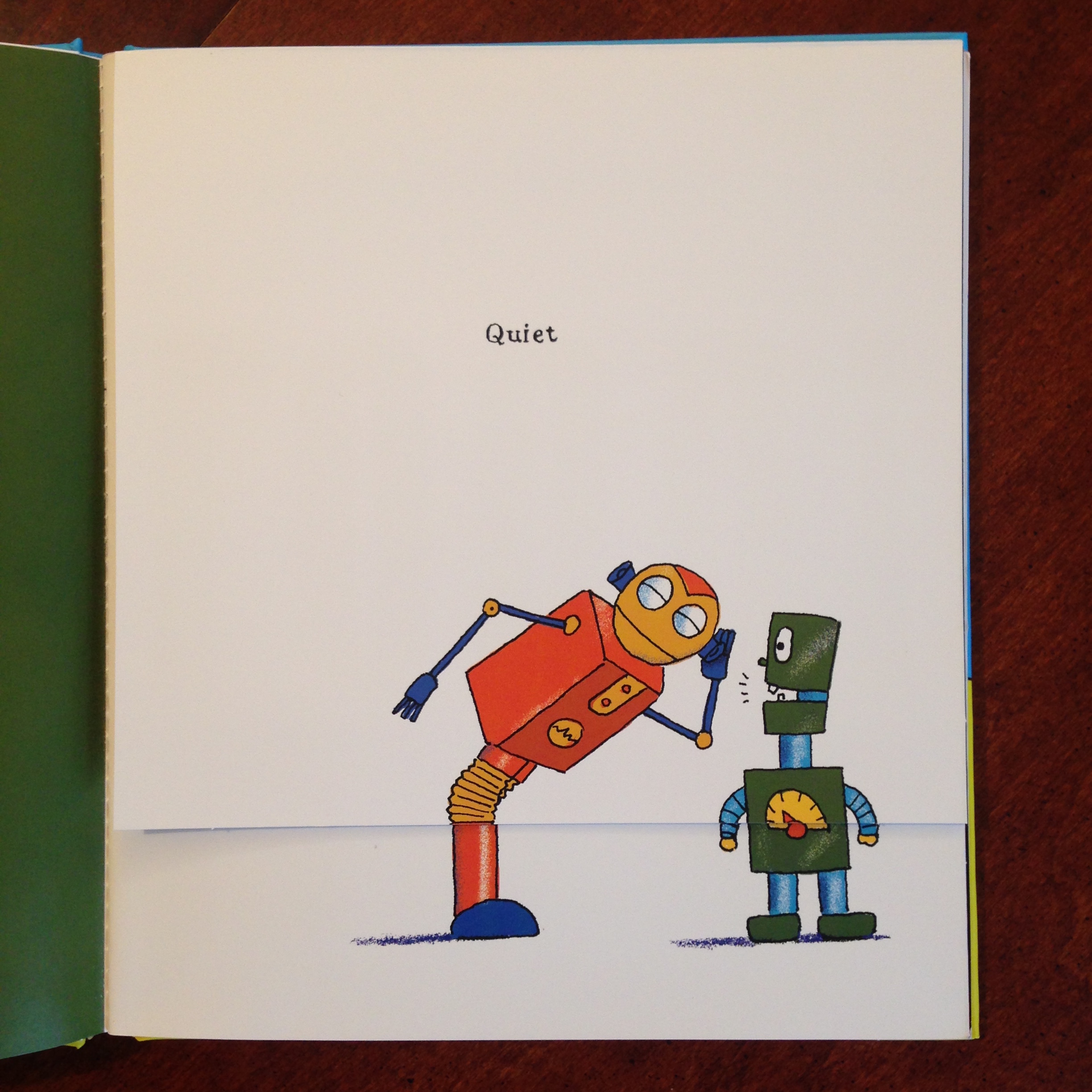
When you lift the flap, the opposite is revealed. So you start with this:


Quiet


And end up with this!


LOUD


I really wanted to just take a picture of every opposite and show it to you, but I will simply recommend the book, instead. The target ages are 2 to 5, which seems spot on to me. (You can see more images here, if you like.)

The book is funny, clever, and engaging. My 3-year-old was a fan from the first time she read it. The paper is nice and thick, too. That means it will give up a pretty good fight when your toddler decides–in a fit of unexplained and inexplicable rage–to rip all their books. (I’ve heard some kids do this.)

It makes for some excellent parent-child reading and interaction.

Find the book at POW! Kids here, or at Amazon here.


Thanks to the good folks at POW! Kids Books for sending the book for review, though that did not influence my opinions.

First Typo I’ve Ever Found in a Bible… and It’s a Good One!

Seriously–check it out. In Luke 11, the crowd demands… a hymn sing!


UBS5 Hymn Sing Typo


I found it in Zondervan’s lovely UBS5-NIV11 diglot, though it also exists in the UBS5 stand-alone version.

I can’t begin to imagine how difficult it must be to proof an entire Bible and get it all right–so no judgment here, just a funny image of a crowd getting tired of Jesus’ preaching and asking for a hymn sing instead!

Zondervan’s Newest (NIV11-UBS5) Greek-English New Testament

Cover in Wrapping


Yes, I’m aware that it’s probably better to practice Greek reading with a Reader’s Bible (N.T. Wright even told me that!) than with a Greek-English diglot.

That said, Zondervan’s new NIV11-UBS5 diglot is an excellent Greek Bible to have on hand and use for both reading and research.


What It Is


  • Zondervan’s recently revised New International Version 2011 is the English text. Read more about the 2011 NIV here
  • The Greek text is the United Bible Societies’ updated 5th edition of the Greek New Testament. If you haven’t familiarized yourself yet with this edition and the changes it contains (summary: general epistles), check out this post, especially the infographic
  • The UBS5 text is accompanied by the full critical apparatus
  • Unlike other diglots I’ve seen, the Greek is always on the left page and the English on the right page
  • Both texts are in single columns


What I Like About It


Overall this edition is really nicely produced. Here are some highlights:

  • The pages are thicker than I expected–this makes for a better reading experience
  • It’s light and portable
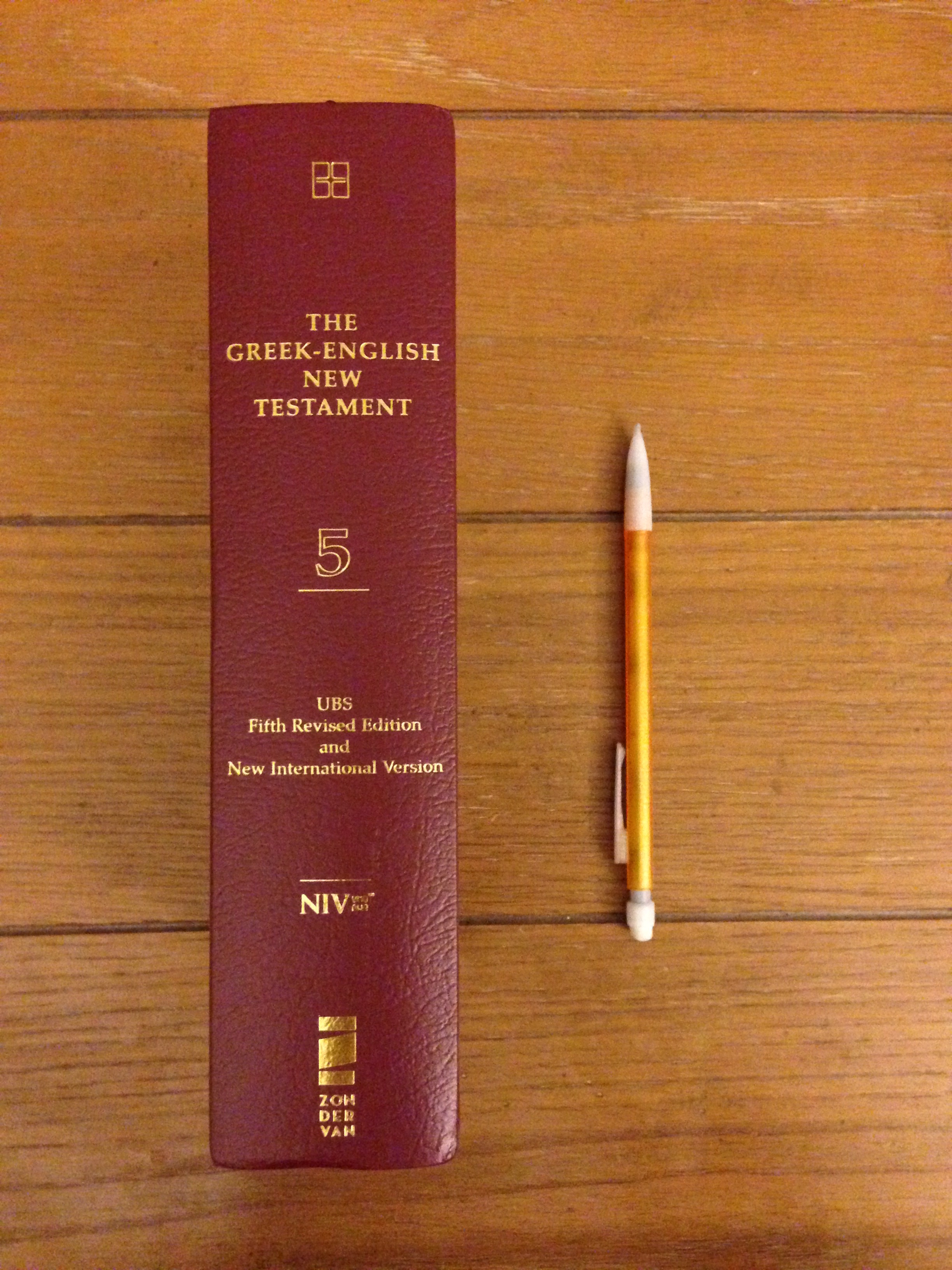
  • The exterior of the book is classy :


Spine and Pencil


  • It lays flat! Even when you’re reading the prefatory material
  • Old Testament quotations are in bold font
  • There’s a really nice ribbon marker
  • And… the Greek font looks great. Check it out:


Mark 1 in Greek


What Could Have Been Better


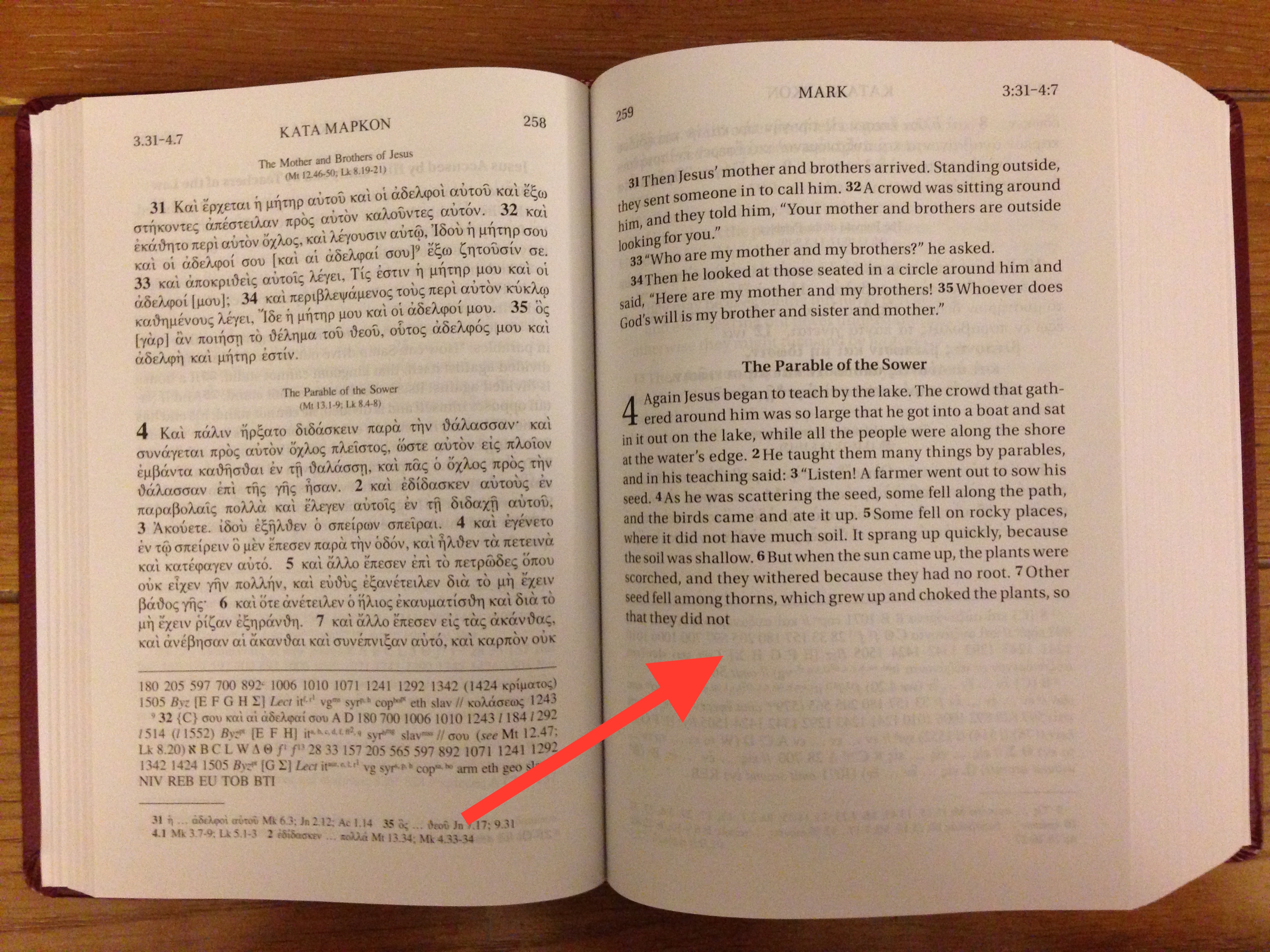
No bullet points here–just one major critique. In a deliberate move, the English on a page may cut off mid-sentence to try to more exactly match the Greek. Of course a one-to-one match is impossible because of the differences between the two languages (not the least of which is word order), but the intention is good, if not always perfectly executed in terms of matching English to Greek. Regardless, the unexpected editorial decision leads to awkward looking pages like this one (click image to enlarge):


Greek and English


To each their own, I guess, but I still haven’t gotten used to it, even after reading through full chapters of text.

But everything else (layout, font, book construction, feel, etc.) is spot on. I’m a fan of this Bible, and while I’m pushing myself to use a Reader’s edition (Greek only), when I want English and Greek side-by-side, this is my new go-to.

You can learn more at the Bible’s product page here. It’s on sale at Amazon here.


Thanks to Zondervan for the copy, provided to me as part of a series of ongoing posts about the 2011 NIV–though there was no expectation as to the content of my review.

Alpha: The NATO Alphabet for Kids (and Their Parents)

image


With Isabelle Arsenault’s Alpha, I finally have a tool to keep the NATO phonetic alphabet in my head. That’s more useful to me than you might think, not least of which is because I really do have to spell both my first and last name quite often when talking to various phone reps. (A… B as in Bravo… R… A… M as in Mike.)

It’s first and foremost a children’s book–though also a good visual aid for learning what is also known as the International Radiotelephony Spelling Alphabet.

The book’s cover is actually a fine way to judge its contents in this case: It is the clever illustration–a paper airplane–for Delta.


image


The next spread, Echo, has a child at school throwing such an airplane at the child sitting in front of him.

Each letter of the alphabet receives a two-page spread: the word at left and an illustration at right. Some illustrations you might have guessed–like the couple dancing the Foxtrot. Others are more subtle and creative–like Hotel, which is the Monopoly hotel piece. Romeo and Juliet share a ghostly motif that ties the two images together, separated they are by some pages (and… uh… other impediments).

The letter under consideration has its own color, so that with even younger children you could focus just on A, B, C, D, and so on. Of course, my eight-year-old can appreciate that this section of his Dangerous Book for Boys now has some visual reminders to help him with his NATO alphabet.

There’s no storyline to follow, of course. But it’s been an interesting (and visually pleasing) read for each of my three kids, from three up to eight years old.

The sewn binding and high-quality paper will find approval with parents who want a book that will withstand a few throws across the room. (From the kids, not the parents.)

Alpha is a smart, nice-looking, and useful take on the classic children’s abecedarian.

Find Alpha at Amazon here, or at Candlewick Press’s page here. See Isabelle Arsenault’s page (with lots of images) here.


Thanks to Candlewick Press for the review copy, given with no expectation as to the content of the review.

Children’s Book Review: The Little Snowplow

The Little Snowplow


We need the little snowplow in our neighborhood. Last winter we saw more than 100 inches of snow pile up. The kids loved it, and we parents sort of did, but it made getting around a challenge. And it got old fast.

Enter the little snowplow:

On the Mighty Mountain Road Crew, the trucks came in one size: BIG.

That is, until a new snowplow joined the crew.

“You’re such a little snowplow,” the big trucks said.
“Leave the heavy lifting to us.”
And off they roared.

My five-year-old was enraptured at this point. And what young child wouldn’t identify with the little guy in the story? Each night he does his “reps” (raising and lowering his plow ten times). He pulls blocks of concrete. “Just in case.” Had he been training for 2015 in Massachusetts, he would have been oh-so-glad for all the hours he put in.

Then a blizzard hits–more than the little snowplow can handle, and the plow driver has to call for backup. In the end, against the odds, the little snowplow turns out to be a real hero, with his place secured among the Mighty Mountain Road Crew.

Most grown-ups will see the story coming–the motifs are familiar ones. One thinks of the setting and improbability of Katy and the Big Snow, with echoes of The Little Engine That Could, and a scene reminiscent of Little Blue Truck. The story ends with the little snowplow ready to bed down, though the “He could hardly wait for sleep” ending felt a little less satisfying than expected.

Still, The Little Snowplow is engaging. It’s an important idea that one can succeed even though small or dismissed by others. The message of the book is a good one, and the story moves along nicely. My three kids are all fans of the book.

The Little Snowplow is Lora Koehler’s first children’s picture book. Jake Parker illustrates the story. And the illustrations are great. They’re colorful, clear, and absorbing. They really make the book. There are enough of them, too, that a non-reader can easily enough make his or her way through the story. (See a few more illustrations here.)

I don’t even want to think about winter coming soon, but I’m sure we’ll continue to reach for this book when the snow comes–and we are reading it now, even with potential blizzards months away.

Find The Little Snowplow at Amazon here, or at Candlewick Press’s page here.


Thanks to Candlewick Press for the review copy, given with no expectation as to the content of the review.

Children’s Book Note: Almost an Animal Alphabet

Almost an Animal Alphabet


Our family has read a lot of alphabet books in our day–now I’m working on letters with Kid #3 (!). We read through Almost an Animal Alphabet the other day, which she sincerely enjoyed. (The Yeti is my favorite–and, I think, what makes it only almost an all-animal alphabet.)

The illustrations are creative and fun, and the book is both educational (as you’d hope) and funny. Check it out via POW! Books here, or here on Amazon.

Full PDF: Comparative Review of Software for Septuagint Studies

JSCS (2014) Cover
JSCS (2014) Cover


I’ve received permission to post the full .pdf of my comparative review of software for Septuagint studies. It appears in volume 47 (2014) of the Journal of Septuagint and Cognate Studies (JSCS). In the review I consider and evaluate Accordance 10, BibleWorks 9, and Logos 5, specifically with an eye toward their use and resources in the field of Septuagint studies.

Since I wrote that review, new versions of each of those programs have appeared: Accordance 11, BibleWorks 10, and Logos 6. Perhaps the biggest change worthy of mention is that BibleWorks now offers as part of its program the New English Translation of the Septuagint.

Here is the offprint of my review.

You can subscribe to JSCS and see information about the International Organization for Septuagint and Cognate Studies (IOSCS) at this link. Journal Table of Contents are on Eisenbrauns’s site here.

Conference Prices on Some Hebrew Language Gems from Eisenbrauns

This month Eisenbrauns has a sale on my favorite series of theirs: Linguistic Studies in Ancient West Semitic (LSAWS). These titles are not often on sale, and you can rarely (if ever) find a cheaper copy of anything here, even if used via Amazon.

I highlight two volumes:

Word Order in the Biblical Hebrew Finite Clause, by Adina Moshavi


Moshavi Hebrew Word OrderMany of Moshavi’s examples come from Genesis, which make them easy to understand, as she is mostly using a narrative/historical text for purposes of illustration. I’ve read 75 pages (closely) and found the book both substantive and easy to understand.

Here is the publisher’s description:

Over the last 40 years, the study of word-order variation has become a prominent and fruitful field of research. Researchers of linguistic typology have found that every language permits a variety of word-order constructions, with subject, verb, and objects occupying varying positions relative to each other. It is frequently possible to classify one of the word orders as the basic or unmarked order and the others as marked.

Moshavi’s study investigates word order in the finite nonsubordinate clause in classical Biblical Hebrew. A common marked construction in this type of clause is the preposing construction, in which a subject, object, or adverbial is placed before the verb. In this work, Moshavi formally distinguishes preposing from other marked and unmarked constructions and explores the distribution of these constructions in Biblical Hebrew. She carries out a contextual analysis of a sample (the book of Genesis) of preposed clauses in order to determine the pragmatic functions that preposing may express. Moshavi’s thesis is that the majority of preposed clauses can be classified as one of two syntactic-pragmatic constructions: focusing or topicalization.

This meticulous yet approachable study will be useful both to students of Biblical Hebrew and to persons doing general study of syntax, especially those interested in the connection between linguistic form and pragmatic meaning.


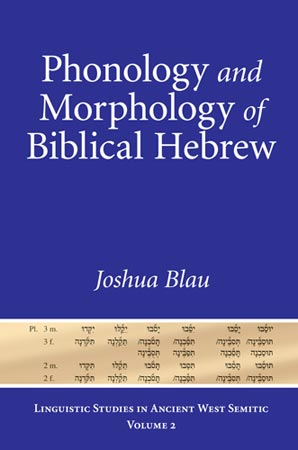
Phonology and Morphology of Biblical Hebrew, by Joshua Blau


Blau Phonology and MorphologyI haven’t read as much of this one, but is it ever detailed! It’s an excellent reference tool to look up and learn why Hebrew words are formed the way they are, and how each little part (morpheme) of a word comes into being and functions. Easily worth the $39 sale price.

From the publisher:

More than 80 years have passed since Bauer and Leander’s historical grammar of Biblical Hebrew was published, and many advances in comparative historical grammar have been made during the interim. Joshua Blau, who has for much of his life been associated with the Academy of the Hebrew Language in Jerusalem, has during the past half century studied, collected data, and written frequently on various aspects of the Hebrew language.

Phonology and Morphology of Biblical Hebrew had its origins in an introduction to Biblical Hebrew first written some 40 years ago; it has now been translated from Modern Hebrew, thoroughly revised and updated, and it distills a lifetime of knowledge of the topic. The book begins with a 60-page introduction that locates Biblical Hebrew in the Semitic family of languages. It then discusses various approaches to categorization and classification, introduces and discusses various linguistic approaches and features that are necessary to the discussion, and provides a background to the way that linguists approach a language such as Biblical Hebrew—all of which will be useful to students who have taken first-year Hebrew as well those who have studied Biblical Hebrew extensively but have not been introduced to linguistic study of the topic.

After a brief discussion of phonetics, the main portion of the book is devoted to phonology and to morphology. In the section on phonology, Blau provides complete coverage of the consonant and vowel systems of Biblical Hebrew and of the factors that have affected both systems. In the section on morphology, he discusses the parts of speech (pronouns, verbs, nouns, numerals) and includes brief comments on the prepositions and waw. The historical processes affecting each feature are explained as Blau progresses through the various sections. The book concludes with a complete set of paradigms and extensive indexes.

Blau’s recognized preeminence as a Hebraist and Arabist as well as his understanding of language change have converged in the production of this volume to provide an invaluable tool for the comparative and historical study of Biblical Hebrew phonology and morphology.


Access the sale here. The two volumes above–and some other really good titles–are available at the best discounts you’re likely to find.

The LEGO Movie: The Essential Guide

LEGO Movie Essential Guide


We are big fans around here of The LEGO Movie. My then-six-year-old offered a review of The Official Movie Handbook and the Junior Novel. My favorite two parts of that interaction were: “Emmet…falls out of a tower that, like, goes past heaven,” and his description of Bad Cop as “a bad police.” (No, I’m the only one who watches The Wire around here.)

DK’s Essential Guide does a great job of covering the movie. It has colorful two-page spreads of the main characters (Emmet, Wyldstyle, Benny, and more), as well as sections like “Emmet’s Big Idea” and “Everything is Awesome,” so you can learn all the lyrics to the movie’s catchy tune. “To the Kraglizer” shows both Benny’s Spaceship and Emmet’s Construction Mech–you get to see not just scenes of the movie, but the sets as they are currently packaged and offered by LEGO now.

A two-page “Behind the Scenes” section closes the book with Q and A, including such questions as “How much of The LEGO Movie set was developed as real LEGO models?”

The book is a bedtime (and daytime) favorite with my four-year-old and seven-year-old. They keep coming back to it. It’s great for bedtime reading, because, although we can’t read all 64 pages before bed, I can tell the kids we’ll read three characters, which can easily keep us engaged for 10 minutes. There’s a lot to pore over here. (MetalBeard’s short “Guide to Pirate Speak” on page 47 was fun.)

Here’s a look inside The Essential Guide, from the publisher’s UK page:


DK LEGO_Awesome


DK LEGO_Wyldstyle


DK LEGO_Master Builders


Lots of entertainment is waiting to be had here–our DK Essential Guide to the Cars movie is a well-loved household item, now missing its fold-out insert (from so much love). The LEGO Movie: The Essential Guide is already similarly appreciated around here, though all the pages are so far still in tact!


Thanks to DK Publishing for the review copy, given with no expectation as to the content of the review. Find The Lego Movie: The Essential Guide here at Amazon (affiliate link) or here at DK’s site.