Whether it’s another school shooting, a cancer diagnosis, an unjust imprisonment, violence perpetrated against the peaceful, or an unkind word that brings tears to the eyes of the one who received it… there’s a lot to lament in this world–too much.
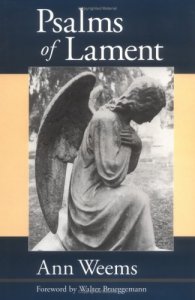
A year-and-a-half ago I read a fantastic book called Psalms of Lament by Ann Weems (see more here). I continue to come back to her modern-day lament psalms from time to time. Of course, it’s hard to top the lament psalms in the biblical book of Psalms, so really Weems and David go together. I appreciate the freshness with which Weems approaches the important practice of lament.
Weems tragically lost her son just after his 21st birthday. It is out of that sense of loss and grieving that she writes many of her lament psalms. She says:
This book is not for everyone. It is for those who weep and for those who weep with those who weep. It is for those whose souls struggle with the dailiness of faithkeeping in the midst of life’s assaults and obscenities. This book is for those who are living with scalding tears running down their cheeks.
So if you are weeping right now, or weeping with someone who is weeping… or if you feel like maybe you should be weeping but can’t, or don’t know how… here is Weems’s Lament Psalm Thirty-two (posted with publisher’s permission), which can help to give shape and voice to a heartfelt prayer of lament:
O God, explain to me
the cruelty of your world!
Make sense of those
who make no sense!
Tell me why the innocent die,
and evil people live
to kill again!
Tell me why the faithful
are shunned,
and the self-righteous
point their fingers!
Tell me why the wounded
are wounded,
and sorrow falls
on the shoulder of sorrow!
Tell me why the abused
are abused,
and the victims
victimized!
Tell me why the rains
come to the drowning,
and aftershocks
follow earthquakes.
O God, is this any way
to run a world?
O Merciful One, let us rest
between tragedies!
Speak to us
for we are your people.
Speak to us of hope
for the hopeless
and love for the unloved
and homes for the homeless
and dignity for the dying
and respect for the disdained.
Speak to us, O God,
of the Resurrected One!
Speak to us of hope,
for in spite of
the tidal wave of tears,
we remember your story
of new life!
Tell the world again,
O God of creation!
Tell us that winter will fade,
and spring will wash us new,
and the world will green again,
and we will be new creations
in the garden of our God.
Free us from these tentacles
of sorrow,
and we will fall on our faces
and worship you,
O God of goodness,
O God of a new green world!
“Beautiful is the moment,” Archbishop Oscar Romero said, “Beautiful is the moment in which we understand that we are no more than an instrument of God; we live only as long as God wants us to live; we can only do as much as God makes us able to do….”
The book above–La Violencia del Amor, or, The Violence of Love–is available as a free download from the publisher, here (Spanish) and here (English).
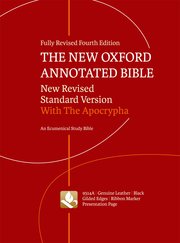
On the top of my bookshelf at home sits an old, falling-apart, heavily marked-up edition of The New Oxford Annotated Bible. So it has been with anticipation and appreciation that I’ve been able to use the The New Oxford Annotated Bible in its most current, 4th edition.
What the Annotated Bible Is
The Bible text in The New Oxford Annotated Bible is the New Revised Standard Version (NRSV). I’ve always appreciated this translation’s blend of readability and fidelity to the original languages.
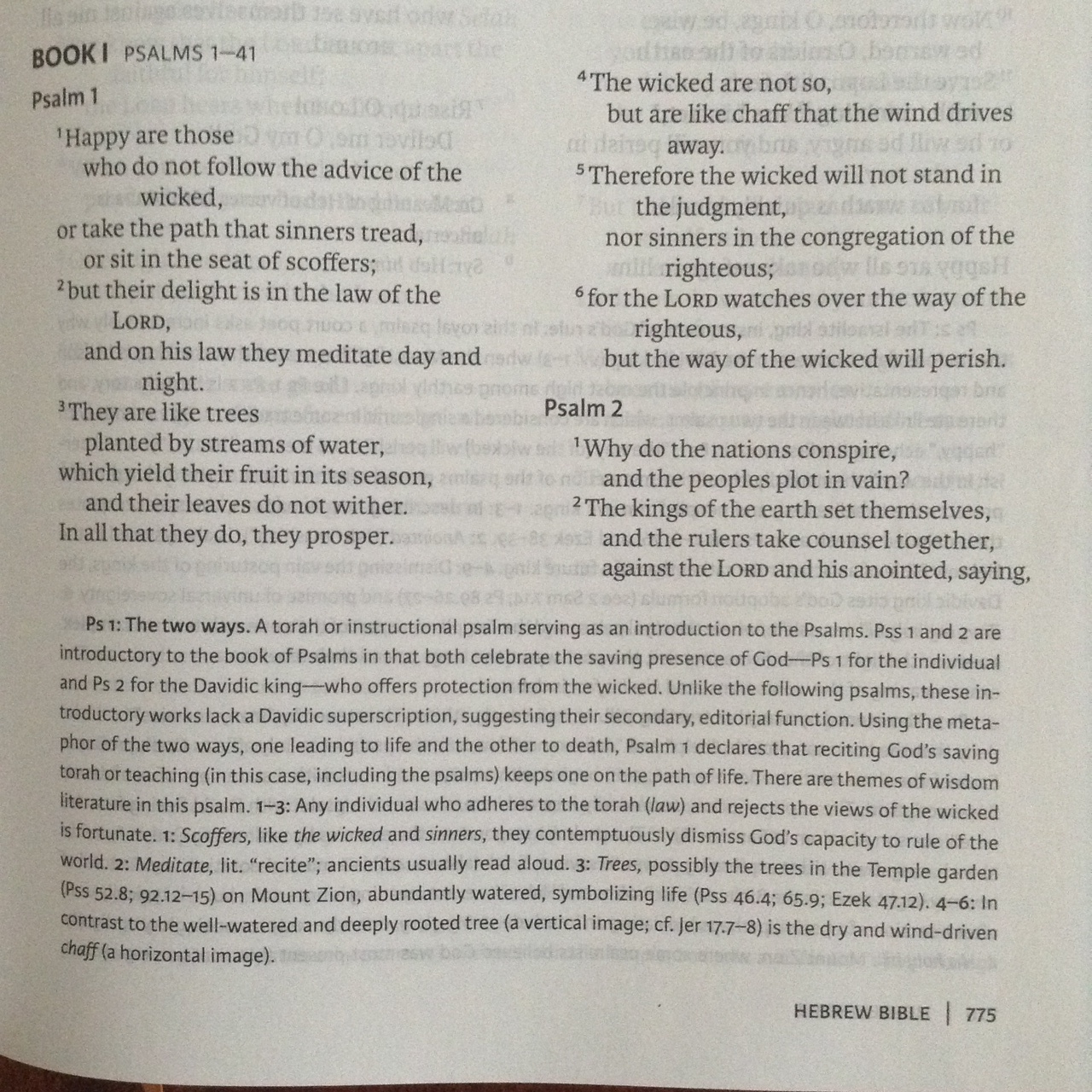
Each biblical book receives a short introduction, covering topics like authorship, date of composition, literary structure, and interpretive helps for reading. (The “guide to reading” that precedes most books is especially helpful when doing a book study or reading through a whole book of the Bible.) The biblical text itself appears in a clear, uncluttered font, with the study notes appearing at the bottom of the page. The brief but illuminating notes address each passage of the text (as a passage), and then comment more specifically on individual verses, terms and words.
Here is Psalm 1 with study notes:
Psalm 1
The title page bills this as “An Ecumenical Study Bible.” Its balance in this regard is, indeed, fair. The Editors’ Preface reads:
We recognize that no single interpretation or approach is sufficient for informed reading of these ancient texts, and have aimed at inclusivity of interpretive strategies.
The editors and contributors have succesfully met this aim. The introduction to Colossians, for example, does not make a heavy-handed assessment one way or the author as to Pauline authorship, but lays out the different views (with support) so the reader can decide. I appreciated this.
At the end of the Bible are some “General Essays,” covering topics at considerable length, such as:
The Canons of the Bible
Translation of the Bible into English
The Persian and Hellenistic Periods
The Geography of the Bible
and more. Also included are a glossary, concordance, 14 color maps, and other study helps.
“With the Apocrypha”
One thing that sets this study Bible apart from others is its inclusion of the Apocrypha. Not only is the text included, but its contributors are top in their field: John J. Collins (3 Maccabees), Lester Grabbe (Wisdom of Solomon), Amy-Jill Levine (Additions to Daniel, Tobit), and David A. deSilva (4 Maccabees), to name just a few. The introductory articles are clear and concise, yet contain the sort of information most users of this Bible will be looking for. For example, after a section on “Definitions” of terms like “Apocrypha” and “deuterocanonical,” the introduction to the Apocryphal section has “The Roman Catholic, Orthodox, and Protestant Canons of the Old Testament.” The comparison chart in that part of the introduction is especially useful, so readers can see “which religious communities accept [the Apocryphal/Deuterocanonical books] as scripture.”
In Mattathias’s speech on his deathbed in 1 Maccabees, to explore just one passage, the explanatory note for 1 Maccabees 2:49-70 simply reads:
Jacob (Gen 49), Moses (Deut 33), and Samuel (1 Sam 12) utter similar speeches; compare also the praises of famous men in Sir 44-50.
The biblical characters that Mattathias extols (Abraham, Joseph, Phinehas, Joshua, and so on) have accompanying biblical references in the study notes so readers can explore their stories further. It’s, of course, not nearly as in-depth as a commentary would be, but neither does it intend to be. It covers the basics well, and addresses most initial questions readers would have of the text.
Construction and Aesthetics
The leather-bound edition (what I am considering for review) is a well-constructed Bible. Despite its weight–to be expected of a Study Bible–it is a pleasure to hold and read. And to smell. Its gilded edges and two ribbon markers give it a classic feel. Its sewn binding and leather cover mean that it lays flat anywhere you have it open, even at Genesis 1:
Laying Flat at Genesis 1 (click to enlarge)
The pages are a bit thin, though this may be inevitable. (A delicate balance in Bible production is how thick the pages can be without weighing down an already bulky Bible). I was aware of bleed-through but not really distracted by it as I read. Note, too, the book name tabs in the image above, which help readers to quickly get to a desired spot.
Three Ways I’ve Used the Annotated Bible
There have been three primary ways in which I’ve made use of the Annotated Bible. One is for personal, devotional reading. In this context I have found the book introductions and notes to be just enough to answer my top-of-mind questions, but not so much that I was distracted from a focus on the text itself.
Second, this is the Bible I had in my hands while leading a small group Bible study last Lent on the Sermon on the Mount. Again, I found that most of our questions of the text were addressed in the notes by succinct, summary statements. And the NRSV was a good version for group reading.
Third, I’ve found the introductions and essays to be helpful in teaching and preaching preparation.
You can find the Bible here at Amazon and here at OUP’s site.
Many thanks to Oxford University Press for a copy of this beautiful Bible to review. They provided it with no expectation as to the nature of my review, except that I be honest.
To get the discount, you’ll need to sign up here, using your .edu email address. Sign-ups are open through June 12. Baylor sends the discount code June 13. Then you can apply the discount code to orders placed from June 14-18.
A couple of weeks ago I reviewed the inspiring Preaching in an Age of Distraction. Whereas that book took a largely big picture approach, building on itself chapter by chapter, One Year to Better Preaching contains 52 exercises (plus a few “Bonus Exercises”) that give preachers a tangible, nuts-and-bolts set of practices to engage.
Overdorf wants to help preachers “sharpen preaching skills.” Just “an hour or two of effort” is required for most of these practices, so it’s an easy book to pick up, get right into, and use right away in preparing next week’s sermon.
The 52 exercises can be weekly ones for a year, or can easily be spread out over more than a year. Overdorf wisely suggests that preachers could focus on exercises that help them overcome their particular preaching weaknesses.
To try to achieve a “process similar to cross-training,” the 52 exercises are grouped into eight categories:
Prayer and Preaching
Bible Interpretation
Understanding Listeners
Sermon Construction
Illustration and Application
Word Crafting
The Preaching Event
Sermon Evaluation
Exercises include an introduction and setup to that exercise, a description of the exercise itself, an “I Tried It” testimonial section, and “Resources for Further Study.” A preacher could easily make the benefits of this book stretch out beyond a year.
To take just one example, Exercise Two, “Balance Your Biblical Diet,” suggests that preachers be sure they are preaching from both Testaments and from a variety of literary genres. Overdorf suggests charting out recent sermons to see where they fall, and shows a chart of his last 175 sermons in various biblical genres as an example. As balance in this sense is one of my preaching priorities, I appreciated this section.
Overdorf also makes the welcome suggestion that even a preacher’s illustrations be well-balanced:
Additionally, you may consider charting your recent illustrations. What aspects of life have you used most to illustrate biblical truth? How many illustrations have come from the world of sports? From your family? How many stories have you told from the Civil War, or from popular movies? How often have you quoted Tozer, Bonhoeffer, or your favorite contemporary authors?
Other exercises that I found helpful (and have tried put to use in the pulpit) have been: “Show, Don’t Tell” (on phrasing), “Have Listeners Evaluate You,” “Listen to a Storyteller,” and especially, “Craft Evocative Words.”
Despite how truly thorough the book is, one lack I noticed was any mention of the lectionary. For as many preachers as use the lectionary, some reference to it would have been useful. Or especially for preachers who don’t ever use the lectionary, suggesting they at least try it for a while would have been a good exercise.
One Year to Better Preaching is the kind of book you put right on your desk (not your bookshelf) where you can reference it repeatedly. I’m looking forward to continuing to mine its riches in the weeks and months of preaching ahead.
Thanks to Kregel for the review copy, offered with no expectation as to the content of this review. Find the book on Amazon here (affiliate link), at Kregel’s site here, and check out a pdf sample of the book here.
Any undertaking by the body of Christ for the cause of Christ should be done with excellence. Our Lord and Savior deserves the very best from his redeemed people. Therefore, the church of Jesus Christ ought to excel.
The book is both prescriptive and descriptive. It aims to (prescriptively) suggest how a church’s Sunday School can excel by (descriptively) offering case studies and anecdotes from churches.
The book begins with the chapter, “The State of Sunday School Today,” in which editor and author Steve R. Parr interviews Dr. Thom Rainer. Thankfully there is an early and concise definition of “Sunday school” offered in that chapter: it “consists of Bible study groups for all ages that ordinarily meet on Sunday mornings in conjunction with a worship experience either before or aftewards.”
Rainer notes three key features that successful Sunday school programs should have:
The lead pastor’s support.
“A strong core of lay leaders” that receive solid training.
A sense of Sunday school as “a hero of the church.”
Following the helpful wisdom of Rainer, the next 14 chapters note some specific settings and ways in which Sunday school programs should and do excel. These range from Sunday school that “Excels in the Middle of Nowhere” to Sunday school that “Excels on the Heels of a Crisis,” and more. Contributors generally reinforce Rainer’s assessment of what is needed for a robust Sunday school.
The last two chapters offer a few more short case studies and some general concluding principles for how to help move a Sunday school program forward.
Initial Observations
The case studies come predominantly (but not exclusively) from Baptist churches in the South. So ministers in other traditions may need to do some cultural adaptation in seeking to implement some of what’s recommended here. The more than dozen contributors are all male, and almost all “white.” (Southern) Baptist Sunday School That Really Excels, As Told By Mostly White Males would have been a more accurate title. (No snark intended–I had just expected more diversity of background and perspective.)
All the same, there are plenty of inspiring stories and recommendations for building healthy Sunday schools. Whether it’s the call to make sure a church has clarified the purpose of their Sunday school, or specific suggestions as to how to teach with various learning styles in mind (Ken Coley’s chapter 15–probably the best chapter), anyone reading this book will find herself or himself making a running to-do list as they read. (This is what I did.) The anecdotes from various churches were at times inspiring.
Some Lacks and Disagreements
There wasn’t much about Sunday school for young children or youth, something I had hoped this book would include. And there is what I consider to be some unsound (maybe even dangerous?) missions advice in one chapter about a Sunday school program’s effort to reach out to families at a local trailer park: “They need to see the church as a place where we will help you even if you hate us for doing it.” Good intentions, for sure, but probably bad advice as so-called development efforts go.
And I found it hard to believe that some of the evangelism efforts described would actually have positive long-term results. One contributor (whose chapter seems not to relate much to Sunday school, per se) suggests “Accountability Evangelism,” practiced by a pastor who “planned to reach the lost friends of his members” by asking “everyone to invite a neighbor to the new building and get their friend to promise attendance by filling out a ‘Yes’ card. Their signature and ‘Yes’ indicated they would be present.”
That’s: get the potential visitor (not the church member) to fill out a “Yes” card.
No doubt–God can and does choose to bless efforts of every stripe, even misguided ones. And I want to be reluctant to criticize another Christian’s evangelism efforts, but the approach described above, which also refers to said neighbors as “prospects,” just strikes me as odd, off-putting, and counter-productive.
While Sunday School That Really Excels does describe “growth” in terms of spiritual depth, the underlying assumption seems to be that healthy and excelling Sunday schools are growing numerically–and exponentially is even better. I won’t engage that presupposition at length here, but it passes as a critically unexamined axiom in this book that I don’t think is always true. I.e., “bigger” is not always and necessarily “better.”
Finally, I was surprised that none of the contributors addressed theories of culture change. To help a languishing Sunday school to excel could require a re-orientation and re-creation of the culture surrounding Sunday school. Programmatic fixes may not be enough. I’d have liked to see part of the book address how pastors and ministry leaders can help a church to navigate the change process itself, keeping systems and culture in mind.
Conclusion
So I found some things lacking and a lot to disagree with here, some of which I thought was unsound in a prescriptive sense, even if it had worked in a church in a descriptive sense.
But there were some helpful ideas and reminders to me of things I as a pastor can be contributing in my own church’s setting, as we seek to have a healthy and thriving Sunday school program. For that I’m grateful, even if on the balance I might not recommend the book as a great read for someone seeking to help a Sunday school truly excel.
If you want to see more, there is a pdf excerpt here, including Table of Contents, list of contributors, introduction, and chapter 1.
Thanks to Kregel for the review copy, offered with no expectation as to the content of this review. Find the book on Amazon here (affiliate link), or through Kregel here.
A reminder: Wipf and Stock Publishers is offering Words on the Word readers 40% off anything in their online store through the month of May. Just use the coupon code LETTERS at checkout. Last week I reviewed their Reading Bonhoeffer (pictured above). Here are a couple of ideas of books you could get from them.
Preaching in an Age of Distraction has really stuck with me since I finished reading it a few days ago. I’ll be turning back to its pages in the weeks and months to come to remind myself of some of its winsome insights into the preaching process. Here is one:
A preacher would do well to set up this inner standard: that every sermon will have in it some insight, some personal awe, some wonder of Scripture that is for him or her quite new—and therefore quite exciting. Obviously I’m not suggesting insights outside scriptural and doctrinal integrity; rather, I’m calling for insights that make the familiar idea come alive with a new glory, like a suit or dress that reveals a personality not formerly apparent in the wearer. The longer a preacher serves a given congregation, the more important it is that this kind of creativity mark the pulpit fare.
See my review of the book here. The above quotation can also be found in the press kit for the book (PDF), which contains a lengthy excerpt.
Any worship leader or preacher knows what it’s like to be distracted–either by something internally (himself or herself) or externally (something going on in the room).
“We live in the Age of Distraction,” says J. Ellsworth Kalas, Senior Professor of Homiletics at Asbury Theological Seminary, “and it seems to be accelerating.” Kalas notes that “the altar of the new” (a great turn of phrase) is constantly beckoning, but it is “a poor place to bow.”
Over the course of ten chapters, Kalas seeks to guide the preacher through distractions and distractedness, offering counsel as to how to prepare messages and preach to potentially distracted congregations.
The book started more slowly than I’d have liked. This could, of course, be a function of my own distractedness and lack of patience in reading. But there were more vague assertions than were helpful for building his case from the beginning, a trend which popped up again throughout the book. (E.g., “Sports have probably had a place in human life for as far back as we have any record” (ch. 2), and, “Surveys show that…” (ch. 4), and, “Some brain research indicates that…” (ch. 9), etc.)
Perhaps I was looking for more practical “take-aways.” And Kalas does give these as the book progresses.
However, at about chapter 3 or so, I realized that I was reading some reassuringly wise counsel. I received it as such. Kalas has generations of experience in preaching (and teaching about preaching). This allows him to see our current day in a fuller historical light. Distractions may change from generation to generation (TV vs. iPhone), but distractions themselves are not unique to the second decade of the 21st century. Kalas is worth quoting at some length here:
All of this reminds us that while the times have changed in some details–the sources of the distractions and the means by which those distractions are delivered–the pastor in his or her study has always been susceptible to distraction. Paul must surely have hoped that his guard would stop humming that first-century show tune. Bunyan no doubt had to deal with insects and assorted vermin as he thought his way through Pilgrim’s Progress. And who can guess the physical and emotional intrusions that assailed Dietrich Bonhoeffer day after day in his imprisonment!
There are significant recent changes to congregations, though. In chapter 3, “The Distracted Preacher,” Kalas notes that it “is no longer the world of our great-grandparents, where nearly all the people in the pews had the same occupation–say, dairy farming or working at the local factory–and essentially the same education.” Even if this overgeneralizes a bit, Kalas brings his point into focus by continuing, “Now the preacher looks out on vocations that did not exist a decade ago, let alone a century ago.” They are “more specialized.” Because no preacher can possibly “be a Renaissance person,” we preachers “must be highly discriminating in the knowledge we pursue.”
That itself is not a novel idea, but Kalas gives the preacher needed reminders (that we too often forget) like, “The Internet will take as much of our time as we allow it to have.” And to any preachers who may not think much about a pre-Internet world, Kalas suggests “reading across the centuries,” a practice he himself has obviously employed, as his book passes on some of the wisdom of those he has read.
An underlying theme of the book is that the ones who follow after distractions (whether preacher or congregation, or both) are “expressing the longing of a restless heart.” Kalas writes, “[W]hat gets our attention gets us.” The challenge is that not all distractions are harmful, per se; some stimulate creativity and pull us out of ruts. How to discern the difference? Kalas suggests asking:
Does this [distraction or thought] incline me toward Christ or away from him? If I pursue this thought, what will it do to my mind and spirit?
and:
Will this “distraction” lead to more life or to less?
If there is an antidote (or “counterforce”) to the distractions that lead to less of life, it is “excellence.” How Kalas teases this out makes the book worth pursuing. Canned illustrations are okay, he suggests, but even better is “the excitement that comes when an idea springs forth after the preacher has wrestled with the Scriptures until a light has come on in the soul.” With the Holy Spirit as guide, director, and inspirer, the pastor also needs to remember that “preaching is a relationship,” so deliberate relationship-building with the congregation necessarily precedes good preaching.
Are you burned out on preaching? Get this book. Kalas doesn’t say he set out to write for burned-out preachers, per se, but I can’t think of anything better for such a preacher to read.
Are you not burned out, but looking to take a step forward in your preparation or delivery? Kalas gives a slew of sage advice and some practical suggestions to pursue excellence.
Are you distracted or unsettled when you go to prepare a sermon? Kalas offers soul care, and in the midst of a distraction-filled life helps the preacher take a look inward, and an awe-filled look outward to God.
Thanks to InterVarsity Press for the review copy, given to me so I could write this review, but with no expectation as to my assessment of the book. Find Preaching in an Age of Distraction here (publisher’s page) or here (Amazon affiliate link).
Wipf and Stock Publishers is offering Words on the Word readers 40% off anything in their online store through the month of May. Just use the coupon code LETTERS at checkout. Yesterday I reviewed their Reading Bonhoeffer (pictured above). Here are a couple of ideas of books you could get from them.







 Words on the Word
