When my wife was reading to the kids tonight (from Ranger Rick, Jr.), she read, “A cane toad can be as big as a small dog.”
My response, from the other room was: “Gross!”
My six-year-old promptly corrected me: “No… that’s awesome!”
I suppose he’s right. The photo above is of a cane toad, which I have not had the privilege of seeing in person. (They’re not around these here parts.)
Yesterday was a momentous occasion: the first all-family ice cream outing of the summer. (Shhh… it’s summer in my mind.) We did the almost-impossible-to-beat triumvirate of
ice cream
park
used bookstore
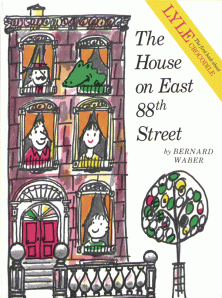
At the used bookstore, we got a hardcover edition of four Lyle the Crocodile books bound together (sewn binding, mind you!) for a mere $5.
Tonight we read the first one:
In The House on East 88th Street, Mr. Primm, Mrs. Primm, and their son Joshua move into a new house, only to find a crocodile in the bathtub. They’re even more shocked when–as they’re trying to figure out how to get rid of it–it saunters down the stairs and starts doing tricks for them.
It’s a funny and well-written book. We’re looking forward to reading the rest. Highly recommended #kidlit!
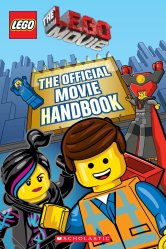
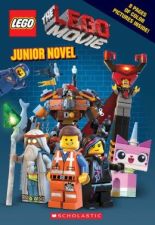
Having seen and thoroughly enjoyed The LEGO Movie, my six-year-old son has been reading a couple of related books: The LEGO Movie: The Official Movie Handbook andThe Lego Movie: Junior Novel.
The Movie Handbook packs a lot in, both text and full-color illustrations, especially for the price.
In the words of my six-year-old, “It’s really good. If someone had never seen it, I’d say that the best pages ever are ‘Where are My Pants?’ This is an episode of a TV show in Bricksburg in The LEGO Movie.”
[Dad’s editorial note: it’s more tame than it sounds, and one of the funnier parts of the movie, which is quite clever throughout.]
Here are some of the characters in the books, as told by my six-year-old:
Emmet: A construction worker. He is always scared of the bad guys. He falls out of a tower that, like, goes past heaven.
Lord Business: A bad guy. Someone who tries to defeat the good guys. He tries to wreck the Piece of Resistance.
Batman: A superhero. He turns Bad Cop’s car into a baby carriage in the book (i.e., in the Junior Novel).
Bad Cop: A bad police. Someone who helps Lord Business.
Wyldstyle: A superhero. She asks Emmet if he’s “the Special.” Her hair has a ponytail on the side.
P. UniKitty (i.e., Princess UniKitty): She’s really cute. She says, “Any idea is a good idea, except the not happy ones!”
Here’s a look inside the Movie Handbook:
The Junior Novel is more than 100 pages of text at a level that seemed to be just right for a six-year-old. Its opening lines are as silly as the rest of the book and the movie:
Bright red lava flowed from the volcano that marked the entrance to the hidden temple. Inside, a mighty weapon called the Kragle was nestled in a glowing sarcophagus.
Here is a shot of the Table of Contents from the Movie Handbook:
The books tie in well with the movie, yet still leave a lot on the screen. The Movie Handbook also comes with a fold-out poster, which is now taped to the ceiling above my son’s top bunk bed.
Thanks to Scholastic for the review copies, given with no expectation as to the content of the review. Find The Lego Movie: The Official Movie Handbook here at Amazon (affiliate link) or here at Scholastic’s site. The Junior Novel is here at Amazon (affiliate link) and here at Scholastic’s site.
Fall 2014 UPDATE: The UBS5 is out. Go here for a chance to win one of two free copies.
******
On the heels of the release of the NA28 Greek New Testament, the UBS4 is giving way to a revised UBS5. Find the book’s product page here. Just as I reviewed the NA28 (plus LXX), I hope to post more in the future about the UBS5 edition, which is geared more toward translators than academics, per se.
Here’s a sample pdf of the first few chapters of Mark, posted by Hendrickson.
The most noticeable change right off the bat is that the italicized font of the UBS4 has been replaced with something I find much more readable and aesthetically pleasing:
Other than punctuation and paragraph divisions, the text is the same as that of the NA28, with the differences between the two coming in the critical apparatus.
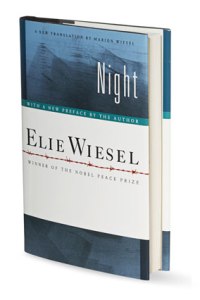
Amazingly, I made it through high school and college without reading Elie Wiesel’s Night. Having just found a copy in good condition at a local used bookstore, I plan now to read it. My recent reading of Bonhoeffer has revived my interest in Holocaust and genocide studies.
(Yes, I know it's a reality of "white/male privilege" to be able to choose when to think about oppression and to make "studies" out of genocide.)
I may or may not report back here again about Night, but I expect it to be a powerful read.
This month Bonhoeffer for Armchair Theologians is free in Logos Bible Software. You can find it here.
Here is part of the product description from Logos:
This volume in the ever-popular W. J. K. Armchair series turns its sights on contemporary theologian Dietrich Bonhoeffer (1906–1945). Born in Breslau, Germany, Bonhoeffer led quite an intriguing life. This book, with dozens of illustrations by artist Ron Hill, highlights Bonhoeffer’s background and theological education; his time at Union Seminary in New York City; his involvement in the resistance movement against Adolf Hitler; and his participation in the plot to assassinate Hitler.
Brill’s MyBook program, available on the BrillOnline Books and Journals platform, enables users to purchase a print-on-demand paperback copy of books of their choosing, provided they have access to the e-book version via their institution.*
MyBook has a fixed price of €25.00 / $25.00* per copy. Brill will ship your copy free of charge, though VAT will be added where applicable.
Amazon’s Kindle Matchbook program launches today. If you buy (or bought in the past) a book new from Amazon, the Kindle version is available at a discount–either $2.99, $1.99, $0.99, or free.
This would be advantageous, as I see it, in the following situations:
You lost a book you once purchased
It’s in storage but you want to read it again without going through seven boxes to find it
You want to easily keyword search a book on any device
You like it so much (or you like the author so much) you want to buy it again
Okay, so the last one is a stretch–I doubt this is raking in royalties for authors, but it’s a cool idea on Amazon’s part. All the available books are here.
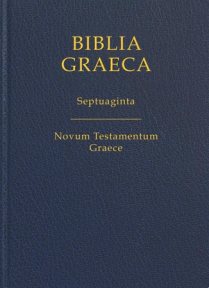
Look at that! It’s an all-Greek Bible. Just like the one Jesus carried around! Okay, not quite, but it is very good to see the Greek Septuagint and the Greek New Testament together under one cover. Augustine would be pleased:
For Greek aficionados—a 2-in-1 resource that’s designed specifically for extensive research, textual criticism, and other academic endeavors. Featuring both the Rahlfs-Hanhart Septuagint (Greek translation of the Hebrew Old Testament) and the 28th edition of the Nestle-Aland Novum Testamentum Graece, this user-friendly tool includes critical apparatus, cross-references, and more. 3216 pages, hardcover from German Bible Society.
What It Looks Like
It’s a mere three pounds (in weight, not price). Amazon lists its dimensions as 7.5 x 5.7 x 2.8 inches.
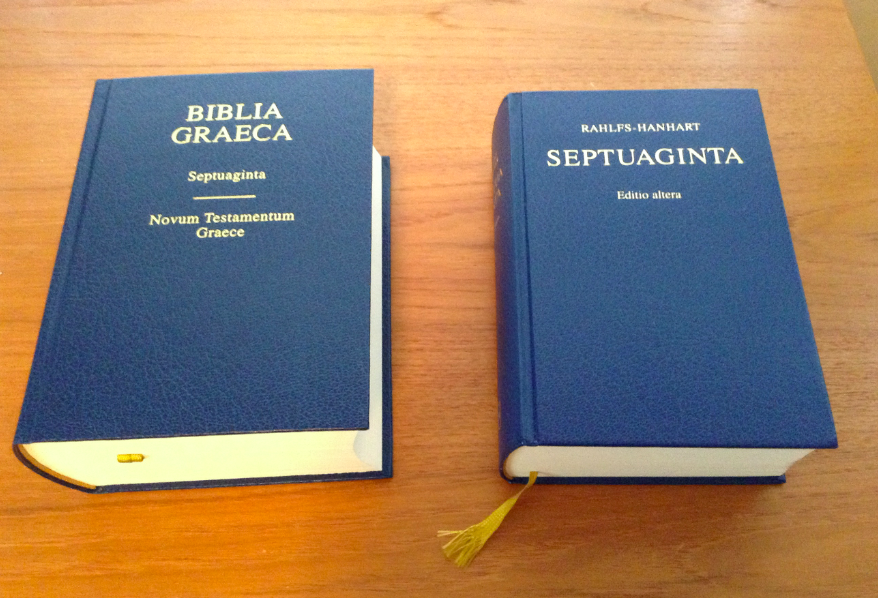
This impressive edition is two previously published Greek texts put together in one cover. It’s obviously thicker than the Septuagint alone, and just a little bigger in length and width. Here are the two side by side: the Septuagint alone on the right, and its “upgrade” version (with GNT) on the left:
v. 1.0 (at right) and v. 2.0 (at left)
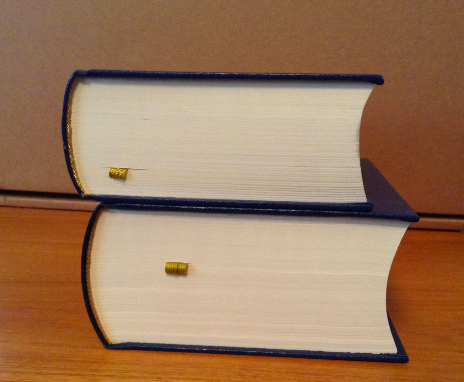
Before receiving the volume, I was concerned that its 3,000+ pages would defeat Alfred Rahlfs’s initial intention to have a Handausgabe (i.e., a manual and portable edition). Indeed, Hanhart’s “Introductory Remarks to the Revised Edition” translate Handausgabe as “pocket-edition,” which this is decidedly not. (It would fit nicely in a purse or man-purse, though.) That said, the addition of the Greek New Testament really does not add a lot of bulk, as Rahlfs-Hanhart was already more than 2,000 pages. Biblia Graeca is still a (fairly) portable edition, though, if not literally pocket-sized. The sewn binding and hard cover appear that they will hold up under regular use. Here are v. 1.0 (LXX only) and v. 2.0 (LXX+GNT) stacked on top of each other:
You can barely make it out from the above photo, but the LXX/GNT combo comes (wisely) with two ribbon markers. Was it a coincidence that mine were both placed at the beginning of Odes? I think not.
The Greek Typesetting/Font
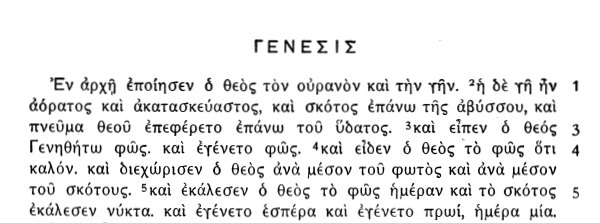
Rahlfs has not been re-typeset, so its Greek font is not as crisp or readable as that of the New Testament portion. Compare:
Genesis 1:1-5, from publisher’s pdf sample
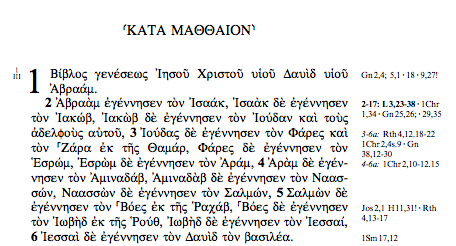
Here now is the Greek in the New Testament portion, which is clear and crisp:
Matthew 1:1-6, from publisher’s pdf sample
After reading enough Septuagint, one does get used to the Rahlfs font. It’s not too bad.
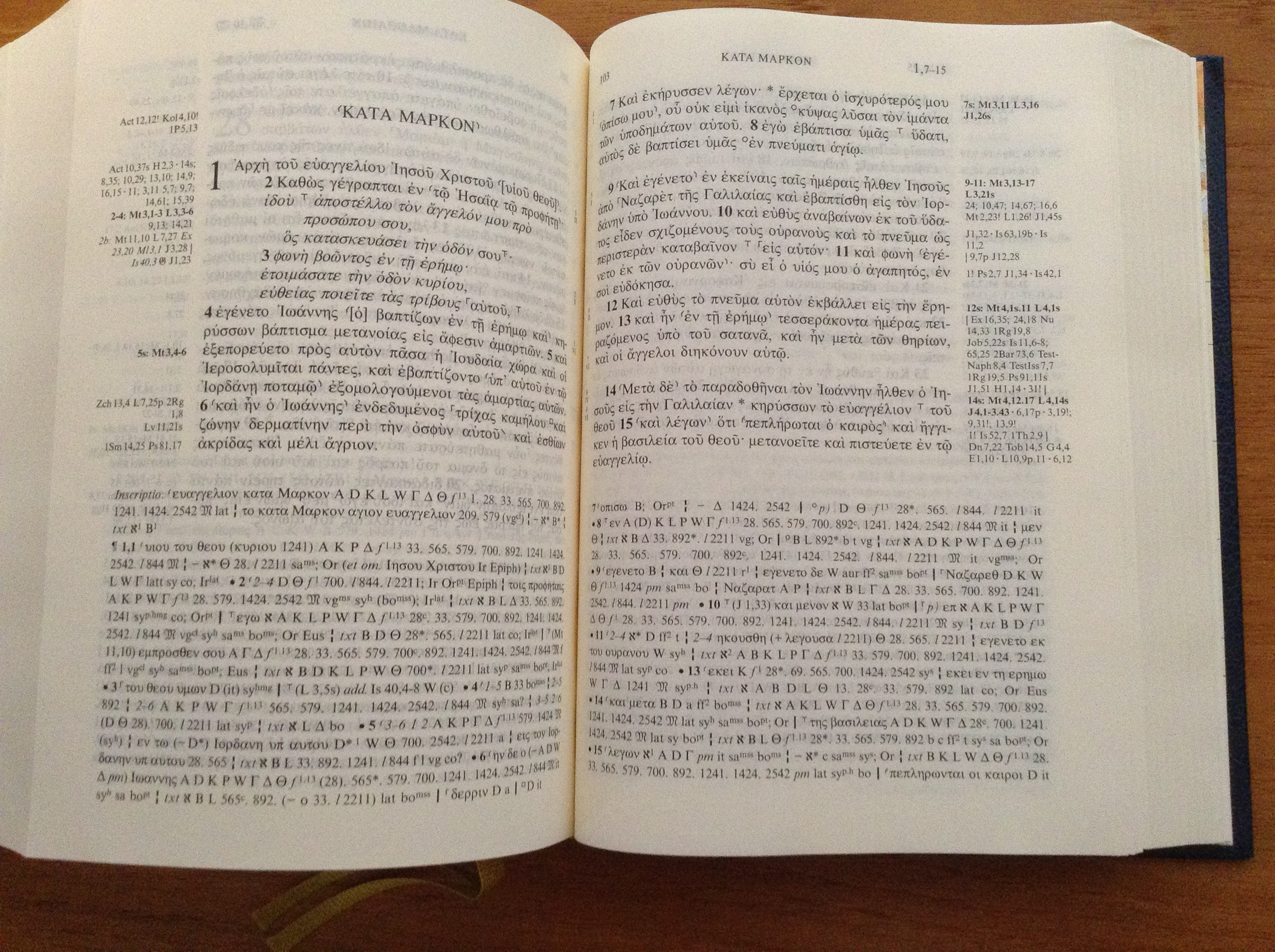
Always a concern with Bibles this big is that the requisite thin pages will mean bleed-through of text from the reverse side. This is noticeable to a degree here, but not in a way that negatively affects reading:
Mark 1
Rahlfs-Hanhart (Septuaginta)
The Rahlfs-Hanhart edition is not the go-to for extensive text-critical research that the Göttingen editions are, where they are present (on which, see my posts here and here on using Göttingen). Rahlfs is still useful, though, because it contains an entire Septuagint text, whereas Göttingen (published as individual volumes) does not.
It is probably the best starting place for readers of the Septuagint, even with its deliberately more limited apparatus. It is best thought of as a “semi-critical edition,” as noted here. Rahlfs “reconstructs” the text using, primarily, Codex Vaticanus (B), Codex Sinaiticus (S or א), and Codex Alexandrinus (A), a methodology that the revisor, Robert Hanhart, honors. Here is the apparatus for the first page, covering Genesis 1:1-14. This is a funny case, because of how much of Genesis is missing in B, so Genesis 1-46:28 up through the Greek word ηρωων is just based on A here. The rest (from πολιν in 46:28 to the end, chapter 50) take into account B and A.
Preceding the actual text and apparatus are Hanhart’s 2005 “Introductory Remarks to the Revised Edition” in German, English, and Greek. Then in German, English, Latin, and Greek follow three more sections: (1) Rahlfs’s “Editor’s Preface,” (2) an illuminating 10-page essay, “History of the Septuagint Text”, and (3) Explanation of Symbols. Everything you need to get started reading the Septuagint (minus the Greek lessons) is here.
The long-awaited 28th edition of the Novum Testamentum Graece has now been published. Once again the editors thoroughly examined the critical apparatus and they introduced more than 30 textual changes in the Catholic Letters, reflecting recent comprehensive collations. With the intent to make this book more user-friendly, the editors also revised the introductions and provided more explanations in English. This concise edition of the Greek New Testament, which has now grown to 1,000 pages, will continue to play a leading role in academic teaching and scholarly exegesis.
The NA28 has its own snazzy site here. (What a day we live in, when a Greek Bible gets its own Website! Its writers would be amazed.) Recent text-critical work on the New Testament has led to revisions in the Catholic Letters, but not elsewhere. So the Gospels and Pauline epistles, for example, retain the same text as the NA27. However, there are changes that affect the whole edition, as the publisher points out:
Newly discovered Papyri listed
Distinction between consistently cited witnesses of the first and second order abandoned
Apparatus notes systematically checked
Imprecise notes abandoned
Previously concatenated notes now cited separately
Inserted Latin texts reduced and translated
References thoroughly revised
As for the textual differences themselves, those are explained and listed here. There are more details to be digested about the new NA28 edition. I can do no better than to refer you to the writings/reviews of Larry Hurtado, Rick Brannan, Daniel Wallace, and Peter Williams.
All the quick-reference inserts you need to make sense of symbols and abbreviations are included:
Concluding Thoughts: Sell All You Have?
The product page for the beautiful Biblia Graeca is here for CBD, here at the German Bible Society, here at Hendrickson, and here for Amazon. And, best yet, you can look at a sample of the book here. If it’s just the text (and not the apparatuses) that you’re interested in, you can read the NA28 online here and the Rahlfs-Hanhart Septuagint here.
Rahlfs wrote in his preface that he sought to “provide ministers and students with a reliable edition of the Septuagint at a moderate price.” If you click the links above, you will see that this is not “a moderate price.” It’s significantly cheaper to buy the same critical editions of each Testament under separate cover.
But there are at least two major advantages to putting them together. First, when the New Testament writers quoted Scripture, they predominantly did so in a form that is closer to what we have now in a Septuagint text. Comparing a quotation (in Greek) with its source (in Greek) is facilitated by this edition. Second, that this edition exists is an important symbolic statement. Lovers of the Septuagint are fond of affirming that it was the Bible of the early Church. If that is so, why can we not have one, too? Now we can, printed and bound in a way that would shock the pre-printing press world that first heard all these Scriptures together when gathered for worship.
Professor Ferdinand Hitzig has often been quoted saying, “Gentlemen!” (and today, he would say, “Ladies!” too) “Have you a Septuagint? If not, sell all you have, and buy a Septuagint.”
In true biblical storytelling fashion, he is using hyperbole to communicate his point. But for those who are so inclined and able, if selling a few things to get a Septuagint is a good idea, how much more might someone like Hitzig encourage them to sell a few things for the Biblia Graeca?
Christians believe that the Septuagint has come to full fruition through the New Testament.
So it only makes sense to be binding the two together.
Many thanks to Hendrickson for the privilege of reviewing this fine work. A copy came my way for review, but with no expectation as to the nature of my review, except that it be honest.
Amazon has announced “Kindle Matchbook,” coming in October. If you have bought a book new from Amazon, you can get the Kindle version at a greatly discounted price. They write:
For thousands of qualifying books, your past, present, and future print-edition purchases will soon allow you to buy the Kindle edition for $2.99, $1.99, $0.99, or free.













 Words on the Word