Feasting on the Word Commentary for Preachers

Feasting on the Word

Alas, the burden and the glory of preaching consist in proclaiming things that are not yet fully realized, but the hope for them holds a powerful grip upon the faithful imagination.

–Feasting on the Word

Here is a 12-volume commentary set that covers all the lectionary readings from multiple angles. Feasting on the Word offers four different “perspectives” (theological, pastoral, exegetical, and homiletical) for each lectionary passage in the weekly Revised Common Lectionary.

The 12 volumes cover the three-year lectionary cycle (A, B, and C), split into four volumes per year:

  • Advent through Transfiguration
  • Lent through Eastertide
  • Pentecost and Season after Pentecost 1 (Propers 3-16)
  • Season after Pentecost 2 (Propers 17—Reign of Christ)

The Scripture index makes it accessible to preachers who are not following the lectionary, too. From the Logos product page:

The editors and contributors to this series are world-class scholars, pastors, and writers representing a variety of denominations and traditions. And while the twelve volumes of the series will follow the pattern of the Revised Common Lectionary, each volume will contain an index of biblical passages so that non-lectionary preachers, as well as teachers and students, may make use of its contents.

Logos Bible Software has the full set in a format that is hyperlinked, laid out well, and easy to navigate by date or Scripture reference. Here’s the Table of Contents in the Logos iOS app for the current volume:

Table of Contents
Table of Contents

Here’s how a given Sunday looks:

FotW Proper 25
Four lectionary readings of Proper 25

And then each of the passages splits into the four “perspective” sections.
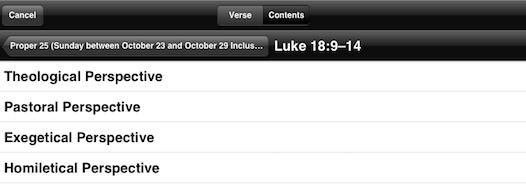
Four perspectives on Luke 18:9-14

Since being able to access Feasting on the Word, it’s actually jumped toward the beginning of my pile (or bytes) of resources that I consult when preaching. I try to pray through my preaching ideas from the text and in conversation with others before consulting commentaries, but the “Homiletical Perspective” (and the other sections, for that matter) do a good job of helping the preacher think about how to preach a text.

The Theological Perspective and Exegetical Perspective might be the best starting points in this commentary. Perhaps by design and due to the constraints of this resource, they are not as in-depth as you would find with a commentary on a given book of the Bible. But those two sections do show a general awareness of the major interpretive issues a preacher needs to be aware of.

The Pastoral Perspective differs from the Homiletical Perspective in that the former helps the preacher be aware of pitfalls and opportunities in preaching a text. For example, Stacey Simpson Duke offers the following pastoral suggestion on Isaiah 11:1-10 (which is the OT text for the 2nd Sunday of Advent in a couple of weeks):

Our fear for children’s safety and future is especially acute. Some in our congregations may have had the tragic experience of a child’s death; they may be particularly fragile when it comes to Isaiah’s images of vulnerable children living and playing in safety. That grief may not be confined to those who have suffered the loss of near ones. We are intimately acquainted with suffering children through heartbreaking images broadcast via the electronic media. This produces its own brand of grief. Isaiah’s word is for all, but the pastor must be sensitive to the grief in the room. Isaiah promises future security; how might this be a word of hope for those from whom security has already been stolen? Answers are not easy, but the pastor who wants to care for congregants in grief will want to wrestle with the question.

This has been the section of the commentary that I most consult.

I appreciate the overall depth and thoughtfulness of the series. This portion from the series introduction is apropos:

We also recognize that this new series appears in a post-9/11, post-Katrina world. For this reason, we provide no shortcuts for those committed to the proclamation of God’s Word. Among preachers, there are books known as “Monday books” because they need to be read thoughtfully at least a week ahead of time. There are also “Saturday books,” so called because they supply sermon ideas on short notice. The books in this series are not Saturday books. Our aim is to help preachers go deeper, not faster, in a world that is in need of saving words.

So far, I not only can recommend Feasting on the Word, but have begun drawing on it as a regular part of my preaching preparation each week. I’ll write more about the series in a future post.

Thanks to Logos Bible Software for the review copy of Feasting on the Word (12 vols.). Find it here. You can find my other Logos reviews here.

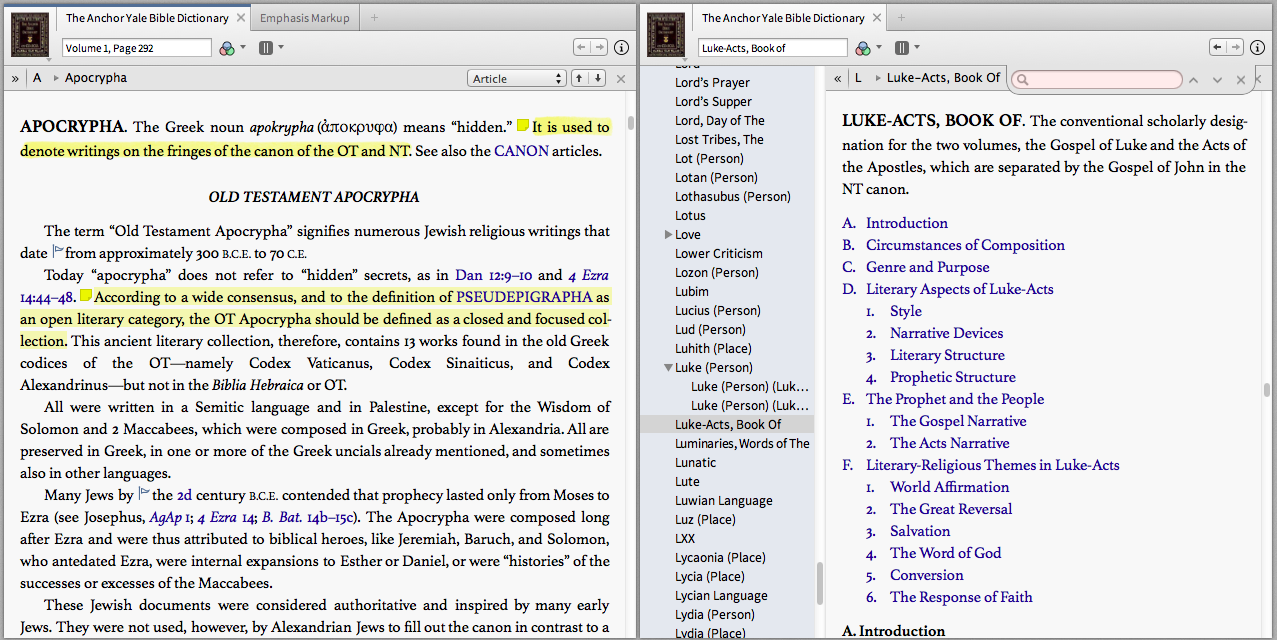
“Tax Collectors” in The Anchor Yale Bible Dictionary

AYBD in Logos
The Anchor Yale Bible Dictionary

Recently I’ve been spending time with The Anchor Yale Bible Dictionary in Logos Bible Software. In the coming weeks I’ll review it here, summarizing some of the articles, commenting on their content, and evaluating the dictionary’s presentation in Logos. (You can find my other Logos reviews here.)

The dictionary is massive, consisting of six volumes and somewhere in the ballpark of 7,000 total pages. Here are a few more features, taking from the dictionary’s publisher’s page:

– Includes six volumes of approximately 1,200 pages each
– More than 6,000 entries
– More than 7,000,000 words
– Nearly 1,000 contributors
– Multicultural and interdisciplinary in scope
– An unprecedented interfaith exploration of the Bible
– Illustrated throughout with easy-to-find references
– Extensively cross-referenced for comprehensive coverage of topics
– Easy-to-read article and chapter headings for speedy location of material
– Full bibliographical references following all major entries

In Logos on a computer there is the added bonus of being able to open more than one entry at a time:

Two articles open at a time
Two articles open at a time (click to enlarge)

As with the rest of Logos’s resources, all of the content in blue above is hyperlinked. So with the verse references you can hover over them for a popup of the verse text, or click on a hyperlink to open its contents in a new window. In the right half of the screen above, clicking on a section in the article takes you directly there.

I’m preaching this week on the Pharisee and the Tax Collector, so wanted to read a bit more about tax collectors. I type the entry name into the search bar to get there. Or I could navigate there via the left contents sidebar.

Tax Collector in AYBD
Looking something up

The “Tax Collector” article by John R. Donahue begins this way, with elaboration on each of the three mentioned “problems”:

Among the NT writings, only the Synoptic Gospels recount Jesus’ association with tax collectors (telōnai, KJV, “publicans”). Three problems attend this picture: (1) the identity and status of the telōnai, (2) the moral evaluation of them, and (3) the significance of Jesus as “a friend of tax collectors and sinners” (Matt 11:19; Luke 7:34).

In “Identity and Status” Donahue helpfully begins, “Etymologically telōnēs is a combination of telos in the sense of something paid for the purpose of the state, a toll, tax or duty; and ōneisthai (noun, ōnē), to buy or purchase.” I highlighted this sentence in Logos on my iPad and then moved to a computer, where the highlight had almost instantaneously synced to display there, too. Had I made a note at that sentence, it would sync, as well.

Donahue summarizes the Greco-Roman history of the term and office of the telōnēs, then moves into the details of how “Palestine was forced to pay tribute to Rome” after Pompey’s siege in 63 B.C.E. He differentiates between the different kinds of taxes (poll/census taxes, land taxes, etc.), as well as the different senses in which “tax collector” (telōnai) could be used. He concludes that the telōnai with whom Jesus interacts appear to be “toll collectors,” or, “minor functionaries fulfilling the orders of higher officials.”

In “Moral Evaluation” of the tax collectors, Donahue notes that “negative views” of this group of people occur outside the New Testament, as well (e.g., in rabbinic and secular literature). The author writes, “In Roman and Hellenistic literature they are lumped together with beggars, thieves, and robbers,” citing sources and giving examples. Knowing this helps me to better appreciate just how universally despised tax collectors were. This adds more punch to the parable in Luke. The New Testament itself (including Luke 18), as Donahue notes, mentions them in the same breath as “sinners” and “immoral people.”

“Jesus and the Tax Collectors” is the third and final section of the article. Multiple hyperlinked NT references in the article take the reader to places in the Synoptic Gospels where Jesus sits with and shows love to tax collectors. Citing Norman Perrin, Donahue notes:

Jesus’ association with them is viewed as an “acted parable” of his message of God’s mercy to sinners and “an anticipatory sitting at table in the kingdom of God” (Perrin 1967: 107).

A 15-source Biblography concludes the article.

Personally I’m not a big fan of the transliteration throughout the AYBD; I’d rather see τέλος than telos, for example. But that is the editorial decision of this dictionary. It’s not insurmountable, but does require a little extra work on the part of anyone who knows other languages but may not be used to seeing their transliterations.

Other than that quibble, Donahue’s article is indicative of what I’ve seen so far in the Anchor Dictionary: careful and top-notch scholarship that does not therefore suffer from dryness or inaccessibility. There is strength, too, in Donahue’s succinctness.

Evangelical scholars, pastors, and readers will want to be aware of and use their judgment regarding the dictionary’s “critical” approach to biblical studies. Donahue’s citation of “Q” will not be warmly accepted by all. (I and others still want to hear about manuscript evidence for Q.) But this generally does not make the dictionary any less useful or of lower quality.

Though I have other Bible dictionaries I use, when I’m studying, teaching, or preaching on a given topic, I’ll likely reach for (or, rather, click on) the Anchor Dictionary first.

Thanks to Logos Bible Software for the review copy of the Anchor Bible Dictionary. Find it here.

Highlights in Baker Exegetical Commentary on the NT (Stein, Jobes, Köstenberger)

BECNT set

I’ve long benefitted from the 15-volume Baker Exegetical Commentary on the New Testament (BECNT) series. Recently I’ve been able to use it in Logos Bible Software. In this post I introduced the commentary, layout, and setup in Logos on a computer. Then I wrote again here about navigating BECNT for Logos on iPad. Finally, I interacted at length with a passage in Luke from Darrell L. Bock. That third post is here. This post is a fourth part of my BECNT series of posts, concluding my review. Here I highlight some other volumes in the series: Mark (Robert H. Stein), 1 Peter (Karen H. Jobes), and John (Andreas J. Köstenberger). Continue reading “Highlights in Baker Exegetical Commentary on the NT (Stein, Jobes, Köstenberger)”

Of Millstones and Mustard Seeds: Bock on Luke 17

"Magisterial" is perhaps not an exaggeration
“Magisterial” is perhaps not an exaggeration

The apostles said to the Lord, “Increase our faith!”

 He replied, “If you have faith as small as a mustard seed, you can say to this mulberry tree, ‘Be uprooted and planted in the sea,’ and it will obey you.”

–Luke 17:5-6 (NIV 2011)

This Sunday I’ll preach on the above verses, taken from the lectionary reading of Luke 17:5-10. The rest of the passage goes on:

“Suppose one of you has a servant plowing or looking after the sheep. Will he say to the servant when he comes in from the field, ‘Come along now and sit down to eat’? Won’t he rather say, ‘Prepare my supper, get yourself ready and wait on me while I eat and drink; after that you may eat and drink’? Will he thank the servant because he did what he was told to do? So you also, when you have done everything you were told to do, should say, ‘We are unworthy servants; we have only done our duty.’”

My first three questions of the text were as follows:

  1. How should I take Jesus’ statement about the mulberry tree? Should I really be trying to uproot trees (or move mountains, in a synoptic parallel)? Can I?
  2. What do verses 7-10 have to do with 5-6?
  3. What about Jesus as a servant? Is he here the one being served, and we are just dutiful servants, with no expectation of thanks or “well done” from God?  Continue reading “Of Millstones and Mustard Seeds: Bock on Luke 17”

Colossians and Philemon (Zondervan ECNT), reviewed

col phil zecntI got an ad in the mail the other day for a new commentary series that claimed to avoid all the weaknesses of previous commentary series while building on their strengths. (!)

With how many good “old” commentaries there are, I think commentary users should critically examine new series, and certainly not take claims like the above too seriously. (Every commentary set has weaknesses.)

That said–Zondervan’s new Exegetical Commentary on the New Testament series is a real winner. It adds important elements to the mix that are not present in previously published commentaries. As a preacher with a scholarly interest in Scripture, I find this series to cover many bases well. It would be good for a student, professor, preacher, or even someone who didn’t know Greek and wanted to go more deeply into a given book.

I’ve (favorably) reviewed James and Luke in the same ZECNT series. Like the rest of the series, Colossians and Philemon includes the following for each passage of Scripture:

  • The full Greek text of Colossians and Philemon, verse by verse
  • The author’s English translation
    • First, passage by passage in the graphical layout
    • Second, verse by verse next to the Greek
  • The broader “Literary Context” of each passage (within the larger book)
  • An outline of the passage in its surrounding context
  • The Main Idea (this is a great focus point for preachers)
  • Structure
  • A more detailed “Exegetical Outline”
  • “Explanation of the Text,” which includes the Greek and English mentioned above, as well as the commentary proper
  • “Theology in Application” concludes each passage

The fact that the commentary has within it all the Greek and English of the two books under examination means you can take the single book (and no other) with you for thorough study of Colossians and Philemon.

Author David W. Pao makes frequent use of Greek throughout the commentary, but a non-Greek reader would also make profitable use of his comments.

Colossians has a 16-page introduction and 8-page bibliography; Philemon’s introduction is 13 pages, its bibliography 4. A “theology” section of 13 and 9 pages, respectively, concludes each book.

Regarding authorship of Colossians, Pao writes, “Among the various possibilities, to consider Paul as the author of Colossians is still the best hypothesis on which our reading can be constructed.” Like Murray J. Harris, Pao deduces this due to the various parallels (e.g., the opening greeting sections) between Colossians and Philemon, which is almost universally accepted as Pauline. He dates both letters to 60-62 AD, being written by Paul during his Roman imprisonment.

Pao is a good writer, too. This is from the introduction to Colossians, on its significance:

This letter that addresses a congregation challenged by a form of syncretism has significant contemporary application in a society in which the “virtues” of pluralism and tolerance are exalted as most important. Instead of simply pointing out the errors of the various practices and beliefs promoted by the false teachers, Paul begins and ends with an intense focus on Christ as the foundation of the believers’ existence. As a result, one finds powerful theoretical and practical outworkings of a robust Christology. In this letter, the readers encounter a detailed portrayal of the unique identity and final authority of Christ, and this portrayal enriches the high Christology found elsewhere in Paul’s letters.

This  slightly longer excerpt on Col. 3:3 shows how adeptly Pao blends lexical study with historical background in a way that incorporates today’s Christian settings… all from an appreciated doxological posture:

That this life “is hidden with Christ” is significant in a number of ways. First, the verb “to hide” (κρύπτω) can signify close association (cf. Luke 13:21), and this meaning is certainly present in light of Paul’s identification of Christ as “your life” (ἡ ζωὴ ὑμῶν). To be “hidden with Christ” reaffirms the believers’ participation in Christ’s death and resurrection as they anticipate the final consummation of God’s salvific act at the end of time.

Second, to be “hidden with Christ” necessarily implies the security that one finds in Christ. The following verse explains the purpose of this hiddenness as it guarantees the final participation of believers in the revelation of God’s glory. This security from the evil powers is also implied in the reference to their dying with Christ, an act that points to the freedom of the threats posed by the opposing spiritual powers (2:20).

Third, in light of 2:3, where Paul asserts that in Christ “all the treasures of wisdom and knowledge are hidden,” Paul is here affirming that the lives of believers are also contained in Christ. This may serve a polemical purpose as Paul argues against those who continuously seek to get access to the heavenly mysteries. Paul’s response is that believers are already hidden with all the treasures in Christ. The sufficiency of Christ cannot be challenged, and to seek for these treasures elsewhere is to betray the true gospel. 

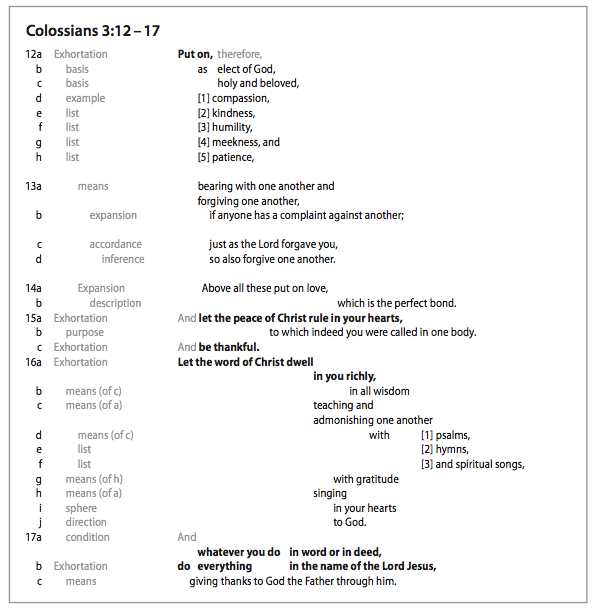
Out of all of the above features, the graphical layout is my favorite in this series and in this volume. It’s what makes the ZECNT something I’ll always reach for when preaching on a given passage–and early on in the process, too. Here’s what it looks like:

Col. 3:12-17
Col. 3:12-17

The main clauses are in bold, and subordinate clauses are indented under them. It’s easy to see, at a glance, how all the parts of a sentence and paragraph relate. The words in gray at left describe the function of each line (exhortation, expansion, etc.).

Pao is a refreshingly enjoyable writer who knows this terrain very well. Preaching or teaching from Colossians/Philemon (or even studying in depth on one’s own or with others) would be greatly enhanced by use of his commentary.

I am grateful to Zondervan for the gratis review copy of this commentary, which was offered to me in exchange for an unbiased review. You can find the book on Amazon here. The Zondervan product page is here. See a pdf sample of the book here.

LSJ Greek–English Lexicon in Logos (for iPad), reviewed (part 2)

The massive LSJ Greek-English Lexicon for Logos (9th ed. with revised supplement) is an invaluable resource for Greek lexicography, covering the classical and New Testament eras. I wrote more about the lexicon in Logos here. How does it look and work on an iPad?

Continue reading “LSJ Greek–English Lexicon in Logos (for iPad), reviewed (part 2)”

Liddell and Scott Greek–English Lexicon (LSJ) in Logos, reviewed (part 1)

LSJ coverAs much as I still look back nostalgically on my early days of Greek and Hebrew reading–where I used only a paper lexicon to look up words I didn’t know–I don’t miss how time-consuming it was. I’m able to do more reading now, not just because of (hopefully!) increased language proficiency, but also because of computerized versions of the same lexicons.

The Liddell and Scott Greek–English Lexicon (LSJ) covers Greek of the classical variety (Homer, Plato, Aristotle, etc.) and of the Septuagint, New Testament, and early church variety. I’ve had the pleasure recently of accessing LSJ via Logos Bible Software.

And, to be clear, what Logos has is Continue reading “Liddell and Scott Greek–English Lexicon (LSJ) in Logos, reviewed (part 1)”

Baker Exegetical Commentary on the New Testament in Logos Bible, reviewed (part 1)

BECNT Logos

Something I immediately appreciated about the Baker Exegetical Commentary set is its clear statement of purpose in the Series Preface, found in each of the 15 volumes published so far:

The chief concern of the Baker Exegetical Commentary on the New Testament (BECNT) is to provide, within the framework of informed evangelical thought, commentaries that blend scholarly depth with readability, exegetical detail with sensitivity to the whole, and attention to critical problems with theological awareness. We hope thereby to attract the interest of a fairly wide audience, from the scholar who is looking for a thoughtful and independent examination of the text to the motivated lay Christian who craves a solid but accessible exposition.

This is an ambitious set of aims for a single commentary, but Continue reading “Baker Exegetical Commentary on the New Testament in Logos Bible, reviewed (part 1)”