The Gospel of Matthew: A Socio-Rhetorical Commentary

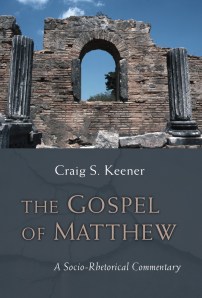
Craig S. Keener’s Gospel of Matthew: A Socio-Rhetorical Commentary utilizes two particular approaches to Matthew:

[A]nalysis of the social-historical contexts of Matthew and his traditions on one hand, and pericope-by-pericope suggestions concerning the nature of Matthew’s exhortations to his Christian audience on the other.

Keener is behind the ever-useful IVP Bible Background Commentary, now in a revised edition. And his exegetical commentary on the first two chapters of Acts is more than 1,000 pages, not counting the bibliography and indeces. Quantity does not always mean quality–it’s harder to write less than more, most of the time–but one can rightly expect Keener to be both thorough and insightful.

Let me jump right in with why I like (and trust) his Matthew commentary.

Layout Matters

The Gospel of Matthew is one of the best laid out commentaries I’ve used. The section on the Lord’s Prayer (“The Kingdom Prayer,” as Keener has it) is a good example. There’s a bold heading with an introduction to the prayer. Here Keener compares the prayer in Matthew to the version in Luke, while offering explanations as to why the two forms differ slightly. Then Keener goes through the passage phrase-by-phrase in eight parts, with the summary statement for each of the parts in bold.
Keener on Matthew

For example, he writes, “Second, the prayer seeks first God’s glory, not the petitioner’s own needs….” Then he uses italics for key questions or insights in each of the eight parts of the prayer. As here: “What did it mean in a first-century Jewish context for God’s name to be hallowed in the future?

The result is a commentary that is highly scannable and readable. Just the simple use of bold and italics, throughout the book, helps orient the reader to what Keener is doing–not to mention offers some really good ideas for how to preach or teach on the text. The layout also makes it easy to get a quick, cursory overview of how Keener understands a given passage.

Matthew, According to Keener

Keener’s humility is refreshing, as he writes that, “in contrast to [his] earlier opinion,” he is:

therefore presently inclined to accept the possibility of Matthean authorship on some level, although with admitted uncertainty. Perhaps the most probable scenario that incorporates the best of all the currently available evidence is the presence of at least a significant deposit of Matthean tradition in this Gospel, edited by the sort of Matthean school scholars have often suggested (though I believe the final product is the work of a single author, not a “committee”).

His judicious weighing of the consideration for and against actual Matthean authorship will allow the reader to have an informed opinion. Does it matter?

Yet what we do conclude about the author does affect our understanding of the Gospel. Matthew is clearly Jewish, in dialogue with contemporary Jewish thought, and skilled in traditional Jewish interpretation of the Old Testament…. Matthew also knows the context of his citations much better than many modern readers have supposed…, and he demonstrates familiarity with a variety of text-types….

On author and intended audience, Keener concludes:

Concurring with the perspectives of what is still probably the minority view, I find in the Gospel an author and audience intensely committed to their heritage in Judaism while struggling with those they believe to be its illegitimate spokespersons. On this reading, Matthew writes to Jewish Christians who, in addition to being part of their assemblies as believers in Jesus, are fighting to remain part of their local synagogue communities.

The introductory material covers the rest of the expected territory: dating, rhetoric, social settings, Gospel sources, the use of narratives in the early church, structure, and more. I found the introductory sections on Jesus (as teacher, as prophet-healer, as Messiah/King, as Son of God) especially illuminating for understanding Matthew as a whole. Keener also has a couple pages upfront about Matthew’s important “Kingdom of Heaven” theme, including this gem:

In short, the present significance of the future kingdom in early Christian teaching was thus that God’s people in the present age were citizens of the coming age, people whose identity was determined by what Jesus had done and what they would be, not by what they had been or by their status in the world.

Though the commentary is academic in nature, it also “will preach” pretty well, as Keener’s lines above make clear.

A Few More Highlights

As soon as picking up the commentary, one will want to read the Excursus on Pharisees (p. 538) and Excursus: Was Jesus Executed on Passover? (p. 622).

One should not expect to find lexical or grammatical comments on each keyword or phrase in Matthew. The comments on Matthew 6:25-34, for example, do not address the meaning of the oft-repeated “worry.” Keener points out that Jesus utilizes the Jewish qal wahomer (“How much more?”) argument to show God’s care for “people in his image and for his own beloved children.” That insight itself is in most commentaries already, but Keener goes further and covers yet more rhetorical territory:

Greek philosophers sometimes disdained such bodily needs altogether, complaining that their bodies were prisons because they were dependent on food and drink (Epict. Disc. 1.9.12) and advising that one turn one’s mind to higher pursuits (Marc. Aur. 7.16). …Jesus never condemns people for recognizing these basic needs…. Yet he calls them to depend on God for their daily sustenance, a provision that Jewish people considered one of God’s greatest miracles….

Keener consistently breaks passages down into main points, which helped me see both the flow of Matthew’s narrative and think about how I could apply each passage. For example, in Matthew 20:29-34 (“Persistent Prayer”) two blind men receive their sight when Jesus’ compassion leads him to heal them. Keener’s four sentences in bold (with a paragraph explanation after each) are:

First, these suppliants recognized the identity and authority of the one whose help they entreated (20:30).

Second, they refused to let others’ priorities deter them (20:31).

Third, Jesus’ compassion was the ultimate motivation for his acting (20:34).

Finally, recipients of Jesus’ gifts should follow him (20:34).

This 2009 edition is not essentially different from Keener’s 1999 Commentary on the Gospel of Matthew. (I.e., the Socio-Rhetorical Commentary is not a revised edition, per se.) There is, however, an addendum at the front of the commentary called, “Matthew and Greco-Roman Rhetoric.” Here Keener goes chapter-by-chapter through the book of Matthew and adds his recent insights into how Jesus and Matthew make use of known rhetorical practices in their teaching and writing, respectively. In the end, though, Keener finds that Jewish rhetoric offers “much closer analogies…than Greek or Roman rhetorical handbooks do.”

Finally, if you’ll permit me one more quotation of Prof. Keener, here is an example of the inspiring nature of his commentary:

But above all the teaching towers the figure of Jesus himself: King, Messiah, Son of Man, the rightful Lord of Israel whom their people would one day acknowledge (1:21; 23:39). The final judge, the true revelation of the Father (11:27), was the meek and lowly One who had walked among the first disciples and died for his people (11:29; 20:28; 21:5), the One who would also empower Matthew’s readers to fulfill the task he had given them (10:19-20; 11:28-30).

Bonus: The Bibliography

It may be strange to praise a book for its bibliography, but Keener offers 150 pages of bibliography on Matthew. Keener seems to not leave any stone unturned, whether it’s another commentary, monographs, or journal articles. He writes, “The purpose of this commentary does not allow me to summarize and interact in detail with all secondary sources on Matthean research.” And yet one would be hard-pressed to find a more thorough list of secondary sources for Matthew elsewhere. In this regard, Keener is successful in offering a commentary that “will contribute to further research.”

The reader should realize that, as noted above, though this commentary was published in 2009, it was not really a revision of the 1999 volume, so the bibliography has not been brought into the 21st century with any updates. (So Nolland and France, for example, are not listed.)

The commentary’s Index of Ancient Sources is 142 pages, taken “from a variety of narrative genres to illustrate Matthew’s narrative techniques, with special attention to ancient biography and historiography.” Copious references throughout the commentary give the researcher multiple good leads.

For all of Keener’s thoroughness, the use of bold and italics for main points keeps the commentary well-organized, so that the research does not become overwhelming. Keener’s heart seems to be pastoral, and his reverence toward the Jesus of Matthew is clear and an inspiration throughout the commentary.

You don’t need any Greek to use this commentary, but a good cup of coffee and a full night’s rest might help, as it can be dense and detailed (but not impenetrable) in places. The reader of Matthew who is willing to work at Keener’s commentary will be rewarded. This volume has already vaulted its way into my top four Matthew commentaries.

Thanks to Eerdmans for the review copy. You can find the book’s product page here. It is on Amazon here. Amazon links above are affiliate links, described further here.

Matthew (NIGTC) in Logos Bible Software

The below is adapted from my full-length review of the print edition of NIGTC Matthew. Here I reproduce some of the content of that post, but with an eye toward the commentary’s presentation and use in Logos Bible Software.

NIGTC MatthewReaders of this blog (and those with whom I worship on Sunday!) will know I’ve been preaching through Matthew this year. I have made profitable use of John Nolland’s commentary almost every week in my preparation.

This is what Nolland says about his commentary:

My central concern in this commentary is with the story Matthew has to tell and how he tells it. Though the reader will recognise that I have been influenced by some scholarly methods more than by others, my work is committedly eclectic.

Nolland comments on Matthew using redaction criticism, grammatical analysis, rhetorical criticism, and more. Though the NIGTC series does not seek to be devotional, per se, and though Nolland’s Matthew is not an application commentary, the author is consistently sensitive to the broader context of Matthew and his aims. (Nolland says he cares about “a close reading of the inner logic of the unfolding text.”)

Nolland’s Introduction to Matthew

The introduction includes the following sections (the bullet points below are all the author’s words):

  • authorship of the Gospel
  • the sources for the Gospel
  • the prehistory of the sources
  • the date and provenance of the Gospel
  • the kind of document the Gospel intends to be
  • the state of the Greek text of the Gospel
  • aspects of the author’s narrative technique
  • the Gospel’s use of the OT and of other Jewish tradition
  • and the theology of the Gospel of Matthew.

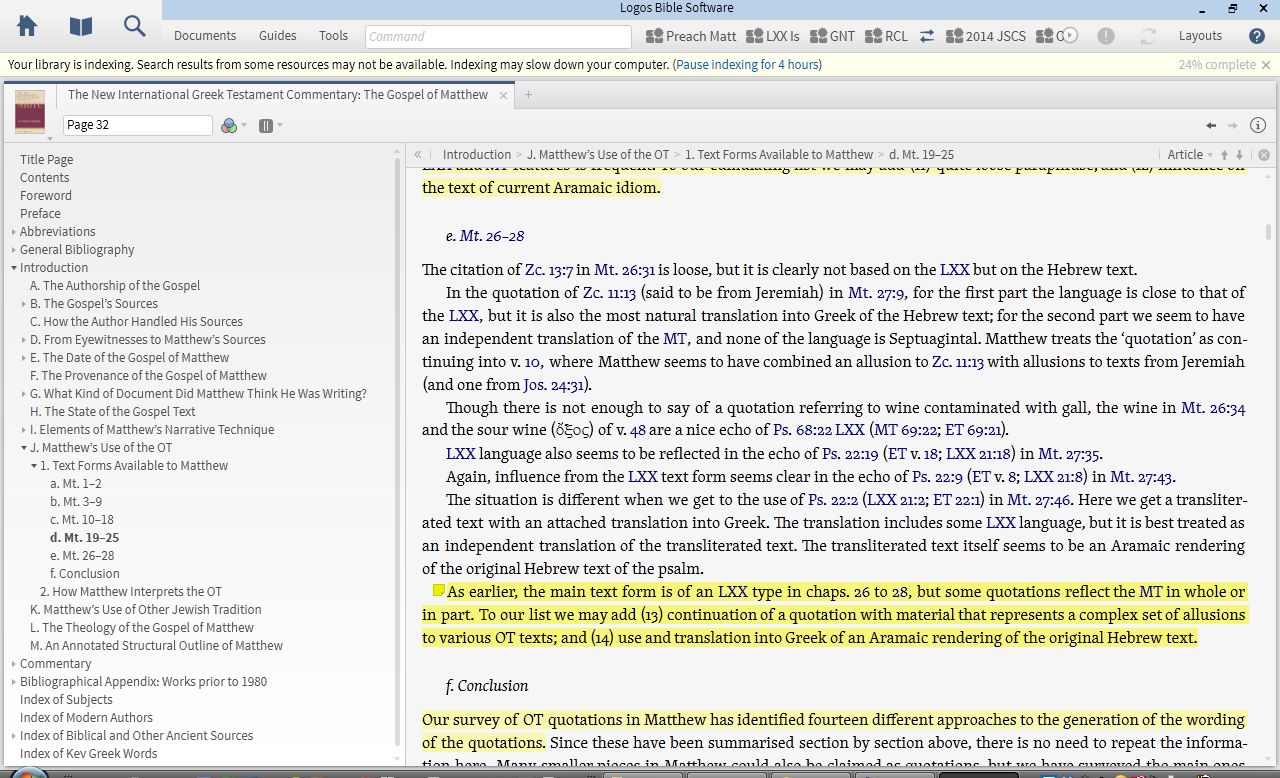
Here’s what it looks like in Logos on a PC. You can hide or show the table of contents at the left, and many of its sections have expand/collapse triangles (click or open in a new tab to enlarge the image below):

Introduction to Matthew

Any highlights or notes I add (which you can see above) automatically sync with any other devices that run the Logos app.

Like R.T. France, Nolland would rather elaborate on certain points in the body of the commentary itself, which makes the introduction accordingly shorter. I experienced this as a relief, because (a) I could get into the commentary proper more quickly and (b) when primarily coming to the commentary with a specific passage in mind, I found quite a bit of substance in the commentary proper, without having to go back to the introduction. Getting to a given passage via Logos is almost instantaneous.

Nolland on Matthew’s Use of the OT

There is more of note in the introduction, but “Matthew’s Use of the OT” is probably the most exceptional section (pictured above). It details both (a) what text forms Matthew might have had and (b) how he used them. Nolland lists 14 (!) “different approaches to the generation of the wording of the quotations.” And yet, amid the detail, he can conclude:

Though some of Matthew’s text forms come to him straight from the Gospel tradition, the overall impression is of a man who freshly scrutinises, at least on many occasions, the OT texts to which he appeals, and is able to do so in Greek, Hebrew (not always the Hebrew of the preserved MT), and occasionally in Aramaic. When it suits him to do so, he produces translations that reflect influence along more than one track of tradition.

Nolland then identifies eight different ways in which Matthew uses the OT. This section of the commentary alone is worth half the price of the commentary. A nearly 20-page “Annotated Structural Outline of Matthew” at the end of the introduction is quite impressive (and maybe even worth the other half of the price of the commentary).

The Author’s Translation of Matthew

Nolland admits that his translation of Matthew (located at the beginning of each section) “may at times be wooden,” and this woodenness is noticeable in a number passages. For example, the genealogy reads: “Abraham produced Isaac; Isaac produced Jacob….” Nolland acknowledges the “unfortunately impersonal and nonbiological” implications of that translation. Indeed, a better word is needed.

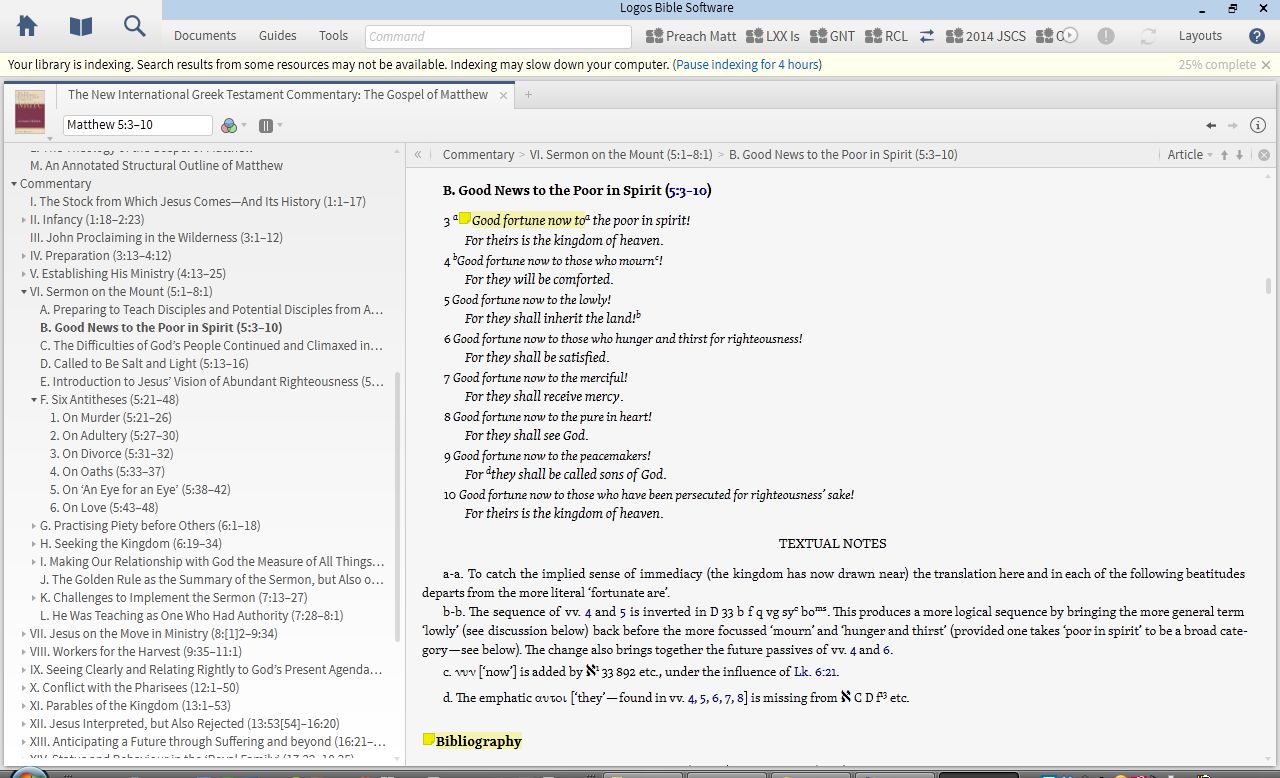
And for the Beatitudes (where the Greek μακάριος is admittedly difficult to translate), he has, “Good fortune now to….” I liked  the “now” part of this (it carries an “implied sense of immediacy”), but the more traditional “blessed” still seems to leave room in English for the divine blesser, who should be kept in view here. “Good fortune now” seems to miss that.

The commentary proper (with original translation)
The commentary (with original translation)

A more readable translation would not have compromised Nolland’s aims in producing a fairly literal rendering of the Greek. It wasn’t an enormous distraction from a well-written commentary, but it stood out, nonetheless.

The Commentary Proper

It would be impossible for Nolland to be comprehensive at every turn. There were some Greek words or passages of Matthew where I had hoped for more detail, but on the whole, Nolland is thorough.

For instance, in the narrative of the devil’s temptation of Jesus in Matthew 4, Nolland writes of verse 1:

The opening ‘then’, the role of the Spirit, and the Son of God language to come in vv. 2 and 6 create a strong link between 4:1–11 and 3:13–17.

and:

Because of the agency of the devil (and the specific temptations to come) πειρασθῆναι has been translated ‘to be tempted’, but there is in fact a play on the two senses of the πειραζ- root: ‘test’ or ‘tempt’.

This commentary matches literary sensitivity and Greek analysis with conclusions that can easily lead the reader to application. In the same passage: “[T]he devil suggests that sonship is a privilege to be exploited, that Jesus should use his opportunities to see to his own needs.”

Nolland often presents multiple scholarly interpretations of a given passage before offering his own–and even then, he does it humbly (though not unconvincingly). In the Beatitudes, for instance, he notes 11 different understandings of “poor” and four different understandings of “in spirit” for Matthew 5:3. One gets the sense that the author is just as interested in historical interpretation of given passages as he is with his own. This is a good thing.

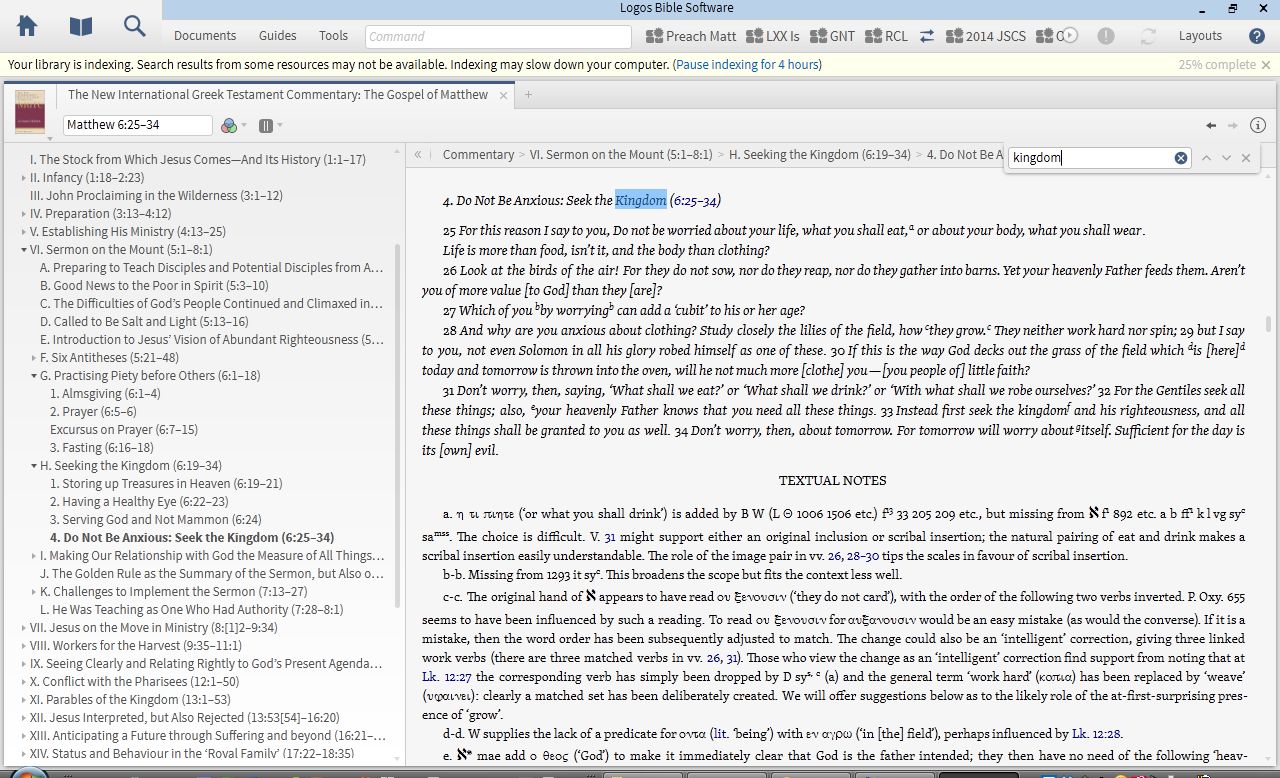
In Logos, one can search the commentary using control+F (PC) or command+F (Mac):

Keyword searching NIGTC
Keyword searching NIGTC for “kingdom”

One cool thing about this is that if you are already in Matthew 6:25 of the commentary (as above), the search results start right where you are (instead of going back to the beginning of the commentary). This way one can research a given word or theme as it unfolds in Nolland’s writing.

Concluding Evaluation

Despite the technical nature of the commentary (which I appreciated), the writing style is engaging and accessible, even inspiring in places. I loved this:

Jesus proclaims the imminent arrival of the kingdom of heaven. God now intends to establish afresh his rule among his people. If people are to be ready for this development, then repentance is urgent. Only a fundamental change of life direction will match the needs of the moment.

The bibliographies are a gold mine. One wonders if there’s any journal article or monograph on Matthew that Nolland hasn’t examined. Even so, he says in his preface that he had to trim his listing to accommodate the requirements of the editors!

My critique of the author’s translation notwithstanding, Nolland’s Matthew is a magnificent work, probably even one of the very first places one should go when doing in-depth study of Matthew’s text. Nolland does not disappoint in his technical analysis of words and passages, and yet he somehow is able to keep the Gospel as a whole before him and the reader as he expounds on its component parts. The reader cannot help but be impressed throughout the commentary, both with Nolland, and with Matthew’s Gospel which he describes.

Thanks to Logos for the review copy of the NIGTC series. I will post more in the future about the series and its use in Logos.

John Nolland’s Matthew (NIGTC) reviewed

NIGTC MatthewThe series preface to The New International Greek Testament Commentary (NIGTC) states:

At a time when the study of Greek is being curtailed in many schools of theology, we hope that the NIGTC will demonstrate the continuing value of studying the Greek New Testament and will be an impetus in the revival of such study.

This is a welcome series to those who want assistance in making good sense of the Greek text.

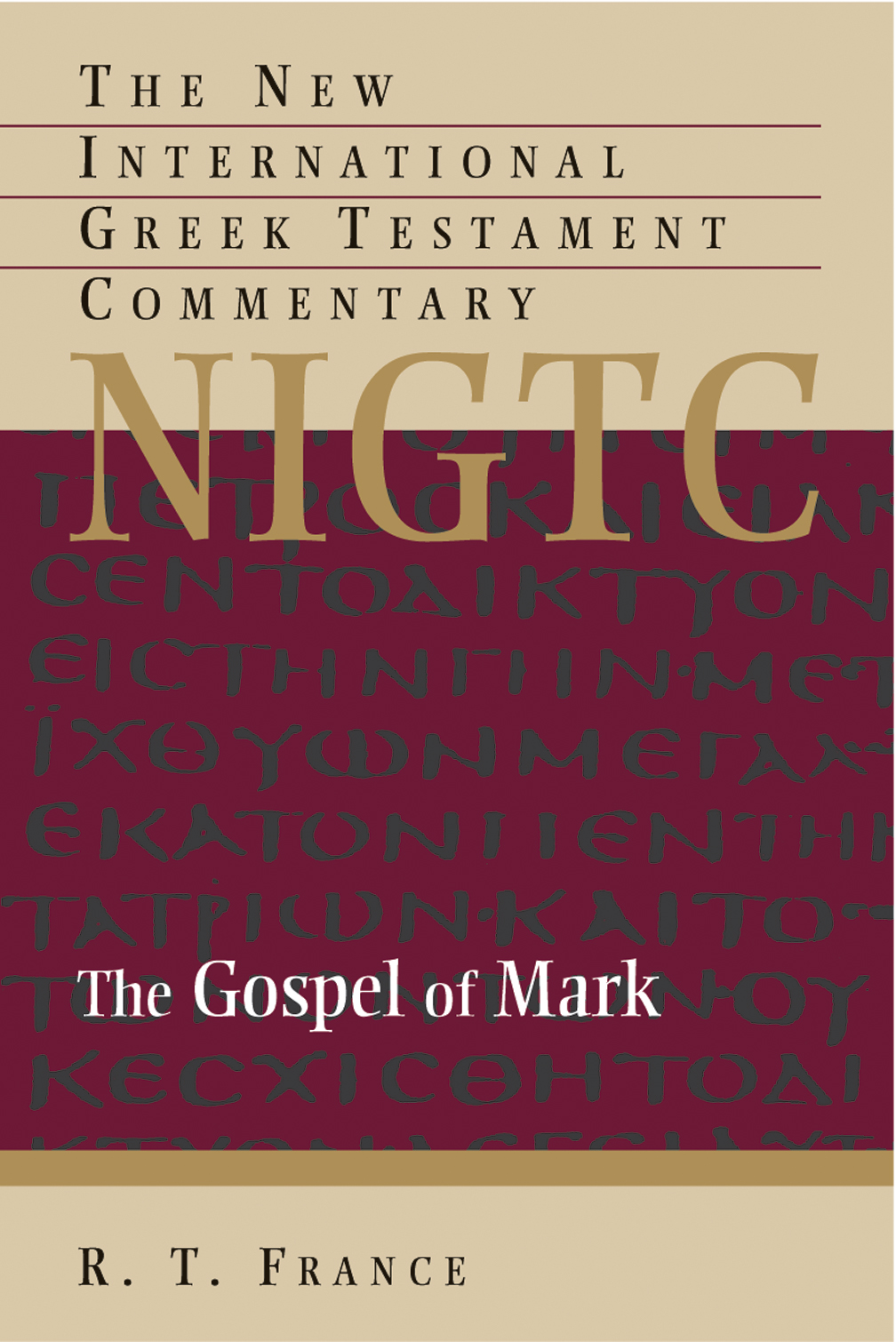
R.T. France’s volume in NIGTC (Mark) is not only one of my favorite commentaries of all time; it’s one of my favorite books. (I note it briefly here.) And Paul Ellingworth’s Hebrews volume greatly helped me through an exegesis course covering that epistle.

NIGTC: Matthew

Here I review John Nolland’s Matthew volume. I’ve been preaching through Matthew this year, and have used Nolland in my preparation almost every week.

This is how Nolland describes his commentary:

My central concern in this commentary is with the story Matthew has to tell and how he tells it. Though the reader will recognise that I have been influenced by some scholarly methods more than by others, my work is committedly eclectic.

In other words, Nolland looks at Matthew via redaction criticism, language, rhetorical criticism, and more. Though the series does not seek to be devotional, per se, and though NIGTC Matthew is not an application commentary, Nolland is consistently sensitive to the broader context of Matthew and his aims. (Nolland says he cares about “a close reading of the inner logic of the unfolding text.”)

Nolland’s Introduction to Matthew

The introduction includes the following sections (the bullet points below are all the author’s words):

  • authorship of the Gospel
  • the sources for the Gospel
  • the prehistory of the sources
  • the date and provenance of the Gospel
  • the kind of document the Gospel intends to be
  • the state of the Greek text of the Gospel
  • aspects of the author’s narrative technique
  • the Gospel’s use of the OT and of other Jewish tradition
  • and the theology of the Gospel of Matthew.

Like R.T. France, Nolland would rather elaborate on certain points in the body of the commentary itself, which makes the introduction accordingly shorter. I experienced this as a relief, because (a) I could get into the commentary itself sooner and (b) when primarily coming to the commentary with a specific passage in mind, I found quite a bit of substance in the commentary proper, without having to go back to the introduction.

That Matthew was actually the author of this Gospel seems to Nolland to be “most unlikely,” though I would have liked to see more support for Nolland’s conclusion. He doesn’t offer much. The “majority” (though not all) of sourcing for Matthew is attributed to “Mark and Q materials.” Refreshingly, Nolland has this to say about the idea of a historical Jesus:

These considerations do, however, suggest that we may have considerable confidence that the Jesus with whom the Gospels connect us is, and is in detail, the Jesus who actually operated in Palestine in the first century and not some mythical construct. The Gospel writers and those who supplied them their raw materials wanted people to get in touch with Jesus because of his potential significance for them, but they would feel no need to apologise for failing to meet all the needs of our historical curiosity.

Though aware of Gentiles, too, “Matthew writes for Jewish Christians who are very conscious of their Jewish identity.” Nolland writes, “Matthew seems to have understood himself to be creating a foundational text to which people would feel the need to return again and again.”

Nolland on Matthew’s Use of the OT

There is more of note in the introduction, but “Matthew’s Use of the OT” is probably the most exceptional section. It details both (a) what text forms Matthew might have had and (b) how he used them. Nolland lists 14 (!) “different approaches to the generation of the wording of the quotations.” And yet, amid the detail, he can conclude:

Though some of Matthew’s text forms come to him straight from the Gospel tradition, the overall impression is of a man who freshly scrutinises, at least on many occasions, the OT texts to which he appeals, and is able to do so in Greek, Hebrew (not always the Hebrew of the preserved MT), and occasionally in Aramaic. When it suits him to do so, he produces translations that reflect influence along more than one track of tradition.

Nolland then identifies eight different ways in which Matthew uses the OT. This section of the commentary alone is worth half the price of the commentary. A nearly 20-page “Annotated Structural Outline of Matthew” at the end of the introduction is quite impressive (and maybe even worth the other half of the price of the commentary).

The Author’s Translation of Matthew

Nolland admits that his translation of Matthew (located at the beginning of each section) “may at times be wooden,” and this woodenness is noticeable in a number passages. For example, the genealogy reads: “Abraham produced Isaac; Isaac produced Jacob….” Nolland acknowledges the “unfortunately impersonal and nonbiological” implications of that translation. Indeed, a better word is needed.

And for the Beatitudes (where the Greek μακάριος is admittedly difficult to translate), he has, “Good fortune now to….” I liked  the “now” part of this (it carries an “implied sense of immediacy”), but the more traditional “blessed” still seems to leave room in English for the divine blesser, who should be kept in view here. “Good fortune now” seems to miss that.

Finally, the regular use of brackets in the translation made it read even less fluidly than it already did in places. As in: “It is no more fitting that people should light a lamp and put it under the peck measure; rather, [they put it] on the lampstand, and it shines out for all in the house.”

The above is all to say: a more readable translation would not have compromised Nolland’s aims in producing a fairly literal rendering of the Greek. It wasn’t an enormous distraction from a well-written commentary, but it stood out, nonetheless.

The Commentary Proper

It would be impossible for Nolland to be comprehensive at every turn. There were some Greek words or passages of Matthew where I had hoped for more detail, but on the whole, Nolland is thorough.

For instance, in the narrative of the devil’s temptation of Jesus in Matthew 4, Nolland writes of verse 1:

The opening ‘then’, the role of the Spirit, and the Son of God language to come in vv. 2 and 6 create a strong link between 4:1–11 and 3:13–17.

and:

Because of the agency of the devil (and the specific temptations to come) πειρασθῆναι has been translated ‘to be tempted’, but there is in fact a play on the two senses of the πειραζ- root: ‘test’ or ‘tempt’.

This commentary matches literary sensitivity and Greek analysis with conclusions that can easily lead the reader to application. In the same passage: “[T]he devil suggests that sonship is a privilege to be exploited, that Jesus should use his opportunities to see to his own needs.”

Nolland often presents multiple scholarly interpretations of a given passage before offering his own–and even then, he does it humbly (though not unconvincingly). In the Beatitudes, for instance, he notes 11 different understandings of “poor” and four different understandings of “in spirit” for Matthew 5:3. One gets the sense that the author is just as interested in historical interpretation of given passages as he is with his own. This is a good thing.

Concluding Evaluation

Despite the technical nature of the commentary (which I appreciated), the writing style is engaging and accessible, even inspiring in places. I loved this:

Jesus proclaims the imminent arrival of the kingdom of heaven. God now intends to establish afresh his rule among his people. If people are to be ready for this development, then repentance is urgent. Only a fundamental change of life direction will match the needs of the moment.

The bibliographies are a gold mine. One wonders if there’s any journal article or monograph on Matthew that Nolland hasn’t examined. Even so, he says in his preface that he had to trim his listing to accommodate the requirements of the editors!

My critique of the author’s translation notwithstanding, Nolland’s Matthew is a magnificent work, probably even one of the very first places one should go when doing in-depth study of Matthew’s text. Nolland does not disappoint in his technical analysis of words and passages, and yet he somehow is able to keep the Gospel as a whole before him and the reader as he expounds on its component parts. The reader cannot help but be impressed throughout the commentary, both with Nolland, and with Matthew’s Gospel which he describes.

Thanks to Eerdmans for the review copy. Nolland’s Gospel of Matthew is on Amazon here. Its product page is at Eerdmans’s site here.

The Gospels as “the Song of the Four Living Creatures”

Gospel Writing

Where gospel difference is seen as a problem or weakness that calls for elaborate harmonization procedures or critical unmasking, the root cause is a dissatisfaction with canonical pluralism as such and a determination to reduce it to singularity. But that is to overlook the hermeneutical significance of the canon itself, which strives to integrate the voice of the individual witness into an encompassing polyphony. As an ancient tradition suggests in word and image, this evangelical polyphony echoes the song of the four living creatures around the divine throne.

–pp. 615-6 of Francis Watson’s Gospel Writing: A Canonical Perspective (Eerdmans, 2013)

I’m reviewing Watson’s book for an upcoming Bible Study Magazine issue. Watson’s comfort with the co-existence of history and theology–as if one could be devoid of the other in the case of gospel reception–is refreshing.

The Book of Isaiah: One Author or Three?

Eerdmans Companion

Isaiah 1:1 reads, “The vision of Isaiah son of Amoz, which he saw concerning Judah and Jerusalem in the days of Uzziah, Jotham, Ahaz, and Hezekiah, kings of Judah” (NRSV).

Scholars remain divided as to whether or not this “vision of Isaiah” verse is meant to apply to all 66 chapters, or whether Isaiah might be the author of just the first 39 chapters, with other authors (in the tradition of Isaiah) having penned chapters 40-55 and 56-66.

I’ve long had my eye on The Eerdmans Companion to the Bible and have begun using it recently. Its introductory section to Isaiah had what I thought was a refreshingly balanced approach to the issue of authorship in Isaiah:

Taken as an introduction to the book as a whole, Isa. 1:1 identifies the contents of the subsequent 66 chapters as the “vision” of 8th–century Isaiah. But modern scholars have challenged the traditional view that considers him the source of all the material contained in the book that bears his name. Though chapters 40–66 echo certain themes contained in chapters 1–39, they also contain specific, predictive prophecies that some scholars doubt Isaiah foretold. For example, they consider it unlikely that an 8th–century prophet not only predicted the 6th–century Persian king Cyrus’s conquest of the Babylonian Empire but also named him specifically (see 44:28 and 45:1). Old Testament prophets normally directed their messages to contemporaries. For Isaiah to have directly addressed the Babylonian exiles (and perhaps returnees to Judah) pictured in chapters 40–66, his prophetic ministry would have to have extended well beyond the reign of Hezekiah (the last king mentioned in 1:1), and he would have to have lived for more than two centuries.

On the other hand, in this book God holds out his power to predict the future as proof of his divine supremacy (chs. 41, 44, 46, and 48). It is not unreasonable, therefore, to think that Isaiah mediated predictive messages as words from God and at times addressed audiences of future generations.

More details on this Bible guide are here at the Eerdmans page. I’m finding that it’s a concise yet substantive way to get myself oriented to a given book of the Bible.

R.T. France on Mark

R.T. France’s commentary on Mark focuses on the Greek text, but I’d recommend it to anyone interested in carefully working through the Gospel of Mark, regardless of Greek knowledge. France takes the utmost care to interpret the text, providing much relevant background and comparison with other Gospels. Even as he is exegeting a single word or phrase from one verse, he always has the whole contour of the book in mind. While he does not formally have an application section as such, the conclusions he draws from the text are such that the careful reader could easily come up with applications from France’s insights.

France’s work is technical, yet easy enough to read, especially for a commentary. Beyond its superb quality as a technical/academic commentary, it has even gone so far as to more deeply inspire me in my own view of Jesus and his ministry. It’s well worth the money to purchase this book, and well worth the effort to work one’s way through it.

Sadly, France just passed away in February.  I was fortunate to be taking a class this past semester where this commentary was the primary textbook.