I came across this powerful description of Jesus this morning:
Jesus, the poor layman turned prophet and teacher, the religious figure from rural Galilee without credentials, met his death in Jerusalem at least in part because of his clash with the rich aristocratic urban priesthood. To the latter, a poor layman from the Galilean countryside with disturbing doctrines and claims was marginal both in the sense of being dangerously antiestablishment and in the sense of lacking a power base in the capital. He could be easily brushed aside into the dust bin of death.
John P. Meier, A Marginal Jew: Rethinking the Historical Jesus, vol. 1: The Roots of the Problem and the Person, p. 9. Quoted in this awesome Richard Hays book. Emphasis mine.
Click on the thumbnail above for a short reflection I shared with the church I pastor. It’s something important–but easy to overlook–that happened before Jesus fed 5,000+ people.
There is a Bible verse that always stops me in my tracks:
Herod was furious when he realized that the wise men had outwitted him. He sent soldiers to kill all the boys in and around Bethlehem who were two years old and under, based on the wise men’s report of the star’s first appearance.
—Matthew 2:16 (New Living Translation)
This is some of the most heinous evil the Bible reports. Can you imagine?
Herod couldn’t find Jesus, but he knew Jesus was in Bethlehem or nearby, and he knew Jesus was two years old or under. So Herod just took that whole group of people and had them killed. It’s an egregious abuse of power.
The Gospels record attempts on Jesus’s life once he is active in ministry, but it’s a miracle that Jesus even made it to adulthood. He emerged from an entire generation of babies that Herod ordered murdered.
The story of those babies and their families doesn’t stop with their murder. The parents had to live with the death of their children for the rest of their lives. All the birthdays, yearly feasts, and celebrations: gone. Two high school graduations—class of ’13 and class of ’14—cancelled, because no one was there to graduate. A murderous, abusive, vindictive tyrant stole those kids from their parents.
Jesus’s birth was surrounded by child abuse.
“O Little Town of Bethlehem, how still we see thee lie”? Nope. At least not for long. Herod was making that little town a cesspool of death and trauma. There’s no stillness in what Matthew goes on to describe, quoting the prophet Jeremiah:
“A cry was heard in Ramah— weeping and great mourning. Rachel weeps for her children, refusing to be comforted, for they are dead.”
Did Mary and Joseph and Jesus have survivor’s guilt? How awful must Mary and Joseph have felt about all this? And what was Jesus’s reaction when he realized the circumstances surrounding his birth? Surely this did not look like the salvation the angel had promised Jesus would bring—maybe even its opposite.
I’ve started wondering: all this killing of little babies… did this shape Jesus’s passion for ministering to children? Was it a deeply formative experience for how Jesus would live in the world?
More specifically, did the abuse and trauma Jesus learned about inspire him to especially love the abused and traumatized? Did the erasure of children and complete destruction of their rights lead him to become a champion of children?
Reading against such a backdrop, these words of Jesus strike me as even more poignant—and powerful:
“Let the little children come, and do not forbid them, for of such is the kingdom of heaven.”
“If anyone causes one of these little ones—those who believe in me—to stumble, it would be better for them to have a large millstone hung around their neck and to be drowned in the depths of the sea.”
“Truly I tell you, whoever does not receive the kingdom of God as a little child will never enter it.
And this powerful moment:
And he took them up in his arms, laid his hands on them, and blessed them.
I have to think Jesus carried all the death and grief and trauma that others experienced, not just at the cross, but from the very time he was born. When he looked at the children coming to him, did he remember all the children that would never have a chance to approach him? When he blessed the children, was it a deliberate undoing of the curse Herod had pronounced?
Miraculously, Jesus survived citywide infanticide. He lived through that systemic abuse. Now he would prioritize the well-being of children. He would make sure they could truly live.
Indeed, the person at peace with me, in whom I hoped, he who would eat of my bread, magnified trickery against me.
(NETS translation)
Jesus will apply this verse to Judas in John 13:18: The one who ate bread with me has turned his back on me.
And this was one of the 12! Even one of Jesus’s inner circle would turn his back on him. A sobering reminder of all that Jesus endured as we “journey toward the cross” this week.
Easter is near, the time of year where—if I haven’t already reached for it recently—I pull out my favorite Gospels resource: Synopsis of the Four Gospels.
There are three versions of this resource of which I’m aware:
– an all-Greek one (complete with Latin title: Synopsis Quattuor Evangeliorum)
– an all-English one
– the one linked above, which has both Greek and English
I love the color. The binding is secure. The size is beautifully large but not overwhelmingly so. My copy, though I got it used some years ago, even smells good. It might be the aroma of the Holy Spirit.
For those seemingly rare but delightful stories, parables, or teachings that all four Gospels treat, the Synopsis is a great way to see everything lined up together. Each year I choose whichever Easter account is the Gospel lectionary for the day, but I always look at all the Gospels side by side before preaching about the story of the resurrection.
Here are some pictures:
And if you really want to get into this text, check out this review—more of an homage, rightly—at the Bible Design Blog.
which made me think of Malachi 4:6 (versification from English Bible):
NRSV He will turn the hearts of parents to their children and the hearts of children to their parents, so that I will not come and strike the land with a curse.
It’s as if two possible realities (choose wisely!) are being prophesied in each place… surely Jesus had Malachi in mind?
Maybe! The Septuagint does not have the parents-children-children-parents rhythm, but gives instead:
NETS who will restore the heart of the father to the son and the heart of a person to his neighbor so that I will not come and utterly strike the land.
If Jesus did have the Malachi text in mind to allude to here (of course he knew it), he sure does seem to favor the Hebrew text over its Greek translation.
This itself is not shocking, as Jesus would have known the Hebrew Scriptures (in Hebrew) well, have heard them read at synagogue, etc. But as much as the NT writers seem to employ the LXX over the Hebrew (where they diverge), this was surprising to me.
But in the post linked in the sentence above, I also found this from R.T. France (may he rest in the good Lord’s great peace!) that seems to suggest perhaps I should not be surprised (IF Jesus has Malachi in mind in the first place).
Summarizing the results so far, we may now say that of the sixty-four Old Testament quotations in the sayings of Jesus which may be regarded as certain or virtually so, twenty are to some degree independent of the LXX, and of these twenty, twelve are closer to the MT at this point. The addition of a further ten cases of likely or possible allusions to the MT against the LXX further strengthens the impression that it is wrong to speak of the Old Testament quotations in the sayings of Jesus as basically LXX form.
The textual comparisons are fun, but at the end of the day, all I really want is to be a father whose heart is turned to his children, and whose children turn their hearts to me!
It’s interesting that Matthew quotes Jesus as saying that not a ἰῶτα will pass away/fall away/disappear from the law. That’s a Greek letter. Could this mean Matthew/Jesus are referring to the Septuagint translation of the Torah, specifically? Or at least had the Greek translation in mind, alongside the Hebrew Torah?
More questions, maybe unanswerable: Was Jesus speaking Aramaic here? Or Greek? Or Aramaic and then said ἰῶτα in Greek?
“To what does Matthew intend ἰῶτα to refer? While ἰῶτα is the simplest of the Greek letters (a vertical line), it does not make a particularly striking image for a tiny detail of the wording of the Law. The synagogue practice of giving the reading from the Law in Hebrew, followed by translation, may suggest that Matthew has the Hebrew text in mind. In that case ἰῶτα could represent yod (as frequently claimed), the smallest of the Hebrew consonants, and one which sometimes contributes nothing to the meaning.”
I find this less than compelling. If Matthew had the Hebrew Law in mind, couldn’t he have put a Greek transliteration of yod (or some other Hebrew letter) on Jesus’s lips?
Or is Nolland right, and Matthew simply translated Jesus’s “yod” into Greek, much as he would already be translating Jesus’s Aramaic speech into Greek (assuming Jesus did, in fact, primarily speak Aramaic)?
The larger interpretive question of what Jesus means theologically doesn’t seem to hinge on these language-specific questions, but I find them interesting all the same.
I am one week in with the Greek Gospels in 2018 reading plan I made. Last week I also invited my congregation to join me in English, so I’ll be able to have some good in-person conversations about the content of the Gospels, too.
Each Gospel has its own three months. Readings are listed for Monday-Friday, with weekends left open for review, other reading, catch-up, or a break. Friday always ends with the last verse of a chapter.
The plan linked below also includes suggested passages each week for lectio divina, an ancient way of reading Scripture that goes back to at least the Middle Ages. Lectio divina, many readers of this blog will be aware, is Latin for “divine reading” or “holy reading,” where we read Scripture slowly, reflectively, and prayerfully. (There is a short primer on the practice here, based on a sermon I preached in Lent 2016.)
Let me know if you’ll be reading along! The plan is here.
I plan to read through the four canonical Gospels in Greek in 2018: Matthew, Mark, Luke, and John.
I’ve created a reading plan, which divides the Gospels into three months each, Monday through Friday (with weekends to catch up, review, or take a break).
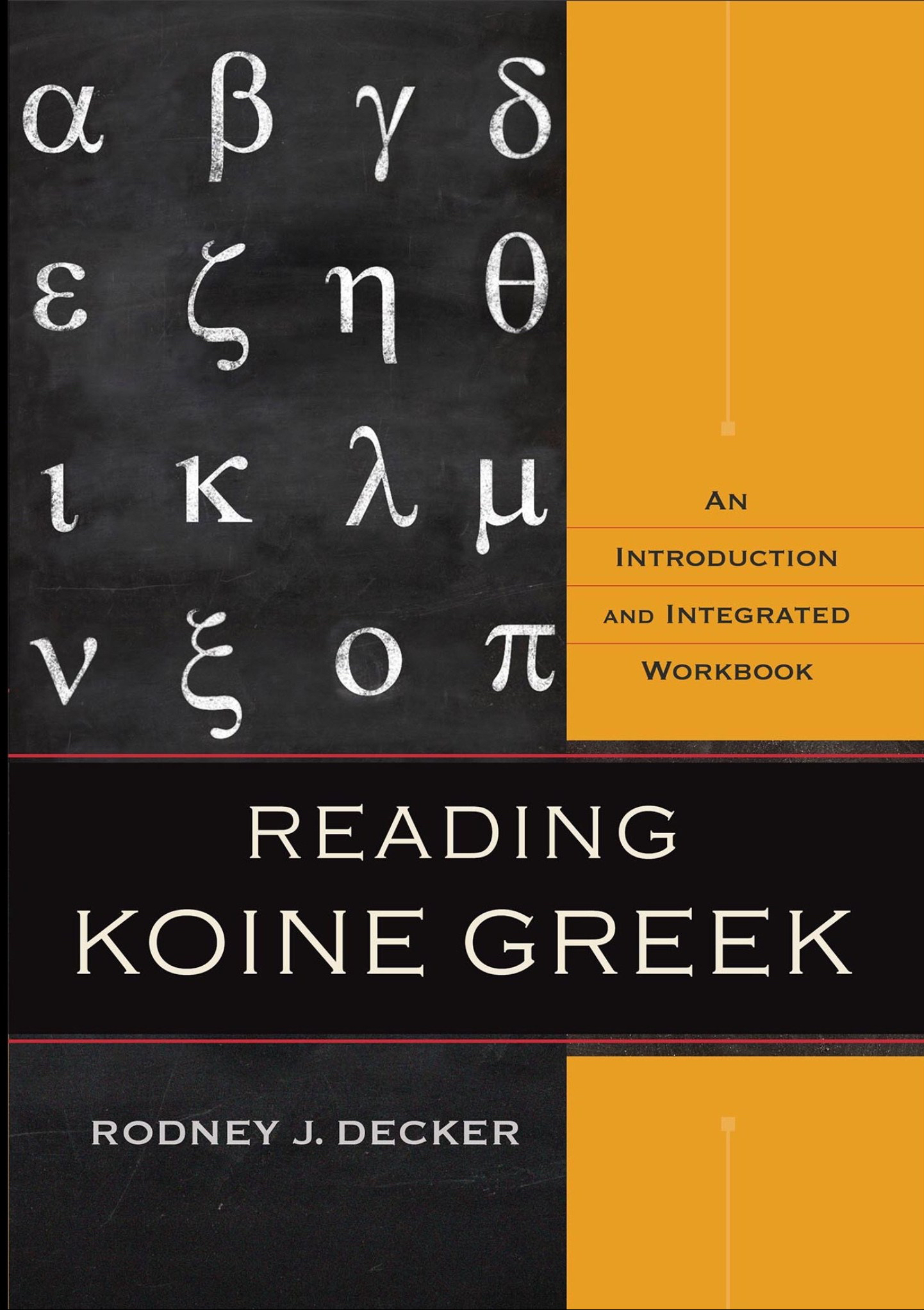
There is also a weekly reading suggestion for an accompanying Greek textbook to help with vocabulary and grammar: Rod Decker’s Reading Koine Greek.
The plan also includes suggested passages for lectio divinaeach week, for those who want to engage with the Greek text reflectively and prayerfully. Finally, the plan concludes with 16 tips for Scripture memory, for those who want to add that component, as well.
Phew! I am looking forward to reading through the Gospels in this way.
Here is the plan as a PDF, with navigable/hyperlinked Table of Contents: PDF.
And here is the plan as an interactive Accordance User Tool: User Tool.
Would you like to join me? Let me know in the comments or by emailing me through this form. I’m off all social media in 2018 (woo hoo!), but will respond to comments here, as well as at Accordance Bible Software’s “Greek in a Year” forum (here).


 There is also a weekly reading suggestion for an accompanying Greek textbook to help with vocabulary and grammar: Rod Decker’s

 Words on the Word