Here are a few blog posts from November, regarding the Septuagint, that are worth taking a look at:
J.K. Gayle considers the question of whether the Septuagint translator of the Hebrew Song of Songs might have been a woman, then raises some challenges inherent to that view, at least as it is presented by the NETS (see image at left). J.K. also offered insight into the possible motherliness of God and the patriarch Joseph. Suzanne responded here, preferring to talk about “wombly feelings” instead of “motherly” ones. Kurk writes back again, noting some “maternal” language (with help from Greek Isaiah) in the “Our Father.”
I’ve just this month learned of a blog called Old School Script, which focuses on linguistics and biblical languages. Check out as much as you can of that site, starting with an October post that I missed last month, “Word Order in Septuagint Judges.” Note also some extended exploration this past month about Paul’s use of the LXX. Said blog also pointed this month to Randall Buth’s thinking about an SBL session on the Greek perfect.
Also, this month Logos Bible Software released (for free) Codex Sinaiticus, includingits Septuagint portions.
Did I miss anything? Feel free to leave more November 2013 LXX links of interest in the comments. And in case you didn’t see it, the first Septuagint Studies Soirée is here; the second one is here; the third one is here.
One other thing to note–a reading group of nearly 200 folks on Facebook (and more who are not on Facebook) finished a reading plan last Friday through Greek Isaiah.
Reading through Isaiah, I’ve made connections between biblical texts that I never noticed before. I’ve posted about Philippians and Ephesians. Today I saw something in Isaiah 63:11 that seems to have inspired the author of Hebrews.
Isaiah 63:11
English: And the one who brought up from the landthe shepherd of the sheep remembered the days of eternity. Where is the one who put his holy spirit in them?
English: And the God of peace, who brought up from the deadthe great shepherd of the sheep, our Lord Jesus Christ, by the blood of the eternal covenant…
Though Hebrews has “great” in addition to “the shepherd of the sheep,” the latter phrase (τὸν ποιμένα τῶν προβάτωνin Greek) is identical in both passages.
The author of Hebrews seems to want to explicitly identify “the shepherd of the sheep” from Isaiah, which he/she does by noting that this “great” shepherd is “our Lord Jesus Christ.”
Did the author of Hebrews intend with “brought up from the dead” to echo Isaiah’s “brought up from the land”? The Greek verbs are different, but both have the ἀνα=up prefix, and both are in participial form.
If Hebrews’s bringing up is meant to evoke Isaiah’s bringing up, is Hebrews taking Isaiah’s exodus motif in Isaiah 63 and holding up Jesus as the leader of the new exodus?
Both passages have “eternity” (αἰώνιος) in view.
I haven’t checked commentaries yet, but after observing the above, I noticed that the critical apparatus (manuscript notes) in the Göttingen edition of the Septuagint notes that Hebrews 13:20 should be consulted.
I plan to see what others have written about this, but for now, the similarities above have me fairly convinced that this was a deliberate reference, and that the author of Hebrews was finding Jesus in Isaiah 63:11.
Ephesians 6:10-11 says, “Finally, be strong in the Lord and in his mighty power. Put on the full armor of God….”
This “of” is perhaps best understood to mean, “the armor that God himself wears, that is also available to you.” Isaiah 59:17 talks about the Lord (“Yahweh”) putting on righteousness like a breastplate and a helmet of salvation. Ephesians 6 mentions these same items.
The “armor” we are called to put on, then, is God’s own armor. We “put on” the attributes and characteristics of God. Because of his righteousness, we are called righteous. Because he is a God of peace, we can be at peace and make peace with others. Because of the faithfulness of Jesus, we can have faith.
And, what is more, God-as-Warrior is going on ahead of each of us, wearing that “armor,” fighting spiritual battles before us. As we follow him, we are given his same armor to wear.
Though it was a quiet month in the Septuagint blogosphere, J.K. Gayle turned up the heat with some top-notch posts. Gayle looked at the phrase “ἄρσεν καὶ θῆλυ” (a “Greek frozen phrase”) in “Aristotle,” “Moses,” and Paul. Gayle writes:
As my son and my daughters grow into adulthood more in this world, I long for English counterpart terms like the Greek ἄρσεν καὶ θῆλυ and the Hebrew זכר ונקבה. These phrases do not have a default sex for the sex, the gender, of adult human beings the way our English “men and women” and “male and female” do. So I do tend to try to use “boys and girls” even when referring to adults, even though I always have to explain what I mean since the term applies to children not grown ups. I also like “masculine and feminine” since the phrase includes equal counterparts that does not place one over the other.
A section titled, “The Reception of ‘ἄρσεν καὶ θῆλυ’ in Contemporary Sexist Theology” concludes the post. Read it all here.
When I read Psalm 34 in the Greek (aka the Septuagint’s Psalm 33), I have lots of questions. For example, does the psalmist have a possibly-pregnant female soul?
Brian Davidson reviewed some Hermeneia volumes, including the one on 2 Maccabees by Robert Doran. Michael Bird reviewed T.M. Law’s When God Spoke Greek at Patheos.
And this beauty is now available:
Jim West took a picture of it here. I reviewed it here.
To help alleviate October’s LXX lacunae–the dearth of Septuagint mirth–you could check out the Greek Isaiah in a Year group. We’re on Facebook here. It’s not too late to join! We’re just 60 chapters in.
Did I miss anything? (It seems I checked at least 70 or 72 blogs.) Feel free to leave more October 2013 LXX links of interest in the comments. And in case you didn’t see it, the first Septuagint Studies Soirée is here; the second one is here.
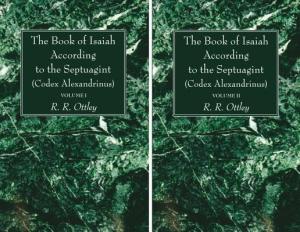
The text will be, as usual, from R.R. Ottley’s Book of Isaiah According to the Septuagint(pictured above). Ottley is here in Logos (reviewed here) and here as a free, downloadable pdf in the public domain. The full reading plan for our group is here (pdf).
See here for more resources and links to texts for Greek Isaiah.
And now a video review of a solid and versatile iOS app for learning Greek vocabulary. You can adjust the video setting in the bottom right part of the video below to watch in HD and full screen, if you like.
Thanks to Danny Zacharias for the app, given to me for the purposes of a review. Find out more about FlαshGrεεk here.
UPDATE: I made the video above using the handy Reflector app. Reflector mirrors your iOS device to a computer, from which you can record. (I added the audio later.)
We are getting close to the end of Greek Isaiah in a Year. This week and next week cover Isaiah 55:7-Isaiah 58:9.
Below is the text from R.R. Ottley’s Book of Isaiah According to the Septuagint. Ottley is also here in Logos (reviewed here) and here as a free, downloadable pdf in the public domain. The full reading plan for our group is here (pdf).
See here for more resources and links to texts for Greek Isaiah.
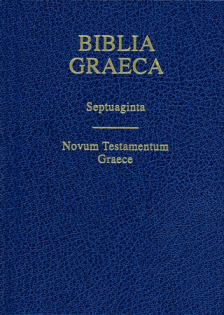
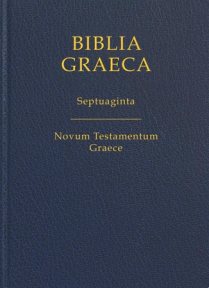
Look at that! It’s an all-Greek Bible. Just like the one Jesus carried around! Okay, not quite, but it is very good to see the Greek Septuagint and the Greek New Testament together under one cover. Augustine would be pleased:
For Greek aficionados—a 2-in-1 resource that’s designed specifically for extensive research, textual criticism, and other academic endeavors. Featuring both the Rahlfs-Hanhart Septuagint (Greek translation of the Hebrew Old Testament) and the 28th edition of the Nestle-Aland Novum Testamentum Graece, this user-friendly tool includes critical apparatus, cross-references, and more. 3216 pages, hardcover from German Bible Society.
What It Looks Like
It’s a mere three pounds (in weight, not price). Amazon lists its dimensions as 7.5 x 5.7 x 2.8 inches.
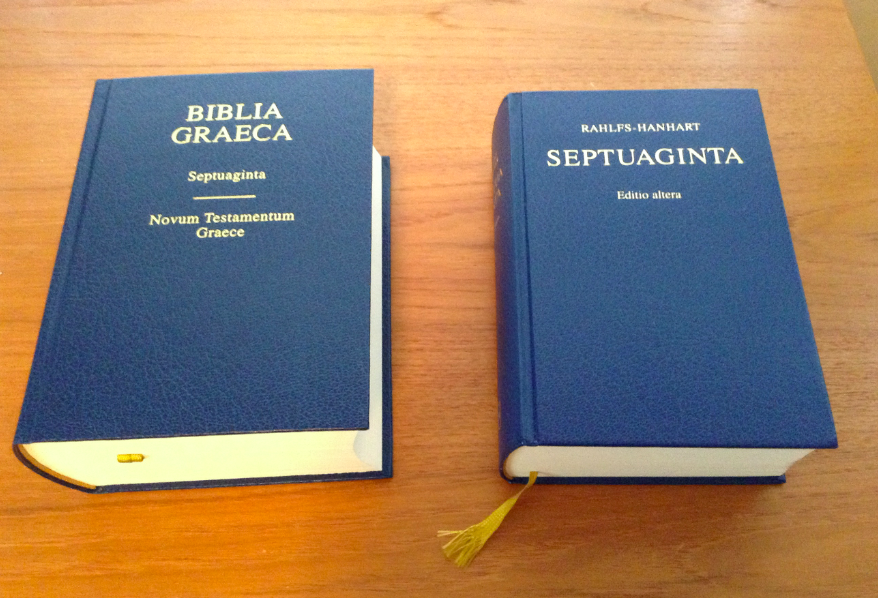
This impressive edition is two previously published Greek texts put together in one cover. It’s obviously thicker than the Septuagint alone, and just a little bigger in length and width. Here are the two side by side: the Septuagint alone on the right, and its “upgrade” version (with GNT) on the left:
v. 1.0 (at right) and v. 2.0 (at left)
Before receiving the volume, I was concerned that its 3,000+ pages would defeat Alfred Rahlfs’s initial intention to have a Handausgabe (i.e., a manual and portable edition). Indeed, Hanhart’s “Introductory Remarks to the Revised Edition” translate Handausgabe as “pocket-edition,” which this is decidedly not. (It would fit nicely in a purse or man-purse, though.) That said, the addition of the Greek New Testament really does not add a lot of bulk, as Rahlfs-Hanhart was already more than 2,000 pages. Biblia Graeca is still a (fairly) portable edition, though, if not literally pocket-sized. The sewn binding and hard cover appear that they will hold up under regular use. Here are v. 1.0 (LXX only) and v. 2.0 (LXX+GNT) stacked on top of each other:
You can barely make it out from the above photo, but the LXX/GNT combo comes (wisely) with two ribbon markers. Was it a coincidence that mine were both placed at the beginning of Odes? I think not.
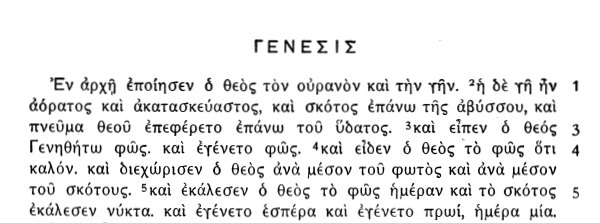
The Greek Typesetting/Font
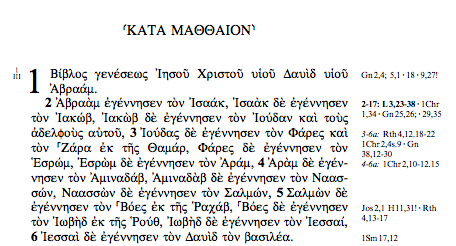
Rahlfs has not been re-typeset, so its Greek font is not as crisp or readable as that of the New Testament portion. Compare:
Genesis 1:1-5, from publisher’s pdf sample
Here now is the Greek in the New Testament portion, which is clear and crisp:
Matthew 1:1-6, from publisher’s pdf sample
After reading enough Septuagint, one does get used to the Rahlfs font. It’s not too bad.
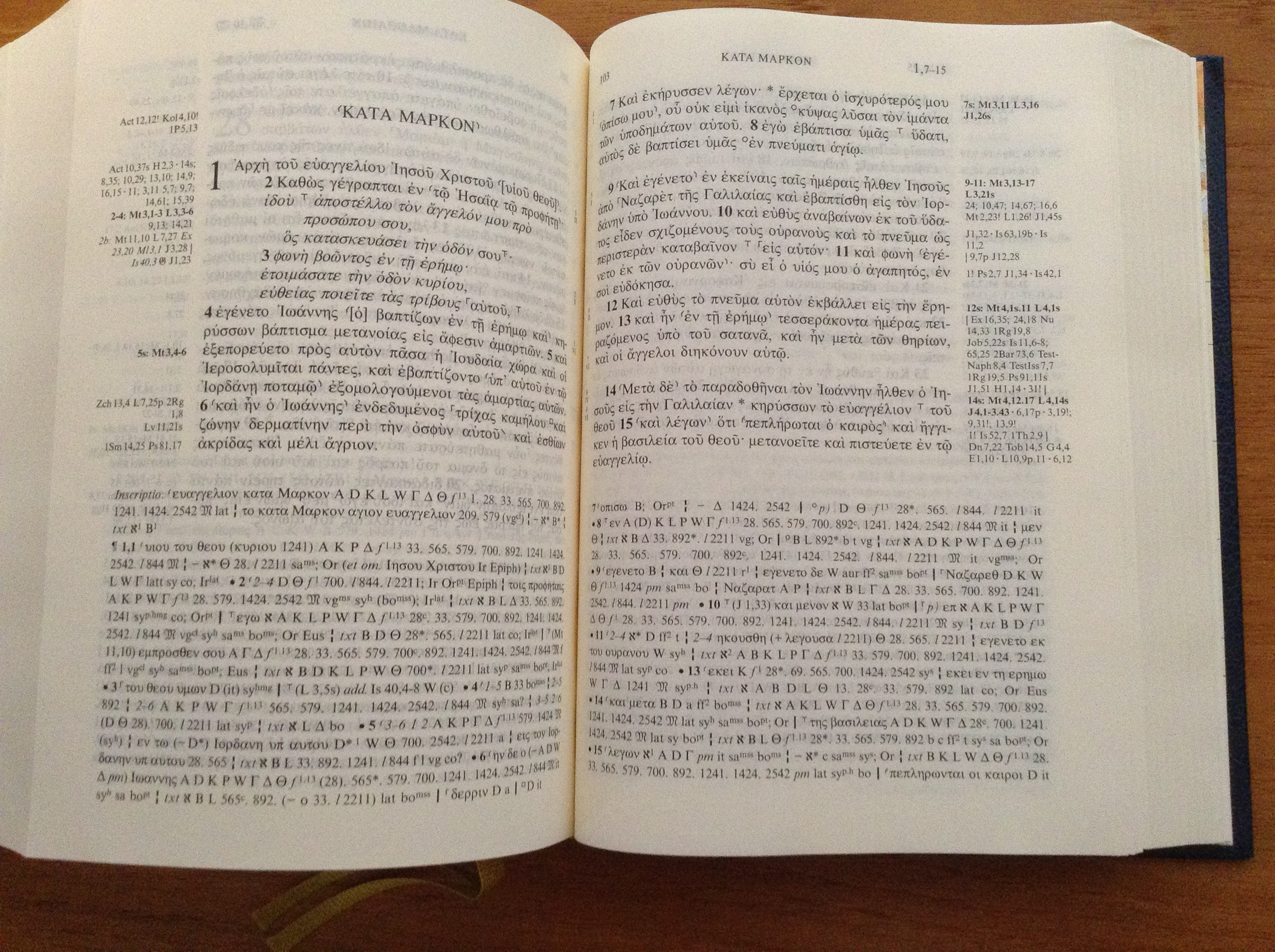
Always a concern with Bibles this big is that the requisite thin pages will mean bleed-through of text from the reverse side. This is noticeable to a degree here, but not in a way that negatively affects reading:
Mark 1
Rahlfs-Hanhart (Septuaginta)
The Rahlfs-Hanhart edition is not the go-to for extensive text-critical research that the Göttingen editions are, where they are present (on which, see my posts here and here on using Göttingen). Rahlfs is still useful, though, because it contains an entire Septuagint text, whereas Göttingen (published as individual volumes) does not.
It is probably the best starting place for readers of the Septuagint, even with its deliberately more limited apparatus. It is best thought of as a “semi-critical edition,” as noted here. Rahlfs “reconstructs” the text using, primarily, Codex Vaticanus (B), Codex Sinaiticus (S or א), and Codex Alexandrinus (A), a methodology that the revisor, Robert Hanhart, honors. Here is the apparatus for the first page, covering Genesis 1:1-14. This is a funny case, because of how much of Genesis is missing in B, so Genesis 1-46:28 up through the Greek word ηρωων is just based on A here. The rest (from πολιν in 46:28 to the end, chapter 50) take into account B and A.
Preceding the actual text and apparatus are Hanhart’s 2005 “Introductory Remarks to the Revised Edition” in German, English, and Greek. Then in German, English, Latin, and Greek follow three more sections: (1) Rahlfs’s “Editor’s Preface,” (2) an illuminating 10-page essay, “History of the Septuagint Text”, and (3) Explanation of Symbols. Everything you need to get started reading the Septuagint (minus the Greek lessons) is here.
The long-awaited 28th edition of the Novum Testamentum Graece has now been published. Once again the editors thoroughly examined the critical apparatus and they introduced more than 30 textual changes in the Catholic Letters, reflecting recent comprehensive collations. With the intent to make this book more user-friendly, the editors also revised the introductions and provided more explanations in English. This concise edition of the Greek New Testament, which has now grown to 1,000 pages, will continue to play a leading role in academic teaching and scholarly exegesis.
The NA28 has its own snazzy site here. (What a day we live in, when a Greek Bible gets its own Website! Its writers would be amazed.) Recent text-critical work on the New Testament has led to revisions in the Catholic Letters, but not elsewhere. So the Gospels and Pauline epistles, for example, retain the same text as the NA27. However, there are changes that affect the whole edition, as the publisher points out:
Newly discovered Papyri listed
Distinction between consistently cited witnesses of the first and second order abandoned
Apparatus notes systematically checked
Imprecise notes abandoned
Previously concatenated notes now cited separately
Inserted Latin texts reduced and translated
References thoroughly revised
As for the textual differences themselves, those are explained and listed here. There are more details to be digested about the new NA28 edition. I can do no better than to refer you to the writings/reviews of Larry Hurtado, Rick Brannan, Daniel Wallace, and Peter Williams.
All the quick-reference inserts you need to make sense of symbols and abbreviations are included:
Concluding Thoughts: Sell All You Have?
The product page for the beautiful Biblia Graeca is here for CBD, here at the German Bible Society, here at Hendrickson, and here for Amazon. And, best yet, you can look at a sample of the book here. If it’s just the text (and not the apparatuses) that you’re interested in, you can read the NA28 online here and the Rahlfs-Hanhart Septuagint here.
Rahlfs wrote in his preface that he sought to “provide ministers and students with a reliable edition of the Septuagint at a moderate price.” If you click the links above, you will see that this is not “a moderate price.” It’s significantly cheaper to buy the same critical editions of each Testament under separate cover.
But there are at least two major advantages to putting them together. First, when the New Testament writers quoted Scripture, they predominantly did so in a form that is closer to what we have now in a Septuagint text. Comparing a quotation (in Greek) with its source (in Greek) is facilitated by this edition. Second, that this edition exists is an important symbolic statement. Lovers of the Septuagint are fond of affirming that it was the Bible of the early Church. If that is so, why can we not have one, too? Now we can, printed and bound in a way that would shock the pre-printing press world that first heard all these Scriptures together when gathered for worship.
Professor Ferdinand Hitzig has often been quoted saying, “Gentlemen!” (and today, he would say, “Ladies!” too) “Have you a Septuagint? If not, sell all you have, and buy a Septuagint.”
In true biblical storytelling fashion, he is using hyperbole to communicate his point. But for those who are so inclined and able, if selling a few things to get a Septuagint is a good idea, how much more might someone like Hitzig encourage them to sell a few things for the Biblia Graeca?
Christians believe that the Septuagint has come to full fruition through the New Testament.
So it only makes sense to be binding the two together.
Many thanks to Hendrickson for the privilege of reviewing this fine work. A copy came my way for review, but with no expectation as to the nature of my review, except that it be honest.

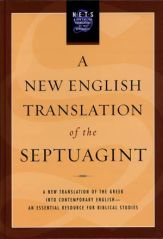 J.K. Gayle considers the question of whether the Septuagint translator of the Hebrew Song of Songs might have been a woman, then raises some challenges inherent to that view, at least as it is presented by the NETS (see image at left). J.K. also offered insight into the possible motherliness of God and the patriarch Joseph. Suzanne responded here, preferring to talk about “wombly feelings” instead of “motherly” ones. Kurk writes back again, noting some “maternal” language (with help from Greek Isaiah) in the “Our Father.”









 Words on the Word