Hipster Septuagintalist

The Septuagint has become cool–or at least a bit hip.

–Ben Wright in “The Septuagint and Its Modern Translators,” from Die Septuaginta—Texte, Kontexte, Lebenswelten

(quoted in Wolfgang Kraus’s excellent review of the New English Translation of the Septuagint)

I’m not sure that a Septuagintalist (yet another word you can use when you study the Septuagint!) is necessarily the best judge of what’s cool or hip… but I’m going to concur with Wright. As yet another LXX post on Words on the Word is attesting (Happy Septuagint Sunday!), the Translation of the Seventy is at least becoming very hip with me. Also, with this guy:

Greek Vocabulary Guide: Another Book Giveaway by Zondervan

Head over to Koinonia, Zondervan Academic’s blog, for another Wednesday giveaway. Now they are giving away Complete Vocabulary Guide to the Greek New Testament. Details are here.

Koinonia is accepting submissions until Thursday midnight.

The book is available on Amazon here.

BibleWorks and the Septuagint

I recently blogged on why you need the Septuagint. And here are some great resources to begin and further pursue Septuagint study.

One indispensable resource for Septuagint study that I use almost daily is the computer program BibleWorks. I have not yet made the upgrade from version 8 to version 9, but much if not all of what I have to say here will still be applicable to users of version 9 (and 7, for that matter).

Here is what my BibleWorks looks like for 1 Maccabees (click or open in a new tab to view larger):

The following features help me navigate my way through the Septuagint:

  • A nice, big Browse Window (middle column in the top window) so that I can see the whole Greek verse easily at once, with English translations below. Both the LXA (Brenton’s Septuagint with Apocrypha, in English) and the NRS (NRSV, which includes the Apocrypha) are part of BibleWorks.
  • A stand-alone Word Analysis Window (bottom right of the screen) so I can better use my other columns. I set the default lexicon to LEH (Lust/Eynikel/Hauspie’s Greek-English Lexicon of the Septuagint, Revised Edition).
    Not only is this a fantastic Septuagint-specific lexicon; it also includes word frequency counts. What I particularly like about this is that I can use the Stats window (in the Analysis Window, the right column in the top window) to find out how many times a word appears in the whole Greek Bible (LXX+New Testament). Then using the LEH frequency counts, I can get a quick number on how many times a word is used in the LXX and the NT. This is helpful if I see an LXX word that occurs 200+ times, have never heard of it, and then see it only appears 10 times in the NT.
  • The Resource Summary Window (bottom left of the screen). Here I can access Conybeare’s Grammar of Septuagint Greek, which comes with BibleWorks and is hyperlinked both by part of speech and Scripture index. Another nice feature is that I can pull up BibleWorks paradigms quickly for a given part of speech–a helpful grammatical refresher! The IVP Dictionary of Jesus and the Gospels in that window is an add-on from WordSearch, but their IVP Dictionary package has a bunch of great Septuagint articles.
  • Note: There is no punctuation in the BibleWorks Septuagint text. This is not a display error; it’s just how it is. There are accents and breathing marks, though. And, the way I see it, even if Rahlfs in print has punctuation, the original manuscripts did not, so no huge loss.
  • I hesitate to write too much more about the Analysis window (right column in the top window), because BibleWorks 9 has significantly changed (=improved) the layout. In fact, there are now four columns, as seen here. However, for anyone using 8 or less, the above configuration allows you to work with the LXX profitably. For BibleWorks 9, I’m sure you could use the above layout as is (BW9 lets you use just three columns if you want, I believe) or make whatever modifications you wanted in BW9.

1 Maccabees has no existing Hebrew text. The scholars I’ve read on it all think that the Greek of 1 Maccabees has the flavor of translation Greek, and so translated a Hebrew original. But we don’t have it. (BibleWorks is powerful, but not quite that powerful!)

How I use the LXX when there is a corresponding Hebrew text (e.g., when I’m reading Micah) looks a little different. For example, in addition to the above, I’ll have the Hebrew text and English translation displayed. BibleWorks has the amazing Tov-Polak Parallel Hebrew/LXX Database, too, that comes with the base package.

BibleWorks allows me to read through the Septuagint in Greek with English translations displayed underneath. (I can also hide them–that’s what my “No Eng.” tab is in the left column of the top window.) It gives me instant word analysis (its parsing and then word definition and frequency count through LEH). I get grammatical helps from Conybeare and BibleWorks paradigms. I can search on a word to see how it’s used throughout the Septuagint and/or New Testament (note the highlighted word above). And with the IVP add-ons, I get historical background, too.

Using BibleWorks is a fabulous way to read through the Septuagint. I feel very blessed to have access to such a tool as this.

And I know there is much more BibleWorks can do. Fellow BibleWorks users and lovers of the Septuagint, how do you use BibleWorks for LXX success?

Septuagint Sunday is a regular feature of Words on the Word. All my LXX posts are here. The full contents of BibleWorks (now in version 9) are listed here. You can buy the program here or here.

Free Book! Ephesians commentary by Arnold (Zondervan)

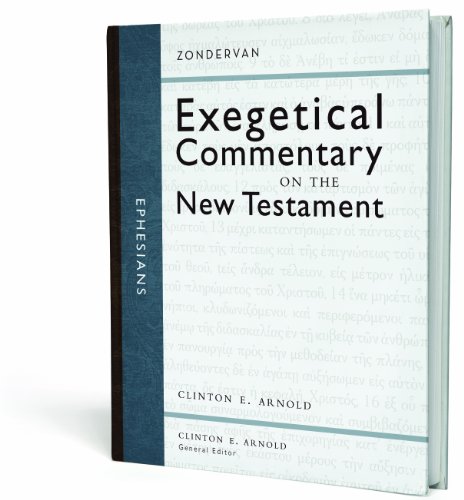
I am giving away a book at Words on the Word this weekend. It’s a commentary on Ephesians by Clinton E. Arnold, from Zondervan’s Exegetical Commentary on the New Testament series.

Last weekend I reviewed Luke from that same series. You can read that review to find out more about the structure and layout of each book in the series. Anyone who is preaching, teaching, or just studying their own way through Ephesians will find this book illuminating. Those who know even a little Greek will benefit most from this book, but Arnold translates everything, so those who know no Greek will benefit, too.

I will choose a winner at random. To enter the drawing, comment on this blog post with your answer to the question, “If you had a chance to sit down for a cup of coffee or tea with the apostle Paul today, what is the first thing you would ask him?” (I know what I would ask!)

Then if you link to this post on your Facebook, Twitter, blog, etc., come back here to tell me in the comments section that you did, and you’ll receive a second entry. I will announce the winner on the blog first thing Monday morning.

If you want to skip the giveaway contest and just buy the book for yourself, you can find it here.

All you need is your Septuagint and this (LXX+ALS=Septuagint Success)

I wrote a few days ago about why you need the Septuagint. I noted:

For students of Greek, the LXX is a good way to challenge oneself in Greek beyond the New Testament. There is a fuller and deeper vocabulary in the Septuagint that helps Greek students grow in their knowledge of the language.

While this is true, the challenging nature of Septuagint vocabulary is also one reason why even students of New Testament Greek stay away from the Septuagint. How can one make her or his way through the Septuagint in Greek in a way that is not entirely frustrating?

I’ve listed some helpful Septuagint resources here, including vocabulary helps. But what if someone just wants to read through the Septuagint in Greek, unencumbered by multiple resources at hand? One thing I value is not having to use four or five additional reference works to understand the first reference work.

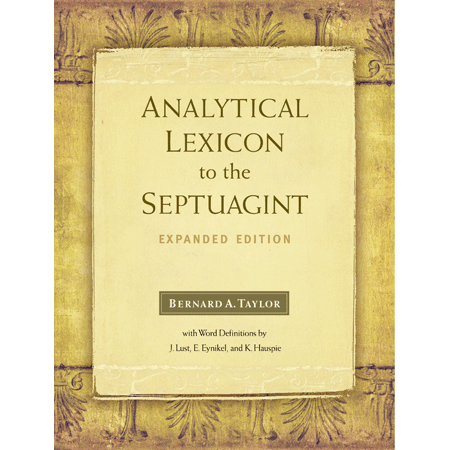
Enter Bernard A. Taylor’s Analytical Lexicon to the Septuagint: Expanded Edition (Hendrickson, 2009).

Taylor lists every single word found in Rahlfs Septuagint, the standard LXX text, as it appears (inflected) in the text. Each word then has full parsing information and the basic word meaning taken from Lust, Eynikel, and Hauspie’s Greek-English Lexicon of the Septuagint [GELS].

This means that the user of this expanded edition (ALS, hereafter) does not need an additional lexicon at hand to get basic word meanings. To be sure, Taylor notes:

The abridged GELS entries in this volume include only the basic word definitions, not the contextual meanings found in the subsequent paragraphs of many of that work’s entries. The word definitions included are glosses, or translation equivalents, rather than [full] descriptions of each word’s meaning.

If you’re looking to read the Septuagint and do word studies, you’ll need an additional resource. But if you need only the basic meaning (what most people want who are reading straight through), Taylor’s lexicon covers all your needs. (And he certainly doesn’t claim that the glosses in his ALS are anything more than that, glosses.) You get full parsing information, which then refers you to the lexical form of the word, which then has the basic word meaning from GELS. Especially helpful is the inclusion of proper nouns, so that there is really no word in the LXX that is left untouched by this lexicon.

ALS is intuitive, well-laid out, and easy to use. The Greek font is clear and big enough to read easily. The lexical forms of words (i.e., where the basic word definitions are) are in bold for easy reference. The book is not very heavy (two pounds), so it travels well. More than 20 pages of introductory material clearly and concisely explain the features of the lexicon, abbreviations, suggestions for use, and overview notes on various parts of speech, transliterations, and so on. The introductory materials are instructive and easy to read, yet ALS presents its information so well that its user can easily put it to work right away.

It’s tempting to debate the merits of a work like this in print, when all that Taylor offers (and more) can be had in electronic Bible programs like BibleWorks. However, to do that would not be to review this lexicon in its own right. Of course an electronic database (that can parse and provide lexical meanings of words) is faster to use, but a print copy is easier on the eyes, you don’t have to wait for it to boot up, etc. That’s all beside the point, though. The important thing about Taylor’s expanded edition is that it has morphological and lexical analysis, so it functions as an all-in-one supplement to guide the reader through the Greek of the Septuagint.

Analytical Lexicon to the Septuagint: Expanded Edition is now on my bookshelf right next to my Rahlfs Septuagint. It’s hard to imagine a more useful Septuagint resource than Taylor’s.

I thank Hendrickson Publishers for the review copy of this book, which was provided to me free of charge in exchange for an unbiased review. Taylor’s lexicon is available here.

Why you need the Septuagint

I recently had somebody ask me, in so many words, why the Septuagint?  Why bother with the Greek Septuagint when we have the Old Testament in Hebrew, in which it was first written? English translations of the Bible in most churches use the Hebrew text as a base, anyway.

Before giving my top 10 reasons why, here are a couple ways to access the Septuagint (often abbreviated LXX after the tradition of the 70(+2) who were said to have translated it). This site has the whole Septuagint in Greek with an English translation. And here‘s a good, up-to-date English translation of the whole thing. (For hard copies, the standard Greek text is the Rahlfs Septuagint, and a recent English translation is the NETS.)

Here are 10 good reasons to pay attention to the Septuagint:

10. It helps us read Scripture in new, fresh ways.

9. You get to use fun words like Septuagint, intertextuality, and urtext.

8. It’s the Bible the New Testament writers used and quoted. (See here for more about this.)

7. For students of Greek, the LXX is a good way to challenge oneself in Greek beyond the New Testament. There is a fuller and deeper vocabulary in the Septuagint that helps Greek students grow in their knowledge of the language.

6. The Septuagint was translated from a set of Hebrew texts that are centuries earlier than the Hebrew text underlying most English Old Testaments. This helps us get closer to the “original” text.

5. There are books that, while additional to the Protestant canon, still shed light on life. (I’m looking at you, Wisdom of Solomon!)

4. The Odes. This is a collection of texts appended to the end of the Psalms. It compiles some beautiful prayers found in the Old Testament (and apocryphal books). A few of these are in the Book of Common Prayer’s Morning Prayer canticles.

3. It connects us to the broad sweep of history in the Church. This was not only the Bible of the New Testament writers; it was the Bible of the Greek-speaking early church.

2. Books like 1 Maccabees, especially, fill out the intertestamental gap between Malachi and Matthew. I’ve been working my way through 1 Maccabees lately, and it’s really helping me better understand Jewish expectation of a conquering Messiah who would expel oppressive Roman rule.

1. Jesus used it. I’m intrigued by this, and want to explore it more. [UPDATE: This is a complex issue, especially since Jesus spoke Aramaic and knew and used the Hebrew Bible. I am reading this now.] But it does seem to me that his use of the Septuagint constitutes at least an implicit endorsement of it. If it was good enough for Jesus….
        [UPDATE 2: Perhaps it’s more accurate to say that the Gospel writers quote Jesus sometimes using a Septuagint text that differs from the Hebrew/proto-Masoretic Text. Many say this means only that the Gospel writers–not Jesus himself–used the Septuagint. Did Jesus himself not “use” the Septuagint, then? I will research this more and blog about it at a future date.]

More on Junia

Thanks to a blog I’ve just discovered, I keep learning more about Junia.

Here‘s a post about Junia in some ancient manuscripts of Romans. And here is a post about another Junia in ancient Corinth.

Actually, the blog (BLT) has a ton of stuff about Junia, including a multi-post series called “The Junia Evidence.” Check out more here.

Luke (Zondervan ECNT), reviewed

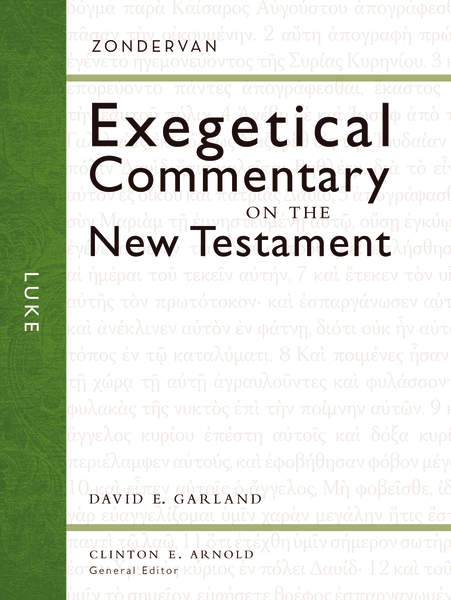
The last few weeks I’ve been spending time with David Garland’s Luke volume in Zondervan’s Exegetical Commentary on the New Testament (ZECNT) series.

Garland’s commentary is more than 1,000 pages, but this should not be a surprise, since Luke is the longest Gospel. Like the rest of the ZECNT series, it is “designed for the pastor and Bible teacher.” Garland assumes a basic knowledge of Greek, but Greek is not required to understand his commentary. For each passage the commentary gives the broader literary context, the main idea (great for preachers!), an original translation of the Greek and its graphical layout, the structure, an outline, explanation, and “theology in application” section.

The graphical layout of each passage is a unique contribution that Garland’s Luke makes to Luke studies. Even though a narrative book like Luke is easier to follow than some of Paul’s detailed arguments, seeing main clauses in bold with subordinate clauses indented under them (plus how they relate back to the main clause) gives the reader a quick, visual grasp of the entire passage at hand. Garland does this well, too. Pages 50 and 62-63 of the commentary in this sample pdf give you a taste.

Luke has the full Greek text of Luke, verse by verse, and full English translation by Garland (passage by passage in the graphical layout, then again verse by verse next to the Greek). A value for me in using reference works is not having to pull five more reference works off the shelf to use the first reference work! This is about as portable as exegesis of Luke gets. Garland’s English translation is a bit wooden at times–just about every καὶ in the opening narrative of 1:5-25 receives the translation “and,” which it shouldn’t always. ὁ δὲ ἀποκριθεὶς εἶπεν in 10:27 becomes “He answered and said,” where just “He said,” would be preferred.

Garland’s intro is short, but covers what it needs to. He attributes authorship to Luke and holds to Luke-Acts unity, as many scholars do. (“[Luke] is writing not simply about the life of Jesus but what Jesus inaugurated that continued in the deeds of his followers (Acts 1:1-8)” (27).) He understands Luke-Acts as fitting into the genre of “Hellenistic historiography.” He treats Luke’s potential sources, date of writing, readers, location, purpose, and structural outline. There is an additional “theology of Luke” section at the back of the commentary that complements the introduction. It doesn’t cover all the theological themes in Luke (healing/exorcism, for example, is absent), but it doesn’t claim to, either.

Where Garland really shines in this commentary is in his treatment of the Greek words and phrases that comprise the Luke text. He attends to the lexical meaning of given words, how they function in context, and their use in other parts of Scripture. This is helpful especially for parts of Luke where the Greek vocabulary is more obscure or difficult.

Teachers and preachers especially will appreciate the “Theology in Application” section that concludes each passage. To the pastor wondering how to preach on something like Luke’s prologue, Garland writes:

The purpose of the gospel is not to give information but certainty that will change lives. Erudition about Jesus is not the same as insight into Jesus. The history of Jesus is not to be divorced from the proclamation about Jesus, as if the two were somehow incompatible. (58)

This comes after a detailed exegesis of the first four verses. As someone with preaching experience, I can say this combination of thorough attention to the Greek text with contemporary application is pure gold.

Inevitably no commentary can say everything about every word in the text, but there are parts of Luke that I thought deserved more attention. For example, in Luke 8:31 the demons known as Legion beg Jesus not to cast them into the Abyss (Greek ἄβυσσος). Garland just offers, “The Abyss is the place of punishment for evil spirits” (358). Although he infers that this verse shows the “eschatological dimension” to exorcisms, nothing more is given about ἄβυσσος. For a word that appears just once in the Gospels yet multiple times in the Old Testament and Apocrypha, more background on this term would have been useful to the reader. This could, of course, merely reflect a space limitation in the commentary.

On the other hand, Garland’s commentary on the Good Samaritan parable (“merciful” as Garland has it) leaves out just about nothing. To provide needed historical context to the passage, Garland draws on what Josephus said about priests, what Sirach said about helping those in need, and includes an excursus on the “adversarial history” of Jews and Samaritans. Garland compellingly concludes from the parable:

The original Jewish audience must enter the ditch and accept a Samaritan as a savior, helper, and healer. They must experience being touched by this unclean enemy who treats a wounded man as a compatriot. (446)

Garland seeks to prove right the series claim that “all who strive to understand and teach the New Testament will find these books beneficial,” and he succeeds in this. Preachers or students of Luke will want to supplement Garland’s work with other works on Luke (Bock’s two volume set remains the standard), but the graphical layout of each passage and the theology in application sections alone are enough to warrant careful consideration of this volume.

(I am grateful to Zondervan for the free review copy of this commentary, which was offered to me in exchange for an unbiased review. You can find the book on Amazon here.)

UPDATE: Enter to win a free book giveaway of Ephesians from this same series.

Leaving it all on the field

I took a Septuagint test today. It was about Micah generally, the passage where Micah and Isaiah have basically the same text, the verse in Matthew that quotes Micah, and a verse in Joel that on first glance seems to say the opposite of a verse in Micah. I was asked to explain these things and do a bunch of translating.

This is how I felt before, during and after the test:

Yes, I’m a nerd, but the Septuagint really is awesome. I hope in future posts (perhaps on Septuagint Sundays) to share more about what I’ve been learning in my Septuagint directed study.