The Verse Tab: Review of BibleWorks 9, part 2

I continue to be impressed with BibleWorks 9. The new Use Tab is likely my favorite new feature (I posted about it in part 1 of my review). The Verse Tab is another new feature. Here’s how the BibleWorks site describes it:

The Verse Tab tracks with any Bible version. For the current verse under the mouse, it displays the relevant sections in resources such as the CNTTS apparatus, the NET Bible textual notes, the Tischendorf apparatus, Metzger’s Textual Commentary (requires unlock), and the ESV Study Bible (requires unlock).

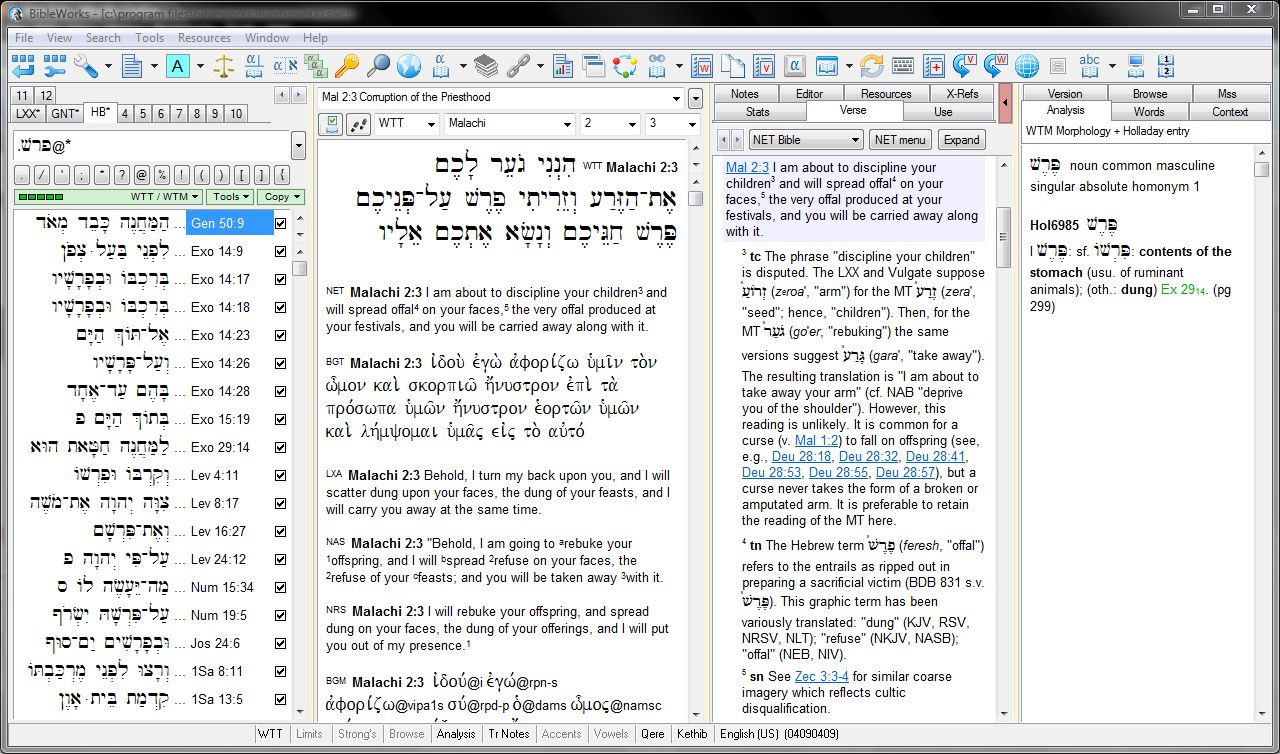
I will devote a future post to the CNTTS apparatus. Today I want to comment on and review the Verse Tab and its usefulness. Just so you can have a visual of what I’m working with, here’s a layout I’m currently using to look at the Hebrew of Malachi. (Click on the image below for larger.)

(Editorial note. File this under: can you believe that’s in the Bible? I had somehow never noticed this verse until the other day… thou shalt not trifle with the Lord, especially if you’re a priest or pastor. Take obedience to God seriously.)

Here’s the great thing about the Verse Tab. In previous versions of BibleWorks, the NET Bible study notes were only available via the Analysis Window. But this meant that if the Analysis Window were open to an NET study note, you couldn’t also at the same time easily see morphological analysis and lexical data–it was one or the other in that window. Now, however, as you can see above, you can easily access both study notes and a separate analysis window for individual word analysis. I find this new feature an immense help.

The NET study notes are fantastic. (It’s worth reading more about that translation and its notes here.) Honestly, a verse like the one I’ve chosen to highlight above might be a bit jarring to some–although in context it makes perfect sense. Yahweh was dealing with a corrupt and complacent priesthood. They were not making sacrifices in the way he had commanded (and they knew it, too). So his response in context really ought not to be a surprise. The NET note (see superscript number 4 and “tn” in the image above) clarifies that Yahweh is speaking of the entrails of to-be-sacrificed animals. The priests were supposed to dispose of these away from the sacrificial altar, but apparently were not in Malachi’s time. Bad idea. Clicking on Lev. 4:11 in the BibleWorks Search column (far left column) immediately takes me to the verse that explains this requirement.

One other neat thing about the Verse Tab: if you click on the “Expand” button, you can get a free-floating window that shows you all the NET notes for the whole Bible. This is easy to navigate through, as you can imagine:

I welcome the Verse Tab as an addition to the BibleWorks program. I’ve already made heavy use of it and will continue to in the future. For a mere $20 you can buy a module that gives you the notes and maps from the ESV Study Bible in that same tab. The program comes with the NET Bible notes already loaded.

See all that’s new in BibleWorks 9 here.

I received a free upgrade to BibleWorks 9 in exchange for an unbiased review. See my prolegomenon to a review here and part 1 (setup and layout) here. You can order the full program here or upgrade here. It’s on Amazon, too.

What language did Jesus speak?

In my top 10 reasons why you need the Septuagint I conclude with the #1 reason being that the Gospel writers record Jesus’ words as occasionally matching the Old Greek of the Hebrew Bible against the Hebrew. This has become a new research interest of mine, and there is no lack of scholarly opinion on the issue! It’s hard to tell if there’s scholarly consensus. The conventional wisdom seems to be that Jesus spoke Aramaic and read from and recited Hebrew scrolls, but that’s certainly not a universal view, from what I can tell. For example, Stanley E. Porter suggests:

… Jesus not only had sufficient linguistic competence to converse with others in Greek but also even to teach in Greek during his ministry. 

I believe that, first, it can be firmly established that Jesus did speak Greek and that we do indeed have some of his actual words. 

Porter explores the question “Did Jesus Ever Teach in Greek?” here (pdf). Thanks to the LXX Yahoo! group for the link.

Septuagint Sunday: I Heart Maccabees


I’d give away half a bookshelf worth of books to see Mark Wahlberg or Matt Damon star in a film adaptation of 1 Maccabees. Judas Maccabeus (“Hammer” will be his nom de film) and his Hasmonean family drive out imperial powers and call the Jewish people back to faithful observance of the Torah. They do it with great violence, against all odds. (This would be an action movie, and not for small children.)

Here’s how Jonathan A. Goldstein, in his 1 Maccabees Anchor Bible commentary, begins his introduction. Try to call to mind that deep male voice that does movie trailer voice-overs:

The faithful Israelite living in Judaea under the rule of the Ptolemies and the Seleucids in the third and second centuries B.C.E. learned from childhood that the LORD’s chosen people had nothing to fear if they kept the LORD’s commandments. Subjection to the great empires of Persia and the Hellenistic kings had brought stability and security over long periods, which in part compensated for galling exploitation and servitude and for episodes of devastating warfare. Then, under the Seleucid Antiochus IV from 167 to 164 B.C.E., obedience to the LORD’s commandments became a crime punished with extreme severity. No harsher trial ever tested the monotheistic faith of the Jews.

[Cue music swell.] Goldstein/our movie trailer goes on:

The outcome was entirely unexpected: the desperate resistance of the Jews prevailed, and for a time the “yoke of foreign empires” was lifted from the Jews as they became independent under the Hasmonaean dynasty. After the centuries of heartbreaking delay, were the glorious predictions of the prophets of a mighty restored Israel being fulfilled?

That’s got to be good watching, folks. It’s certainly making for great reading! (I’m focusing on the first four chapters for a directed study for one of my seminary classes.) Here is a “Quick and Dirty Summary” of 1 Maccabees from Gordon College professor Ted Hildebrandt.

As I wrote in an earlier post about the Septuagint:

Books like 1 Maccabees, especially, fill out the intertestamental gap between Malachi and Matthew. I’ve been working my way through 1 Maccabees lately, and it’s really helping me better understand Jewish expectation of a conquering Messiah who would expel oppressive Roman rule.

Good book. Would make an awesome movie. The Maccabean Identity? Or, perhaps, simply: I Heart Maccabees.

BibleWorks out of the box: Review of BibleWorks 9, part 1 (setup and layout)

The perennial question: Should I upgrade my BibleWorks program? I was perfectly happy with BibleWorks 7 until I upgraded to 8. (Then I was really happy with 8.) I thought 8 was such a vast improvement that when 9 came out, I saw no need… at least until I got to know version 9 a little better. Versions 7 or 8 are certainly still powerful in their own right, but my upgrade to 9 has been a great experience so far. In this and future posts, I’ll highlight why. Today: BibleWorks 9, out of the box.

The installation is easy and quick. I consider myself somewhat proficient when it comes to computer know-how, but certainly don’t have programming expertise. No matter. BibleWorks is easy to install and keep updated. And the BibleWorks staff is constant in making updates available if and as they find bugs in the program. Better than any other computer software I’ve used, in this sense.

BibleWorks 9 comes with a “Quick-Start Guide,” which has the Installation Instructions (they are mercifully short–three pages and easy to follow) and a 12-page Orientation to BibleWorks guide. The guide focuses on the Search Window, the Browse Window, and the Analysis Window, and gives instructions and specific examples as to how to best utilize each in studying the Biblical text. My only quibble with the helpful guide is that the images contained therein seem to be from BibleWorks 8, not 9. But that doesn’t really keep it from doing what it needs to, namely, quickly and effectively orienting the new or only somewhat experienced user to using the program well. (The instructions do detail the contents of the new tabs in version 9.)

BibleWorks 9 adds a delicious fourth column (essentially, a second analysis window). It looks like this (click on the png below for a larger view, if you wish):

Already this opens more options. There are also more available tabs in the Analysis Window. For example, the new “Use” tab, in my third column above, instantaneously shows you all the uses of a word with how many occurrences it has in that book and version (here, the WTT=Hebrew Bible). You had to search on a word in previous versions to do this (using the first column above). I find this particularly useful for vocabulary acquisition. As I come across a word I don’t know in the text, I can easily see–does this occur 121 times and I should know it? Or is it just in the text two or three times, so I was okay in not knowing right away what it means?

The “Verse” tab and the “Mss” tabs are new, too–those are worthy of their own post. (Anyone familiar with BibleWorks, whether they have 9 or not, may already know that this new version allows you to look at and work with images of original manuscripts.)

And, what I find best of all, you can drag and drop the tabs between the third and fourth columns so that you can customize your setup. I had already figured out a setup so that I had my own equivalent of a “fourth column” in BibleWorks 8. Now I can do even more! Check this out (from a previous post):

It’s a thing of beauty.

BibleWorks has unbeatable customer service. The user forums are active and always helpful. (Good things to know when you’re considering getting set up with them.) And they’ve provided quite a few videos to show users their way around the program. If you don’t want to wait for the rest of my review, you can see all that’s new in BibleWorks 9 here. You can order the full program here or upgrade here. It’s even on Amazon!

I received a free upgrade to BibleWorks 9 in exchange for an unbiased review. See my prolegomenon to a review here.

William L. Lane free downloads on the Gospel of Mark

Here’s a link to a Mark teaching series that Dr. William L. Lane led at Christ Community Church in Franklin, TN in 1998. He’s the author of the commentary pictured at right, one of the best for the Gospel of Mark. (Click on the image to look inside the book at Amazon.) From the By/For site:

This Mark teaching series is led by Dr. William L. Lane, author of The Gospel According to Mark from the New International Commentary on the New Testament series. This series was the final time Dr. Lane lectured on Mark.

The study page includes a pdf file of class notes and 13 lectures by Dr. Lane. See it all here.

“Septuagint” is the wrong word to use


“Septuagint” is perhaps the wrong word to use to describe the Greek translation of the Hebrew Scriptures. Just about every author I’ve read so far on the Septuagint is quick to point this out. In the mail the other day I was happy to receive my review copy of Tessa Rajak’s Translation & Survival: The Greek Bible of the Ancient Jewish Diaspora (Oxford University Press, 2009). She puts it this way:

The term “Septuagint” does not appear in the title of this book, and that is no accident. It is in fact an inappropriate description for the Jewish Bible in Greek. The problem is that “Septuagint” is a term which evolved in the usage of the early Church and refers to the corpus created there as we find it in the great biblical codices of the fourth century CE. It is precisely these layers of reception that we shall need to strip away, at any rate until the last chapter of this book. But even were we to resolve to stick with the name, as one of convenience, we would soon find that the ambiguities and complications of its usage outweighed that convenience. (14-15)

Larry Hurtado recommends the book here. Keep checking back here–I’ll have a full review up some time next month.

Review of The Greek of the Septuagint: Supplemental Lexicon

This, then, is the single dominant characteristic of the LXX vocabulary: it is normal, idiomatic Greek. I base my construal of it on this hypothesis whenever I can.

–Gary Alan Chamberlain in The Greek of the Septuagint: A Supplemental Lexicon

Not long ago I noted that “the challenging nature of Septuagint vocabulary is … one reason why even students of New Testament Greek stay away from the Septuagint. How can one make her or his way through the Septuagint in Greek in a way that is not entirely frustrating?” To begin, you could read about why you need the Septuagint here, and some helpful resources here to get started. Also, I recently reviewed Bernard A. Taylor’s Analytical Lexicon to the Septuagint: Expanded Edition, a one-stop reference work to guide readers through the LXX.

I have now had the occasion (and privilege) to spend some time with The Greek of the Septuagint: A Supplemental Lexicon, by Gary Alan Chamberlain. (Thanks to Hendrickson for the review copy, provided in exchange for an unbiased review.)

Chamberlain intends his lexicon to be a supplemental one, an addition to any Greek New Testament lexicon. (He has BDAG specifically in view.) The vocabulary of the Septuagint is more expansive and potentially different enough from New Testament vocabulary that a lexicon like this is warranted. Many Greek students, especially Biblical studies ones, come to the LXX after first studying the New Testament. So if they already own BDAG or some other New Testament lexicon, the potential need for something like this to “fill in the gaps” could make sense.

The Greek of the Septuagint contains lexicon entries for 5,000 LXX words not in the NT, as well as 1,000 words with LXX-specific uses that a NT lexicon would not carry. For the latter, Chamberlain simply adds to the BDAG numbering system, so that the entry for καθίστημί, for example, begins, “3.b. seek to establish, declare.” Words that the lexicon does fully treat have morphological information (e.g., principal parts for verbs) and citations of word usage in the LXX and beyond.

There is “no treatment of the most common words” in the LXX, so not just a cursory knowledge but a solid grasp of Greek vocabulary would be needed to use this lexicon on its own. I.e., a first- or second-year Greek student really would have to use this as the “supplemental” lexicon it intends to be. “Throughout this work,” Chamberlain notes, “I have assumed that the user has sufficient command of ancient Greek to cope with articular infinitives, genitive absolutes, and the varied means of expressing volition and command. The thousand or so most common LXX words should convey relatively few difficulties.” This work won’t serve the Greek initiate, in other words, but Chamberlain does not intend for his work to be “elementary.”

One might ask, Why not just purchase a full-on Septuagint lexicon? Here is where Chamberlain makes the “distinctive contribution…to LXX studies” that he aims to make.

The dense 19-page introduction explains several classifications of LXX words, and is complemented by an exceedingly useful set of word lists in the appendices. (Hendrickson has the intro in pdf here.) Chamberlain includes word lists and discussion of:

  1. Precise parallels between the LXX and extrabiblical texts. This is where he asserts that LXX vocab is “normal, idiomatic Greek.” He accounts for what others have claimed are examples to the contrary (e.g., “Semitisms”) with the following categories.
  2. Transliterations of the Hebrew into Greek.
  3. Hapax Legomena–Greek words that occur once in the LXX and nowhere else in ancient Greek literature, as well as words that occur multiple times in the LXX but nowhere else (he notes all this and all these categories throughout the lexicon in the appropriate entries, a sample pdf of which is here).
  4. Greek words that occur first in the LXX.
  5. Words with no parallel in other ancient Greek sources.
  6. Stereotypical translations (“calques,” where “translators faced severe challenges in rendering a few common Hebrew terms for which no equivalent was possible within the framework of Greek language”).
  7. Mistranslations (where “LXX translators misconstrued the meaning of their sources’ words, through a confusion of roots or a misunderstanding of meaning of the source”).
  8. Textual variants (more than 200 instances, including his suggested emendations, helpfully organized in canonical order).
  9. More complicated words “involving multiple factors” (“We are simply trying to explain how a Greek word was placed in a context that does not make good sense if we read it as a Greek sentence”).

Having read the descriptions of each of these categories and looked through the corresponding word lists, this reader is convinced that The Greek of the Septuagint offers something that neither BDAG nor any other LXX lexicon on the market (of which I’m aware) currently does. Even without the actual lexicon entries, the word lists and explanations are an invaluable contribution to LXX studies. (The lexical entries themselves are appropriately concise yet substantive.)

His Appendix II is the place to start when looking up a word. It shows (through the use of bold, italics, and regular font) if a word is in this lexicon but not BDAG; if it is in BDAG and supplemented here; or if the word is sufficiently covered in BDAG and therefore not in Chamberlain’s lexicon. Appendix III has a neat listing of LXX book titles in English and Greek, as well as a table that shows the differing versification between the two.

The Greek and English fonts are clear and easy to read (the Hebrew font is a bit small).

I found The Greek of the Septuagint to be a lexicon one has to work at. In other words, it’s not like Taylor’s lexicon, which one could easily pick up and use right away off the shelf. Carefully reading the 4-page preface and 19-page introduction is pretty much required to be able to make use of Chamberlain’s work. But that’s true of BDAG, too, and sort of the point of a preface and introduction in the first place. So that’s not at all a strike against this lexicon. In fact, the user who is willing to put in the work will find great reward in a deepened understanding of the LXX and its vocabulary.

Chamberlain concludes his introduction in this inspiring way:

For many years I have been reflecting upon and experimenting with the question of what the faithful reading of Scripture is in relation to life lived very much “in the world.” Both the method and the goal of preparing this lexicon have been the reading of the LXX text itself (alongside the Hebrew Bible, the Greek NT, and not infrequently the Vulgate) with the prayerful attention the Benedictines call lectio divina. I have made constant and grateful use of the astonishing resources of biblical and classical scholarship, with an embarrassed and hopeless inability to be in any sense in command of those resources. I want simply to apprehend the text, and beyond that to engage the living reality of which the text intends to speak.

Chamberlain’s lexicon is available here.

“How do I get more out of my Bible reading?”

“How do I get more out of my Bible reading? What was going on during the gap between the Old and New Testaments? How do all the books of the Bible fit together as a whole?”

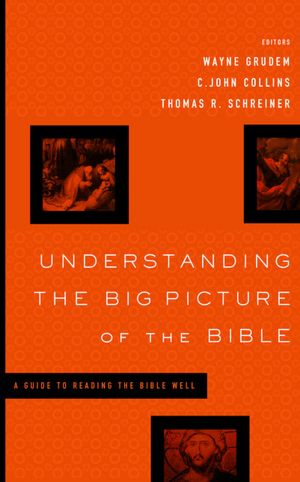
It is the aim of Understanding the Picture of the Bible: A Guide to Reading the Bible Well to answer those questions and put “clear, readable Bible study aids at your fingertips.” (All quotes from back cover and also found here.) Here I review the book for another installment of Magnificent Monograph Mondays.

The book begins with “An Overview of the Bible’s Storyline,” then continues with three parts, one for the Old Testament (subdivided into OT Theology, Pentateuch, Historical Books, Poetry/Wisdom Literature, and Prophets), one for New Testament background (intertestamental history and literature), and one for the New Testament (NT Theology, Gospels/Acts, Epistles, and Revelation). Each author gives a thorough yet concise overview of the section of the Bible he (all authors are male) treats. Each also discusses themes within a given section of the Bible and how they connect with the larger Biblical narrative.

What first stands out in Understanding the Big Picture of the Bible is that almost every author has a knack for simply explaining important concepts and terms. The summary overviews of sections of the Bible provide the reader with a firm foundation for better understanding the purpose and scope of that section. For example, Paul House’s excellent chapter on the prophetic books has an excursus on “pronouns in the prophets.” He begins: “As prepositions are to the letters of Paul, so pronouns are to the oracles of the prophets: crucial for meaning, but often puzzling” (72). In the five following pages he does much for the reader to make prophetic pronouns (and how they often shift person and gender) easier to understand. Other highlights are Gordon Wenham’s chapter on the Pentateuch and Dennis Johnson’s essay on Revelation.

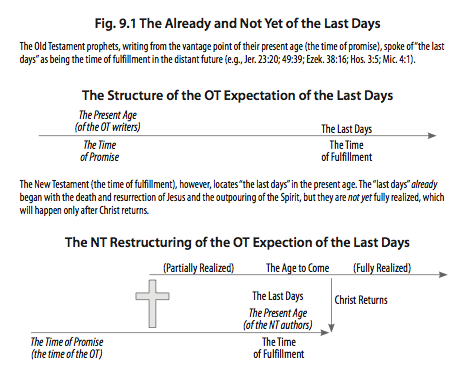
Timelines and charts throughout are a great feature. In addition to timelines in the back of the book covering all of Biblical history (including intertestamental times), there are charts throughout the book that aid the reader. Thomas Schreiner lists all the Epistles, their authors, dates, place of writing, and recipients. Johnson uses nine separate figures to visually (and clearly) display the differences in how Christians interpret Revelation. And House has a table that lines up the prophets with the kings during whose time they prophesied. (A couple of similarly simple and clear maps could be a great addition to future editions of this book.) Here’s an example (taken from a pdf sample of the book):

And then there’s the middle section, part two of Understanding the Big Picture of the Bible. That section alone makes this book worth more than its purchase price. It contains the following:

  • “The Time between the Testaments,” by J. Julius Scott Jr.
  • “The Roman Empire and the Greco-Roman World at the Time of the New Testament,” by David Chapman
  • “Jewish Groups at the Time of the New Testament,” by John Delhousaye

Take just this short quotation from Chapman as an example:

Amid this history, Jesus Christ launched his ministry in a Galilee governed by a Roman client king, a Judea under Roman procurators, and a Judaism tinged with Hellenism. After his crucifixion by the Romans and his resurrection, his gospel was carried by the apostles directly into the heart of Greek culture and Roman power. (94)

Having this background in mind when approaching the New Testament will greatly advance the efforts of any Bible reader. Most Bible overview guides that I’ve seen go right from Old Testament to New Testament. But what about all that time in between? I’ve written more here about why that time period is essential to NT understanding. This book really gets that, and covers that period well. Someone with no knowledge of NT background would find this section easy to follow, and even a budding scholar would appreciate the clarity of the historical overview.

While it’s hard to discern what is the work of the editors (this book has three: Wayne Grudem, C. John Collins, and Schreiner) and what is the work of the writers, this book could have benefitted from a little more careful editorial oversight. There are a few little typos scattered throughout the book (tehillah instead of tefillah for Hebrew prayer, e.g.). I found the use of the sex-specific “man” to refer to all of humanity–even when not quoting the ESV–distracting (although this may not bother other readers).

But there is a bigger editorial oversight. While the book excellently helps the reader to better understand the “big picture” of the Bible, it never directly answers the question it seeks to answer of “How do I get more out of my Bible reading?” The authors present all the necessary information to better understand the background (context) and foreground (content) of the Bible, yes. But understanding context and content is only necessary and not sufficient for “reading the Bible well.” I wish the editors would have made sure the book gave more attention to how one can read the Bible, for example, devotionally… or for transformation rather than just the receiving of information. In other words, I wanted this book, based on its title, to answer: How can I grow closer to God as I read the Bible? How can I allow the Bible to convict me of my sin? What about the importance of reading Scripture in community and corporate worship? David Reimer’s essay gets closest to this when he says, “[T]he art and craft of the Bible’s poems offers an invitation to read slowly, to have one’s vision broadened, once’s perception deepened… to see literary reflection in the service of worship and godly living” (54). I wanted to hear more about this. The key question for me is: Is overview knowledge of the Bible’s context and content sufficient to read the Bible well? Necessary, yes. Sufficient, no.

However, even if the book doesn’t execute its aim listed in the subtitle, it is still a valuable work to have in hand while reading through the Bible. Its unique contribution to works of this kind is in the middle section. I’d imagine this book sitting well on someone’s shelf next to his/her Bible and notebook. (It has on mine these last few weeks!) It would benefit a serious Bible reader to read, say, Darrell Bock’s essay on the Gospels and Acts before reading those Biblical books through.

Thank you to Crossway who provided me with a review copy of this book in exchange for an unbiased review. You can find Understanding the Bible Picture of the Bible at Amazon here.

BibleWorks in the pew? (Not quite, but the next best thing)

[GEEK ALERT] In an effort to integrate my learning of Biblical languages with church attendance and participation, I can be spotted at my church carrying this and this around. If I had an extra hand, I’d bring this, too. At first I feared it would look pretentious–it still may–but my motives are just to use my Greek and Hebrew in the context of corporate worship, while Scripture is being read aloud (in English, in my church’s case). So I follow along the Scripture readings, as best I can, in the original languages.

By Gerard Whyman (http://www.gerardwhyman.co.uk/)

To take it a step further, some time ago on the BibleWorks forums there was a user-initiated discussion about whether it is appropriate to have a laptop with BibleWorks open in the middle of a church service.

While I personally find the idea of a pew-sitter with a laptop tacky, I do understand the sentiment behind wanting to look at the Bible in the original languages while it’s being read and exposited in church. Hence my solution of having a print Bible with me. That’s not quite as out of place as a laptop would be.

So having my Greek and Hebrew Bibles with me is the next best thing to having BibleWorks open during church. However, there are two other next best things that do involve BibleWorks. First, there is a free user-created module that has the Revised Common Lectionary, linked to texts in BibleWorks. I rarely have time to use it on Sunday morning as we rush out the door, but I have at times been able to look ahead to the texts we’d be reading in church that week and use BibleWorks to work my way through them. The RCL module is really nifty. More about it here.

Today I found myself with the unexpected blessing of some time to play around with BibleWorks a bit. (I just received BibleWorks 9 in exchange for an unbiased review, which I will be offering in parts in coming weeks. Consider this a prologue of sorts.) Using the Report Generator, I was able to create a “Reader’s” version of Jeremiah 23:1-6, the Old Testament reading in church from the RCL this morning. Here’s the screen shot of how to get there, which also shows how I have my BibleWorks set up for Septuagint study. (Click on image for larger, or open it in a new tab.)

Once there, I set the Report Generator in the following way:

Then I clicked on “Build Report” and got a report with the text of Jeremiah 23:1-6 in Greek, followed by the listing of all words used in that passage, with frequency counts, followed by lexicon entries. After some manual organizing, I ended up with the below. Resources like this exist for the Hebrew Bible and the Greek New Testament (what I take to church with me), but there is not as of yet a “Reader’s” Septuagint.

Fellow language-lovers… what do you think? And do you take your languages with you to church? If so, how?

Jeremiah 23:1-6 (Rahlfs Septuagint)

–with footnoted vocabulary (glosses) for words that appear less than 200 times in entire Greek Bible (LXX+NT together). Glosses from here: print / BibleWorks module.

1 Ὦ[1] οἱ ποιμένες[2] οἱ διασκορπίζοντες[3] καὶ ἀπολλύοντες τὰ πρόβατα τῆς νομῆς[4] μου.
2 διὰ τοῦτο τάδε λέγει κύριος ἐπὶ τοὺς ποιμαίνοντας[5] τὸν λαόν μου Ὑμεῖς διεσκορπίσατε[6] τὰ πρόβατά μου καὶ ἐξώσατε[7] αὐτὰ καὶ οὐκ ἐπεσκέψασθε[8] αὐτά, ἰδοὺ ἐγὼ ἐκδικῶ[9] ἐφ’ ὑμᾶς κατὰ τὰ πονηρὰ ἐπιτηδεύματα[10] ὑμῶν·
3 καὶ ἐγὼ εἰσδέξομαι[11] τοὺς καταλοίπους[12] τοῦ λαοῦ μου ἀπὸ πάσης τῆς γῆς, οὗ ἐξῶσα[13] αὐτοὺς ἐκεῖ, καὶ καταστήσω αὐτοὺς εἰς τὴν νομὴν[14] αὐτῶν, καὶ αὐξηθήσονται[15] καὶ πληθυνθήσονται·
4 καὶ ἀναστήσω αὐτοῖς ποιμένας[16], οἳ ποιμανοῦσιν[17] αὐτούς, καὶ οὐ φοβηθήσονται ἔτι οὐδὲ πτοηθήσονται[18], λέγει κύριος.
5 Ἰδοὺ ἡμέραι ἔρχονται, λέγει κύριος, καὶ ἀναστήσω τῷ Δαυιδ ἀνατολὴν δικαίαν, καὶ βασιλεύσει βασιλεὺς καὶ συνήσει[19] καὶ ποιήσει κρίμα καὶ δικαιοσύνην ἐπὶ τῆς γῆς.
6 ἐν ταῖς ἡμέραις αὐτοῦ σωθήσεται Ιουδας, καὶ Ισραηλ κατασκηνώσει[20] πεποιθώς, καὶ τοῦτο τὸ ὄνομα αὐτοῦ, ὃ καλέσει αὐτὸν κύριος Ιωσεδεκ[21].


[1] ὦ (109) woe (to)
[2] ποιμήν (99) shepherd
[3] διασκορπίζω (64) scatter
[4] νομή (39) pasture
[5] ποιμαίνω (65) shepherd
[6] διασκορπίζω (64) scatter
[7] ἐξωθέω (31)  force out
[8] ἐπισκέπτομαι (181) visit
[9] ἐκδικέω (97) exact vengeance
[10] ἐπιτήδευμα (58) practice, way of living
[11] εἰσδέχομαι (20) gather
[12] κατάλοιπος (98) remnant
[13] ἐξωθέω (31)  force out
[14] νομή (39) pasture
[15] αὐξάνω (63) grow
[16] ποιμήν (99) shepherd
[17] ποιμαίνω (65) shepherd
[18] πτοέω (39) tremble
[19] συνίημι (144) have understanding
[20] κατασκηνόω (70) dwell, settle
[21] Ιωσεδεκ (18) proper noun (name)