Magnificent Monograph Monday: The Later New Testament Writings and Scripture, Reviewed

Eisegesis. Not a label most evangelical Biblical interpreters want to wear. If exegesis is drawing the meaning out of a text–with a careful eye toward its original context and authorial intention–eisegesis is taking one’s own set of meanings and intentions into the text. Evangelical scholars aim to practice the former and avoid the latter, although of course everyone comes to any text with some presuppositions. (And new hermeneutics like reader response criticism may see this as a good thing anyway.)

My seminary teaches an exegetical method that majors on reading a text in its original context and understanding its original purpose. I’ve often thought that if New Testament writers submitted any of their works as exegesis papers, they’d fail because of the various “hermeneutical fallacies” they commit! It seems that New Testament writers freely appropriate or proof-text Old Testament passages for their own purposes, no matter the original context or intention of the passage at hand. They might even be accused of eisegesis, were they employing their methods today.

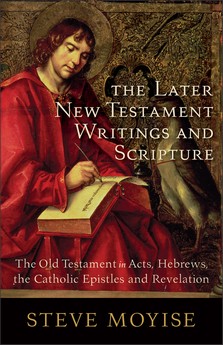
Baker Academic has just published the third volume of Steve Moyises’s de facto trilogy, in which he examines how Jesus, Paul, and the later New Testament writers use Scripture. He seeks to “give an account of” and “consider the use of Scripture” in the later NT writings. This is a “study” of “important engagements with Scripture.”

Just picking up the book before reading it was a pleasure–the layout is great, the paper quality is high, the font is clear and easy to read, and the cover design is appealing. Especially for a paperback, it’s an attractive volume to have on a bookshelf. (I note here that I received a free copy from Baker in exchange for an unbiased review.)

Moyise treats Acts, 1 Peter, Jude/2 Peter, James, Hebrews, Revelation, and includes a brief excursus on 1-3 John. He is thorough in the Scriptures he treats, which is especially aided by a UBS index in the back that serves as an index of all the quotations of the Old Testament in the above books. (There are full Scripture and author/subject indeces, too.)

The author groups the Scriptures thematically or by Old Testament book, rather than going verse by verse through each of the New Testament writings under consideration. In Acts, for example, he considers how the author Luke uses Old Testament Scripture to address themes like “Salvation for Jews and Gentiles,” “Christ’s death, resurrection, and exaltation,” “Judgement,” and so on. In 1 Peter Moyise has sections devoted to I Peter’s use of the Psalms, of Isaiah, etc. Moyise does this so as not to “miss the wood for the trees,” and he is successful. The reader, then, can conclude each portion of the book with a solid overview of how each NT writer uses the OT.

The text is accessible to a non-scholar or non-specialist in this field. For example, Moyise explains on p. 4:

[I]n some cases the New Testament authors appear to know a version of the text that differs from the majority of manuscripts that have come down to us. The discovery of the Dead Sea Scrolls (1948–) has shown that the biblical text existed in several forms in the first century and it is not always clear which form is being quoted.

He uses gray shaded boxes at various points to succinctly explain key concepts such as “typological interpretation” or to address things like 2 Peter’s use of the largely unknown 1 Enoch. The endnotes include more textual details and point the reader in the direction of the scholarly writings about each book. One does not need knowledge of the original language to read Moyise, but he does at times use transliteration of various Greek words if it helps his explanation.

The potential reader might be concerned that a book about intertextuality could end up as just a dry list of references. Moyise does thoroughly catalog the quoted OT passages, yet he draws conclusions from such use, as well:

Although James’s use of Scripture is not christological in a doctrinal sense, it bears comparison with Jesus’ own interpretation of the law, particularly his emphasis on seeing the law in the light of the twin commands to love God and neighbour. (63)

Moyise presents various interpretations in an even-handed, balanced way. I felt more than once like I was reading R.T. France, a favorite commentator of mine. He includes, too, the full text of many of the verses he cites, eliminating the need to flip back and forth through other reference works while reading this one. Jude and 2 Peter have a helpful table of comparisons where the two are lined up side-by-side, and this feature is present for other passages also.

There were a couple times where I thought Moyise might be guilty of the fallacy of post hoc ergo propter hoc (inferring causation just because one thing chronologically follows the other). In Revelation, for example (which he notes quotes no Scripture explicitly but is full of allusions), he speaks in terms of the “source” of (129, 137) or “inspiration behind” (130) John’s descriptions of his visions. My response to this was–just because John’s language has much in common with the Scriptures that came before him, do they therefore have to be his source? What if his source was, in fact, the vision he had, and he just used Scriptural language to express it?

Finally in the conclusion to his section on Revelation, Moyise addresses this very question. In fact, he is quite aware of questions like mine, and in the end treats it thoroughly and fairly, citing those who advocate a “scribal model” (where John is said to have basically just compiled Scriptures into a new presentation) and those who advocate a “rhetorical model” (where John uses OT language to express something new that he actually saw).

My question about whether or not NT writers are in some sense eisegetes is not an uncommon one. Students often ask: If we’re not supposed to handle Scripture that way, how can they? Though Moyise doesn’t necessarily set out to answer that question in this volume, he answers it beautifully:

The important point in all this is that the Scriptures did not exist in a vacuum. They were part of a living tradition where text and interpretation were transmitted together. (148)

In describing Revelation’s use of Daniel, for example, he says it is “not necessarily an ‘improper’ use of Scripture but hardly what Daniel had in mind” (140).

Moyise (87) quotes Susan E. Docherty from her book The Use of the Old Testament in Hebrews:

The author of Hebrews as much as any ancient Jewish exegete…regarded it as legitimate interpretation to seek out what scriptural texts imply as much as what they actually say, presumably believing that the new meaning he gave them was inherent in the original revelation, which he regarded as having endless depths of meaning and real contemporary relevance.

That Moyise’s trilogy of books on NT use of Scripture exists is a testament to the depth of Scripture. Moyise is a fantastic guide for exploring what can be confusing and difficult territory.

(Here’s the book at Amazon.)

Resources for Septuagint Study

Yet another reason to love Sunday: it’s Septuagint Sunday at Words on the Word. (Settle down.) Here are some resources I’ve found helpful for the study of the Septuagint:

Resources Relating to the LXX. From the Codex biblical studies blog by Tyler Williams. This is up-to-date and probably the best place to start working your way through what’s out there in Septuagint land right now. Williams lists available English translations, introductions, Greek editions, language tools, topical studies, and electronic resources for the study of the Septuagint. He includes brief and helpful descriptions of each resource he links to. The page looks to have been last updated in 2009, but it’s still pretty current.

Rod Decker’s LXX Resources page. Decker is behind the ever-helpful Koine Greek Reader, which includes grammar review, vocabulary lists, and graded readings in the Greek of the New Testament, the Septuagint, the Apostolic Fathers, and a few early church creeds. His resources page has some very helpful Septuagint vocabulary lists. This one (PDF) has all words occurring more than 100 times in the Septuagint. And this one (PDF) has words that occur more than 100 times in the Septuagint but less than 25 times in the New Testament. The second list is ideal for those who know their NT Greek, but want to branch out into the much larger vocabulary pool of the Septuagint.

Septuagint Online. By Joel Kalvesmaki. He gives a great historical overview of the Septuagint, including clarifying some terminology (see here). And here is his link to other Septuagint resources.

The International Organization for Septuagint and Cognate Studies (IOSCS)The IOSCS is “a nonprofit, learned society formed to promote international research in and study of the Septuagint and related texts.” Yes, I’m a member, as of this last week (honey, sorry you had to hear about it on the blog, but it was only $15). The IOSCS puts out an annual journal, has published some Septuagint monographs, and even has a book-by-book commentary series on the Septuagint in the works.

Albert Pietersma’s page. Pietersma co-edited the New English Translation of the Septuagint (NETS, all online for free here). His page contains, among many other useful resources, a couple of .pdfs on various Psalms, where he does a verse-by-verse commentary that examines both the Greek and the Hebrew. He prints the Greek and the Hebrew before commenting on it, too, so it’s a great way to increase one’s language skills. This allows one to see the kinds of issues that Septuagint translators were working on.

You may also wish to bookmark this link, which gathers all my posts that have a “Septuagint” tag (including this one, previous ones, and future ones I post).

Prophetic Whiplash…God of Mercy or God of Wrath?

Reading the Biblical prophets (like Micah) can give the reader emotional whiplash. The prophets often alternated abruptly between communicating God’s good news and bad. So which one is it: does God graciously forgive his people’s sins, or does he harbor his anger against them in judgment?

The prophets didn’t feel a need to necessarily resolve this tension; both are true in some measure. But in the end the witness of the Hebrew Bible–very much confirmed in the New Testament–is summed up in Exodus 20:5-6 (AKJV):

Do not worship any idol, and do not serve them, for I am Yahweh your God, a zealous God. For the sins of parents I hold accountable their children, to the third and fourth generations of those who hate me. But I show covenant loyalty to thousands of generations of those who love me and who keep my commandments.

Insofar as the tension between God’s mercy and God’s anger finds resolution, the Bible indicates that mercy is the overriding attribute of God.

Micah’s bifid structure, alternating as it does between woe and weal, seems to resolve at the end in favor of God’s mercy to his unfaithful people. This is Septuagint Sunday at Words on the Word, so a bit of Greek is in order. (You don’t have to know Greek to follow here.)

Micah 1:1 is the book’s superscription (=title page, essentially) where Micah identifies himself as a messenger of Yahweh, who has received his word to give to his people. The very first prophetic utterance, in the next verse (AKJV, from the Greek), is,

Hear these words, people, and let the earth and all that is in it pay attention. The Lord will serve as a witness (εἰς μαρτύριον) against you, the Lord from his holy dwelling place.

What follows in chapter 1 is fairly damning lawsuit language that calls God’s people into a courtroom setting for their transgressions of God’s covenant… where, of course, they have no defense. The woe-weal or wrath-mercy alternation continues through the rest of the book, until Micah concludes in 7:18-20 with a hymn of praise to God (AKJV again, from Greek):

Who is a God like you, who forgives injustices and overlooks the sins of the remnant of his inheritance?

He does not retain his anger as a witness (εἰς μαρτύριον), for he is one who delights in mercy. He will turn and have compassion on us. He will sink our injustices and hurl all our sins into the depths of the sea.

You will give truth to Jacob and mercy to Abraham, just as you swore to our ancestors from ancient days.

Of special note is how εἰς μαρτύριον (“as a witness”) serves as bookends for the book. In the first few verses, God himself is a witness against his people that they have committed sin against him. But in the final verses, he chooses not to call himself (specifically, his anger) to the stand as a witness (εἰς μαρτύριον) against his people. Rather, he overlooks (ὑπερβαίνων) their sins, sinking them into the depths of the sea.

Quite a different use of εἰς μαρτύριον to close out the book! In his last verses, Micah echoes the Exodus passage, that God forgives our wrongdoings and shows mercy, even with all he has to call as a witness against us.

God’s wrath is real, and our sins deserve it, yet in the end he has chosen to have mercy on his people.

Can’t be perfect? Do what you can.

I’ve been reading the Didache lately, an important discipleship treatise in the early church. It was probably written in the late first century.

It quotes a good deal of Scripture, and speaks primarily to would-be disciples about choosing between “two ways, one of life and one of death.” The early church held it in high regard, considering it to be at least comparable to canonical Scripture and worthy of study. I’ll have a chance to post more about the Didache this summer.

Here’s some great advice from Didache 6:2: “For if you are able to bear the whole yoke of the Lord, you will be perfect. But if you are not able, do what you can.”

That much I can do.

Restoration in the Wilderness

From the wilderness comes restoration.

The wilderness for Israel was all too often a place of dissension and lack of trust in God’s promises.

Exodus 17:7 says, “Moses called the name of the place Massah and Meribah, on account of the quarreling of the children of Israel, and on account of their testing Yahweh, which they did by saying, ‘Is Yahweh in the midst of us or not?'” (AKJV) Massah means testing and Meribah means strife or quarreling. “Whining” would not be an inappropriate translation for Meribah. Psalm 78 (go here and scroll down to 78) details the repeated lack of faith Israel had in their delivering God.

(Disclaimer: I am not claiming I would have done better or have done better in wilderness settings.)

In the Gospels, however, Jesus redeems and transforms the wilderness experience on behalf of the entire people of God. In the New Testament Jesus serves as a stand-in for the people of God, both in the wilderness and on the cross.

One of Mark’s first καὶ εὐθὺς statements has Jesus going into the wilderness to be tempted by Satan. But unlike the people of God in Exodus, Jesus did not sin when he was tempted to walk away from God and worship another. I once heard a preacher say that where Adam failed, where Israel failed, and where all humanity failed… Jesus succeeded on behalf of all people when he refused to listen to Satan in the wilderness.

The wilderness, isolated place that it is, connects with hope to the whole of salvation history.  John the Baptist, the “voice of one crying in the wilderness,” hearkens back to Old Testament prophets that “prepare the way of the Lord.”  John self-identifies as the prophet par excellence who prepares the way for Jesus. The wilderness may be lonely and despairing, but it is also the place to which Jesus comes.

As R.T. France writes, “The wilderness was a place of hope, of new beginnings…in the wilderness God’s people would again find their true destiny.”

From the wilderness comes restoration—even if it’s only the beginning of the process of restoration. Saint Mark’s first listeners/readers saw the wilderness motif immediately at the beginning of the Gospel (no birth narrative!), with John as prophet in the wilderness and with Jesus conquering Satan’s temptation in the wilderness. This alerted them that something significant was about to happen.

“Is God in our midst or not?”

I confess I’m too quick to ask that question with Israel when I find myself in a proverbial desert. But the desert wilderness is the exact place to which God saw fit to send John, preaching the good news of forgiveness and calling people to a baptism of repentance. The desert wilderness is the exact place to which God saw fit to drive Jesus, so that he could resist the devil’s temptations, beginning to win for us a victory we could never win for ourselves. God in Jesus restores what we have made “Massah” and “Meribah” by our lack of trust and rush to complaint.

Next wilderness I come to, I’m going to try to ask myself… what restoration is on the other side of this?

Junia

My wife and I just gave birth to our third child, Junia. The name Junia comes from Romans 16:7–she was an “outstanding” apostle, as noted by the apostle Paul.

There is nothing else about Junia in the New Testament except for the rest of what Paul says about her in that verse, the full text of which is, “Greet Andronicus and Junia, my fellow Jews who have been in prison with me. They are outstanding among the apostles, and they were in Christ before I was.”

What we know about Junia from Paul is:

  • She was a fellow Jew;
  • She is mentioned alongside Andronicus, presumed to be her husband and ministry partner;
  • She was in prison with Paul at some point;
  • She and Andronicus were “outstanding among the apostles”;
  • She and Andronicus were “in Christ” before Paul was.

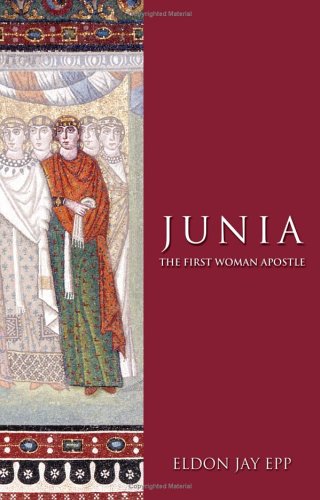
There is a little bit of literature about Junia. She is the source of a short but dense scholarly study by Eldon Jay Epp (the cover is pictured above). Epp explores the difference that comes up in some English translations–i.e., why Junia occasionally (but incorrectly, according to him) appears as a male “Junias.” There is also an investigative journalist’s take on Junia, exploring some of the church’s history as to how and why the apostle Junia has sometimes been understood in the text (incorrectly, she also says) as a male Junias.

Finally, Scot McKnight has just come out with a short Kindle-only monograph called Junia is Not Alone, which explores Junia’s contribution to the church, as well as other “overlooked” women in Scripture and church history. (The publisher’s description unfortunately calls the essay “fierce.” I’ve not yet read it, but all that I’ve read and heard from Scot is anything but fierce. (UPDATE: I review it here.) He is a gentle and caring Biblical scholar, not polemical. Unless they mean “that’s fierce” in a Project Runway sense.) He posts about his e-book here.

UPDATE: Read all my Junia posts here.

Mark the Action Movie

And immediately!

Mark’s Gospel has earned a reputation as the fast-moving, action-oriented Gospel out of the four. It is shorter than the other two Synoptic Gospels and John (cool chart on NT book length here). At times Mark’s urgency in his narrative accounts feels like an action movie. He frequently uses the Greek  εὐθὺς (“at once” or “immediately” in most English translations) as he shifts from scene to scene, especially in his first chapter. And unlike the other Synoptic Gospels of Matthew and Luke, there is no birth story of Jesus, no genealogy. Instead, Mark announces right off the bat what his book is about: “The beginning of the gospel of Jesus Christ, Son of God” (1:1), then quickly brings in John the Baptist to introduce a full-grown Jesus, who begins his ministry preparation by receiving John’s baptism.

And immediately, as he came up out of the water, he saw the heavens opening and the Spirit descending on him like a dove, and a voice came from the heavens: ‘You are my beloved son; with you I am well pleased” (1:10-11).

And immediately the Spirit compelled him to go into the wilderness” (1:12)….

“And” (Greek  καὶ), “immediately” ( εὐθὺς), and “then immediately” ( καὶ εὐθὺς) are favorites of Mark’s. I once heard someone compare his storytelling style to an excited young kid who really wants to tell you a story: “And then… and then… and then!”  Mark’s enthusiasm, even coming through this one small literary device, is contagious to the reader who is listening to Mark tell about Jesus, the Son of God. Mark seems barely able to catch his breath as he recounts his gospel.

Micah and the Septuagint

A few semesters ago I had the privilege of taking a great class at Gordon-Conwell with Dr. Doug Stuart: Intermediate Hebrew Grammar (syllabus PDF).  Dr. Stuart is an excellent professor and scholar.  In that class we worked our way through the Hebrew text of Micah (which is quite a challenge!).  The class left a lasting impression on me, and kindled in me a love for the prophet Micah.  (It doesn’t hurt that I have a really great brother with that same name.)

Now I’m doing a “reading course” (directed study) with Dr. Al Padilla in the Greek Old Testament version of Micah (as well as I Maccabees 1-4).  The Greek in Micah is as difficult as the Hebrew (which it translates), but I’m having a great time working my way through the book again and trying to increase my Greek vocabulary.

Part of my course is to read a book I’ve wanted to read for a long time, Invitation to the Septuagint, by Dr. Karen Jobes (who teaches at Wheaton, where I did undergrad) and Moises Silva (who used to teach at Gordon-Conwell).  It’s a fantastic introduction–simple enough, yet still challenging.  The Greek Old Testament (“Septuagint”) translated the Hebrew Bible beginning in about the 3rd century B.C.  Thus it “was the primary theological and literary context within which the writers of the New Testament and most early Christians worked” (23).  Our English Bibles today translated the Old Testament from Hebrew, whereas New Testament writers quoted the Old Testament in Greek–which is why a NT quotation may differ from the OT when you go look it up in an English Bible.

I’m excited to read more of this book and continue my studies in Micah.  What is really fascinating to me is how Septuagint scholars have to know both Greek and Hebrew cold, since much of their work is trying to figure out what Hebrew the Greek before them translated.  I may never get to that level with my languages, but I’m going to at least make a little progress in the meantime.

R.T. France on Mark

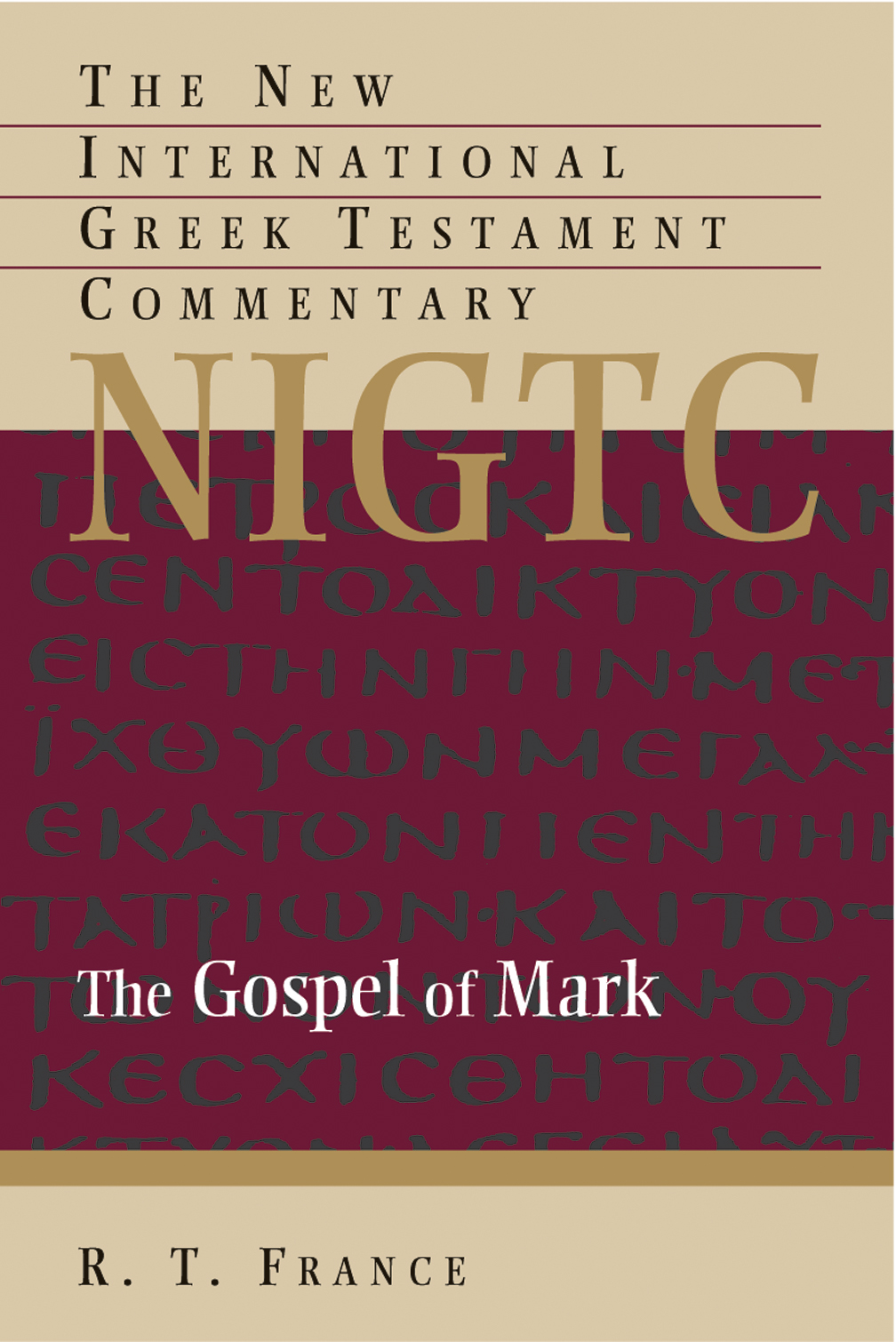
R.T. France’s commentary on Mark focuses on the Greek text, but I’d recommend it to anyone interested in carefully working through the Gospel of Mark, regardless of Greek knowledge. France takes the utmost care to interpret the text, providing much relevant background and comparison with other Gospels. Even as he is exegeting a single word or phrase from one verse, he always has the whole contour of the book in mind. While he does not formally have an application section as such, the conclusions he draws from the text are such that the careful reader could easily come up with applications from France’s insights.

France’s work is technical, yet easy enough to read, especially for a commentary. Beyond its superb quality as a technical/academic commentary, it has even gone so far as to more deeply inspire me in my own view of Jesus and his ministry. It’s well worth the money to purchase this book, and well worth the effort to work one’s way through it.

Sadly, France just passed away in February.  I was fortunate to be taking a class this past semester where this commentary was the primary textbook.