Do You Want to Contribute to a Septuagint Dictionary?

Scholar’s Publisher is seeking contributors:

The aim of the DSEGJS [Dictionary of the Septuagint and Early Greek Jewish Scriptures] is to provide a comprehensive reference guide to the Greek Jewish Scriptures (GJS) in their Greco-Roman context as well as their subsequent influence on the early church and post Second Temple Judaism. The field as well as the general interest in matters related to the GJS has grown significantly in the past 30 years, but the discipline is lacking an informative reference tool for students and specialists, as well as scholars and students in related fields. The scope of the dictionary is to provide factual information about books, persons, places, and events, as well as define words and explain theories as they relate to the GJS. In most cases, the next step is to read an article or volume that is devoted to the topic itself, though in some cases the nature of this new endeavour means the DSEGJS is the primary source of information.

Find out more here.

From the Study… Books for Sale

Last weekend I built a sandbox; this weekend I’m cleaning up the study. I have a few books I’m trying to unload. Contact me here if you’re interested.


Simplified Guide to BHS (Hebrew Bible)
(Scott, 1990 Second Edition, includes Ruger’s English Key to Latin Words, bound together), hard to find in print. One page has writing, but is helpful to understanding text. Previous owner’s name inside front cover; sticker residue on back (slight).
$20


Hand Concordance to Greek NTHandkonkordanz zum Griechischen Neuen Testament (English and German)
Super-handy small concordance to Greek New Testament… I just don’t have use for it recently. See reviews at Amazon link here. Good to Very Good condition (sticker on back, some regular wear, but clean inside and strong binding).
$22


Seow Hebrew GrammarC.L. Seow’s Grammar for Biblical Hebrew (1987)
Pencil notations throughout (one page pen), otherwise great condition. Old sticker on back.
$10


The increasingly hard-to-find NIV Triglot Old Testament
Yes, English, Greek and Hebrew. It’s a big and impressive-looking hardback. Really good condition. Name inside front cover. No markings that I’m aware of. No dust cover (but you were just going to take that off as soon as you got it anyway, right?).
$22


Behold, the Triglot
Behold, the Triglot


Spurgeon Treasury of DavidSpurgeon’s 3-Volume Treasury of David
Commentary on the Psalms, hardcover (green dust jackets). Hardly used, in great shape. One volume has a small coffee splash on page edges. Not a set of books I’d normally want to part with, but I have it electronically now.
$29


Bonhoeffer Fiction from Tegel PrisonDietrich Bonhoeffer Works, Volume 7 (Fiction from Tegel Prison)
Hardcover. Brand new, still in shrink wrap.
$14


Dietrich Bonhoeffer Works, Volume 9 (The Young Bonhoeffer, 1918-1927)
Hardcover. Still in original shrink wrap. Just a tiny bit of bumping to spine edges, one corner ever-so-slightly dinged.
$20


Dietrich Bonhoeffer Works, Volume 10 (Barcelona, Berlin, New York: 1928-1931)
Hardcover. Dust jacket, page edges, and corners show some wear/bumping, but not much. Insides unmarked, never used.
$25


Interested? Contact me here to inquire.


And the Winners of the UBS5 Greek NT Are….

UBS5 Infographic


There were more than 50 entries into the UBS5 Greek New Testament giveaway. (Click here to read more about that new edition of the GNT.)

Using a random number generator, the two winners are:

  • spencerclark2013 (see here)
  • thanksgutenberg (see here)

Congratulations! I’ll get in touch with both of you via email in order to get the Bible shipped out to you.

And check back here, too, or subscribe to the blog at the right of the top of the page. Just as I reviewed the impressive LXX-NA28 combo, I will soon be reviewing the UBS5 Greek New Testament.

Win a Free Copy of the New UBS5 Greek New Testament with Dictionary

UBS5
By now many of you Words on the Word readers will have heard that the UBS edition of the Greek New Testament has recently been published in its fifth revised edition, the UBS5. See here for more.

Check out this smart graphic from Hendrickson Publishers announcing the edition (academia needs more good infographics):
UBS5 Infographic

Just as I reviewed the amazing LXX-NA28 combo, I will soon be reviewing the UBS5 Greek New Testament.

While I work my way through it, with just about a minute of your time and a few clicks, you can enter to win your own copy of the UBS5, thanks to the great people at Hendrickson Publishers.

You Can Earn Up to 8 Entries: Here’s How

Simply comment on this blog post with a short sentence on what interests you in the Greek New Testament. That will give you one entry.

If you share on Facebook and/or Twitter, and then come back and post the link to your share in the comments, you get two additional entries.

If you want to earn five additional entries, you can record a (however lo-fi) video of yourself answering the questions: Why does Bible translation matter? and: What does translating the Bible mean to you personally?

To receive those five additional entries, post the url to your video (whether you’ve uploaded to YouTube, Facebook, Vimeo, etc.) in the comments. Then others can see your video, too.

I’ll select two winners using a random number generator.

If you don’t want to wait for the results of the giveaway, you can find the UBS5 on sale at Amazon here (affiliate link) or through Hendrickson here.

A Bit of Fine Print

The giveaway is open through Sunday, September 7, 11:59 p.m. EDT. On Monday I’ll notify the winner and post about it both here and in the comments below. Then Hendrickson will mail you your UBS5 GNT! (Note: Only domestic/U.S. shipping addresses are eligible for this contest, with apologies to the rest of the world!)

Make sure in when you leave a comment that you include your email address—I can use that to contact you, and the email address isn’t public.

Happy entering, and the folks at Hendrickson and I look forward to seeing your videos. Drop me a line if you have any questions.

The Bible’s Other* Hymnal

Psalms with OdesMany Greek Septuagint manuscripts do not contain them, but the Odes are a fascinating collection of texts appended to the end of the Greek Psalter in Codex Alexandrinus and a few other manuscripts.

The Odes compile some beautiful prayers from Scripture. A few of them are in the Book of Common Prayer’s Morning Prayer canticles.

Good information on the Odes is hard to come by, though. In part this is because they are generally not accorded the same status as, say, the Psalms. The NETS introduction to the Psalms, for instance, has:

One “book” not included in NETS, however, is Odes since it has dubious integrity as a literary unit, and, in any case, almost all of the individual Septuagint odes have already been included in their native setting in other books. The sole exception is Ode 12 in Rahlfs’ edition, the Prayer of Manasses, which for that reason has been separately appended to the Psalter.

I’ve just discovered, however, that David Lincicum has a nice rundown of the Odes, their numbering, and their contents. He also includes a bibliography for further reading. Check it out here.


*HT to a member of the Yahoo! LXX email group for the idea of the Odes as a sort of “little hymnal.”

Septuagint Studies Soirée #9 and #10: Buy One, Get One Free Edition

How would you do on this exam?

The Septuagint Studies Soirée is back. You can find all previous months gathered here, where I post links to what I find around the blogosphere in Septuagint studies. This soirée covers two months: April and May.

T. Michael Law continues to dominate the Septuagintablogosphere with his Septuagint Sessions podcast. Since the last soirée he posted episode 4 (on Greek Isaiah’s style), episode 5 (“Your BHS is safe with me!”), and episode 6 (“about a problem in research on the LXX that stems from a canonical bias”).

Suzanne McCarthy at BLT asks whether Judith was originally written in Greek or Hebrew. She also looked at our two “prototypical parents” in Greek Genesis 3 and 4. Her co-blogger J.K. Gayle examined the use of “baptism” in Plato and the LXX. BLT is one of the more substantive biblioblogs I read. You would do well to bookmark BLT’s Septuagint tag page, which includes even more recent LXX-related posts. (Also, add this one to your slate of BLT posts to read.)

Linguae Antiquitatum posted a nice review (with some interesting pedagogical musings) of a book about teaching beginning Greek and Latin. The same blog posted the first ever “Ancient Languages Carnival.”

Mosissimus Mose continues an ongoing review of  T. Michael Law’s When God Spoke Greek. Chapter 5 posted in May.

William Ross posted about papyri.info, and offered this and this post as to how to use it for LXX research.

Summer beach reading?

Brian Davidson at LXXI suggests some summer reading. If you have made it this far in reading this post, you might even consider his recommendations to be good beach reading.

Here is Ed Gallagher on “The Greek Bible among the Jews.” And here he is with an illuminating post on the word “deuterocanonical.”

We’ve been in Easter season. And the LXX may have had “an increasing awareness of resurrection theology.” Read a short but fascinating post about it here.

Allow me to make a plug again for The International Organization for Septuagint and Cognate Studies (IOSCS), which publishes a yearly journal. I’m excited to say that the forthcoming issue will include a fairly lengthy review article I’ve written about the use of Bible software for Septuagint studies.

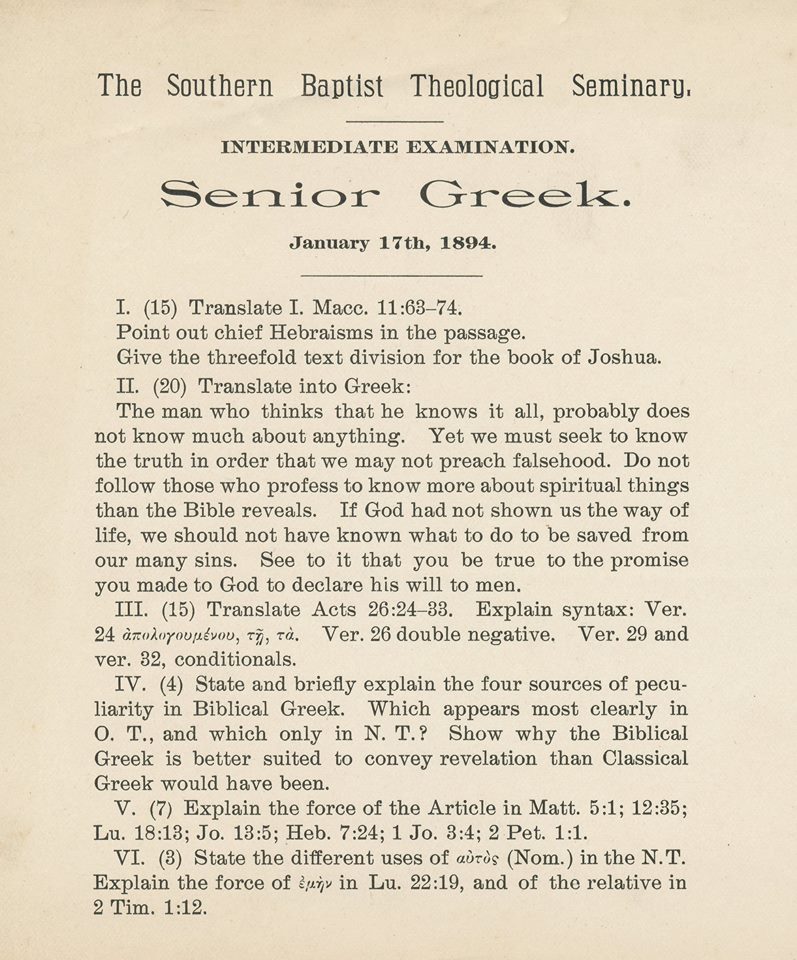
Finally, check out Jacob Cerone’s post of a Greek exam given in the late 19th century by John Broadus and A. T. Robertson (pictured at the top of this post). He even takes part of it and posts his answers. Nice work, Jacob!

One last note–Rod Decker passed away this last month. Read a note from his family here. I’ve found his Koine Greek Reader and Septuagint-related vocabulary lists quite helpful. He will be missed.

Did I miss anything? Feel free to post an LXX-related link in the comments. Until next time!

Translating Jude Clause by Clause

Translating Jude Clause by Clause

It’s been fun to watch the Baylor Handbook series progress, with volumes on both the Hebrew Text and the Greek Text. Not only do we who are currently engaged in Hebrew and Greek reading have amazing technological tools at our fingertips, but there are also series like Baylor’s that focus specifically on the original languages.

Herbert W. Bateman IV inaugurates a new series of his own, via his Cyber-Center for Biblical Studies, with Translating Jude Clause by Clause: An Exegetical Guide. More volumes of these EBooks for Translating the New Testament have been projected to release in 2014 and 2015.

Jude is a difficult book. It receives far less teaching and preaching attention than most New Testament books. It has clear references to “apocryphal” literature, about which Protestants, in discussions on canonicity, seem to feel compelled to say, “Jude is not citing such as Scripture.”

And the Greek is tough. Paul’s letters are easier! In Jude’s 25 verses, there are more than a dozen hapax legomena (words that occur only once in a body of literature, here understood as the New Testament). Because words are best defined by their context and usage, this doesn’t give the student of the New Testament much to go by for understanding these words.

So a guide to Jude’s Greek text is welcomed by anyone who wants to work through that book. In this post I review Bateman’s Translating Jude. I was eager to receive and work my way through the book, since I found Bateman’s Charts on the Book of Hebrews to be “a top-notch resource for an important biblical book.”

What Is Translating Jude Clause by Clause?

There are three primary sections in Translating Jude Clause by Clause:

  1. Introduction
  2. Clausal Outlines for Translation
  3. Clausal Outlines Translated and Syntax Explained

1. Introduction. Bateman’s first section packs a punch. After I reading it I felt very well set up to begin working my way through Jude’s Greek. In the introduction Bateman explains the layout of his uniquely structured book, includes a substantive section on independent clauses (of three types) vs. dependent clauses (of four types), and suggests “Tips for Translating Jude.” That last section explores some unique characteristics of Jude’s style, such as his frequent use of participles, long sentences, and parallel constructions (among other features).

2. Clausal Outlines for Translation. Here is where the reader will do the work of translating Jude. Bateman understands Jude as consisting of five main sections (vv. 1-2, vv. 3-4, vv. 5-16, vv. 17-23, and vv. 24-25), which is then further broken down into nine total passages, according to which Translating Jude is set up.

In addition to the robust introduction to Jude, each section of the clausal outlines begins with Contextual Orientation to the passage, which I found to be the most consistently excellent part of Bateman’s work. It is “a summary statement based on Jude’s flow of thought in order to provide some contextual orientation to the Greek paragraph to be translated.” It delivers each time.

After that there is the Greek Text for Verbal Recognition, where Bateman reprints the Greek text of Jude so that readers can mark it up to identify the various verbs and verbal forms.

Then there is the Clausal Outline for Translating Jude. Here Bateman spaces out and appropriately indents the various clauses in a passage so that the reader can visualize the flow of Jude’s thought. There’s plenty of space to write in one’s own translation, too. Here is a screenshot from the sample pdf of the interactive edition (i.e., you can fill in the blanks by typing).

Translating Jude

3. Clausal Outlines Translated and Syntax Explained. The final section serves as a sort of answer key for the section above. Bateman shows the clausal structure of Jude again (with indentations), this time with his English translation below the Greek. His “Syntax Explained” offers explanation along the lines of “grammatical function, syntactical function, and semantical function.” Bateman often cites and points to other Greek grammars, which helps enable further study.

What I Found Helpful

The book is highly interactive throughout. Even in a static, print book, I often had the feeling that I was being coached through Jude by an experienced and knowledgeable Greek professor. For those who haven’t used clausal outlining, I recommend it! Bateman walks the reader through the method well.

I especially appreciated how much the third section went from grammatical observation to exegetical insight. For example, Bateman notes the use of a constative aorist in Jude 11. He concludes:

Jude alludes to the behavior of the godless as a whole or in a summary fashion. Thus the godless have made their bed and currently lie in it.

The introduction offered far more than I expected from a book of this length. In addition to the insights noted above, Bateman includes a number of grammatical summary charts in the introduction that I found myself referring to often as I worked my way through Jude.

What I Found Not as Helpful

The user of Translating Jude will have to overlook an unexpectedly large number of misprints and typos, as well as a couple of Greek errors. I found this to be a major distraction that detracted from what is otherwise a good book. Fortunately, I understand that future printings will include corrections. (And the electronic version of Translating Jude will be easy to correct and update.)

By about verse 8 or so of the “Syntax Explained” section, I started to experience the format of the translation notes as repetitive. Perhaps their predictability serves a value–e.g., a Greek verb receives a parsing, its lexical form is noted, there is a brief BDAG gloss, and then there are sentences beginning with, “Syntactically,” “Semantically,” and, “Thus,” each in turn. But something that felt a little less boilerplate would have been more engaging, at least to me personally. Others may not find it an issue.

Finally, simply because it seemed remarkable to me, I was surprised at Bateman’s proposal for understanding the “fault finders” and “grumblers” of verse 16: “two words that might be summed up into one: bitching. They bitch regularly.” It could be just my own sensitivities, but I think that word has enough potentially derogatory connotations (surely unintended here) that leaving it out of a commentary and suggesting another English word would have been better. I otherwise appreciated the English translations.

Concluding Evaluation

Of course one wants to know how Translating Jude compares to the Baylor Handbook on the Greek Text series, especially since Baylor has a volume by Peter H. Davids on II Peter and Jude (review forthcoming!). Davids does not aim to do what Bateman does in terms of clausal outlining and written-out reader translations–Bateman is more interactive in that sense. Davids is more thorough when it comes to explaining the Greek text. Bateman does note that his translation notes focus on verbs and verbals, but Davids has more detail overall, even in defining and explaining the usage of various verbs.

Bateman writes that Translating Jude “is not a commentary. It is a tool designed to help translate and visualize Jude’s train of thought.” With its emphasis on clausal outlines–and with how clearly they are presented and explained–the book succeeds in its aim.

Apart from my (hopefully constructive) criticisms noted in the section above, I’d recommend this book to students of Greek, especially any who have become over-reliant on using Bible software for parsing and translating. Anyone whose Greek or grammar is rusty will also benefit from the clear introduction to Translating Jude and its verse-by-verse explanations.

Thanks to the Cyber-Center for Biblical Studies for the review copy. Prof. Bateman’s other books are here. You can find Translating Jude Clause by Clause at Amazon here (affiliate link). A sample pdf of the book is here.

New UBS5 Greek New Testament, Next Month

UBS5


Fall 2014 UPDATE: The UBS5 is out. Go here for a chance to win one of two free copies.

******

On the heels of the release of the NA28 Greek New Testament, the UBS4 is giving way to a revised UBS5. Find the book’s product page here. Just as I reviewed the NA28 (plus LXX), I hope to post more in the future about the UBS5 edition, which is geared more toward translators than academics, per se.

Here’s a sample pdf of the first few chapters of Mark, posted by Hendrickson.

The most noticeable change right off the bat is that the italicized font of the UBS4 has been replaced with something I find much more readable and aesthetically pleasing:

UBS5 text

Other than punctuation and paragraph divisions, the text is the same as that of the NA28, with the differences between the two coming in the critical apparatus.

UBS5 is slated to release in May.