The First Place on the Web to Go for Septuagint Studies…

IOSCS Logo

…besides the Septuagint itself, is this spot right here. It’s the Web presence of The International Organization for Septuagint and Cognate Studies (IOSCS). The IOSCS is “a nonprofit, learned society formed to promote international research in and study of the Septuagint and related texts.

Membership in the organization is affordable (especially for students). They put out an annual journal (some volumes of which are freely available here), offer a yearly prize, and link to some useful LXX resources here.

The IOSCS home page is updated fairly regularly with news of publications, conferences, and other announcements. Check it out.

Septuagint Studies Soirée #8: The One Week Late Edition

Translation is Required

Here are some posts from around the Septuagintabiblioblogosphere in March:

Lee Irons blogged his way through Translation is Required: The Septuagint in Retrospect and Prospect in six parts, accessible here.

T. Michael Law posted two more installments of his Septuagint Sessions podcast, here and here.

BLT blog wrote about God’s first Greek puns (brought to you largely by the letters γ and ν).

William Ross promises upcoming LXX Resource Reviews. You can see a resource page he has up now, here. Also, in the last soiree I missed his February review of Abi T. Ngunga’s Messianism in the Old Greek of Isaiah. (It’s on my shelf, too, and I’ve worked with it a little.) Here it is, in excerpted form.

Daniel Streett uses the LXX to venture an answer to the question: Did Enoch Die? He also mentions a couple options for a bound LXX-Greek NT combo.

Mosissimus Mose continues a review of  T. Michael Law’s When God Spoke Greek in dialogic form. The fourth part posted in March.

Here’s a post on “ditching flashcards” (via here).

Jacob Cerone has been posting his way through LXX Jonah. See here, here, and here.

Did I miss anything? Feel free to post an LXX-related link in the comments.

Koine Greek Reader and Septuagint Vocabulary Lists

Koine Greek ReaderProf. Rodney Decker is the creator of Koine Greek Reader, one of my favorite resources for learning and practicing Greek. The book includes grammar review, vocabulary lists, and Greek readings with helps. The Reader covers the New Testament, the Septuagint, the Apostolic Fathers, and a few early church creeds (which are really fun to look at in Greek).

His resources page has some very helpful Septuagint vocabulary lists. This one (PDF) has all words that occur more than 100 times in the Septuagint. This list (PDF) includes words occurring more than 100 times in the Septuagint but less than 25 times in the New Testament. This second list is a good starting point for those who are (somewhat) proficient reading the New Testament in Greek, but who want to expand their reading into the more difficult (and larger) vocabulary pool of the Septuagint.

You can read an excerpt (PDF) from the Reader here, and much more about it is here at Prof. Decker’s NT Resources blog.

A Short Note on God’s First Greek Words

The Greek of Genesis 1:3 reads,

καὶ εἶπεν ὁ θεός Γενηθήτω φῶς. καὶ ἐγένετο φῶς.

In English it reads, “And God said, ‘Let there be light.’ And there was light.”

The Septuagint straightforwardly translates the Hebrew, which is:

ויאמר אלהים יהי אור ויהי־אור

The Greek καὶ is versatile. The first καὶ in Genesis 1:3 is connected to what precedes it in 1:2 (darkness over the deep), but not necessarily inextricably so. In other words, one could leave it untranslated when going into English, with 1:3 beginning just, “God said….” The second  καὶ in 1:3, however, seems to be more closely related to what precedes it. “And there was light” follows immediately upon God’s calling for light. God said it, and it happened.

Susan Brayford, in her LXX Genesis commentary (Septuagint Commentary Series, Brill) writes:

God’s first words bring light into being in order to counter the darkness that was over the earth. In the first words attributed to God, LXX-G establishes a formulaic speech pattern that continues throughout the chapter, namely, a verb in the third person imperative (let x be), followed by ‘and,’ and concludes with a verb in the aorist (and x was). The pattern, similar to that in the MT noticed by Westermann and others, not only represents God as an orderly creator, but more importantly, as a powerful creator whose very words accomplish actions.

Dietrich Bonhoeffer has much to say about this in his Creation and Fall lectures on Genesis 1-3. On Tuesday I’ll post about his take on the link between God’s speech and the resulting creation.

Grammar of Septuagint Greek

Grammar of Septuagint Greek

A book that I desire to delve into more deeply is Conybeare and Stock’s Grammar of Septuagint Greek. The grammar itself is short, and still leaves to be desired a fuller grammar of Septuagint Greek. But the selected readings have Septuagint text with reading helps at the bottom of each page, and make for a nice bridge into reading Old Testament Greek. The readings section looks like this (click to enlarge):

From the reading on Joseph

You can access the whole book for free (and legally) here. The format there is a little unwieldy, so you might also consider checking it out in print (affiliate link).

The grammar is pretty dense, and feels sparse in places, but I haven’t had a chance to examine the book thoroughly yet. The selected readings have helped me in improving my Greek, though. It’s recommended reading on this Septuagint Sunday.


Matthew (Zondervan ECNT), reviewed

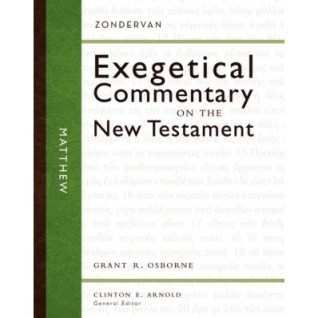
Matthew ZECNT

Now that I’ve been preaching through the early sections of Matthew for 10 weeks, I’ve had a chance to make regular use of a number of commentaries. I continue to value Zondervan’s Exegetical Commentary on the New Testament. Its Matthew volume is very much on par with the rest of the series (which I’ve reviewed here, here, and here). Author Grant R. Osborne primarily intends it for preachers, but I’ve seen it assigned as a seminary textbook, as well.

ZECNT Layout

Matthew, like the rest of the ZECNT series, includes:

  • The full Greek text of Matthew, verse by verse, or often split up phrase by phrase
  • The author’s English translation
    • First, appearing in the graphical layout for the entire passage
    • Second, verse by verse or phrase by phrase, next to the Greek
  • Matthew’s broader Literary Context for each passage
  • An outline of the passage in its immediately surrounding context
  • The Main Idea (probably the first place preachers would want to look)
  • Structure and Literary Form (with focus on source criticism)
  • A more detailed Exegetical Outline of the passage under consideration
  • Explanation of the Text, which includes the Greek and English mentioned above, as well as the commentary proper
  • A concluding Theology in Application section

This sounds like a lot, but the result is not a cluttered commentary. Rather, as one gets accustomed to the series format, it becomes easy to quickly find specific information about a passage. The section headings are in large, bold font.

The Greek font is aesthetically pleasing and readable. Here’s a picture:

ZECNT font

Osborne’s Introduction to Matthew

For a commentary of more than 1,000 pages, the introduction is surprisingly short (27 pages). Seven of those pages are a section called, “How to Study and Preach the Gospel of Matthew.” Osborne acknowledges,

[T]he details I chose to include in this commentary, both exegetical and theological, were chosen on the basis of one major question: What would I want to know as a pastor preparing a sermon on this passage?

So it’s fitting that he speaks directly to preachers at the very beginning of his introduction. He suggests understanding the Gospels as “history seen through theological eyes” and encourages the preacher to try to grasp the distinct “theological purposes of each [Gospel] author.”

Though the introduction is short, and someone doing extended work on Matthew will need to also look elsewhere for introductory concerns, Osborne is able to give an informative enough overview of dating, authorship, genre, purpose, audience (the thinnest subject in the introduction), sources, history, Matthew’s use of the Old Testament, and structure.

There are also more than 20 pages at the end of the commentary that cover the theology of Matthew. Although that section is tucked away, it’s not to be missed, especially Osborne’s coverage of Christology and of discipleship.

The Commentary Proper: Highlights and Observations

There is just enough Greek (grammar and word studies) to keep one’s Greek sharp. There’s not the level of detail found in the Baylor Handbook on the Greek Text series, which does not yet have a Matthew volume.

Matthew 13:54 begins, “He came into his hometown and began teaching (ἐδίδασκεν) them in their synagogue.” In the commentary you’ll find comments like this one:

The imperfect ἐδίδασκεν could refer to an ongoing practice but is probably ingressive, “began teaching” on this occasion (as in v. 8).

Osborne is sensitive to larger biblical context and theology–even in explaining individual words–so that one gets, for example, a fairly robust explanation of the “righteousness” Jesus talks about fulfilling in Matthew 3:15. And here is Osborne’s take on the “peacemakers” that Jesus calls blessed in 5:9:

The term “peacemaker” only appears elsewhere in verb form in Col 1:20, where Jesus made peace by his blood on the cross, but the concept is found often (Ps 34:14; Isa 52:7; Rom 12:18; 14:19; Jas 3:18; Heb 12:14; cf. 1 En. 52:11). This connotes both peace with God and peace between people—the latter flows out of the former. Jesus is the supreme peacemaker, who reconciles human beings with God through the cross (Col 1:20), so the supreme peacemaking is the proclamation of the gospel.

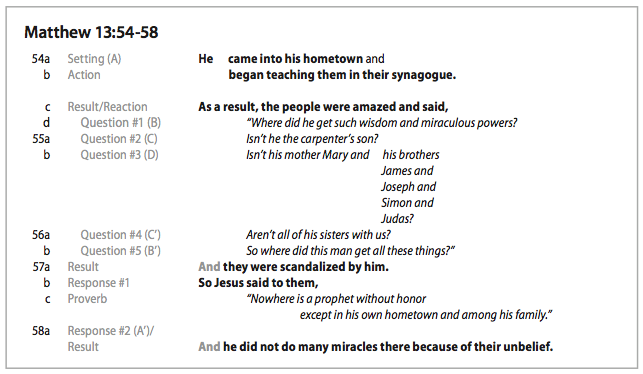
The graphical layout remains one of my favorite parts of the series. Look at Matthew 13:54-58 (from which the comment above is taken):

ZECNT passage flow

It’s readily apparent how Osborne sees the parts of a passage working together and relating to one another.

By way of critique, even with the commentary’s length there were times when I wanted more coverage. The “Explanation of the Text” section for Matthew 5:38-42, for example, barely covered two pages. The single paragraph on “turn the other cheek” addressed the main points that most other commentaries do, but given how many Christians have wrestled through this important passage (both on paper and in action), more could have been said.

Conclusion

Osborne succeeds in keeping the preacher in view throughout the commentary. I’ll give one last example, since this typifies Osborne’s blend of research and presentation in a way that will both assist and inspire preachers and teachers. In Matthew (and Luke) the Lord’s Prayer that Jesus gives his disciples to pray does not have the ending it does when prayed in liturgical settings (“for thine is the kingdom…”). Whether this should make it into a sermon or not is another question, but Osborne anticipates that readers and preachers will at least be wondering about it. He writes:

The traditional doxology (“for yours is the kingdom and the power and the glory forever. Amen”) appears in only a few late manuscripts (L W Θ 0233 et al.), and several of the best manuscripts end here (א B D Z et al.), with a variety of endings in others. This makes it almost certain that it is not original. It is possible that churches added their own doxology when praying this prayer, and this one emerged as the best summary of the contents of the prayer. However, it (and the other endings) is based on 1 Chr 29:11 – 13 and is meaningful, so it is not wrong to utter the ending as a personal prayer.

Where does the Matthew ZECNT volume rate among Matthew commentaries for preachers? Definitely toward the top. I still go to R.T. France’s NICNT volume first. And for Greek and history of interpretation, John Nolland (NIGTC) covers more territory. But Osborne’s constant eye on the larger literary context, the detailed structural outlines, the inclusion of Greek and English texts, the Theology in Application sections, and the graphical layout make his commentary a welcome guide for preaching and teaching through the First Gospel.

Thanks to Zondervan for the review copy. You can find the book’s product page here. It is on Amazon here. Amazon links above are affiliate links that help further the work of this blog, described here.

Septuagint Studies Soirée #7: Mostly Just Links Edition

LXX decal

Welcome to the Septuagint Studies Soirée #7, covering February in the Septuagintablogosphere.

There is now a Septuagint podcast. Check it out here.

Via Jim West: There will be a Historical and Theological Lexicon of the Septuagint (HTLS), which you can read more about here and here. You can even read a sample article (pdf)!

Do you want to contribute to a Septuagint Dictionary? Then check this one out.

This is a review of the Joshua volume of the Septuagint Commentary Series (Brill).

Here’s Lawrence Shiffman on Isaiah and the Greek Septuagint.

Brian Davidson posted a rockin’ interview with the editors of the Lexham English Septuagint.

It’s the International Septuaginta Summer School 2014. It sounds incredible, and it’s on Greek Isaiah. If you have a benefactor, go (and then introduce him or her to me, and I’ll meet you there).

Into prizes? Submit an LXX paper here for a prize of $350.

UPDATE 3/3/14: Wayne Coppins writes about Dietrich-Alex Koch’s analysis of Paul’s use of the Septuagint.

Finally, here and here you can find more interaction with T. Michael Law’s When God Spoke Greek.

Did I miss anything? Feel free to leave more February 2014 LXX links of interest in the comments.

Review of Luke (Baylor Handbook on the Greek Text)

Luke Baylor

Luke: A Handbook on the Greek Text is part of an expanding series by Baylor University Press that walks a reader through each word, phrase, and verse of the Greek New Testament. Of the series Baylor writes:

What distinguishes this series from other available resources is the detailed and comprehensive attention paid to the Greek text of the New Testament. Each handbook provides a convenient reference tool that explains the syntax of the biblical text, offers guidance for deciding between competing semantic analyses, deals with text-critical questions that have a significant bearing on how the text is understood, and addresses questions relating to the Greek text that are frequently overlooked or ignored by standard commentaries, all in a succinct and accessible manner.

The Luke volume is some 800 pages of lexical, grammatical, and syntactical detail. Language nerds will love it. The Baylor Handbook on the Greek New Testament series (BHGNT) “is designed to guide new readers and seasoned scholars alike through the intricacies of the Greek text.”

The Approach

Luke begins with a 15-page Introduction, with the following section headings:

  • Luke’s Style: “a mix of styles” and “higher on the literary scale than Matthew, Mark, or John”
  • Verbal Aspect: aorist tense verbs encode perfective aspect, generally used for mainline narrative events; imperfect tense verbs encode imperfective aspect, generally used for background events; present tense (imperfective aspect) is for quoted speech… but these are “tendencies only, not hard and fast linguistic rules”
  • The Use of Conjunctions at the Discourse Level: the authors focus here particularly on καί and δέ, which “serve distinct functions that assist readers in tracking the flow and status of information through large blocks of text”
  • Participles: primarily context (not just syntax) “drives the analysis” throughout the handbook
  • Word Order: the Greek verb defaults to a position at the start of a sentence; anything preceding it is “fronted” (which does not, the authors note, always imply emphasis)

Additionally, the Series Introduction addresses deponency, a label often given to middle/passive verbs with “active” meanings, but considered now by a number of scholars (and by the BHGNT series) to be an unhelpful concept “leading to imprecise readings of the text.” As a result,

users of the BHGNT will discover that verbs that are typically labeled “deponent,” including some with -θη- morphology, tend to be listed as “middle.”

The body of the handbook offers an English translation of each section of biblical text. Next there is the full Greek text of a given verse. Then follows a word-by-word (and/or phrase-by-phrase) analysis of the Greek text. One advantage to this structure is that, without having to have recourse to any other books, the user of this handbook has the full Greek and English texts of Luke in front of them.

There is also useful material at the back of the handbook: a glossary of nearly 50 grammatical terms and concepts, a bibliography, a grammar index (with grammatical concepts listed in English and words listed in Greek), and an author index. If I wanted to trace Luke’s use of the double accusative, for example, I’d see a list of verse references in the grammar index for further study.

An Example Passage: Zacchaeus in Luke 19:1-10

Luke 19:1-10 tells the well-known story of Zacchaeus’s encounter with Jesus. This handbook volume does comment on what a Greek phrase might “literally” mean, yet not (thankfully) to the point of making its English translation overly wooden, at least not on a regular basis. The translation is generally smooth, with additional comments on meaning throughout the notes.

Luke 19:1, for example, reads, “After entering Jericho, Jesus was passing through the city.” The handbook entry on that verse is as follows:

19:1 Καὶ εἰσελθὼν διήρχετο τὴν Ἰεριχώ.

Καὶ. The conjunction closely links this pericope with the preceding one, while the rest of the verse marks a shift in scene.
εἰσελθὼν. Aor act ptc masc nom sg εἰσέρχομαι (temporal).
διήρχετο. Impf mid ind 3rd sg διέρχομαι. The first three verses supply background information for the narrative that follows using imperfect verbs and equative clauses (διήρχετο; ἦν, v. 2; ἐζήτει, ἠδύνατο, v. 3).
τὴν Ἰεριχώ. Accusative complement of διήρχετο. Lit. “entering, he was passing through Jericho.”

Sometimes the entries are not much more than parsing, with a brief description of function (as in εἰσελθὼν, above). Other times there is more detail, as in διήρχετο. This reflects a concern throughout the handbook with discourse analysis: the authors are regularly asking (and answering) the question, “Why did Luke choose these words here? Why this verb tense? Why this position? What does it do for the narrative and the reader-hearer’s experience of it?”

Though Luke is not meant to be a full-on commentary, the authors nonetheless interact with other literature (commentaries and grammars, especially). For example, on 19:3’s “he was short in stature” (Greek: τῇ ἡλικίᾳ μικρὸς ἦν), they have this note:

The meaning of the phrase is debated. It could refer to Zacchaeus’ age (Green, 669–70) or his physical stature (Fitzmyer, 2:1223). The phrase probably not only refers to Zacchaeus’ height, but also serves to characterize him in a negative fashion (see Parsons 2001, 50–57; 2006, 97–108).

Whether or not one agrees with the conclusion (that Luke is talking about height), Culy, Parsons, and Stigall present the options, give bibliographical information, and–most important–say what the function of this phrase is in Luke’s story. Similarly, the authors consider textual variants where they would impact the meaning of the text.

What Luke: A Handbook on the Greek Text Is Not

This is a specialized work and does not aim to situate each passage in its literary or historical context. For example, when I was preaching on the Parable of the “Good Samaritan”, I turned to that passage. There is no introductory comment that sets it up, neither there nor at the beginning of chapter 10. There is a note that ἰδοὺ “is sometimes used to introduce a major character in a narrative, as here,” but that’s it.

Since the commentary does not set out to provide literary context or structural outlines, it would be unfair to criticize it for not doing that. The reader should be aware that this book is really true to its series title: it’s a handbook (that at times feels like a collection of notes) on the Greek text. Given that even technical, Greek-oriented commentaries pass over some words and concepts in the Greek text, there is definitely a place for a book like this. Those who want to go in-depth with the Greek (word-by-word and phrase-by-phrase) will find many riches to appreciate here, as I have.

Even so, I was pleasantly surprised by some places (i.e., the difficult Luke 18:7) where Culy, Parsons, and Stigall did offer insight into how to understand a passage as a whole.

The handbook will not replace a good lexicon. Some words simply have parsing information given, with little to no elaboration on the word’s meaning. To be truly comprehensive in this regard would double the size of the book, so it’s an understandable decision. Just keep BDAG close by as you read. That said, in this handbook you will get detail even down to the level of Greek accents!

Concluding Evaluation

The series preface says:

Readers of traditional commentaries are sometimes dismayed by the fact that even those that are labeled “exegetical” or “critical” frequently have little to say about the mechanics of the Greek text, and all too often completely ignore the more perplexing grammatical issues.

I have definitely felt this way as a commentary reader and user (and wanna-be Greek nerd). To have a handbook (albeit one that requires large hands to hold!) devoted to the Greek and its grammar is a great aid to anyone wanting to maintain or deepen their use of biblical languages. The lexical analysis (with sensitivity to larger New Testament context), grammatical insights, and linguistic nuances make for a smart and challenging companion to the Greek text. I’m excited to see more coming from this series.

N.B.: I have also reviewed Malachi in the similar Baylor Handbook on the Hebrew Text series, in two parts: here and here.

Thanks to Baylor University Press for the review copy. You can find the book’s product page here. It is on Amazon (affiliate link) here, where you can also “look inside” the book.


Where Cultural Anthropology, Geography, History, and Praise All Meet

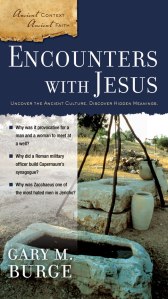
Encounters with JesusI learned my very first bit of Hebrew–the Sh’ma–from Gary Burge at Wheaton. His knowledge of cultural backgrounds of the Bible–and ability to communicate about it–is impressive. In Encounters with Jesus he explores the connections between “the ancient landscape,” encounters people in the first century had with Jesus, and how that can draw us into a deeper faith in Jesus today.

The short book consists of six chapters:

  1. Encountering Jesus
  2. The Woman with the Hemorrhage (from Matthew 9:18 – 26 and Mark 5:21 – 43)
  3. Zacchaeus of Jericho (from Luke 19:1 – 10)
  4. The Centurion of Capernaum (from Luke 7:1 – 10)
  5. A Woman in Samaria (from John 4:4 – 26)
  6. A Greek Woman in Tyre (from Matthew 15:21 – 28 and Mark 7:24 – 30)

In the series preface Burge writes:

We have forgotten that we read the Bible as foreigners, as visitors who have traveled not only to a new geography but a new century. We are literary tourists who are deeply in need of a guide.

The goal of this series is to be such a guide….

Burge asks, “Have you ever wondered what it would be like to encounter Jesus personally?” In chapter 1 he sketches a picture of a teacher who “took time for people who generally assumed that they were invisible.” And yet as accustomed as we are to thinking of Jesus as present with the poor, the sick, the outcast, and the powerless, Burge notes that Jesus does not deliberately avoid the powerful, either. Case in point: the centurion in Capernaum (chapter 4).

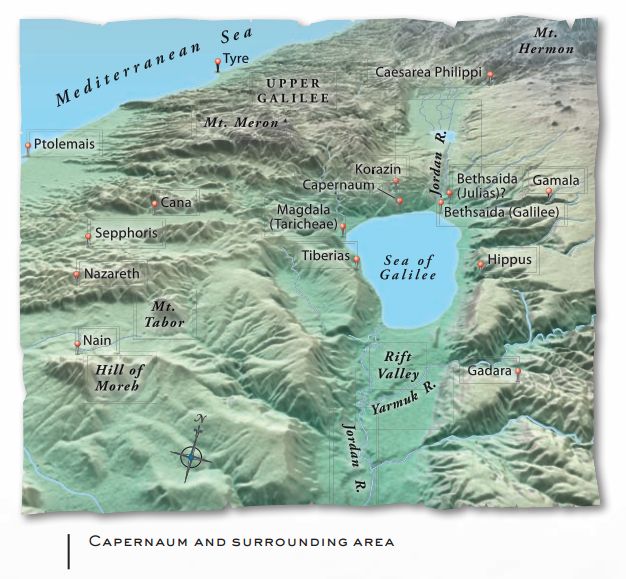
A map from the book
A map from the book

You can read the story of the centurion’s encounter with Jesus and find much to appreciate and marvel at already. But as Burge unpacked what was behind that encounter, the improbability of such an interaction became increasingly clear. That chapter begins with important geographical information on Capernaum, and then notes that it was Jesus’ home, as well as the site of the Sermon on the Mount and the Feeding of the 5,000. (No wonder, Burge notes, that Jesus says woe to Capernaum in Matthew 11, when they won’t believe.)

Capernaum was an economically strategic trade center, and so the Roman occupiers had made a home there–hence the presence of the centurion. Burge explains the organization of the Roman army, a “highly disciplined, professional fighting force.” An easy-to-understand diagram shows the division of the army into legions, cohorts, and centuries (which consisted of one centurion overseeing 80 men).

It is against this backdrop that Burge then tells the story of Jesus’ encounter with the centurion, a man who “understands that Jesus is similarly empowered by God in a way that others are not.” Jesus takes “social risks” in responding to him. Burge similarly unpacks the four more encounters with Jesus in the Gospels.

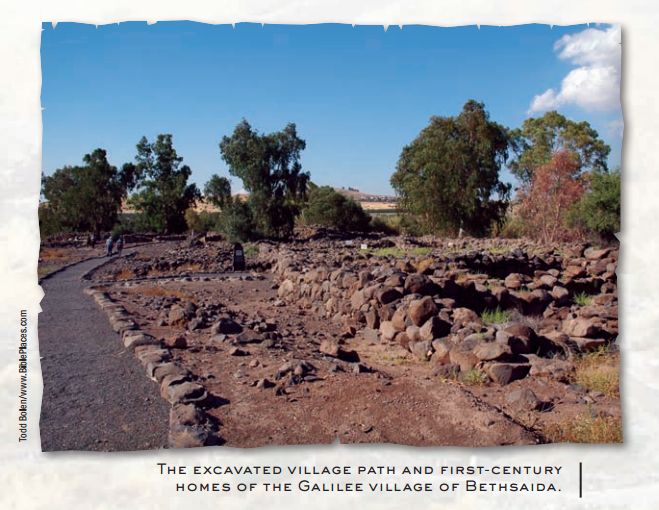
Like the other books in the Ancient Context, Ancient Faith series, Encounters with Jesus is printed on thick, glossy paper (which you can still easily mark in pencil) and is full of high-quality, color photographs and maps. Both the selection and placement of the visuals is perfect. (This truly is the guidebook the author seeks to produce.) Here’s one photograph from the book:

A photograph from the book

There are endnotes at the back of the book, but as with another book in the series, there is no Subject or Place Names or Scripture index, which I experienced as a lack. That’s about the extent of what I found to critique, though.

Encounters with Jesus is something I love: a book of biblical studies that also draws the reader into the presence and praise of God. I began reading it because I wanted to learn more about the cultural and historical background of some of the Gospel stories, but by the time I had finished the first chapter, I moved to reading it deliberately as part of my personal devotions.

I highly recommend Encounters with Jesus. As I read I had a better sense of what was happening in the Gospel stories Burge recounts, and–more important–I found myself growing in admiration and awe of Jesus.

Thanks to Zondervan for the review copy. Encounters with Jesus is on Amazon here. Its product page is at Zondervan’s site here. A sample pdf is here.